The Complete Bra Style Guide: Every Type Explained by a Fit Specialist
15 bra styles — how each works, who it fits, which outfits need it, and exactly when to skip it. Matched to your breast shape, not just your size.
There are 15 main bra styles, each designed for a specific outfit, support need, or breast shape. The most important styles to own are: a T-shirt bra (everyday smoothness), a plunge bra (V-necklines), a full-coverage bra (larger busts), a sports bra (exercise), and a strapless bra (bare-shoulder looks). Choosing by construction — not just size — is what actually makes a bra feel right.
Bra Styles at a Glance
| Bra Style | Best For | Cup Support | Wired? |
|---|---|---|---|
| T-Shirt Bra | Fitted tops, everyday | A–G | Usually yes |
| Plunge Bra | V-necks, low-cut tops | A–F | Yes |
| Full Coverage | D+ cups, long wear | C–K+ | Yes |
| Balconette | Wide necklines, round shape | A–H | Yes |
| Bralette | Light support, layering | A–D | No |
| Sports Bra | Exercise | All sizes | Optional |
| Strapless | Strapless / off-shoulder looks | A–H | Yes |
| Push-Up | Lift + cleavage | A–DD | Usually yes |
| Wireless | Comfort, relaxed days | A–F | No |
| Minimizer | Shirts, streamlined silhouette | C–K | Yes |
| Convertible | Varied outfits | A–F | Usually yes |
| Longline | Back smoothing, formal wear | B–H | Yes |
| Nursing | Breastfeeding | B–J | Optional |
How to Choose a Bra Style: 5-Step Method
Bra size is a number. Bra style is a decision. The same 34DD can wear a T-shirt bra, a balconette, or a minimizer — and all three will feel and look completely different. Here’s how to think it through:
Confirm your correct size first
No style recommendation works if you’re in the wrong size. If you haven’t measured in the last 6 months — or after any weight change, pregnancy, or hormonal shift — measure now. Use the Bra Size Calculator for a 60-second result.
Identify your breast shape
Your shape determines which cup construction will actually fit. Full-on-top tissue overflows demi cups. East-west tissue needs forward projection. Use the Breast Shape Identifier if unsure — it takes 2 minutes.
Match the outfit neckline
Your outfit is usually the final filter. A plunge works for a V-neck but shows under a crew neck. A strapless works for an off-shoulder dress but adds no support for daily wear. Check the outfit routing table below.
Decide your support priority
Are you wearing this all day? High-impact activity? Formal event? Support requirements vary hugely. A bralette is fine for a desk day; it’s wrong for a long commute with D+ cups. Match support level to what you’re actually doing.
Check the size range of the style
Many push-up and convertible bras stop at DD or E. If you’re an F cup or above, confirm the specific style is available in your size — not just the brand. Panache, Elomi, and Freya consistently extend through K and beyond. See also: breast size comparison guide.
1. T-Shirt Bra — The Non-Negotiable Daily Essential
A T-shirt bra has smooth, seamless, or lightly moulded cups designed to be completely invisible under fitted tops. There are no visible seams on the outer cup surface, which means no texture lines under thin fabric. Most T-shirt bras are lightly padded (3–5 mm foam) to maintain cup shape even when worn against the body. The underwire holds the cup architecture stable throughout the day.
This is the bra most women wear 80% of the time — and the one most commonly purchased in the wrong construction. The key variable is cup depth: a T-shirt bra with shallow cups will gap on projected breasts; one with deep cups will feel compressed on flatter tissue. For larger busts (E cup and above), the foam should be minimal — heavy padding adds volume rather than shape.
What to look for: 3–5 mm foam (not heavy padding), smooth outer cup, underwire that sits flat on the sternum, straps that don’t slip. For D+ cups, prioritize bras with 3-section cups (side-support seaming inside is fine — it just can’t show on the outer surface).
2. Plunge Bra — For V-Necks, Low Cuts & Natural Lift
A plunge bra has a deep-cut center gore (the bridge between the cups) that sits significantly lower than a standard bra — typically 2–3 cm lower. This allows the bra to remain hidden under deep-V necklines while still lifting tissue forward and upward. The cups angle inward, creating a natural gathering effect and defined shape without padding.
Plunge bras work for most breast shapes, but they’re particularly well-suited to close-set, asymmetrical, and east-west tissue because the inward-angling cups bring tissue toward the center. For full-on-top breasts, a plunge can cause overflow at the top edge — check cup height before purchasing.
For low-cut styles specifically, look for plunge bras with a “floating gore” design — the center section flexes rather than rigidly bridges the two cups, making it far more comfortable for projected or close-set shapes. Panache and Fantasie make particularly strong options in extended cup sizes.
3. Full-Coverage Bra — Maximum Support, No Compromise
Full-coverage bras enclose the entire breast — no tissue escapes at the top, sides, or center. The cup height is taller than a balconette or plunge, and the wings (the side fabric) extend higher and wider to fully anchor the underwire. These bras provide the most stable support structure available in a non-specialty bra.
For larger cup sizes (E, F, G and above), a full-coverage bra is almost always the better daily choice over a demi or plunge. The extra cup height contains tissue that would overflow in shorter styles. The wide, padded straps reduce the load per cm² on your shoulders — the reason demi and plunge straps dig in at larger sizes is simply that the cup is catching spilling tissue, which then transfers all force upward.
4. Balconette Bra — Lift, Shape & a Defined Décolletage
A balconette (also called a balcony bra) cuts horizontally across the top of the breast, with cups that sit lower than a full-coverage style and straps placed wide apart. This creates a horizontal neckline effect that works beautifully under wide-neck, boatneck, and bardot-style tops. The underwire is typically wider than in a plunge, which gives balconettes a strong lateral support base.
Balconettes are designed for round, full-on-bottom, and teardrop shapes where there’s enough lower volume to fill the cup from below. If you have full-on-top tissue — more fullness above the nipple than below — the horizontal cut will create gaping at the center top edge. That’s a shape issue, not a size issue. Try a soft cup or stretch-lace balconette instead, which flexes to accommodate top fullness.
5. Bralette — Comfort, Layering & Lifestyle Wear
Bralettes are wire-free, lightly structured bras typically made from soft fabric — stretch lace, modal, jersey, or mesh. They provide light support through a wide, elasticated underband rather than an underwire frame. The cups are usually unpadded or very lightly lined, making them form-following rather than shape-creating.
Bralettes are ideal for A–C cups, smaller-framed D cups, and anyone who wants comfort over structure. For D cup and above, the wide band provides some control but not the level of support an underwired bra delivers — the physics of cantilevering breast weight without a rigid frame has limits. For E cup and beyond, look specifically for full-bust bralettes from Elomi, Panache, or Curvy Kate that use wider side panels and internal sling construction.
6. Sports Bra — Movement, Sweat & Real Impact Control
Sports bras reduce breast movement during physical activity by combining encapsulation (individual cups per breast), compression (pressing tissue toward the chest), or both. Low-impact sports bras (yoga, walking) are typically compression-only. High-impact bras (running, HIIT, cycling) use encapsulation cups with underwire or structured foam to control vertical and lateral movement independently.
The research is clear: inadequate breast support during exercise causes irreversible stretching of Cooper’s ligaments — the connective tissue that maintains breast shape. For C cup and above at any impact level, a compression-only bralette is insufficient for structured exercise. Use a properly fitted encapsulation sports bra with a firm, non-stretch underband.
For a sport-specific size, use the Bra Size Calculator and apply the same band and cup measurement. Your sports bra should feel one hook tighter than your everyday bra on first wear — this accounts for stretch during movement.
7. Strapless Bra — The One That Needs to Actually Stay Up
Strapless bras achieve support entirely through the band — no straps contribute any lift. The band must be at least one hook size firmer than your everyday bra, and the inner surface of the band uses silicone grip strips to resist sliding. Without straps to pull the cups upward, the cup must be independently structured — shallow or soft-cup strapless bras slide down, regardless of size.
For D cup and above, look for strapless bras with a boned side panel, internal underwire at the side seam, and at minimum 4 hooks at the back. The Wacoal Red Carpet Strapless and Longline Strapless styles are among the few genuinely reliable options for larger cup sizes. For G cup and above, a longline strapless offers more surface area for grip and is more stable than a standard strapless.
8. Push-Up Bra — Lift, Projection & Controlled Cleavage
Push-up bras use angled padding placed at the lower-outer cup position to lift breast tissue upward and inward, increasing visible projection and cleavage. They come in three standard levels: Level 1 (natural lift with light padding), Level 2 (moderate lift and visible cleavage), and Level 3 (maximum push-up, significant shape change). Many push-up bras also have removable pads, allowing you to adjust lift level day to day.
Push-up bras are most flattering for A–C cup sizes where the padding creates proportional volume. For D cup and above, push-up padding often creates a rounded, shelf-like shape rather than a natural lift because there’s already sufficient volume — the padding has nowhere neutral to go. Full-on-bottom and teardrop shapes see better results with a plunge or balconette for defined shape without push-up padding.
9. Wireless Bra — Comfort Done Properly (Not Just Comfortable)
Wireless bras use band tension, cup construction, and panel structure — rather than a rigid underwire frame — to support breast tissue. The best wireless bras are not simply wired bras with the wire removed; they’re designed from scratch with wider bands, multi-part cups, and internal channeling to distribute weight without a frame.
For A–C cups, a quality wireless bra provides fully adequate daily support. For D cup and above, the support depends entirely on the construction: a thin jersey bralette is not the same as a structured wireless bra with an inner sling. Brands like Elomi, Triumph, and Wacoal produce wireless styles specifically engineered for larger busts — these work; generic wireless soft cups don’t.
10. Minimizer Bra — Redistribute, Don’t Compress
Minimizer bras redistribute breast tissue laterally — spreading fullness across a wider area — rather than compressing it downward. A properly fitted minimizer reduces the forward projection of the bust by up to 1.5 inches (4 cm) without pressing tissue into the ribcage. This creates a streamlined silhouette under button-down shirts, structured blazers, and fitted workwear that would otherwise gap at the buttons.
The key is that minimizers work through cup engineering, not compression. If a minimizer feels tight or constricting, it’s the wrong size or wrong construction. A correct minimizer allows tissue to fill the cup fully — it simply distributes that tissue over a flatter, wider cup shape rather than a projected one. For minimizer shopping, also refer to the cup size comparison guide to understand how different constructions compare.
11. Convertible Bra — Maximum Outfit Flexibility
Convertible bras have detachable, repositionable straps that can be worn in 4–8 different configurations: classic (both straight), crossed (X-back), halter (both straps join at the front), one-shoulder, or strapless. The cups are typically underwired and moderately padded. The back closure is usually a standard 2–3 hook.
Convertible bras are a practical wardrobe solution — particularly for anyone with a varied wardrobe of tops and dresses. The trade-off is that no single strap configuration delivers as much support as a bra designed specifically for that use. If you need genuine strapless support, a dedicated strapless will outperform a convertible worn strapless. If you need high-impact sports support, a convertible worn as racerback won’t get there either. Think of it as a versatility tool, not a specialist.
12. Longline Bra — Architecture, Stability & Back Smoothing
A longline bra extends the band 3–6 inches below the standard band position, reaching toward the waist rather than ending at the ribcage. This extended surface area distributes breast weight over a larger frame area, reducing pressure per cm² on the ribcage and eliminating the “shelf” that standard bands can create on softer tissue. For D+ cup wearers, a longline bra often provides more comfortable all-day wear than a standard band in the same size.
Longlines are also structurally valuable for fuller-figure and plus-size wearers where the larger band surface provides more stable anchoring. Many longline styles are boned — with vertical boning on the side panels — creating a smoothing, corset-like effect under formal wear. For strapless occasions with larger busts, a longline strapless bra is almost always more effective and comfortable than a standard strapless.
13. Nursing Bra — Function, Fit & Changing Sizing
Nursing bras have drop-down or pull-aside cups that allow breastfeeding access without fully removing the bra. The cups typically use soft, flexible fabric that can be folded back cleanly with one hand. Most nursing bras are wire-free during the breastfeeding period (underwire can press on milk ducts and contribute to blocked ducts in some cases), though underwired nursing styles exist and are considered safe when properly fitted.
Sizing during pregnancy and nursing changes substantially — cup size typically increases 1–3 letters across pregnancy and again after milk comes in. Purchase 2–3 nursing bras at 36 weeks pregnant (sizing for your current band, up 2 cup sizes from pre-pregnancy) and plan to remeasure every 6–8 weeks as milk supply stabilizes. Use the Bra Size Calculator after any significant change in fullness.
Expert-Picked Bras — Tested Across Every Style
Affiliate disclosure: Bra-Calculator.com earns from qualifying Amazon purchases via the bracalculator-20 program at no extra cost to you.

Wacoal Basic Beauty Underwire Bra
The benchmark T-shirt bra. Smooth 3 mm foam cups with no visible outer seam, stable underwire, and consistent sizing from 32B to 42DDD. Works invisibly under every fitted top.
Natori Feathers Contour Plunge
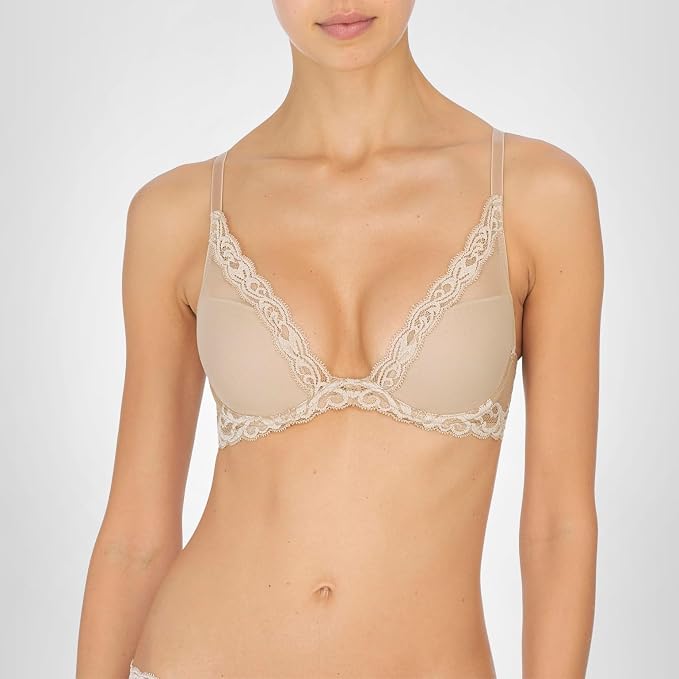
Ultra-low center gore stays hidden under deep V-necks. Barely-there foam lifts without pushing. The go-to plunge for close-set, asymmetric, and east-west shapes at A–DDD cup.
Panache Andorra Full Cup Bra
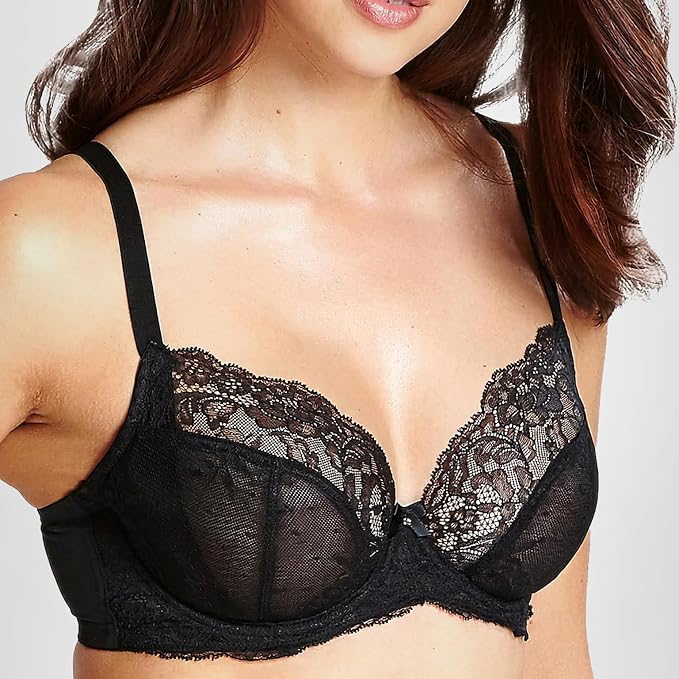
The D–K cup full-coverage benchmark. Wide underwire root, side-support construction, and a 3-section cup that contains full-on-top and projected tissue without overflow. Available 28D–42K.

Elomi Cate Underwired Full Cup
The most reliable all-day bra for F–K cups. 4-section cup construction, flexible underwire, side-support engineering, and consistent sizing from 34F to 46K. A wardrobe anchor for larger busts.
Outfit → Bra Style Routing Guide
The most common fit problem isn’t size — it’s wearing the wrong style for the outfit. Use this routing table to match your outfit’s neckline to the correct bra construction:
| Outfit / Neckline | Best Bra Style | Why |
|---|---|---|
| Fitted T-shirt / knit top | T-shirt bra (seamless) | No cup seams show through thin fabric |
| Deep V-neck / low-cut top | Plunge bra | Low center gore stays hidden |
| Open-neck / wide scoop | Balconette | Wide strap placement stays clear of neckline |
| Button-down shirt | Minimizer or full-coverage | Reduces projection, prevents gaping at buttons |
| Strapless / off-shoulder dress | Strapless or longline strapless | No visible straps; grip band holds in place |
| Backless or cut-out top | Adhesive bra or convertible (halter) | Standard straps and back closure would show |
| Sheer top / lace overlay | Lace balconette or demi bra | Decorative bra visible intentionally or matched to sheer |
| Workout top | Sports bra (impact-appropriate) | Encapsulation reduces movement and ligament strain |
| Work from home / lounging | Wireless bra or bralette | Comfort without underwire pressure during extended sitting |
| Formal gown / structured dress | Longline strapless or built-in boning | Extended band anchors, back smoothing under structured fabric |
| Racerback top / tank | Convertible (racerback mode) or racerback clip | Straps meet at center back and clear racerback neckline |
Bra Style by Breast Shape
Every size recommendation falls apart if the cup construction doesn’t match your breast shape. This is why two women wearing the same 34D can have completely different experiences in the same bra. Use the shape-matching grid below — and the Breast Shape Identifier if you’re unsure of your shape:
Round Shape
- T-shirt bra (molded)
- Balconette
- Half-cup demi
- Push-up (A–C cups)
Teardrop / Full-on-Bottom
- Plunge bra
- Demi / half cup
- Lightly padded T-shirt
- Balconette (shallow)
Full-on-Top
- Full-coverage bra
- Stretch-lace balconette
- Soft T-shirt (deep cup)
- Wire-free full cup
East-West Shape
- Side-support T-shirt bra
- Plunge with inward-angling cups
- Contour T-shirt (pulls forward)
- Front-closure bra
Close-Set / Narrow Root
- Plunge (low gore)
- Floating-gore plunge
- Minimizer (wider wire)
- Soft-cup wireless
Bell-Shaped / Relaxed Tissue
- Full-coverage underwire
- Side-support full cup
- Firm-band plunge
- Longline bra
Projected / Cone Shape
- Deep-cup full coverage
- 3-section cup T-shirt bra
- Soft-cup plunge
- Side-seam balconette
Asymmetric / Uneven
- T-shirt bra with removable pad
- Plunge with adjustment room
- Lace bra with flex cups
- Bras with adjustable closure
Wired vs Wireless: Which Is Better?
The wired vs wireless debate is a sizing and construction debate, not a health one. There is no conclusive peer-reviewed evidence that underwire causes breast cancer or lymph drainage problems. The discomfort associated with underwire is almost always a fit problem — wire sitting on breast tissue (instead of the ribcage) because the cup is too small. Here’s a direct comparison:
| Factor | Underwired Bra | Wireless Bra |
|---|---|---|
| Support for A–C cups | Excellent | Excellent |
| Support for D–F cups | Excellent | Good (construction-dependent) |
| Support for G+ cups | Excellent | Limited (specialist brands only) |
| All-day comfort | Yes (if fitted correctly) | Yes |
| Shape definition | High | Moderate |
| Breast health risk | None (if correctly fitted) | None |
| Suitable for exercise | Partial (sports bra needed) | No (except low-impact A–B) |
| Available size range | AA–K+ | Mostly A–F mainstream |
Not Sure Which Style Is Right for You?
Start with your accurate size, then let your breast shape and outfit guide the style decision. Both tools below are free and take under 2 minutes.
Frequently Asked Questions
The best everyday bra is a T-shirt bra in your correct size. It has seamless molded cups that stay invisible under any top, underwire for shape stability throughout the day, and a band that carries 80% of breast weight. A smooth T-shirt bra in a neutral color (nude for skin tone, black, or white) forms the foundation of any bra wardrobe.
A functional bra wardrobe for most women is 5–7 bras: 2–3 T-shirt bras (rotate daily), 1 plunge bra, 1 strapless bra, 1 sports bra (or 2 for frequent exercisers), and 1 comfortable wireless option. Specialist styles — minimizer, nursing, longline — are added based on individual needs. Rotating at least 2–3 everyday bras extends elastic life significantly.
No. There is no peer-reviewed evidence linking underwire bras to breast cancer, lymph drainage problems, or any systemic health issue. Underwire discomfort is almost always a fit problem — specifically, a wire that’s too narrow for your breast root or sitting on breast tissue because the cup is too small. A correctly fitted underwire bra is safe for daily wear and provides more structural support than wireless alternatives for D+ cups.
For D cup and above, full-coverage underwired bras, balconettes with wide-base underwire (such as Panache, Elomi, and Freya), and longline bras provide the most reliable daily support. The priority at larger cup sizes is a firm, non-stretch band (which carries 80% of breast weight), adequate cup height to prevent overflow, and straps wide enough to distribute load without digging.
A balconette cuts horizontally across the top of the breast with wide-set straps, creating a lifted horizontal neckline. A demi bra cuts diagonally, covering roughly half the breast in a scoop that follows the natural breast curve. Balconettes work best for wide necklines; demi bras are more versatile under V-necks and scoop tops. Both provide less coverage than full-cup styles.
Push-up padding is typically most effective for A–C cups, where it adds visible volume and lift. For D cup and above, push-up padding tends to create a shelf-like rather than lifted shape, because there’s already sufficient breast volume — the padding has nowhere proportional to go. Larger cup sizes usually achieve better lift from a balconette, plunge, or well-fitted full-coverage bra than from push-up padding.
Wear a seamless T-shirt bra with smooth, non-seamed outer cups. The cup foam should be 3–5 mm (not heavy padding that adds visible bulk) and the band should sit level across your back without riding up. A nude or skin-tone-matched color — not white — is least visible under thin white or light fabric. Avoid lace, decorative seaming, or thick-edged cups under fitted tops.
If the bra fits in the band but overflows or gaps in the cups, try a size adjustment first (one cup size up or down). If it fits in the cup but gaps at the top, overflows at the side, or wires sit on tissue — that’s usually a style mismatch (wrong cup construction for your breast shape). Use the Bra Fit Problem Solver to diagnose the exact cause before purchasing a new bra.