Accurate Bra Size Calculator: Find Your US, UK & EU Size
Measure your snug underbust and fullest bust, then get a practical starting bra size in seconds. See your US, UK, EU, FR, AU, JP and KR equivalents, plus sister sizes and the fit checks that tell you whether the result is really right for your body.
Updated August 2026 · Reviewed for fit accuracy and clarity

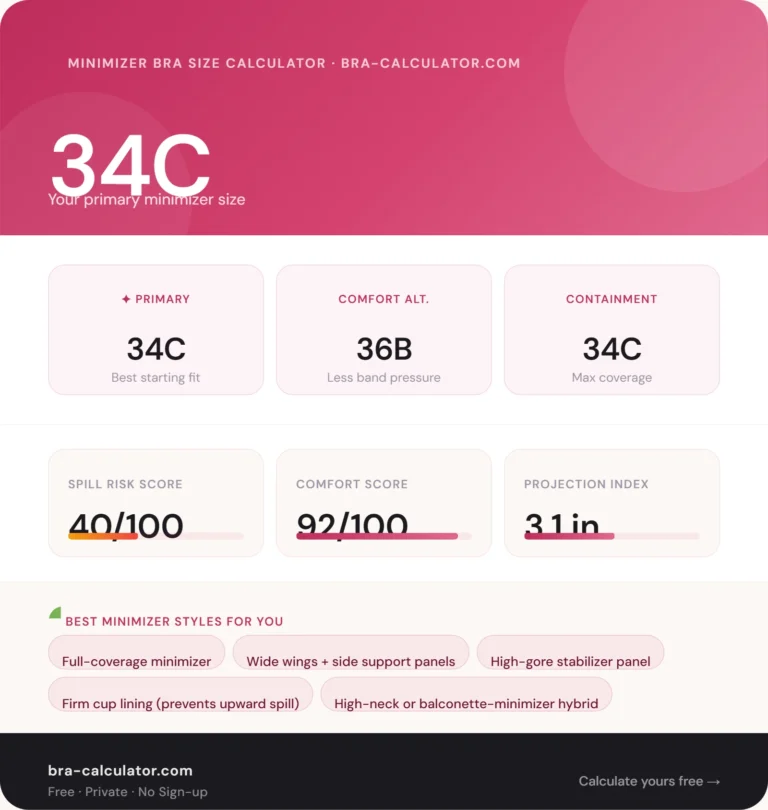
Enter a snug underbust and a loose full-bust measurement to get a practical starting bra size. This calculator does not automatically add four inches to your underbust. It estimates the band from your raw ribcage measurement, calculates the cup step from the difference between bust and underbust, then shows the equivalent label in US, UK, EU, FR/BE, AU/NZ, JP and KR sizing. Use the result as your first try-on size, then confirm it with the band, cup, gore and wire fit checks below.
Your measurements are calculated in your browser. Bra construction varies by brand, so the number on the result card is a starting point—not a promise that every bra with that label will fit the same way.
A bra size calculator should do more than give you a number
If you have ever measured yourself twice and received two different bra sizes online, the problem is usually not that your body changed in five minutes. Different calculators use different band rules, cup progressions and regional labels. Some still add four inches to the underbust; others use the raw ribcage measurement. Some stop at a narrow cup range or silently switch between US and UK letters.
This tool is designed to make the logic visible. You can see the sizing system you selected, your international equivalents and the two nearest sister sizes. More importantly, the page tells you what to look for when you try the result on. That last step matters because the best-fitting bra is confirmed by fit, not by arithmetic alone.
Use raw snug underbust and loose full bust. No hidden +4 adjustment is added automatically.
US, UK and EU cup letters diverge above D/DD, so the calculator shows each system instead of pretending they are interchangeable.
A size is useful only if the band stays level, the cups contain the tissue and the wires sit around the breast root.
How to get the most accurate result from an online bra size calculator
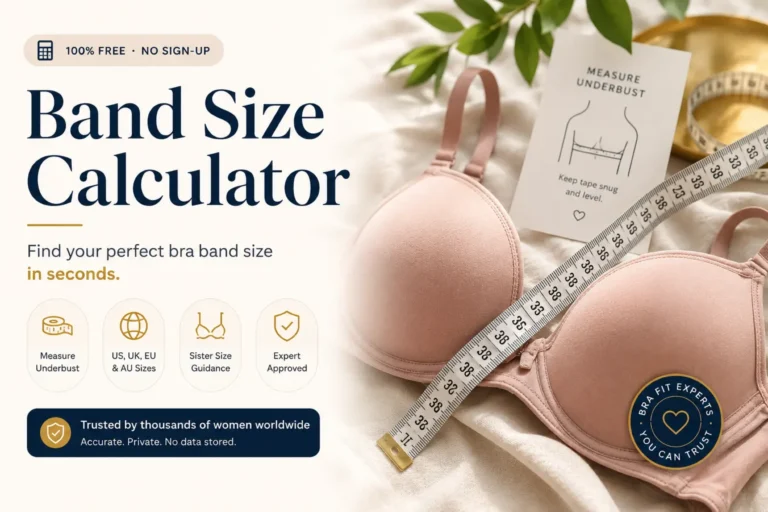
An accurate bra size calculation starts with accurate measurements. Use a soft tape, measure on bare skin or over a very thin non-padded bra, keep the tape level across your back and take each measurement at least twice. If the readings are different, do not average wildly different numbers—remeasure until you get a repeatable result.
For the underbust, the tape should feel firm enough to stay in place without digging in. For the bust, it should skim the fullest point without flattening the tissue. A bust measurement pulled too tightly can push the calculator toward a cup that is too small.
| What improves accuracy | Why it matters |
|---|---|
| Measure a snug underbust | The band provides most of the support and anchors the entire size. |
| Measure the bust loosely | Compressing breast tissue can underestimate the cup step. |
| Choose the correct sizing system | A US G and a UK G are not the same cup step. |
| Verify with fit symptoms | Shape, projection, wire width and brand construction cannot be read from two numbers alone. |
| Try a nearby size when needed | Small changes in band tension or cup depth can improve fit without changing your body measurements. |
Does a bra size calculator work for DD+ and larger cup sizes?
Yes, a measurement-based calculator is still a useful starting point for fuller-bust sizes, but the try-on check becomes even more important. Two people can calculate to the same 34G and need very different bras: one may have narrow roots and strong projection, while another may have wider roots and shallower tissue. Both can be the same size on paper.
For DD+ results, pay extra attention to the center gore, wire width, cup depth and side containment. If the gore floats or the breast tissue pushes the bra away from the body, the issue may be cup volume or cup depth rather than the band.
How to measure bra size at home in about three minutes
You only need a soft measuring tape and two numbers. Measure in the same unit you plan to enter into the calculator—either inches or centimetres.
Prefer written instructions? The same measurement method is explained below.
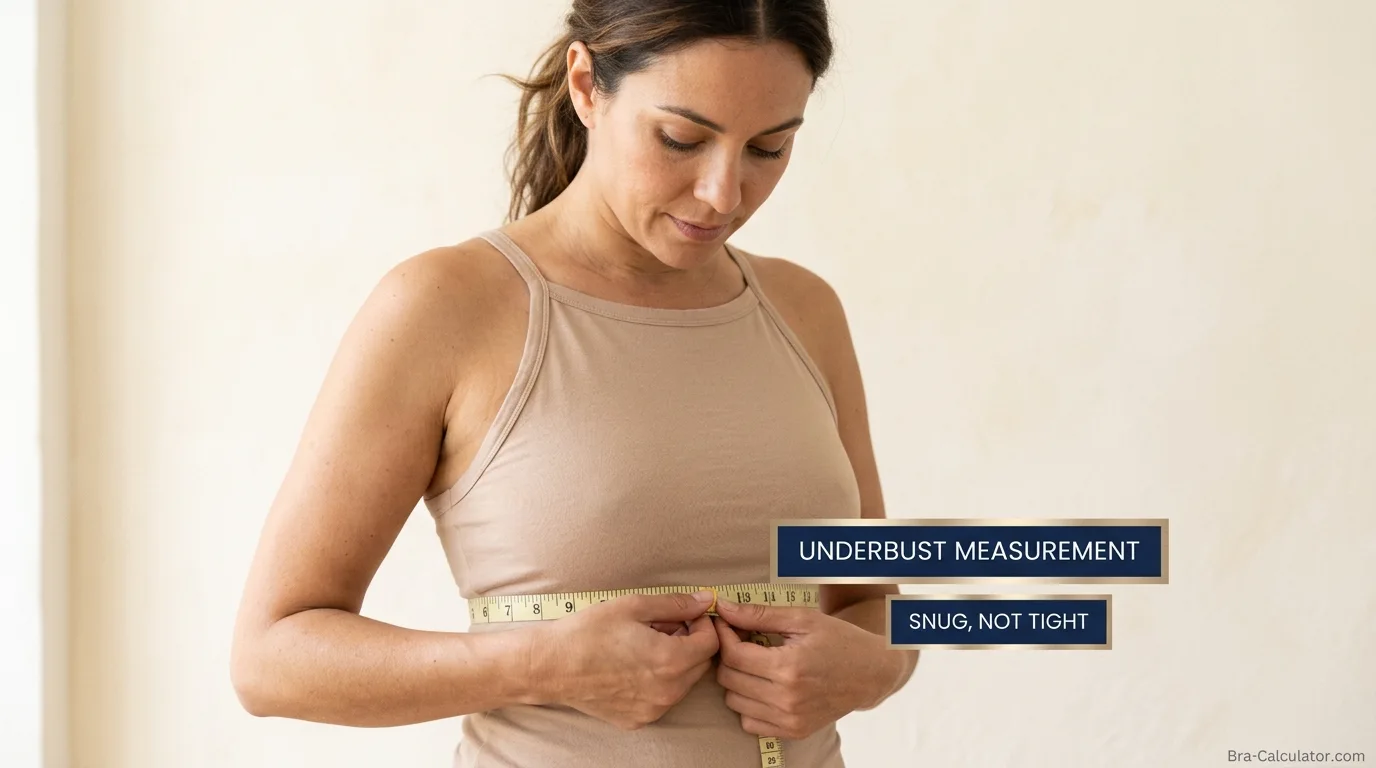
Underbust: directly beneath the breast tissue, firm and level.
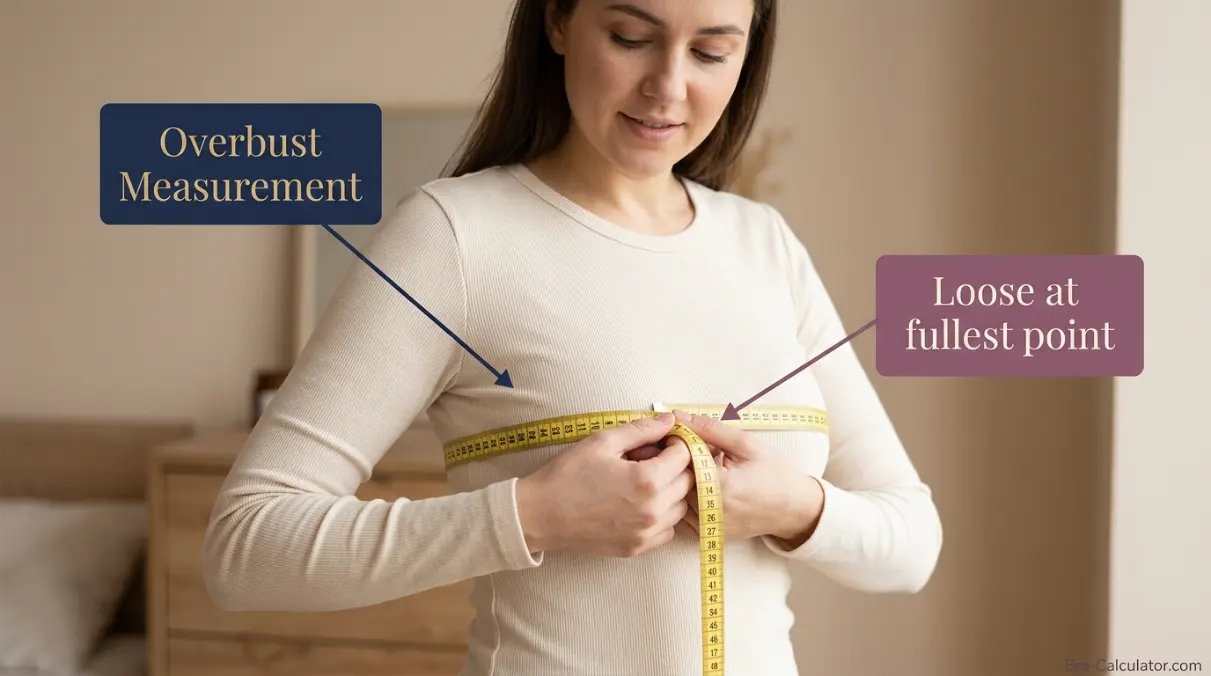
Full bust: around the fullest point without compressing the tissue.
- Start without heavy padding. Bare skin is ideal. If you prefer to wear a bra, choose a thin, non-padded style that does not push the breasts up or inward.
- Measure the underbust snugly. Place the tape directly under the bust where the band sits. Keep it horizontal all the way around and exhale normally.
- Measure the fullest bust loosely. Keep the tape level and let it touch the body without squeezing the breast tissue.
- Enter both measurements in the same unit. Choose Inches or Centimetres first, then select the sizing system you normally shop in.
- Use the result as your first fitting size. Check the band, cups, center gore and wires before deciding whether you need a sister size or a different cup shape.
How this bra measurement calculator works
The calculator separates the two parts of a bra size. The band is based on the snug underbust. The cup step is estimated from the difference between the full-bust and underbust measurements. The base result is then translated into the label used by the selected country system.
1. Your band is the foundation
For US and UK sizing, this calculator rounds the raw snug underbust to a practical even-numbered starting band. It does not automatically add four inches. The international conversion row then maps that base band into EU, French, Australian, Japanese and Korean labels.
2. Your cup letter is proportional to the band
A cup letter is not a fixed breast volume. A 32D and a 40D do not hold the same amount of volume, even though both use the letter D. Cup letters only make sense when they are paired with a band.
| Bust minus underbust | US cup step | UK cup step | EU cup step |
|---|---|---|---|
| 1 in | A | A | A |
| 2 in | B | B | B |
| 3 in | C | C | C |
| 4 in | D | D | D |
| 5 in | DD | DD | E |
| 6 in | DDD/F | E | F |
| 7 in | G | F | G |
| 8 in | H | FF | H |
| 9 in | I | G | I |
| 10 in | J | GG | J |
This simple difference table is useful for understanding the result, but it should not be treated as a universal manufacturing standard. Brands can grade cups differently, and some US brands use E, F or DDD in different ways. Always check the sizing system used by the specific retailer.
Why this calculator does not automatically add 4 inches
Older retail fitting methods often added several inches to the ribcage measurement before assigning a band. That can produce a looser band and a smaller cup than many modern wearers prefer. This calculator instead starts from the raw snug underbust and lets the real try-on fit tell you whether the band needs to move up or down.
If you want to compare this faster two-measurement method with a multi-measurement approach, see our A Bra That Fits calculator comparison.
Sister sizes: what to try when the cup fits but the band does not
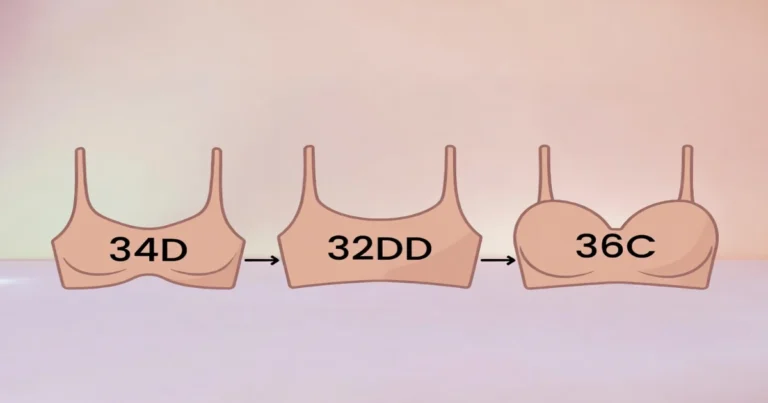
Sister sizing changes the band and cup together so the cup volume stays approximately similar. It is useful when you like how the cups fit but need more or less band tension.
| What you feel | What to try | Example from 34DD |
|---|---|---|
| Cups fit, band feels too firm | Go up one band and down one cup step | 36D |
| Cups fit, band rides up or feels loose | Go down one band and up one cup step | 32DDD/F |
| Band feels right, cups spill | Keep the band and increase the cup | 34DDD/F |
| Band feels right, cups wrinkle or gap | Test a smaller cup or a different cup shape | 34D, depending on the cause |
Use the Sister Size Calculator when you want the full size ladder rather than only the two closest alternatives.
US, UK and EU bra sizing: why the same body can have different labels
International bra conversion is not simply a matter of changing the band number. The cup sequence changes too. US and UK bands usually use the same inch-based labels, but their cup letters separate above DD. EU and French systems use different band numbers and a different cup progression.
| Example starting size | US | UK | EU | FR/BE |
|---|---|---|---|---|
| 34C | 34C | 34C | 75C | 90C |
| 34D | 34D | 34D | 75D | 90D |
| 34DD step | 34DD | 34DD | 75E | 90E |
| Next cup step | 34DDD/F | 34E | 75F | 90F |
| Next cup step | 34G | 34F | 75G | 90G |
If you are shopping from a retailer in another country, use the calculator's conversion row as a starting point and then check the brand's own chart. For additional country and retailer labels, use the Global Bra Size Converter.
Your calculator result looks right on paper. Does the bra actually fit?
The try-on is where a calculated size becomes a useful size. Put the bra on using the loosest hook when it is new, scoop the breast tissue fully into the cups, then check these four areas before changing anything.
Band
It should feel secure and remain roughly level around the body. If it climbs up your back, it is usually too loose.
See band-fit fixes →Cups
Breast tissue should be contained without top or side spillage. Wrinkles can mean excess room or the wrong cup shape.
See cup-fit fixes →Center gore
On most wired bras, the center should sit close to the sternum. A floating gore often points to cup volume or depth.
See gore-fit fixes →Underwires
The wire should surround breast tissue rather than rest on it. Poking can come from a cup that is too small, too narrow or simply the wrong shape.
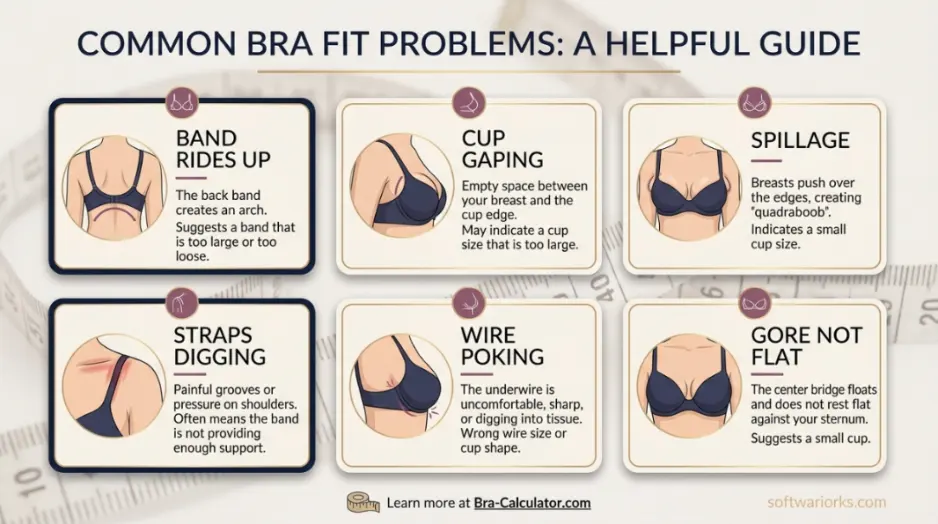
See wire-fit fixes →| Fit symptom | Likely direction | First thing to test |
|---|---|---|
| Band rides up | Band may be too large | Tighter-band sister size |
| Top or side spillage | Cup may be too small | One cup up on the same band |
| Gore floats | Cup may be too small or shallow | Larger/deeper cup before increasing the band |
| Gaping at the top | Could be excess volume or a shape mismatch | Check cup shape before automatically sizing down |
| Straps do all the work | Band may be too loose | Recheck band tension |
Use your fit symptoms to diagnose the next move
The Bra Fit Problem Solver walks through spillage, gaping, riding bands, digging straps, floating gores and underwire problems so you change the right part of the size.
Open the Fit Problem Solver →Want a second opinion? Compare the measurement result with the photo-assisted estimator
A tape measure is best for calculating the band and cup step, while a photo can add clues about projection, root width, spacing and fullness distribution. If you want a second route to the same decision, use the AI Bra Size Calculator & Visual Estimator. For the strongest result, combine the photo clues with real underbust and bust measurements rather than asking a picture to guess an exact size by itself.
Why your calculated size can fit differently between brands
A bra size label describes a proportional size, not a single universal mould. Band elasticity, cup depth, wire width, gore height, strap position and fabric stretch all change how a bra feels. That is why someone who calculates as 34D may comfortably own 34D in one brand, 32DD in another and occasionally 36C in a very firm band.
| Construction difference | How it can change fit |
|---|---|
| Stretchy band | May feel looser than the label suggests, especially after wear. |
| Firm band | Can make your normal size feel tight even when the cup is correct. |
| Shallow moulded cup | May cause spillage on projected breasts despite enough nominal cup volume. |
| Narrow wire | Can sit on side tissue if your breast root is wider. |
| Stretch lace upper cup | Often adapts better to asymmetry and small size fluctuations. |
If you already know the brand you want to buy, take your result to the Brand Size Decoder before ordering.
Size gets you into the right range; breast shape helps choose the right bra style
Two people can wear the same size and prefer completely different bras. A projected breast often needs more cup depth; close-set breasts may prefer a lower or narrower gore; soft tissue may feel more secure in a full-cup or side-support design. Shape does not change the arithmetic of the size, but it can completely change which bra feels “correct.”
| Shape clue | Styles often worth trying |
|---|---|
| Projected / forward | Seamed cups, deeper balconettes, side-support styles |
| Shallow / wide-rooted | Shallower balconettes, half cups, selected moulded styles |
| Close-set | Plunge bras or lower/overlapping center gores |
| Soft or pendulous tissue | Full cups, side support, stretch-lace upper panels |
| Asymmetry | Stretch-lace or flexible cups; fit the larger side first |
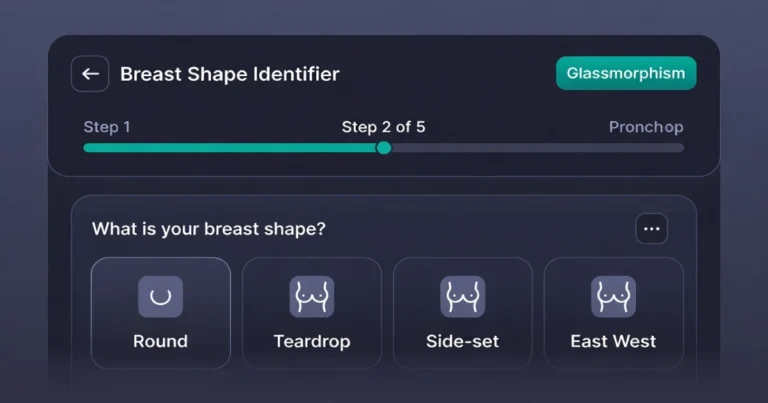
Use the Breast Shape Identifier if you want style guidance after calculating your size.
Your calculator result is a starting size. Before ordering, confirm whether the bra uses US or UK sizing and check the brand chart. If the cup feels right but the band does not, compare the sister size shown above instead of changing cup volume at random.
Affiliate disclosure: As an Amazon Associate, Bra-Calculator.com may earn from qualifying purchases at no extra cost to you.
A practical starting point if you want smooth cups under fitted tops. Compare your calculated size with one nearby sister size when brand reviews mention a firm or stretchy band.
Shop T-shirt bras →Useful when you want more containment, side support or a deeper cup. This category can be especially helpful for fuller busts and softer tissue.
Shop support bras →Choose this route when comfort is the priority. Still check band stability and cup containment—wireless does not mean the band should ride up or the cups should spill.
Shop wireless bras →Use the result instead of stopping at the result
Once you have a starting size, the next best tool depends on what you are trying to solve.
Find tighter- and looser-band alternatives while keeping similar cup volume.
Add visual shape and projection clues to your measurement-based starting size.
Use what the band, cups, gore and wires are doing to decide what to change.
Check sizing-system and fit differences before ordering from a new brand.
Translate your size across additional country and retailer labels.
See why cup letters change volume with the band and compare nearby sizes.
Bra size calculator FAQs
What is the most accurate way to calculate bra size at home?
Measure a snug underbust and a loose full bust with a level tape, repeat both measurements, calculate a starting size, then verify it in a real bra. The fit check is essential because two measurements cannot show breast projection, root width or brand construction.
Can I use this bra size calculator in inches?
Yes. Select Inches before entering the snug underbust and full-bust measurements. You can switch to Centimetres instead if that is easier; do not mix units between the two fields.
Is this a US bra size calculator?
Yes. Select US to see the primary result in US sizing. The result panel also shows UK, EU, FR/BE, AU/NZ, JP and KR equivalents so you can compare international labels without recalculating.
Do I add 4 inches to my underbust measurement?
No—not in this calculator. Enter the snug underbust exactly as measured. The tool uses the raw underbust to estimate a modern starting band and does not automatically apply the older +4 method.
What is the difference between a bra size calculator and a cup size calculator?
A cup size calculator estimates the cup step from the difference between bust and underbust. A full bra size calculator combines that cup step with a band size and applies the cup progression used by the selected sizing system.
Why is my US bra size different from my UK size?
US and UK bands usually use the same numbers, but their cup sequences diverge above DD. For example, a cup step that may be labelled DDD/F in the US is typically E in UK sizing. Always check which system a brand uses.
What if the calculator gives the right cup but the band feels wrong?
Try a sister size. Go up one band and down one cup step for a looser band, or down one band and up one cup step for a firmer band. This keeps the cup volume approximately similar while changing band tension.
Why does the same bra size fit differently between brands?
Band stretch, cup depth, wire width, gore height, fabric and pattern blocks vary. The label can be identical while the three-dimensional shape is different, which is why a calculated size should be treated as a starting point rather than a universal guarantee.
Can I calculate bra size from a photo instead?
A photo can help identify shape, spacing and projection, but it cannot reliably provide scale on its own. For the strongest result, combine photos with actual measurements in the AI Bra Size Calculator & Visual Estimator.
How often should I measure my bra size again?
Remeasure when your bras stop fitting the way they used to, after a meaningful body change, during or after pregnancy, or whenever the band and cup fit have clearly shifted. If your bras still fit well, there is no need to chase a new number on a fixed schedule.
Reviewed by Amelia
Founder & Bra Fit Specialist, Bra-Calculator.com
Amelia reviews the site's sizing guides for practical fit logic, regional cup-label differences and clear next-step advice. Her approach is simple: use measurement tools to get a strong starting point, then let real fit signals decide whether the band, cup or bra shape needs adjusting.
Was this calculator and fit guide helpful?
Thanks — your feedback helps us improve the guide.