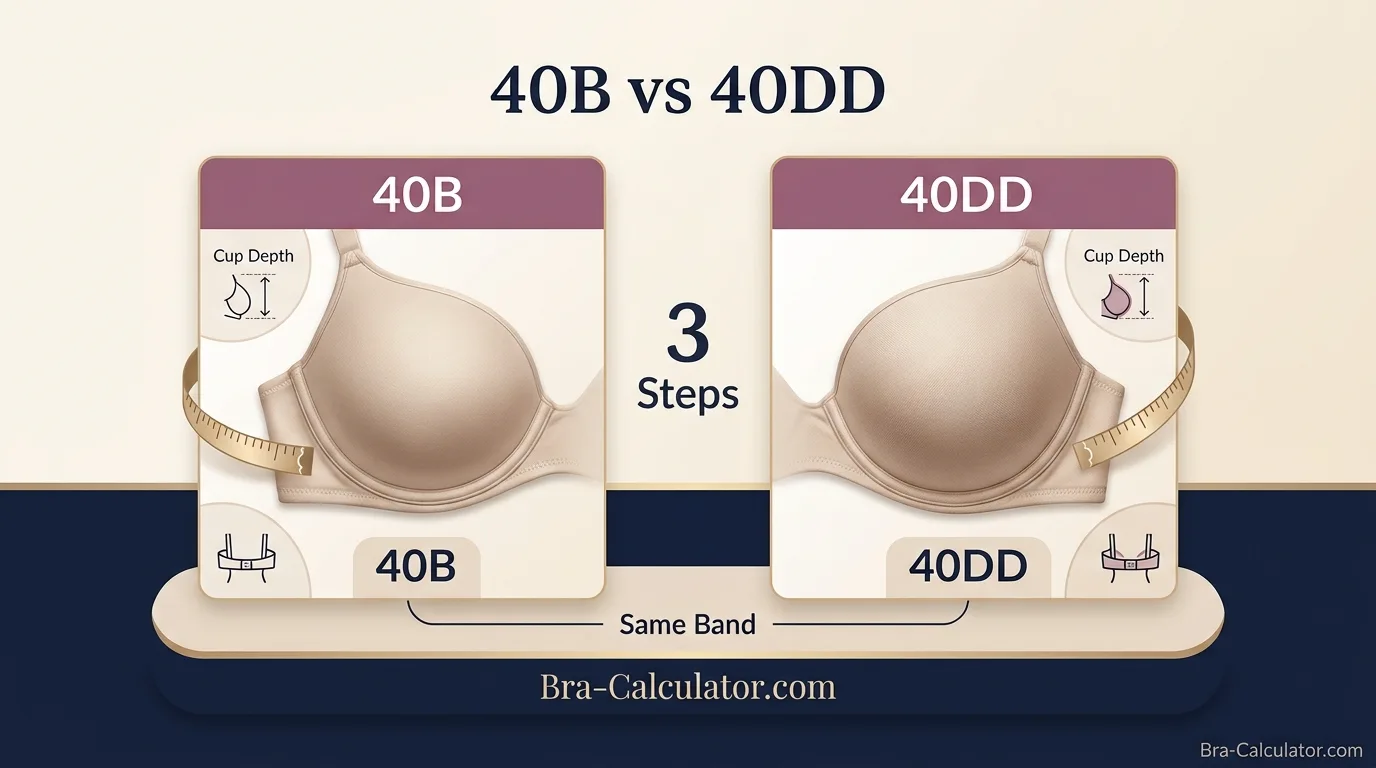
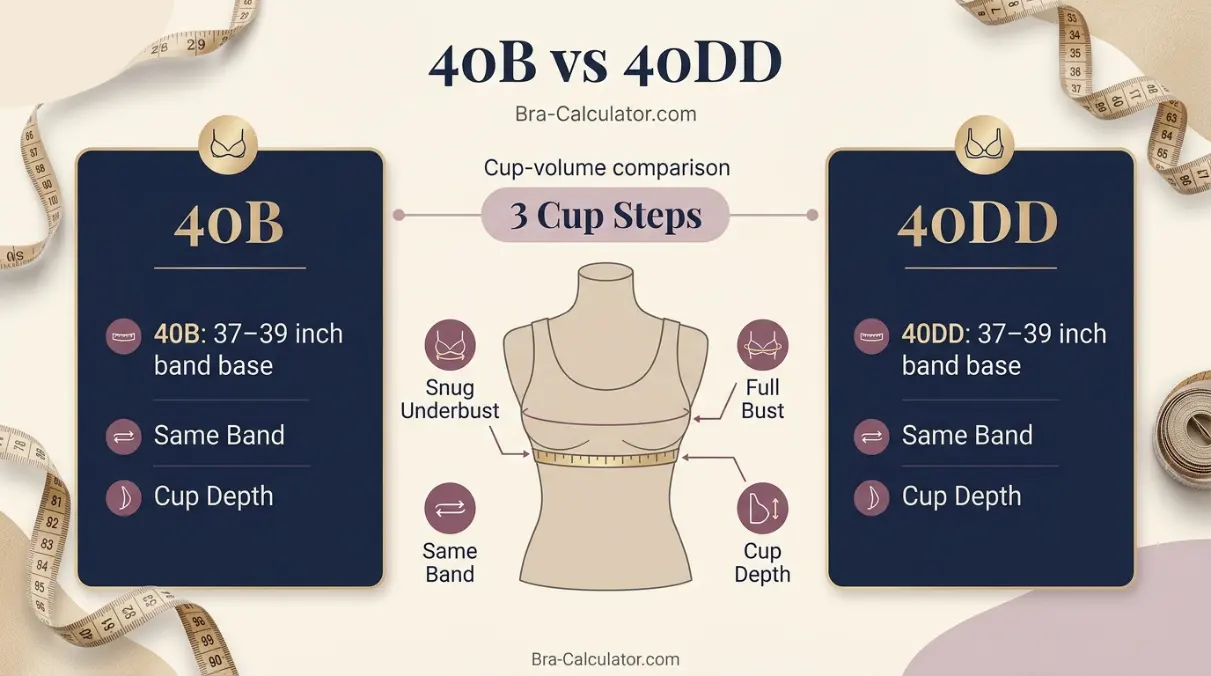
On the same 40 band, 40DD is about 3 cup steps larger in cup volume than 40B. This is a same-band comparison, so the main question is cup depth, side containment, upper-cup room, and whether the center gore can sit correctly. Choose 40B if 40DD wrinkles, stands away, feels too tall, or creates empty space at the cup edge. Choose 40DD if 40B cuts in, spills, compresses tissue, or makes the gore float.
Jump to a Section
Choose the fit signs you notice in the band, cups, center and straps. We’ll turn them into a practical next step for 40B.
Private fit check — your answers stay in your browser and are used only for this on-page guidance. Nothing is stored or submitted.
40B vs 40DD at a Glance
| Attribute | 40B | 40DD |
|---|---|---|
| Band starting point | 37–39 inches | 37–39 inches |
| Comparison type | Same band | |
| Size relationship | 3 cup steps | |
| Main fit clue | Choose 40B if 40DD wrinkles, stands away, feels too tall, or creates empty space at the cup edge. | Choose 40DD if 40B cuts in, spills, compresses tissue, or makes the gore float. |
| Core reminder | Always judge band, cup, wire, straps, and movement together. The size label alone cannot diagnose fit. | |
What Does 40B vs 40DD Really Mean?
40B vs 40DD is a practical fit comparison, not just a size-label debate. In this range, support depends heavily on whether the band can stay level, whether the cup has enough depth, and whether the wire surrounds the full breast root without sitting on tissue.
This is a same-band comparison, so the main question is cup depth, side containment, upper-cup room, and whether the center gore can sit correctly. A correct size should look calmer under clothing, feel more secure during movement, and reduce the need to overtighten straps. A wrong size may still look acceptable in a mirror for a few seconds, but it usually reveals itself through riding bands, floating gores, side spillage, strap pressure, or cup edges that dig in.
This guide separates measurement logic from real fit behavior so the page is useful for shoppers, fit checks, and sister-size decisions. The goal is simple: identify which option gives cleaner containment, steadier support, and more comfortable all-day wear.
Measurement Logic for 40B and 40DD
Start with the snug underbust measurement. 40B usually begins around 37–39 inches, while 40DD usually begins around 37–39 inches. That band starting point matters because a loose band can make a good cup look wrong, and a tight band can make the cup feel smaller than it really is.
After the band, compare the full-bust measurement and the way tissue sits in the cup. Projected tissue often needs deeper cups; shallow tissue may need a lower or more open cup; soft tissue may need firmer side support. That is why the same two labels can behave differently on different bodies.
Check whether your snug underbust is closer to 40 or 40 before deciding by cup letter.
Do not compress tissue; this gives a better starting point for cup depth.
Testing the same bra model keeps the comparison fair.
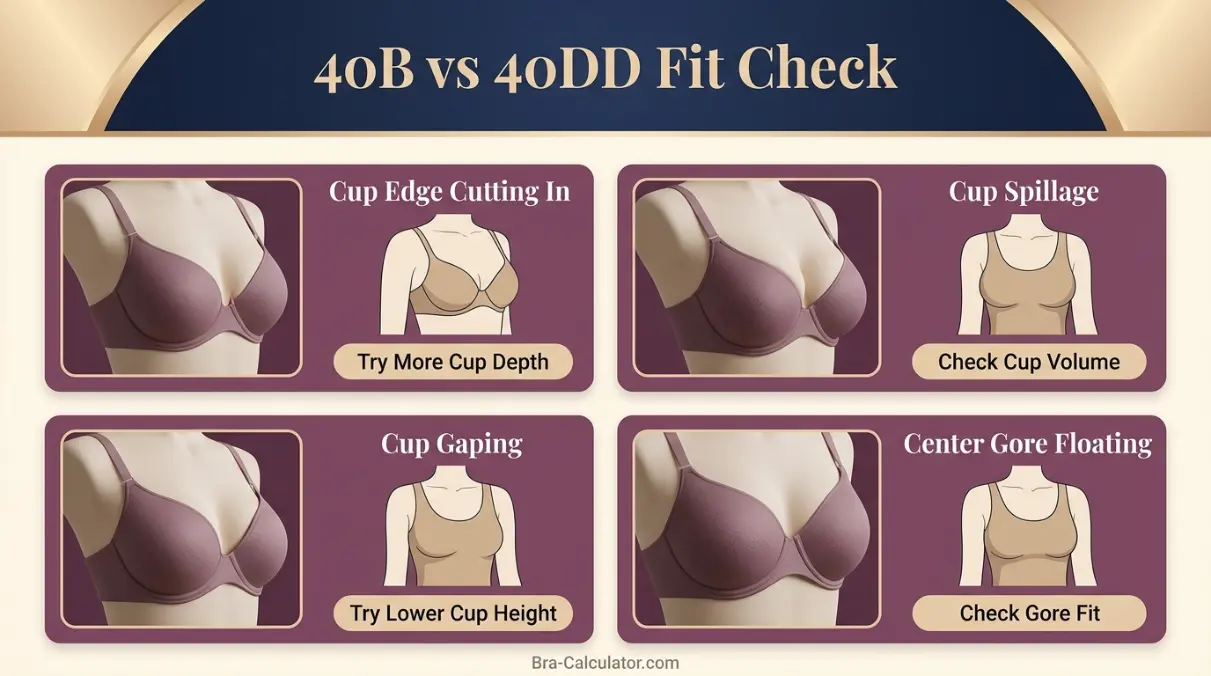
Look for gaping, cutting, floating gore, side tissue, riding band, and strap pressure.
What Does 40B vs 40DD Look Like?
Visually, 40B and 40DD may look close if the volume relationship is similar, but the body feel can still be very different. A firmer band usually gives more anchoring and lift, while a looser band can feel easier around the ribs but may allow shifting if it is not stable enough.
Fuller cups in this range often need stronger side support, smoother cup edges, and stable strap placement. A cup that is technically close but shaped wrong can wrinkle, flatten, push tissue sideways, or create pressure near the wire.
Fit truth shows in movement. Raise your arms, sit down, walk, and breathe normally. The better size should stay calmer without needing constant adjustment.
For 40B vs 40DD, the most reliable signs are a level band, contained side tissue, a smooth cup edge, and a center gore that sits close without painful pressure.
Best Products to Test 40B vs 40DD
These product-card suggestions focus on structured comparison bras: stable bands, clear cup shapes, and enough support to expose real fit issues instead of hiding them.

Structured Full-Coverage Bra
- Helps compare cup depth without hiding fit clues.
- Useful for 40 and 42 band comparisons where band anchoring matters.
- Works best when tested in the same model across both sizes.

Side-Support Balconette Bra
- Centers tissue and makes side-spillage easier to diagnose.
- Helpful when one size feels wide, flat, or unstable.
- A strong option for fuller lower-cup and outer-cup fit checks.

High-Support Encapsulation Sports Bra
- Reveals bounce, compression, band riding, and hidden cup issues quickly.
- Useful when a mirror check looks fine but daily movement feels wrong.
- Better for judging real support than soft stretch bralettes.
How Body Shape Changes 40B vs 40DD
Body shape can change the result even when measurements look obvious. Projected tissue, shallow tissue, wide roots, close-set tissue, soft tissue, and torso length all affect whether one size feels supportive or awkward.
Depth matters most
Projected shapes often need deeper cups and may show a floating gore quickly when the cup is too shallow.
Check lower cupShape can beat volume
A tall or projected cup may gap even when the size is close. A more open, shallower cut may work better.
Check cup heightContainment matters
Softer tissue often needs stable side panels and smooth upper edges to avoid cutting or spilling.
Side supportWire width matters
If the wire sits on tissue, the size may feel wrong even if the cup volume is close.
Wire check40B vs 40DD Sister Sizes
Sister sizing helps separate a band issue from a cup issue. If the cup feels close but the band rides up, go down a band and up a cup. If the band is genuinely too tight, go up a band and down a cup.
40B
40DD
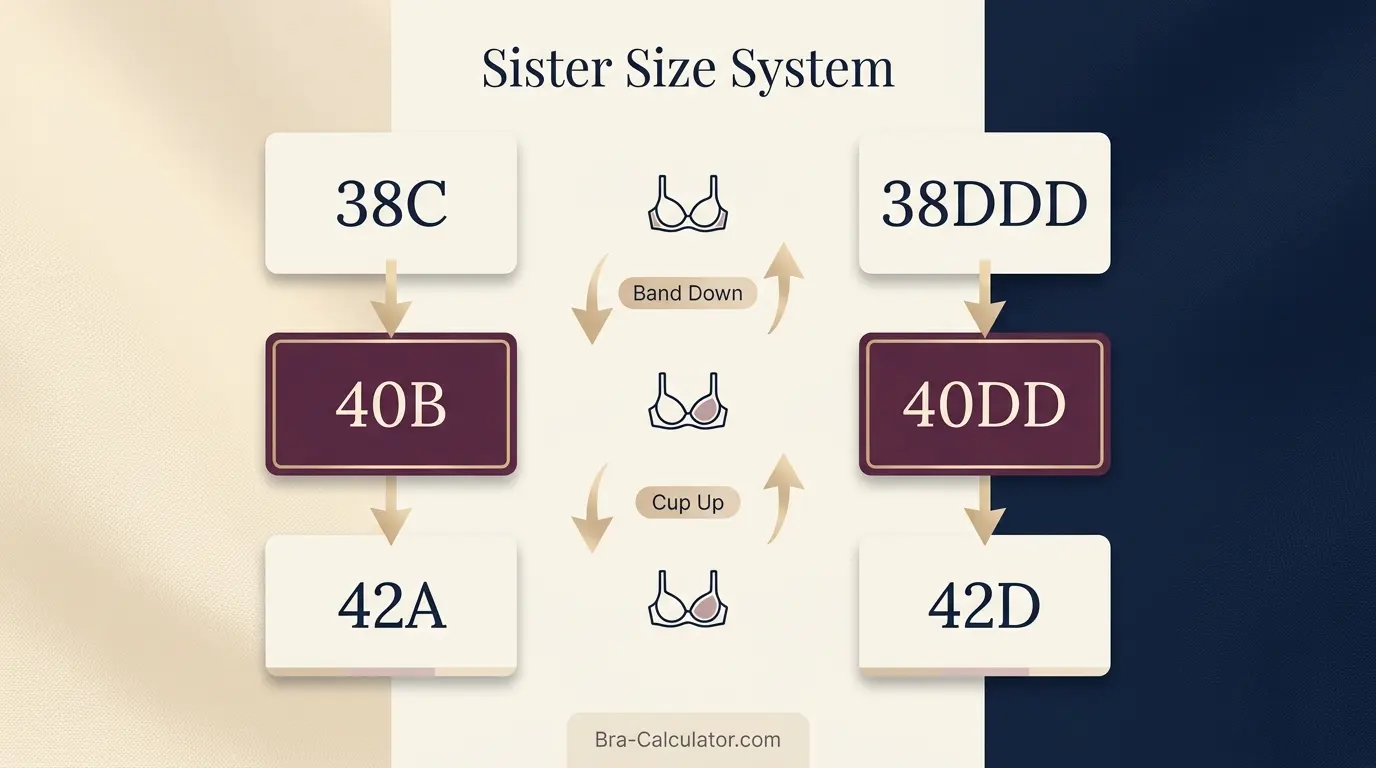
40B vs 40DD: Real Fit Differences
- 40B starts from a 40 band and B cup.
- Usual snug underbust starting point: 37–39 inches.
- Best when it keeps the band level and cups smooth without strap strain.
- Check the center gore and side wire after scoop-and-settle.
- 40DD starts from a 40 band and DD cup.
- Usual snug underbust starting point: 37–39 inches.
- Best when it improves comfort without sacrificing containment.
- Movement testing reveals whether the band and cup are truly stable.
- Check whether the cup height matches your tissue.
- Look for smooth top edge and stable wire placement.
- Do not judge before scoop-and-settle.
- Check whether the band stays level through movement.
- Look for clean side containment and comfortable depth.
- Different brands may scale the cup differently.
- Best if the band anchors comfortably.
- Should not require overtightened straps.
- Must contain tissue without side pressure.
- Best if it improves ribcage comfort without riding up.
- Should keep cups stable when you move.
- Needs proper side support in fuller ranges.
- Try this if the looser option shifts or rides up.
- Use a structured style for a fair test.
- Check the return policy before buying.
- Try this if the firmer option feels restrictive.
- Compare the same style where possible.
- Use brand charts for cup naming differences.
Which Bra Styles Work Best for 40B vs 40DD?
Structured T-shirt bras, seamed full cups, side-support balconettes, and encapsulation sports bras give the cleanest test. Very soft bralettes may feel comfortable, but they often hide band and cup issues.
Best for checking depth, smoothness, and full tissue containment.
Helps center tissue and diagnose outer-cup problems.
Useful when cup height or upper-edge shape is the issue.
Shows how the size behaves under everyday clothing.
Reveals bounce, band movement, and cup compression fast.
Too flexible for a clean size comparison.
Common Fit Problems in 40B vs 40DD
The band is too loose or the cup is pulling the frame out of position.
The cup may be too small, too closed, or not projected enough.
The cup may be too tall, too deep, or wrong for your shape.
The cup may lack depth or the band may not anchor the frame.
The wire may be too narrow or the cup may not have enough side coverage.
International Conversion Notes for 40B vs 40DD
International sizing can change the letter sequence, especially around DD, DDD, E, F, G, H, and I. Always check the brand chart before assuming US, UK, EU, and AU labels mean the same thing.
Use the Global Bra Size Converter and Brand Size Decoder before buying across regions.
Related Tools & Guides for 40B vs 40DD
| Guide / Tool | Why It Helps |
|---|---|
| Bra Size Calculator | Calculate your size from measurements. |
| Sister Size Calculator | Find nearby band-and-cup alternatives. |
| Cup Size Visuals | Understand why letters change with band size. |
| Global Bra Size Converter | Compare US, UK, EU, and AU labels. |
Frequently Asked Questions
On the same 40 band, 40DD is about 3 cup steps larger in cup volume than 40B.
It may be close in the sister-size family if the band and cup move in opposite directions. Even when capacity is similar, the band tension, wire width, and cup height can feel different.
Start with the size that matches your snug underbust range: 37–39 inches for 40B and 37–39 inches for 40DD. Then use cup symptoms to choose the final option.
That usually points to a shape mismatch. Try a different cup cut, stretch-lace edge, side-support style, or wire width before assuming both labels are wrong.
Fasten the bra on the loosest hook, check that the back band sits level, raise your arms, sit down, and move for a few minutes. A good band should stay anchored without painful tightness.
A floating gore can mean the cup is too shallow, too small, too narrow, or the band is not stable enough to pull the frame close to the body.
Yes. Different bras can change cup height, wire width, and projection. Testing the same model gives the cleanest comparison.
Judge the full fit system: band, cup depth, wire placement, tissue shape, strap pressure, and movement comfort. The label alone is never enough.
Find Your Best Fit
Use your measurements, symptoms, body shape, and sister-size options to decide which size gives the cleanest support.