A B cup usually means your full bust is about 2 inches larger than your underbust. But B cup is also one of the most commonly mismeasured sizes because many stores use 34B or 36B as a “default” fitting size. A true B cup can look petite, softly rounded, or fuller depending on the band. A well-fitted B cup bra should sit smooth, keep the band level, avoid top-cup gaping, and create gentle shape without forcing extra padding or slipping straps.
B Cup at a Glance
| Attribute | Detail |
|---|---|
| Cup Difference | About 2 inches between underbust and full bust |
| General Category | Small to small-medium cup volume |
| Common Reference Size | 32B, but B cup exists across many band sizes |
| Common Sister Sizes | 32B ≈ 30C ≈ 34A |
| Most Common Fit Issue | Being placed in 34B or 36B by default, top-cup gaping, loose bands, slipping straps, and shallow molded cups |
| Best Bra Styles | Demi bras, plunge bras, balconettes, soft bralettes, lightly lined T-shirt bras, and flexible wireless bras |
| Usually Avoid | Overly tall molded cups, stiff full-coverage cups, very thick push-up padding, and loose-band “default” sizes |
| US / UK / EU / AU Cup Label | B in most systems |
| Unique B Cup Fit Rule | Do not assume 34B is the default; band accuracy matters more than choosing the most common retail size. |
| Important Rule | B cup volume changes as band size changes |
What Is a B Cup Size?
A B cup is a bra cup size where the full bust is usually about 2 inches larger than the underbust. In simple terms, if your ribcage measurement is around 32 inches and your full bust is around 34 inches, you may be close to a 32B. If your underbust is around 34 inches and your full bust is around 36 inches, you may be close to a 34B.
The real problem with B cup sizing is that it is often treated as a “default” size. Many people are handed a 34B or 36B in stores because those sizes are widely stocked, not because they match the body perfectly. This is why so many B cup wearers experience slipping straps, loose bands, top-cup gaping, or bras that shift during the day. The issue is not always the B cup itself — it is often the wrong band and cup combination.
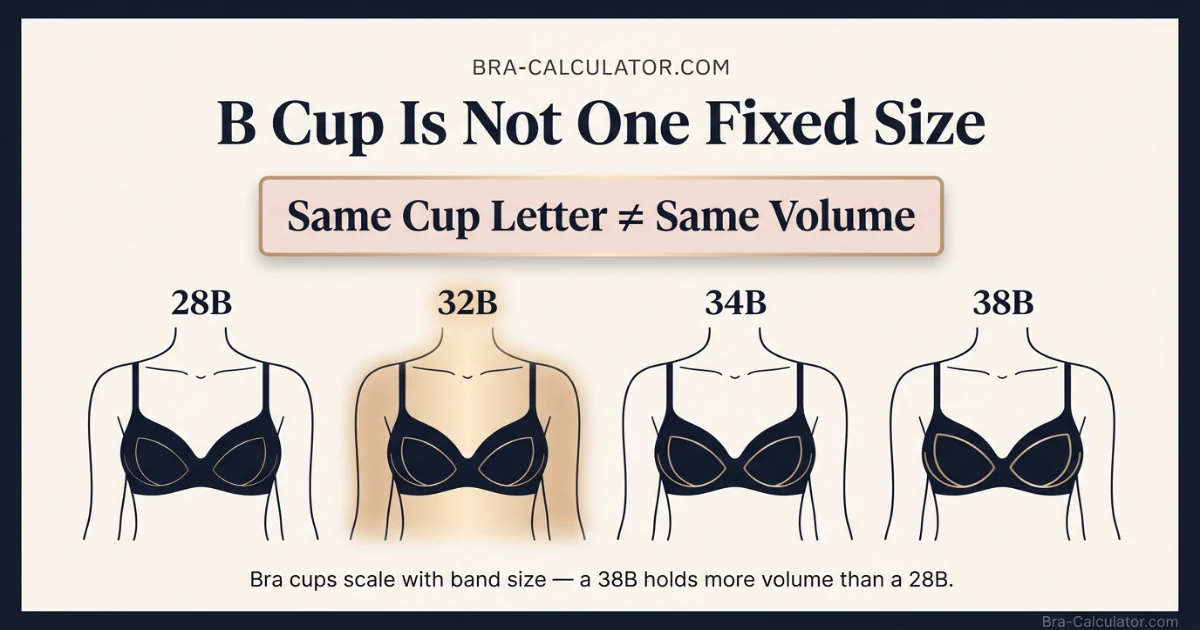
B cup is not one fixed breast size. A 28B is smaller in volume than a 36B. A 38B holds more breast tissue than a 32B. This is why B cup can look petite on one person, balanced on another, and fuller on a wider frame. The cup letter tells you the bust-to-band difference; the band tells you the actual scale of the cup.
B cup breasts often have gentle roundness with light-to-moderate projection. Compared with A cup, there is usually more visible curve from the side and more natural filling in soft cups. Compared with C cup, the volume is still relatively light and usually does not need heavy support engineering. Many B cup wearers fit best in demi cups, plunge bras, lightly lined T-shirt bras, bralettes, soft wireless bras, and flexible balconettes.
The best B cup bra should feel easy and stable: the band stays level, the cup edge lies smooth, the straps stay in place, and the shape looks natural under clothing. If a B cup bra gaps, cuts in, or slides around, do not assume your body is the problem. Check the band size, cup height, cup stiffness, and whether the bra is designed for your actual breast shape.
B Cup Measurements
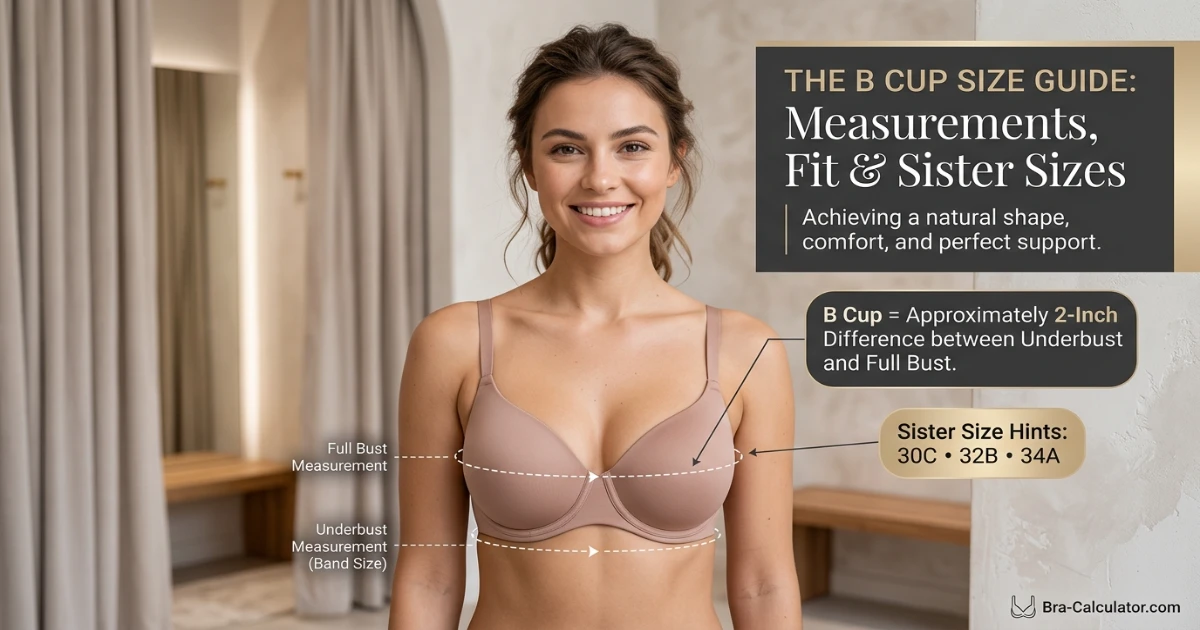
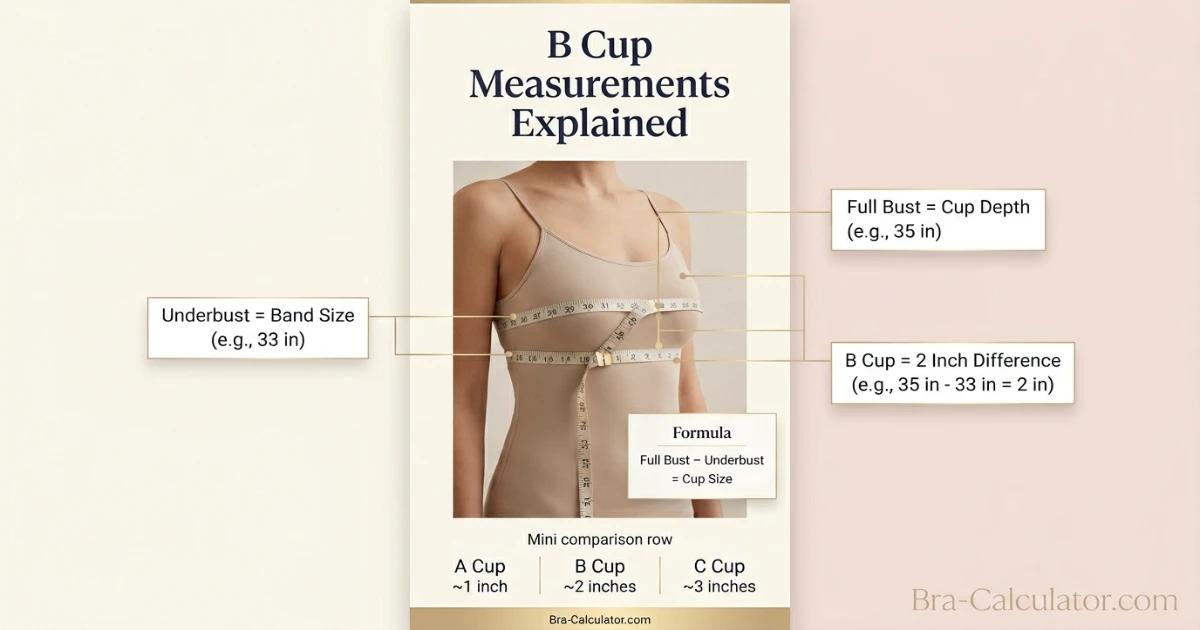
To calculate a B cup, measure your underbust and full bust. Your underbust helps determine the band size, while your full bust minus underbust gives the cup size. For a B cup, the difference is usually about 2 inches, or about 5 cm.
About 2 inches difference = B cup
| Example Size | Typical Underbust | Typical Full Bust | What It Means |
|---|---|---|---|
| 28B | 27–28″ | 29–30″ | Petite B cup volume |
| 30B | 29–30″ | 31–32″ | B cup on a narrow band |
| 32B | 31–32″ | 33–34″ | Common B cup reference size |
| 34B | 33–34″ | 35–36″ | B cup on a medium band |
| 36B | 35–36″ | 37–38″ | Wider-frame B cup |
| 38B | 37–38″ | 39–40″ | Larger B cup volume than 32B |
Wrap the tape around your ribcage directly under the bust. Keep it level and snug. This gives your band starting point.
Measure around the fullest part of your bust without compressing tissue. For B cups, a small measuring error can move you toward A or C, so measure carefully.
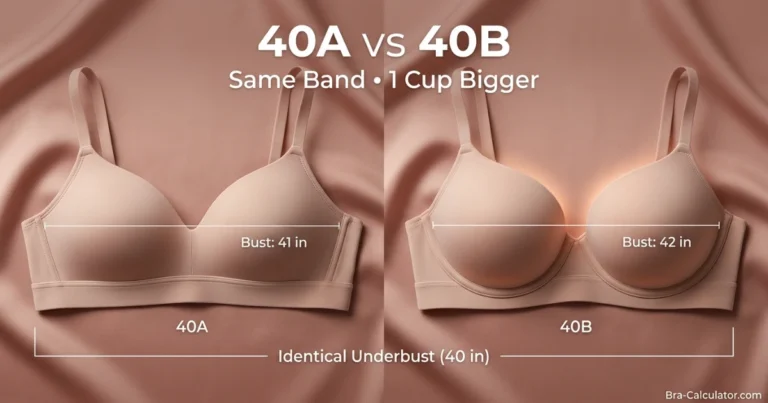
If the full bust is around 2 inches larger than the underbust, you are likely in the B cup range. Around 1 inch suggests A. Around 3 inches suggests C.
The cups should sit smooth without gaping or cutting. The band should stay level. Straps should support lightly, not hold the entire bra up.
B Cup Measurement Visual
What Does a B Cup Look Like?
A B cup usually creates a softly rounded, natural bust shape. It has more visible curve than an A cup, but it is still usually light enough that the bra’s main job is shape, smoothness, and comfort rather than heavy lifting. From the side, B cup projection is noticeable but not dramatic. From the front, it can appear subtle, balanced, or softly full depending on the band size and body frame.
On a petite band like 28B or 30B, the B cup often looks small and neat. On a 32B, it is a very common small-to-medium reference size. On a 36B or 38B, the same letter covers a wider chest area and may look broader or fuller because the cup volume increases with band size. This is why “B cup looks small” and “B cup looks full” can both be true depending on the body.
In clothing, a well-fitted B cup usually gives a smooth, balanced line. T-shirts tend to sit cleanly. Button-down shirts are usually easier to fit than they are for larger cups. Swimwear can be flexible, but triangle tops, lightly padded bikini tops, and demi-style swim bras often work better than deep molded cups built for fuller bust projection.

Seamed Balconette Bra — Smooth Shape & Natural Lift for B Cup
- Helps create a rounded outline without excessive padding
- Lower neckline reduces top cup gaping
- Good for small-to-medium cup wearers who want subtle lift
- Works well under fitted tops and everyday outfits

Wireless Seamless Bralette — Gentle Hold Without Stiff Cup Edges
- Soft stretch fabric adapts to natural B cup volume
- No underwire pressure at the center gore
- Ideal for lounging, casual outfits, travel, and daily comfort
- Better for shallow or wide-set B cup shapes than rigid molded cups
Narrow Ribcage
B cup looks compact and gently rounded. Choose 28B or 30B if your ribcage is small instead of sizing up into a loose 32A.
Firm band fitShallow Shape
Breasts may sit wider with less forward projection. Demi, plunge, and lightly lined bras often look smoother than tall molded cups.
Demi or plungeBalanced Volume
32B or 34B often gives a balanced silhouette with light lift. A T-shirt bra or soft balconette can work beautifully.
Everyday fitFlexible Shape
Soft B cup tissue may settle inside molded cups. Stretch fabric, lightly lined cups, and lower necklines usually prevent gaping.
Soft stretch cupIs a B Cup Considered Small or Medium?
A B cup is usually considered small to small-medium. It is larger than A cup, but it is not automatically “average” for everyone. The look depends strongly on band size, body frame, breast root width, tissue firmness, and breast placement. A 30B can look petite. A 36B can look more noticeable because the cup volume is wider and larger.
The most human way to understand B cup is this: it is often the size where the bust is visible enough to benefit from shaping, but still light enough that comfort is usually easy to achieve with the right style. Most B cup wearers do not need heavy-duty support, but they do need cups that match their shape. A poorly shaped B cup bra can gap, flatten, or slide just as badly as any other size.
B cup is a normal, common, and beautifully versatile size. It can look subtle, balanced, athletic, softly rounded, or more noticeable depending on the band and body shape.
If your B cup bra gaps, do not assume your bust is “too small.” The cup may simply be too tall, too stiff, or attached to the wrong band size. Shape mismatch is extremely common in B cup bras.
How Much Do B Cup Breasts Weigh?
B cup breast weight is usually light to moderate, but it changes by band size because cup volume increases as the band gets larger. A 28B and a 38B are both B cups, but the 38B cup is built on a wider frame and usually holds more tissue. These estimates are approximate and can vary by tissue density, hormones, body composition, and breast shape.
| B Cup Size | Approx. Breast Weight | Fit Note |
|---|---|---|
| 28B | Approx. 0.25–0.40 lb per breast | Petite volume; soft bralettes, demi cups, and triangle styles often fit well. |
| 32B | Approx. 0.35–0.60 lb per breast | Common B cup reference; shape match and band accuracy are key. |
| 34B | Approx. 0.45–0.75 lb per breast | Often used as a default size, but the band may be too loose for some wearers. |
| 36B | Approx. 0.60–0.95 lb per breast | Wider-frame B cup; avoid cups that are too tall or too stiff. |
| 38B | Approx. 0.75–1.15 lb per breast | Larger B cup volume than 32B; cup width and band stability matter more. |
Important: These are practical fitting estimates, not medical measurements. Breast weight varies by tissue density, body fat distribution, hormones, age, and individual anatomy.
For B cup wearers, discomfort usually comes from poor band fit, cup shape mismatch, tall cups, stiff foam, or straps placed too wide — not from breast weight alone.
B Cup Sister Sizes
Sister sizes preserve similar cup volume while changing the band. This is especially useful for B cup because many people are sold a common size like 34B or 36B when they actually need a smaller band and larger cup, such as 32C or 30D. The cup may feel “okay,” but the band fails to support correctly.
For example, 32B has a similar cup volume to 30C and 34A. If a 32B cup feels right but the band rides up, try 30C. If a 32B band feels too tight but the cup volume feels right, try 34A. The cup volume stays similar, but the band fit changes.
Rule: Up one band → Down one cup | Rule: Down one band → Up one cup | Example: 32B ≈ 30C ≈ 34A.
| Reference Size | Tighter Sister Size | Looser Sister Size |
|---|---|---|
| 30B | 28C | 32A |
| 32B | 30C | 34A |
| 34B | 32C | 36A |
| 36B | 34C | 38A |
B Cup vs Other Sizes
These comparisons help you understand when B cup is right and when you may need A, C, or a sister size instead. B cup sits in a tricky middle zone: small enough to gap in tall cups, but full enough to spill in shallow cups if the shape is wrong.
- About 2-inch bust difference
- More curve than A cup
- Better if A cup cuts in or feels too shallow
- About 1-inch bust difference
- Less projection
- Better if B cup gaps even in soft styles
- Smaller than C cup
- Gentle natural projection
- Often works in bralettes, demi cups, and light T-shirt bras
- About 3-inch bust difference
- More rounded volume
- Try C if B cup spills or gore floats
- Reference B cup size
- Good for a 31–32 inch underbust
- Looser than 30C
- Sister size to 32B
- Similar cup volume
- Better if 32 band rides up
- Firmer band than 34A
- Better support if underbust is 31–32 inches
- Looser sister size
- Similar cup volume
- Use only if 32 band feels too tight
Best Bra Styles for B Cup
B cup is one of the most flexible sizes for bra styling, but it is also one of the easiest to misfit because many brands design around a generic 34B shape. The best B cup bra is not always the most padded one. It is the one with the right band, cup height, cup flexibility, and neckline for your breast shape. If your tissue is shallow, lower cups usually work better. If you have more lower fullness, lightly structured cups can lift without adding too much bulk.
Lower cup height reduces gaping and gives a soft rounded shape under everyday tops.
Gives natural shape without heavy padding. Best when the cup is not too tall or rigid.
Works well when the breast tissue sits more toward the sides or the center gore feels too tall.
Great for relaxed wear, casual outfits, and soft tissue that dislikes stiff molded cups.
Can leave empty space at the top, especially for shallow or lower-full B cup shapes.
Push-up bras can work, but if the band is too loose, the padding moves and creates gaps.
Common Fit Problems with B Cup
The cup may be too tall, too rigid, or designed for more upper fullness than you have.
The cup may be too small, too shallow, or too closed on top.
The band may be too loose, or the straps may be set too wide for your frame.
The band is too loose and cannot anchor the cups properly.
The padding may be too thick or shaped for a different breast root.
International Size Conversion for B Cup
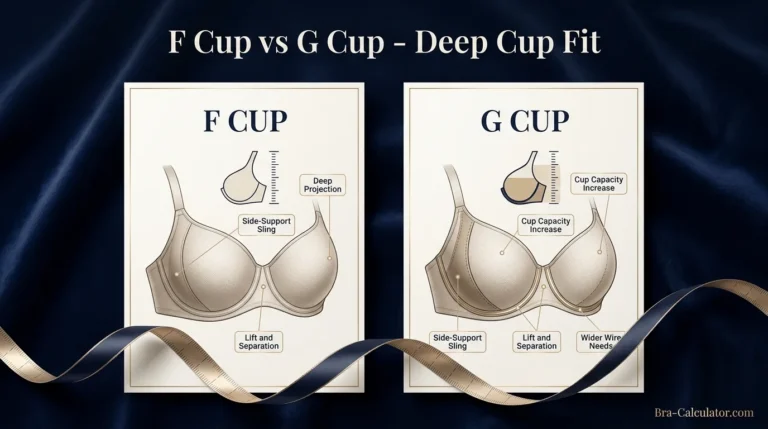
The B cup letter is mostly consistent across US, UK, EU, and AU sizing systems. The band size is where the conversion changes. This makes B cup easier to buy internationally than larger cup sizes such as DD, DDD, E, F, FF, G, or H, where cup letters start to differ by country.
For example, a US 32B is usually close to a UK 32B, EU 70B, and AU 10B. If you are shopping from international brands, use the Global Bra Size Converter before buying so you match both the band and cup correctly.
Related B Cup Tools & Guides
Use these supporting pages to confirm your size, compare cup visuals, and find a better sister size if your current B cup bra does not fit smoothly.
| Guide / Tool | Why It Helps |
|---|---|
| Bra Size Calculator | Calculate your exact band and cup size from measurements. |
| Cup Size Visuals | Compare B cup with A, C, D, DD, E, F, G, H, and J visually. |
| Sister Size Calculator | Find sister sizes like 32B, 30C, and 34A. |
| Global Bra Size Converter | Convert B cup band sizes across US, UK, EU, AU, FR, JP, and more. |
Frequently Asked Questions
A B cup usually means your full bust is about 2 inches larger than your underbust. The actual volume depends on your band size.
B cup is usually considered small to small-medium. It is bigger than A cup but still relatively light in volume compared with C, D, DD, or larger cups.
The main sister sizes of 32B are 30C and 34A. 30C has a tighter band with similar cup volume, while 34A has a looser band.
B cup bras often gap when the cup is too tall, stiff, molded, or not shaped for your breast tissue. Try demi, plunge, balconette, or soft wireless styles.
Yes, B cup is usually labeled B in both US and UK sizing. The bigger difference usually appears in band conversion and larger cup letters.
Choose B cup if the cup sits smooth without cutting in. Choose C cup if the B cup presses into your tissue, creates overflow, or feels too shallow.
32B and 34A are sister sizes with similar cup volume, but 34A has a looser band. The fit and support will feel different even if the cup volume is close.
Yes. B cup can wear push-up bras, but light or moderate push-up usually looks smoother than very thick padding.
A cup is one cup size smaller than B cup in the same band. AA and AAA are smaller than A cup.
C cup is one cup size larger than B cup in the same band. For example, 32C has more cup volume than 32B.
The band may be too large. Many people wearing B cup are actually in the wrong band size. Try sister sizing to check whether a smaller band gives better support.
Demi bras, plunge bras, bralettes, and lightly lined soft cups usually fit shallow B cup breasts best because they reduce top gaping.
Continue the Cup Size Guide Series
If B cup is close but not perfect, compare it with nearby cup sizes and sister sizes before buying. A small change in band size, cup height, or sister size can completely change the fit.
| Next Step | Best For |
|---|---|
| ← A Cup Size Guide | Use this if B cup gaps even in soft, low-cut styles. |
| C Cup Size Guide → | Use this if B cup feels shallow, cuts in, or creates overflow. |
| Cup Size Visuals → | Compare B cup with A, C, D, DD, E, F, G, H, and J visually. |
| Sister Size Calculator → | Check sizes like 32B, 30C, and 34A. |
Find Your Best B Cup Fit
Measure your underbust and bust to confirm whether B cup, A cup, C cup, or a sister size is your most comfortable match.