The Menopause Bra
Size Calculator
The only bra calculator built for how your body actually changes — hot flashes, tenderness, swelling days, tissue softness. Seven sizing systems. A to P cups.
Fresh measurements matter
During menopause, hormones shift your band and cup even if your weight hasn’t changed. Take new measurements now for the most accurate result.
How to measure
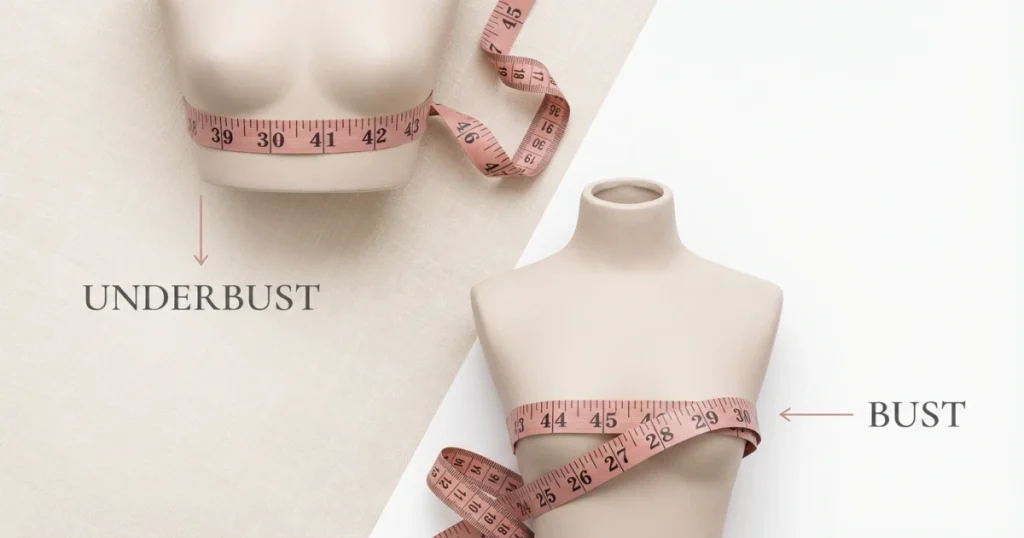
- Underbust (band): snug tape directly under breast — breathe out
- Full bust: tape at fullest point — parallel to floor, loose not tight
- Stand straight, arms down. No bra for accuracy.
Around the fullest part, level with floor
Snug but not tight, directly under breast
Comfort settings
These adjust the recommendation to match your menopause reality. Toggle what applies to you right now.
Wire sensitivity
Ribs tender or underwire feels sharp
Hot flash comfort
Prioritise breathable, sweat-friendly fit
Swelling days
Size fluctuates — need flexible range sizing
Tissue softness
Shape changed — need more lift or structure
Band preference
Coverage preference
Menopause changes where fullness sits. Choose the coverage that best matches how you want to feel — not just look.
Full coverage
Maximum containment, softer top edge. Best if you fluctuate or feel tender at the top.
Standard coverage
Classic everyday balance. Works for most shapes and outfits.
Demi / balconette
Lower neckline, lifted shape. Best when top-of-cup overspill is not an issue.
Wireless / bralette
Soft, gentle structure. Great if wire sensitivity is high or you prefer minimal restriction.
Your full result is shown below
Calculating…
Band (US/UK)
Cup (US)
Cup (UK)
Swelling option
Your size across 7 international systems
Sister Sizes — same cup volume, different band
Same cup volume in a different band. Use when a brand runs tight or loose.
🍖 Menopause fit tips
Menopause Bra Size
Personal fit snapshot
Recommended size (US/UK)
Band
Cup US/UK
EU size
Comfort settings applied
Band rides up → down 1 band. Top edge cuts in → up 1 cup. Swelling day → try cup-up option.
Built for bodies that change
Standard bra calculators assume stable measurements. Menopause doesn’t. This tool accounts for the real physics of perimenopause — because your comfort matters.
Hot flash comfort mode
Adjusts fabric and style recommendations for sweat-heavy days.
Swelling-day sizing
Gives you a primary and a flexible range size for fluctuating days.
7 sizing systems
US, UK, EU, FR/BE, AU/NZ, JP, KR — all converted instantly.
100% private
No data stored. No account needed. No ads. Just your size.
Menopause bra problems, solved
Band feels tight after a few hours?
Cause: Bloating or swelling during the day.
Fix: Try your sister size up in band (34→36) or fasten on a looser hook.
Underwire digs into ribs or breast tissue?
Cause: Rib tenderness is common in perimenopause.
Fix: Wireless or wide-channel flex-wire styles.
Cup overflows or spills at the top?
Cause: Cup too small, or demi on a full-on-top shape.
Fix: Go up 1 cup; switch to full-coverage.
Straps keep slipping off?
Cause: Band too loose — straps compensating for poor band support.
Fix: Size down 1 band, adjust cup upward accordingly.
Wet and uncomfortable during hot flashes?
Cause: Polyester linings trap heat and sweat.
Fix: Bamboo-lined, cotton-panel, or moisture-wicking bras.
Shape has changed, don’t know your new size?
Cause: Oestrogen loss changes breast tissue density and distribution.
Fix: Re-measure every 6 months using this calculator.
Menopause Bra Size Calculator (2026): Measure Smarter, Fit Better, Feel Like Yourself Again
Designed specifically for perimenopause and postmenopause.
Accounts for swelling days, rib tenderness, tissue softness, and hot flashes.
If your bra suddenly feels wrong — band riding up, cups collapsing at the top, wires poking by midday, straps carving into your shoulders — you’re not imagining it.
Perimenopause and menopause genuinely change how bras fit.
And here’s the important part: you don’t need to gain or lose weight for your size to change.
This guide explains:
- Why menopause alters bra fit
- How to measure accurately for this stage of life
- How to interpret fluctuating results
- What to do next so comfort lasts all day
Use the Menopause Bra Size Calculator above first. Then read this guide to understand your results properly. Studies show that up to 1 in 5 women change bra size after menopause due to hormonal redistribution and tissue softness.
What Is a Menopause Bra Size?
A menopause bra size is your current band and cup measurement recalculated to reflect hormonal tissue changes, ribcage shifts, fluid retention, and daily swelling fluctuations.
Is This Calculator Right For You?
This tool is ideal if you:
✔ Are 45+ and noticing fit changes
✔ Experience rib tenderness from wires
✔ Have swelling or bloating days
✔ Feel your old size suddenly feels wrong
✔ Notice your breasts feel softer or sit lower
Why Menopause Changes Your Bra Size (Even If the Scale Doesn’t)
Menopause shifts breast tissue composition, posture, and fluid balance — all of which directly impact fit.
1️⃣ Softer, Less Dense Breast Tissue
As estrogen declines, glandular tissue reduces and is gradually replaced by softer fat.
That often means:
- Breasts feel less firm
- Volume shifts lower or outward
- Cleavage patterns change
- Cups that once lifted perfectly now gape or spill
Same “size” on paper — completely different fit reality.
2️⃣ Ribcage & Posture Changes
Many women experience a 0.5–2 inch increase in underbust measurement due to:
- Postural rounding
- Ligament laxity
- Natural aging
That’s enough to shift band size entirely.
If you were a 36 band for years, you may now measure closer to a 38 — even without weight change.
For a full refresher on proper measuring fundamentals, review the complete step-by-step guide here:
👉 https://bra-calculator.com/how-to-measure-bra-size/
3️⃣ Hormonal Fluid Fluctuations
Perimenopause especially can cause:
- Temporary swelling
- 1+ inch bust measurement swings
- “Puffy” days
This can mean an entire cup size difference depending on the week.
That’s normal.
And that’s exactly why this calculator accounts for fluctuation days — unlike generic sizing charts.
4️⃣ Increased Sensitivity
Skin and connective tissue thin with age.
Result:
- Underwires feel harsher
- Narrow bands irritate faster
- Stiff lace becomes uncomfortable
Fit isn’t just about size anymore — it’s about construction and comfort.
Menopause-Smart Measuring: Do This Differently
Grab a soft tape measure.
Measure braless or in a very unlined bra.
Step 1: Underbust (Band Size)
- Wrap tape snugly under breasts
- Keep it level
- Exhale naturally
- Don’t overtighten
If ribs feel tender, record honestly — then adjust via sister sizing later.
Step 2: Bust (Fullest Part)
- Tape lightly touching skin
- No compression
- Keep level across back
💡 Pro Tip:
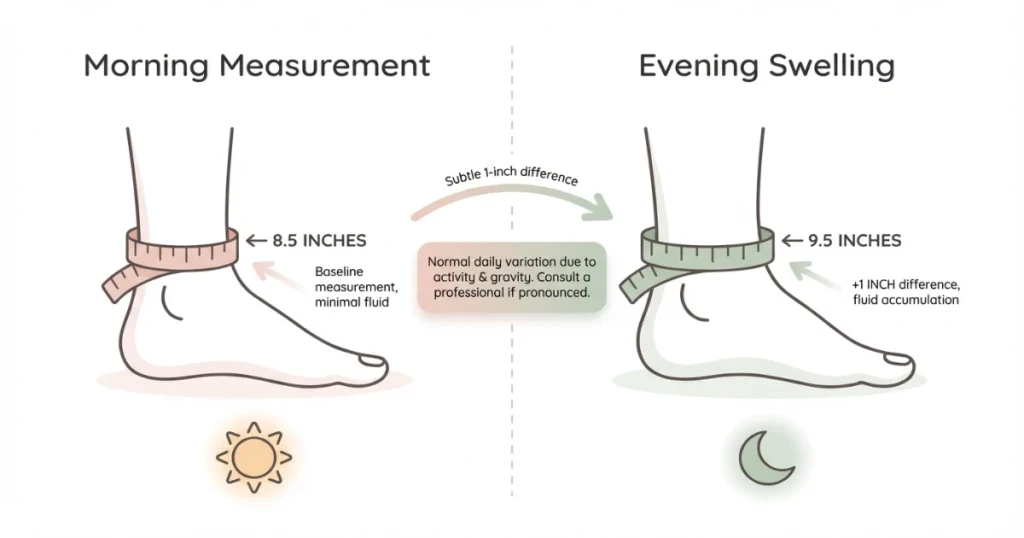
Measure in the morning and again late afternoon for 2–3 days.
If you see a consistent 1-inch+ difference:
- Choose a primary size
- Keep a swelling-day sister size
This is extremely common in perimenopause.
Understanding Your Results: Sister Sizes Are Essential Now
Sister sizes keep cup volume the same while changing band tension.
Example:
- 36DD = same cup volume as 34E (tighter band)
- 36DD = same cup volume as 38D (looser band)
Use sister sizes when:
- Band digs but cups feel right
- Band rides up
- You fluctuate between comfort levels
Explore sister sizes if your band feels tight:
👉 https://bra-calculator.com/sister-sizes/
Cup Letters After DD (Why It Gets Confusing)
US and UK systems differ.
US progression:
DD → DDD/G → H
UK progression:
DD → E → F → FF → G
If you’re shopping internationally, use the Global Converter here:
👉 https://bra-calculator.com/global-bra-size-converter/
Menopause is not the time to guess sizing differences.
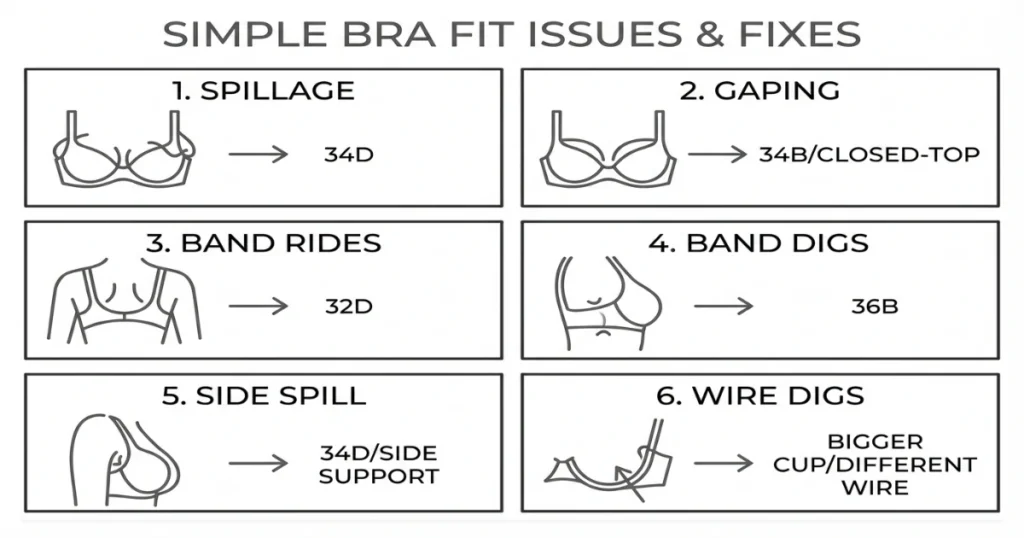
Most Common Menopause Bra Problems (And What They Actually Mean)
Common Sizing Mistakes During Menopause
• Wearing the same band size for years without remeasuring
• Ignoring daily swelling fluctuations
• Tightening straps instead of fixing band
• Switching to wireless without resizing
Band Riding Up
Almost always too loose.
Go down a band, up a cup (sister size adjustment).
Underwire Hurts by Afternoon
Likely rib tenderness + tissue softening.
Try:
- Wider wires
- Flex-wire styles
- Properly fitted wireless bras
Gaping at Top of Cup
Breast fullness has shifted lower.
Try:
- Slightly smaller cup
- Fuller coverage styles
Straps Digging
Band isn’t carrying weight.
Fix band before adjusting straps.
For deeper troubleshooting, use the bra fit diagnostic here:
👉 https://bra-calculator.com/bra-fit-problems/
When It’s Not Size — It’s Shape
Menopause often shifts women from:
- Even fullness → fuller bottom
- Center fullness → side-set
- Firm tissue → softer tissue
This affects how cups sit, where support is needed, and which styles feel stable. If bras “never” feel right anymore, your shape likely changed.
Identify your current shape here:
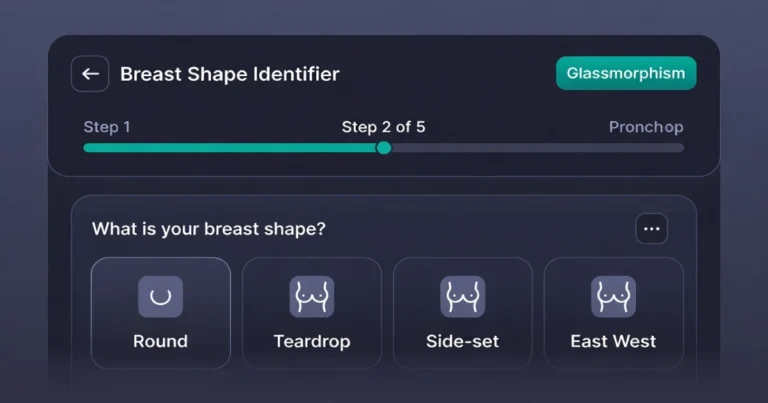
👉 https://bra-calculator.com/breast-shape-identifier/
Then refine results using the AI Smart Fit tool:
👉 https://bra-calculator.com/ai-smart-fit-bra-calculator/
Combining size + shape is what creates real comfort.
What To Look For In A Menopause-Friendly Bra
✔ Wider bands (reduce rib pressure)
✔ Stretch upper cup panels (handle swelling)
✔ Flex-wire or wide channel wires
✔ Breathable lining (hot flash support)
Before choosing a bra, sizing comes first.
But once you know your updated size, comfort construction matters just as much.
Here are menopause-friendly options that align with the fit principles above.
Once you know your updated size, choosing the right construction becomes just as important as choosing the right number.
Best Bras for Menopause Comfort (Editor Picks 2026)
Soft support. Wider bands. Flexible comfort for fluctuating days.

Warner’s Easy Does It Wireless Bra
- Wire-free comfort
- Wide smoothing band
- Ideal for rib tenderness
- Great for swelling days
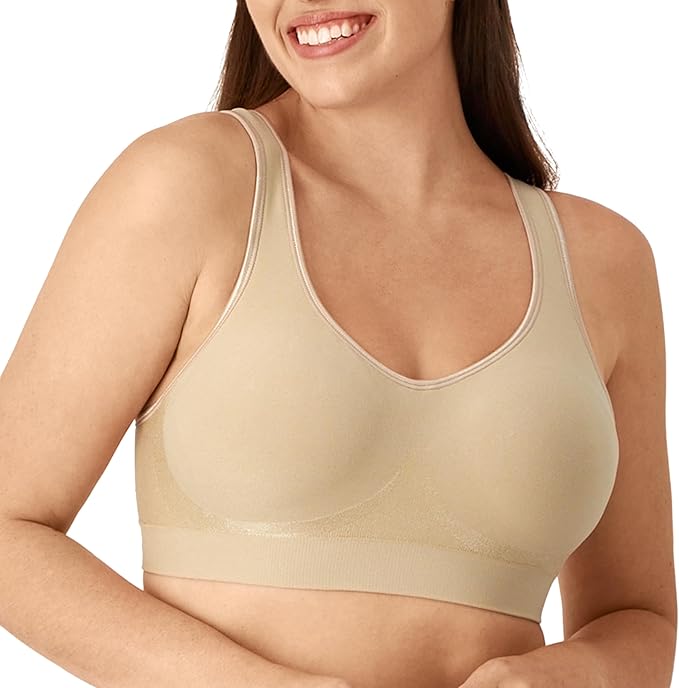
Bali Comfort Revolution Shaping Bra
- Flexible stretch cups
- Moisture-wicking fabric
- Soft no-pinch straps
- Hot-flash friendly material
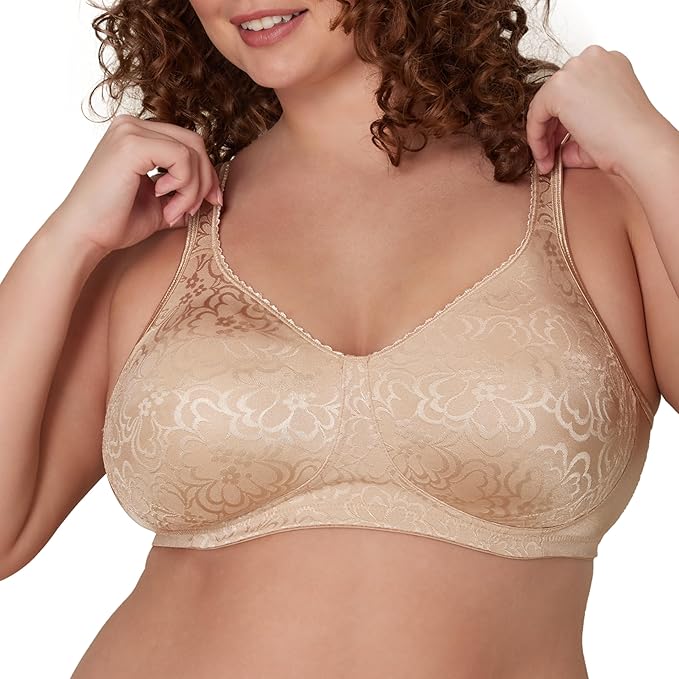
Playtex 18 Hour Ultimate Lift
- Wide cushioned straps
- Full coverage cups
- Excellent side support
- Best for fuller tissue
As an Amazon Associate, we may earn from qualifying purchases at no extra cost to you.
Quick FAQs (Menopause Edition)
Does menopause always change bra size?
Very often — due to softness, redistribution, rib changes, or fluid swings.
How often should I remeasure?
Every 4–6 months during active perimenopause.
Is fluctuation normal?
Completely. Many women rotate between two sister sizes.
Should I switch to wireless permanently?
Not necessarily — but comfort construction matters more now than ever.
Can menopause make you go up a cup size without weight gain?
Yes, due to fat redistribution and tissue softness.
Why do my bras feel fine in the morning but tight at night?
Daily fluid shifts can change measurement by up to 1 inch.
If your size feels wrong more days than right, it’s time to remeasure.
The Real Takeaway
If your bras feel wrong more often than right, the issue isn’t you.
It’s that you’re wearing a size that fit a different version of your body.
Measure for the body you have today.
Start with the Menopause Bra Size Calculator above, then refine using sister sizes and shape tools if needed.
It’s Not You. It’s Biology.
Your body isn’t “changing for the worse.”
It’s redistributing, softening, adapting.
Your bra should adapt too.
Comfort at this stage isn’t optional.
It’s something you deserve.
Last updated March 2026 to reflect current international sizing systems, brand mapping updates, and menopause-specific fit research.