Bra Cup Size Chart A to K: How to Measure Your Cup Size (Inches & CM)
Every cup letter from A to K in inches and centimeters, US vs UK vs EU labels, and why a 30D and a 40D are nowhere near the same size.
Bra cup size = bust measurement minus band (underbust) measurement. Each 1 inch (2.54 cm) of difference moves you up one cup: 1″ = A, 2″ = B, 3″ = C, 4″ = D, 5″ = DD, 6″ = DDD/F, 7″ = G, 8″ = H, 9″ = I, 10″ = J, 11″ = K in US sizing. UK and EU brands label the same measurement with different letters after D. Cup letters are relative — the same letter holds more volume on a bigger band.
Skip the math: the free Bra Size Calculator converts your two measurements into US, UK and EU sizes instantly.
- One inch of bust-to-band difference equals one cup size in US and UK sizing.
- EU and French sizing use centimeters, stepping one cup every 2 cm, so EU letters drift away from US letters after D.
- US and UK letters are identical from A to DD, then split: a US DDD is a UK E; a US K is a UK H.
- A cup letter has no fixed volume — 30D, 34B and 32C all hold roughly the same amount.
- Your measured size is a starting point; gore, wire and band fit confirm it.
How to Measure Your Bra Cup Size at Home
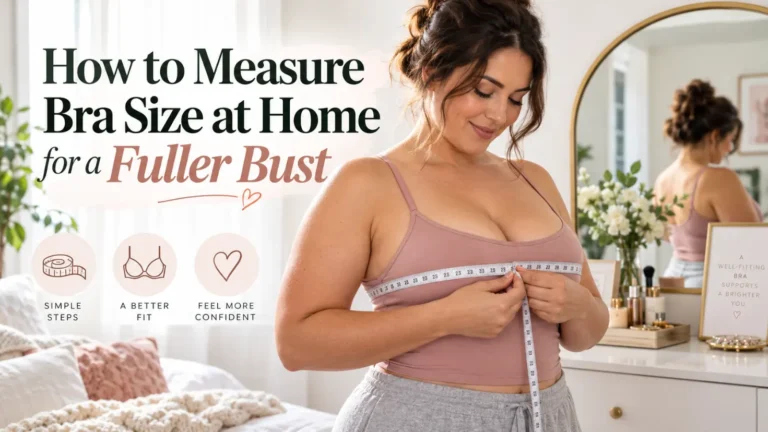
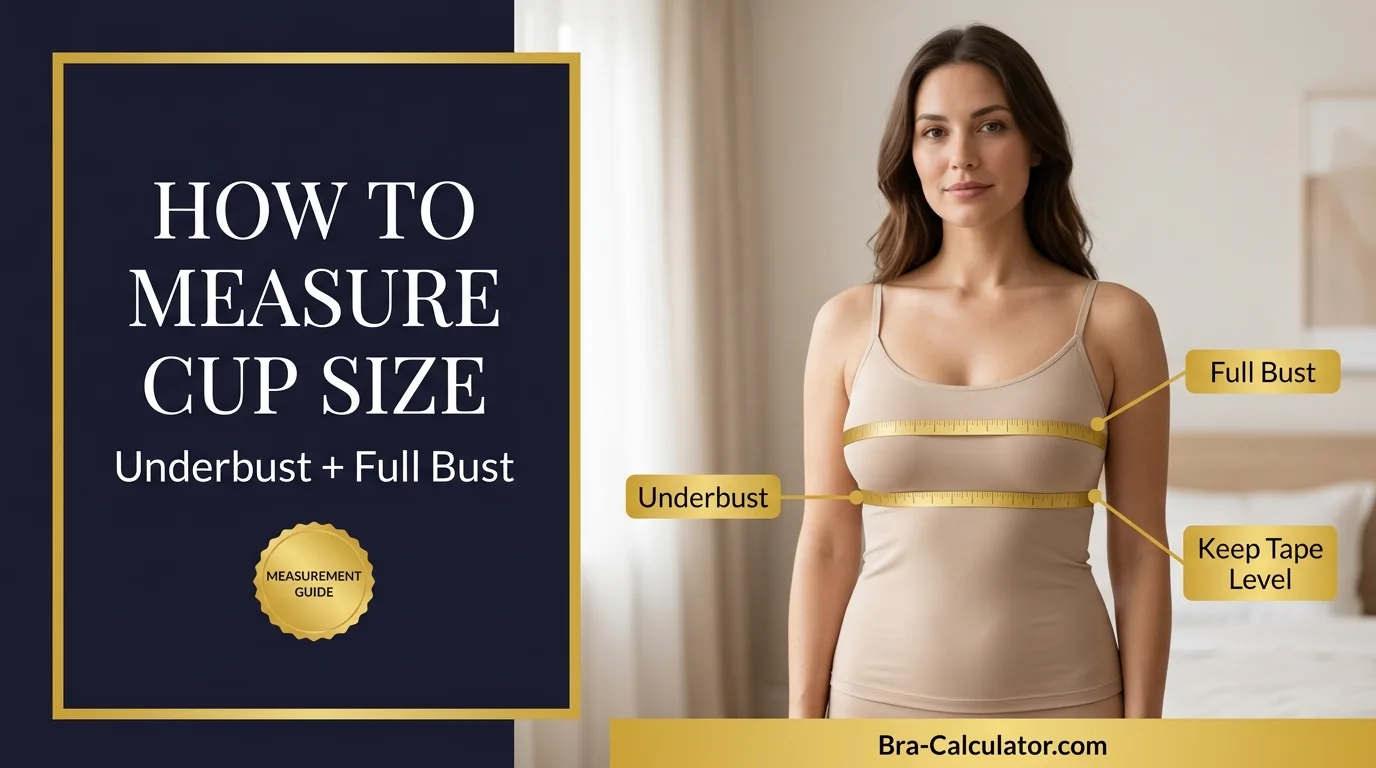
To measure bra cup size, you need two numbers — underbust and full bust — taken with a soft tape while wearing an unpadded bra. The whole process takes about two minutes.
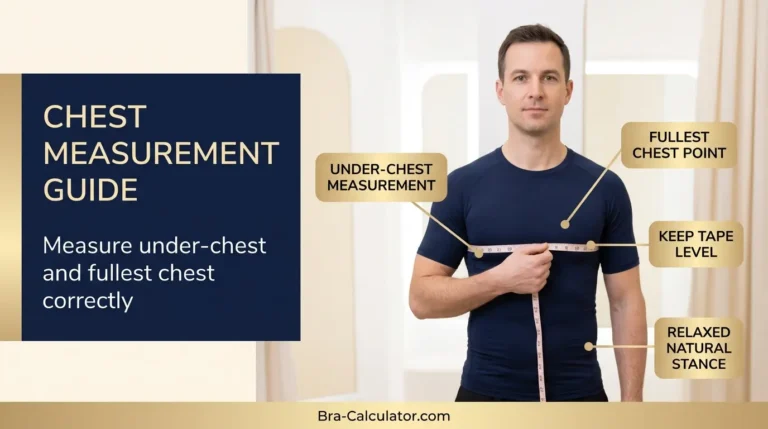
- Measure your underbust (band)Wrap a soft tape snugly around your ribcage directly under your breasts, level and parallel to the floor. Exhale, then read the number. Round to the nearest whole inch.
- Measure your full bustWrap the tape loosely around the fullest part of your bust — usually across the nipples — without compressing tissue. Keep your arms relaxed at your sides.
- Lean-forward check (fuller busts)If you’re likely DD or above, also measure bent forward at 90°. If it’s 1″+ larger than standing, average the two for a more accurate bust number.
- Subtract band from bustBust − band = cup difference. Example: 38″ bust − 34″ band = 4″ = 34D.
- Confirm with a real fit checkTry the size: band level, center gore flat to your sternum, wires surrounding (not sitting on) tissue, no spillage or wrinkling.
Bra Cup Size Chart A to K (Inches)
Match your bust-minus-band difference to the row below. US and UK letters are identical up to DD, then diverge — which is why a “G cup” means something different on a US and a UK label.
1 inch = 1 cup size · 38″ − 34″ = 4″ = 34D
| Difference | US Cup | UK Cup | Example (34 band) | Bust at 34 band |
|---|---|---|---|---|
| < 1″ | AA | AA | 34AA | ~34.5″ |
| 1″ | A | A | 34A | 35″ |
| 2″ | B | B | 34B | 36″ |
| 3″ | C | C | 34C | 37″ |
| 4″ | D | D | 34D | 38″ |
| 5″ | DD (E) | DD | 34DD | 39″ |
| 6″ | DDD / F | E | 34DDD / UK 34E | 40″ |
| 7″ | G | F | US 34G / UK 34F | 41″ |
| 8″ | H | FF | US 34H / UK 34FF | 42″ |
| 9″ | I | G | US 34I / UK 34G | 43″ |
| 10″ | J | GG | US 34J / UK 34GG | 44″ |
| 11″ | K | H | US 34K / UK 34H | 45″ |
US lettering past DDD varies by brand (some skip F, some use DDDD). When a label and your measurement disagree, trust the brand’s own chart.
Bra Cup Size Chart in CM (EU, FR, Japan)
EU sizing measures in centimeters and moves up one cup every 2 cm of bust-to-underbust difference — smaller steps than the 2.54 cm inch system. That’s why an EU F is not a US F.
| Difference (cm) | EU / FR Cup | Nearest US | Nearest UK |
|---|---|---|---|
| 12–14 cm | A | A | A |
| 14–16 cm | B | B | B |
| 16–18 cm | C | C | C |
| 18–20 cm | D | D | D |
| 20–22 cm | E | DD | DD |
| 22–24 cm | F | DDD | E |
| 24–26 cm | G | G | F |
| 26–28 cm | H | H | FF |
| 28–30 cm | I | I | G |
| 30–32 cm | J | J | GG |
| 32–34 cm | K | K | H |
EU bands are also in cm (75 ≈ US 34, 80 ≈ 36). Japan follows the same cm cup progression, but its A starts around 10 cm. Convert any size across systems with the Global Bra Size Converter.
Is a D Cup Big? Why Cup Letters Are Relative
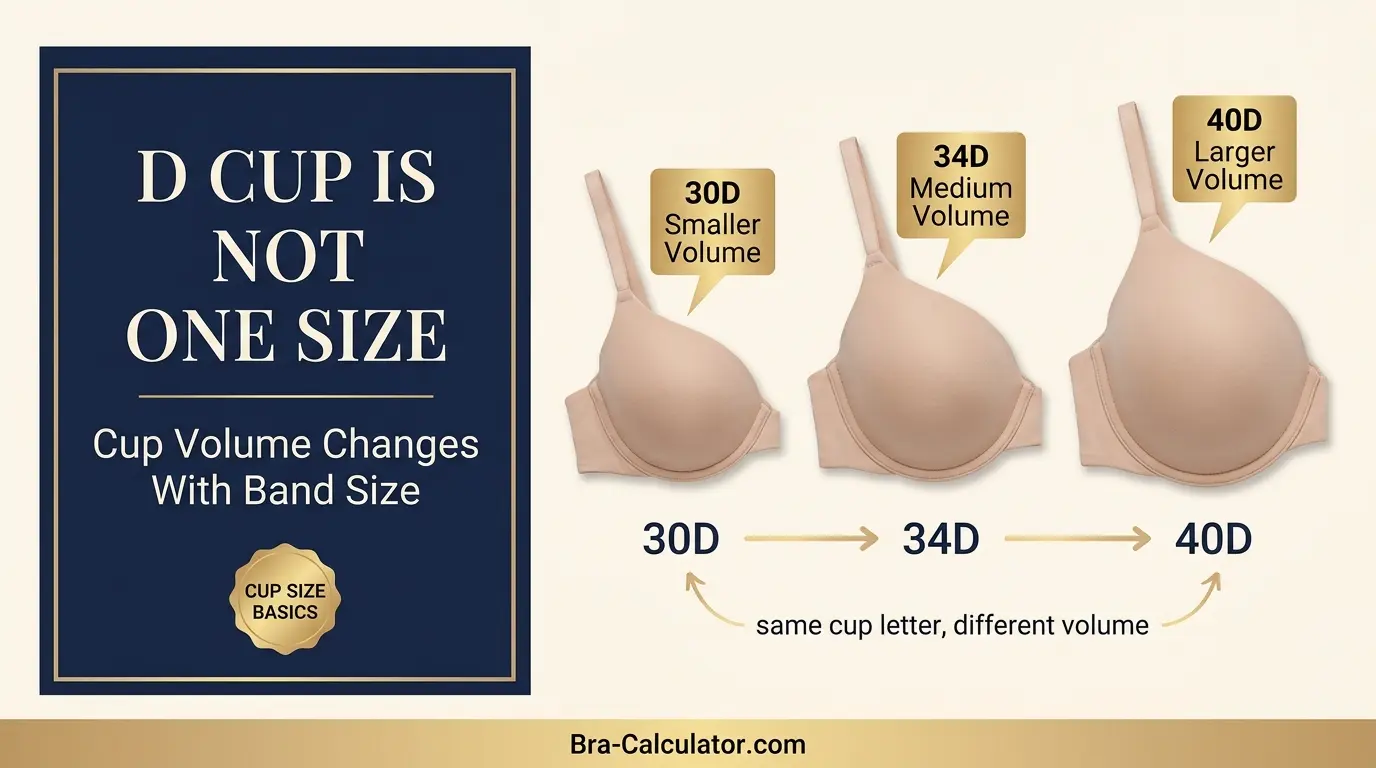
A D cup is not automatically big. A cup letter only describes the difference between bust and band, so the actual volume grows with the band. A 30D holds about the same volume as a 34B; a 40D holds about the same as a 34G (US).
| Size | Same volume as (US) | What that means |
|---|---|---|
| 30D | 32C · 34B · 36A | A “D” that holds B-on-34 volume |
| 34D | 32DD · 36C · 38B | The size most people picture as “D” |
| 40D | 38DD · 36DDD · 34G | Roughly three cups more volume than 34D |
| 32K | 34J · 36I · 38H | K on a small band = H-level volume on a 38 |
What Is a K Cup? I, J & K Cups Explained
A K cup is an 11-inch (about 28 cm) difference between bust and band in US sizing. On a 34 band, that’s a roughly 45-inch (114 cm) bust; on a 40 band, roughly 51 inches (130 cm). In UK sizing the same measurement is labeled H — a UK K cup is about 14 inches of difference.
| Cup | US difference | UK label for same size | Bust on 34 band | Bust on 40 band |
|---|---|---|---|---|
| I (US) | 9″ / 23 cm | G | 43″ / 109 cm | 49″ / 124 cm |
| J (US) | 10″ / 25 cm | GG | 44″ / 112 cm | 50″ / 127 cm |
| K (US) | 11″ / 28 cm | H | 45″ / 114 cm | 51″ / 130 cm |
| K (UK) | 14″ / 36 cm | K | 48″ / 122 cm | 54″ / 137 cm |
From about US G upward, full-bust specialists (Panache, Elomi, Freya, Curvy Kate, Bravissimo) build cups with different wire widths and deeper projection rather than scaling up a smaller cup. Most of them use UK lettering — so a US K shopper usually buys a UK H.
9″ difference
US-only letter. UK brands skip I entirely (G → GG → H), a common source of confusion.
10″ difference
Equals UK GG. At this range, wire width and band firmness matter more than the letter.
L, M, N, O
UK specialist brands extend to O cup. There’s no universal standard past K — always use the brand chart.
US vs UK vs EU Cup Size Labels
| System | Band unit | Cup sequence after D | Watch out for |
|---|---|---|---|
| US | Inches (32, 34, 36) | DD, DDD/F, G, H, I, J, K | Inconsistent letters after DDD |
| UK | Inches (32, 34, 36) | DD, E, F, FF, G, GG, H, HH, J, JJ, K | Doubled letters; no I |
| EU | cm (70, 75, 80) | E, F, G, H, I, J, K | 2 cm cup steps |
| FR / ES | EU band + 15 (85, 90, 95) | Same as EU | Band number looks 15 higher |
| AU / NZ | Dress-size style (10, 12, 14) | UK-style letters | AU 12 ≈ US 34 |
Sister Sizes: Same Cup Volume, Different Band
A sister size keeps the same cup volume while changing the band: go down one band and up one cup for a firmer band, or up one band and down one cup for a looser one.
US labels · UK equivalents: 32E = 34DD = 36D
| Your size (US) | Sister down (tighter band) | Sister up (looser band) |
|---|---|---|
| 32C | 30D | 34B |
| 34B | 32C | 36A |
| 34C | 32D | 36B |
| 34D | 32DD | 36C |
| 36D | 34DD | 38C |
| 36DD | 34DDD | 38D |
| 38DDD | 36G | 40DD |
Sister sizing fixes band tension, not cup shape. If cups gape or overflow in every sister size, change the cup style. Find every option with the Sister Size Calculator.
How to Tell If Your Cup Size Is Right
Your cup size is right when the wire sits behind all breast tissue, the center gore lies flat on your sternum, and the cup edge meets your skin without cutting in or gaping.
| Sign | Likely cause | Fix |
|---|---|---|
| Spills over top or sides | Cup too small or too shallow | Go up one cup, or a deeper/full-coverage style |
| Cup wrinkles or caves in | Cup too big or too tall | Go down one cup, or a demi/plunge style |
| Center gore floats | Cup too small or wire too wide | Go up one cup; try narrower wires |
| Wire sits on breast tissue | Cup too small or wire too narrow | Go up one cup; try wider wires |
| Top-edge gap only | Shape mismatch, not size | Balconette or stretch-lace upper cup |
Diagnose anything else with the Bra Fit Problem Solver.
6 Mistakes That Give You the Wrong Cup Size
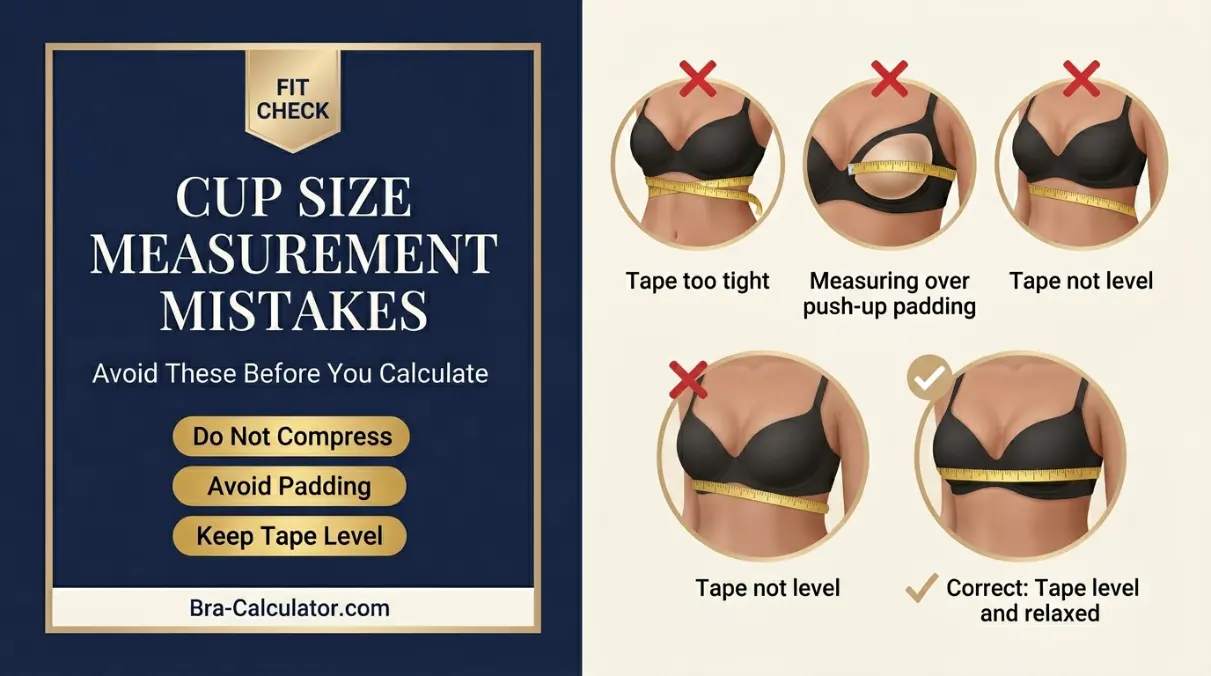
Tape too tight on bust
Compressing tissue shrinks the bust number and underestimates your cup by one or more sizes.
Measuring in a padded bra
Push-up padding adds inches that aren’t you.
Adding 4″ to the band
The outdated method gives a loose band and too-small cups.
Mixing US and UK letters
A UK G is a US I. Buying across systems without converting is the #1 large-cup error.
Tape not level
A tape riding up at the back adds 1–2 inches.
Never remeasuring
Weight, hormones, pregnancy and age shift cup size — recheck every 6–12 months.
Cup Size vs Breast Shape
Cup size measures volume; breast shape decides which cup construction holds that volume well. Two people measuring 34DD can need completely different bras.
| Shape | Common issue | Best styles |
|---|---|---|
| Full on top | Top edge cuts in | Balconette, stretch lace |
| Full on bottom | Upper cup gapes | Plunge, demi |
| Shallow | Deep cups wrinkle | Shallow molded, demi |
| Projected | Gore floats | Seamed, deeper cups, narrow wires |
| East-west | Tissue falls outward | Side-support panels |
Match styles to your shape in Best Bra Types for Every Breast Shape, or see real examples on the Cup Size Visuals page.
What You Need to Measure & Test Your Cup Size
As an Amazon Associate we earn from qualifying purchases, at no extra cost to you.

Soft Body Measuring Tape
- Wraps curves without distorting the reading.
- Inches and cm on one tape — read US and EU sizes directly.

Everyday T-Shirt Bra
- Smooth molded cups show gaping or spillage instantly.
- Best first test of a newly calculated size.

Full-Coverage Support Bra
- Deeper cups confirm whether tissue is fully contained.
- Firmer band built for fuller busts.
Related Bra Size Tools & Guides
| Tool / Guide | Use it to |
|---|---|
| Bra Size Calculator | Get band + cup in US, UK and EU from two measurements |
| Global Bra Size Converter | Convert any size between US, UK, EU, FR, AU and Japan |
| Sister Size Calculator | Find same-volume sizes when the band feels wrong |
| Cup Size Visuals | See what each cup size looks like with examples |
| How to Measure Bra Size | Full band and bust measuring walkthrough |
| How to Know If a Bra Fits | Confirm your size in real life |
Bra Cup Size FAQs
How do I measure my bra cup size?
Measure snugly around your ribcage under your bust for the band, then loosely around the fullest part of your bust. Subtract the band from the bust. Each inch of difference is one cup: 1″ = A, 2″ = B, 3″ = C, 4″ = D, 5″ = DD.
What cup size is a 4 inch difference?
A 4-inch difference between bust and band is a D cup in both US and UK sizing. For example, a 38-inch bust on a 34-inch band is a 34D.
What does K cup size mean?
In US sizing, a K cup means an 11-inch (about 28 cm) difference between bust and band — a roughly 45-inch bust on a 34 band. The same measurement is labeled H in UK sizing. A UK K cup is about a 14-inch difference.
How big is a K cup in inches and cm?
It depends on the band. A US 34K is about a 45-inch (114 cm) bust; a US 40K is about 51 inches (130 cm). The cup difference stays 11 inches (28 cm), but total volume rises with band size.
Is a D cup big?
Not necessarily. A D cup is only a 4-inch bust-to-band difference, so its volume depends on the band. A 30D holds about the same as a 34B, while a 40D holds about the same as a US 34G.
What comes after DD in bra sizes?
In US sizing, DD is followed by DDD (or F), then G, H, I, J and K. In UK sizing, DD is followed by E, F, FF, G, GG, H, HH, J, JJ and K. EU sizing uses single letters: E, F, G, H.
Is a UK cup size the same as a US cup size?
Only from A to DD. After DD they split: US DDD equals UK E, US G equals UK F, US I equals UK G, and US K equals UK H. Always check which system a brand uses before ordering.
What is DD in EU sizing?
A US or UK DD cup is an E cup in EU sizing. EU sizing measures in centimeters and steps one cup every 2 cm, so EU letters run ahead of US/UK letters after D.
What are sister sizes?
Sister sizes hold the same cup volume on a different band. Go down a band and up a cup for a firmer fit, or up a band and down a cup for a looser fit. 34DD, 32DDD and 36D are sister sizes (US).
Should I measure with or without a bra?
Measure in a non-padded, well-fitting bra or none at all. Padded and push-up bras add inches to the bust measurement and push your calculated cup size too high.
Why does my calculated cup size feel wrong?
The most common causes are a band measured too loosely, mixing US and UK letters, or a cup shape that doesn’t match your breast shape. Try one sister size and one different cup style before changing size.
How often should I remeasure my cup size?
Every 6–12 months, and after weight change, pregnancy, breastfeeding, or starting hormonal medication — all of which can change cup size by one or more letters.
Get Your Exact Cup Size in 60 Seconds
Enter two measurements and get your size in US, UK and EU — plus your sister sizes — instantly.