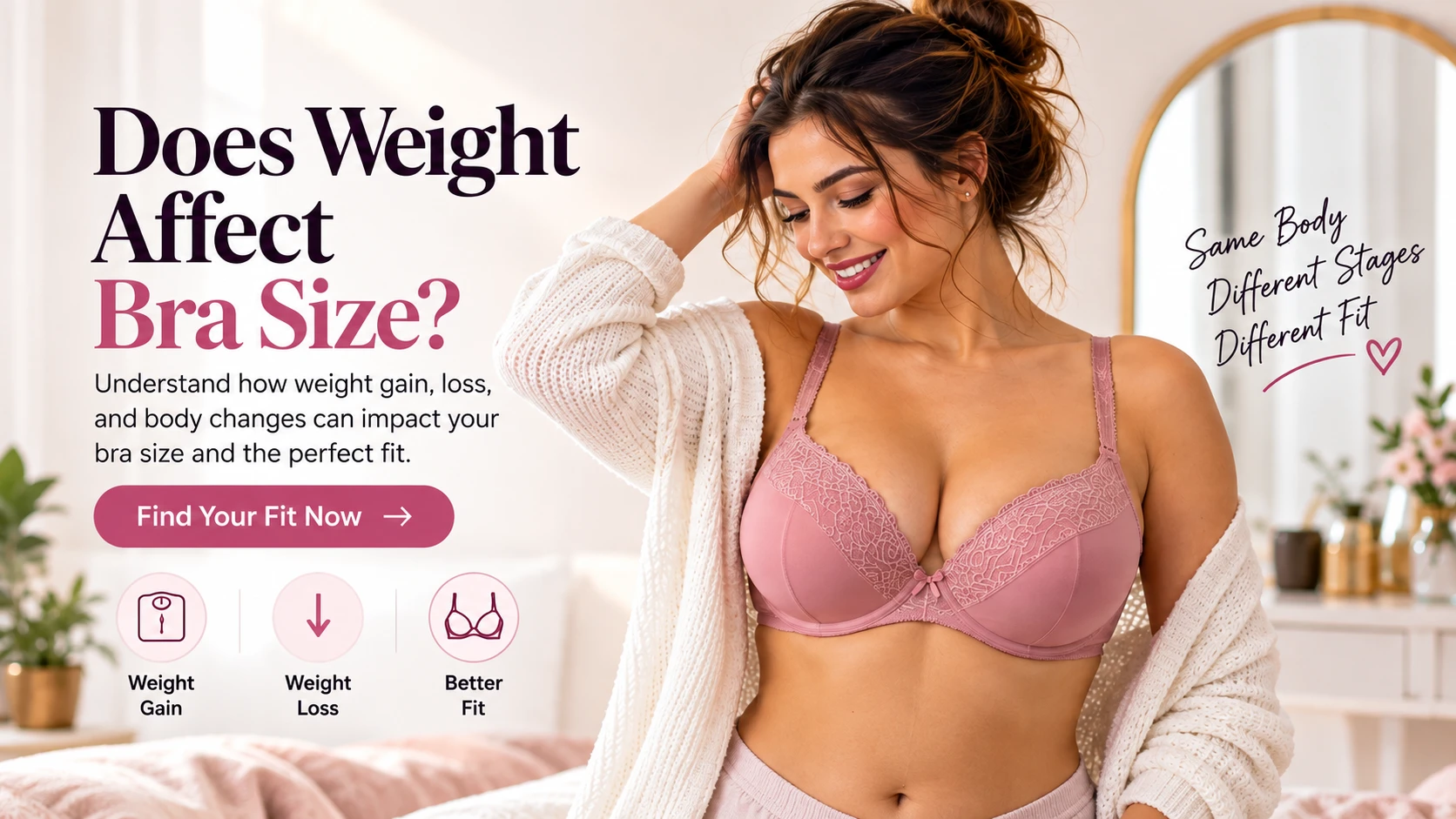
Does Weight Affect Bra Size?
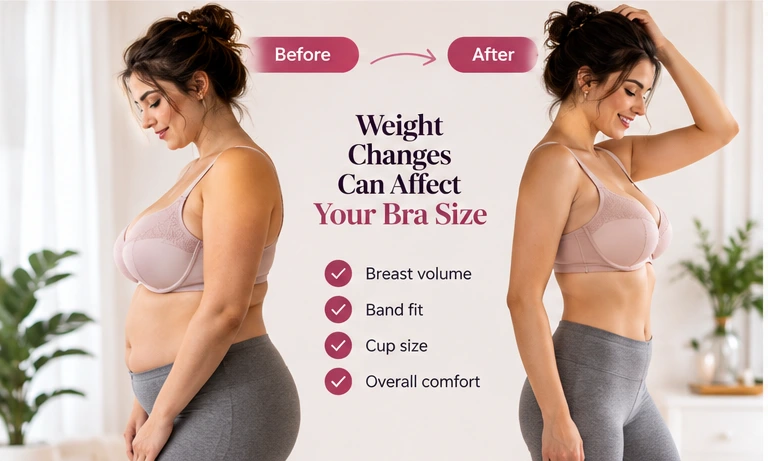
Weight gain or loss can change your ribcage measurement, your breast volume, or both. Find out which one moved, then refit with the right band and sister size instead of guessing from the scale.
- 1RemeasureUnderbust and bust, same method as before.
- 2CompareBand moved, cup moved, or both?
- 3RefitMove to the right band and sister size.

Quick answer: weight can change your bra size, but the scale cannot tell you which size you need.
Your band changes when your underbust measurement changes. Your cup volume changes only when breast volume changes. Because a cup letter is relative to its band, moving from a 34 band to a 36 band may call for a smaller cup letter to keep similar cup volume. The reliable route is to remeasure, then confirm the result by fit.
Before & After Bra Size Comparison Tool
Have your earlier measurements? Enter them next to your current ones. The tool gives a starting size for each set and shows whether the band, the cup step, or both changed.
Compare your before and after measurements
Use inches. Measure the underbust snugly and the bust around the fullest part without squeezing.
Before
Now
Treat the result as a fitting starting point, not a guarantee. Brand patterns, cup depth, wire width and breast shape all change how a nominal size fits. For a full calculation with more fit detail, use the Bra-Calculator.com bra size calculator.
How Weight Changes Your Band and Cup
A bra size is not one measurement. It is a relationship between the circumference under your bust and the volume the cups need to hold. That is why weight changes can make a once-reliable bra feel wrong in several different ways, even when the number on the scale moved by the same amount as someone else’s.
The band number is tied to the torso. If your underbust gets larger or smaller, the old band may dig in, ride up, or stop anchoring the bra. The cup letter is not a fixed volume: a C cup on a 32 band is smaller than a C cup on a 38 band. So when the band moves, the cup letter may need to move too, even when breast volume feels similar.
| What changed | Likely band effect | Possible cup effect | What you may notice |
|---|---|---|---|
| Weight gain around the torso | Band may increase | May stay similar in volume | Band feels tight; side and back tissue is compressed |
| Weight gain including the breasts | Band may increase | Cup volume may increase too | Spillage plus a tight band |
| Weight loss around the torso | Band may decrease | May stay similar in volume | Band rides up; straps work too hard |
| Weight loss including the breasts | Band may decrease | Cup volume may decrease | Loose band plus wrinkling or gaping cups |
| Short-term swelling | Usually temporary | Temporary fullness possible | Fit varies day to day instead of staying changed |
Important fit principleThe band is the anchor of the bra. If it stops sitting level and snug around the torso, cup and strap problems can appear even when the cup was never the original problem.
Is It a Band Problem or a Cup Problem?
Match what you feel to the most likely cause before you change anything. Fixing the wrong part is the most common and most expensive refitting mistake.
| What you notice | Most likely culprit | First thing to try |
|---|---|---|
| Band rides up the back | Band too big, or too loose after stretch | Go down a band, up a cup for similar volume |
| Band digs in or leaves painful marks | Band too small | Go up a band, down a cup for similar volume |
| Spillage over the top or sides | Cup too small, or band too small pushing tissue up | Check the band first, then cup volume |
| Wrinkling or empty space in the cup | Cup too large, or wrong cup shape | Try a smaller cup or a different cut |
| Straps dig or slide | Band is not anchoring the bra | Fix the band so straps stop carrying the load |
| Wires sit on tissue or float off the chest | Cup or wire width mismatch | Test sister sizes and another wire width |
What Usually Happens to Bra Size After Weight Gain?
Weight gain often shows up in the band first: the elastic feels less forgiving, the wires press more firmly into the ribs or sides, or a band that used to feel secure becomes uncomfortable even on the loosest hook. That does not automatically mean you need the same cup letter on a larger band.
Band increased, cup volume feels right
- Move up one band step.
- Move down one cup step to preserve similar volume.
- Example: 34C → 36B.
- Then check the wire still encloses all breast tissue.
Band and breast volume increased
- Move up the band first.
- Then assess cup containment and wire position.
- A 34C may become 36C, 36D or something else.
- Do not guess from body weight alone.
Do not “fix” a tight band with a bigger cup aloneIf the band itself is too small, increasing only the cup leaves the anchor too tight while adding unnecessary cup space. Separate the band problem from the cup problem.
What Usually Happens to Bra Size After Weight Loss?
After weight loss, a reliable bra may start moving around. The back can ride upward, you tighten the band farther than before, and straps begin slipping because the band no longer does its share of the support. Cup shape can change even when measured volume changes only a little.
Band decreased, cup volume feels right
- Move down one band step.
- Move up one cup step for similar cup volume.
- Example: 36B → 34C.
- Check wire width and cup depth, not only the letter.
Band and breast volume decreased
- Remeasure both underbust and bust.
- A smaller band may pair with the same or a smaller cup letter.
- Look for smooth cups with no empty space.
- Prioritize fit over returning to a familiar old size.
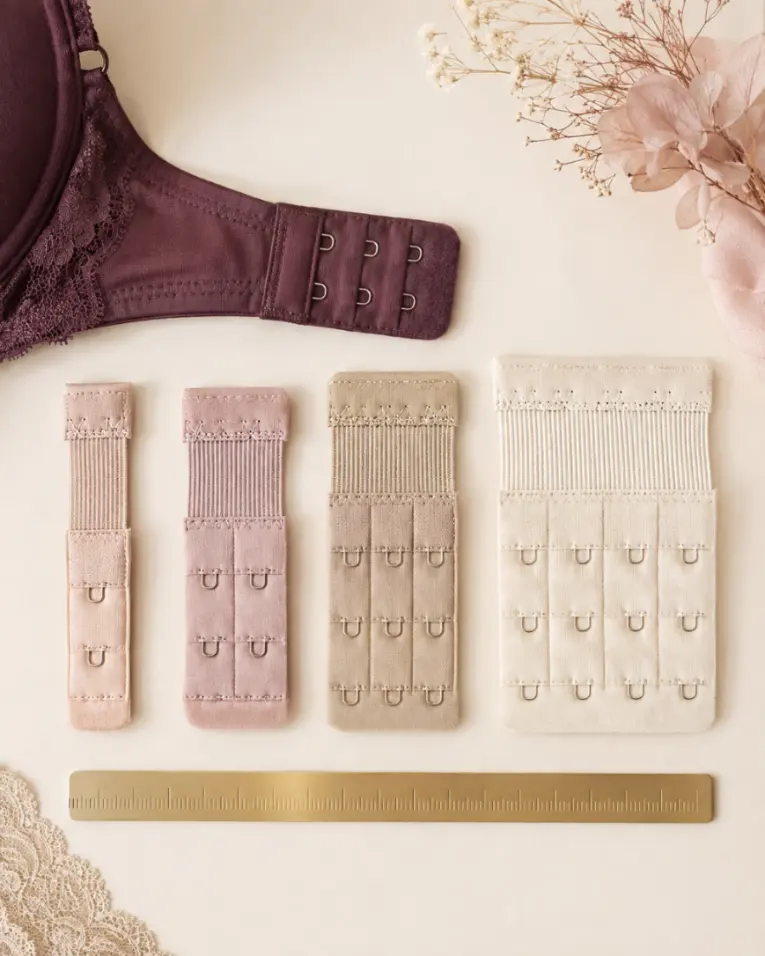
New-bra hook ruleA new bra should normally feel secure on its loosest hook, so you can move inward as the elastic relaxes with wear. If a brand-new bra needs the tightest hook immediately, test a smaller band or another style.
Worked Examples: What the Measurements Actually Say
These use the same rounding as the tool above: underbust rounded to an even band, cup step from the bust minus band difference.
Underbust 33″ to 35″, bust 37″ to 39″
Both measurements rose two inches. The band went up a size and the cup letter stayed C, but a 36C holds more volume than a 34C. That points to gain in the bust as well as the ribcage, so a sister size alone would not be enough.
Underbust 36″ to 34″, bust 40″ to 37″
The band dropped two sizes and the cup letter dropped one. The sister size of a 36D is 34DD, so landing on 34C means cup volume reduced as well, not just the ribcage.
Why Two People Can Change the Same Weight and Need Different Bra Sizes
There is no dependable formula such as “X pounds equals one cup size.” Breasts contain varying proportions of fatty and glandular tissue, and bodies store and lose fat in different patterns. A weight change can alter one person’s band far more than their cups, while another person notices the opposite.
- Breast composition: changes in fatty tissue can alter breast volume, but the degree varies.
- Weight distribution: some bodies change more through the torso, hips or abdomen than the bust.
- Frame: the same circumference change feels very different on a smaller or larger ribcage.
- Breast shape: softer tissue may fit better in a different cup cut after weight loss even if the calculated size looks familiar.
- Hormonal stage and age: these can change fullness, tissue distribution and elasticity independently of weight.
That is why a fresh measurement and a fit test are more useful than trying to predict bra size from the number on the scale.
How to Re-Measure Your Bra Size After Weight Changes
Use a soft tape and measure on bare skin or in a thin, unpadded bra. Keep the tape parallel to the floor and avoid pulling the bust measurement tight.
- Measure a snug underbust. Place the tape directly under the bust, exhale normally, and keep it level around the back.
- Measure the fullest bust. The tape should touch the body without compressing breast tissue.
- Compare with your old measurements. A changed underbust points to a band shift; a changed bust-to-underbust difference points to a cup-volume shift.
- Calculate a starting size. Use the main bra size calculator rather than relying on an old bra label.
- Confirm by fit. Check band level, cup containment, center gore, wire placement and straps before keeping the bra.
For better comparisonsIf you are tracking changes over time, measure under similar conditions: same tape position, similar time of day, same method. Consistency matters more than chasing a perfect quarter inch.
Sister Sizes When Your Band Changes but Cup Volume Still Works
Sister sizing is most useful when the cups of your current bra feel right but the band no longer does. Moving down a band usually means moving up a cup step; moving up a band usually means moving down a cup step.
| Current size | Smaller band, similar cup volume | Larger band, similar cup volume |
|---|---|---|
| 32B | 30C | 34A |
| 32C | 30D | 34B |
| 34B | 32C | 36A |
| 34C | 32D | 36B |
| 34D | 32DD | 36C |
| 36C | 34D | 38B |
| 36D | 34DD | 38C |
| 38C | 36D | 40B |
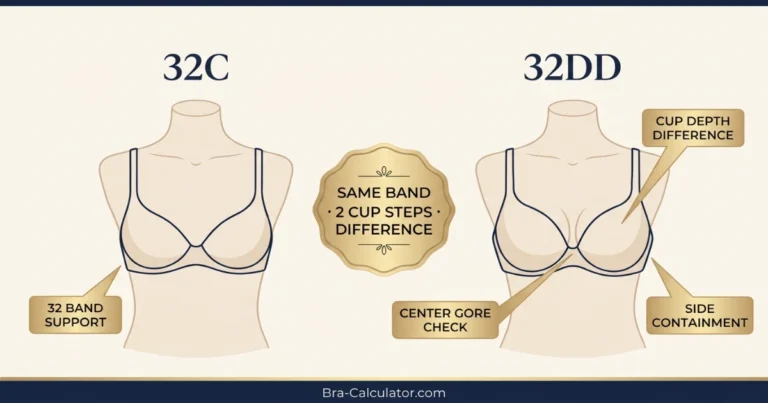
Cup lettering is not fully standardized between brands or countries, especially above D. Use sister sizes as a fitting path, then compare the result with the brand’s own chart. The sister size bra calculator and the global bra size converter help when a label uses a different system. For a hands-on comparison, see 32C vs 32DD.
Signs Your Bra Size May Have Changed
Your current bra may be too small
- Band feels painfully tight on the loosest hook.
- Breast tissue spills over the top or sides.
- Underwire rests on breast tissue.
- Center gore cannot sit against the sternum in a compatible wired style.
- Red marks are deep, painful or persistent.
Your current bra may be too large
- Band rides upward or shifts when you raise your arms.
- A new bra already needs the tightest hook.
- Cups wrinkle or have empty space.
- Straps keep sliding even after adjustment.
- Wires sit too wide or low instead of framing the breast root.
A 60-second fitting check
- Band: level around the torso, comfortably firm, not riding upward.
- Cups: tissue contained without cutting in or obvious empty space.
- Underwire: surrounds breast tissue rather than sitting on it.
- Gore: tacks flat in many wired styles, though anatomy and design can affect this.
- Straps: secure but not carrying most of the support.
Not sure which problem you have? The bra fit quiz finds your fit problem in about 60 seconds. If cups spill even in a correct size, read about double bust and quad boob.
Common Refitting Mistakes After Weight Change
- Buying the old size automatically. Familiarity is not evidence the old size still matches your measurements.
- Changing the cup letter without checking the band. Cup letters only make sense in relation to a band.
- Treating sister sizes as identical bras. Cup volume may be similar, but band tension, wire width and proportions still change.
- Replacing your whole bra drawer mid-transition. If measurements are still moving, a small rotation is more sensible.
- Assuming every fit issue is a size issue. A different cup shape or wire width can fix problems another size cannot.
Pregnancy, Hormones, Training and Other Changes Affect Fit Too
Weight is only one reason a bra can stop fitting. Pregnancy and nursing, menstrual-cycle swelling, menopause, changes in exercise, and natural changes in breast tissue can all alter how a bra sits. If your measurements are moving for more than one reason, refit more often instead of waiting for a yearly check.
Related guides: the senior bra size calculator, the sports bra size calculator, and the plus-size bra calculator.
What to Buy While Your Weight Is Still Changing
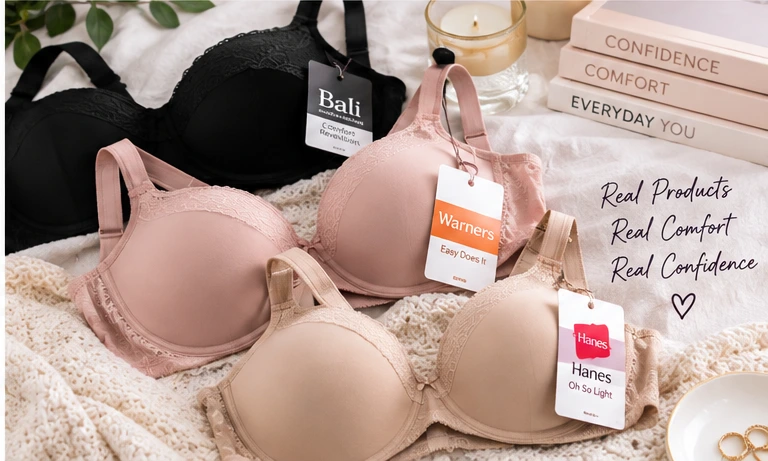
If your measurements are actively changing, prioritize forgiving stretch, adjustable straps and enough closure range to handle small shifts. Buy a small transition rotation, test each bra at home with movement, and save a larger premium wardrobe for when your fit has been stable for a while. Our best comfort bras guide goes deeper on this.
Three practical Amazon options for a changing fit
Established product lines chosen because their stretch, wireless construction or adjustable design can be more forgiving during small fit changes. Always use the brand’s current size chart before ordering.
Warner’s Easy Does It® Underarm Smoothing Wireless Bra
Allover stretch, side-smoothing panels, adjustable straps and Easy Size™ sizing make this a sensible transition option when you want flexibility instead of a rigid cup.
- Wireless
- Seamless stretch
- Adjustable straps
Bali Comfort Revolution® EasyLite Wireless Bra
A lightweight seamless wireless style with stretch fabric and convertible adjustable straps. Useful when you want softness and some forgiveness across modest measurement changes.
- Wireless
- 360° stretch feel
- Convertible straps
Hanes Oh So Light® Wireless T-Shirt Bra
A light wireless T-shirt bra with ComfortFlex Fit® stretch, flexible foam cups, breathable mesh and convertible straps. A lower-cost temporary rotation piece.
- Wireless
- Flexible foam cups
- Breathable mesh
Affiliate disclosure: As an Amazon Associate, Bra-Calculator.com may earn from qualifying purchases. Availability, colors, size ranges and prices can change. Recommendations are based on fit features, not a promise that one style suits every body.
Still unsure whether the band or the cup changed?
Use fresh measurements in the main calculator, then compare one sister size on either side before you buy.
Calculate my bra sizeFrequently Asked Questions
Does weight affect bra size?
Yes. Weight change can alter your underbust measurement, breast volume or both. That can change the band, cup volume and overall fit.
Does losing weight always make your cup size smaller?
No. Your band may get smaller while breast volume changes only a little. In that case you may need a smaller band with a larger cup letter as a sister size.
Does gaining weight always mean going up a cup?
No. If your underbust increases but breast volume stays similar, you may go up a band and down a cup letter. If breast volume increases too, you may need more cup volume as well.
How much weight change causes a bra-size change?
There is no universal number. Bodies distribute weight differently, so fit symptoms and fresh measurements are more useful than a pound threshold.
Should I change my band or my cup first?
Check the band first. If it rides up, digs in or sits on the tightest hook, fix the band, then reassess the cup. Fixing only the cup can leave the real problem in place.
Why is my band loose when the cups still fit?
Your underbust may have decreased or the band may have stretched with wear. Try a smaller band with the corresponding sister-size cup as a starting point.
What is a sister size and how do I use it after a weight change?
A sister size has a different band but similar cup volume, such as 34C, 32D and 36B. When your band changes but the cups still feel right, move the cup letter the opposite way to the band.
Can breast shape change after weight loss even if cup volume is similar?
Yes. Tissue distribution and firmness can change, so a different cup shape may fit better even when the calculated size is close to your previous one.
How often should I remeasure while my weight is changing?
Remeasure when your band position, cup fit or clothing fit changes enough that your bras no longer feel stable. There is no need to measure after every small scale fluctuation.
Should I buy expensive bras before my weight stabilizes?
Usually it is more practical to keep a small, comfortable transition rotation and invest more once your measurements have been stable for a while.
Keep Exploring
About this guide: Prepared for Bra-Calculator.com and reviewed by Amelia, Founder & CEO. It explains bra-fitting principles for educational purposes and is not medical advice. A sudden or unexplained breast change should be discussed with a qualified healthcare professional.