Wrinkled or puckering bra cups almost always mean there is more cup than breast filling it — but the location of the wrinkle tells you whether the problem is cup volume, cup height, cup depth or fabric type. All-over wrinkling with no tissue contact usually means the cup is too large and you need to go down a size. Top-only puckering usually means the cup is too tall for your breast shape, not necessarily too large overall. Wrinkles near the wire may mean the cup lacks depth, not that it is too big. Identify the location first, then apply the right fix.
Wrinkled & Puckering Bra Cups at a Glance
| Wrinkle Sign | What It Usually Means |
|---|---|
| Fabric folds all over the cup; no tissue touching most of it | Cup volume is probably too large — try going down one cup size after scoop-and-swoop. |
| Puckering at the top edge only; lower cup fills smoothly | Cup is too tall or too open for your amount of upper-breast fullness — a shape mismatch, not necessarily a size mismatch. |
| Wrinkles only near the underwire at the bottom | Cup may be insufficiently deep for your breast projection — the issue can be the wrong shape rather than too much size. |
| One cup wrinkles; the other does not | Natural breast asymmetry — the smaller breast is not filling its cup fully. |
| Wrinkles visible from outside through clothing | Moulded foam is holding a shape larger than your breast; try a more conforming fabric or a smaller size. |
| Wrinkles only when sitting or bending forward | Rigid cup construction cannot flex with the body; consider spacer or soft-seamed cups. |
What Does It Mean When Bra Cup Fabric Wrinkles or Puckers?
A well-fitted bra cup sits against the breast in smooth, continuous contact with no loose fabric, folds or visible air pockets. When the cup fabric bunches, puckers, folds inward or collapses in places, this is described as bra cup wrinkling or puckering. It is one of the most visible signals that a bra does not fit correctly — wrinkles often show through clothing and create an uneven silhouette even under a T-shirt.
The instinctive conclusion is that the cup is too big, and often that is exactly right. A cup with more volume than the breast needs will have fabric with nowhere to go — it folds over itself. However, wrinkles are not always a straightforward size problem. A cup can wrinkle at the top while fitting adequately at the base, meaning the cup is the right volume but too tall for the breast shape. A cup can wrinkle at the wire while the upper half is filled, meaning the cup is wide but not deep enough.
Understanding where the wrinkle appears is the single most important step in choosing the correct fix. Going down a cup size when the real problem is cup height or fabric rigidity can result in spillage, underwire pressure and a bra that is uncomfortable in a completely new way.
Key diagnostic rule: Before deciding what the wrinkle means, always put the bra on correctly — lean forward, scoop tissue fully into the cups and check the band is level. Only then note where the wrinkle appears and use that location to guide your fix.
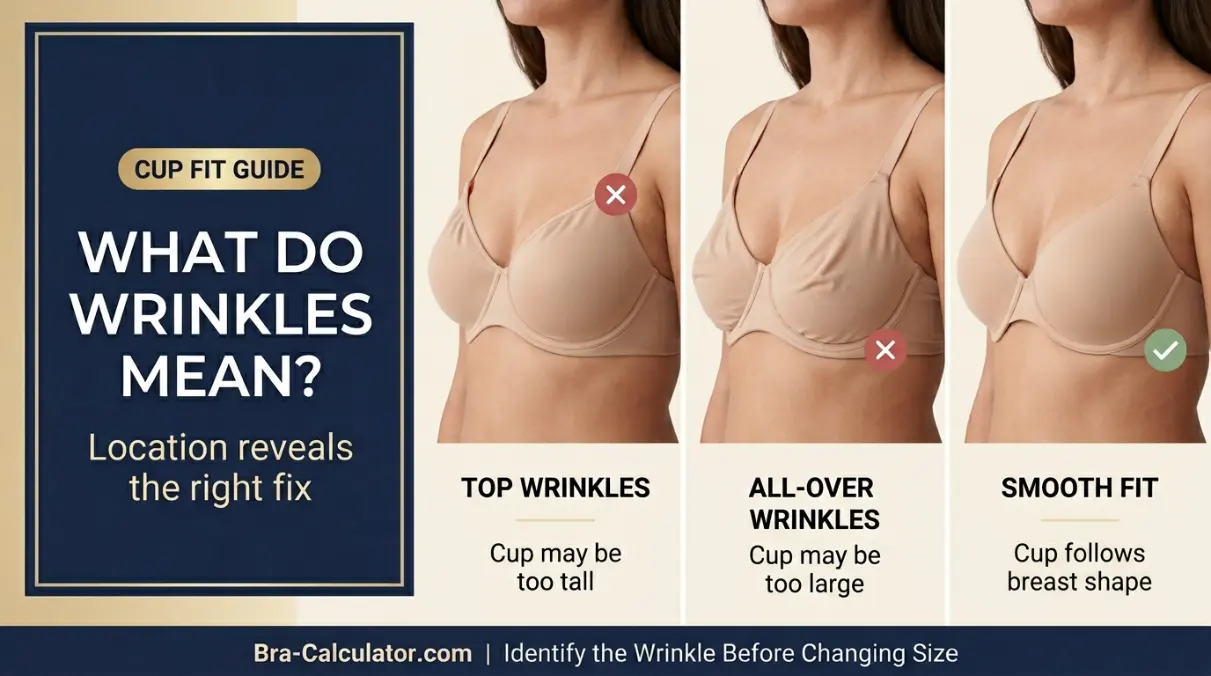
Where Are Your Cups Wrinkling? The Location Changes Everything
The position of the wrinkle or pucker is the fastest diagnostic tool available. Each location points to a different root cause and requires a different correction.
Too Tall or Too Open at the Neckline
The cup neckline sits higher than your breast tissue extends. This is a cup height and shape problem, not always a cup volume problem. Common in full-coverage styles on bodies with less upper fullness or bottom-heavy breast shape.
Cup Volume Is Too Large
Fabric folds broadly with no single filled area. This is the clearest sign that the cup has more volume than the breast occupies, even after correct fitting with scoop-and-swoop and a secured band.
Cup May Lack Depth — Not Necessarily Too Big
When breast tissue fills the upper and central cup but fabric bunches at the very base near the underwire, the cup may be too shallow for the breast’s projection. Tissue sits forward without settling into the cup base.
Natural Breast Asymmetry
Most people have some size difference between their two breasts. If one cup fits while the other wrinkles, you are likely sized to the smaller breast. The fuller side should set the cup size.
Rigid Moulded Cup Cannot Flex
A cup that fits when standing but wrinkles when you sit or bend may simply be a rigid foam mould that does not move with the body. The wrinkle is the cup maintaining its shape while your breast tissue redistributes.
Moulded Foam Holding Its Own Silhouette
From the outside, a moulded cup looks smooth even when the breast inside does not fill it. But under a fitted top, the cup-to-body gap shows as a depression or ripple in the fabric of your clothing.
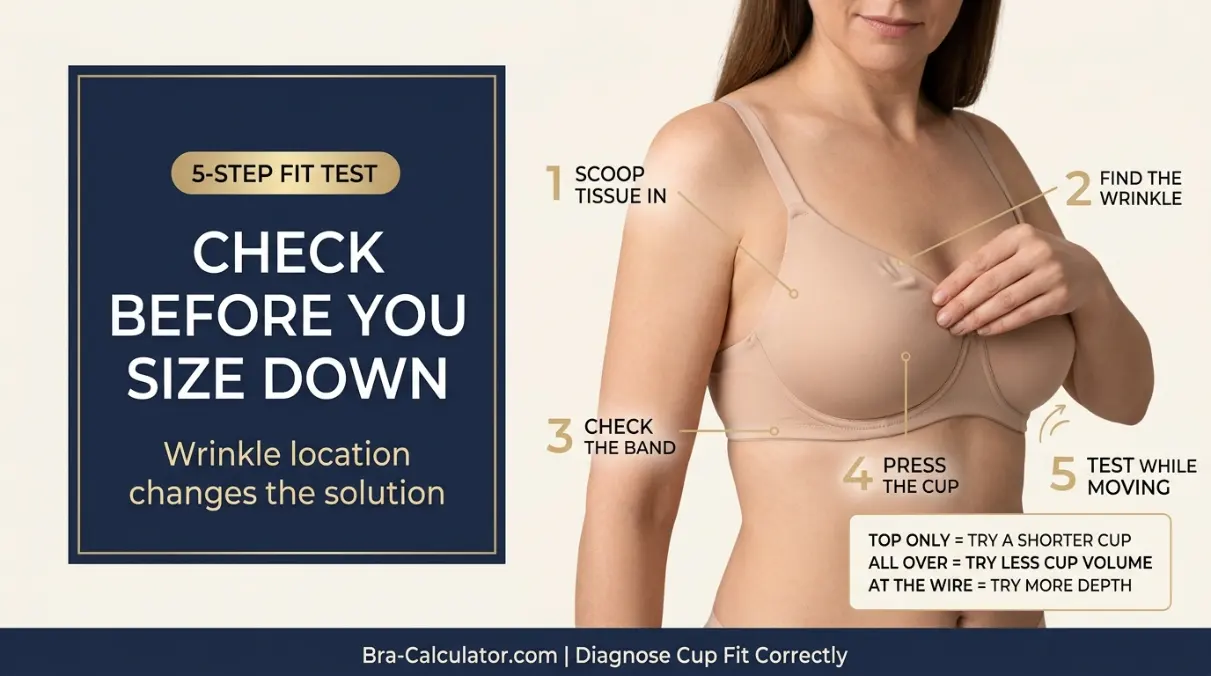
Five Checks Before You Fix Puckering Bra Cups
Work through these in sequence. A single symptom in isolation is less reliable than seeing the full pattern.
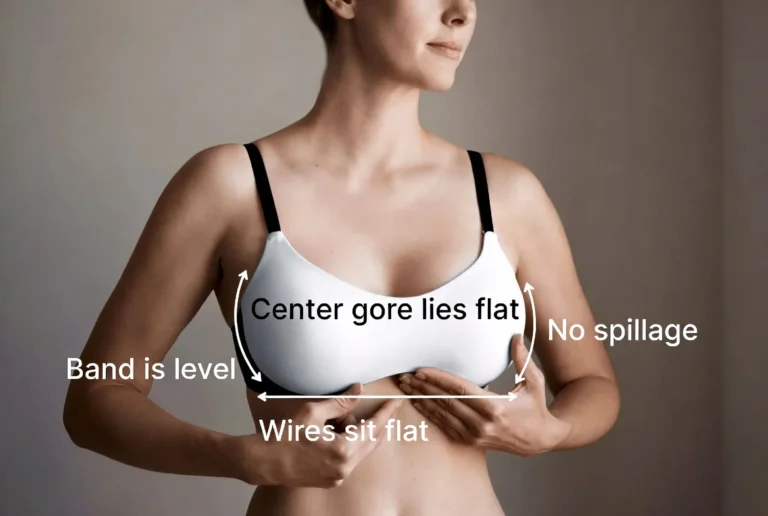
Fasten on the appropriate hook, lean slightly forward and scoop all breast tissue from the sides and underneath into each cup. A surprising amount of apparent wrinkling disappears once tissue is correctly positioned inside the cup.
Use the location guide above: top of the cup, all over, near the wire, one side only, or only during movement. Write it down if necessary — this determines which fix you apply, not the overall size difference.
The band should be level and secure on the loosest hook. A band that rises at the back can tilt the cups forward, creating false wrinkling along the upper cup edge that corrects itself once the band is properly anchored.
With the bra on, press the cup fabric lightly toward the breast. If the cup immediately touches tissue and the wrinkle was just surface folding, the cup is close in size. If the cup collapses inward a significant distance before touching tissue, it is too large.
Moulded cups hide fit problems by holding their own shape. If you are unsure whether the cup is too large or just the wrong shape for your silhouette, a seamed unlined bra in the same size will show the actual fit far more clearly because the fabric follows the breast rather than holding a preset form.
| Test Result | Likely Cause | Best First Fix |
|---|---|---|
| Wrinkles everywhere; cup collapses significantly when pressed | Cup volume too large | Go down one cup size, keep same band. |
| Top wrinkles; bottom cup is smooth and filled | Cup too tall — shape mismatch | Try a demi or shorter neckline in the same cup size. |
| Wrinkles at the wire; upper cup fills well | Cup lacks depth for your projection | Test a more projected or seamed cup in the same size. |
| Only one cup wrinkles | Breast asymmetry | Size to the fuller breast; adjust the smaller side separately. |
| Band rises; cups wrinkle as a result | Band stability issue | Fix the band first; reassess cup after band is anchored. |
Why Your Bra Cup Is Not Smooth
1. The Cup Is Genuinely Too Large
When the cup offers more volume than the breast occupies, surplus fabric has nowhere to go and folds over itself. This is the most common cause of all-over wrinkling and is straightforward to fix.
2. The Cup Is Too Tall for Your Breast Shape
Bras with a high, straight-across neckline are designed for breasts with more upper fullness. When the breast is fuller at the base or bottom-heavy, that tall neckline stands away and puckers even when the overall cup volume is not dramatically large.
3. Moulded Foam Holds Its Own Shape Instead of Yours
Rigid foam-moulded cups maintain a fixed silhouette regardless of what the breast inside is doing. From the outside the cup looks smooth, but inside there is empty space that shows as a depression under tight clothing or causes the cup to make no contact at certain points.
4. Insufficient Cup Depth for Your Projection
Breasts that project more forward than average may not settle fully into the base of a shallow cup. This leaves fabric bunched near the wire even when the overall cup measurement is correct. It can look like the cup is too big when it is actually the wrong shape.
5. The Band Is Loose and Cups Are Tilting
A loose or stretched-out band cannot hold the cups flat against the body. When the band rides up, the cups tilt forward and the upper edges pull away, creating wrinkles along the top that have nothing to do with cup size.
6. Natural Breast Asymmetry
Most people have some difference between their two breasts. If the bra has been sized to the smaller breast, the fuller side fits correctly while the smaller-breast cup wrinkles from excess room.
7. The Bra Has Stretched or Aged
Elastic, foam and fabric all lose resilience over time. A bra that once fitted smoothly can develop wrinkling and puckering as the cup structure softens and the band loses its stretch. The correct cup size has not changed — the bra has.
Why the Cup Material Affects Wrinkling More Than You Think
Two bras in the same size can behave very differently when it comes to wrinkling — not because of size, but because of how their cup fabric behaves. Understanding which fabrics conform versus hold their own shape helps you choose a style that will fit more smoothly before you even try it on.
Rigid Moulded Foam Cup
Holds a fixed shape independent of the breast inside it. Looks smooth from outside even when the breast does not fill the cup fully. Hides fit problems but shows them through tight clothing. Cannot flex with body movement.
Most likely to hide wrinkles but show cup gapsSeamed Unlined Cup
Follows the breast shape rather than imposing its own. Wrinkles are immediately visible if the cup is even slightly too large, making this the most honest fit test available. When sized correctly, it lays perfectly smooth.
Best honest fit indicator — wrinkles show instantlyStretch-Lace Cup
The most forgiving construction for varying or soft breast tissue. Lace stretches to conform rather than maintaining a rigid shape, so minor wrinkles that would appear in moulded foam tend to smooth out naturally.
Self-conforming — minimises shape mismatchSpacer Foam Cup
A breathable, structured foam that sits between rigid moulded and soft lace. More flexible than traditional T-shirt bra foam, adapting to some variation while still offering a smooth under-clothing silhouette.
Good balance of smoothness and flexibilitySoft Microfibre Unlined Cup
Thin and contouring but without stretch lace texture. Shows wrinkles clearly when the cup is too large, making it a reliable fit indicator. Less forgiving of size errors than stretch lace but less rigid than moulded foam.
Shows fit errors clearly — size must be accuratePadded Push-Up Cup
Padding occupies volume in the lower cup, so a push-up bra that is slightly too large may wrinkle at the top edge even though the bottom feels snug from the padding. Top-only wrinkling in push-up styles does not always mean the full cup is wrong.
Top wrinkles common even in correct size — check other signsPractical tip: If you are between cup sizes or unsure whether a wrinkle is a size problem or a shape problem, try the same size in a seamed unlined cup before going down. An unlined cup will show the true fit far more honestly than a moulded one.
Step-by-Step: How to Fix Wrinkled Bra Cups
Work through these steps in order. The most common mistake is going straight to a smaller cup size when the real issue is cup height, cup depth or fabric rigidity.
Fasten on the loosest secure hook, lean forward and scoop all breast tissue into both cups. Settle the underwires at the breast root and stand naturally before judging any wrinkle.
Use the wrinkle location map above to assign your wrinkle to a category: all-over, top-only, bottom/wire area, one cup, or movement-only. Each location has a distinct solution.
If the band is loose or rising, the cups cannot stay flat regardless of their size. Review the bra band too loose guide and stabilise the band before assessing the cups.
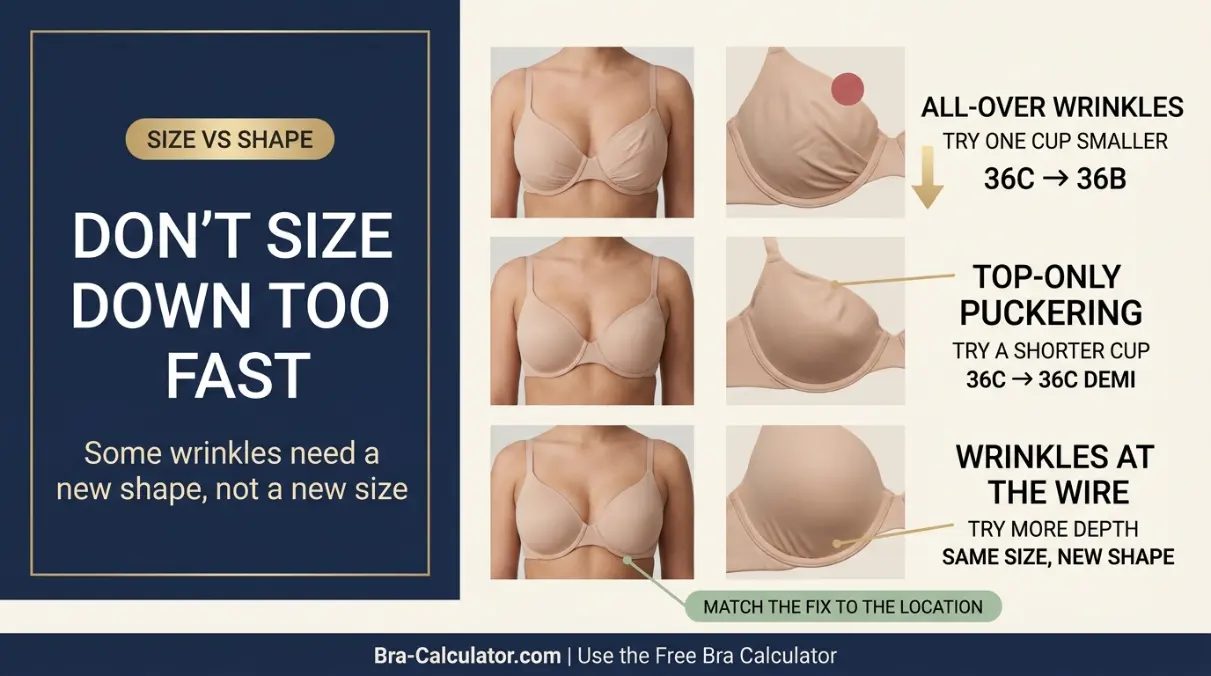
All-over wrinkling with empty space: go down one cup size. Top-only: try a shorter cup style in the same size. Bottom wrinkles: try more cup depth. One-sided: size to the fuller breast and adjust the smaller side separately.
A correctly fitting cup should be smooth in all positions. If wrinkles appear only when moving, a more flexible fabric construction is the next change — not necessarily a different size.
Why Cup Wrinkling Happens on Different Bodies
Wrinkled bra cups are not a sign of an unusual or difficult body shape. They are simply a signal that cup height, depth or fabric does not match your specific breast tissue distribution at this point in your life.
Top Edge Puckers Frequently
Breasts that are fuller below and less full at the top experience consistent top-cup puckering in high-neckline styles even when the overall volume is correct.
Try demi cutsRigid Foam Creates Air Pockets
Softer breast tissue does not push against a moulded cup with the same pressure as firmer tissue, so even a nominally correct moulded cup can have significant internal air space.
Try stretch laceBreast Volume and Firmness Shift
After breastfeeding ends, upper fullness and tissue firmness can change significantly. A bra that fitted before pregnancy may now wrinkle at the top because the breast distribution has changed.
Remeasure nowCup Size May No Longer Match
Breast tissue often changes with body weight. A cup that fitted at a higher or lower weight may wrinkle now even if you have not formally measured yourself recently.
Fresh measurementWhen to Change Cup Size or Try a Different Shape
Not every wrinkle requires a size change. Sometimes the fix is purely shape — a shorter cup, a deeper cup or a more conforming fabric — with no change to the cup letter at all.
| Wrinkle Pattern | Try First | Why |
|---|---|---|
| All-over wrinkling; cup collapses when pressed | Same band, one cup size smaller | The cup has more volume than the breast occupies. |
| Top-only puckering; bottom cup is filled | Shorter cup style — same cup size | Cup is too tall for the amount of upper fullness, not too large overall. |
| Wrinkles near the wire; upper cup fills | More projected or seamed cup — same size | The cup lacks depth for breast projection, not excess volume. |
| One cup wrinkles; other fits well | Size to fuller breast; adjust smaller side | Sizing down compresses the fuller breast to fix the smaller side. |
| Band loose; cups wrinkle and tilt | Sister size — down one band, up one cup | Band instability is causing cup tilt; the cup volume may be close. |
What Should You Fix First?
- Wrinkles appear all over the cup
- Cup collapses inward when pressed lightly
- No tissue fills the centre or upper area of the cup
- Band is stable and level throughout the day
- Go down one cup size, keep same band
- Refit with scoop-and-swoop after sizing down
- Confirm no new spillage before stopping
- Only change one size at a time
- Top puckers but bottom cup is filled
- Wrinkles appear near the wire only
- Moulded bras wrinkle but soft cups are smooth
- Sizing down creates spillage or discomfort
- Try a demi or lower-neckline cut for top wrinkling
- Try more projected or seamed cups for wire wrinkling
- Keep the same cup size — change the shape
- Compare a seamed unlined bra for an honest fit read
- Moulded foam shows wrinkles through clothing
- Wrinkles appear when sitting or moving only
- The same size in a soft cup fits without wrinkling
- Air pocket between foam and breast tissue
- Switch to stretch lace or spacer foam in the same size
- Try a seamed unlined cup to see the true fit
- Do not change size based on moulded-cup wrinkling alone
- Flexible fabric conforms — rigid foam does not
- Only one cup wrinkles consistently
- The other side fits smoothly with no issues
- One breast visibly fills the cup more fully
- Straps set differently to compensate
- Size to the fuller, larger breast
- Adjust the smaller-side strap independently
- Use a removable insert in the smaller cup if needed
- Consider stretch-lace cups that flex to uneven fullness
Bra Styles That Minimise Cup Wrinkling and Puckering
The most honest fit indicator. Seam construction follows breast shape exactly. When sized correctly, these cups are almost wrinkle-free. Ideal for diagnosing true fit before buying other styles.
Self-conforming lace fabric adjusts to breast shape and movement. Minor volume differences that would wrinkle a rigid foam cup smooth out naturally under stretch lace.
A shorter cup neckline eliminates the height mismatch that causes top-only puckering, especially for breasts with less upper fullness or bottom-heavy distribution.
More flexible than rigid moulded foam. Offers a smoother under-clothing silhouette than lace while adapting slightly better to breast shape than standard T-shirt bra foam.
Sizing to the fuller breast and padding the smaller cup with a removable insert solves one-sided wrinkling without compressing the larger breast.
Holds its own shape regardless of the breast inside. Prone to top puckering on bottom-full or soft breast tissue. Hides the gap from the outside while creating the wrinkle internally.
Support Styles to Explore After the Correct Size Is Confirmed
Cup wrinkling is solved by size and shape first. Once you have confirmed the correct cup volume using the steps above, these construction types offer the best starting point for a smooth, wrinkle-free everyday fit. Always check the retailer’s size guide and return policy before purchasing.

Full-Coverage Underwire Bras
- A high neckline contains upper tissue smoothly — effective when top puckering occurs because the neckline of a previous style sat too low for your breast root.
- Ensure the cup fits the actual breast volume: a full-coverage cup in too large a size will still wrinkle internally even if the neckline appears higher.
- Check the cup construction — a full-coverage style in seamed or stretch fabric will show fit more honestly than a rigid moulded version.

U-Back Wide-Strap Bras
- A stable back design anchors the band and prevents the cup tilting and wrinkling that a loose or riding-up band can create.
- Individually adjustable straps allow each cup to be independently positioned — useful when wrinkle is one-sided due to asymmetry.
- Confirm cup size is correct first: a stable band in the wrong cup size will still produce wrinkles from excess volume.

Wireless Soft-Cup Comfort Bras
- Flexible cup fabric conforms to breast shape and adapts during movement — the primary reason moulded bras wrinkle when sitting or bending does not apply here.
- An excellent test style for confirming whether the cup volume is correct when moulded bras have been giving misleading fit feedback.
- Avoid using comfort as a reason to overlook a significant size difference — wrinkles in a soft cup still point to a size mismatch that should be corrected.
Problems Often Confused With Wrinkled Bra Cups
Cup gaping is an open space at the cup edge with or without fabric folding; wrinkling involves the fabric itself folding. Both can indicate too much cup, but the diagnostic steps and shape fixes are slightly different.
This is the opposite problem — the cup is too small and tissue overflows. Wrinkling means too much cup; double bust means too little. Applying one correction to the other’s problem will make both worse.
A rising band can cause cups to tilt forward and appear to wrinkle at the top edge. This is not a cup-size problem and should be addressed at the band before any cup change is made.
Loose straps allow the upper cup to droop and create apparent puckering near the strap attachment. Adjusting straps before assessing the cup may resolve apparent top-cup wrinkling.
Frequently Asked Questions
Why are my bra cups wrinkled?
Bra cups wrinkle when there is more cup volume, height or width than the breast fills. All-over wrinkling with no tissue contact usually means the cup is too large. Top-only puckering usually means the cup is too tall for your breast shape. Wrinkles near the wire can mean the cup is too shallow for your projection. Identifying the location of the wrinkle is the critical first step before choosing any fix.
Does a puckering bra cup always mean the cup is too big?
Not always. Top-only puckering frequently means the cup neckline is too tall for the amount of upper-breast fullness present — a shape issue, not strictly a volume issue. All-over wrinkling with no tissue contact is the clearest sign of a cup that is genuinely too large in volume.
What is the fastest bra cup wrinkle fix?
First, scoop all breast tissue into the cups correctly and confirm the band is level. Then identify where the wrinkle is: all-over means try one cup size smaller on the same band; top-only means try a shorter cup in the same size; wire-area means try more cup depth; one-sided means size to the fuller breast. Each location has a distinct correct fix.
Can bra cup wrinkles be caused by the wrong fabric?
Yes. Rigid moulded foam holds its own fixed shape regardless of what the breast does inside it. It can maintain a smooth exterior while having significant internal empty space. Softer fabrics such as stretch lace or seamed jersey conform to the breast instead, showing wrinkles more honestly but also conforming more accurately when sized correctly.
Why does my bra cup wrinkle at the bottom near the underwire?
Wrinkles at the very base of the cup near the underwire can indicate that the cup is too shallow for your breast projection. Breast tissue that projects forward may not settle into the cup base, leaving fabric bunched at the wire. This is not always a too-large problem — a seamed or more projected cup in the same size may solve it without reducing cup volume.
Will going down a cup size fix wrinkled bra cups?
Only when the entire cup is too large after correctly fitting the bra with scoop-and-swoop and a stable band. If wrinkles appear only at the top or only near the wire, going down a cup size can create spillage or underwire pressure without solving the underlying shape mismatch.
Do new bras wrinkle more than worn-in ones?
Occasionally. Stiff new moulded foam can sit away from softer breast tissue slightly before it settles. However, obvious all-over wrinkling in a new bra is still a reliable sign of too much cup volume or the wrong cup shape rather than a break-in issue.
Which bra styles are least likely to have wrinkled cups?
Seamed unlined bras show the most accurate fit because fabric follows the breast shape exactly. Stretch-lace cups self-conform and minimise minor volume differences. When sized correctly, these styles show almost no excess fabric. Rigid moulded foam cups are the most likely to maintain an internally mismatched fit that only becomes visible through clothing.
Stop Guessing Why Your Cups Wrinkle
A smooth bra cup starts with the right size, the right cup shape for your breast distribution, and the right fabric construction for your tissue. Use the location guide above to diagnose your wrinkle precisely, then confirm your size with the free calculator before choosing a new style.