Average Bra Size by Country
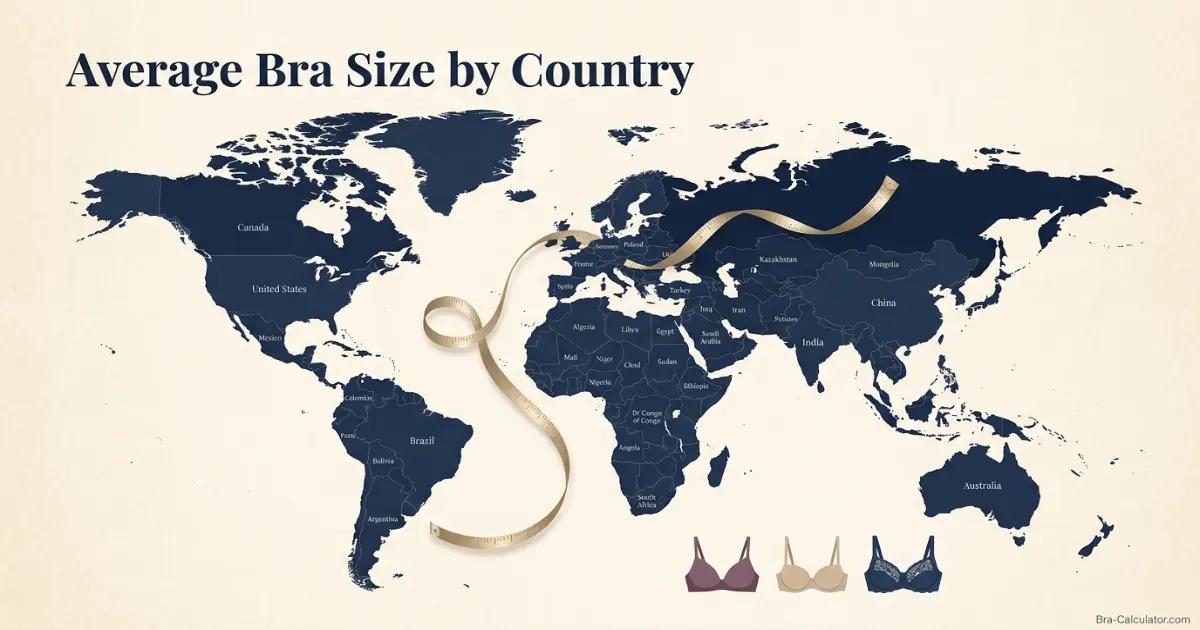
Searches for the average bra size by country often lead to neat maps and confident rankings. Real bra sizing is messier. This guide compares the available cup-category estimates for 30 countries, shows where the figures came from, and explains why your own measurements matter far more than a national average.
By Amelia, Fashion & Sizing Editor
Quick answer: In the secondary country comparison used for this guide, Norway is listed around C–D, while Iceland, the United States and the United Kingdom are listed around C on a simplified US-equivalent cup scale.[1] Most of the selected countries fall somewhere between A and C.
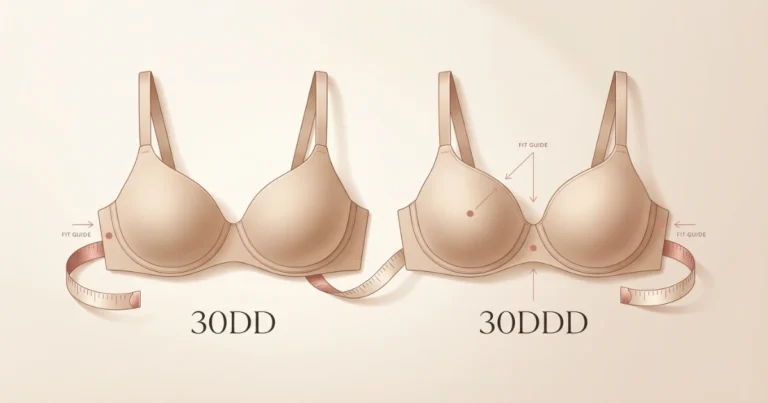
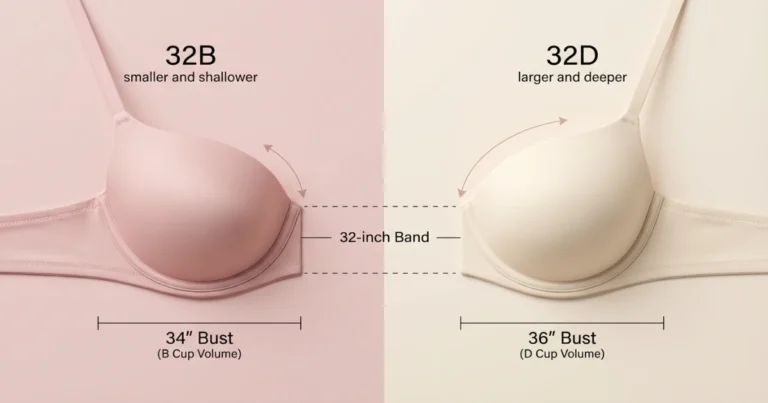
Those letters are broad categories, not complete national bra sizes. A cup letter has no fixed volume without a band: a 30D and a 40D do not hold the same cup volume. Treat the table as cultural and retail context, never as a shortcut for choosing your own bra.
Average bra size by country: the useful takeaway
The country table is most useful as a reminder that retail sizing, body measurements and fitting access vary around the world. It is least useful when readers treat one cup letter as a precise description of millions of people.
Average bra size by country: 30-country comparison
There is no standardized global bra-size census. The comparison below therefore keeps the original ranges from one secondary compilation instead of mixing unrelated retailer claims, surveys and headlines country by country. That source combines multiple surveys with manufacturer sales information and explicitly says the result should be read as an approximate international comparison rather than scientifically reliable population data.[1]
We use the source only for the broad country categories. We do not convert a reported “C” into an invented full size such as 34C or 36C, and we do not use its BMI column as a fitting recommendation.
| Country | Approx. cup category | What to remember | Best next step |
|---|---|---|---|
| Norway | C–D | Broad secondary estimate only | Global converter |
| Iceland | C | Broad secondary estimate only | Global converter |
| United States | C | Not a complete US bra size | US calculator |
| United Kingdom | C | Shown in a simplified US category | UK calculator |
| Colombia | B–C | Broad secondary estimate only | Global converter |
| Sweden | B–C | Broad secondary estimate only | Global converter |
| Netherlands | B–C | EU band context is required | EU calculator |
| Canada | B–C | Not a complete Canadian bra size | Canada calculator |
| Finland | B–C | Broad secondary estimate only | EU calculator |
| Poland | B–C | Brand grading can vary widely | Brand size decoder |
| Denmark | B–C | Broad secondary estimate only | EU calculator |
| New Zealand | B | AU/NZ bands use different numbering | NZ calculator |
| Australia | B | AU bands are not US band numbers | AU calculator |
| Ireland | B | Commonly shops in a UK-style system | UK-system calculator |
| Switzerland | B | Check the retailer’s exact system | EU calculator |
| Brazil | A–B | Retail labels may follow local conventions | Global converter |
| Germany | A–B | EU band and cup context required | EU calculator |
| Spain | A–B | EU and French labels may both appear | Global converter |
| Japan | A–B | Japanese labels need local conversion | Global converter |
| France | A–B | French bands differ from EU labels | Global converter |
| South Africa | A | Broad secondary estimate only | Global converter |
| Saudi Arabia | A | Broad secondary estimate only | Global converter |
| Mexico | A | Broad secondary estimate only | Global converter |
| Pakistan | A | Broad secondary estimate only | Global converter |
| Italy | A | Italian band labels require conversion | Global converter |
| India | A | Broad secondary estimate only | Country calculators |
| China | AA–A | Age and body composition affect distributions | Global converter |
| South Korea | AA–A | Measured and commonly worn sizes can differ | Global converter |
| Malaysia | AA | Broad secondary estimate only | Malaysia calculator |
| Philippines | AA | Broad secondary estimate only | Global converter |
Evidence note: the country categories above are taken from Source 1 and retained as published ranges. The table is a curated 30-country selection, not a new survey or a ranking created by Bra-Calculator.com.
What the global comparison shows—and what it cannot show
Norway, Iceland, United States and United Kingdom
Includes Canada, Sweden, Australia and New Zealand
Includes Germany, Japan, France, Pakistan and India
China, South Korea, Malaysia and the Philippines
The broad pattern places several northern European and English-speaking countries in the upper categories and several Asian countries in the lower categories. That pattern is descriptive of this dataset, not a biological rule. Body composition, age, sample design, available size ranges, fitting habits, retailer stock and income can all influence what gets measured or sold.
It is also worth noticing what the comparison does not contain: no consistent national band-size distribution, no shared measurement protocol, no shape data and no representative sample collected in the same year. That is why this page avoids “largest to smallest” language beyond describing what the secondary source lists.
Is average breast size the same as average bra size?
No. The phrases are often used interchangeably online, but they answer different questions. Breast size might refer to volume, width, depth, projection or bust circumference. A bra size is a clothing label that combines an underbust-based band with a cup difference inside a particular sizing system.
A cup letter is only half a size
Cup capacity increases with band size. A 30C, 34C and 40C share a letter but not the same cup volume, wire width or garment proportions.
Best-selling is not the same as average
Sales reflect what brands manufacture, what stores stock, what shoppers can access and how people have been fitted. Retail data does not directly measure every body in a country.
One national figure hides wide variation
Every country includes many ages, regions, body compositions, life stages and communities. A single letter cannot represent that diversity.
Brown and Scurr reviewed popular claims that breasts were “getting bigger” and found that sales-based cup claims could not be treated as clean anthropometric evidence, particularly because bra sizing varies between brands and full objective datasets were limited.[2] Their work is a useful warning for any page that turns retail labels into biological certainty.
How we built this comparison without false precision
People genuinely search for country averages, so simply saying “the data is imperfect” is not enough. Our approach is to answer the question, keep the published categories visible, and place clear limits around what readers can conclude from them.
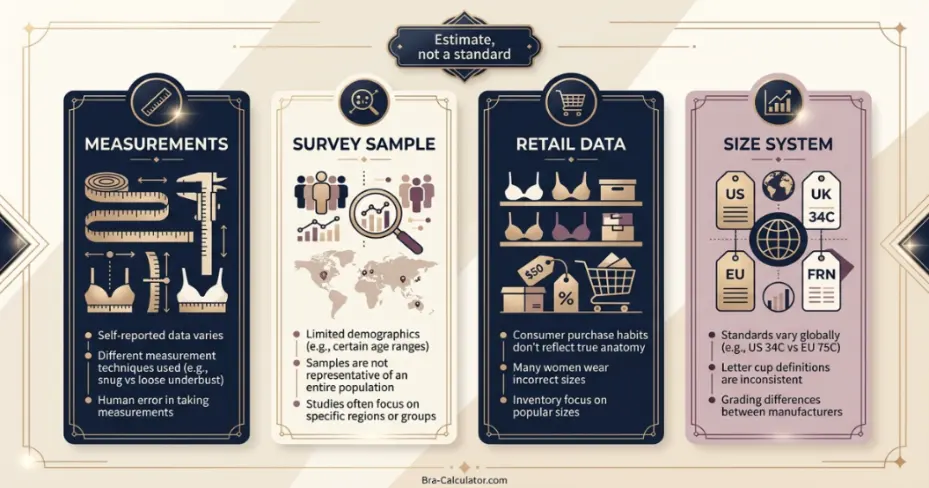
- We used one secondary compilation for all 30 country rows. This avoids quietly changing the method from a retailer sales report in one country to a self-reported survey in another.
- We preserved ranges such as A–B and B–C. Turning a range into one tidy letter would make the answer easier to scan but less faithful to the published data.
- We never invented national band sizes. The source reports broad cup categories, so this page does not manufacture unsupported claims such as “the average German size is 34B.”
- We separated country data from age data. Age and body composition can affect size distributions; those questions belong in the dedicated bra size by age guide rather than being blended into a national estimate.
- We checked the interpretation against anthropometric research. A study based on measurements of Sichuan Chinese women found that age and BMI significantly influenced band and cup allocations, supporting the need for sample context.[4]
- We used current clothing-size context. ISO 8559-2:2025 describes clothing size designation through primary and secondary body dimensions, which supports a measurement-first approach rather than treating a country label as a fitting tool.[3]
Why the same cup letter does not mean the same size worldwide
US, UK, EU, French, Italian, Japanese and AU/NZ systems do not all use the same band numbering or cup progression. A familiar-looking label can therefore be misleading when you shop from another country. Brand construction adds another layer: two bras with the same printed size can differ in band stretch, wire width, cup depth, strap placement and overall grading.
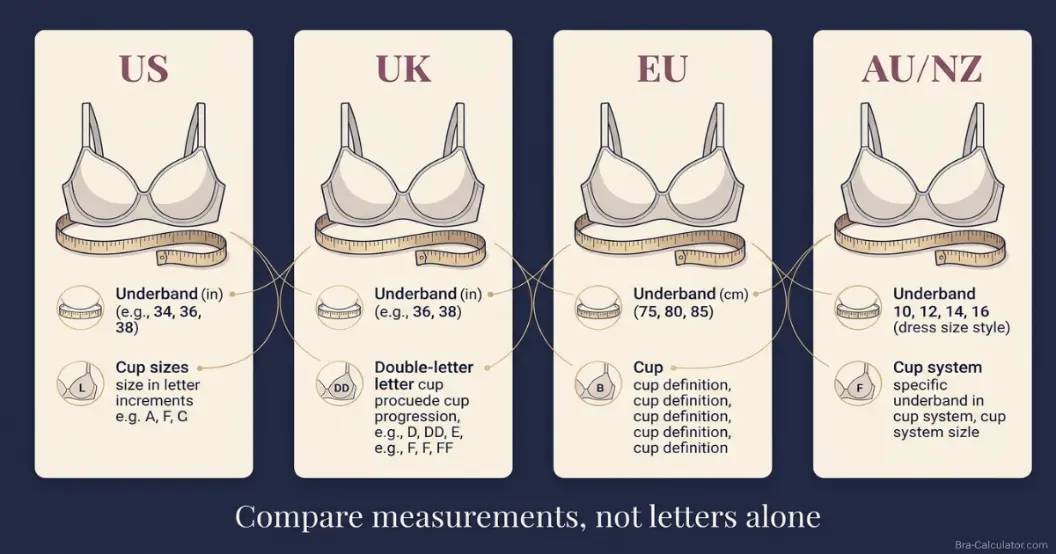
A national cup estimate may be interesting for a global comparison, but it is a poor shopping shortcut. Fit starts with your underbust and bust measurements, then continues with the size system and construction used by the bra you are actually buying.
Already have a size that fits? Start with the global bra size converter, then confirm the result against the specific brand. The international bra size charts explain common systems, while the brand size decoder helps when the label or retailer chart is confusing. When only the band tension needs changing, use the sister-size guide rather than jumping randomly between cup letters.
How to use country bra-size data responsibly
Reasonable uses
- Understanding why international retail ranges may differ.
- Recognizing that one sizing system cannot be assumed worldwide.
- Starting a discussion about survey quality and fit access.
- Choosing the correct local calculator or converter.
Uses to avoid
- Guessing your own size from your country.
- Ranking bodies, health, attractiveness or femininity.
- Assuming a cup letter has the same volume on every band.
- Presenting an approximate table as a medical or biological fact.
National averages can also create unnecessary anxiety. Being above or below an estimate says nothing meaningful about whether your body is “normal.” Comfort, support and fit are individual. The useful question is not “Do I match my country?” but “Does this bra stay level, contain the tissue and feel comfortable through my day?”
How to find your bra size in any country
Use the average for context—not fit
You need two basic measurements for a practical starting point: a snug underbust and a relaxed fullest-bust measurement. Measure without compressing the tissue, calculate in the system used by the brand, and then judge the result by how the bra behaves on your body.
Follow the complete how to measure your bra size guide or use the bra cup size measurement guide when the cup calculation or measuring position feels unclear.
A supportive fit usually means
- The band stays level without painful pressure.
- The wire surrounds tissue instead of resting on it.
- The cups contain tissue without cutting in or persistent gaping.
- The center and cup construction suit your shape.
- The straps assist rather than carry all the support.
Simple measurement tools that genuinely help
Affiliate disclosure: As an Amazon Associate, Bra-Calculator.com may earn from qualifying purchases made through the links below. We do not display live prices, ratings or stock claims because those details can change.
Soft dual-scale body measuring tape
A flexible, non-stretch tape is the only essential tool. Dual inches-and-centimeters markings are especially helpful when you buy from international brands.
- Choose soft fiberglass or fabric-style tape.
- Avoid rigid construction tapes.
- Check that the start edge is not frayed or stretched.
Adjustable or full-length mirror
A mirror helps you see whether the tape is level during measuring and whether the back band rises after you put the bra on.
- Useful for checking back-band position.
- Helps spot strap asymmetry.
- Not a substitute for measuring.
Multi-hook bra extender set
An extender can help when a new band is genuinely firm but the cups, wires and overall construction already fit well. It is not a fix for the wrong cup volume.
- Match the hook count and spacing.
- Use for a short break-in period.
- Skip it when cups spill or wires sit on tissue.
Frequently asked questions
What is the average bra size worldwide?
There is no scientifically established worldwide average full bra size. The secondary compilation used on this page places the global natural breast average between a large US A and a smaller US B, but the publisher also states that its comparison is approximate and not scientifically reliable.[1] A band size would still be required to describe a complete bra size.
Which country has the largest average bra size?
In the secondary dataset used here, Norway has the highest listed category at approximately C–D, followed by Iceland, the United States and the United Kingdom around C.[1] This is not a definitive national measurement census, so the result should be described as a dataset estimate rather than a proven ranking.
Is average bra size the same as average breast size?
No. A bra size combines a band and a cup inside a garment-sizing system. Breast size can be described through volume or physical dimensions. Bust circumference also includes the chest, and the volume represented by a cup letter changes with the band.
Why do average bra-size figures differ between websites?
Different pages may use retailer sales, self-reported surveys, old maps, different years or different size conversions. Some sources do not publish their sampling method at all. Without a shared measurement protocol, sample and band-size context, the results are not directly comparable.
Do bra sizes change between countries?
The body does not change when you cross a border, but the label can. US, UK, EU, French, Italian, Japanese and AU/NZ systems use different numbering or cup progressions. Brands may also grade bras differently, so convert your measured size and check the specific retailer chart.
Can I use my country’s average to choose a bra?
No. A country estimate cannot predict your band, cup volume, shape, root width or preferred tension. Measure your own underbust and bust, calculate in the correct sizing system, and confirm the result through observable fit signs.
Does age affect bra-size distributions?
Age can influence distributions alongside body composition and other measurements. Anthropometric research has found age and BMI to be significant factors in band and cup allocations within a measured sample.[4] That does not justify guessing an individual’s size from age alone.
Why is a 34C not the same volume as a 40C?
Cup letters are graded relative to their band. As the band increases, the cup capacity attached to the same letter also increases. That is why cup volume must always be discussed with the band and why sister sizes use different letters to retain a similar cup capacity.
Sources and evidence notes
These references are listed for transparency without outbound source links, as requested.
- WorldData.info. “Cup Sizes in Global Comparison.” Secondary compilation of country cup categories using mixed surveys and manufacturer sales data. The publisher states that the evaluation is approximate and should not be considered scientifically reliable. Page last modified July 2026; reviewed for this article July 14, 2026.
- Brown, Nicola, and Joanna Scurr. “‘Breasts Are Getting Bigger’: Where Is the Evidence?” Journal of Anthropological Sciences, 2016, volume 94, pages 237–244. DOI: 10.4436/JASS.94020.
- International Organization for Standardization. ISO 8559-2:2025 — Size Designation of Clothes, Part 2: Primary and Secondary Dimension Indicators. Edition 2, published September 2025.
- Shi, Yuyuan, Hong Shen, Lindsey Waterton Taylor, and Vien Cheung. “The Impact of Age and Body Mass Index on a Bra Sizing System Formed by Anthropometric Measurements of Sichuan Chinese Females.” Ergonomics, 2020, volume 63, issue 11, pages 1434–1441. DOI: 10.1080/00140139.2020.1795276.