Bra Clasp Keeps Coming Undone? Why It Happens & How to Fix It
If your bra clasp keeps coming undone, do not assume you just need stronger hooks. A loose band, worn elastic, distorted cups, overtight straps or damaged hardware can all make the closure twist and release.

Quick answer
The clasp usually opens because the closure is damaged or the bra is moving more than it should. Inspect the hooks and eyes first, then check band stability, cup fit and strap tension. If an older band is loose even on the tightest hook, replacing the bra is usually more useful than repairing only the clasp.
Why Does My Bra Clasp Keep Coming Undone?
If your bra clasp keeps coming undone, the problem is usually mechanical or fit-related—not something you should have to keep fixing all day. A hook can open because the band is shifting, the closure is bent, the bra is being stretched unevenly, or the elastic has lost enough support that the clasp is taking more movement than it was designed to handle.
The fastest clue is whether this happens with one older bra or with several bras in your current size. One failing clasp points toward damage. Several bras opening or twisting point more strongly toward a size, band-stability or movement problem.
7 Reasons a Bra Clasp Comes Undone
| Cause | What you may notice | Best first check |
|---|---|---|
| Band is too loose | Back rides up, closure twists, bra shifts during movement | Try a tighter sister size |
| Hooks are bent outward | One side releases easily even when band feels right | Inspect every hook |
| Eyes are stretched or torn | Hook enters but does not stay secure | Compare unused rows |
| Band is worn out | Tightest hook still feels unstable | Compare with a newer bra |
| Cups distort the band | Spillage, floating gore, strong forward pull | Recheck cup size/depth |
| Washing damaged hardware | Hooks are flattened, twisted or snagged | Inspect closure flat |
| Closure quality failed | Clasp opens despite otherwise correct fit | Repair or replace panel |
A Loose Band Can Make the Clasp Twist
The clasp works best when the band is level and evenly tensioned around the torso. When the band is too loose, it can ride upward, rotate or shift as you reach and bend. That repeated movement puts twisting force through the hook-and-eye closure.
If your back band sits higher than the front or you can pull it far away from your body with little resistance, read the Bra Band Rides Up guide. If the cups still fit, moving down one band and up one cup step may give a more stable sister size.
Inspect the Hooks and Eyes Before Changing Size
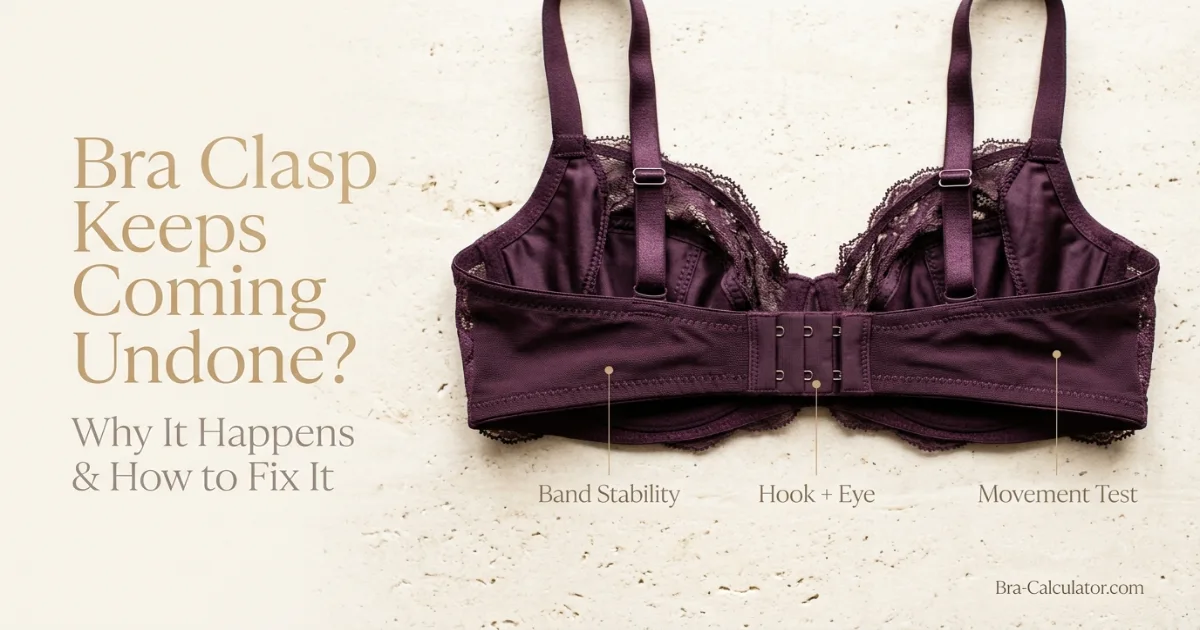
Take the bra off and lay the closure flat. Each hook should curve inward enough to catch the eye securely. An outward-bent hook may look almost normal but release as soon as the band moves. The eye loops should also be intact rather than stretched open, torn from the fabric or crushed flat.
Compare all hook rows. If the loosest row fails but a less-used row holds normally, the closure itself may be worn rather than the entire bra size being wrong.
Hardware clueIf only one hook repeatedly opens, focus on that hook and eye before changing the whole size. If all rows feel unstable, test the band and elastic next.
Cup Fit Can Put Uneven Tension on the Closure
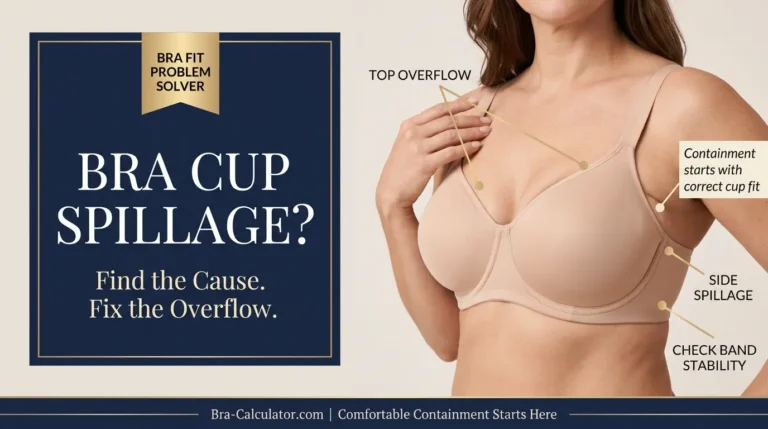
A clasp problem can begin at the front of the bra. Cups that are too small or too shallow can push the bra away from the body, increasing tension through the band and making the closure sit at an angle rather than flat.
- Top or side spillage
- A center gore that floats forward
- Wires sitting on breast tissue
- Lower-cup compression
- The whole bra shifting when you raise your arms
If several of these signs appear, use the Bra Size Calculator before assuming the clasp is the only problem.
Overtight Straps Can Pull the Back Up
Straps should stabilize the cups, not lift the entire bra by pulling the back band toward your shoulders. If straps are overtightened, the back can ride upward and the closure may sit under more movement and uneven force.
Loosen the straps slightly, then check whether the band remains level. If the bra loses all support when the straps are relaxed, the band or cups are not doing enough structural work.
The Bra May Simply Be Worn Out
If you are already using the tightest hook and the band still moves, the closure may be showing a larger problem: the elastic no longer anchors the bra. New everyday bras generally start on the loosest secure hook and move inward as the band relaxes. Once the tightest row is no longer enough, there is no adjustment range left.
See How Often Should You Replace a Bra? if the band, straps or cups are also losing structure.
Washing Can Damage the Closure
Loose hooks can snag other garments or the bra itself in a washing machine. Repeated pulling can bend the hook, stretch the eye or damage the stitching that holds the closure panel. Fastening the bra before washing and using a mesh lingerie bag can reduce snagging.
Heat can also shorten the working life of elastic. Air-drying is kinder to most bra bands than high dryer heat.
Movement Can Expose a Borderline Fit
A bra may look fine while you stand still but fail when you reach, twist or bend. After putting the bra on correctly, raise both arms, reach forward, rotate your torso gently and sit down. The closure should remain flat and fastened.
If the band climbs or the clasp twists during this test, the bra is not stable enough in motion—even if the mirror fit looked acceptable.
How to Stop a Bra Clasp From Coming Undone
- Inspect the hook-and-eye hardware. Look for bent hooks, stretched eyes and loose stitching.
- Use the loosest secure hook on a new bra.
- Check that the band is level.
- Scoop and swoop fully into the cups.
- Relax overtightened straps.
- Do a movement test. Raise your arms, bend and sit.
- Repair or replace the closure if the hardware itself fails.
Repair the Clasp or Replace the Bra?
Repair makes sense when the cups, wires, straps and band elastic are still in good condition and only the closure panel is damaged. Replacement makes more sense when the clasp problem appears alongside a loose band, stretched straps, warped wires, collapsed cups or constant adjusting.
A repair should restore a secure closure without shortening the band so aggressively that the fit changes. If the elastic itself has gone slack, a new clasp cannot restore the original support.
Is the clasp problem really a band-size problem?
Check your measurements and compare your current size with a tighter or looser sister size before replacing the bra with the same fit.
Check My Sister SizeFrequently Asked Questions
Why does my bra clasp keep coming undone?
The most common reasons are a loose or worn band, bent hooks, stretched eyes, uneven cup tension or a damaged closure panel.
Can a bra band that is too loose make the clasp open?
Yes. A loose band can ride up, rotate and twist the closure during movement.
Should I bend the hook tighter?
A slightly misshapen hook can sometimes be adjusted carefully, but repeatedly bending damaged metal can weaken it further.
Why does only one hook keep opening?
That hook or its matching eye may be bent, stretched or poorly stitched.
Can cups that are too small affect the back clasp?
Yes. Small or shallow cups can push the bra forward and increase uneven tension around the band.
When should I replace the bra instead of repairing the clasp?
Replace it when the clasp problem appears with stretched elastic, a loose band on the tightest hook, warped wires or collapsing cups.
How can I protect bra hooks in the wash?
Fasten the closure before washing, use a mesh lingerie bag on a gentle cycle if machine washing, and air-dry rather than using high heat.
Keep Exploring
About this guide: Prepared for Bra-Calculator.com and reviewed by Amelia, Founder & CEO. It explains bra-fitting principles for educational purposes and is not medical advice. Persistent pain, skin injury or unusual breast changes should be discussed with a qualified healthcare professional.