Australian Bra Size Chart: AU to US, UK & EU Conversion
Australian bra sizing looks simple — until you order from an overseas brand and the numbers stop matching anything you know. This guide breaks down the AU dress-size band system, gives the centimetre ranges behind each size, converts across US, UK, EU and French labels, and explains why cup letters above DD need to be matched by position, not by the letter alone.
How does the Australian bra size chart work?
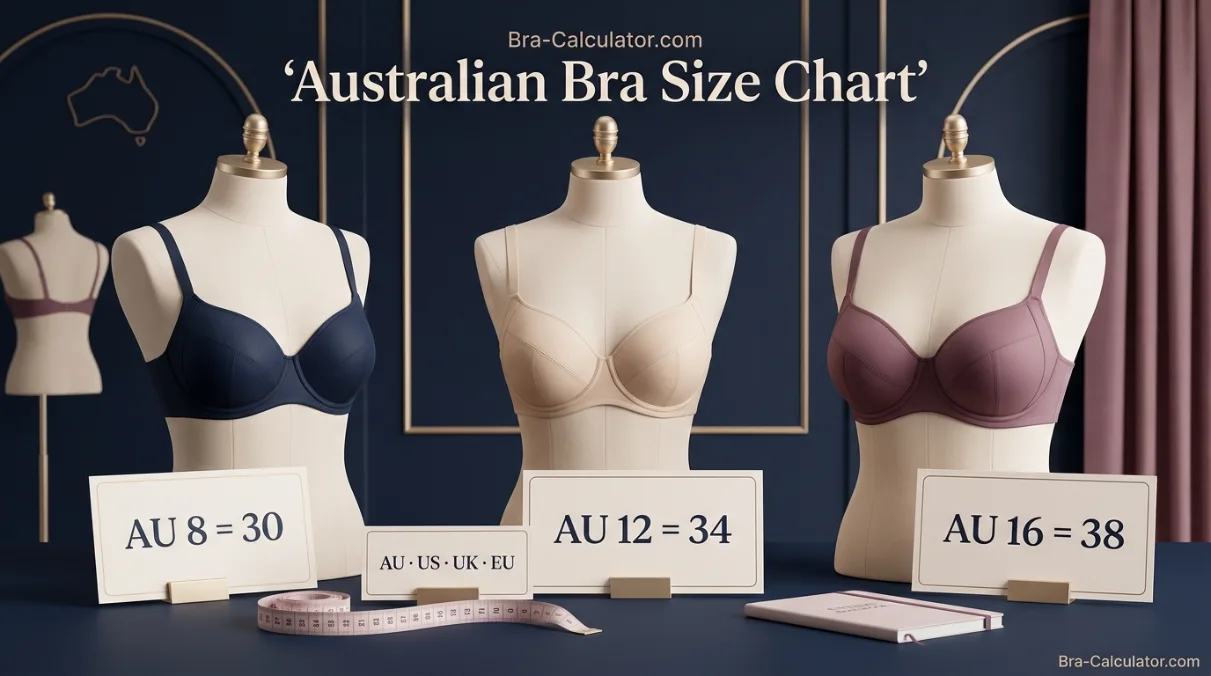
Australian bras are sized around even-number dress-size bands — AU 8, 10, 12, 14, 16, 18, 20 and up. The band conversion is consistent: AU 8 = US/UK 30, AU 10 = 32, AU 12 = 34, AU 14 = 36, AU 16 = 38. Cup letters are trickier. Mainstream Australian charts typically run A, B, C, D, DD, E, F, G, H, which isn’t always identical to specialist UK lettering once FF and GG appear. Convert the cup by its position in the sequence, not the letter itself, and check the brand’s own chart before ordering.
Australian Bra Size Converter
Select your Australian band and cup below to get a practical starting conversion for US, UK, EU and French sizing — no manual maths required.
Worth knowing: this converter follows the common Australian mainstream sequence A–H used by major local retailers. Imported UK full-bust brands may insert FF and GG; imported US brands may use DDD/F, G, H, I and beyond. Always confirm against the product’s own chart before buying.
Australian Bra Band Size Chart
Here’s what trips up first-time overseas shoppers: the number in an Australian bra size isn’t an inch band or a centimetre band — it’s a dress-size-style label. That’s why an Australian 12C doesn’t convert to a “12C” anywhere else. The correct band equivalent is 34, which is what makes AU 12C into US/UK 34C once the cup system lines up.
Quick shortcut: add 22 to the Australian band number — AU 8 becomes 30, AU 10 becomes 32, AU 12 becomes 34, and so on. Treat that as a lookup trick rather than a measuring formula; when choosing from your own measurements, use the brand’s underbust range instead, since Australian charts typically assign a five-centimetre window to each band.
| Australia / NZ | US / UK / Canada | EU | France / Spain | Typical underbust range |
|---|---|---|---|---|
| AU 8 | 30 | 65 | 80 | 63–67 cm |
| AU 10 | 32 | 70 | 85 | 68–72 cm |
| AU 12 | 34 | 75 | 90 | 73–77 cm |
| AU 14 | 36 | 80 | 95 | 78–82 cm |
| AU 16 | 38 | 85 | 100 | 83–87 cm |
| AU 18 | 40 | 90 | 105 | 88–92 cm |
| AU 20 | 42 | 95 | 110 | 93–97 cm |
| AU 22 | 44 | 100 | 115 | 98–102 cm |
| AU 24 | 46 | 105 | 120 | 103–107 cm |
| AU 26 | 48 | 110 | 125 | 108–112 cm |
What is an Australian size 12 bra in the US? The band converts to US 34. That makes AU 12C a US 34C, AU 12D a US 34D, AU 12DD commonly a US 34DD, and AU 12E commonly a US 34DDD/F. Once you’re past DD, it’s worth checking the exact US brand’s own sequence rather than assuming.
Australian Bra Size Chart in CM
An Australian bra size chart in centimetres works off two measurements. The underbust range picks your band; the overbust range in that same row narrows your cup. A 74 cm underbust lands in the 73–77 cm range, pointing to AU 12. A 95–97 cm fullest bust on top of that puts you close to AU 12DD.
The table below follows the two-centimetre cup increments used in current Australian retail charts. Treat it as a starting range, not a guarantee — stretch lace, firm sports-bra elastic, moulded cups, wire width and fabric recovery all change how a labelled size actually feels.
| AU band | Underbust | A cup bust | B cup | C cup | D cup | DD cup | E cup | F cup | G cup | H cup |
|---|---|---|---|---|---|---|---|---|---|---|
| 8 | 63–67 | 77–79 | 79–81 | 81–83 | 83–85 | 85–87 | 87–89 | 89–91 | 91–93 | 93–95 |
| 10 | 68–72 | 82–84 | 84–86 | 86–88 | 88–90 | 90–92 | 92–94 | 94–96 | 96–98 | 98–100 |
| 12 | 73–77 | 87–89 | 89–91 | 91–93 | 93–95 | 95–97 | 97–99 | 99–101 | 101–103 | 103–105 |
| 14 | 78–82 | 92–94 | 94–96 | 96–98 | 98–100 | 100–102 | 102–104 | 104–106 | 106–108 | 108–110 |
| 16 | 83–87 | 97–99 | 99–101 | 101–103 | 103–105 | 105–107 | 107–109 | 109–111 | 111–113 | 113–115 |
| 18 | 88–92 | 102–104 | 104–106 | 106–108 | 108–110 | 110–112 | 112–114 | 114–116 | 116–118 | 118–120 |
| 20 | 93–97 | 107–109 | 109–111 | 111–113 | 113–115 | 115–117 | 117–119 | 119–121 | 121–123 | 123–125 |
If you land right on a boundary, resist sizing the band up automatically — a cup that’s too small can make the whole bra feel tight by pushing the band forward. Try the size the chart points to plus its nearest sister size, and judge the band on its own by fastening the bra backwards with the cups hanging in front. That isolates band feel from cup feel.
Australian Bra Size Chart to US, UK, EU and French Sizes
Band conversion is the easy half. Cup conversion is where most shoppers lose accuracy, since the letters look interchangeable and usually aren’t. Up to a D cup, letters line up cleanly across every system below. DD tends to align across Australian, UK and many US charts too — though EU switches to E at that step. Past that, the alphabets genuinely diverge.
| Australian size | US size | UK size | EU size | French size |
|---|---|---|---|---|
| 8A | 30A | 30A | 65A | 80A |
| 8C | 30C | 30C | 65C | 80C |
| 8DD | 30DD/E | 30DD | 65E | 80E |
| 8E | 30DDD/F | 30E | 65F | 80F |
| 10B | 32B | 32B | 70B | 85B |
| 10D | 32D | 32D | 70D | 85D |
| 10E | 32DDD/F | 32E | 70F | 85F |
| 12C | 34C | 34C | 75C | 90C |
| 12DD | 34DD/E | 34DD | 75E | 90E |
| 12E | 34DDD/F | 34E | 75F | 90F |
| 12F | 34G | 34F | 75G | 90G |
| 14C | 36C | 36C | 80C | 95C |
| 14DD | 36DD/E | 36DD | 80E | 95E |
| 14E | 36DDD/F | 36E | 80F | 95F |
| 16D | 38D | 38D | 85D | 100D |
| 16F | 38G | 38F | 85G | 100G |
| 18DD | 40DD/E | 40DD | 90E | 105E |
| 20E | 42DDD/F | 42E | 95F | 110F |
Convert the band first, then convert the cup by counting its position in the sequence — not by copying the letter directly. An Australian G doesn’t automatically mean a US G or a UK G; it depends entirely on which cup alphabet that specific Australian brand is using. For a wider international lookup beyond AU/US/UK/EU, the Global Bra Size Converter covers more systems in one place.
Australian Cup Size Chart: Why F, G and H Can Be Confusing
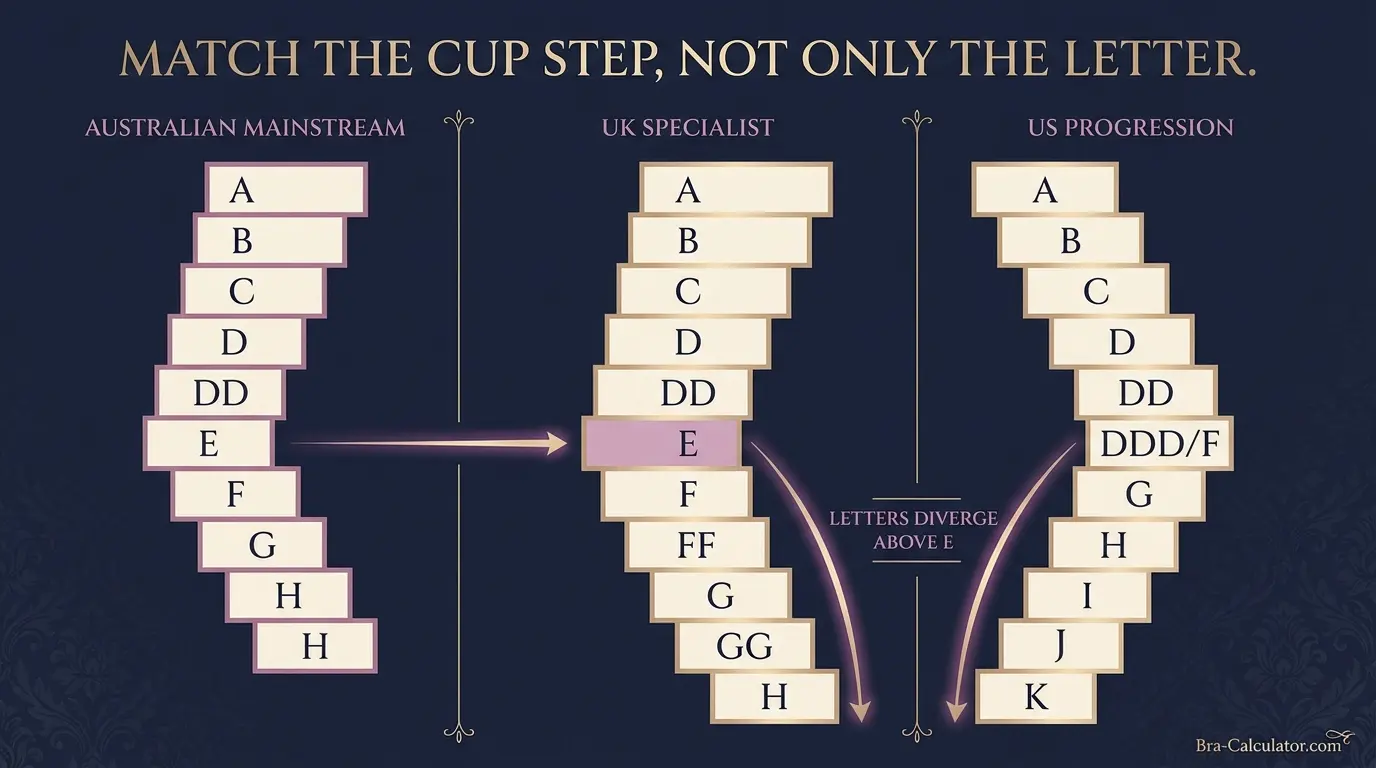
People say “Australian cups are the same as UK cups” fairly often, and that’s a fine rule of thumb up to a D cup. Past that, it’s too broad to trust. Mainstream Australian charts commonly run A, B, C, D, DD, E, F, G, H. UK full-bust specialist brands commonly run A, B, C, D, DD, E, F, FF, G, GG, H instead — those extra double letters mean the same printed letter on two tags can represent two different cup volumes.
Common mainstream AU progression
A → B → C → D → DD → E → F → G → H
This is what you’ll typically find in broad Australian retail charts. Under this sequence, AU G is the eighth cup step listed, and AU H is the ninth.
Common specialist UK progression
A → B → C → D → DD → E → F → FF → G → GG → H
Here, UK G is actually the ninth step, because FF slots in before it. The lesson: match the position in the sequence, not the letter printed on the tag.
To complicate things, plenty of Australian shops stock imported UK brands and keep the original UK label rather than converting it — so two products on the same storefront can quietly use two different cup alphabets. The clearest tell is FF or GG anywhere on the chart: if you spot it, you’re looking at the UK-style progression, not the shorter mainstream Australian one.
Practical cup-step conversion
| Cup step | Mainstream AU | UK | Common US | EU |
|---|---|---|---|---|
| 1 | A | A | A | A |
| 2 | B | B | B | B |
| 3 | C | C | C | C |
| 4 | D | D | D | D |
| 5 | DD | DD | DD/E | E |
| 6 | E | E | DDD/F | F |
| 7 | F | F | G | G |
| 8 | G | FF | H | H |
| 9 | H | G | I | I |
Treat this as a framework, not a guarantee every brand labels each step identically. US brands especially are inconsistent around DD, DDD, E and F. If a product chart lists DDD and F as separate sizes rather than one combined label, don’t assume the mapping above applies — follow whatever sequence that manufacturer publishes.
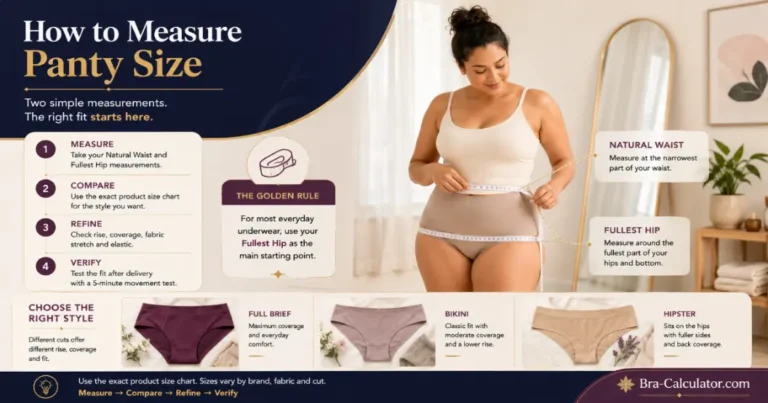
How to Measure Australian Bra Size at Home
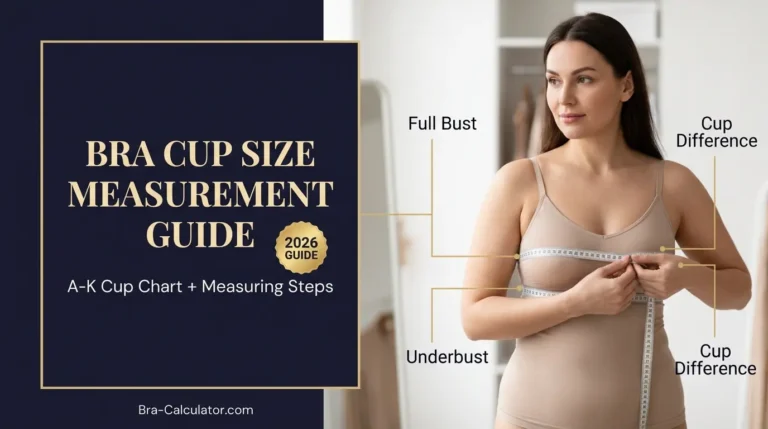
Conversion only works as well as the size you start from, which is the part people skip most. A bra bought years ago has likely stretched, your body may have changed, or the original size was never quite right. A soft tape and two careful readings beat guessing from an old tag.
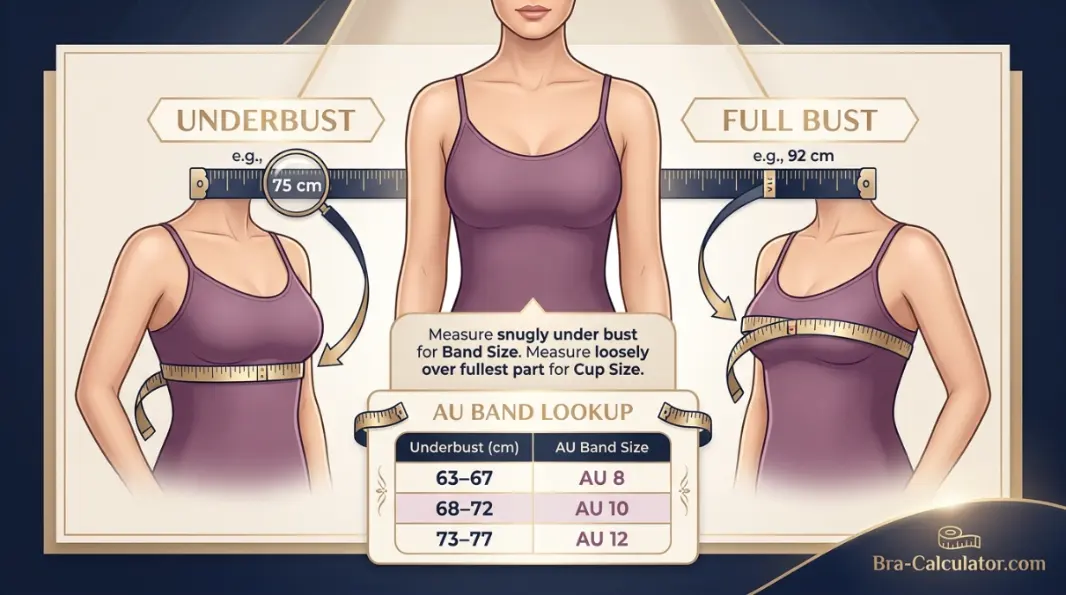
Measure the snug underbust
Wrap the tape directly beneath your bust, level all the way around. Breathe out normally and keep it snug without digging in. This number selects your AU band range.
Measure the fullest bust
Wrap the tape around the fullest part of your bust, kept level. Let it sit lightly rather than pulling tight. Measure without a bra, or in a thin unpadded one.
Match both numbers to the chart
Find your underbust in the band-chart row, then move across until your fullest-bust number lines up with a cup range. A 74 cm underbust with a 96 cm bust points to roughly AU 12DD.
Test the result on your body
Fasten the bra on its loosest hook, scoop all tissue into the cups, then check the band sits level and the wires, gore and cup edges feel right. Measurement proposes a size — wearing it confirms it.
Want an instant result across every system at once? The Australian Bra Size Calculator does the maths for you, and our How to Measure Bra Size guide covers the fuller technique step by step.
Popular Australian Bra Size Conversion Examples
What is a US 34D in Australian sizing?
A US 34D usually converts to AU 12D. Only the band number changes here, from 34 to 12 — the D cup stays exactly as D, because both systems align at that particular cup step.
What is a UK 36DD in Australia?
A UK 36DD usually converts to AU 14DD. Same logic: the cup step aligns cleanly at DD, and it’s really only the band label that shifts.
What is an EU 80F in Australian sizing?
EU 80 converts to AU 14. EU F sits at the sixth cup step, which typically lines up with AU E in the mainstream Australian sequence — so the practical starting size to try is AU 14E.
Australian Sister Size Chart
Sister sizes keep roughly the same cup capacity while changing how firm or loose the band feels: move down one band and up one cup step for a firmer band, or up one band and down one cup for roomier. Since Australian bands increase in steps of two, AU 12D has AU 10DD on the firmer side and AU 14C on the roomier side.
| Your AU size | Firmer-band sister | Roomier-band sister | When it may help |
|---|---|---|---|
| 10C | 8D | 12B | Cups fit but the band needs adjusting |
| 10DD | 8E | 12D | Keep cup capacity while changing band feel |
| 12D | 10DD | 14C | The classic Australian sister-size swap |
| 12E | 10F | 14DD | Useful when the E cup fits but the band doesn’t |
| 14DD | 12E | 16D | Similar volume across adjacent bands |
| 16E | 14F | 18DD | Fine-tune support without losing cup room |
It isn’t a fix for every complaint, though. A cup can have the right volume and still be the wrong shape — too shallow, narrow, tall, or open at the top. When the cups feel right and only the band is the issue, the Sister Size Bra Calculator is the quicker route than working it out by hand.
How an Australian Bra Should Fit
Getting the conversion right doesn’t guarantee a good fit — construction matters just as much as the label. Run through these checks after putting the bra on and scooping all breast tissue into the cups.
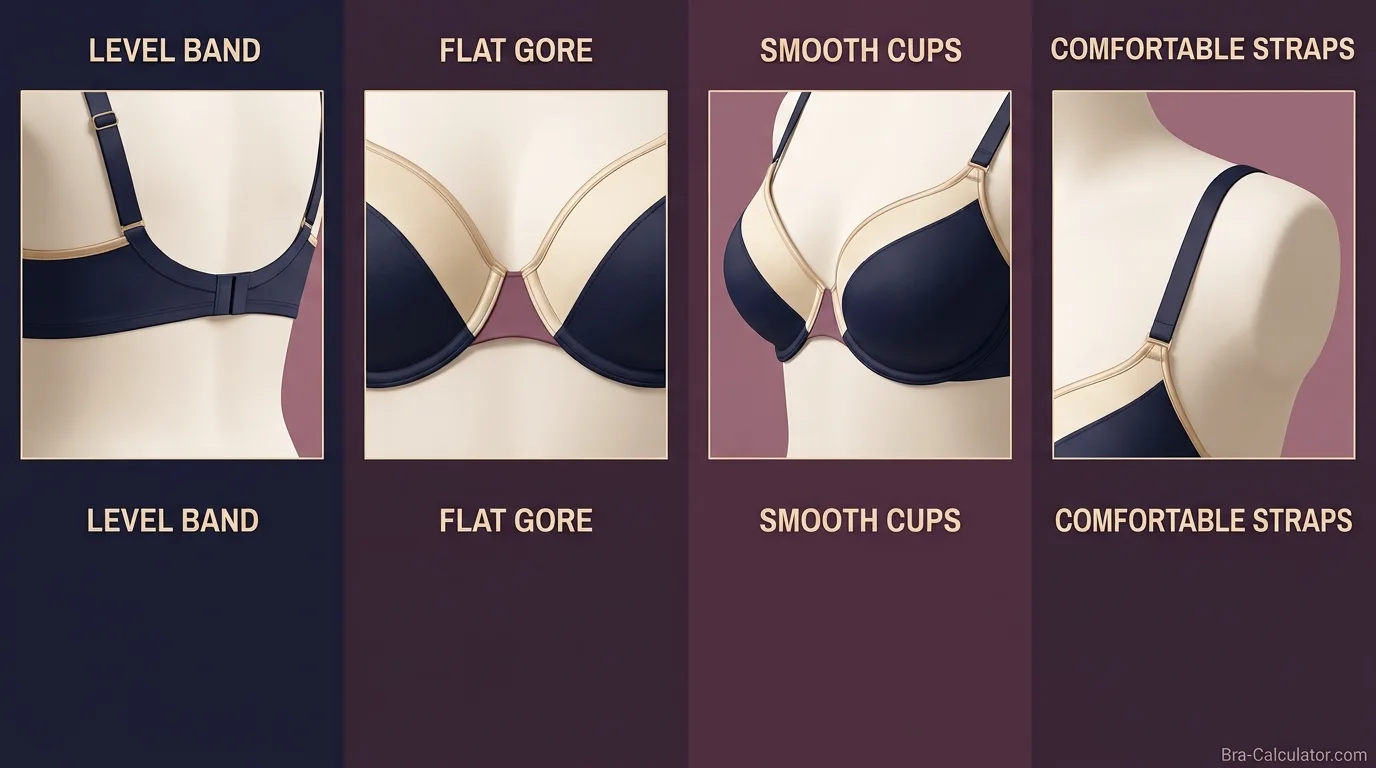
Work through it in this order: band first, cups second, straps last. Adjusting the straps before you’ve sorted the band out tends to mask the real problem rather than fix it. Our Bra Fit Problem Solver walks through spillage, gaping, riding bands, slipping straps and wire discomfort one at a time.
Why Australian Bra Sizes Vary Between Brands
A size chart describes a target body range; the garment is a separate set of design decisions layered on top. Two bras both labelled AU 12D can differ in band stretch, cup depth, wire width and fabric recovery — a gap that widens once you compare across brands and countries. Sports bras run firmer since they’re built to control movement, strapless styles use tighter elastic to compensate for the missing straps, and wireless moulded bras fit a narrower range of breast shapes than a soft cup even at the “correct” size.
Mainstream Australian retailers
The larger local retailers stick to dress-size bands with a straightforward A-through-H chart. Their conversion pages simplify US and UK equivalents to whatever range they stock, which is convenient but doesn’t capture every variation once you shop other brands.
Imported UK full-bust brands
Brands like Panache, Freya and Elomi typically keep their UK cup lettering, FF and GG included, even sold through an Australian retailer — so check the product page for a sizing-system note before assuming the local chart applies.
Imported US brands
US cup notation gets inconsistent above a D cup. One brand uses DD, DDD, G, H, I; another uses DD, F, G, H, I; a third treats E and DD as the same thing. Past DD with a US brand, check that manufacturer’s own chart rather than trusting one universal table.
Alpha-size bralettes and sports crops
XS–XL bras bundle several band-and-cup combinations under one label — convenient, but imprecise. Choose by the garment’s own chart, not your dress size: someone who wears AU 12E needs a different alpha size from someone who wears AU 12B, even with the same band, because the cup volume differs so much.
For more, the Bra Size Charts Hub covers international systems broadly, the Cup Size Comparison Guide helps you picture relative cup volume, and the Bra Style Guide is worth a look when the size is right but the shape isn’t.
Australian Bra Size Chart FAQs
What is an Australian bra size?
An Australian bra size pairs an even-number dress-size band with a cup letter. AU 12D converts to a 34D starting point in both US and UK sizing.
What is AU 12 in US bra sizing?
AU 12 converts to a US 34 band. AU 12C is usually US 34C, AU 12DD is commonly US 34DD/E, and AU 12E is commonly US 34DDD/F.
What is AU 14 in UK bra sizing?
AU 14 converts to a UK 36 band. AU 14D is UK 36D, and AU 14DD is UK 36DD in the common sequence.
Are Australian and UK cup sizes the same?
They line up through the early sequence, not universally. Many mainstream Australian charts go straight from F to G to H, while specialist UK charts insert FF and GG. Check the brand’s own sequence past E.
What is a US 36D in Australian sizing?
A US 36D usually converts to AU 14D — the band shifts from 36 to 14, while D stays at the same step.
What is EU 75E in Australia?
EU 75 converts to AU 12. EU E sits at the fifth cup step, which typically matches mainstream AU DD — so AU 12DD is the practical starting conversion.
How do I convert an Australian bra size to US?
Convert the band first: 8 to 30, 10 to 32, 12 to 34, 14 to 36, 16 to 38. Then convert the cup by sequence position, and above DD, verify against the specific US brand.
How do I measure for an Australian bra?
Measure snugly beneath the bust for the band, and loosely around the fullest part of your bust for the cup. Use the underbust range to pick your AU band, then read that row for your cup.
Is Australian bra sizing the same as clothing sizing?
The band numbers resemble Australian dress sizes, but clothing size alone can’t tell you your bra size — ribcage measurement and cup still need to be measured separately.
Why does my converted size still not fit?
Conversion only translates the label — it can’t account for how firm a bra runs, or whether its cups are shallow, narrow or shaped differently than yours. Try an adjacent size only when a clear symptom points to it; consider a different style when volume is right but shape isn’t.
Useful Bra-Calculator.com Guides
Editorial sources and methodology
Measurement bands were checked against the current Berlei Australia size chart, and international examples against the current Bras N Things sizing guide. Because manufacturers use different cup alphabets, the product’s own chart remains the final word for that item.