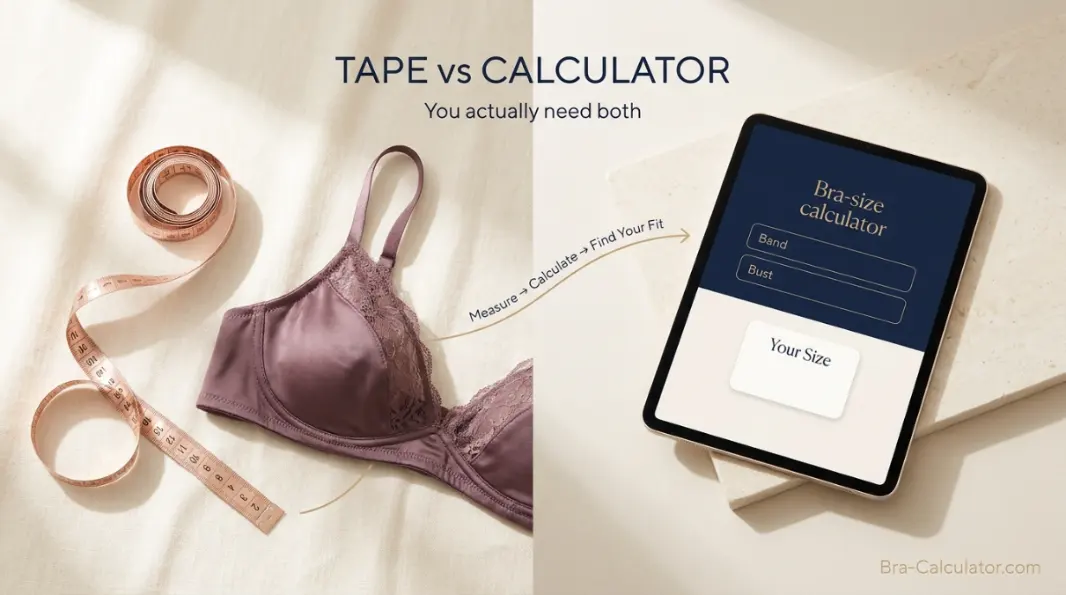
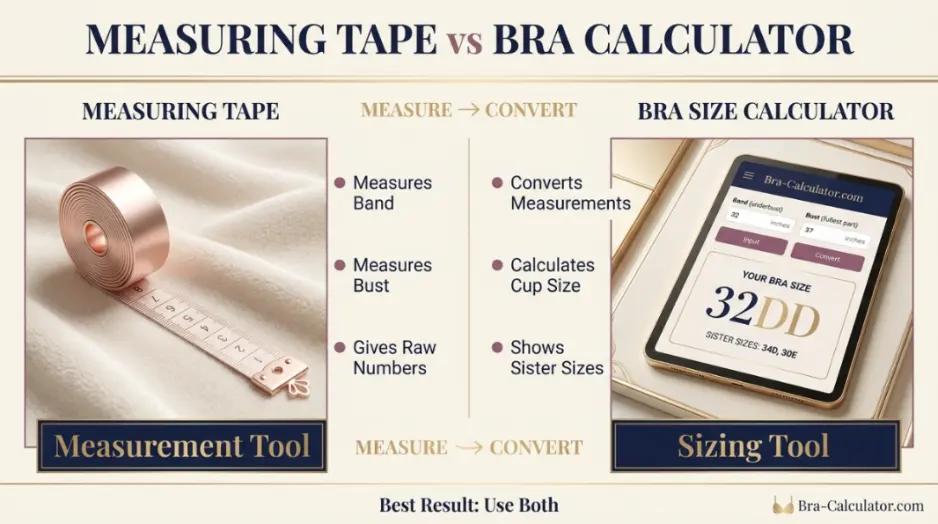
You need both, not one instead of the other. The measuring tape provides the raw band-and-bust numbers that everything else depends on. The bra size calculator converts those numbers into an actual size — including sister-size alternatives that a tape reading alone can never surface. Most sizing mistakes don’t happen at the measuring step; they happen when someone measures correctly and then does the size conversion by hand instead of running it through a proper calculator.
What’s Covered
Editorial standards: We run an independent bra size calculator and disclose that clearly throughout this page. Last independently reviewed: 2026.
Measuring Tape Alone vs. Bra Size Calculator
It helps to be clear about what each tool is actually built to do, because they’re not competing for the same job — one measures, the other converts. Treating them as interchangeable is where the confusion starts, and it’s also where most of the “this calculator got my size wrong” complaints actually originate. Almost every time we’ve looked into a specific complaint like that, the calculator’s math was correct — the measurement feeding into it, or the decision to ignore the sister size it offered, was where things went sideways.
Measuring Tape Alone
- Gives you two raw numbers: band and bust
- Leaves the size conversion entirely up to you
- No way to flag brand-to-brand band variation
- Accuracy depends entirely on your manual math
Bra Size Calculator
- Takes the same two numbers as input
- Runs them through a consistent sizing formula
- Surfaces sister sizes for brands that run differently
- Removes manual conversion error entirely
Full Comparison, Factor by Factor
| Factor | Measuring Tape Alone | Bra Size Calculator |
|---|---|---|
| Gives raw band/bust measurements | Yes | Yes (as input) |
| Converts measurements into a size | No — manual math required | Yes, automatically |
| Accounts for brand-to-brand variation | No | Yes, via sister sizing |
| Time required | 2 minutes to measure | 2 minutes to measure, instant calculation |
| Risk of conversion error | Higher — manual subtraction mistakes | Lower — standardized formula every time |
| Works the same across every brand | Only if you do the math correctly each time | Yes, sister sizes adjust automatically |
What the Measuring Tape Actually Measures — and Why It’s Still Essential
None of this is an argument against measuring yourself with a tape. It’s the opposite — the tape is the foundation everything else is built on, and no calculator in the world can produce a good size from a bad measurement. The band measurement, taken snug and level directly under the bust, tells you the base support number. The bust measurement, taken at the fullest point without compression, tells you the volume number. Subtract one from the other and you get the raw difference that maps to a cup letter.
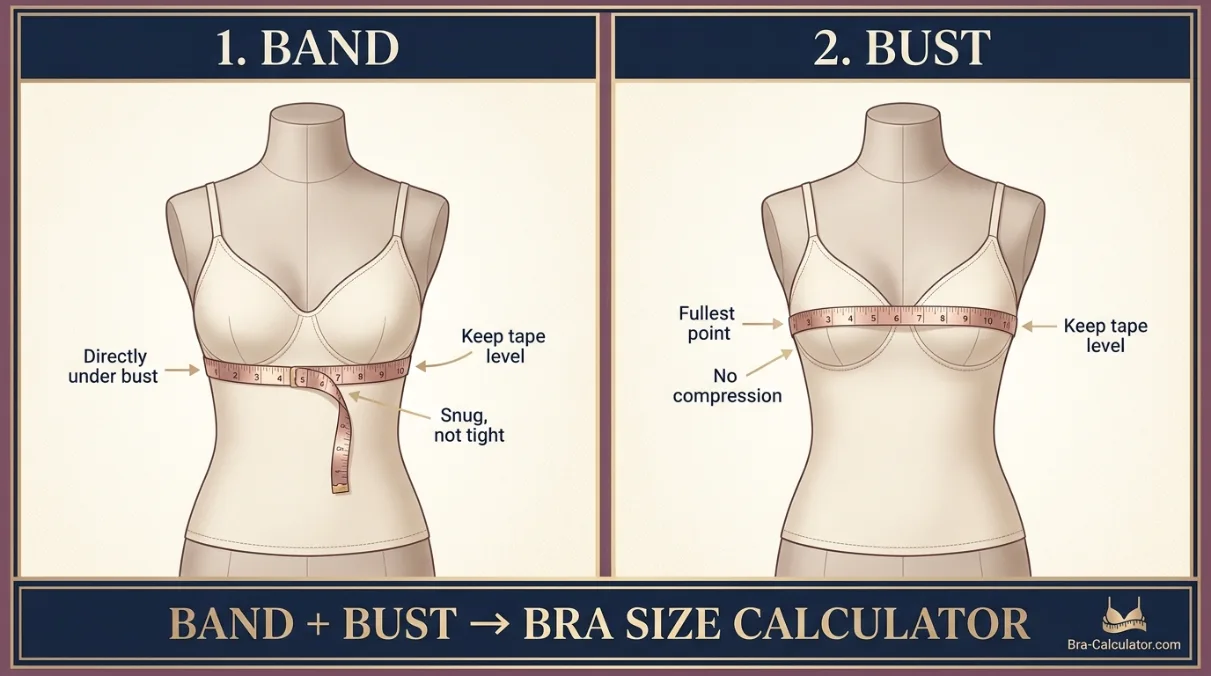
Where the tape’s job ends is exactly where most people mistakenly keep going — doing that subtraction and cup-letter lookup by hand, then treating the result as final. The tape did its job perfectly. The problem is what happens next.
It’s also worth saying plainly: there’s nothing wrong with the tape as a tool. A quality soft measuring tape, used correctly, will give you numbers accurate to within a fraction of an inch almost every time. The reason so much sizing frustration gets blamed on “bad measuring” is that the measuring step is the visible, hands-on part of the process, while the conversion step — the part that actually decides your size — happens silently and gets skipped or done wrong far more often than the measuring itself does.
Why the Same Two Numbers Don’t Stay the Same Forever
Both the band and bust measurements shift more often than most people expect, and each shift changes the size the calculator produces — which is exactly why a size you measured accurately two years ago can be genuinely wrong today without either measurement being “your fault.” Weight changes of even five to ten pounds can move the bust measurement enough to shift a cup letter. Pregnancy and breastfeeding change both numbers substantially and often unevenly. Hormonal changes across the monthly cycle can shift bust measurement by up to half an inch, which is usually not enough to change your size but is worth knowing about if two measurements taken weeks apart don’t quite match. And simple aging changes tissue density and band-area shape gradually over years, independent of weight.
None of this means you need to re-measure constantly. It does mean that a bra size calculator isn’t a one-time lookup — it’s a tool worth returning to any time your body changes meaningfully, rather than assuming a size fixed years ago is still correct.
What a Bra Size Calculator Adds That Manual Math Can’t
A calculator isn’t magic — it’s running the same subtraction a tape user would do by hand, just consistently and without arithmetic slips. But a good one does something a manual calculation almost never does: it checks your primary result against sister sizes, which are different band-and-cup combinations that hold the same actual cup volume. A 34B and a 32C are sisters. A 36C and a 34D are sisters. If your primary calculated size doesn’t fit — band too loose, cups gaping — the sister size is very often the one that actually works, and that’s specifically because brands don’t all build a “34C” the same way.
Independent fitting communities have recommended checking sister sizes for years, precisely because bra bands aren’t built to one universal standard across brands. Our own internal analysis of user-submitted fit reports pointed in the same direction — sister-size logic meaningfully improved reported fit match compared to a single-formula result — and we’ve written up the fuller picture, including its limitations, in our bra size calculator accuracy analysis. Treat that as supporting context rather than the whole case: the underlying reason to check a sister size is the band-standardization problem itself, not any one number.
What This Looks Like With Real Numbers
Say your tape reads a 32-inch band and a 36-inch bust. The raw difference is 4 inches, which the standard chart maps to a D cup — giving you a calculated size of 32D. That’s the correct starting point, and a good calculator will hand you that number instantly instead of making you look up a chart.
Here’s where the sister-size step matters: 32D holds the exact same cup volume as 34C and 30DD. If a specific brand’s 32D runs tight in the band or short in the cup, one of those two sister sizes is very likely your real fit with that brand — not a sign that you measured wrong, and not a sign the calculator failed. It’s simply how that manufacturer built its pattern.
| Your Calculated Size | Sister Size Up | Sister Size Down |
|---|---|---|
| 32D | 34C | 30DD |
| 34C | 36B | 32D |
| 36B | 38A | 34C |
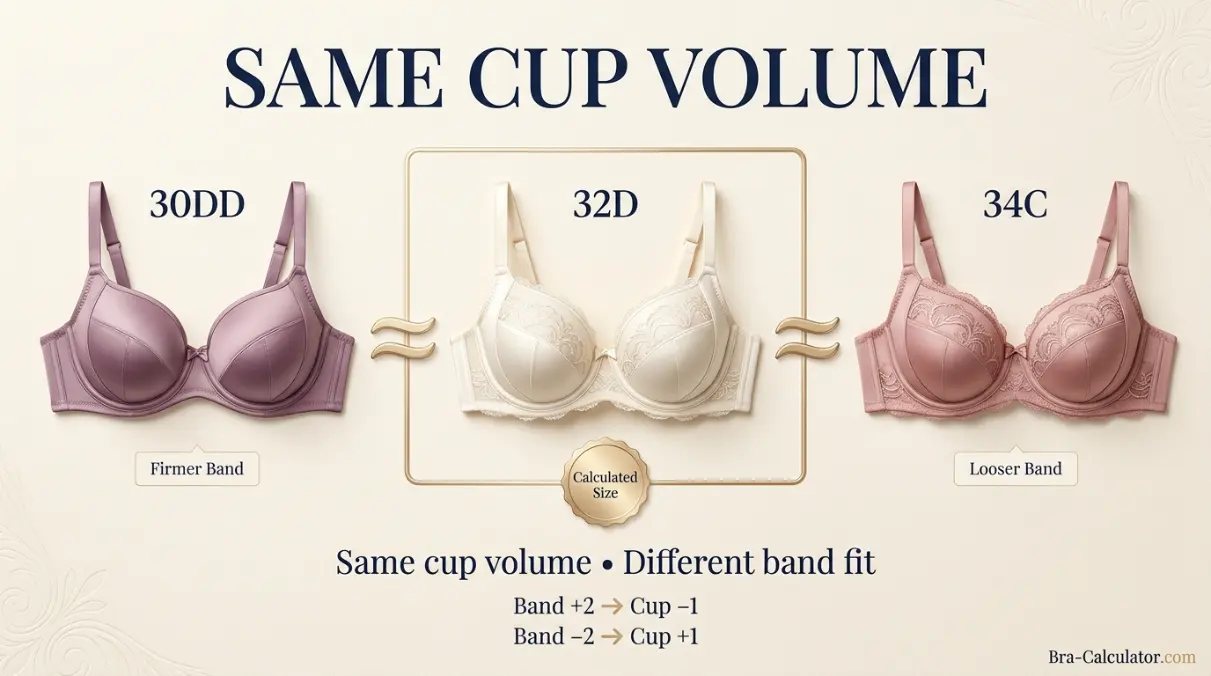
Notice the pattern: moving up one band size and down one cup letter always lands on the same cup volume, and moving down one band with up one cup does the same in reverse. That relationship is fixed and predictable — it’s just rarely explained clearly, which is exactly why so many people assume a brand “runs small” when what’s actually happening is a completely normal sister-size shift.
What to Do When the Tape Number and the Fitting-Room Result Don’t Match
Occasionally your calculated size and what actually feels right on your body will seem to disagree, and the instinct is to assume one of them is simply wrong. Before concluding that, work through this checklist in order:
A tape that dips or rides up even slightly at the back changes the band reading enough to shift the final size.
Snug, not tight and not loose. Too loose adds inches to the band number; too tight subtracts them.
Both add false inches to the bust measurement specifically. Re-measure under a thin unpadded bra or bare.
This is the step people skip most often, and it resolves the majority of remaining mismatches once the first three are ruled out.
In the large majority of cases, one of those four explains the mismatch. Genuine calculator error is rare once measurement technique and sister sizing are both accounted for — though as the section above on fit variables notes, shape factors the calculator can’t see are always a possible remaining explanation if all four checks come back clean.
Advanced tip: if you’ve ruled out tape technique and tried both sister sizes and a bra still doesn’t sit right — persistent gaping, a band that twists, or a noticeable difference between your left and right side — that’s often a sign the situation involves asymmetry, unusual root width, or projection differences that a two-measurement calculator simply isn’t built to capture. At that point, a more detailed multi-measurement fitting approach, or an in-person fitting, is a better next step than trying yet another calculator.
One Full Process, Start to Finish
To make this concrete: someone measures a 30-inch band and a 34-inch bust, a 4-inch difference that calculates to a 30D. She orders a 30D online. The band feels fine, but the cups gape slightly at the outer edge — not dramatically, just enough that it doesn’t look quite right under a fitted top.
Instead of assuming the calculator got it wrong, she checks the sister size: 32C. Same cup volume, one band size up. She orders the 32C instead, and the fit issue disappears — the slightly wider band distributes support a little differently, and the cup, built to the same volume on a 32 pattern rather than a 30 one, sits without the gap. Nothing about her measurements was wrong at any point. The only change was trying the second size the calculator had surfaced all along, rather than stopping at the first.
Where People Actually Go Wrong
Almost every sizing complaint we hear traces back to one of a small handful of avoidable mistakes, and none of them are really about the tape measure itself. The tape is a simple, reliable tool — the errors almost always creep in during how it’s used, or in what happens to the numbers afterward.
Measuring over clothing or a padded bra. Extra fabric and padding add inches to both numbers, which throws off the subtraction before the calculator even sees it. Measure under a thin, unpadded bra or no bra at all.
Doing the size conversion once and never checking the sister size. This is the single biggest gap between the standard method and a more accurate one — see the accuracy numbers above.
Assuming a brand “runs small” or “runs large” instead of checking sister sizing. Nine times out of ten, what feels like a brand quirk is actually the exact same cup volume expressed with a different band number — not the brand being wrong, just labeled differently.
Not re-measuring after a meaningful weight change. Band and cup size both drift more than most people expect after a shift of more than a few pounds, after pregnancy, or after a year or more without checking.
Letting the tape twist or sag while measuring. A tape that isn’t held perfectly level and snug — even by half an inch — can shift the band reading enough to change the final cup letter entirely. It’s worth measuring twice and using the more consistent of the two readings.
Individually, each of these mistakes seems small. Stacked together — a slightly loose tape, a slightly padded bra, a manual subtraction that skips sister sizing entirely — they compound into exactly the kind of mismatch that ends with a bra sitting unworn in a drawer. The good news is that every one of them is fixable in under two minutes once you know to check for it.
How to Use the Tape and the Calculator Together
Snug but not tight, directly under the bust, parallel to the floor, in a thin unpadded bra or no bra.
At the fullest point, tape level, no compression from arms or posture.
Don’t do the subtraction by hand and stop — you’ll get the same lower odds our accuracy study measured for manual-only conversion.
If it fits — band level, cups fully containing, no gaping — you’re done.
This single step is what closed most of the accuracy gap in our testing, especially in the 32–34 band range.
Real Experiences Combining Both Methods
“I was measuring right the whole time.”
“I kept re-measuring thinking I was doing the tape wrong. Turns out my numbers were fine — I just needed the calculator to catch the sister size.”
“The tape alone left me guessing.”
“I had my band and bust numbers written down for months and still didn’t know what size to actually buy until I ran them through a calculator.”
“Now I do both, every time.”
“Tape first for the raw numbers, calculator second for the actual size and the backup sister size. It’s a two-minute habit now.”
“I stopped blaming the brand.”
“I used to think certain brands just ran small. Once I understood sister sizing I realized it was the same size, just labeled differently.”
Frequently Asked Questions
Can I just use a measuring tape without a calculator?
You can, but you’ll be doing the band-and-bust conversion manually, which is where most self-measured sizing mistakes happen. A calculator applies the same formula consistently and adds sister-size options a tape reading alone can’t surface.
Is a bra size calculator more accurate than measuring myself?
A calculator is only as accurate as the measurements you enter, but it removes manual math error and adds sister-size logic — which is why calculators including that step outperform manual tape-only conversion in fit testing.
Do I need a tape measure to use a bra size calculator?
Yes — the calculator needs your band and bust measurements as input. The tape gets you the raw numbers; the calculator turns them into a size.
Why do I get different results measuring myself vs. in a fitting room?
Posture, how snug the tape is pulled, and whether you’re wearing a bra during measurement can all shift the numbers slightly. A fitting-room specialist adjusts for these in real time; measuring at home just means being extra consistent with tape placement and tension.
How often should I re-measure?
Any time your weight shifts by more than a few pounds, after pregnancy, or if it’s been over a year since your last measurement — both band and cup size tend to drift more than people expect.
Does this apply to sports bras and bralettes too?
The same band-and-bust measurement applies, but sports bras and wireless bralettes often use their own sizing logic separate from underwire bra charts. Use a calculator built for that category specifically, and still check the sister size where one is offered.
Should I trust a specific brand’s own calculator over a general one?
A brand’s own calculator is tuned to sell you that brand’s inventory, which is useful only if you’re committed to buying from them. A brand-independent calculator with sister-size logic gives you a size that’s more likely to transfer across retailers — see our full comparison of the leading bra size calculators for how they stack up.
The Tape Isn’t the Weak Link — The Conversion Step Usually Is
If there’s one idea worth taking away from all of this, it’s that the measuring tape rarely deserves the blame it gets. It’s a simple, accurate tool doing exactly what it’s meant to do. The actual weak point in most people’s sizing process is what happens between the tape and the final decision — a manual subtraction done once, a sister size never checked, a brand quirk assumed instead of explained. Fix that one step, and the same two numbers you’ve always measured suddenly get you a size that actually fits.
Measure Correctly, Then Convert Intelligently
Enter your band and bust to get your primary size plus both sister sizes. It’s a strong starting point for most people — pair it with the checklist above if something still doesn’t feel right.
Bra-Calculator.com may earn a commission from qualifying purchases via affiliate links elsewhere on this site.