Bra straps usually keep falling off because the strap position, band stability, cup shape or shoulder shape is wrong for the bra — not because you simply failed to tighten the straps enough. First adjust each strap so it sits securely without digging. Then check whether the band rides up, the cups gap, the straps are set too wide, or the elastic has stretched out. Persistent slipping is often solved by a stable band and a bra with centered, convertible, U-back or racerback-style straps.
Jump to a Section
Bra Straps Falling Off at a Glance
| Attribute | What It Means |
|---|---|
| Main symptom | One or both straps repeatedly slide toward the shoulder edge, especially when moving. |
| Fastest first check | Adjust straps individually, then raise your arms and walk; straps should stay secure without digging. |
| Common hidden cause | A loose or riding-up band shifts the strap anchor points out of position. |
| Shape-related cause | Narrow or sloping shoulders paired with wide-set strap construction. |
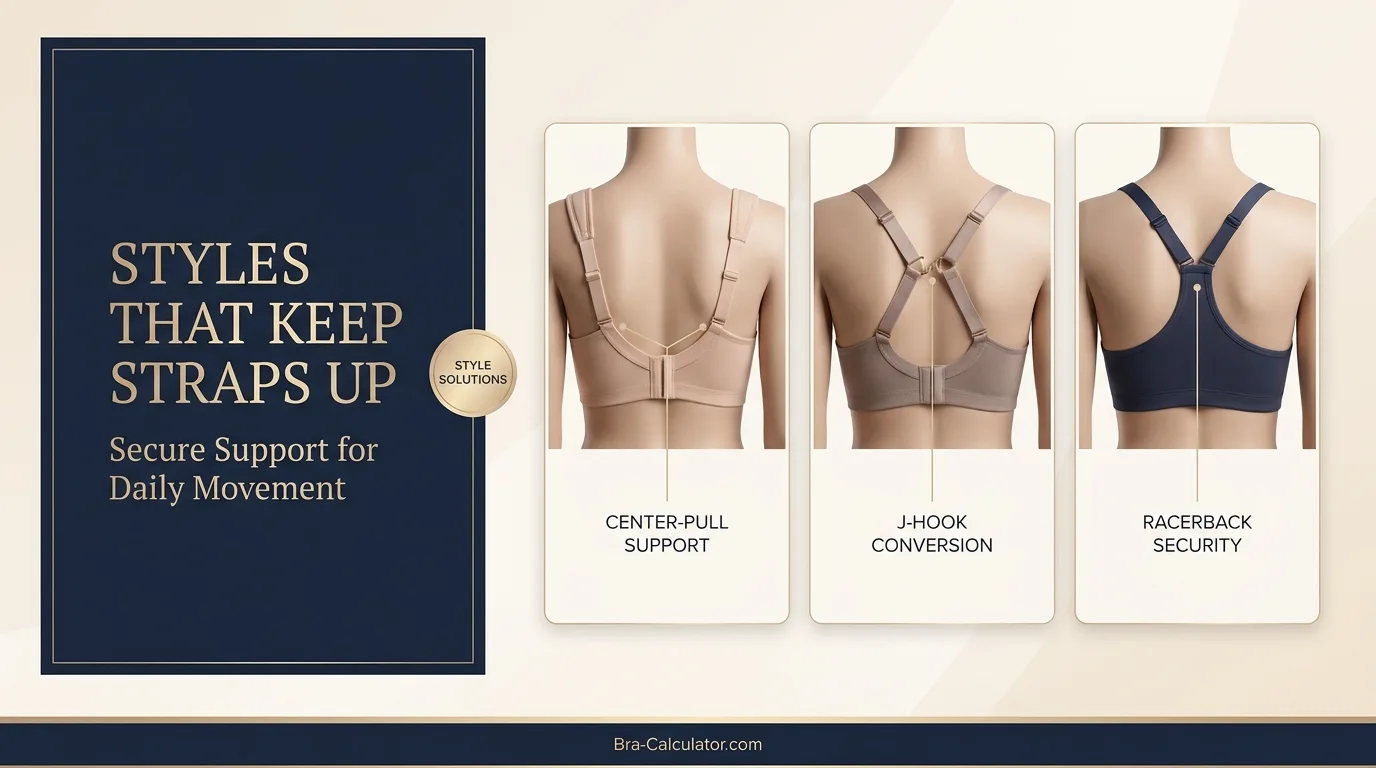
| Style solution | Center-pull, U-back, J-hook, convertible or racerback bras. |
| What not to do | Do not overtighten straps until they leave marks; that trades slipping for shoulder pain. |
What Does Repeated Strap Slip Really Mean?
A bra strap is designed to fine-tune cup height and keep the upper cup close to the body. It is not supposed to be the bra’s main anchor. When straps continually fall off, the problem is often lower down in the system: the band may be moving, the cups may be pulling the straps too far apart, or the strap placement may simply be incompatible with your shoulders.
This matters because the obvious fix — tightening the straps again and again — can create a second problem. Straps that are overtightened may stop sliding for a few minutes, but they can dig into the shoulders, pull cups upward, distort the neckline and leave the wearer feeling uncomfortable all day. The aim is not tight straps. The aim is secure straps held in place by a correctly supported bra.
Shoulder shape is also a genuine fit factor. People with narrow shoulders, sloping shoulders, relaxed posture or natural asymmetry can struggle with widely placed straps even in the correct band and cup size. A balconette or very open neckline bra may fit beautifully in the cups but still lose its straps because the anchor points sit close to the outer shoulder line.
The most useful way to solve slipping is therefore to separate four possible causes: strap adjustment, band instability, cup or construction mismatch, and shoulder anatomy. Once the cause is clear, the fix becomes much more predictable.
Comfort rule: straps should rest securely on the shoulders with gentle tension. They should not fall repeatedly, but they also should not be tightened until they press into skin or carry the entire weight of the bust.
Four Checks for Slipping Bra Straps
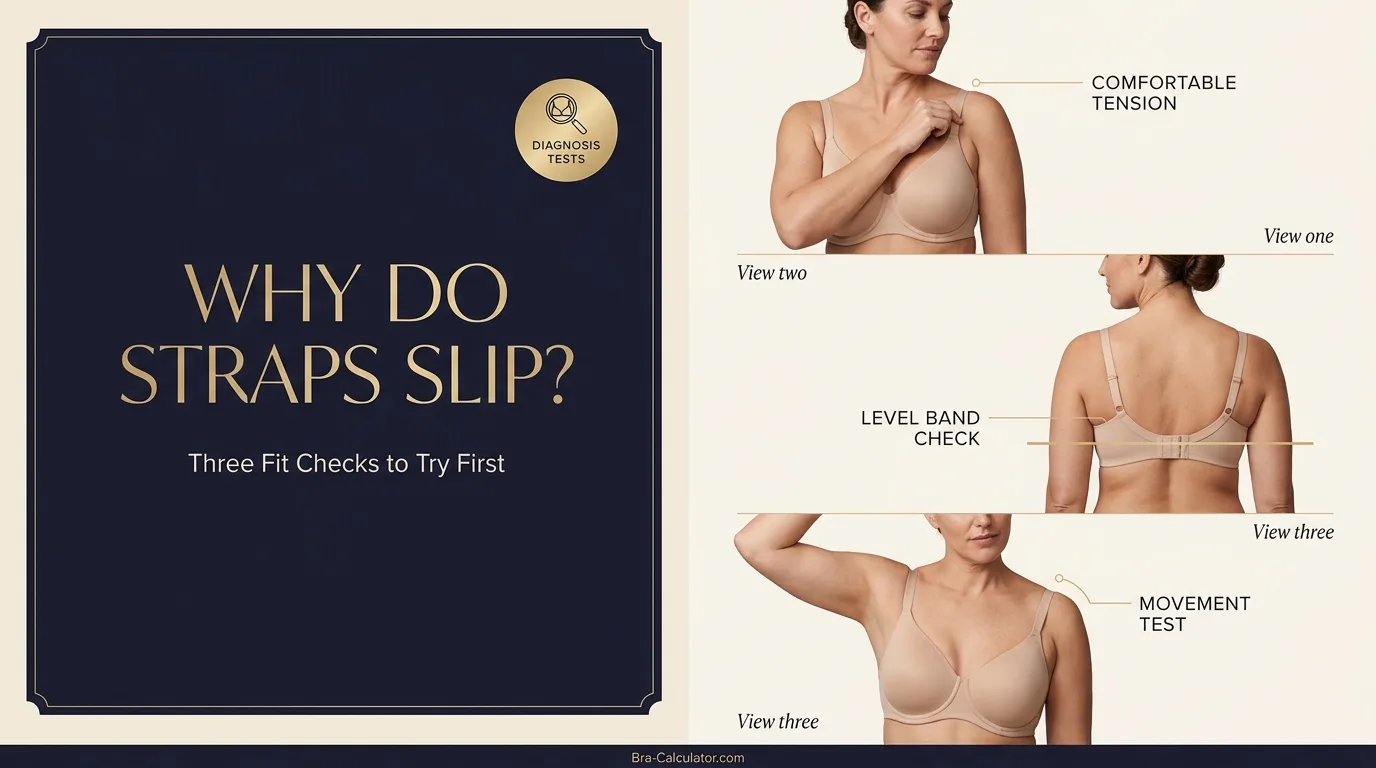
Run these tests in the bra that slips most often. Test after scooping tissue into the cups and fastening the bra on its usual hook setting.
Shorten each strap separately until it is secure but not tight. If one side needs noticeably more adjustment, your shoulders or strap elastic may be uneven.
Raise your arms, roll your shoulders, lean forward and walk for a minute. If straps fall only during movement, strap placement or band shift is likely involved.
Look in a mirror from the side or back. If the band rises up or moves when the straps slip, the band is not anchoring the bra correctly.
If your bra allows it, clip or cross the straps temporarily. If slipping stops immediately, your primary issue is likely strap spacing or shoulder slope rather than cup volume.
| What You Notice | Likely Cause | Best Next Move |
|---|---|---|
| Both straps slip while band rides up | Band too loose or stretched | Check a firmer band or sister size down. |
| Straps slip but band stays level | Wide strap position or sloping shoulders | Try U-back, center-pull or convertible straps. |
| One strap always falls | Asymmetry, posture or unequal elastic stretch | Adjust sides separately; consider a J-hook. |
| Cups gape at top and straps slip | Cup too large or wrong shape | Try a better cup shape before tightening straps. |
| Adjuster slides down during wear | Worn strap elastic or hardware | Replace the bra or use a secure style. |
Why Do Bra Straps Keep Falling Off?
1. The straps are simply adjusted too loosely
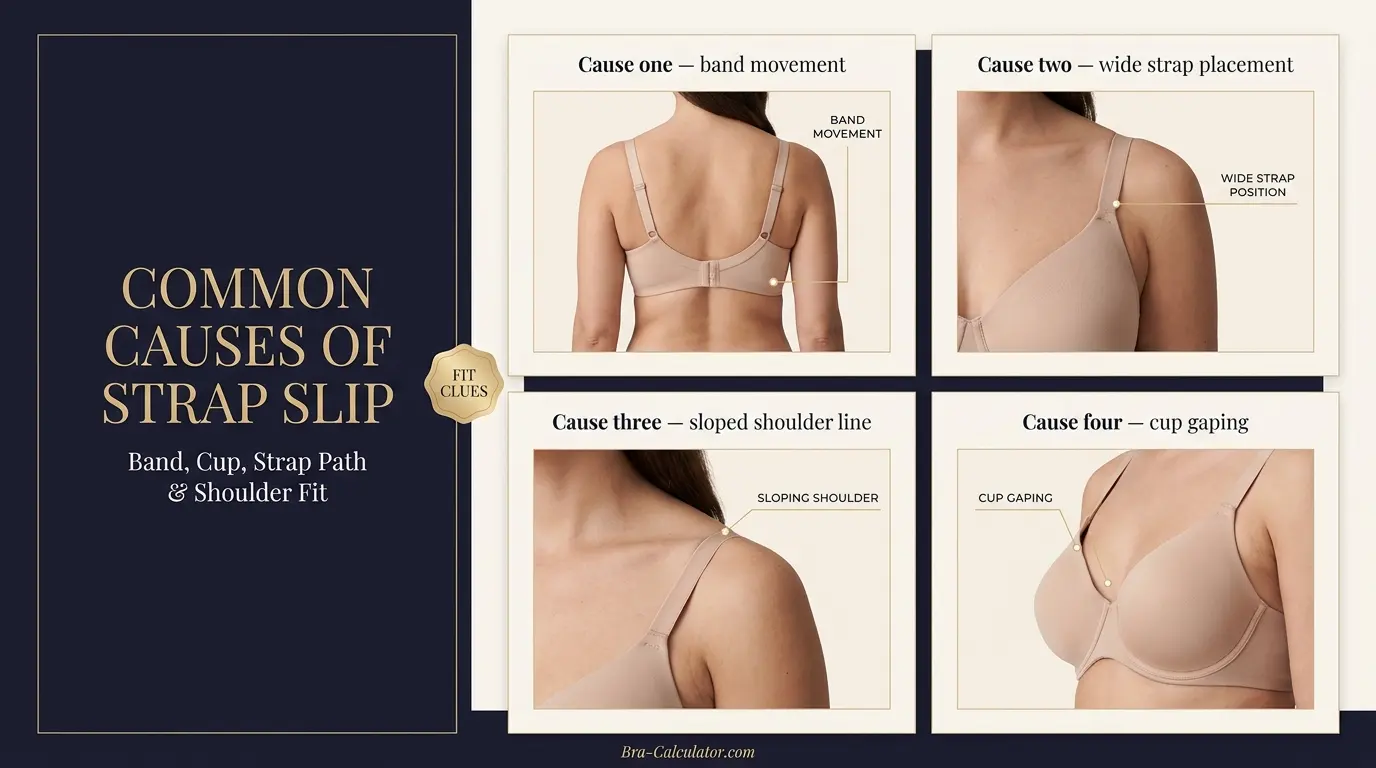
Straps can loosen after washing, repeated wear or accidental adjustment. This is the simplest cause and the easiest to fix. Adjust each strap while wearing the bra, because shoulders are rarely perfectly identical. The correct tension keeps the strap in place without indenting the skin.
2. The band is too loose or has stretched out
The band anchors the bra around your torso. When it rides up or shifts, the back strap attachment moves higher and outward, changing the angle of the straps. They can then slide off even if they are adjusted correctly. If your band moves on the tightest hook, the bra may be worn out or you may need a firmer band.
3. The straps are positioned too widely for your shoulders
Balconette, demi and fashion bras often place straps toward the outside of the cup to create a wider neckline. This can be ideal for some frames, but frustrating on narrow or sloping shoulders. The bra can fit in the cups and still be the wrong construction for your shoulder line.
4. The cups are gaping or shaped incorrectly
A cup that stands away at the upper edge may leave the strap with poor tension. This can happen when the cup is too large, too tall, or too open for your breast shape. Before tightening a slipping strap, check whether the cup edge itself sits smoothly against the body.
5. One shoulder is naturally lower or more sloped
Many people have one shoulder that sits slightly lower due to posture, dominant-side use or natural asymmetry. This does not mean your body is wrong; it means one strap may require a shorter adjustment or a construction that prevents sideways movement.
6. The strap elastic or adjuster has worn out
If straps are tightened correctly but gradually extend during wear, the problem is no longer fit adjustment. Old elastic or slipping hardware cannot hold the setting. A worn bra may need replacement even when its cups still appear fine.
Step-by-Step: How to Stop Bra Straps Slipping
Start by shortening the slipping strap only enough to keep it stable. A comfortable strap lets you slide a finger underneath without deep pressure.
If the band rises in the back or rotates, fix band support first. Stable straps are difficult to achieve when the bra foundation shifts.
If the cup gaps or the strap begins very far outward, switch cup construction rather than making the strap painfully tight.
Test a J-hook, convertible cross-back, racerback, center-pull or U-back bra. These constructions bring strap tension inward.
If the adjuster slides or straps loosen within an hour, adjustment will not be reliable. Replacement is the comfort-first fix.
How Your Shape Changes Strap Slip
Straps can fall on any body, but shoulder width, slope, posture and bra construction strongly affect which fix feels most secure.
Outer Straps Slip Easily
Wide-set straps may sit close to the shoulder edge even when the size is correct. More centered strap placement is usually more secure.
Try center-pull strapsGravity Encourages Sliding
Straps naturally move outward on a downward shoulder line. J-hooks and convertible cross-back styles can help maintain position.
Try J-hook or racerbackOne Side May Slip
Do not force both straps to the same length. Individual adjustment and an anti-slip construction usually work better.
Adjust sides separatelyBand Stability Matters More
If the band does not anchor support, strap instability becomes more obvious. Begin with band level and cup containment.
Check foundation firstCan Sister Sizing Help Slipping Straps?
Sister sizing helps only when the straps are falling because the band is loose or moving. If your band rides up while the cups otherwise feel close, moving down one band size and up one cup size can give the bra a firmer anchor without dramatically changing cup capacity.
| Situation | Try | Reason |
|---|---|---|
| Straps slip and band rides up | Down one band, up one cup | Firmer anchoring may keep strap points stable. |
| Straps slip but band is level | Keep size; change strap construction | Likely shoulder shape or wide strap placement. |
| Straps slip and cups gap | Check cup size or shape | Loose upper cups can reduce strap tension. |
| One strap slips only | Adjust individually; try convertible straps | Asymmetry is common and manageable. |
What Should You Fix First?
- Band rides up in the back
- Bra rotates while walking
- Straps slide after movement
- Band feels loose on tightest hook
- Measure your underbust again
- Try a firmer band construction
- Use sister sizing if cups fit
- Replace stretched-out bras
- Upper cup gaps
- Strap loses tension at cup edge
- Cup is tall or open
- Band remains level
- Try a lower-cut cup
- Check a smaller or better-shaped cup
- Compare within the same brand
- Do not overtighten straps
- Band and cups fit well
- Straps sit close to outer shoulder
- Shoulders slope naturally
- Slip stops when crossed
- Choose center-pull straps
- Use J-hook conversion
- Try racerback construction
- Avoid overly wide-set straps
- Adjuster moves during wear
- Elastic feels soft
- Older bra slips suddenly
- Tightening no longer lasts
- Replace worn bra
- Choose firmer elastic
- Wash gently and air dry
- Start new bra on loosest hook
Bra Styles for Straps That Stay Up
Straps attach closer to the center of the cup, reducing outward slide for narrow or sloping shoulders.
Lets you bring straps inward when needed without committing to a full-time racerback fit.
Excellent for movement days and persistent shoulder slip when standard straps will not stay positioned.
A deeper back curve can help stabilize straps while still giving a conventional neckline.
Useful when different outfits or activities require different strap security.
Outer strap placement can worsen slipping on narrow or sloped shoulders, even when cups fit.
Shop Styles That Help Bra Straps Stay Secure
These product-category recommendations are selected for strap placement and stability, not just for appearance. Always confirm your current measurement and fit symptoms before choosing a new bra.

Center-Pull Full-Coverage Bras
- Straps sit farther inward than wide-set fashion styles.
- Pairs stable strap placement with dependable everyday coverage.
- Helpful for narrow shoulders and mild shoulder slope.
- Check that the band remains level before choosing size.

J-Hook Convertible Bras
- Converts straps inward to reduce sideways slip.
- Can be worn traditionally when extra security is not needed.
- Helpful under sleeveless and active outfits.
- Avoid pulling straps so tight that they dig in.

Racerback Support Bras
- Straps are naturally held away from the shoulder edge.
- Strong option when slipping appears during movement.
- Works especially well for walking, errands and activity days.
- Choose encapsulation support when fuller bust stability is needed.
Problems Often Seen With Slipping Straps
When the band moves, the strap anchor points also move and slipping becomes harder to control.
Upper cup space can leave the strap without consistent tension, particularly in molded bras.
This commonly relates to natural shoulder asymmetry, posture or one stretched strap.
Overtightening may stop slipping temporarily but causes a different comfort problem.
Related Tools & Guides for Better Strap Fit
| Guide / Tool | Why It Helps |
|---|---|
| Bra Size Calculator | Confirm your base size before replacing a bra that slips. |
| Bra Fit Problem Solver | Check whether slipping is part of a broader fit pattern. |
| Sister Size Calculator | Adjust band support correctly when the cups otherwise fit. |
| AI Smart Fit Bra Calculator | Compare strap slip with gaping, band movement and other symptoms. |
| Breast Shape Identifier | Understand whether cup construction and strap placement suit your shape. |
| Bra Straps Digging In | Useful if tightening slipping straps has caused shoulder pressure. |
Frequently Asked Questions
Straps usually slip because they are loose, stretched out, placed too widely, or attached to a bra whose band or cups are not stable on your body. Shoulder shape also matters.
Yes. A loose band moves the bra and changes where straps sit on the shoulders. If the band rides up, check band fit before repeatedly adjusting the straps.
No. Straps should be secure without digging. Overtightening may cause shoulder pain and distort cup fit without solving the underlying band or style issue.
Center-pull full-cup bras, U-back bras, J-hook convertible styles and racerbacks often help because they place or hold the straps farther inward.
Natural shoulder asymmetry, posture and uneven strap elastic can make one side slip more. Adjust each side independently and try convertible straps if it continues.
Yes. If the upper cup does not sit against the body, strap tension may become inconsistent. A lower or better-shaped cup can work better than tighter straps.
It helps when the band is too loose or rides up while cup volume is close to right. For example, moving from 36C to 34D keeps similar cup volume with a firmer band.
Replace it when the straps or adjusters no longer hold tension, or the band remains loose at its tightest hook. Worn elastic cannot provide reliable support.
Find the Fit That Feels Secure
Straps should stay in place without being painfully tight. Use your measurement, band stability and shoulder-fit clues to choose a comfortable support solution.