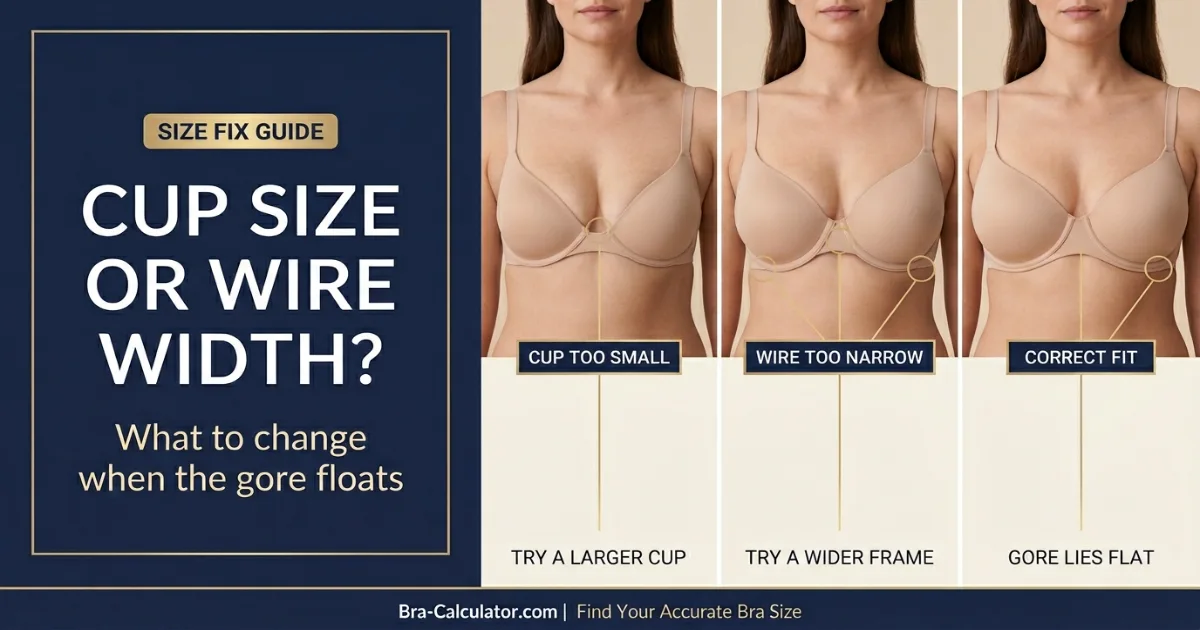
A bra center gore that lifts or floats away from the sternum is almost always a sign that the cup is too small or the underwire frame is too narrow. When the cup cannot fully contain breast tissue, the tissue pushes inward toward the centre and levers the gore away from the body. The fix is nearly always to go up in cup size — or find a wider underwire frame — until both wires sit completely on the chest wall at the natural breast root with zero pressure on breast tissue. Band stability, breast spacing and gore height are secondary factors that can keep a gore floating even after the cup is corrected.
Bra Center Gore Not Laying Flat at a Glance
| Fit Sign | What It Usually Means |
|---|---|
| Gore lifts completely away from the sternum | Cup is too small — breast tissue is pushing the underwires outward and levering the gore up. |
| Gore lies flat standing but lifts when sitting or bending | Cup is borderline too small or the underwire frame is slightly too narrow; breast tissue redistributes and creates outward pressure during movement. |
| Gore lies flat on one side but floats on the other | Natural breast asymmetry — the fuller breast is pushing its underwire out of position more than the smaller side. |
| Gore is flat but tissue spills at the sides or top | Cup may be too shallow or wrong shape even if the gore appears seated — check all overflow signs before concluding the fit is correct. |
| Gore floats even after going up in cup size | Underwire frame may still be too narrow, the gore height may not match breast spacing, or the band is too loose and the whole frame is shifting. |
| Gore is the correct height but causes pressure on the sternum | Gore is too tall or too stiff for your breast spacing — the wire ends are converging before the tissue fills the cup, creating sternal pressure rather than a true flat lie. |
What Does It Mean When the Bra Center Gore Is Floating?
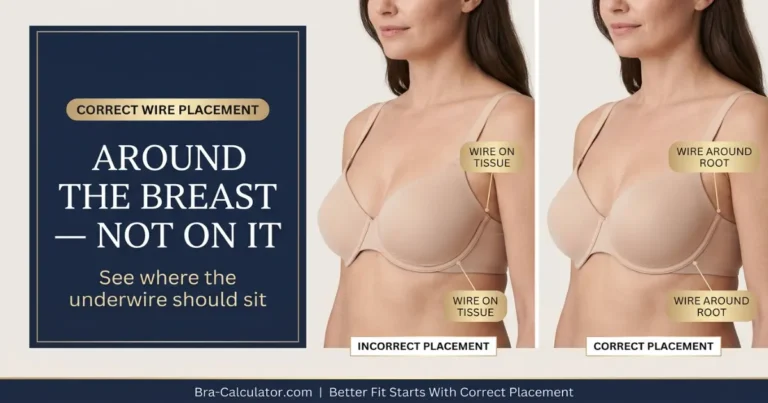
The center gore — also called the center panel or bridge — is the strip of fabric that connects the two bra cups at the front. Its job is simple but critical: it anchors the two underwires in their correct positions relative to each other and relative to the sternum, ensuring that each wire lies against the chest wall at the natural boundary of each breast rather than sitting on breast tissue.
When the gore lies flat against the sternum, it is a reliable sign that the underwires are correctly positioned. When the gore lifts away — floating an inch, two inches or more off the body — it is telling you that one or both underwires are not where they should be. Most of the time, this means the wires are sitting on breast tissue and being pushed outward by that tissue, taking the gore with them.
The reason the cup-too-small connection is so consistent is physics. Breast tissue that cannot fit inside the cup has to go somewhere — and it takes the path of least resistance, which is inward toward the sternum and outward toward the armpits. The inward push acts as a lever on the underwire ends at the gore, forcing the gore away from the body. A cup that is large enough to contain all tissue removes that lever force completely, and the gore drops flat.
The rule of thumb: If the gore is floating, the cup is probably too small. If the gore is digging into the sternum, the cup may be too large or the gore too tall for your breast spacing. These are opposite problems requiring opposite fixes — confirm which one applies before changing size.

Understanding the Center Gore: What It Is and How It Works
Before diagnosing a floating gore, it helps to understand exactly what role it plays in the bra’s structure and what “flat against the sternum” actually means anatomically.
What the Gore Actually Does
The center gore connects the two underwire channels at the front. It determines the angle at which the wires approach the sternum, the minimum distance between the two cups, and how the bra frame distributes lateral force from each side. A gore that lies flat means neither wire is under lateral outward stress — they are resting in their designed position against the chest wall.
What “Laying Flat” Means
The entire inner surface of the gore — from its top edge to its bottom edge — should be in continuous contact with the sternum. There should be no gap you can slide a finger behind, no visible lifting, and no rocking when the bra moves. This contact is only possible when both underwires are on the chest wall, not on breast tissue.
Gore Height and Breast Spacing
Gore height — how tall the center panel is — is matched to breast spacing. A tall gore sits against the sternum in a longer contact area, which works for widely spaced breasts. A short plunge gore sits low and is designed for close-set breasts with inner fullness. Wearing the wrong gore height for your breast spacing can cause floating even in the correct cup size.
Why a Small Cup Floats the Gore
Imagine pressing both palms inward against the wire ends at the gore. That is what compressed breast tissue does when the cup is too small. The inward pressure from each side acts as a lever, pushing the gore outward — up and away from the sternum. Increase cup size, remove the tissue pressure, and the lever force disappears.
Five Checks Before You Fix the Bra Gore Floating
Run these in sequence. The floating gore is a symptom, not a diagnosis in itself — these checks identify exactly which cause applies to your situation.
Put on the bra, lean forward and scoop all breast tissue from the sides and underneath fully into each cup. Check the gore position only after every bit of tissue is inside the cups. If the gore settles closer to the body after this step, the cup was close but tissue placement was contributing.
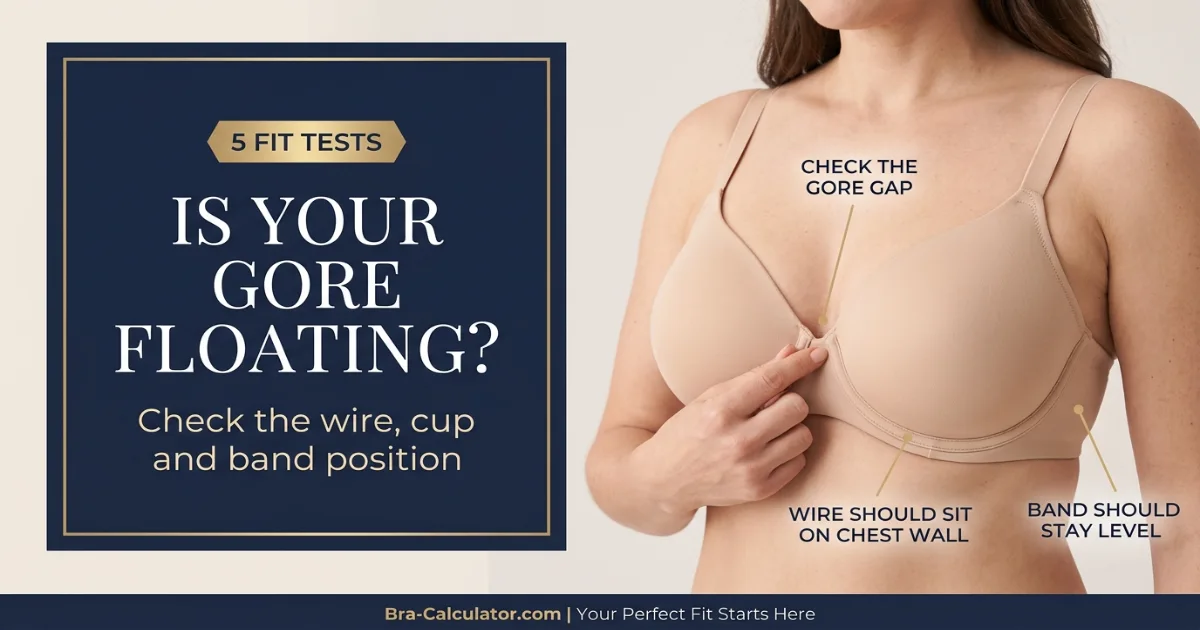
Run a finger along each underwire from the gore end to the side. The entire wire should be in contact with your chest wall — the flat bony surface between and beside the breasts. If any part of the wire is pressing into breast tissue or bouncing when you press it, the wire is not in the correct anatomical position.
Slide two fingers behind the floating gore. If you can slide them in easily, the gap is significant and the cup is almost certainly too small. If only one finger slides in barely, the gap is minor and may be a gore height or breast spacing issue rather than a major size mismatch.
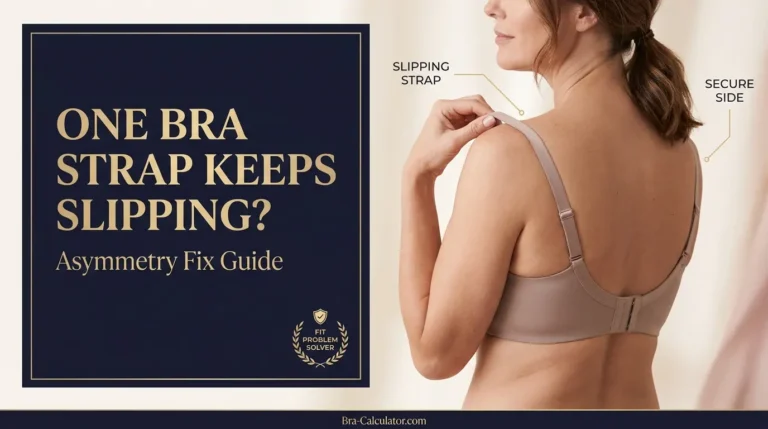
The band should be level and comfortably firm at the back. Slide two fingers under the back band — if it is very easy, the band is too loose. A rising band shifts the entire wire frame upward off the breast root and can push the gore away from the sternum regardless of cup size.
Sit in a chair and notice whether the gore floats more when seated. If it worsens significantly when sitting, the cup is borderline and breast tissue redistributes forward when you sit, increasing the outward wire pressure. A definitive cup size increase is needed rather than marginal adjustments.
| Test Result | Likely Cause | Best First Fix |
|---|---|---|
| Gore lifts significantly; wire clearly on breast tissue | Cup too small | Go up one or two cup sizes on the same band. |
| Gore lifts slightly; wire mostly on chest wall | Underwire frame marginally too narrow | Try a wider wire frame in the same or next cup size. |
| Gore lifts only when sitting or moving | Borderline cup size; breast tissue redistributes | Go up one cup size; confirm fit in both standing and seated positions. |
| Gore floats on one side only | Breast asymmetry — fuller side lifting its wire | Size to the fuller breast; the smaller side may have minor gap. |
| Band rises; gore floats as the whole frame shifts | Band too loose; frame moving off the breast root | Stabilise band with sister sizing before finalising cup size. |
Why Your Bra Center Panel Is Not Flat
1. The Cup Is Too Small
This is the primary cause in the vast majority of cases. Breast tissue that cannot fit inside the cup pushes the underwires outward, and that outward wire movement levers the gore away from the sternum. The tissue does not need to overflow visibly at the top to cause a floating gore — even modest inward tissue pressure is enough to keep the gore from anchoring.
2. The Underwire Frame Is Too Narrow
Even in the nominally correct cup size, a wire frame that is too narrow does not reach the natural side breast root. Breast tissue on the outer chest is left unsupported and pushes the wires inward and upward, creating the same lateral gore-lifting force as a too-small cup.
3. The Band Is Too Loose
A loose band cannot hold the bra frame in position. As the band rides up, the underwires are pulled upward and forward off the chest wall, removing the anchor that keeps the gore flat. The gore then floats because the wire ends are no longer pressing against a stable surface.
4. The Gore Height Does Not Match Breast Spacing
A gore that is too tall for closely set breasts creates sternal pressure — the wires converge before tissue fills the cups. A gore that is too short for widely spaced breasts cannot bridge the gap to the sternum. Both mismatch types prevent a true flat lie even when cup volume is adequate.
5. The Plunge Style Is Wrong for Your Breast Shape
Plunge bras have a very low, angled gore designed for close-set breasts with inner fullness. On bodies with wider breast spacing or less inner fullness, the low plunge gore has no breast tissue to brace against and simply floats regardless of cup size.
6. Significant Breast Asymmetry
When one breast is noticeably fuller than the other, that breast pushes its underwire outward more than the smaller side pushes its wire. This creates unequal lateral force on the gore — it may lie flat on the smaller side while floating on the fuller side, or tilt at an angle.
7. The Bra Style Has an Inherently High Gore
Some full-coverage and minimiser styles are constructed with very tall center gores. If your breast anatomy places the natural breast root lower or closer to the centre than the style assumes, the top of the gore will float even when the cup size and wire width are correct.
Step-by-Step: How to Fix the Center Gore Lifting
Work through these steps in order. The most common mistake is trying multiple style changes before confirming that the cup size itself is correct — that one step resolves the floating gore the majority of the time.
Fasten on the loosest secure hook, lean forward and scoop all breast tissue into the cups completely. Check the gore position only after full scoop-and-swoop. Tissue left in the sides creates outward wire pressure that exaggerates a floating gore.
Check band level and firmness. If the band rides up during movement, the entire wire frame is losing its anchor. Read the bra band too loose guide and stabilise the band before drawing conclusions about cup size.
Try one cup size larger on the same band size. The underwires should move toward the chest wall as the cup accommodates more tissue. The gore should drop noticeably closer to the sternum with each cup increase. If it takes two cup increases before the gore lies flat, both were needed.
If you have gone up in cup size and the gore still floats while tissue appears contained, the underwire frame may be too narrow. The wire must reach the side breast root — not stop short of it. Look for a style with a wider underwire in your confirmed cup size.
Once the cup size is correct and the wire sits on the chest wall, a persisting minor float may be a gore height or breast spacing issue. At this point — and only at this point — test a different gore height: plunge for close-set inner fullness, standard for typical spacing, higher for wider spacing.
Which Gore Height Works for Your Breast Spacing?
Gore height is the vertical measurement of the center panel. Getting it wrong can cause floating even in the perfectly correct cup size. The three main categories map to three distinct breast-spacing profiles.
Best for Close-Set Breasts
A plunge gore sits low — sometimes as little as 1–2 cm tall — and angles the cups toward the centre. It requires inner breast fullness to press against the angled wire ends and anchor the gore down. Without that inner pressure, a plunge gore floats freely because there is nothing bracing against it from the breast side.
Best for Average Breast Spacing
A standard gore height of roughly 3–6 cm suits the majority of breast anatomies. It sits flat against the sternum in the middle chest area and provides balanced lateral support for both cups. The most reliable starting point when breast spacing is average and the cup size is confirmed correct.
For Widely Spaced or Far-Apart Breasts
Breasts that start further from the centre of the sternum need a taller gore that covers more of the sternum surface and bridges the wider gap between the cup edges. A plunge or short gore on widely spaced breasts will float at the top because the breast roots are too far apart for the low gore to reach them both simultaneously.
Important order of operations: Always confirm cup size and wire width are correct first. Gore height is a secondary adjustment. Changing only the gore style without addressing a cup-too-small issue will not fix a floating gore — it will simply move the point of failure slightly.
When to Change Cup Size or Use a Sister Size
Most floating gores resolve with a cup size increase. The sister size is the appropriate tool when the band is also contributing to the problem by being too loose and allowing the wire frame to shift.
| Your Gore Situation | Try First | Why |
|---|---|---|
| Gore floats significantly; wire clearly on breast tissue; band stable | Same band, one cup larger | Cup volume insufficient — tissue is pushing the wires and levering the gore up. |
| Gore floats; wire mostly on chest wall; cup feels close | Same cup, wider underwire frame | Frame too narrow — outer tissue is pushing wires inward despite adequate volume. |
| Gore floats; band also rides up | Sister size — down band, up cup | Loose band lets the whole frame shift; firmer band anchors the wire correctly. |
| Gore flat standing; floats when sitting | One cup size larger | Borderline cup — breast tissue redistributes forward when seated and increases outward wire pressure. |
| Gore floats only on the fuller side | Size to the fuller breast overall | Asymmetry — the fuller side must set the cup size to remove the larger outward force. |
How Breast Spacing Affects Whether the Gore Lays Flat
A floating gore is not exclusively a size problem. Breast spacing — how far the natural breast roots are from the centre of the sternum — determines which gore style has any chance of lying flat regardless of cup size.
Plunge Gores Work Best
Breasts close to the centre of the sternum can brace against a low plunge gore. Standard gores may feel too tall and create pressure rather than a natural flat lie.
Try plunge stylesHigher Gores Are Needed
Breasts that start further from the sternum cannot brace a plunge gore — there is no tissue near the centre to press against it. A taller gore bridges the gap and lies flat across more of the sternum surface.
Try higher goresPlunge Anchors Well
Significant breast tissue at the inner aspect of each breast presses against the angled wires of a plunge bra and anchors the low gore effectively. This is the ideal anatomy for a plunge style to lie flat.
Plunge sits wellStandard or Higher Gore
Without tissue pressing inward against a plunge gore’s angled wires, the gore has nothing to anchor against and floats freely. A standard or higher gore with less extreme wire angles usually lies flatter.
Avoid deep plungeWhat Should You Fix First?
- Gore lifts significantly away from the body
- Underwire clearly sitting on breast tissue
- Tissue may also be overflowing at top or sides
- Band is secure and level
- Go up one cup size, keep same band
- Check gore position again after scoop-and-swoop
- Repeat if gore still floats significantly
- Verify wire is on chest wall before stopping
- Already sized up but gore still floats
- Wire ends stop short of the side breast root
- Side breast tissue escapes toward the armpit
- Cup volume seems adequate elsewhere
- Try a wider underwire frame in confirmed cup size
- Look for fuller-cup brands with wider wires
- Wire must reach to the side breast root completely
- Do not keep sizing up if wire width is the true issue
- Band rises at the back during wear
- Gore floats more as the day goes on
- Gore position worsens when you raise your arms
- Band stretches noticeably when pulled at the back
- Try sister size: down one band, up one cup
- Check the bra is fastened on the loosest hook
- Stabilise band before making any cup judgement
- A firm band anchors the wire frame in position
- Cup size confirmed correct; wire on chest wall
- Band stable and firm
- Minor floating only — not a large gap
- Gore floats at top or bottom but not both
- Map your breast spacing to the correct gore height
- Close-set: try a plunge or lower gore style
- Wide-set: try a standard or taller gore style
- Only adjust style after size and band are confirmed
Bra Styles That Help the Center Gore Lay Flat
Before any style change, the single most effective intervention is wearing the correct cup size in any style. A cup that is one full size too small will float the gore in every style; the right size allows almost any style to lie flat.
Seamed construction accommodates more projection and volume with wider underwires that are more likely to reach the natural side breast root — addressing both cup volume and wire width simultaneously.
A balconette with a standard center gore lies flat on average breast spacing when sized correctly, offering a balance of neckline coverage and center anchorage without the extreme angles of a deep plunge.
Works well when inner breast fullness braces the angled wires. Unreliable for wide-set or low-inner-fullness breast shapes regardless of cup size.
A taller gore bridges the sternum gap more fully for breasts that start further from the centre. Particularly helpful when plunge and standard gores float at the top.
A deep plunge gore on widely spaced breasts with little inner fullness will float freely regardless of cup size — there is simply no breast tissue present at the inner aspect to anchor the low, angled gore down.
Styles to Try After Confirming the Correct Cup Size
A floating gore is solved by size first. Once you have confirmed the correct cup using the steps above, these construction types offer the best starting point for a gore that stays flat through a full day of wear. Always check the retailer’s size guide before purchasing.

Full-Coverage Bras With Standard Center Gore
- A standard gore height suits the majority of breast anatomies and provides the most reliable flat-lie across the sternum when the cup is correctly sized.
- Look for styles where the gore is visibly in contact with the sternum in the product images — a gore that appears to stand away in marketing photos will stand away on the body.
- Confirm the underwire extends to your natural side breast root before purchasing — a narrow wire on a standard-gore bra can float the gore despite correct cup labelling.

Fuller-Cup Bras With Wide Underwire Frame
- A wider underwire frame reaches the natural side breast root, removing the outer tissue pressure that levers the gore up — especially important when going up in cup size alone has not fully resolved the float.
- Brands positioned for fuller cups typically offer wider wire spans that suit bodies where a standard frame leaves side tissue unsupported.
- Confirm the gore drops to the sternum after a full scoop-and-swoop in the new style — this is the definitive confirmation that the wire width and cup volume are both correct.

Wireless Bras With Firm Band and Structured Cups
- If underwire placement is consistently problematic despite correct sizing, a wireless bra eliminates the wire-position requirement entirely — there is no gore to float because there is no underwire creating lateral tension.
- For a wireless bra to provide adequate support, the band must be firmer than average and the cup must still fully contain breast tissue without wrinkles or overflow.
- Not a substitute for a correctly fitted underwire bra in most cases, but a legitimate everyday option when repeated underwire fit issues are affecting comfort and support quality.
Problems That Appear Alongside a Floating Center Gore
If the cup is too small enough to float the gore, it is usually also too small to contain all breast tissue at the top. Double bust and a floating gore frequently appear together because they share the same root cause: insufficient cup volume.
An underwire sitting on breast tissue rather than the chest wall digs in as well as levering the gore upward. Digging and gore floating often come as a pair — the wire is in the wrong position for both problems at once.
A wire that sits on breast tissue rather than the chest wall is under greater flex stress at its anchor points in the casing. Persistent gore floating from a cup that is too small accelerates underwire casing failure at the center front end.
A loose band shifts the whole wire frame off the breast root and can cause the gore to float even when the cup is close to correct. Band instability and a floating gore must be diagnosed separately to avoid making unnecessary cup changes.
Frequently Asked Questions
Why is my bra center gore not laying flat?
In the vast majority of cases, a floating center gore means the bra cup is too small. Breast tissue that cannot fit inside the cup pushes the underwires outward, and that outward wire movement levers the gore away from the sternum. Going up in cup size — enough that both underwires lie completely on the chest wall with no pressure on breast tissue — is the primary and usually sufficient fix.
Does a floating gore always mean the bra is too small?
Almost always yes, in terms of cup volume or underwire width. In rare cases a gore can float because the gore height does not match the wearer’s breast spacing — a plunge gore floating on widely spaced breasts, for example. But cup-too-small accounts for the large majority of floating gore cases and should be addressed first before any style change.
How do I fix a bra gore that won’t lay flat?
Start by fitting the bra correctly with a full scoop-and-swoop and a stable band. If the gore still floats, go up one cup size while keeping the same band size. Check whether the underwire now sits fully on the chest wall. If the gore still floats after cup sizing, assess whether the underwire frame is too narrow or the gore height does not match your breast spacing.
Can a plunge bra gore ever lay flat?
Yes, but only when the breast shape has close spacing and significant inner fullness to brace against the angled wire ends. On bodies with wider breast spacing or less inner fullness, a plunge gore will float regardless of cup size because there is no breast tissue pressing against the inner aspect of the wire to anchor it down.
What is the correct position for a bra center gore?
The full inner surface of the gore should be in continuous contact with the sternum — no gap at the top, no gap at the bottom, no rocking when the bra moves. Both underwires must simultaneously be lying completely on the chest wall at the natural breast root. When those two conditions are met, the gore lies flat.
Can a loose band cause the center gore to float?
Yes, indirectly. A loose band allows the entire bra frame to rise and shift. When the frame moves upward, the underwires move off the breast root and onto breast tissue, creating the same outward pressure on the gore that a too-small cup creates. Stabilise the band and reassess the cup before drawing any final conclusions.
Why does my gore float only when I sit down?
Sitting causes breast tissue to redistribute — it shifts forward and inward. If the cup is a borderline size, there may be just enough tissue at rest to allow the gore to sit close, but when you sit the additional forward tissue movement creates enough outward wire pressure to lift the gore. A definitive cup size increase is the fix, not a marginal one.
Is a floating bra gore something I can ignore?
No. A floating gore is not cosmetic. It means the underwires are not in their anatomically correct position — they are sitting on breast tissue and causing localised compression, contributing to double bust, accelerating underwire casing wear, and providing less overall support than a correctly positioned bra. It should always be addressed with a cup size correction.
A Flat Gore Starts With the Right Cup Size
When the cup is correct and the underwires sit on the chest wall where they belong, the center gore drops to the sternum on its own. Use the free calculator to find your accurate size, then apply the wire position and gore style checks above to dial in the rest.