Band size for men is the ribcage measurement taken directly under the chest tissue. Wrap a soft tape measure around your ribcage under the chest, keep it level all the way around, and use snug but natural tension. The closest even number is usually a practical starting band size. For gynecomastia support, band size helps anchor the garment, but final comfort depends on breathing, shoulder pressure, chest movement, torso shape and the garment type.
Band Size for Men at a Glance
| Band-Size Point | What It Means |
|---|---|
| Band size | The under-chest/ribcage measurement that gives the base support size. |
| Measurement location | Directly under the chest tissue, not over the fullest chest and not around the stomach. |
| Tape tension | Snug and level, but not tight enough to dig into the ribs or change breathing. |
| Rounding rule | Use the nearest even band size as a starting point, then adjust based on comfort. |
| Gynecomastia support role | The band anchors support so the shoulders are not doing all the work. |
| Medical meaning | Band size is only a support measurement; it does not diagnose gynecomastia. |
What Does Bra Band Size Mean for Men?
Band size is the measurement around the ribcage directly under the chest tissue. In bra-style sizing, it is the base number before the cup letter, such as 36B or 40C. For men choosing gynecomastia support, the band measurement helps determine how the garment anchors around the torso.
This matters because support should not hang only from the shoulders. If the base support is too loose, the garment may ride up, shift, or rely on straps to hold the chest. If the base support is too tight, it can restrict breathing, press into the ribs, create discomfort and make the garment unrealistic for daily wear.
Men’s band size is not the same as T-shirt size. A T-shirt may say medium or large, but a support garment needs more precise information: ribcage size, fullest chest, torso length, shoulder width and how much compression you can comfortably tolerate.
Fit truth: The band should feel like a stable base, not a rib cage clamp. It should stay level and supportive while still allowing normal breathing.
How to Find Band Size for Men Bra Support
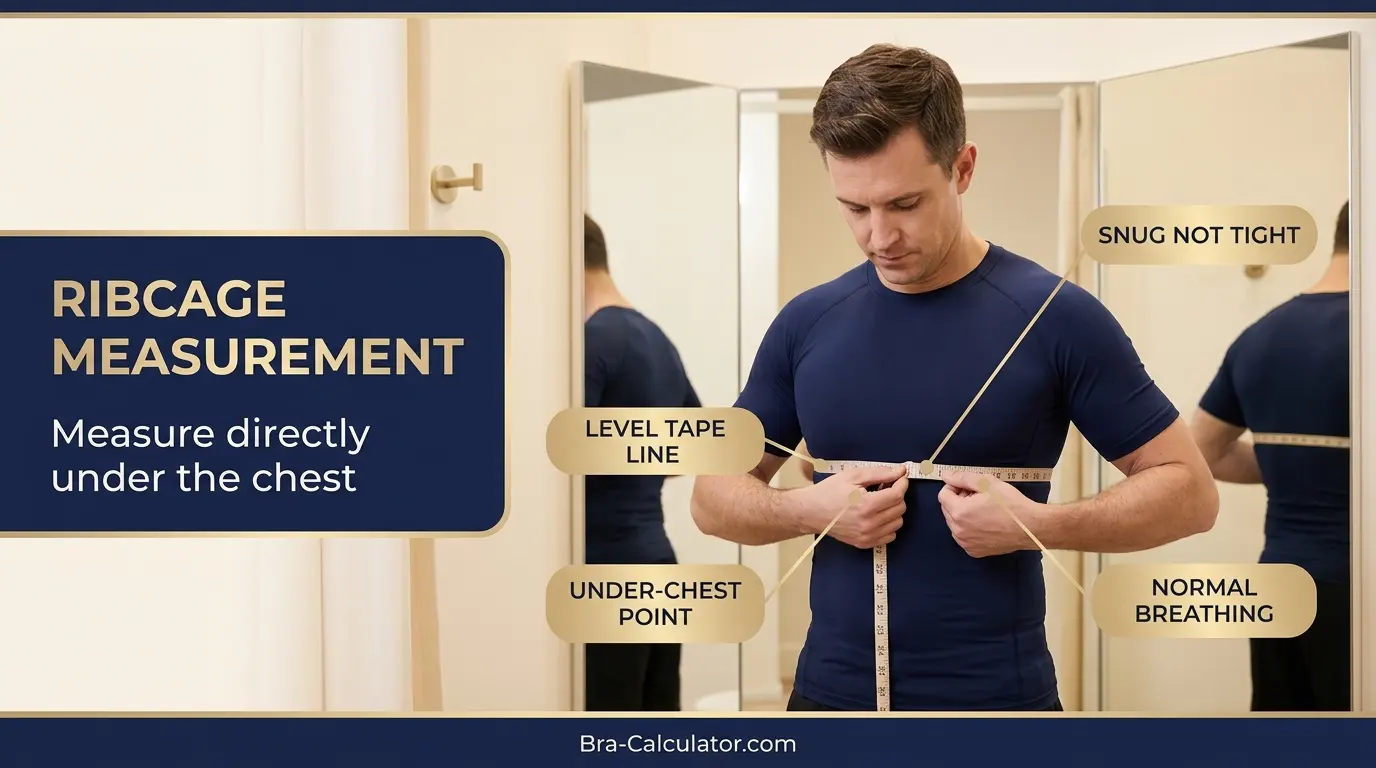
Use this method when choosing a bra-style support top, soft support garment, or any men’s chest support product that asks for band size. A mirror helps you keep the tape level, especially across the back.
Stand upright with shoulders relaxed and arms down. Do not puff out the chest, hold your breath or pull your stomach in. Your normal posture gives the most realistic support size.
Wrap the tape around the ribcage directly below the chest tissue. This is the ribcage measurement men’s bra support uses as the band-size base.
Check that the tape is not dipping at the back or sliding over the stomach. It should sit in one horizontal line around the front, sides and back.
The tape should touch the body and stay flat, but it should not dig in, compress your ribs or make breathing feel smaller. Tight measuring creates a painful band size.
Most bra-style support uses even band numbers. If your under-chest measures close to 35 inches, 36 is usually a practical starting point. If you are between sizes, use comfort checks before deciding.
Band size alone is not enough. Measure your fullest chest too, then use the men’s bra size calculator for a starting support recommendation.
Men’s Bra Band Size Chart by Ribcage Measurement
Use this chart as a practical starting point. Brand charts can vary, especially between bra-style support tops, compression shirts and gynecomastia vests, so always confirm with fit checks.
| Snug Under-Chest / Ribcage | Starting Band Size | Fit Meaning | Watch For |
|---|---|---|---|
| 27–28 in | 28 | Very small band Usually needs careful brand matching. | Avoid overly narrow straps or short torso cuts. |
| 29–30 in | 30 | Small band Good for soft support tops or light compression. | Check if cups or front panel feel too small. |
| 31–32 in | 32 | Common small-medium Often fits compression tanks and bra-style support. | Watch shoulder digging if front volume is higher. |
| 33–34 in | 34 | Medium base Often needs balanced band and front coverage. | Do not size down if breathing feels restricted. |
| 35–36 in | 36 | Common medium-large Good starting band for many support tops. | Check if the garment rolls at the waist. |
| 37–38 in | 38 | Large base Often benefits from wider shoulders or longline cuts. | Avoid short compression shirts if you have a larger stomach. |
| 39–40 in | 40 | XL base May need stable hem and stronger front support. | Watch for riding up and shoulder pressure. |
| 41–42 in | 42 | Extended base Often works better with vests or longline support. | Check torso length and breathability. |
| 43–46 in | 44–46 | Extended sizes Choose brand charts carefully. | Prioritize stable hem, wide shoulders and breathable fabric. |
| 47–52 in | 48–52 | High coverage May need extended-size support garments. | Do not force a smaller band for flattening. |
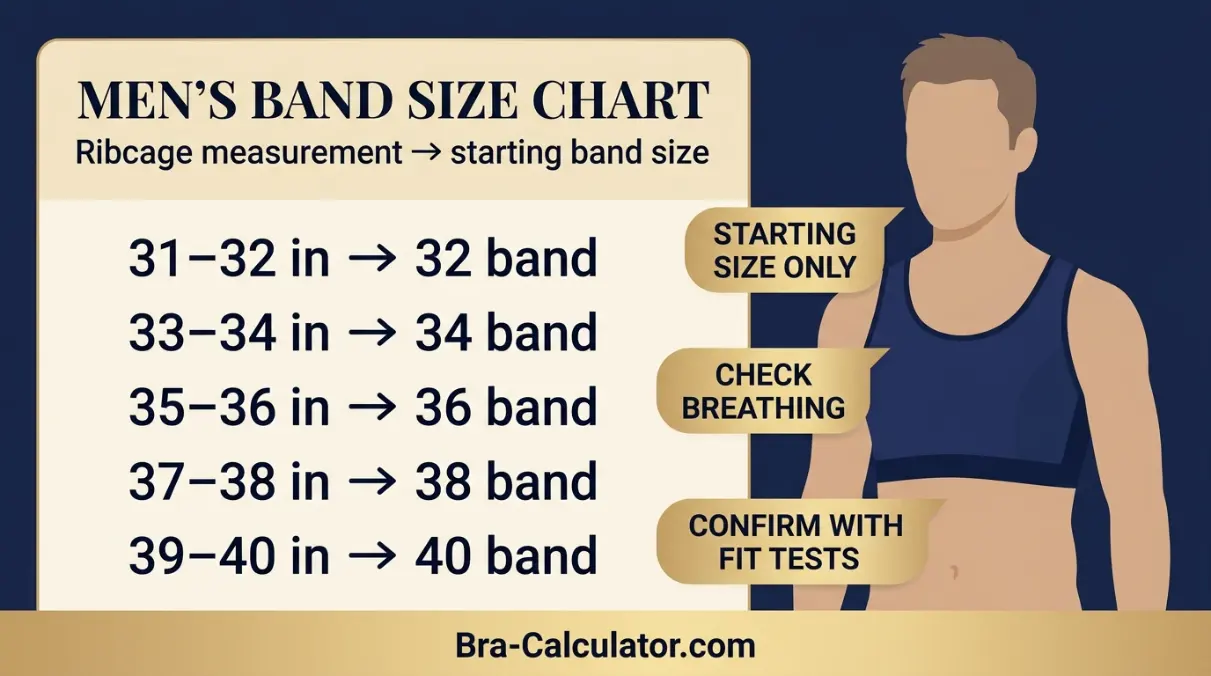
Important: This chart is for support sizing only. It does not diagnose gynecomastia, grade severity or identify the cause of chest fullness.
Should Men Round Band Size Up or Down?
Most bra-style band sizes use even numbers. That means many men will measure between available band sizes. The best answer is not always “round down for support.” For gynecomastia comfort, the better rule is: choose the smallest band that stays supportive without restricting breathing or digging into the ribs.
| Situation | Better Choice | Why |
|---|---|---|
| You measure exactly on an even number | Start with that band size | Example: 36 inches usually starts at 36 band. |
| You measure between even numbers | Try nearest even band | Use comfort checks rather than forcing one rule. |
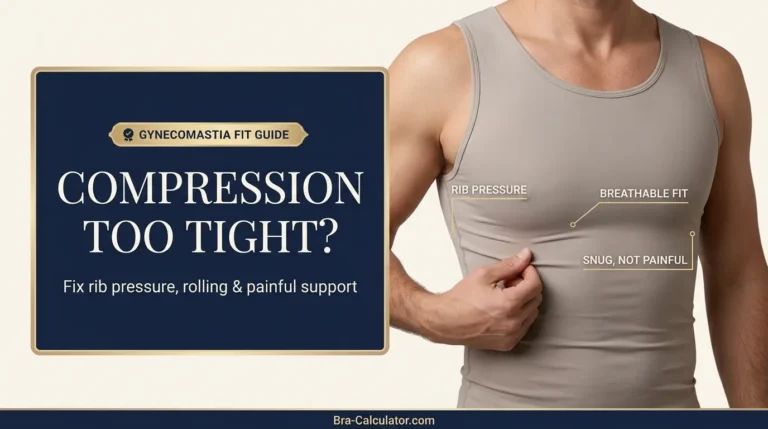
| Band restricts breathing | Size up or reduce compression | Support should not make breathing smaller. |
| Band rides up or shifts | Try firmer band or different support type | The base may be too loose or the garment may lack structure. |
| Chest still moves but band feels tight | Change support structure | The issue may be front support, not band size. |
How a Men’s Bra Band Should Fit and Feel
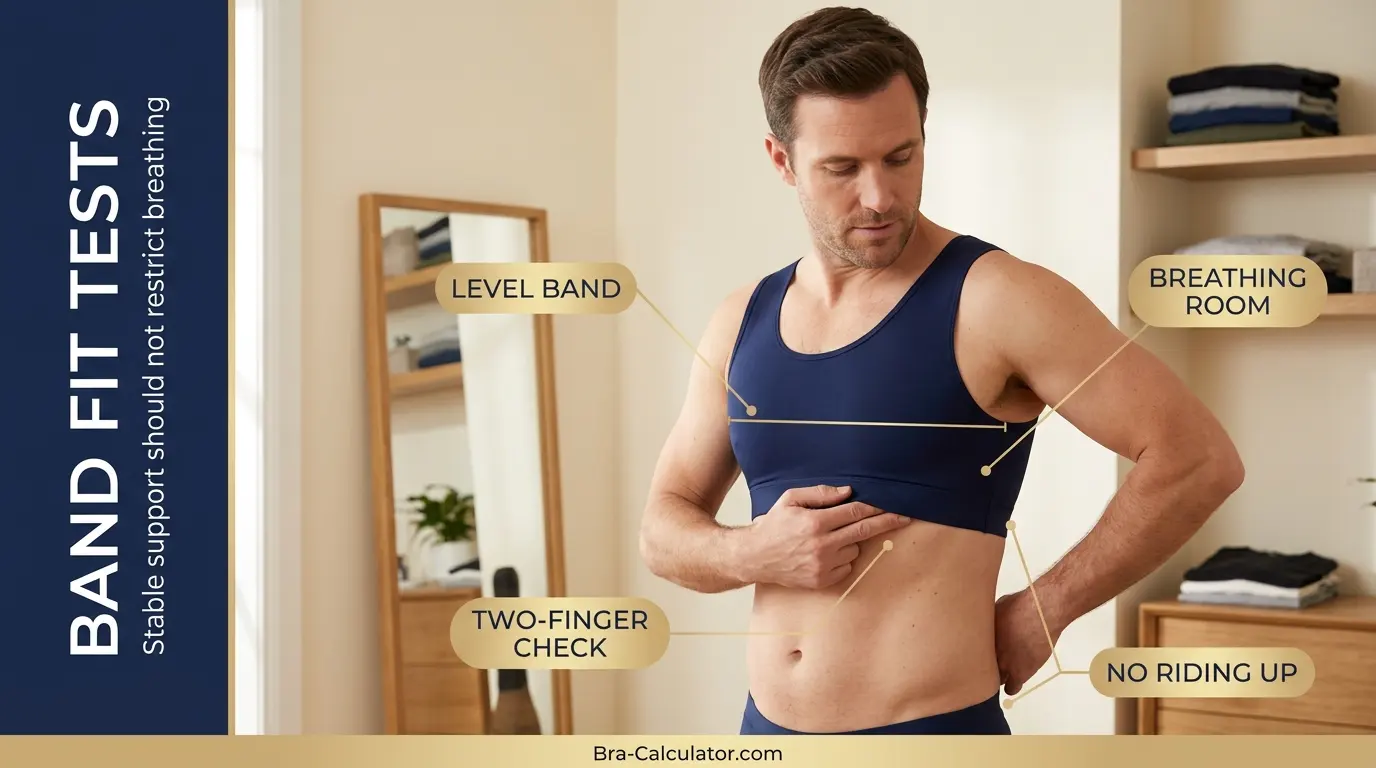
After measuring, try the garment and check the band on your body. A good band should create stability without making you constantly aware of your ribs, shoulders or breathing.
| Band Fit Test | Good Sign | Problem Sign |
|---|---|---|
| Level band | The band stays level around front, sides and back. | The back rides up or the front slides down. |
| Breathing | You can take a full breath while standing and sitting. | Rib pressure or breathing restriction appears. |
| Two-finger check | You can slide two fingers under the band with mild resistance. | The band is either painfully tight or loose enough to gap. |
| Shoulder load | Shoulders feel relaxed because the base is helping support. | Straps or shoulder areas carry most of the tension. |
| Movement | The garment stays stable when walking, sitting and lifting arms. | Band rolls, twists, rides up or shifts after a few minutes. |
Common Mistakes When Measuring Male Bra Band Size
1. Measuring Too Low
Measuring around the stomach instead of directly under the chest gives the wrong base size for bra-style support.
2. Pulling the Tape Painfully Tight
A smaller number can look like “more support,” but it often creates a band that digs, restricts breathing or feels impossible to wear.
3. Letting the Tape Dip at the Back
If the tape slopes upward or downward, the measurement will not represent the actual band line.
4. Confusing Band Size With Chest Size
Band size is under the chest. Fullest chest is measured across the largest part of the chest. Mixing them creates wrong support sizing.
5. Buying by T-Shirt Size Only
A large T-shirt does not automatically mean a large band. T-shirts and support garments solve different fit problems.
6. Ignoring Band Behavior After Wearing
A band can feel fine standing still but ride up or dig after sitting, walking or lifting arms.
Does Band Size Matter for Every Men’s Support Garment?
Band size matters most when the garment uses bra-style support or a defined base band. Compression undershirts and vests may use chest circumference or S–4XL sizing instead, but the ribcage measurement still helps understand how much base support your body needs.
| Garment Type | How Band Size Applies | What Else to Check |
|---|---|---|
| Bra-style support top | Band size is essential because the base anchors support. | Cup/front depth and shoulder comfort. |
| Soft wireless support | Band size helps keep support from shifting upward. | Tenderness, front coverage and fabric softness. |
| Compression undershirt | Band size is indirect; chest, waist and torso length matter more. | Hem roll, shirt visibility and breathing. |
| Compression tank | Band logic helps, but shoulder width and length are also critical. | Strap visibility and shoulder digging. |
| Gynecomastia vest | Ribcage measurement helps estimate base pressure. | Compression level, front panel and closure comfort. |
| Sports compression top | Band size is less direct, but rib comfort still matters. | Breathability, stretch recovery and movement. |
Why the Same Band Size Fits Men Differently
Two men can measure the same ribcage size but need different support because torso length, chest volume, shoulder width and stomach shape change how a band behaves.
Band May Feel Short
Wide torsos may need wider side panels or broader shoulder coverage for stability.
Check side widthBand May Shift
A correct band can still move if the front support is too wide or straps sit too far out.
Check placementBand vs Hem Conflict
The band may fit but lower compression can roll at the stomach if the garment is too short.
Try longlineLength Matters
A correct band size will not stop a short garment from riding up during sitting or bending.
Measure lengthPressure Sensitivity
A technically correct band can feel wrong if it presses too close to tender tissue.
Try softer bandStability Needed
Walking, lifting or workouts may require firmer base support than casual wear.
Test movementDo Not Guess
Recovery compression should follow clinician garment instructions, not casual band-size rules.
Clinical sizingComfort Decides
Use breathing, rib pressure and ride-up tests to choose the better band.
Fit test firstWhat Should You Fix First?
- Rib pressure or breathing restriction
- Red marks that feel painful
- You cannot wear it longer than a short time
- Size up one band or reduce compression
- Use snug, not tight, measurement
- Choose comfort over forced flattening
- Band gaps away from the body
- Chest support shifts when walking
- Shoulders carry most of the pressure
- Try a smaller band if breathing stays comfortable
- Choose firmer base support
- Check whether front panel is too shallow
- Back rides upward
- Front slides or shifts
- Garment needs constant adjustment
- Try a firmer band or different style
- Reduce shoulder tension
- Check torso length and hem stability
- Band fits but chest still moves
- Compression shirt rolls despite correct ribcage size
- Support works standing but fails during daily use
- Change garment category
- Try longline shirt, vest or soft support top
- Do not solve every problem with a tighter band
What Better Band Sizing Usually Improves First
These are practical fit outcomes, not medical claims. The goal is to make support feel more stable and less annoying during real daily wear.
“The support stopped riding up.”
When the ribcage measurement is correct and the band stays level, the garment usually shifts less and does not rely as much on shoulder tension.
“I stopped choosing painful compression.”
Many men realize that a tighter band is not always better. Stable support comes from the right base, fabric, length and garment category together.
Important: If your measured band size looks correct but the garment hurts, rolls, rides up or restricts breathing, the band number is not the full answer. Change the fit or support type.
References and Medical Disclaimer
This guide is for comfort, measurement and support sizing education. It is not medical advice and does not diagnose or treat gynecomastia. Band size can help choose a support garment, but it cannot identify the cause of chest fullness or replace professional evaluation.
Seek medical advice if you notice a new hard lump, sudden swelling, one-sided rapid change, nipple discharge, skin dimpling, redness, bleeding, severe pain or any symptom that feels unusual for you.
Frequently Asked Questions
What is band size for men in bra sizing?
Band size for men is the ribcage measurement taken directly under the chest tissue. It gives the base support size for bra-style support tops and helps estimate the starting size for gynecomastia support garments.
How do men find bra band size?
Measure snugly around the ribcage directly under the chest, keep the tape level and relaxed, then use the nearest even band size as a starting point. Confirm with breathing, shoulder and comfort checks.
Where should men measure ribcage for bra band size?
Measure around the ribcage directly under the chest tissue, not across the fullest chest and not around the stomach. The tape should sit level across the front, sides and back.
Should men round band size up or down?
Use the nearest even number as a starting point. If you are between sizes, choose based on comfort: size up if breathing or rib pressure is a concern, and use support type rather than painful tightness for more hold.
Is male bra band size the same as T-shirt size?
No. T-shirt size is based on general garment fit, while male bra band size is based on ribcage measurement under the chest. A man can wear a large T-shirt but still need a different support band size.
What if my bra band rides up as a man?
If the band rides up, the band may be too loose, the shoulder straps may be doing too much work, or the garment may lack stable support. Try a firmer band fit, wider shoulder design or a different support type.
Can band size diagnose gynecomastia?
No. Band size only measures the ribcage for support sizing. It cannot diagnose gynecomastia or distinguish glandular tissue from fat-related chest fullness.
When should men seek medical advice about chest changes?
Seek medical advice for sudden swelling, a hard lump, ongoing pain, nipple discharge, bleeding, skin changes or fast one-sided enlargement.
Now Pair Your Band Size With Fullest Chest
Once you know your ribcage band measurement, enter it with your fullest chest measurement into the men’s bra size calculator for a practical starting support size.