32DD vs 34C: Are These Sister Sizes?
A complete comparison of band size, cup volume, support, and fit — so you can find the size that truly works for your body.
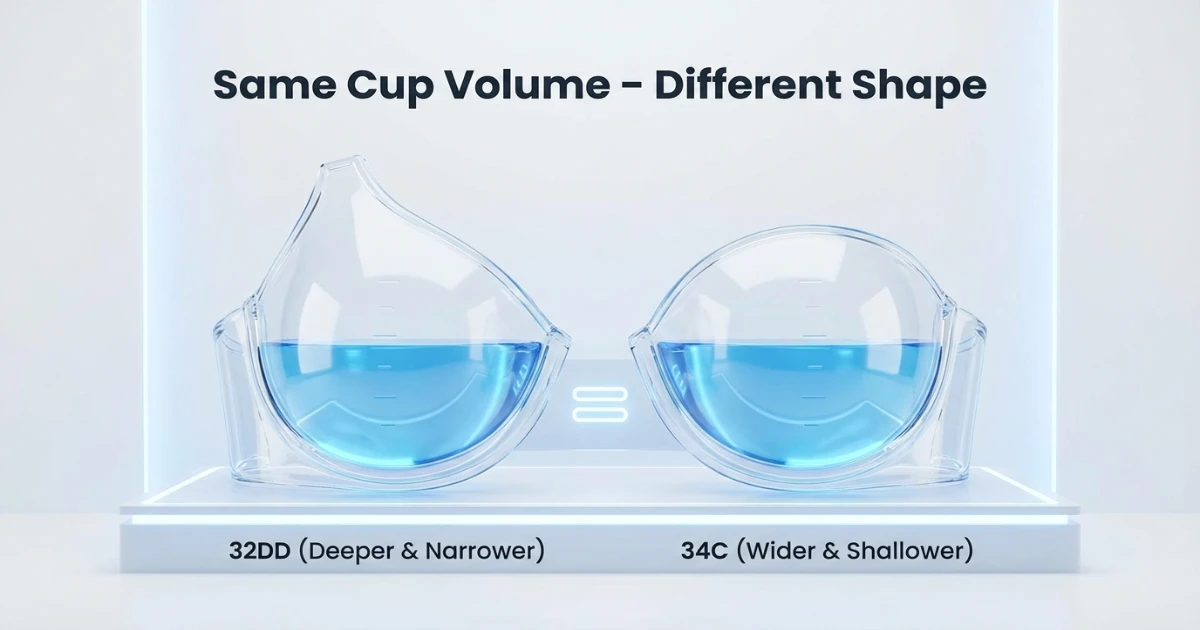
When shopping for a bra, you might notice that two different sizes can look almost identical on a hanger but feel completely different on your body. 32DD and 34C are a perfect example. These two sizes are discussed endlessly in fitting rooms and forums because, on paper, they share very similar cup volume — yet they behave quite differently during wear.
This guide breaks down exactly how these two sizes relate to each other, when each one is the right choice, and how to tell which one your ribcage actually needs. Whether you are currently wearing one of these sizes or are trying to switch between them, you will find precise, science-based guidance below. You can also use the bra size calculator at bra-calculator.com as your primary sizing reference throughout this process.
32DD and 34C are sister sizes, meaning they hold nearly the same cup volume but use different band sizes. A 32DD has a tighter band with slightly deeper cups, while a 34C has a looser band with slightly wider cups. The right choice depends on ribcage measurement and band comfort.
Key Takeaways
- 32DD and 34C are confirmed sister sizes sharing nearly identical cup volume.
- The 32 band sits about two inches tighter around the ribcage than the 34 band.
- A tighter band provides more lift and structural support for the breast tissue.
- Cup letters are not universal — “DD” in a 32 equals roughly “C” in a 34 in terms of actual volume.
- Your correct size depends on your underbust measurement, not just cup preference.
- Switching between sister sizes is possible, but may require strap or hook adjustment.
Choose the fit signs you notice in the band, cups, center and straps. We’ll turn them into a practical next step for 32DD.
Private fit check — your answers stay in your browser and are used only for this on-page guidance. Nothing is stored or submitted.
What Does 32DD Mean?
The number 32 in a bra size refers to the band size — the circumference of the bra’s underband, measured in inches around the ribcage just beneath the breasts. A 32-inch band is considered a smaller band size, generally fitting someone whose underbust measures approximately 30 to 32 inches depending on the brand’s grading.
The DD cup designation describes the difference between the full bust measurement and the band measurement. In UK-origin sizing (which most English-language labelling follows), DD represents approximately a 5-inch bust-to-band difference. In US sizing, DD is sometimes equated to a 4-inch or 5-inch difference depending on the manufacturer.
Together, 32DD describes a relatively snug band with moderately deep cup projection. The band does the heavy lifting — literally — by anchoring the bra firmly to the ribcage, which translates directly into uplift and shape. People who wear a 32DD tend to have a narrower ribcage relative to their breast volume.
What Does 34C Mean?
The 34 band fits a ribcage roughly two inches larger in circumference than a 32 band. A 34-inch band suits someone whose underbust measures approximately 32 to 34 inches depending on the fit standard. It is one of the most commonly stocked band sizes in mainstream retail, which is one reason many people end up in a 34 even when their body calls for a 32.
The C cup indicates roughly a 3-inch difference between full bust and band measurement. At first glance, a C cup sounds significantly smaller than a DD cup — and in everyday conversation it often is treated that way. However, this comparison only holds within the same band size. Across band sizes, the math changes entirely, which is exactly why sister sizing exists. You can explore more about this in the 34C bra size guide for a deeper breakdown of this specific size.
Are 32DD and 34C Sister Sizes?
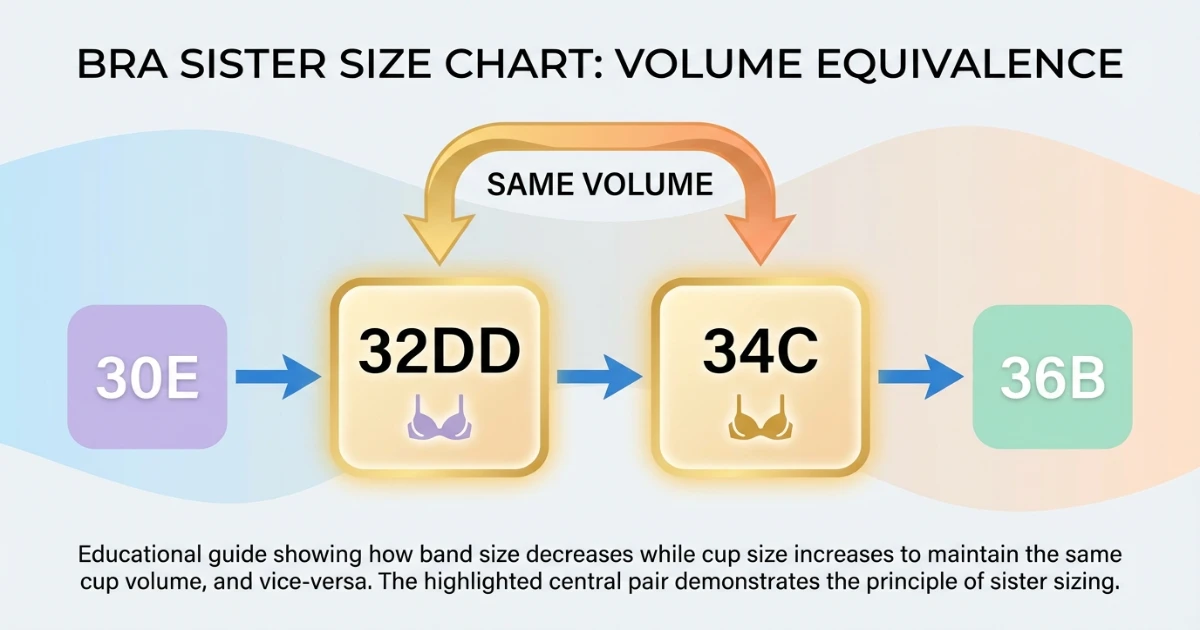
Yes, 32DD and 34C are sister sizes. Sister sizing is a system in bra fitting that recognises how cup volume changes relative to the band. When you go up one band size, the cup letter drops by one to maintain equivalent volume. When you go down one band size, the cup letter increases by one.
The chain above shows how the same approximate cup volume travels across band sizes. As the band number increases by 2, the cup letter steps back by one. As the band number decreases by 2, the cup letter steps forward by one. This is why 32DD sits directly adjacent to 34C in the sister size sequence — they share the same cup volume tier.
You can verify your own sister sizes instantly using the Sister Size Bra Calculator, which maps your current size to its equivalents. For a broader visual overview, the sister sizes educational page explains the full concept in detail.
For other related comparisons in this size neighbourhood, see 32D vs 34C and 34C vs 34D.
Cup Volume Comparison Explained
Cup volume in a bra is not defined by the letter alone — it is defined by the combination of the letter and the band number. This is the single most misunderstood principle in bra sizing and the reason many people end up in the wrong size for years.
In practice, a 32DD cup tends to have a narrower, deeper shape — it projects more forward. A 34C cup tends to have a slightly wider, shallower shape — it spreads more across a broader chest. Both hold roughly the same amount of breast tissue, but the geometry differs. People whose breast tissue is more projected and close-set often find the 32DD shape more accommodating, while those with wider-set or shallower breast tissue may find the 34C cuts out better.
For a visual explanation of how cup shapes vary, the cup size visuals resource shows exactly how cup depth and width shift across sizes.
| Feature | 32DD | 34C |
|---|---|---|
| Band size (inches) | 32 | 34 |
| Cup letter | DD | C |
| Bust–band difference | ~5 inches | ~3 inches |
| Cup volume (relative) | Equivalent | Equivalent |
| Cup shape tendency | Narrower, deeper projection | Wider, shallower projection |
| Band tension | Tighter / firmer | Looser / softer |
| Lift and support | Higher lift | Moderate lift |
| Typical underbust fit | 30–32 in ribcage | 32–34 in ribcage |
| Sister size relationship | Direct sister sizes — equivalent volume | |
Band Size Difference Explained
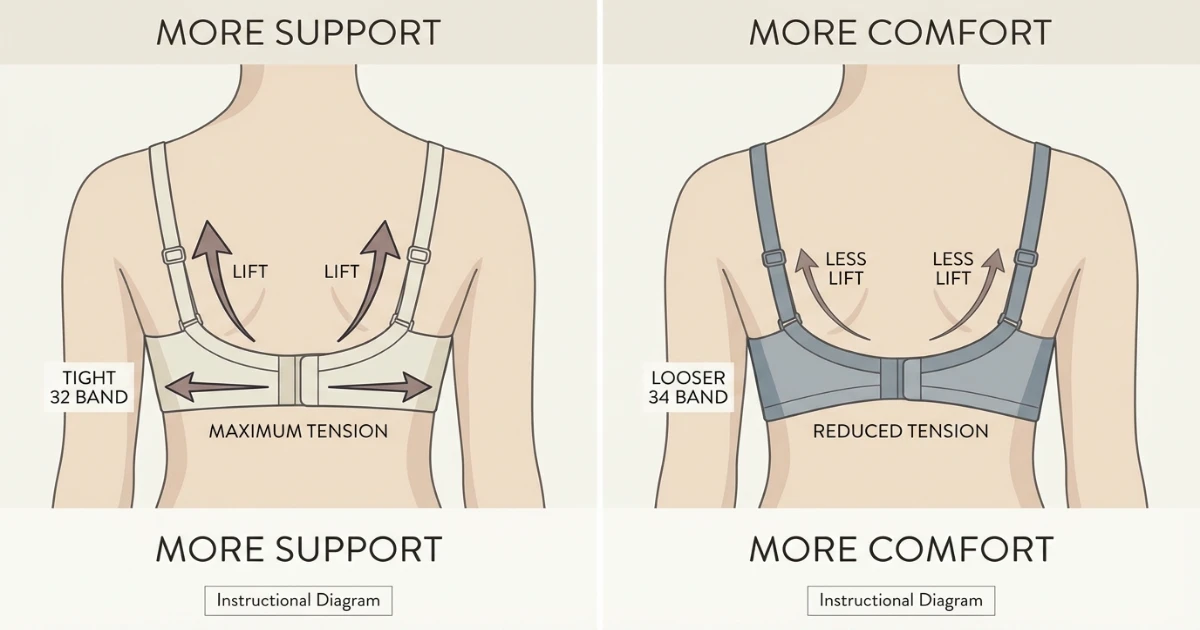
The two-inch band difference between a 32 and a 34 might sound trivial, but it has significant consequences for how a bra performs on your body. The band carries approximately 80 percent of a bra’s total support load. This means band fit is not a secondary consideration — it is the primary one.
What a Tighter Band (32) Does
- Anchors more firmly beneath the bust, preventing the bra from riding up at the back.
- Distributes weight more evenly across the ribcage, reducing shoulder strap pressure.
- Lifts the breast tissue higher relative to the chest wall, creating more defined shape.
- Reduces bounce and movement during daily activity or exercise.
What a Looser Band (34) Does
- Sits with more ease around the ribcage, which some wearers find more comfortable throughout the day.
- Is more forgiving of minor measurement fluctuations (water retention, weight changes).
- May allow more back-band movement if the fit is not carefully calibrated.
- Places more tension on the shoulder straps to compensate for reduced band support.
The fit science is clear: if your underbust genuinely measures in the 30–32-inch range, wearing a 34 band means you are wearing a band that is too loose. You may compensate without realising it by over-tightening straps, which leads to shoulder and neck strain over time. Conversely, if your ribcage measures 32–34 inches, forcing a 32 band may feel uncomfortably restrictive, particularly after meals or during movement.
Visual Fit Differences
Beyond the numbers, the two sizes produce visibly different results when worn:
- Back band height: A well-fitted 32 band sits level and close to the body across the back. A 34 band on a 32-inch ribcage will typically ride up toward the shoulder blades — a classic sign of a too-large band.
- Underwire placement: In the correct band size, the underwire lies flat against the ribcage and fully encases the breast tissue. In a too-large band, the underwire may float or gap, leaving tissue unsupported at the sides.
- Cup projection: 32DD cups project forward slightly more than 34C cups on the same body, which affects how clothing drapes over the chest.
- Strap tension: In a correctly fitted 32 band, straps carry less tension. You should be able to slide two fingers under the strap without difficulty.
For a comprehensive checklist of how a bra should look and feel when the fit is correct, visit How to Know Your Bra Fits.
Who Should Wear 32DD?
A 32DD is likely the better fit for you if:
- Your underbust (measured snugly, directly beneath the breasts) falls between 30 and 32 inches.
- You have previously worn a 34C but found the band riding up at the back.
- Your straps were doing most of the support work, leaving red marks on your shoulders.
- You have narrow shoulders or a petite frame and find standard bands feel loose even on the tightest hook.
- You want maximum lift without an underwire that digs — a snug band naturally elevates tissue.
- You are active and need a bra that stays firmly in place during movement.
A 32DD is also worth exploring if you have been measuring yourself as a 34C but feel that your cups still gap slightly at the top or wrinkle when you lean forward — these can be signs that the band is too large and the cup shape is compensating incorrectly.
Who Should Wear 34C?
A 34C is likely the better fit for you if:
- Your underbust falls between 32 and 34 inches, sitting comfortably in the middle of that range.
- You have tried 32 bands and found them uncomfortably tight — you could not fit more than one finger beneath the band.
- Your breast tissue is wider-set and tends to spill toward the sides — 34C cups typically have a wider base to accommodate this shape.
- You experience significant ribcage fluctuation (breathing, bloating, weight changes) and need the band to have some give.
- You tried a 32DD but found the cup depth too deep or the underwire too narrow for your breast root width.
The 34C is one of the most available sizes in bra retail globally, which makes it easier to find variety in styles and price points. Just be sure you are wearing a 34C because it truly fits, not because it is the easiest size to find on the rack.
Common Bra Fit Problems With These Sizes
Both sizes are frequently worn incorrectly because shoppers often select based on past habit rather than current measurement. Here are the most common problems and their causes:
| Problem | Likely Cause | Suggested Fix |
|---|---|---|
| Band rides up at the back | Band too large (34 on a 32 ribcage) | Try 32DD instead |
| Cups wrinkle or gape | Cup too large or band too loose | Check band first; then try one cup size down |
| Underwire digs into breast tissue | Cup too small or wire too narrow | Try going up one cup; check wire width |
| Shoulder strap marks at end of day | Straps doing band’s job — band too loose | Switch to smaller band size |
| Quadruple boobing / spillage | Cup too small | Upsize cup; check sister size |
| Center gore not lying flat | Cups too small or shape mismatch | Try a wider-underwire style or cup up |
| Bra feels tight but band is correct | Style not suited to body shape | Try a different bra cut/construction |
The Bra Fit Problem Solver and the bra fit problems guide both provide step-by-step diagnosis for each of these issues.
How to Measure Bra Size Correctly
Before committing to either 32DD or 34C — or making a sister-size swap — you should take two precise measurements. This two-step process is the foundation of any accurate bra size calculation.
Step 1 — Measure Your Underbust
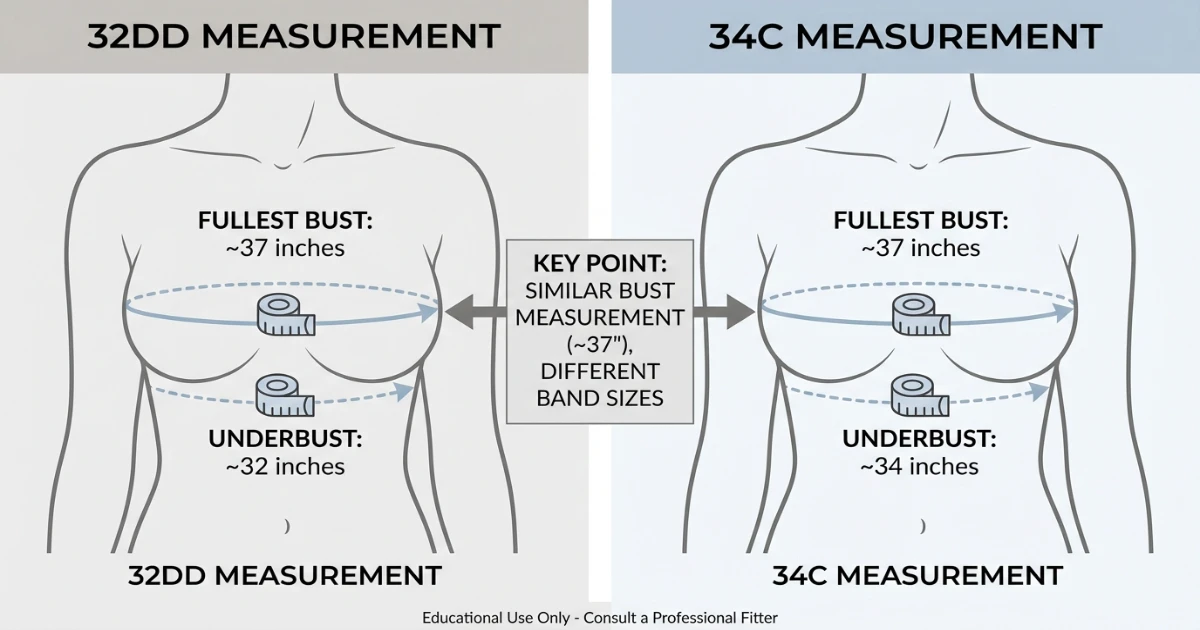
Wrap a soft measuring tape directly beneath your breasts, around your ribcage. Keep the tape parallel to the floor and snug but not compressing. Breathe out normally and record the measurement in inches. This figure determines your band size. Round to the nearest even number: if you measure 31 inches, your band is most likely a 32.
Step 2 — Measure Your Full Bust
Stand upright and measure around the fullest part of your bust, keeping the tape level across the back and loose enough that it does not compress the breast tissue. Record this figure in inches.
Step 3 — Calculate the Bust Difference
Subtract your underbust measurement from your full bust measurement. The result determines your cup size:
- 1 inch = A cup
- 2 inches = B cup
- 3 inches = C cup
- 4 inches = D cup
- 5 inches = DD cup
- 6 inches = E / DDD cup
Step 4 — Determine Your Band Size
Your underbust measurement from Step 1 is your band size (rounded to the nearest even number). If you are between two band sizes and prefer a snugger feel, size down. If you prefer more ease, size up and adjust the cup letter accordingly using sister sizing.
Step 5 — Confirm Cup Containment and Support
Try on the calculated size. The cup should contain all breast tissue without spillage, the underwire (if present) should lie flat against the ribcage rather than on the breast tissue, the center gore should touch the sternum, and the band should sit level all the way around the body. If anything deviates, refer to the fit-check guidance at How to Measure.
You can also input both measurements directly into the AI Smart Fit Bra Calculator or the Bra Size Chart Calculator for an instant result with sister size suggestions. If you wear different sizing systems internationally, the Global Bra Size Converter maps your UK or US size to EU, AU, and other international standards.
Best Bra Styles for 32DD and 34C
Both sizes are well served by the same general categories of bra, but specific features will complement each size’s geometry better.
For 32DD
- Full-cup bras: Provide coverage for the greater cup depth and prevent spillage at the top.
- Plunge bras with side support panels: Help project breast tissue forward and together on a narrower frame.
- Sports bras with encapsulation: A snug band combined with individual cup encapsulation delivers outstanding support during activity.
- Balconette styles: Work well when the cup has a narrower underwire width that matches the breast root width of a smaller ribcage.
For 34C
- T-shirt bras: Smooth moulded cups in 34C are widely available and ideal under fitted clothing.
- Demi cups: Suit the slightly wider, shallower cup shape typical of 34C cups.
- Bralettes with a firm underband: For those who prefer wire-free options, a bralette with a broad, elasticated band replicates much of the support of a wired 34C.
- Minimisers: Readily available in 34C and useful for reducing projection under tailored garments.
For size-specific recommendations and style comparisons, the breast size comparison hub and the size charts provide detailed guidance across many sizes.
Best Bras for 32DD & 34C That Are Actually Worth Clicking
Handpicked for support, comfort, shape, and everyday wear. These two picks suit the needs most readers have when comparing 32DD vs 34C.
Best Bras for 32DD & 34c
Tested by real women. Ranked by comfort, fit, and everyday wearability.

Warner’s Easy Does It
Wireless Bra
The comfort pick our readers keep coming back to — no underwire, no digging, just smooth all-day softness with a clean silhouette under any top.
- Seamless look under fitted t-shirts
- Stays comfortable through long wear days
- Soft stretch fits both 32C & 36B well


Bali Full Coverage
Underwire Bra
When lift and structure matter more than softness — this is the pick. Dependable underwire support with a clean, polished shape that holds all day.
- Fuller coverage, no gaps or gaping
- Firm lift and defined silhouette
- Ideal for workwear and structured outfits
Conclusion
32DD and 34C are genuine sister sizes — two different combinations of band and cup that create nearly identical cup volume. The fundamental difference between them is the band: a 32 provides more ribcage compression, more lift, and a firmer anchor, while a 34 offers more ease and a slightly wider cup base.
Neither size is objectively better. The right size is the one that fits your actual underbust measurement and accommodates your breast tissue without gaps, spillage, or the need to over-tighten straps. Measure first, try both if you are on the boundary between 32 and 34 inches in your underbust, and evaluate fit systematically rather than relying on cup letter alone.
Sister sizing is a practical tool when your exact size is unavailable, but it is not a substitute for wearing your true size. Use the sister size system to temporarily bridge a gap in availability, but always return to your measured size as your primary reference point.
Find Your Exact Sister Size
Use our free tools to calculate your bra size, check your sister sizes, and solve any fit problem.
Sister Size Calculator AI Fit Calculator How to MeasureFrequently Asked Questions
Are 32DD and 34C sister sizes?
Yes. 32DD and 34C are direct sister sizes. In the sister size system, going up one band size (from 32 to 34) requires going down one cup letter (from DD to C) to maintain the same cup volume. Both sizes hold essentially the same amount of breast tissue, but the 32DD achieves this with a tighter band and deeper cup, while the 34C uses a looser band and slightly wider cup.
Is 32DD bigger than 34C?
In terms of total cup volume, 32DD and 34C are considered equivalent — neither is definitively bigger than the other. However, the 32DD cup has a narrower, deeper projection (it sticks out more forward), while the 34C cup is slightly wider and shallower. If “bigger” refers to the letter alone, DD appears larger than C, but this is misleading unless both cups share the same band number.
Which size provides better support — 32DD or 34C?
A 32DD provides more support than a 34C on a body where the ribcage genuinely measures 30–32 inches, because the tighter band carries more of the structural load. However, on a 32–34 inch ribcage, a well-fitted 34C will outperform a 32DD that feels uncomfortably tight and is therefore being worn incorrectly. Support depends almost entirely on how well the band fits the individual wearer.
Can I replace 32DD with 34C?
You can temporarily substitute a 34C for a 32DD if the 32DD is unavailable in a particular style, and the cup volume difference will be minimal. However, the 34C band will be noticeably looser around the ribcage. Some people compensate by fastening the 34C on the tightest hook, but this is not ideal long-term as it causes premature wear. For regular wear, always use your true band size where possible.
How do sister sizes actually work?
Sister sizing works by recognising that cup volume is a ratio of the difference between the full bust and the band. Because a larger band creates a larger baseline, the cup letter must decrease to produce the same volume. Moving up one band size and down one cup letter keeps the approximate volume constant. Moving down one band size and up one cup letter does the same in reverse. The result is a chain of sizes — like 30E, 32DD, 34C, 36B — that all contain roughly the same amount of breast tissue despite having different size labels. You can explore this fully at the sister sizes guide.
Similar Posts
F Cup vs I Cup: Measurements, Fit, Volume & Sister Sizes
F vs I Complete 2026 Guide · Bra Cup Comparison F Cup vs I Cup: Measurements, Fit & Sister Sizes Premium cup…
36C vs 38C: Are They the Same Size? Same Letter, Different Cup | Bra Calculator
36C vs 38C: Are They the Same Size? Same Letter, Different Cup Explained (2026) Quick Answer: No — 36C and 38C are…
Panty Size Chart: Waist, Hip, US, UK & EU Sizes
▦ Bra-Calculator.com · Measurement Chart · XXS–6XL · 2026 Panty Size Chart A practical, measurement-first guide from Amelia B. Compare your waist…
30D vs 30DD Bra Size: Cup Difference Explained (2026 Guide)
30D vs 30DD: What’s the Real Cup Size Difference? (2026 Guide) Updated for 2026 · Reviewed by bra-fit experts · 8-minute read…
30DDD vs 30F: Are They the Same Size? US vs UK Cup Naming Fully Explained (2026)
30DDD vs 30F: Are They the Same Size? US vs UK Cup Naming Fully Explained (2026) Quick Answer: Yes — 30DDD and…
32DDD vs 32F: Measurements, Fit, Cup Volume & Sister Sizes
32DDD vs 32F Premium Fit Guide · Size Comparison 32DDD vs 32F: Measurements, Fit & Sister Sizes Deep comparison guide with exact…