32DD vs 34D: What’s the Real Difference? (2026 Sister Size Fit Guide)
32DD and 34D are sister sizes with nearly the same cup volume, but 32DD has a tighter band for more support while 34D has a looser band for a softer feel.
Choose the fit signs you notice in the band, cups, center and straps. We’ll turn them into a practical next step for 32DD.
Private fit check — your answers stay in your browser and are used only for this on-page guidance. Nothing is stored or submitted.
Key Takeaways
- 32DD and 34D carry almost identical cup volume—they are true sister sizes on the bra size ladder.
- The band is the critical difference: 32DD grips about 2 inches tighter than 34D.
- A well-fitted band provides 80% of your support—cup size alone cannot compensate for a loose band.
- If your 34D rides up at the back, cups gape, or straps dig in, your body is asking for a 32DD.
- If your 32DD leaves red marks, restricts breathing, or feels painful by midday, try the 34D instead.
- Wire width and cup shape behave differently at each size, even with equal volume—so the mirror test matters.
- Use a bra size calculator and measure twice before ordering online.
Visit our breast size comparison hub to explore how 32DD and 34D sit alongside dozens of other sizes on the full size map.
Why Are 32DD and 34D Compared So Often?
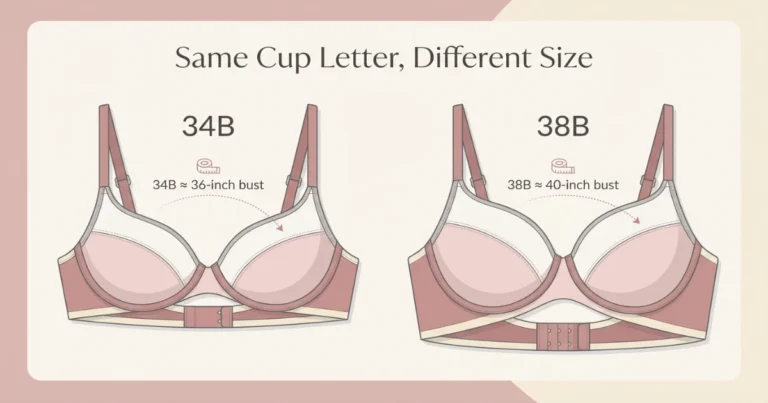
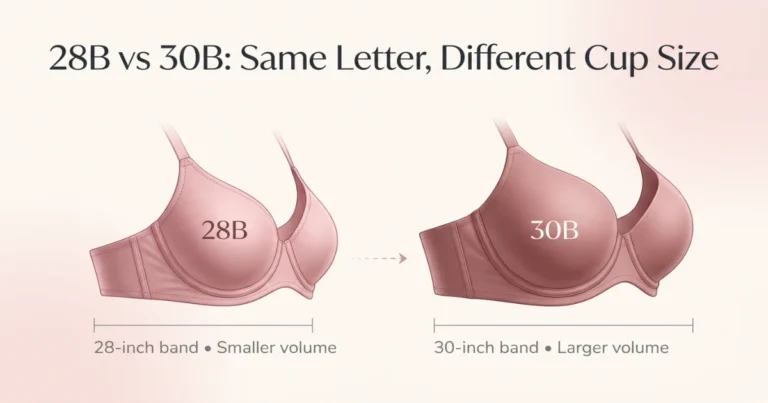
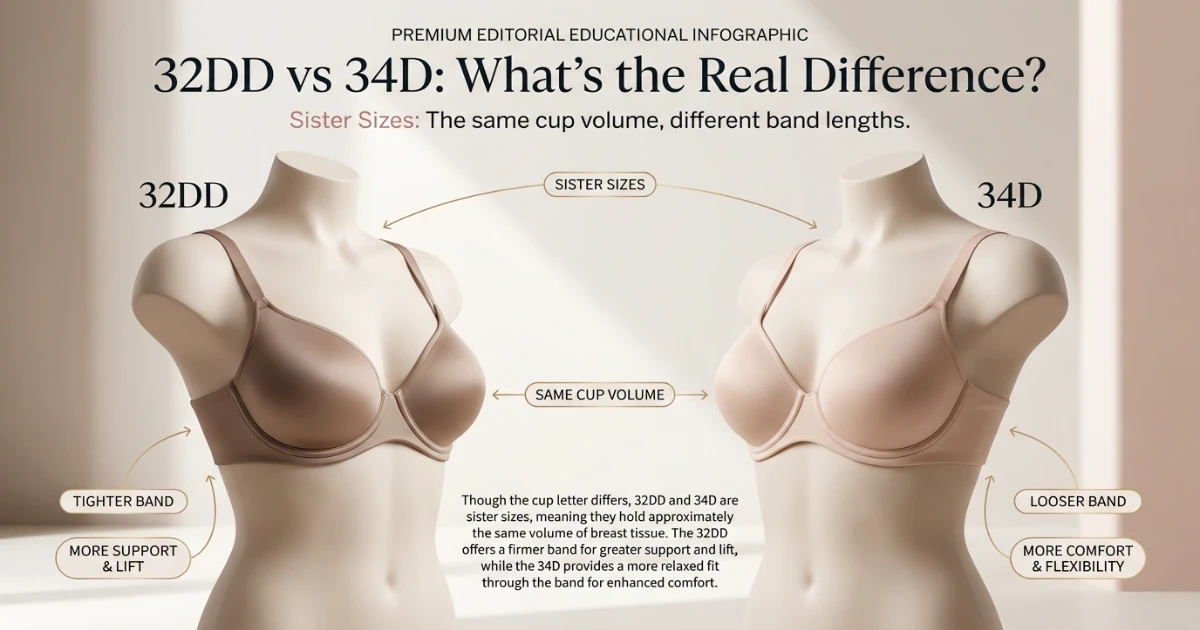
It starts with a concept called sister sizing. Bra sizes aren’t isolated—they exist on a sliding ladder. When you go up one band size (from 32 to 34), you drop one cup letter (from DD to D) to keep the cup volume roughly the same. The result? 32DD and 34D are paired as sister sizes, meaning they were designed to hold the same amount of breast tissue, just distributed differently.
The confusion happens because many women are fitted in one size, feel “off” for reasons they can’t name, and then try the other. One feels snug and secure but sometimes restrictive. The other feels free and easy but slips up by lunchtime. Both experiences make sense once you understand what the band is actually doing.
Check our sister size chart if you want to see the full ladder across all band sizes.
32DD vs 34D: Measurement Breakdown
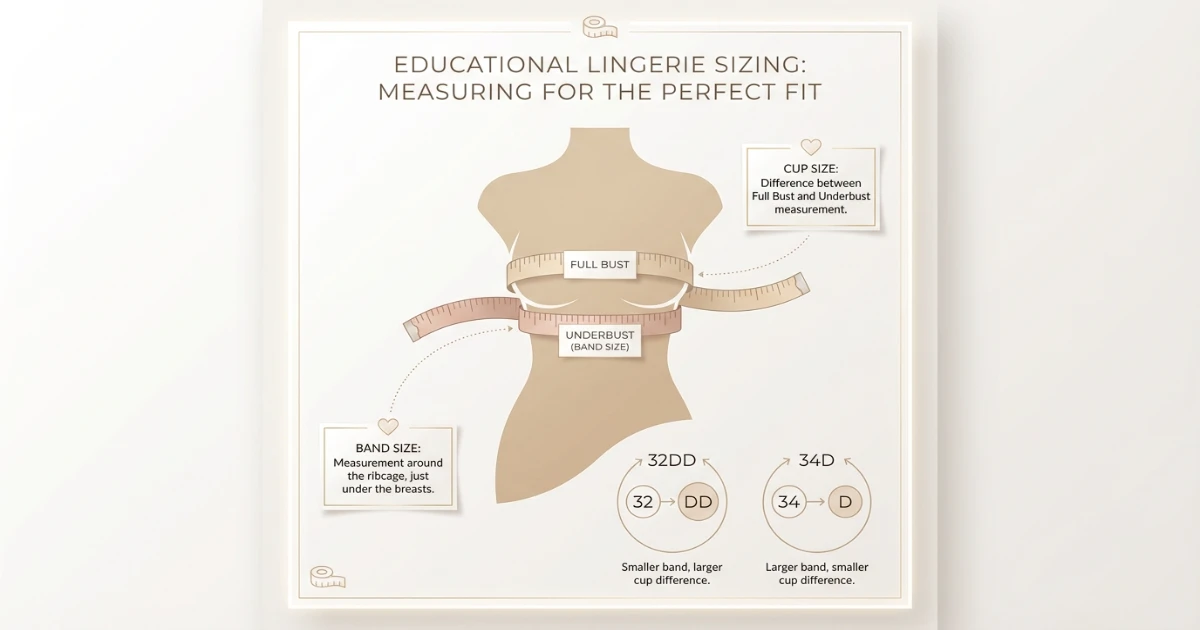
Let’s ground this in numbers. Bra sizing is built on two measurements: your underbust (the circumference of your ribcage just under your breasts) and your bust (the fullest point of your chest). The difference between the two determines cup letter.
| Measurement | 32DD | 34D |
|---|---|---|
| Band (underbust target) | ~27–28 in / 69–71 cm | ~29–30 in / 74–76 cm |
| Bust measurement | ~32–33 in / 81–84 cm | ~34–35 in / 86–89 cm |
| Cup difference (bust − band) | ~4.5–5 in (DD = 5 in) | ~4–5 in (D = 4 in) |
| Cup volume (approximate) | Similar / near equal | Similar / near equal |
The numbers confirm it: the cup volume is close enough that many women can genuinely wear both. The real fork in the road is whether your underbust measurement sits closer to 27–28 inches or 29–30 inches. Learn how to measure bra size correctly—measuring over a padded bra or with too much slack will throw off your result.
Band Difference: What You’ll Actually Feel
The band is the engine of your bra. Done right, it provides roughly 80% of total support—the cups and straps handle the rest. This is why the 2-inch band difference between 32DD and 34D matters far more than people expect.
In a 32DD: The band wraps firmly around your ribcage. On the loosest hook (where all new bras should start), it should feel snug—you should be able to slide two fingers underneath, but it takes effort. This tension anchors the bra horizontally, keeps the underwires flat against your ribcage, and lifts the bust upward rather than outward.
In a 34D: The band is 2 inches longer. It may feel immediately more comfortable, especially if you have a sensitive ribcage or prefer a less structured feel. But if your underbust is genuinely a 27–28 inch frame, that extra fabric has nowhere to go. By afternoon, it can migrate upward—pulling the front of the bra down, creating underboob, and forcing your straps to compensate with pressure on your shoulders.
If you’ve ever said “I just need to loosen my straps to breathe” or noticed your band sitting higher at the back than the front, that’s a signal worth paying attention to. Read more about why bands ride up and what to do about it.
Cup Volume: Are They Really the Same?
Technically, yes—on paper and in terms of raw fabric volume, 32DD and 34D are designed to hold equivalent breast tissue. That’s the whole point of sister sizing.
In practice? The experience of that volume differs. Here’s why:
- Wire width: A 34D cup is cut slightly wider than a 32DD cup. If you have narrower-set breasts, the wider 34D wire may extend into armpit tissue or underarm fat, causing discomfort and side tissue migration.
- Cup depth and projection: The 32DD cup is cut shallower-and-deeper (more forward projection), while the 34D cup is wider with slightly less depth. If you have projected breasts, the 32DD shape may fit your breast tissue better even at the same volume. See our guide to projection and depth for more.
- Cup volume comparison: For those who want to visualize the volume difference numerically, our cup volume comparison tool makes this concrete.
The takeaway: even when the numbers say “same volume,” the shape of your breasts determines which cut actually fits. A 32DD and a 34D are siblings, not twins.
Fit Differences You Can See in the Mirror
Numbers only get you so far. The mirror is the final judge. Here are the key visual fit signals for each size:
Center Gore (the bridge between cups)
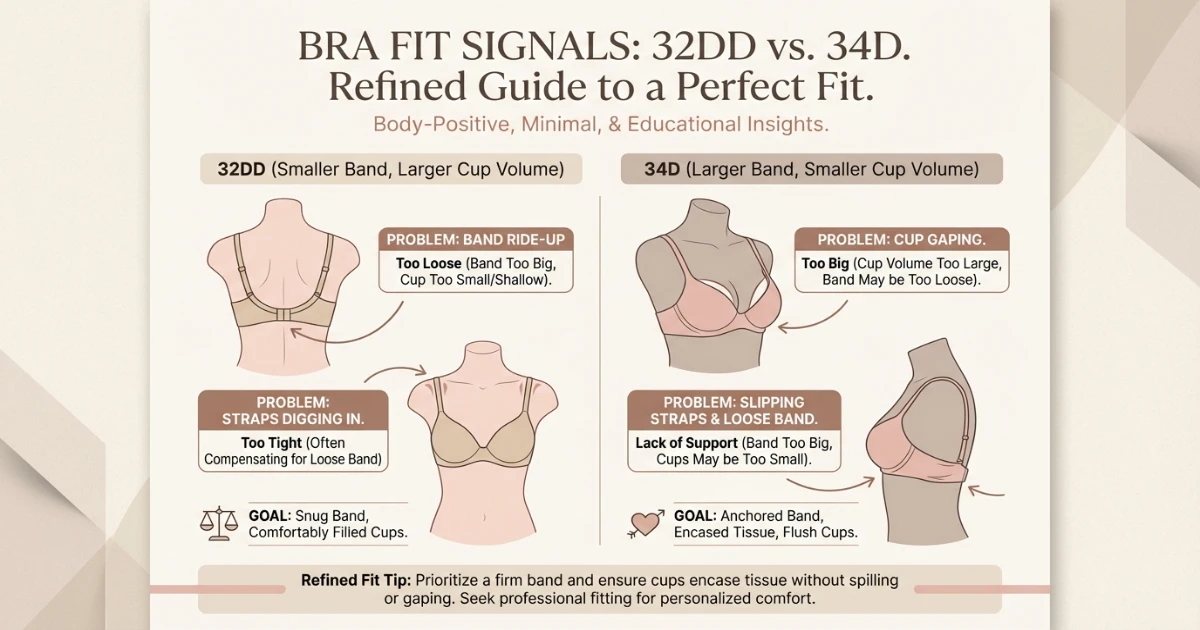
The gore tack—when the center piece lies flat against your sternum—is one of the clearest signs of correct fit. In a well-fitted 32DD on the right frame, the gore should lie flat. In a 34D on a narrower ribcage, the band tension may be insufficient to hold the gore down, creating a floating center that indicates the cups are not fully enclosing the breast tissue.
Spillage
If breast tissue overflows the top edge of the cup, that’s spillage—the cup is too small, or too shallow for your shape. This is sometimes misdiagnosed as a cup-letter problem when it’s actually a cup-depth problem. If you spill over the cups in a 34D, moving to 32DD won’t necessarily fix it unless the issue is band-related tension.
Gaping
Empty fabric at the top of the cup—gaping—usually means the cup is too large, or the shape doesn’t match your breast projection. If your 32DD gaps at the top, your breasts may be fuller at the bottom or more projected forward, meaning you need a different cut, not necessarily a different size.
Side Tissue
Breast tissue that escapes under the arm or sits outside the wire is called side tissue. This often happens when the wire is too wide (common in 34D on narrower frames) or when the band is loose enough to let the wire shift. Scoop and swoop—reaching into the cup and drawing all tissue forward before fastening—can reveal how much tissue you actually have to work with.
32DD vs 34D: Side-by-Side Fit Comparison
| Fit Factor | 32DD | 34D |
|---|---|---|
| Band snugness | Firm, anchored—snug on loosest hook | Looser, more relaxed feel on ribcage |
| Support + lift | Higher lift, better projection control | Softer support; relies more on straps |
| Cup volume feel | Slightly deeper, narrower cup opening | Slightly wider, shallower cup shape |
| Wire width feel | Narrower—better for close-set breasts | Wider—may dig into underarm tissue |
| Comfort for ribcage | Can feel tight for sensitive ribcages | More breathing room, less pressure |
| Stability (active day) | Excellent—minimal movement and ride-up | Moderate—may shift during activity |
| Common fit problems | Marks on skin, difficulty breathing if too small | Band rides up, straps dig in, gore floats |
Who Should Choose 32DD vs 34D?
Choose 32DD if…
- Your underbust measures 27–28 inches snugly
- Your 34D band rides up at the back
- You have to tighten straps to compensate for a loose band
- The gore doesn’t lie flat in 34D
- You want better lift and less movement during the day
- You’re active and need a stable, secure fit
- Your breasts are closer-set or more projected
Choose 34D if…
- Your underbust measures 29–30 inches relaxed
- The 32DD leaves red marks or feels restrictive by midday
- You have a sensitive ribcage or prefer a softer feel
- The 32DD underwires feel short or tight on the sides
- You’re between sizes and prefer the more comfortable option
- You have wider-set breasts that need a broader wire
- You wear bras for extended periods and comfort is a priority
⏱ How to Decide in 3 Minutes: Step-by-Step Checklist
- Measure your underbust snugly (not tight) with a soft tape. Under 28 inches → lean toward 32DD. 29–30 inches → lean toward 34D. Use our measuring guide if you’re unsure.
- Put on your current bra and check the band at the back. Is it higher than the front underwire? That’s band ride-up—a strong sign the band is too big.
- Check the gore. Press two fingers against the center piece between your cups. Does it lie flat against your sternum? If it floats or presses away, the band may be too loose.
- Look at strap tension. If you’ve tightened your straps as far as they go and still feel unsupported, the band (not the straps) is the problem.
- Try the band test. With the bra fastened on the loosest hook, try to pull the band away from your back. In a 32DD, you should barely get 2 fingers under it. In a 34D, you may get your whole hand—that signals too much room.
- Check the cups. After scooping and swooping all tissue in, is there overflow at the top (spillage) or empty fabric (gaping)? Spillage may mean you need a DD in a 34 band. Gaping may confirm a 32DD fits the band but the cup shape needs refinement.
- Cross-reference with a fit check guide. Visit our fit check guide to confirm every fit point before buying.
Common Fit Mistakes (And How to Fix Them)
Comfort isn’t the same as fit. A loose band may feel nicer for the first hour, but by afternoon you’ll be hiking it back down repeatedly. Real comfort comes from a correctly fitted bra that doesn’t shift.
Straps shouldn’t carry weight—that’s the band’s job. If you’re white-knuckling the strap adjusters, the band is too large. Try a 32DD before adding more strap tension.
Red marks under the breasts are almost always caused by the band, not the cup. In a 32DD, marks that fade within 20–30 minutes are normal for a firm band. Marks that last hours indicate the band is genuinely too tight—consider 34D.
Before judging fit, always reach in and pull all breast tissue forward into the cup. Side tissue that sits outside the wire can mimic spillage, or create the illusion of a correct fit when tissue is actually escaping.
This inflates your bust measurement and pushes you toward a larger cup size. Always measure braless or in a non-padded, well-fitted bra. Our measurement guide walks through the correct method step by step.
Sister Sizes to Try Next
If neither 32DD nor 34D feels quite right, you’re not out of options. The sister size ladder extends in both directions. Moving up the ladder = looser band, smaller cup letter. Moving down = tighter band, larger cup letter.
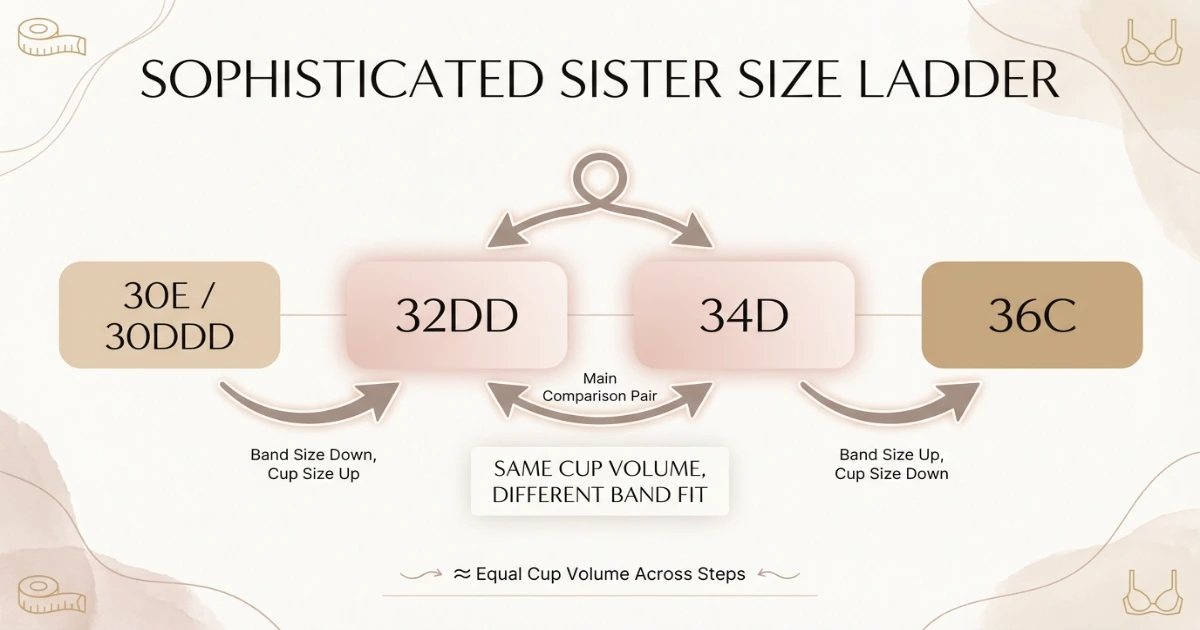
Note: “DD” and “E” refer to the same cup size in many European and UK brands. In US sizing, DD = the 5th cup, while in UK sizing, DD and E differ by a step. Always check brand-specific sizing charts.
Want to explore the full map? Our bra size comparison guide lets you visualize every size relationship in one place. You can also cross-reference with a strapless bra sizing guide if you’re shopping for special occasions where band fit is even more critical.
People Also Ask: 32DD vs 34D
Are 32DD and 34D the same cup size?
They are sister sizes, meaning cup volume is approximately equal—but not identical in shape. The 32DD cup is slightly deeper and narrower; the 34D cup is wider and shallower. Raw volume is close, but the cut and fit on the body differ depending on breast shape and ribcage size.
Which gives more support: 32DD or 34D?
32DD provides more support for a smaller ribcage because the tighter band anchors the bra horizontally. Support comes primarily from the band, not the straps—so a correctly sized 32DD on a 27–28 inch underbust will outperform a 34D every time.
Why does 32DD feel too tight?
A 32DD can feel too tight if your underbust genuinely measures 29+ inches, if you have a rigid or wide ribcage, or if you’ve been wearing looser bands for a long time and your body isn’t used to proper tension. Mild snugness that eases within 20 minutes is normal. Pain, difficulty breathing, or marks that last hours indicate the band is too small.
Why does my 34D ride up at the back?
Band ride-up happens when the band is too loose to stay horizontal. The back of the band lifts to find tighter circumference higher up your torso, pulling the front cups down. This is the most common sign that you need a smaller band—like a 32DD—rather than a different cup.
What if I spill out of a 34D?
Spillage over the cup edge in a 34D usually means you need a larger cup letter—try a 34DD/34E first. If the band also feels loose, then 32DD or even 32E might be your true size. Don’t size up the band to get a bigger cup; move across the sister size chart instead.
Should I size up the band or the cup?
Size up the band if: the bra feels painful, leaves lasting red marks, or restricts breathing. Size up the cup if: tissue spills over the top edge, the underwire sits on breast tissue rather than chest wall, or the gore doesn’t lie flat. Often it’s both—that’s when a bra size calculator with measurement input gives the clearest answer.
Can I switch between 32DD and 34D depending on the brand?
Yes, and this is very common. Sizing varies significantly between brands—some run large in the band, others small. A woman who wears a true 32DD in Freya might comfortably wear a 34D in a brand that runs smaller in the band. Always try on or use a brand-specific size guide when possible.
The Bottom Line
32DD and 34D occupy the same rung on the volume ladder but deliver a meaningfully different experience on the body. The choice isn’t about which size sounds right—it’s about what your measurements and daily experience are telling you.
If your band rides up by afternoon, your straps are doing the heavy lifting, or your gore floats off your sternum, your body is asking for a 32DD. If your bra leaves lasting marks, feels restrictive, or digs into your ribcage from morning, a 34D may be the more appropriate fit for your frame.
Neither answer is wrong. Fit is individual, and the same woman can shift between sister sizes depending on the time of month, the brand, and the style of bra. What matters is knowing what to look for—and now you do.
Not Sure Which Size Is Right for You?
Use our full bra size comparison guide to map your measurements against every size on the ladder—including 32DD, 34D, and all their sister sizes.
Compare Bra Sizes Now →