32D vs 34C: What’s the Real Difference?
Sister sizes explained — how they fit, how they differ, and which one is right for your body.
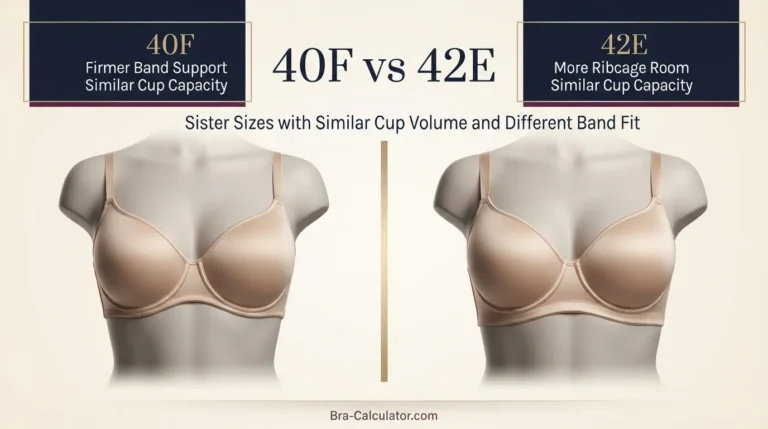
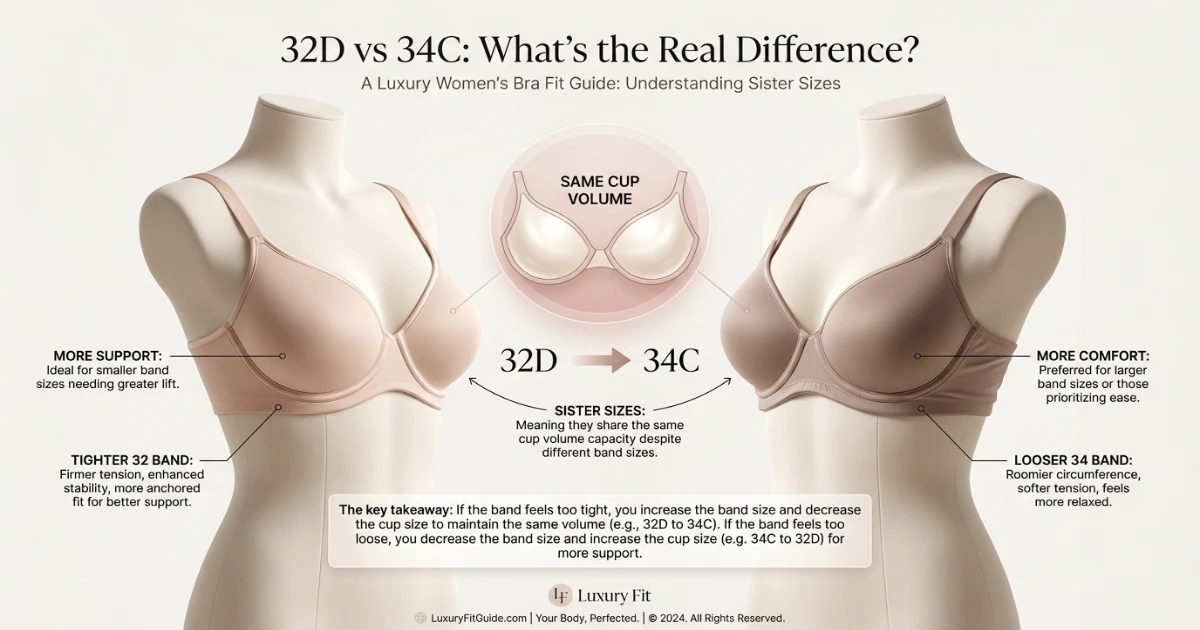
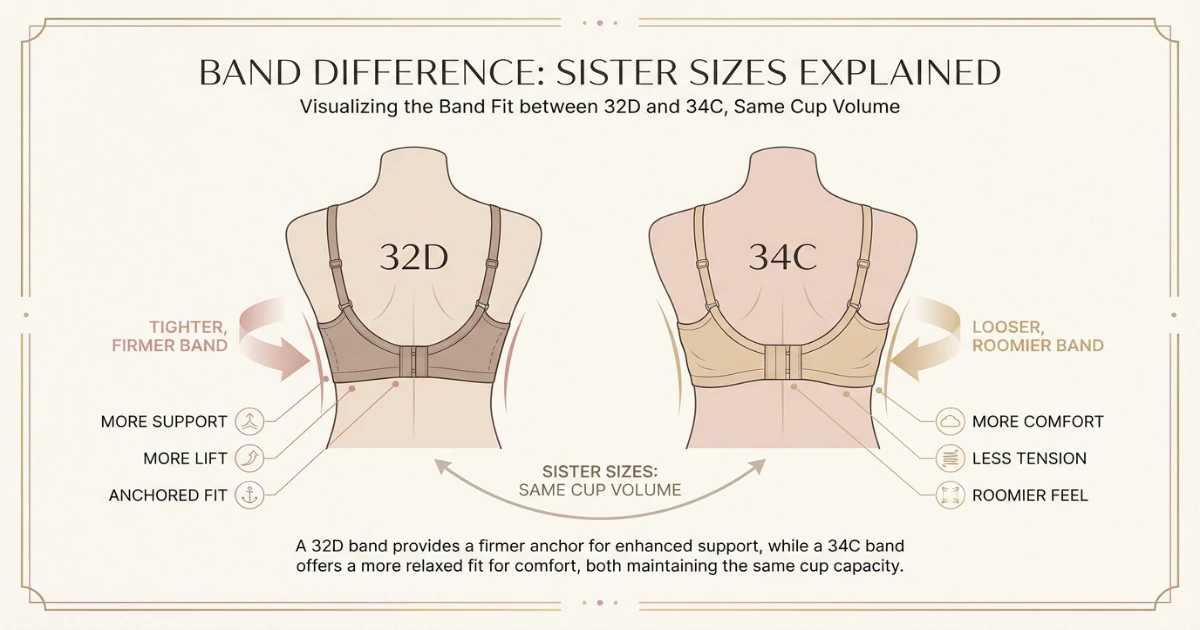
32D and 34C are sister sizes — they share the same cup volume, meaning the actual amount of breast tissue each cup holds is identical. The real difference is in the band: a 32D wraps tighter around a narrower ribcage, while a 34C sits on a wider frame with slightly less tension. If one feels right in the cup but wrong in the band, the other is likely your better fit. For a full breast size comparison guide, our hub covers every pairing in detail.
Key Takeaways
- 32D and 34C are sister sizes — cup volume is the same, band size is different.
- A 32D band is snugger and provides more lift and support for smaller ribcages (26–28 inches underbust).
- A 34C band is roomier and suits a wider ribcage (29–31 inches underbust).
- If your 32D band digs in or feels suffocating, try 34C — and vice versa if your band rides up.
- Cup gaping in 34C often signals you need a larger cup, not just a different band.
- Always measure your underbust and bust before switching between sister sizes.
- Brands vary — a 32D from one label may fit like a 34C from another.
Choose the fit signs you notice in the band, cups, center and straps. We’ll turn them into a practical next step for 32D.
Private fit check — your answers stay in your browser and are used only for this on-page guidance. Nothing is stored or submitted.
Why 32D and 34C Are Often Confusing
You try on a 32D and the cups fit beautifully — but the band feels like a boa constrictor. You grab a 34C and suddenly you can breathe, yet the cups seem a touch loose. Sound familiar? You’re not imagining things, and you haven’t picked the wrong size twice. You’ve stumbled across sister sizing, one of the most misunderstood concepts in bra fitting.
The bra sizing system is built on a simple relationship: every time the band size goes up by one step (two inches), the cup letter drops by one to maintain the same cup volume. So 32D, 34C, 36B, and 38A all hold the same amount of breast tissue — they’re just designed for different ribcage widths. This is why both sizes can feel “almost right” at the same time.
The confusion deepens because most of us were fitted in department stores using the outdated +4 method, which routinely over-estimates band size. Many women who are truly a 32 band have spent years wearing a 34 or 36, so a 32D can feel shockingly tight even when it’s the correct size. Use our bra size calculator to find your true starting measurement before you compare these two sizes.
32D vs 34C Measurement Breakdown
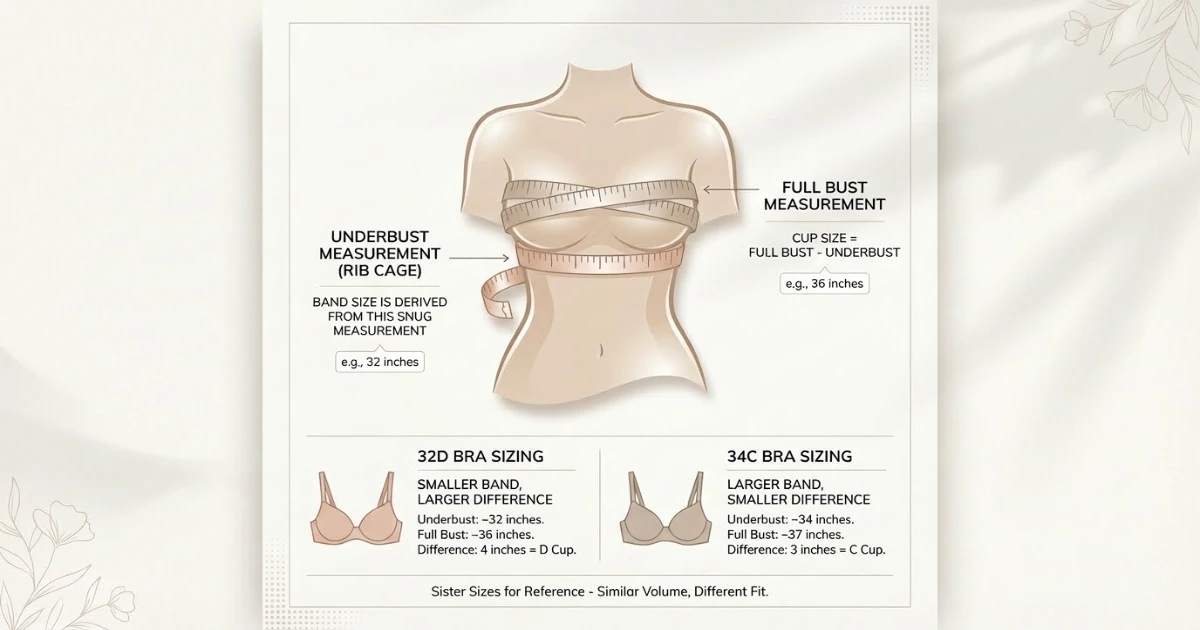
Let’s look at what these numbers actually mean on a body. Bra sizing starts with two measurements: your underbust (the circumference directly under your breasts) and your bust (the fullest point of your chest). The difference between the two determines your cup letter.
Here’s how each size breaks down:
- 32D: Underbust ≈ 27–28 inches (68–71 cm) · Bust ≈ 35–36 inches (89–91 cm) · Difference = 4 inches = D cup
- 34C: Underbust ≈ 29–31 inches (74–79 cm) · Bust ≈ 37–38 inches (94–97 cm) · Difference = 3 inches = C cup
The cup volume is the same because although the letter changes, the relative difference between bust and band is recalibrated. In practice, the underwire width and cup projection are nearly identical. What changes is where the band anchors on your torso. For a deeper look at how cup geometry works, check out our guide to cup volume comparison and bra projection and depth.
32D vs 34C: Quick Comparison
| Factor | 32D | 34C |
|---|---|---|
| Band snugness | Firm — wraps tighter around the ribcage | Roomier — less tension on the torso |
| Support level | Higher — band does more of the work | Moderate — relies more on straps |
| Cup volume | Identical to 34C | Identical to 32D |
| Comfort for smaller ribcage (≤28 in) | Excellent fit | Band may ride up or feel loose |
| Comfort for wider ribcage (≥30 in) | Band may dig in or feel tight | Better, more comfortable fit |
| Common fit problems | Band digging in, red marks, difficulty breathing deeply | Band riding up, straps taking too much load, cup gaping |
Band Size Differences: Support, Tension, and Comfort
The band is the engine of a bra. It should provide 80–90% of a bra’s support — the straps are just there to keep the cups in position. When your band is the wrong size, everything else falls apart (sometimes literally).
The 32 band is designed for a ribcage that measures approximately 27–28 inches. On the first hook, it should feel snug — you should be able to slide two fingers under it, but no more. It should sit horizontally across your back, parallel to the floor. If you can tug the band away from your body by more than an inch, it’s too loose for you.
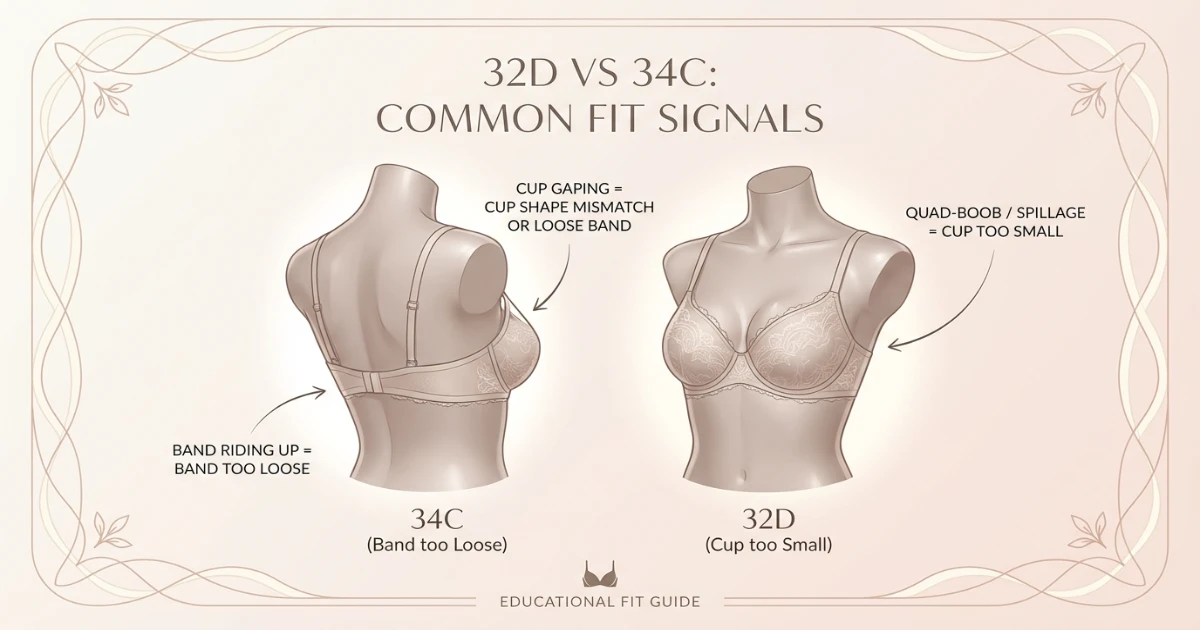
The 34 band is cut for a ribcage of roughly 29–31 inches. On a smaller frame, you might find yourself yanking the band to its tightest hook immediately — and still having it ride up your back throughout the day. When a band rides up, the front of the bra dips down, underwires dig into breast tissue, and straps pull tightly off the shoulders to compensate. This is one of the most common — and most uncomfortable — bra fit problems women experience.
For more on how band size affects overall fit, visit our guide on how to measure bra size correctly.
Cup Volume Comparison: Same Letters, Same Space
Here’s the thing that trips most people up: the letter on a bra tag means nothing without the number next to it. A D cup on a 32 band is dramatically smaller than a D cup on a 40 band. Cup letters are relative, not absolute.
Because 32D and 34C are sister sizes, their cups are cut to accommodate the same breast volume. The cups on a 34C are slightly wider and shallower (to match a broader chest), while the 32D cups are slightly narrower and deeper. But the total space inside is the same.
This means that if cups fit you well in both sizes, the tie-breaker is entirely your underbust measurement and personal comfort with band tension. Don’t let the letter or number intimidate you — they’re just different ways of describing the same shape. Browse our sister size chart to see all the equivalent pairings laid out clearly.
Fit Differences You May Actually Notice
Even though cup volume is theoretically identical, real-world fit can vary in ways that matter. Here’s what women typically notice when moving between 32D and 34C:
Shape and Projection
The 32D’s narrower underwire width suits closer-set, projected breasts — breasts that sit fairly close together and stick forward. The 34C’s wider underwire works better for wider-set or shallower breasts spread further apart on the chest wall. Wearing an underwire that’s too wide can cause gaping at the sides or the cups failing to fully encapsulate the breast.
Strap Tension
In a well-fitting 32D, straps carry almost no load — the band does the work. If you constantly loosen your straps because they’re digging into your shoulders, that’s a classic sign the band is too loose and your straps are compensating. Switching from 34C to 32D often eliminates shoulder dents entirely.
Cup Gaping vs Spillage
If cups gape when you lean forward in a 34C, it doesn’t always mean you need a smaller cup — it may mean your band is too big and the bra is shifting around. If you’re spilling over the top of a 32D, you likely need to go up a cup size within the 32 band (to 32DD/E), rather than switching to a 34C.
Quad-Boob
Quad-boob — that visible double-bulge over the top of the cup — usually means your cup is too small, not that your band needs to change. If you get quad-boob in 32D but the band fits well, try 32DD rather than jumping to 34C.
For a comprehensive breakdown of what’s going wrong in your bra, see our article on common bra fit problems and how to fix them.
Which Size Is Right for You?
Choose 32D if…
- Your underbust measures 27–28 inches (68–71 cm)
- Your 34C band constantly rides up your back
- You need straps on the tightest setting to avoid slipping
- Your 34C band sits on the loosest hook already
- You have a smaller, narrower frame
- You want maximum support without wires digging into sides
- You struggle with straps digging into shoulders in a 34
Choose 34C if…
- Your underbust measures 29–31 inches (74–79 cm)
- Your 32D band leaves red marks or feels painful
- You have a broader ribcage or carry weight evenly
- 32D makes breathing deeply feel restricted
- You’re between sizes and prefer a slightly looser band
- Your 32D cups gap slightly at the sides (wider wire needed)
- You’ve recently fluctuated in weight and need extra room
3-Minute Fit Test: Find Your Size at Home
- Measure your underbust. Wrap a soft measuring tape snugly (not tightly) under your breasts, directly on your ribcage. Exhale normally and note the number in inches. 27–28 in = lean toward 32 band. 29–31 in = lean toward 34 band.
- Measure your bust. Measure loosely around the fullest part of your chest, keeping the tape parallel to the floor. Subtract your underbust from this number.
- Check the band. Put on your bra on the loosest hook. The band should sit horizontally — not ride up in back. Slide two fingers under the back band; it should be snug but not strangling.
- Scoop and swoop. Lean forward, reach into each cup and scoop all breast tissue forward and upward into the cup. Stand up. All tissue should be fully inside the cup with no overflow or gaping.
- Check the center gore. The narrow bridge between the cups (the gore) should lie flat against your sternum. If it pokes out, your cup is likely too small or the underwire width is wrong.
- Test the straps. You should be able to slide two fingers under each strap with ease. If straps are digging in, your band is too loose. If they slip off constantly, the band isn’t doing its job.
- Move around. Do a test jump and raise both arms overhead. The band should stay put. If it rides up when you lift your arms, it’s too big — try the 32D.
Want the full guided version? Our how to measure bra size walkthrough takes you through each step with visual guidance.
Common Bra Fit Mistakes to Avoid
Even after finding your size on paper, it’s easy to make these recurring mistakes that sabotage the fit:
- Tightening straps to compensate for a loose band. Straps are not meant to support weight — they just position cups. If you’re constantly tightening them, go down a band size.
- Wearing a band that’s visibly horizontal in front but slanting upward in back. A band that rides up means it’s too large. This is one of the clearest signs you should try a 32D if you’ve been wearing 34C.
- Assuming cup gaping means you need a smaller cup. Cup gaping often happens because the band is too big and the bra shifts out of position. Fix the band first.
- Buying the same size across all brands. Sizing is not standardized. A 32D in one brand can fit like a 34C in another. Always try before you buy, or check brand-specific size guides.
- Not starting on the loosest hook. New bras should fit on the loosest hook. As the fabric stretches over time, you tighten to the middle, then the tightest hook — this extends the bra’s life and ensures a true fit from day one.
- Ignoring the gore. A floating gore (the bit between the cups that won’t sit flat) signals a cup that’s too small, a wire that’s too narrow, or the wrong cup shape for your breast root.
For help diagnosing your specific situation, our bra fit problems guide covers every scenario with clear fixes. And if you’re shopping for special occasions, see our guide to strapless bra sizing — where getting the band right is even more critical.
Sister Sizes to Try
32D and 34C sit in the middle of a sister size ladder. If neither size feels right, the sizes above and below on this ladder share the same cup volume and are worth exploring:
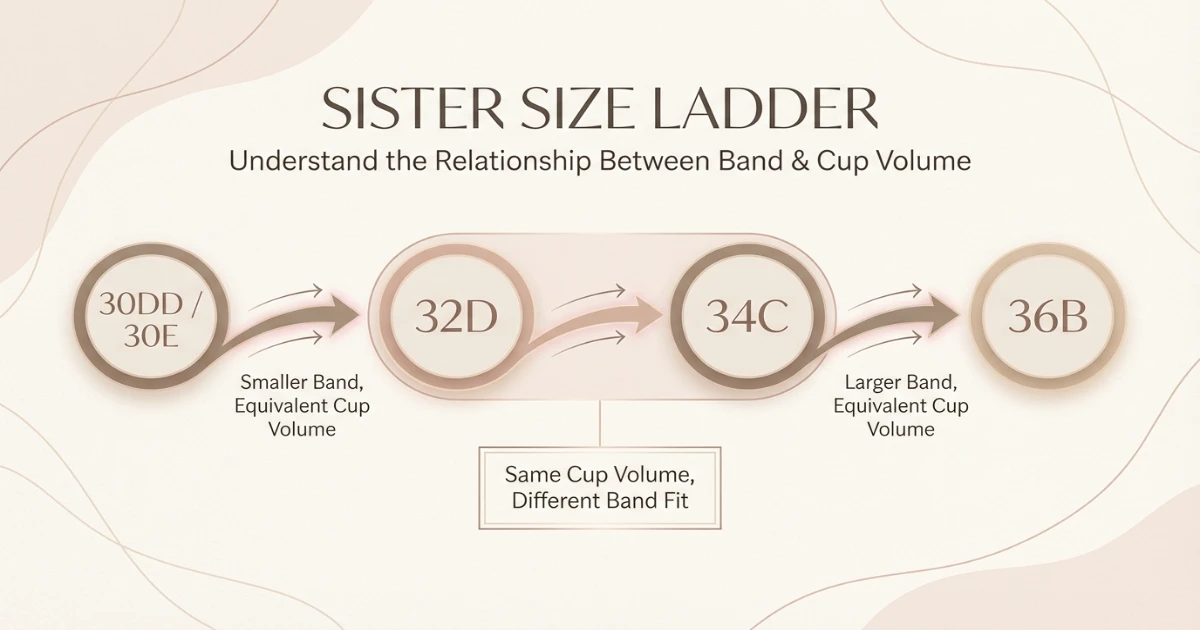
Use our full sister size chart to explore the complete ladder across all cup sizes. And if you want to see how these sizes compare visually, our bra size comparison hub has side-by-side guides for dozens of size pairings.
Cup Volume Scaling Chart: Why the Same Cup Letter Can Still Be a Different Size
One of the most misunderstood parts of bra sizing is that a cup letter is not a fixed volume on its own. A 32C, 34C, and 36C do not all hold the same breast volume. As the band size increases, the cup volume increases too. That is why comparisons like 32C vs 36C, 34B vs 38B, and 34C vs 38C are so important for understanding real bra fit.
Volume Scaling Table
Use this chart to understand how cup letters scale across different band sizes. This helps explain why the same letter can feel very different from one band to another.
| Band Size | A Cup | B Cup | C Cup | D Cup | DD Cup |
|---|---|---|---|---|---|
| 30 | Smallest A volume | Smallest B volume | Smallest C volume | Smallest D volume | Smallest DD volume |
| 32 | Larger than 30A | Larger than 30B | Larger than 30C | Larger than 30D | Larger than 30DD |
| 34 | Larger than 32A | Larger than 32B | Larger than 32C | Larger than 32D | Larger than 32DD |
| 36 | Larger than 34A | Larger than 34B | Larger than 34C | Larger than 34D | Larger than 34DD |
| 38 | Larger than 36A | Larger than 36B | Larger than 36C | Larger than 36D | Larger than 36DD |
Example: 36C holds more breast volume than 32C, even though both use the letter C.
Why This Matters for Bra Fit
Many bra fit problems happen because people focus only on the letter and ignore the band. In reality, the band changes the frame of the bra, the wire width, and the total cup volume. That is why one bra may feel too loose, too tight, too shallow, or too small in the cups even when the letter seems correct.
- Same letter, different total size: a 34B and 38B are not the same overall size because the 38B cup is larger.
- Same band, one cup step up: pages like 34C vs 34D explain pure cup progression on the same band.
- Similar volume, different band: pages like 32D vs 34C help explain sister sizes more accurately.
- Band support still matters: if your band is wrong, even the right cup volume can feel off. See why bra bands ride up in back.
Best Pages to Explore Next
Learn how band and cup change together in the full Sister Sizes guide.
Use the Sister Size Bra Calculator to find a nearby match.
See more size progression examples in Cup Size Visuals.
Start with the basics using the guide on how to measure bra size.
Still not sure which size is closest?
Check your measurements with the AI Smart Fit Bra Calculator, or browse the full Breast Size Comparison hub to compare nearby sizes more accurately.
Frequently Asked Questions
Are 32D and 34C the same size?
They are sister sizes, meaning they hold the same cup volume — the actual amount of space inside the cup is identical. However, the band fits differently: 32D fits a narrower ribcage (27–28 in) with more tension, while 34C fits a wider ribcage (29–31 in) with less tension. They are not interchangeable unless your underbust measurement is between the two.
Is 32D smaller than 34C?
The cup volume is the same. But the 32 band is smaller in circumference (it’s designed for a narrower torso), which makes the overall bra physically narrower. The “D” letter looks bigger than “C,” but in terms of cup space, they are equivalent. Cup letters only make sense relative to their band number.
Which size gives more support — 32D or 34C?
32D gives more support for someone it fits correctly. A tighter band anchors the bra firmly to the torso, meaning it moves less during activity and the underwires stay properly positioned. However, if your ribcage is 30 inches and you wear a 32D, the band is simply too small — and an uncomfortable, poorly fitting band provides no support at all. The best support comes from the band that actually matches your underbust.
Why does 32D feel tight even though I measure a 32 band?
A few reasons: First, new bras are always tightest on the first wear — the elastic needs time to break in and you should start on the loosest hook. Second, you may be used to wearing a too-large band and the correct size feels unfamiliar. Third, band sizing is not consistent across brands — some brands run tight. Try the same size in a different brand, or give the bra a few wears before deciding it’s wrong.
When should I sister size instead of my true size?
Sister sizing is useful when your true size isn’t available in the bra you want, when you’re between band sizes and want to test comfort, or when a brand runs tight or loose and you need to adjust. It’s not a permanent fix — if you’re sister sizing to make a band “feel better,” there’s usually an underlying fit issue worth solving. Use our bra fit problems guide to diagnose the real cause.
Can I switch between 32D and 34C depending on the bra style?
Yes — this is actually quite common. You might wear 32D in an underwire balconette that runs true to size, and 34C in a plunge bra from a brand that runs small in the band. The fit goal stays the same: a band that sits level, a gore that lies flat, and cups that fully contain all breast tissue without gaping or spillage.
What if both 32D and 34C have cup issues?
If cups are consistently too small in both sizes (spillage, quad-boob, floating gore), go up a cup in your correct band size — try 32DD or 34D. If cups gape in both, consider going down a cup (32C or 34B) or look at cup shape — you may need a shallower style. Our cup volume comparison tool can help identify the right next step.
Final Thoughts: Measure First, Then Compare
The 32D vs 34C debate isn’t really a debate at all — they’re two expressions of the same cup volume, designed for two different bodies. The only question is which band belongs on your ribcage.
If you haven’t measured recently — or ever — start there. Grab a tape measure, take your underbust and bust measurements, and run them through our bra size calculator. Then use the 3-minute fit test above to confirm on the body. Numbers on a tag are a starting point, not a verdict.
And remember: no single size works perfectly across every brand, every style, or every season of life. Bodies change, fabrics stretch, and sizing varies wildly between manufacturers. Stay curious, keep measuring, and don’t be afraid to move up and down the sister size ladder until you find what actually works.
For more comparisons like this one, visit our full bra size comparison guide — we break down dozens of commonly confused size pairs in the same detail.
⚠ Disclaimer: Bra sizing can vary significantly between brands, styles, and countries. The sizes and measurements discussed in this article should be used as a starting point for finding your best fit — always try on bras where possible and consult individual brand size guides for the most accurate results.