40DDD vs 40F Bra Size: What Is the Real Difference? (2026 Fit Guide)
Quick Answer: It depends on the brand’s naming system. In brands that separate DDD and F (treating DDD as 6-inch bust-to-band differential and F as 7-inch), 40F is one full cup size larger than 40DDD — holding approximately 180–200 ml more per breast. In brands where DDD and F are treated as the same size, 40DDD and 40F are identical. Both sit on the same 40-inch band. At 40F level, specialty full-bust engineering (4-part seamed cups, side slings, powernet wings, heavily cushioned straps) is mandatory — mainstream construction will not fit correctly.
⚡ Key Takeaways
- Naming varies by brand: DDD and F may be separate sizes or the same size depending on the brand’s system.
- UK doesn’t use DDD: UK brands go DD → E → F, so 40DDD (US) = 40E (UK), and 40F (US) = 40F (UK).
- Same 40 band: Both fit an underbust of ~39–40″ (99–102 cm) — the band width is identical regardless of naming.
- 40DDD (6″ diff) bust: ~46″ (116.8 cm) — fits in 40E (UK) or 40DDD (US brands that separate them).
- 40F (7″ diff) bust: ~47″ (119.4 cm) — fits in 40F (most systems) or 40FF (UK).
- Cup volume: If separated, 40F holds ~180–200 ml more per breast than 40DDD — significant.
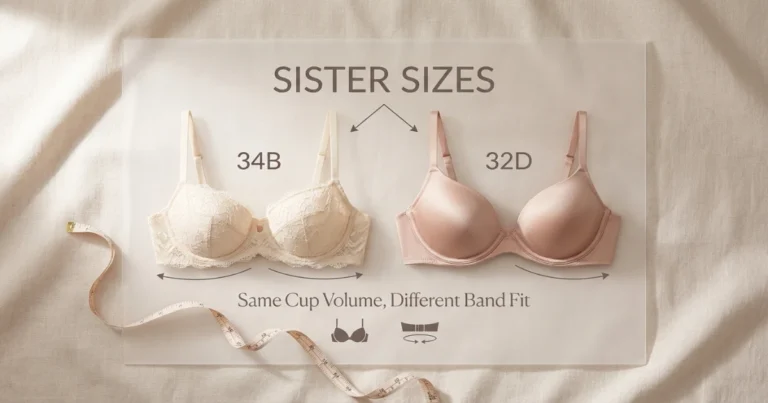
- Not sister sizes: Sister sizes change band and cup together. These are on the same band with different volumes.
- Sister size of 40DDD: 38F/38E (varies by brand) and 42DD.
- Sister size of 40F: 38G and 42DDD/42E (varies by brand).
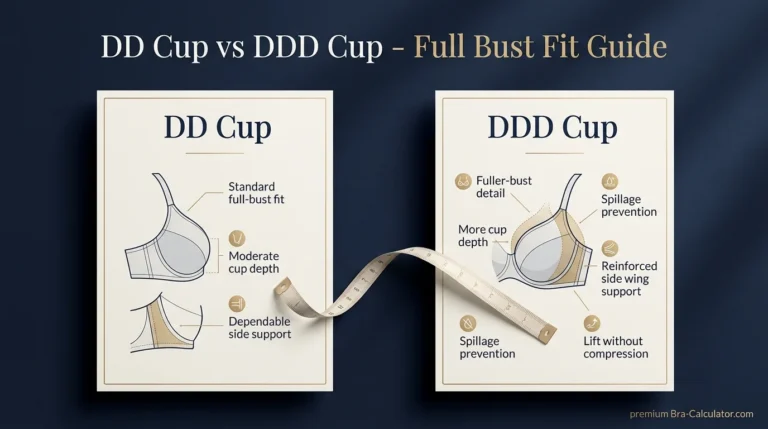
- Construction requirement: 40F requires 4-part seamed cups with side slings. 3-part minimum at DDD.
- Brand requirement: Both require full-bust specialists. Mainstream retailers do not stock this volume.
40DDD vs 40F: The Core Difference Explained
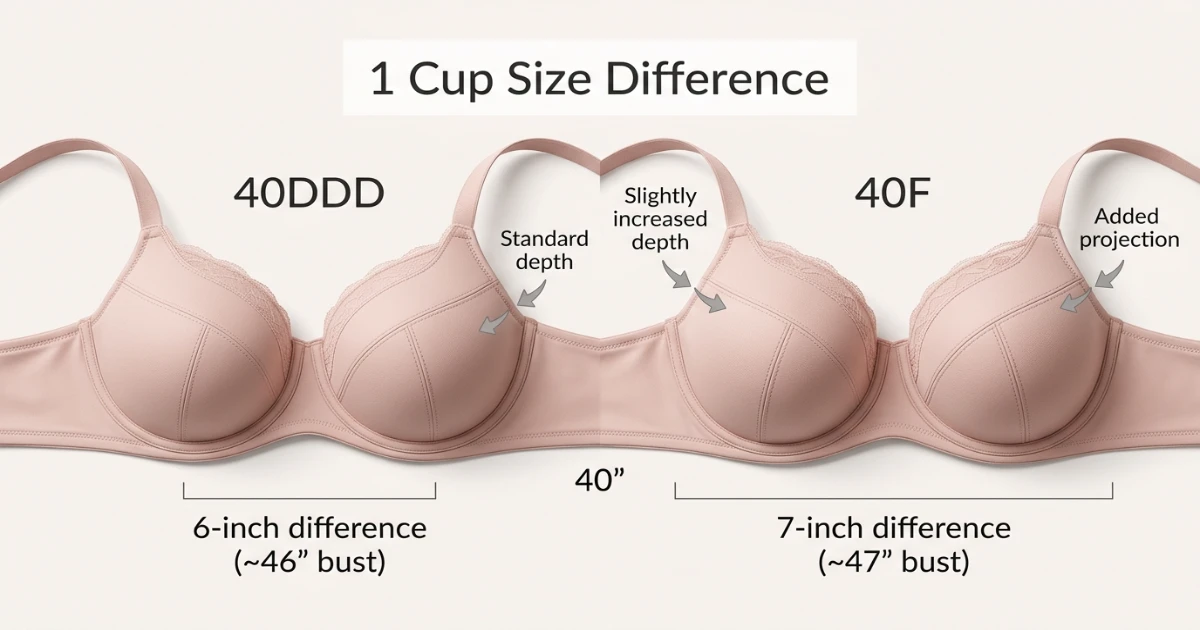
Both 40DDD and 40F are built on the same 40-inch band. The band’s circumference, hook-and-eye length, underwire span, and strap attachment points are all engineered to the same 39–40 inch underbust specification. On the correct ribcage, both will anchor with equal band tension.
The cup volume depends entirely on the brand’s naming system — this is where bra sizing becomes genuinely confusing. Let’s break down the three major naming conventions:
US System (brands that separate DDD and F)
- DD = 5″ bust-to-band difference
- DDD = 6″ difference
- F = 7″ difference
In this system, 40DDD and 40F are one cup apart — 40F is larger.
US System (brands where DDD = F)
- DD = 5″ difference
- DDD = F = 6″ difference (same cup, two names)
In this system, 40DDD and 40F are identical — different labels, same cup.
UK System (no DDD at all)
- DD = 5″ difference
- E = 6″ difference (= US DDD)
- F = 7″ difference (= US F in brands that separate them)
- FF = 8″ difference
In UK brands, 40DDD doesn’t exist as a name — you’d shop for 40E. And 40F in UK = 40F in US (if the US brand separates DDD and F).
The Volume Difference (when separated)
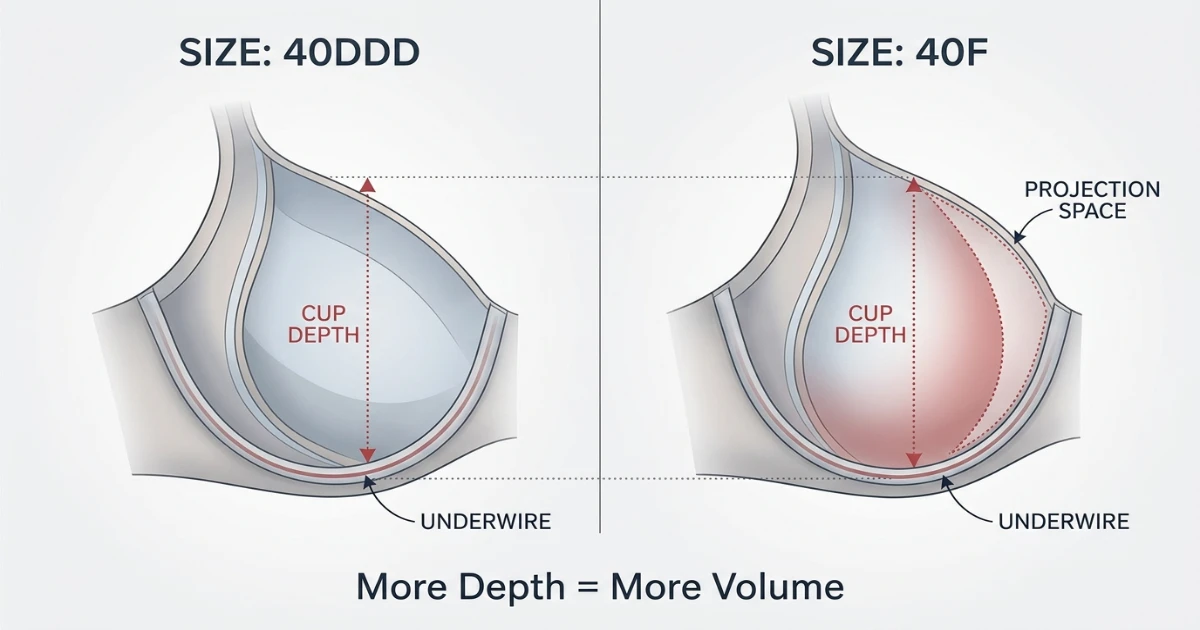
In brands that separate DDD and F, 40F holds one full cup more volume than 40DDD — same band, adjacent sizes. In brands where DDD = F, they’re identical.
Because naming varies, the only reliable way to know what you’re getting is to check the bust measurement range on the brand’s size chart. A 46″ bust on a 40 band is the 6-inch cup. A 47″ bust on a 40 band is the 7-inch cup. The letters are unreliable — the measurements are not.
Measurement Breakdown: 40DDD vs 40F
The table below shows both sizes derived from body measurements, with notes on how naming varies.
| Measurement | 40DDD (6″ diff) | 40F (7″ diff) |
|---|---|---|
| Underbust (Band) | ~39–40″ (99–102 cm) | |
| Bust (Fullest Point) | ~46″ (116.8 cm) | ~47″ (119.4 cm) |
| Bust-to-Band Difference | 6″ (15 cm) | 7″ (18 cm) |
| Approx. Cup Volume | ~1355 ml per side | ~1550 ml per side |
| US Equivalent | 40DDD | 40F (in brands that separate DDD/F) |
| UK Equivalent | 40E | 40F |
| EU Equivalent | 90F | 90G |
| Typical Construction | 3–4 part seamed | 4-part seamed + side sling required |
Key insight: The cup volume difference (~195 ml per side) only applies in brands that separate DDD and F. In brands where DDD = F, there is no volume difference — you’re buying the same cup with two possible labels.
The Three Naming Systems Explained
At DDD/F level, you’re dealing with three different naming conventions. Understanding which system your brand uses is essential.
| Bust-Band Diff. | US (separate DDD/F) | US (DDD = F) | UK | EU |
|---|---|---|---|---|
| 5″ | DD | DD | DD | E |
| 6″ | DDD | DDD = F | E | F |
| 7″ | F | G | F | G |
| 8″ | G | H | FF | H |
What This Means for You:
- Shopping US brands that separate DDD and F: 40DDD is 6″ cup; 40F is 7″ cup — one cup apart.
- Shopping US brands where DDD = F: 40DDD and 40F are the same size — identical cup volume.
- Shopping UK brands: They don’t use DDD. 40E = US 40DDD. 40F = US 40F (one cup larger).
- Shopping EU brands: EU uses E/F/G progression (no DD or DDD). 90F = 6″ cup, 90G = 7″ cup.
Sister Sizes: 40DDD and 40F Each Have Their Own Volume Family
Because 40DDD and 40F hold different cup volumes (in brands that separate them), they belong to entirely separate sister size families. Their chains do not overlap. Sister sizing is useful when your cup fits correctly but your band is too tight or too loose — you swap bands while keeping the same cup volume.
Sister Size Family for 40DDD (6″ differential)
All sizes below hold the same cup volume as 40DDD:
38E (UK)Tighter band
If your 40DDD band rides up or feels loose, try 38F (US brands) or 38E (UK brands) — same cup volume in a tighter band. If it digs in, try 42DD — same cup volume in a looser band.
Sister Size Family for 40F (7″ differential)
All sizes below hold the same cup volume as 40F:
42E (UK)Looser band
If your 40F band rides up, try 38G for a firmer band with the same cup. If it digs in, try 42DDD/42E for a looser band. Use our sister size calculator for your complete ladder.
Real Fit Differences Between 40DDD and 40F
Cup Depth, Volume, and Construction Requirements
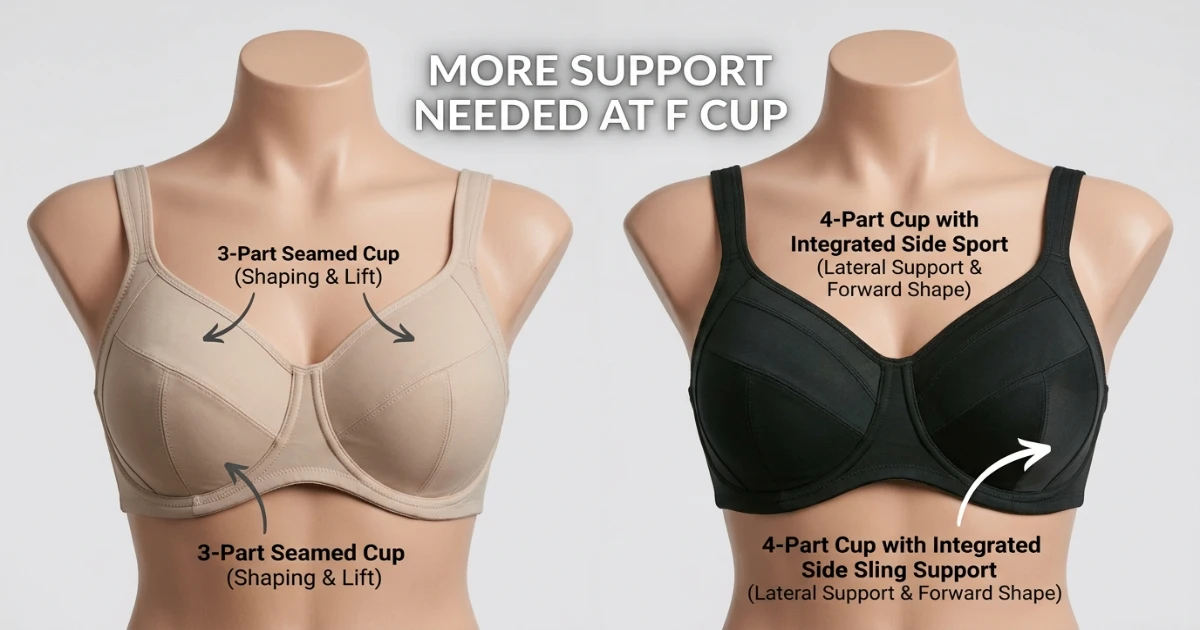
At DDD/F cup level on a 40 band, construction is more important than naming. A 40DDD (6-inch differential) requires 3-part or 4-part seamed cups. A 40F (7-inch differential, in brands that separate them) requires 4-part seamed cups with side slings, powernet-reinforced wings, heavily cushioned straps, and 4+ hooks. The 1-inch measurement difference (~195 ml per side) may sound small, but at this absolute volume it’s enough to require additional construction features.
The F Cup Construction Requirements
At 40F, you need all of the following:
- 4-part cup construction: Volume must be distributed across multiple panels for proper shaping and lift.
- Side slings or banded support: Additional fabric panels that pull breast tissue forward and centre, preventing side spill.
- Powernet wings: Reinforced side panels in the band that smooth back tissue and prevent roll-up.
- Heavily cushioned straps: Minimum 15–20mm width with padding to distribute shoulder load.
- 4+ hook closure: Standard at this volume — 3 hooks may be insufficient.
Band Fit: Identical for Both
Because 40DDD and 40F share the same band, band fit is the same for both. A correctly fitting 40 band sits on a ribcage of approximately 39–40 inches (99–102 cm) and provides 80–90% of the bra’s support. The band should run level all the way around, anchor firmly without digging, and allow two fingers under the back band with firm resistance on the loosest hook.
Weight Distribution and Strap Comfort
At F cup on a 40 band, breast weight is substantial. 40F breasts weigh approximately 200–250 grams more per side than 40DDD. If your straps dig in, the band is carrying insufficient weight. A properly fitted band at this volume should allow straps to sit on the shoulders without pressure — the straps stabilize, not support. If straps are the only thing preventing the bra from sliding down, the band is too loose.
Who Should Wear 40DDD?
- Underbust measurement approximately 39–40 inches (99–102 cm) snugly measured directly under the bust.
- Bust measurement at the fullest point of approximately 45.5–46.5 inches (116–118 cm) — a 6-inch differential.
- Cups contain all breast tissue comfortably with no overflow, no floating gore, and no cup wrinkling after a scoop-and-swoop.
- In 40F (or 40E/40F depending on brand), the cups gap or feel too deep.
- 3-part or 4-part seamed cups fit without construction failures.
- International: Shop for 40DDD (US) / 40E (UK) / 90F (EU) — naming varies by system.
- If 40DDD band rides up: try 38F/38E (sister size — same cup volume, tighter band).
- If 40DDD band digs in: try 42DD (sister size — same cup volume, looser band).
Verify your fit with the five-point check on our how to know your bra fits page.
Who Should Wear 40F?
- Underbust measurement approximately 39–40 inches (99–102 cm) snugly measured directly under the bust.
- Bust measurement at the fullest point of approximately 46.5–47.5 inches (118–121 cm) — a 7-inch differential.
- In 40DDD, the centre gore lifts off the sternum or cups overflow at the top and sides.
- Significant side fullness or “east-west” projection that 40DDD cannot contain.
- Chronic band roll-up even with 3-hook closure — weight is shifting from band to straps.
- International: Shop for 40F (US/UK) / 90G (EU) — F cup is consistent across US and UK.
- If 40F cups overflow or gore floats: move up to 40G (US) / 40FF (UK) on the same band.
- If 40F band rides up: try 38G (sister size — same cup volume, tighter band).
- If 40F band digs in: try 42DDD/42E (sister size — same cup volume, looser band).
- Must shop specialist brands: Elomi, Panache, Fantasie, Goddess, Curvy Kate, Freya (selected styles).
Use our breast shape identifier and size charts to confirm the best construction style for your shape.
Where to Find 40DDD and 40F: Full-Bust Specialist Availability
Neither 40DDD nor 40F is available at mainstream retailers. Both require full-bust specialist brands that engineer for DDD/F cup volumes with proper construction.
Best Sources for 40DDD
- Elomi — UK brand, labels as 40E (no DDD), excellent D+ engineering.
- Panache — UK brand, labels as 40E, strong D+ construction.
- Fantasie — UK brand, 40E labeling, T-shirt and seamed styles.
- Goddess — US brand, uses 40DDD labeling, 6-part cups.
- Curvy Kate — UK brand, 40E labeling.
- Freya — limited DDD coverage in selected styles.
Best Sources for 40F
- Elomi — Charley, Cate, Matilda styles in 40F (UK F = US F).
- Panache — Envy, Jasmine, Andorra styles in 40F.
- Fantasie — Rebecca, Fusion styles rated to G cup.
- Goddess — Verity, Keira, Alicia in 40F with banded support.
- Curvy Kate — Portia, Ellace in 40F.
🛍️ Best Bras for 40DDD and 40F — Our Top Picks
At DDD/F cup on a 40 band, you need specialist full-bust construction: multi-panel seamed cups, side slings, powernet wings, heavily cushioned straps, and 4+ hook bands. These two consistently top-rated options cover both DDD and F volumes with proper full-bust engineering.

Glamorise Women’s MagicLift Active Support Wirefree Bra #1005
A top-rated wire-free option for DDD and F cup volumes on a 40 band who need lift without underwire. The MagicLift internal sling system provides separation and support at full-bust volumes — essential when carrying ~1355–1550 ml per side. The multi-hook back with 3+ hooks distributes weight across a wider band area, reducing shoulder strain. At F cup volume, this construction is necessary. Wide cushioned straps prevent digging. Available in both DDD and F volumes with the same support engineering. Note: Glamorise sizing may vary — verify cup volume by bust measurement range rather than letter alone.
Available in: Band sizes 30–46, cups B–K (includes DDD and F volumes) · Multiple colors
View on Amazon →
Glamorise Women’s WonderWire Front-Close Underwire Bra #1245
A structured underwire option for DDD and F cup volumes requiring lift, separation, and all-day support. The WonderWire cushioned underwire channel distributes wire pressure across a padded channel — critical at F volume where wire ends can cause significant discomfort. Front closure is practical for full-bust wearers who find back closures difficult. Reinforced side panels contain side tissue and prevent spill. The 3+ hook back provides secure anchoring for the band. At 40F, this construction properly supports ~1550 ml per side without relying on straps for lift. Available in both DDD and F cup volumes.
Available in: Full range through 48H including 40DDD and 40F · Multiple colors
View on Amazon →ℹ️ As an Amazon Associate, Bra Calculator earns from qualifying purchases. Product availability and pricing are subject to change. At 40F, we strongly recommend full-bust specialist brands (Elomi, Panache, Fantasie, Goddess) for seamed multi-panel construction with side slings, powernet wings, and 4+ hook bands. The Glamorise options provide accessible support with wire-free and underwire choices, but specialist brands offer superior engineering for DDD/F volume. Sister sizes 38F/38E (for 40DDD volume) and 38G (for 40F volume) are also available.
5-Step Fit Test: Confirm 40DDD or 40F Right Now
On the same 40 band, the distinction between 40DDD and 40F (in brands that separate them) is purely about cup volume — one cup size of difference. These five checks confirm both whether the cup volume is correct and whether the 40 band is the right band for your ribcage.
Lean forward and scoop all breast tissue fully forward and upward into the cup. At DDD/F volume, this step is critical. Overflow at the top or sides after scooping means the cup is too small — move to 40F. Wrinkling or gaping fabric after scooping means the cup is too large — move to 40DDD. Check your brand’s naming to confirm they separate these sizes first.
The centre gore must lie completely flat against the sternum at all times. At DDD/F volume, a floating or lifting gore is a critical sign the cup is too small — breast tissue pushes the gore off the chest wall. Try 40F if you’re in 40DDD and the gore lifts. If the gore sits flat but cups gap, you may be in 40F when you need 40DDD.
If your band rides up at the back, don’t assume the band is too loose. At DDD/F volume, back riding often means the cup is too small — breast tissue pushes the front forward, pulling the back up. Try 40F before trying a tighter band. If the band still rides up in 40F, try sister size 38G for a tighter band with the same volume.
The underwire must encircle all breast tissue and rest entirely on the ribcage at every point. At DDD/F volume, wires are very wide — ensure they don’t extend past the breast root onto the arm or sit on breast tissue at the sides. If wire sits on tissue, the cup is too small — try 40F.
Raise arms overhead, twist side to side, and walk briskly for 60 seconds. The band must stay completely level, gore stays flat, and straps do not dig in. At F volume, any band movement during activity means insufficient support. If the band shifts or rides up during movement, the cup may be too small — try 40F.
Not sure whether 40DDD, 40F, or a completely different size is right for your measurements? Our AI calculator gives you a precise answer — including every sister size that fits the same cup volume and clarifying naming across brand systems.
Try the AI-Powered Bra Size Calculator →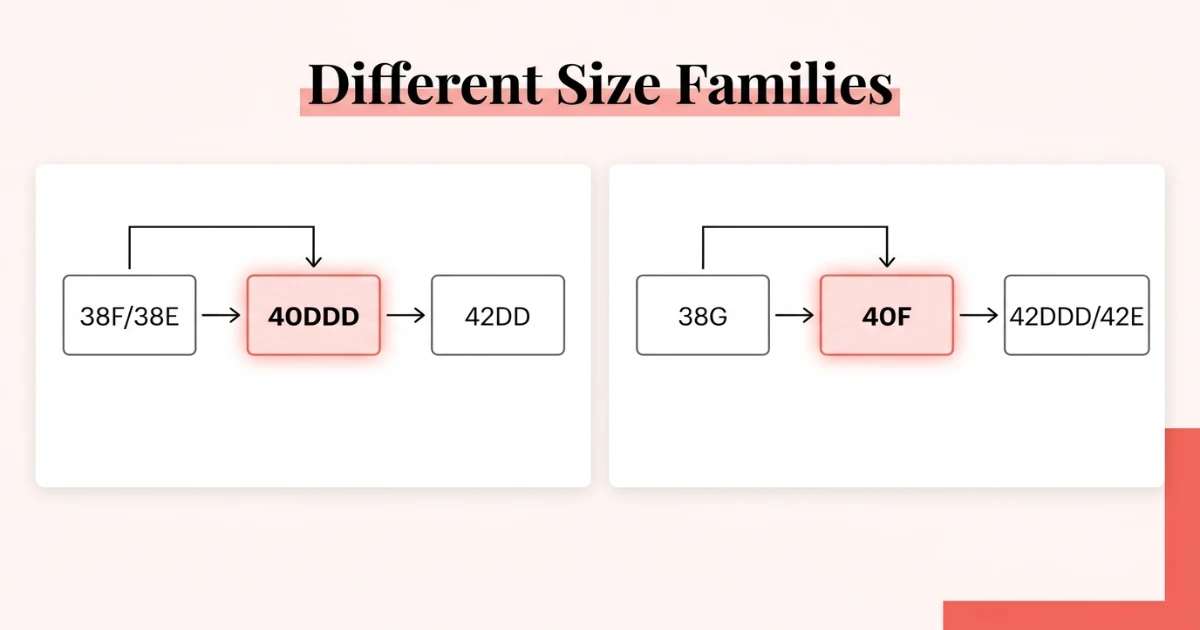
40DDD vs 40F: Full Side-by-Side Comparison
| Feature | 40DDD (6″ diff) | 40F (7″ diff) |
|---|---|---|
| Band Size | 40 — same band, ~39–40″ / 99–102 cm underbust | |
| Bust Measurement | ~46″ (116.8 cm) | ~47″ (119.4 cm) |
| Bust-to-Band Difference | 6″ (15 cm) = DDD cup | 7″ (18 cm) = F cup |
| Cup Volume | ~1355 ml per side | ~1550 ml per side |
| Volume Difference | 40F holds ~180–200 ml more per breast (when separated) | |
| Sister Sizes? | ❌ No — same band, different volumes. Not sister sizes. | |
| Sister Size Family | 38F/38E — 40DDD — 42DD | 38G — 40F — 42DDD/42E |
| US Equivalent | 40DDD (if brand separates) or 40F (if DDD = F) | 40F |
| UK Equivalent | 40E | 40F |
| EU Equivalent | 90F | 90G |
| Typical Construction | 3–4 part seamed | 4-part seamed + side sling required |
| Strap Style | Wide, heavily cushioned | Very wide, powernet-reinforced |
| Hook Count | 3–4 hooks | 4+ hooks with powernet wings |
| Naming Confusion | ⚠️ High — DDD may equal F in some brands, or be separate. Always check bust measurement. | |
| If cups too small | Move to 40F (if brand separates) or 40G | Move to 40G/40FF (next cup up) |
| If cups too large | Move to 40DD (adjacent size) | Move to 40DDD (adjacent size) |
| If band too loose | Try 38F/38E (sister — same cup, tighter band) | Try 38G (sister — same cup, tighter band) |
| If band too tight | Try 42DD (sister — same cup, looser band) | Try 42DDD/42E (sister — same cup, looser band) |
| Availability | Full-bust specialists only | Full-bust specialists only — online |
People Also Ask: 40DDD vs 40F — Answered
Is 40F bigger than 40DDD?
It depends on the brand. In brands that separate DDD and F (treating DDD as 6-inch differential and F as 7-inch), 40F is one full cup size larger than 40DDD — holding approximately 180–200 ml more per breast. In brands where DDD and F are treated as the same size (both representing 6-inch differential), 40DDD and 40F are identical. Always check the brand’s specific size chart for bust measurement range to confirm.
Is 40DDD the same as 40F?
Depends on the brand’s naming convention. UK brands (Elomi, Panache, Fantasie) don’t use DDD — they go DD → E → F, so 40DDD (US) = 40E (UK). Some US brands treat DDD and F as the same size (both 6-inch differential). Other US brands separate them (DDD = 6″, F = 7″). When shopping, look at the bust measurement: 46″ bust on 40 band = 6-inch cup (DDD or E), 47″ bust on 40 band = 7-inch cup (F).
How do I know if I’m 40DDD or 40F?
Measure your bust at the fullest point. If it’s 45.5–46.5 inches with a 39–40 inch underbust, you’re in the 6-inch differential range (40DDD in brands that use DDD, or 40E in UK brands). If it’s 46.5–47.5 inches with the same underbust, you’re in the 7-inch range (40F in most systems, or 40FF in UK). A floating centre gore in 40DDD is a clear signal you need the larger cup.
What is the sister size of 40DDD?
The sister sizes of 40DDD are 38F (US, if F = 7-inch) or 38E (UK), and 42DD. If your 40DDD band rides up, try 38F/38E for a firmer band with the same cup volume. Note the naming varies — check which cup letter corresponds to the 6-inch differential in your brand’s system.
What is the sister size of 40F?
The sister sizes of 40F are 38G (one band tighter, same cup volume) and 42DDD (US) or 42E (UK) (one band looser, same cup volume). If your 40F band rides up, try 38G for a firmer band with identical cup space. If it digs in, try 42DDD/42E for a looser band with the same volume.
What brands carry 40F?
40F requires full-bust specialist brands. UK brands (Elomi, Panache, Fantasie, Curvy Kate, Freya) use F cup clearly. US full-bust brands (Goddess, Parfait by Affinitas) also carry 40F. Mainstream retailers (Target, Walmart, Macy’s) typically stop at DD or DDD — you must shop specialty stores or online. The 40F is a core size for full-bust specialists but unavailable elsewhere.
Why does my centre gore lift in 40DDD?
A floating or lifting centre gore at DDD volume means the cup is too small — breast tissue is pushing the gore away from the chest wall because it has nowhere to go. This is the most reliable signal you need to size up in the cup. Try 40F (in brands that separate DDD and F) or 40E/40F (UK brands). Do not try to fix this by adjusting the band — it’s a cup volume problem.
Do I need a 4-part cup at 40F?
Yes — at 40F, 4-part seamed cup construction is strongly recommended. The volume (~1550 ml per side) must be distributed across multiple panels for proper shaping and lift. You also need side slings or banded support, powernet wings, heavily cushioned straps, and 4+ hooks. 3-part cups may work at 40DDD but are insufficient at 40F for most wearers.
Can I wear strapless at 40F?
Possible but requires specialty construction. At 40F, strapless needs silicone gripping strips, boning throughout the body, long-line back with 4+ hooks, and very firm band tension. Look for strapless styles rated to F or FF cup from specialty brands (Fashion Forms, Wacoal Red Carpet, Goddess). Test extensively by walking, twisting, and raising arms — if it shifts, the construction isn’t adequate for your volume.
Is 40F a plus size?
The 40 band places you in plus/full-figure retail categories, but cup-wise 40F is a specialty full-bust size, not simply “plus.” Many women wearing 40F have narrower ribcages than the band number suggests — they’ve been mis-sized into larger bands by the +4 method. The cup volume is what requires specialist construction, not the band alone. Full-bust and plus-size are different categories.