36DDD vs 38DD: Are They the Same Size? (Sister Size Explained 2026)
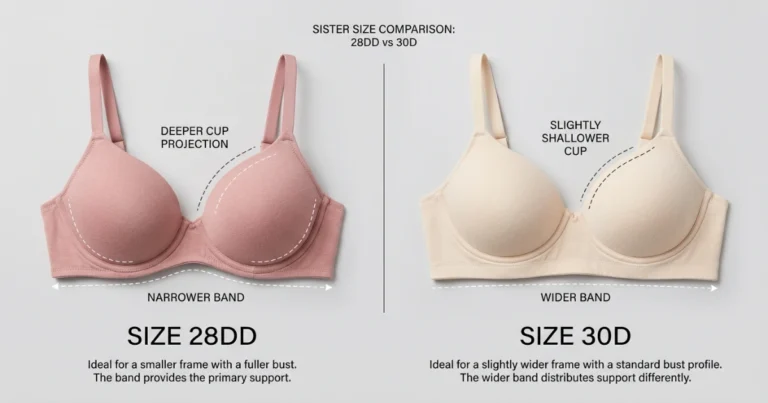
Quick Answer: Yes — 36DDD and 38DD are sister sizes. They hold approximately the same cup volume, meaning the same amount of breast tissue fits comfortably in both. The key difference is the band: a 36DDD grips a narrower ribcage more firmly and produces a deeper, more projected cup, while a 38DD sits on a wider ribcage with a broader, slightly shallower cup. Neither is physically larger — they simply suit different body frames.
Choose the fit signs you notice in the band, cups, center and straps. We’ll turn them into a practical next step for 36DDD.
Private fit check — your answers stay in your browser and are used only for this on-page guidance. Nothing is stored or submitted.
⚡ Key Takeaways
- Same cup volume: 36DDD and 38DD enclose approximately equal breast tissue volume.
- Different band sizes: 36 fits ~31–32″ (79–81 cm) underbust; 38 fits ~33–34″ (84–86 cm) underbust.
- 36DDD = tighter band, deeper cup: More forward projection on a narrower frame.
- 38DD = wider band, shallower cup: More lateral spread suited to a broader chest.
- 36DDD = 36F in UK/EU: Always verify the labelling system when shopping international brands.
- 38DD = 38E in UK/EU: Same applies — DD and E are the same cup on different labelling systems.
- Band support is critical at these cup sizes: Heavier breast tissue demands a firmly anchored band — the margin for error is smaller than at smaller cups.
- Underwire width is a deciding factor: Wider frames need wider wires to avoid digging into side breast tissue.
Understanding the Band Size Difference: 36 vs 38
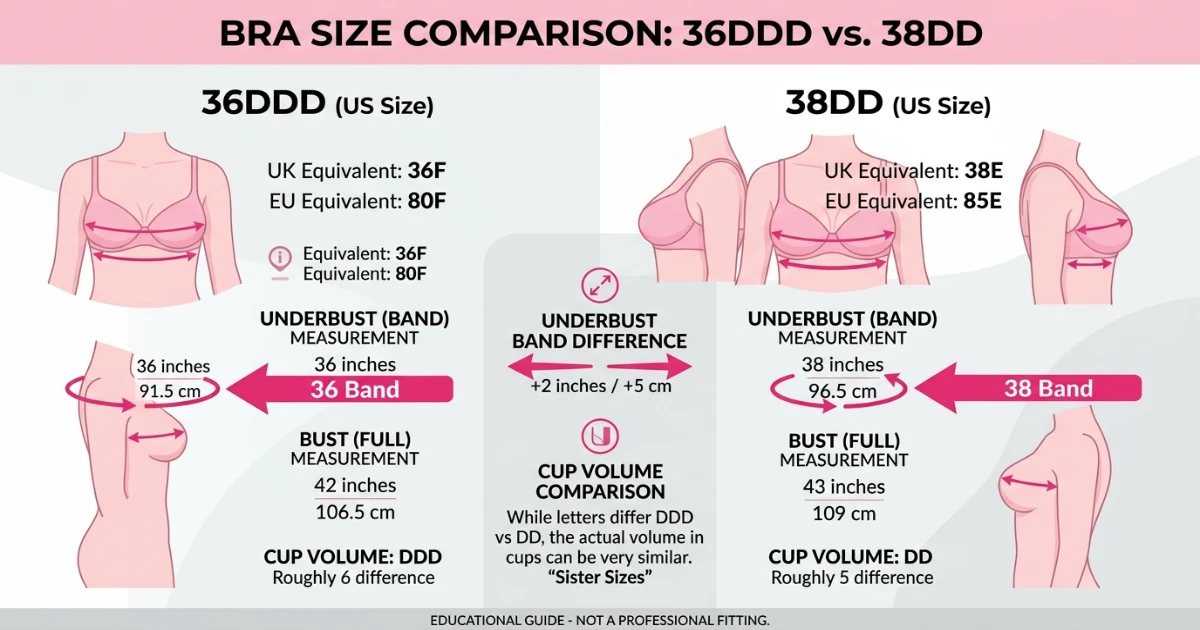
The band number in your bra size reflects a single precise measurement: your underbust circumference — the snug circumference of your ribcage directly beneath the breasts. A 36-band is built for an underbust of approximately 31–32 inches (79–81 cm). A 38-band accommodates roughly 33–34 inches (84–86 cm).
At DDD and DD cup sizes, this two-inch band difference carries more weight than it does at smaller cup sizes. Breast tissue in DDD and DD cups is heavier, and a loose band fails faster — migrating upward at the back within hours, dragging cups downward in front, and placing the full load of that breast tissue onto shoulder straps that are simply not built to carry it. Bra fitting specialists consistently confirm that approximately 80% of breast support comes from the band — and this figure is arguably even more meaningful at larger cup sizes.
The Consequence of a Loose Band at Larger Cup Sizes
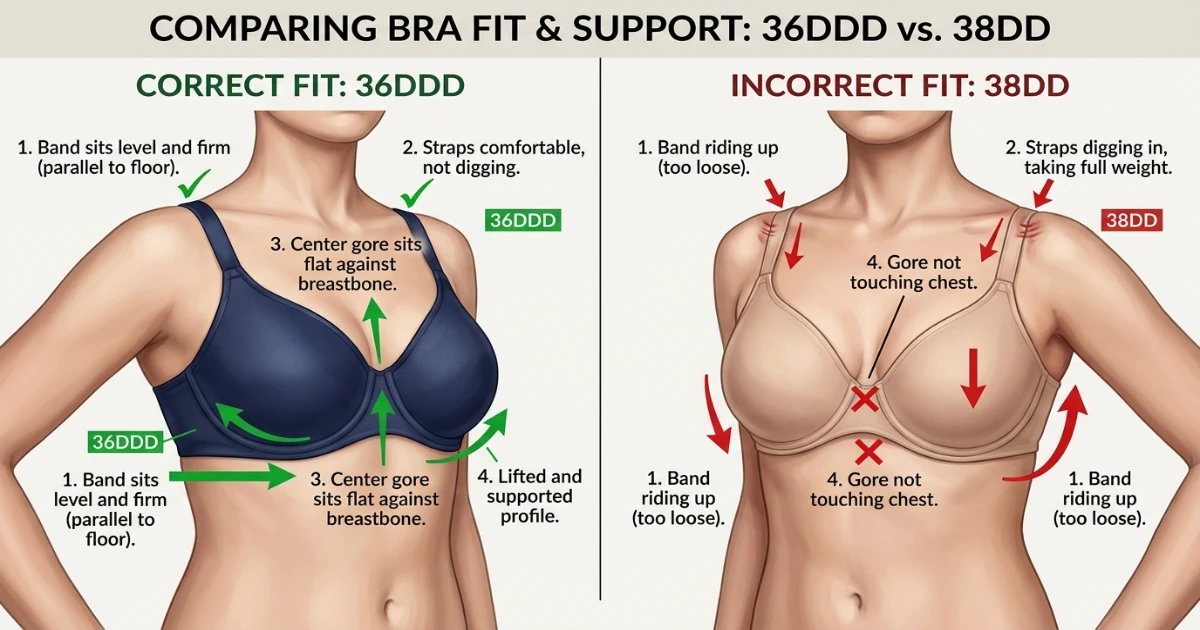
A correctly fitted 36DDD band runs level around the ribcage from front to back, keeps the underwires anchored at the base of the breast, and generates consistent upward lift throughout the day without any contribution from the straps. A 38DD band worn on a 32-inch ribcage starts migrating upward within hours — pushing underwires onto breast tissue, floating the gore off the sternum, and creating the shoulder-groove and neck-tension pattern that many women accept as inevitable. It is not inevitable. It is the direct result of a band that is too large for the body wearing it.
If this sounds familiar, an accurate underbust measurement is the essential starting point before choosing between these two sizes.
Measurement Breakdown: 36DDD vs 38DD
The table below shows how each size is constructed from real body measurements. The cup letter differs between them — but the three-dimensional volume each cup encloses remains approximately equal because the wider band frame of the 38DD compensates for its smaller letter differential.
| Size | Underbust (Band) | Bust (Fullest Point) | Cup Difference | Cup Letter (US / UK-EU) |
|---|---|---|---|---|
| 36DDD | ~31–32″ (79–81 cm) | ~38″ (97 cm) | 6″ (15 cm) | DDD / F |
| 38DD | ~33–34″ (84–86 cm) | ~39″ (99 cm) | 5″ (13 cm) | DD / E |
The bust measurements differ by approximately one inch — consistent with how sister sizing works across all size families. The wider circumference of the 38DD cup offsets its shallower depth, producing approximately the same total enclosed volume as the deeper, narrower 36DDD cup.
EU sizing: 36DDD = 80F; 38DD = 85E. Cross-reference all conventions using our international size charts.
Why Cup Volume Is the Same: The Sister Size Principle
Cup letters are ratios, not fixed measurements. Each inch of difference between bust and underbust equals one cup letter in US/UK sizing:
- 4″ = D | 5″ = DD/E | 6″ = DDD/F | 7″ = DDDD/G
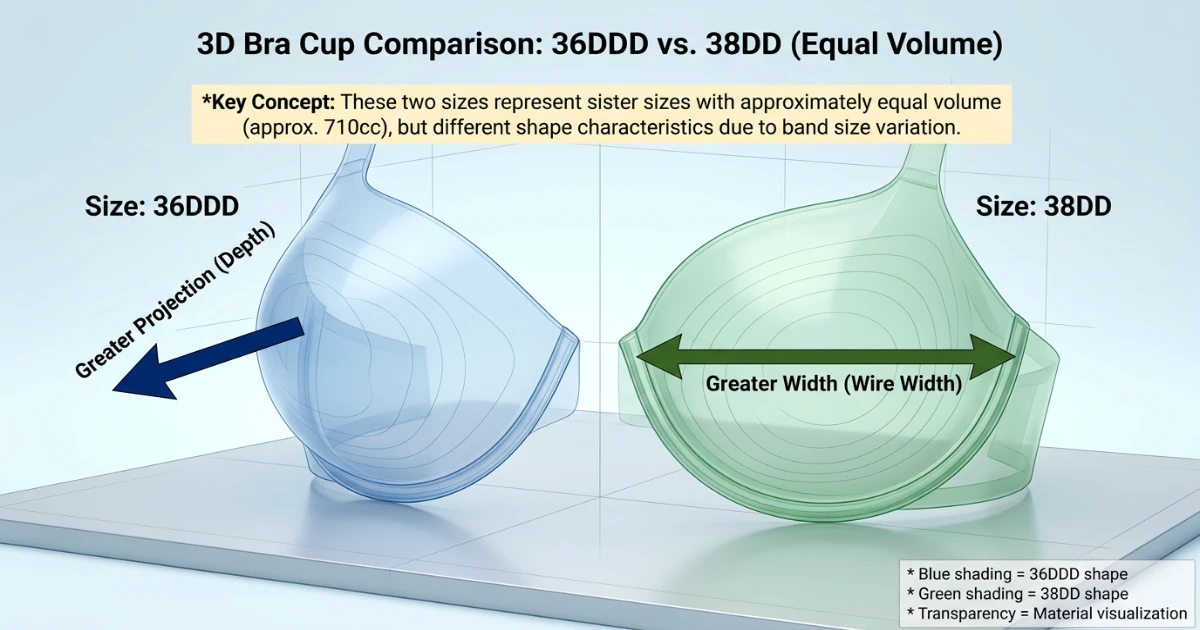
A 36DDD means a 6-inch differential on a 36-inch frame. A 38DD means a 5-inch differential on a 38-inch frame. Because the 38 frame is already 2 inches wider, a smaller letter differential still generates approximately the same enclosed three-dimensional cup volume. DDD on a 36 band is not larger than DD on a 38 band. They are sister sizes — different labels for the same space.
Full Sister Size Equivalency for This Family
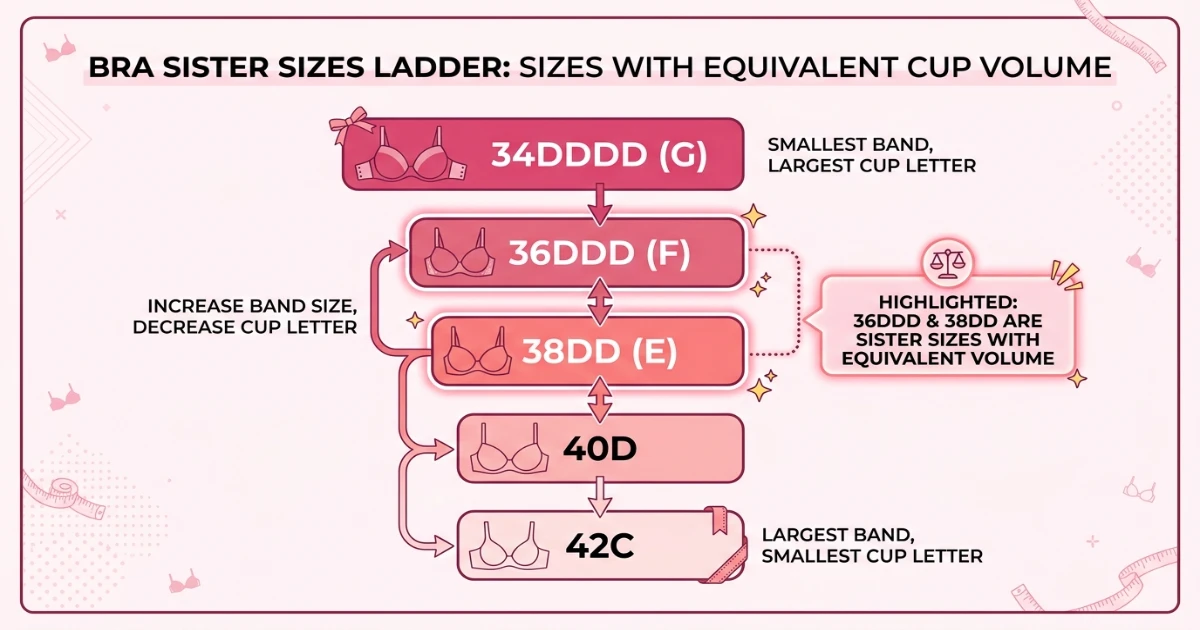
- 34DDDD (34G) ≈ 36DDD (36F) ≈ 38DD (38E) ≈ 40D ≈ 42C — all approximately equal cup volume.
This is especially practical when shopping across brands that size differently, or when a specific size is sold out. Explore the full visual explainer on our cup size visuals page.
Real Fit Differences Between 36DDD and 38DD
Band Tension and Structural Support
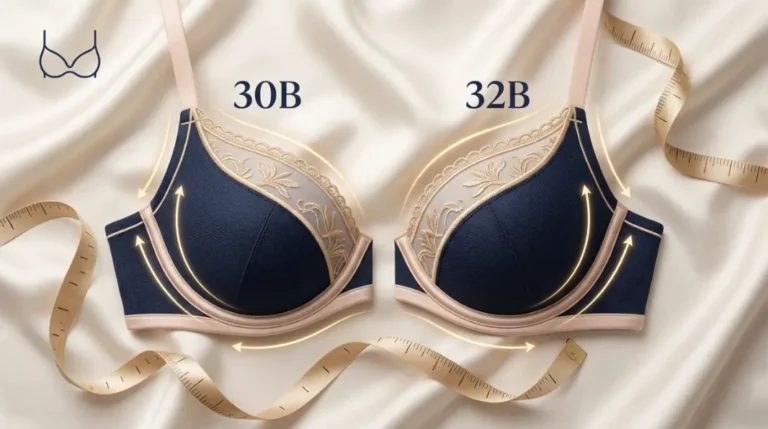
A well-fitted 36DDD band sits firmly and level around the ribcage, functioning as the primary load-bearing structure of the entire bra. It requires minimal contribution from the shoulder straps and maintains its position throughout a full day of activity. A 38DD on a narrower ribcage feels softer at first — but that softness is the band failing to anchor. In DDD and DD cup sizes, the progressive migration of a loose band upward at the back is faster and more disruptive than at smaller cups, because the breast tissue being displaced is heavier and the drop of the cups in front is more pronounced.
Cup Depth, Projection, and Width
The 36DDD cup is engineered for a narrower chest wall: its underwire channel is set closer together and the cup projects substantially forward — ideal for breasts that sit close together, are full at the centre, or have noticeable forward projection. The 38DD cup is broader, with a wider underwire and a more spread-out profile that accommodates breast tissue fanning outward toward the underarms on a broader frame. Both contain the same volume but the silhouette each creates on the body differs distinctly.
Underwire Width — Critical at DDD and DD
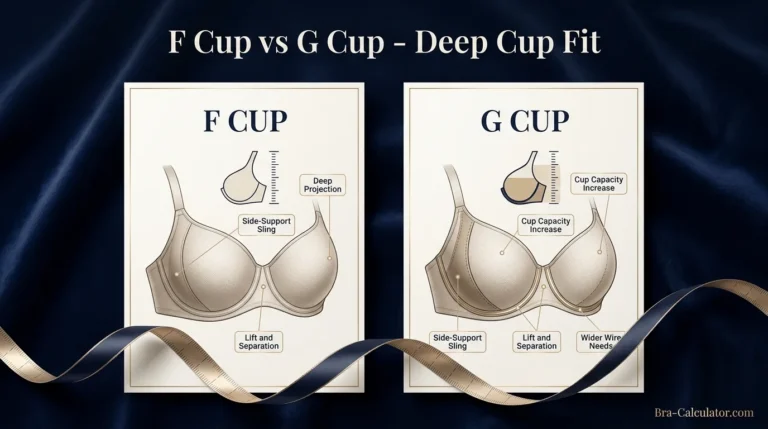
At these cup sizes, the underwire width is as important as the band size. If the 36DDD underwire digs into the soft tissue at the side of the breast rather than sitting cleanly on the ribcage around it, the wire is too narrow for your breast root — not a sign of wrong volume. The 38DD’s wider underwire may resolve this entirely even if your band measurement points toward 36. Diagnose all fit issues on our bra fit problems guide.
Who Should Choose 36DDD (36F)?
- Underbust measurement closer to 31–32 inches (79–81 cm) when measured snugly beneath the bust.
- Current 38DD band rides up at the back during daily activity or exercise.
- Straps require constant tightening throughout the day — the most reliable indicator of a loose band.
- Breasts sit relatively close-set with significant forward projection away from the chest wall.
- The 38DD underwire extends beyond natural breast tissue boundaries into the armpit area.
- You want a bra that stays firmly in place and requires no repositioning throughout a full day of wear.
Confirm that your fit is working correctly on our how to know your bra fits page.

Warner’s Cloud 9 Wireless Bra — For Women Who’ve Given Up on Underwire Comfort
- Cloud-soft, wire-free construction eliminates underwire pain completely
- Flexible cup edges move naturally — no digging, no gaps
- Available in B–DDD sizes with true-to-size fit
- Perfect for sensitive days, hormonal changes, or recovery comfort
⚠ Affiliate disclosure: bra-calculator.com may earn a commission at no extra cost to you.
Who Should Choose 38DD (38E)?
- Underbust measurement closer to 33–34 inches (84–86 cm) when measured snugly.
- A 36DDD band feels genuinely tight even on the loosest hook from the very first wear.
- Breasts have a wide root and spread substantially toward the underarms — the 36DDD underwire digs into the side breast tissue.
- Consistently find 36-band bras constricting across the whole torso regardless of cup size.
- The wider 38DD underwire encircles all breast tissue cleanly without pinching at the sides.
Use our breast shape identifier to understand which cup geometry suits your shape, and verify measurements with our size charts.
The Sister Size Ladder: Where 36DDD and 38DD Sit
36DDD and 38DD are direct neighbours on the same sister size chain. Every size across this ladder holds approximately equal cup volume — only band tightness and cup geometry shift as you move along it.
UK/EU equivalents for this ladder: 34G → 36F → 38E → 40D → 42C. Moving left tightens the band and deepens the cup; moving right loosens the band and widens the cup, while volume stays approximately constant throughout. Explore the full chart on our sister sizes guide or generate your personal ladder with the sister size bra calculator.
Quick Bra Fit Test: 5 Checks for DDD and DD Cup Sizes
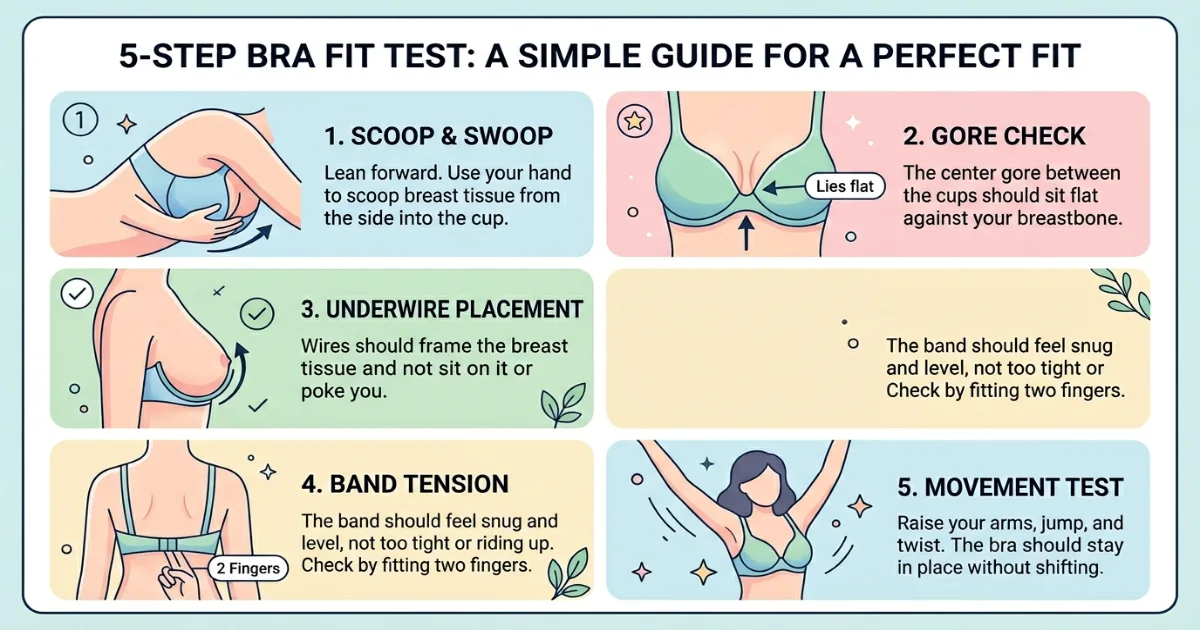
In DDD and DD cup sizes, fit issues can develop quickly and compound over a day of wear. Run through these five checks now to identify whether your current bra is working — or whether your sister size would make a meaningful difference.
Lean forward and scoop all breast tissue — including the significant side and underarm fullness common in DDD and DD sizes — fully forward and upward into the cup. At these cup sizes there is often considerably more tissue sitting outside the cup than wearers realise. Any overflow at the top, sides, or armpit after scooping signals the cup is too small or the underwire too narrow.
Press the centre gore gently against the sternum — it must lie completely flat with no gap. In DDD and DD sizes, a floating gore is one of the most consistent signs of a cup that is too small. If it floats, move up one cup size or try the sister size with a tighter band (e.g., 36DDD if currently in 38DD).
The underwire must fully encircle all breast tissue and rest on firm ribcage from side seam to gore. Also confirm the wire width matches your natural breast root — beginning and ending at its natural edges. A wire that sits inside the breast boundary is too narrow; one that extends onto the ribcage beyond the breast is too wide. Both cause discomfort and reduce containment.
On the loosest hook, slide two fingers under the back band — they should fit with definite resistance. At DDD and DD cup sizes, any band looseness is magnified immediately: if more than two fingers slide in easily, the band is too large. Go down one band size (and up one cup letter to maintain volume).
Raise both arms overhead, twist from side to side, and walk briskly for a full minute. In a correctly fitted fuller-cup bra, nothing should move. Any downward creep of the cups during movement is a definitive sign that the band is too loose for the cup size being worn.
Still unsure whether 36DDD (36F) or 38DD (38E) is the right fit for your body? Our AI calculator gives you a precise answer based on your actual measurements.
Try the AI-Powered Bra Size Calculator →36DDD vs 38DD: Full Side-by-Side Comparison
| Feature | 36DDD (36F) | 38DD (38E) |
|---|---|---|
| Band Size | 36 (31–32″ / 79–81 cm) | 38 (33–34″ / 84–86 cm) |
| Cup (US / UK-EU) | DDD / F — 6″ (15 cm) | DD / E — 5″ (13 cm) |
| EU Size | 80F | 85E |
| Cup Volume | ~Equal ✓ | ~Equal ✓ |
| Bust Measurement | ~38″ (97 cm) | ~39″ (99 cm) |
| Cup Shape | Narrower, deeper — more projection | Wider, shallower — more lateral spread |
| Underwire Width | Narrower — close-set breasts | Wider — wide-root breasts |
| Support Level | High — firm band for narrower ribcage | Good — correct band for broader ribcage |
| Comfort Feel | Snug — firm anchor all day | Relaxed — forgiving around the torso |
| Coverage | Central and forward projection | Broader lateral and underarm coverage |
| Best For | Underbust ~31–32″, projected or close-set | Underbust ~33–34″, wide-root or side-full |
| Availability | Fuller-bust specialists; best range online | Widely stocked in most mid-range brands |
People Also Ask: 36DDD vs 38DD — Answered
Are 36DDD and 38DD the same size?
Yes — 36DDD and 38DD are sister sizes holding approximately the same cup volume. The 36DDD (also labelled 36F) has a tighter band for a ~31–32 inch ribcage with a deeper, projected cup. The 38DD (also labelled 38E) has a wider band for a ~33–34 inch ribcage with a broader, slightly shallower cup. Neither encloses more breast tissue than the other.
Which is bigger — 36DDD or 38DD?
Neither is bigger in cup volume. The 36DDD projects more forward from a narrow base; the 38DD spreads more widely across a broader chest. At these fuller cup sizes especially, the letter alone is a poor guide to actual size — always consider the complete size and match the band to your measured underbust.
Is 36DDD the same as 36F?
Yes — completely. US sizing uses DDD for a 6-inch cup differential; UK and EU sizing uses F for the same measurement. When shopping UK or European brands, search for 36F to find what US brands call 36DDD. Similarly, 38DD in US sizing is labelled 38E by UK and European manufacturers. Always confirm which system a brand uses before ordering.
Is 36DDD tighter than 38DD?
Yes. The 36 band fits an underbust of approximately 31–32 inches (79–81 cm); the 38 band fits roughly 33–34 inches (84–86 cm). At DDD and DD cup sizes, that firmer anchoring is not just a comfort preference — it is directly tied to how effectively the bra can support heavier breast tissue across a full day without the straps compensating.
Can I switch between 36DDD and 38DD?
Yes, in many situations. If your 38DD band rides up or your straps create grooves despite being loose, try a 36DDD for a firmer fit with the same cup volume. If the 36DDD underwire digs into side breast tissue or the band is tight on the loosest hook, the 38DD’s wider construction may suit your frame better. Always try both where possible — brand sizing varies meaningfully.
What is sister sizing?
Sister sizing is the principle that certain bra sizes share approximately equal cup volume despite different band numbers and cup letters. Increasing the band by one step means dropping one cup letter to maintain volume. The sister size chain for 36DDD (36F) is: 34DDDD (34G) → 36DDD (36F) → 38DD (38E) → 40D → 42C — all approximately equal in cup volume.
Does band size change cup shape at these sizes?
Yes — and the effect is most pronounced at larger cup sizes. A 36DDD cup is built with a narrower underwire channel and deep forward projection suited to close-set, projected breasts on a smaller frame. A 38DD cup is wider and slightly shallower, better for wide-root breast tissue on a broader frame. Same volume, distinctly different three-dimensional geometry and underwire width.
Which gives better support — 36DDD or 38DD?
For a 31–32 inch ribcage, the 36DDD delivers noticeably better support. Around 80% of breast support comes from the band — and at DDD cup sizes this matters more, not less. A correctly fitted 36DDD stays anchored all day; a 38DD on the same narrower frame migrates upward within hours, loading the straps and creating neck and shoulder tension that compounds over time.
Is 36DDD (36F) hard to find in stores?
36DDD (36F) is less common on mainstream high-street shelves but well stocked by fuller-bust specialist brands — Freya, Panache, Elomi, Curvy Kate, and Wacoal among them. Online retailers typically carry the broadest range across styles and price points. Do not size up to 38DD purely for availability — a correctly fitting bra in your true size is always worth finding.
How do I know my correct bra size?
Measure your underbust snugly for your band and your bust at the fullest point for your cup. Subtract underbust from bust — each inch equals one cup letter. Verify: level band, flat gore, underwire on ribcage and matching breast root width, two fingers under back band on loosest hook, no movement during activity. Use our bra size chart calculator for a precise result.