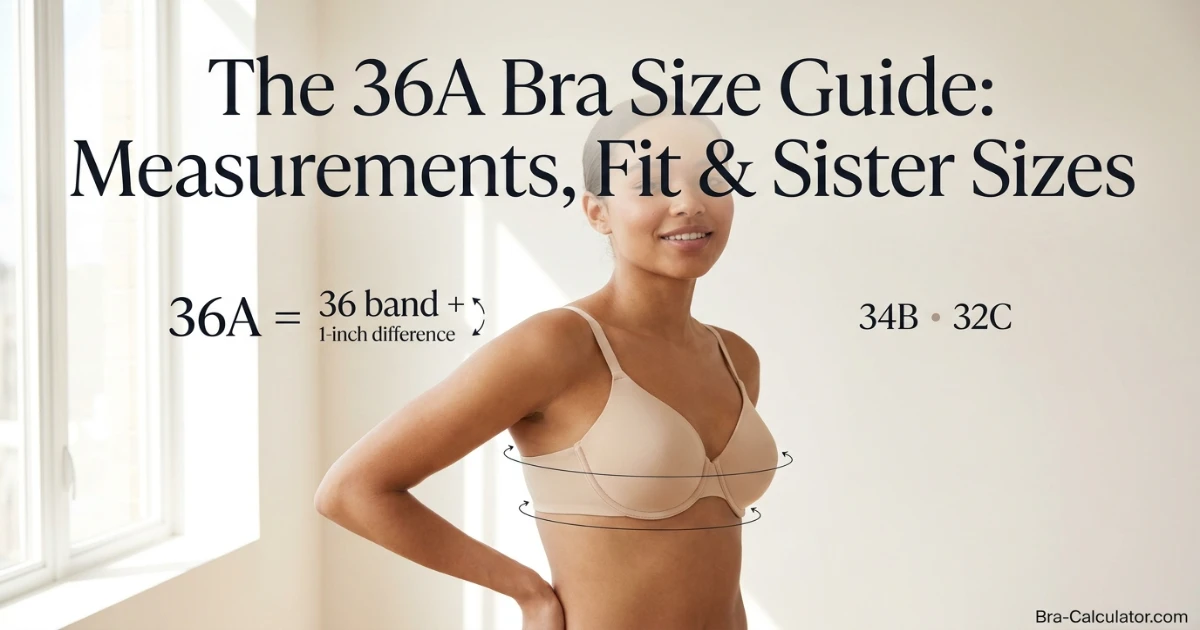
A 36A bra size means your underbust measures approximately 31–32 inches (79–81 cm) and your bust measures 32–33 inches (81–84 cm) — a 1-inch difference that defines the A cup. The number anchors to your ribcage; the letter is a ratio, not a fixed volume. 36A describes a wider-than-average ribcage with minimal breast tissue projection — and is one of the most important sizes to verify with a tape measure before assuming it is correct.
36A at a Glance
| Attribute | Detail |
|---|---|
| Band Size | 36 inches (underbust 31–32″ / 79–81 cm) |
| Full Bust Measurement | 32–33 inches (81–84 cm) |
| Cup Difference | ~1 inch (~2.5 cm) — A cup |
| Sister Sizes | 34B (tighter band) · 38AA (looser band) |
| US / UK Size | 36A |
| EU Size | 80A |
| AU / NZ Size | 14A |
| S/M/L Equivalent | Medium (brand dependent) |
| Cup Volume Equivalent | Same as 34B and 38AA |
What Is a 36A Bra Size?
Breaking down the number and the letter — separately.
36A is a frequently misfitted size — but in a distinctly different direction from the 32A and 34A misfit patterns. Where those sizes are often assigned to people with narrower ribcages who actually need smaller bands, 36A is commonly assigned to people with genuine 34-inch underbusts who actually need 34B. The cups produce a similar visual appearance in the store mirror, the band is one size looser — close enough to feel plausible, not close enough to fit correctly over time.
To understand 36A precisely, the two components must be read independently. The number 36 is your band size — it reflects a ribcage measuring 31–32 inches when measured snugly on bare skin. This is a moderately wide to full-average frame. The band anchors the entire bra to your torso and carries the foundational support load. A band that fits correctly — level across the back, firm without digging — is the single most important determinant of comfort and posture. The letter A is your cup size — a 1-inch difference between underbust and full bust. On a 36-inch ribcage, this means minimal tissue projection above the chest wall: a genuinely wide-framed, small-cup body type.
The most clinically important point about 36A: it holds more absolute cup volume than a 34A or 32A, even though all three carry the letter A. Cup volume scales with band circumference — a 1-inch ratio on a 36-inch frame produces slightly more absolute tissue volume than the same ratio on a 32-inch frame. A genuine 36A wearer has a wider ribcage than a 34A wearer and slightly more breast tissue in absolute terms, even though both sizes carry the same letter.
The 36A misfit pattern is bidirectional and specific. Women with 34-inch underbusts who need 34B are assigned 36A because the slightly wider band is more comfortable than an actually wrong size — but over time the loose 36 band causes straps to migrate and support to erode. Conversely, women with genuine 38-inch underbusts are assigned 36A because the cup volume feels similar to their correct 38AA — but the band is too tight and leaves marks. Both scenarios are resolved by accurate measurement.
36A Bra Measurements
The precise measurements that define this size — in both inches and centimetres.
Difference = A Cup (~1 in)
Wrap tape snugly around your bare ribcage where the band sits — perfectly level across your back. For a 36A, this should read 31–32 inches (79–81 cm).
Stand naturally and measure around the fullest part of your bust without compressing tissue. Keep the tape level. For a 36A, this reads 32–33 inches (81–84 cm).
Bust minus underbust = cup letter. A 1-inch (~2.5 cm) difference = A cup. With a 36 band → you’re a 36A.
A new bra should feel secure on the loosest hook with the band sitting level across your back. Two fingers should fit snugly under the band without pulling. If the band rides up, consider sister size 34B — same cup volume, 2 inches firmer in the band.
What Does 36A Look Like?
Cup size tells you volume — not shape. Your breast shape changes how any size looks on your body.
The most misunderstood part of bra sizing is expecting one size to look identical on everyone. A 36A looks entirely different depending on your height, muscle mass, and natural breast root shape. Two people can share the exact same 32-inch bust measurement and look like they are wearing completely different sizes.

Victoria’s Secret Bombshell Push-Up Bra — Maximum Lift for 36A
- Adds up to 2 cup sizes of visible lift — particularly impactful on wider A cup frames
- Angled foam pads create visible cleavage on a 36 band without gaps or pooling
- Wider 36-band keeps push-up padding stable across a broader chest width
- One of the most effective enhancement options for a wider-frame A cup
Wider Frame
On a genuine 31–32 inch ribcage, A cup volume is proportionally modest relative to the total chest area. Tissue appears subtle and flat rather than projected — not because it is abnormally small but because the band-to-cup ratio places minimal volume across a broader surface. This is the defining visual reality of 36A.
Subtle and flatAthletic Build
Pectoral muscle and broader shoulders on a 36-band frame distribute A cup volume across an even wider surface. Tissue can appear entirely flat despite correct measurements. Push-up padding and structured cups are most effective at creating visible projection on athletic 36A frames.
Very flat appearanceFull-Average Build
On a full-average build with a genuine 36-inch band measurement, A cup tissue is modest but present — a gentle natural roundness without significant forward projection. Soft-cup bralettes and T-shirt bras produce the most natural, comfortable silhouette at this size on a fuller frame.
Gentle natural roundnessWide-Set Breasts
A cup volume spread widely across a 36 band with a sternum gap can appear almost invisible from the front while still creating a natural body curve in profile. Bralettes and balconettes with a wider center opening frame wide-set 36A tissue far more naturally than structured cups.
Gap at centerYour cup size tells you volume, not shape. And your unique breast shape affects how a bra fits far more than the letter on the tag. Two 36A bodies can look completely different — both are perfectly normal.
Is 36A Considered Small?
On a 36-inch band, an A cup is proportionally very small relative to the frame — the 1-inch cup projection is minimal on a 31–32 inch ribcage. This creates a distinctly different visual from a 30A or 32A, where the same ratio on a narrower frame appears proportionate. On a wider frame, 36A can read as essentially flat from the front.
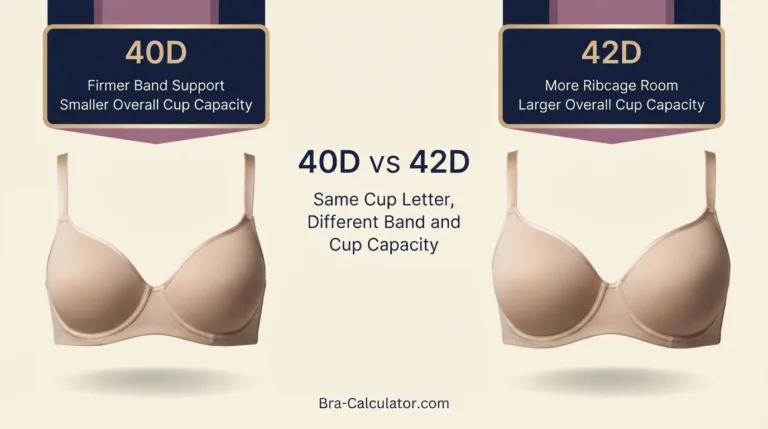
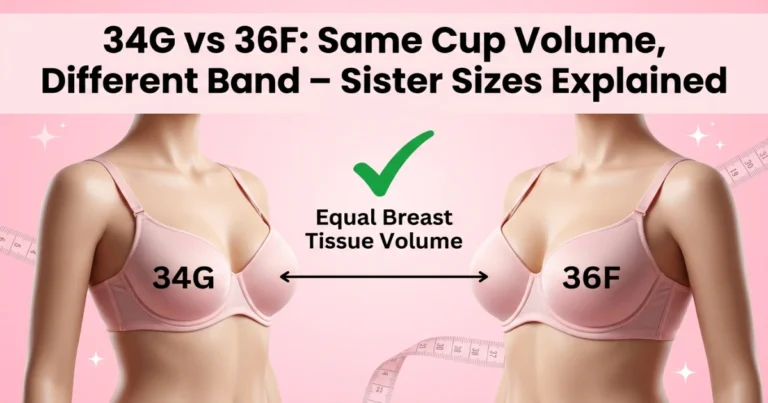
Cup volume scales with band width. A 36A holds the exact same tissue volume as a 34B and a 38AA — these are sister sizes. The same letter A on a 42 band holds considerably more physical tissue than the A on your 36 band.
36A represents a genuinely wider ribcage with genuinely minimal breast tissue. It is not a default small-cup size — it is a specific combination of moderate-to-wide frame and A cup projection. The important thing is that the band measurement is accurate: a genuine 31–32 inch underbust belongs in a 36 band; a 29–30 inch underbust with similar cup volume belongs in 34B, which is the sister size with the same cup capacity.
36A Sister Sizes
Same cup volume — different band and letter combinations. Your lifeline when the band is off but the cups fit perfectly.
When the cups feel right but the band does not, sister sizing is the cleanest fix. Calculate equivalent sizes instantly with the Sister Size Calculator, or read the full Sister Sizes Guide to understand why 34B and 38AA hold the same cup volume as your 36A.
Rule: Go up one band = go down one cup letter | Rule: Go down one band = go up one cup letter | Result: Cup volume stays identical
| Smaller Band (tighter) | Same Volume as 36A | Larger Band (looser) |
|---|---|---|
| 34B | 36A — You | 38AA |
| 32C | 36A | 40AAA |
36A vs Other Sizes
Select a comparison to understand exactly how 36A differs from adjacent sizes.
If you are still stuck between nearby sizes, compare the broader patterns inside our Breast Size Comparison hub.
- Same 36-inch band — identical ribcage fit
- 1-inch cup difference — more volume than 36AA
- More tissue projection and depth than 36AA
- If 36A consistently gapes at top, try 36AA
- Same 36-inch band anchors both
- Less than 1-inch cup difference — very minimal projection
- Less tissue volume — designed for very flat chest on a 36 band
- If 36A spills or feels tight in the cup, you are in 36A correctly
- Same 36-inch band — identical ribcage anchor
- 1-inch cup difference — shallower than 36B
- Tissue fits without spillage at correct A cup volume
- If 36A fabric pools at top constantly, you are correctly in 36A
- Same 36-inch band anchors both
- 2-inch cup difference — more depth and projection
- Larger cup volume on the same wider-frame ribcage
- 36A tissue spillage over cup edge = try 36B
- Tighter band — better lift and structural support
- Slightly less cup volume than 38A
- Correct fit for a genuine 31–32 inch ribcage measurement
- 2 inches looser band — designed for a 33–34″ ribcage
- Same A letter but holds slightly more cup volume
- Only correct if your underbust genuinely measures 33–34 inches
- Looser 36-inch band — fits a 31–32″ underbust
- Identical cup volume to 34B — true sister size
- If 36A band consistently rides up, move to 34B
- 2 inches tighter band — fits a 29–30″ ribcage
- Sister size: exact same cup volume as 36A
- Ideal swap if your 36A band is too loose but cups feel correct
Best Bra Styles for 36A
What actually works on a wider frame with A cup volume — and one style to skip entirely.

Warner’s Cloud 9 Wireless Bra — Soft Support Without Underwire
- Wire-free comfort — no pressure points on a moderately wide 36-inch ribcage
- Flexible cups adapt to 36A shape without gaping or creating empty fabric
- Light support perfect for daily wear, lounging, or low-impact activity
- 36-band provides wide coverage and natural silhouette on a fuller frame
The most impactful style choice for 36A. On a wider frame, A cup volume can appear very flat — push-up padding creates visible projection and cleavage that is otherwise minimal at this band-to-cup ratio. The 36 band keeps pads stable and the result looks natural rather than engineered.
Seamless molded foam gives a smooth, rounded silhouette under fitted tops. At A cup volume on a 36 band, foam cups sit without collapsing — 36A is widely available as a standard size in T-shirt bra constructions from every mainstream brand.
36A sits well within standard bralette sizing at Medium. Soft-cup bralettes in M produce natural, comfortable shaping across the wider 36 band without underwire pressure. A practical and comfortable everyday choice for minimal-structure preference.
Works well for 36A wearers with wider-set tissue. The horizontal underwire lifts from below and the wider cup opening frames natural tissue placement across the broader 36 band without forcing it into an unnatural central position.
A 36-inch band with firm elastic provides adequate support for A cup volume without underwire. Natural, gently lifted silhouette — particularly effective when underwire feels restrictive on a wider ribcage or during temperature-sensitive periods.
Full coverage cups are engineered for heavy, pendulous tissue. On shallow 36A tissue spread across a wider band, the tall cups create persistent top gaping, pools of empty fabric above the breast, and a boxy flattened silhouette rather than the natural shape they promise.
Common Fit Problems with 36A
Identify what’s wrong — and what to actually do about it.
The band is too loose to anchor to your ribs. It migrates upward with movement and forces shoulder straps to carry all weight — causing neck and shoulder pain while eliminating structural support. At A cup volume this is uncomfortable; with heavier post-weight-gain tissue it becomes actively painful.
The cup is either too large or structurally wrong for your shape. At A cup depth on a 36 band, shallow or wide-set tissue placed in tall molded cups always gaps at the top. This is a shape mismatch — most 36A wearers benefit from softer, more pliable cup constructions.
Straps are positioned too far apart for your shoulder width — or the band is too loose, which allows the back of the bra to ride upward and pull straps off the shoulders in the process. Tightening straps alone creates pressure grooves without fixing either root cause.
The underwire is too wide for your breast root width. On a 36 band with A cup volume, underwires are often wider than the actual breast root — particularly on athletic builds where breast tissue is minimal across a broad chest surface.
The gore between cups is floating rather than sitting flush against your sternum. On a 36A with wide-set tissue, the tissue placement is naturally further apart than most bra gore positions — the gore is fighting natural anatomy rather than fitting it.
Overflow above the cup edge means cups are too small. On a 36 band this typically means the measurement was correct but the cup size was underestimated — particularly common when 36A is assigned as a default rather than measured.
International Size Conversion
Ordering a European or Australian bra? Your size changes on the label — but your body doesn’t.
Shopping European lingerie? An 80A in France, Germany, or Poland equals your standard 36A. European sizing converts band measurements to centimetres — 36 inches becomes approximately 80 cm on their charts. The cup letter A remains consistent across all major EU markets. The band number changes significantly (36 → 80) but the garment is identical in every measurement.
At A cup depth on a 36 band, brand fit patterns vary more noticeably than at smaller bands — particularly in how manufacturers handle the underwire width and cup orientation on a wider frame. Use the Brand Size Decoder and the Global Bra Size Converter to find the brands that cut best for your specific frame and tissue placement in 36A.
Frequently Asked Questions
The questions everyone actually searches — answered directly.
No. A 36A and a 34B are sister sizes — they hold the exact same cup volume of breast tissue. The structural difference is the band: 34B features a tighter band for a narrower 29–30 inch ribcage, while 36A fits a moderately wider 31–32 inch torso. Cup capacity is completely identical between them — only the band width and frame fit differ.
The two primary sister sizes are 34B (one band tighter, same cup volume) and 38AA (one band looser, same cup volume). All three contain identical cup tissue capacity. Go to 34B if your 36A band rides up or feels loose. Go to 38AA only if your underbust genuinely measures 33–34 inches — otherwise you are accepting a looser, less supportive band without benefit.
Yes — 36A is widely stocked in mainstream retail and represents a genuine measurement for people with a moderately wide ribcage and minimal breast tissue projection. It is also one of the sizes most frequently misfitted: women with genuine 34-inch underbusts who need 34B are often assigned 36A because the slightly wider band feels acceptable and the cups appear visually similar. Accurate tape measurement clarifies which is actually correct.
Excellent — and particularly impactful at 36A. On a wider frame with A cup volume, tissue can appear very flat or minimal without enhancement. Push-up padding creates visible projection and cleavage that transforms the silhouette more dramatically than at narrower band sizes, because the contrast between enhanced and unenhanced appearance is greater. The 36 band keeps pads stable throughout the day.
On a genuinely wider 31–32 inch ribcage, A cup volume is proportionally very small — it can appear quite flat or subtle on a broader frame, especially on athletic builds. The same A cup volume that looks naturally rounded on a 30-inch ribcage spreads across a wider surface on a 36 band and reads as minimal. This is proportional reality — not a measurement error or body problem.
A 36A typically fits someone with a moderately wide to full-average frame — a ribcage measuring 31–32 inches — carrying a small amount of breast tissue giving approximately 1 inch of projection above the underbust. Common in average-to-full build adults, women post-weight fluctuation with a wider ribcage and modest breast tissue, and people with naturally broader bone structure and minimal breast volume relative to frame width.
In most bralette and sports bra sizing charts, 36A translates to a Medium or Small-Medium depending on the brand. The 36 band is wider than a 32 or 34, so most brands classify it as a Medium in the band component while the A cup depth remains at a Small equivalent. Always check the brand’s specific measurement chart — S/M/L labelling is inconsistent between manufacturers at this band size.
Confirm Your True Size
Measurements don’t lie — store fittings often do. Use two quick measurements to get your exact bra size in seconds. No guesswork, no frustration.