32B vs 34A: Are They Sister Sizes? The Real Bra Fit Difference Explained
Updated 2026 · By Amelia · 12 min read
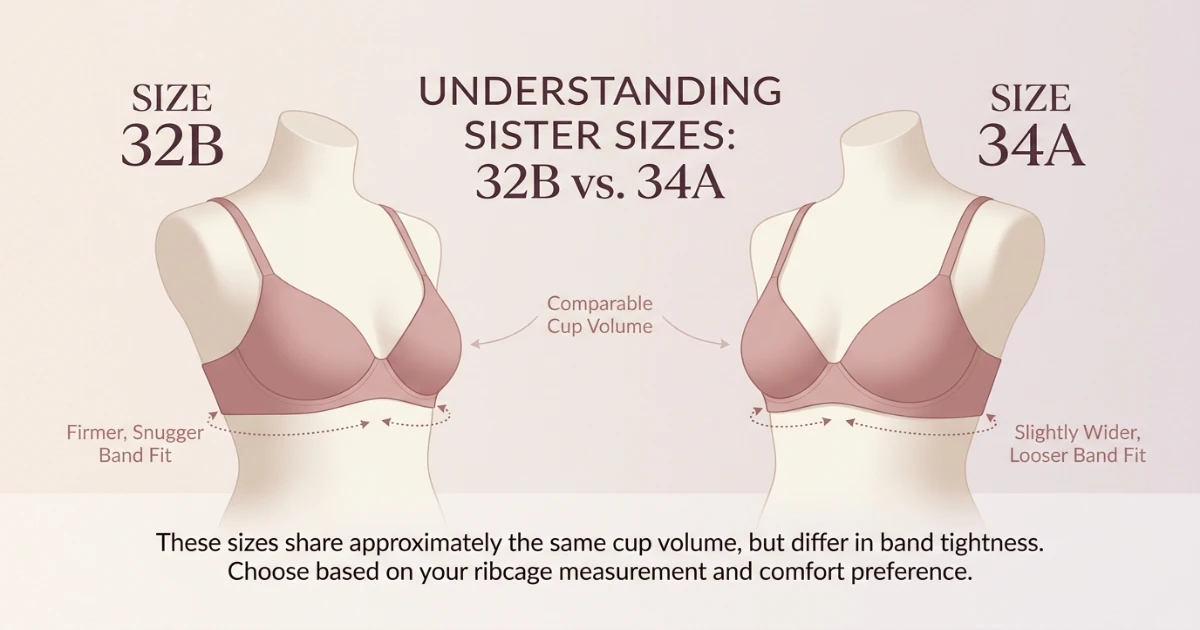
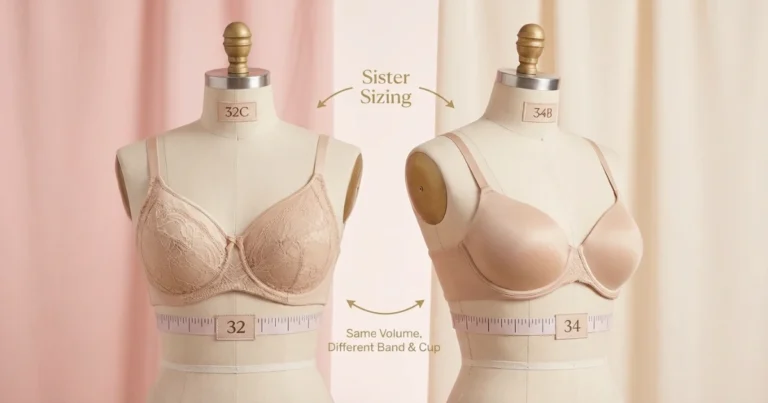
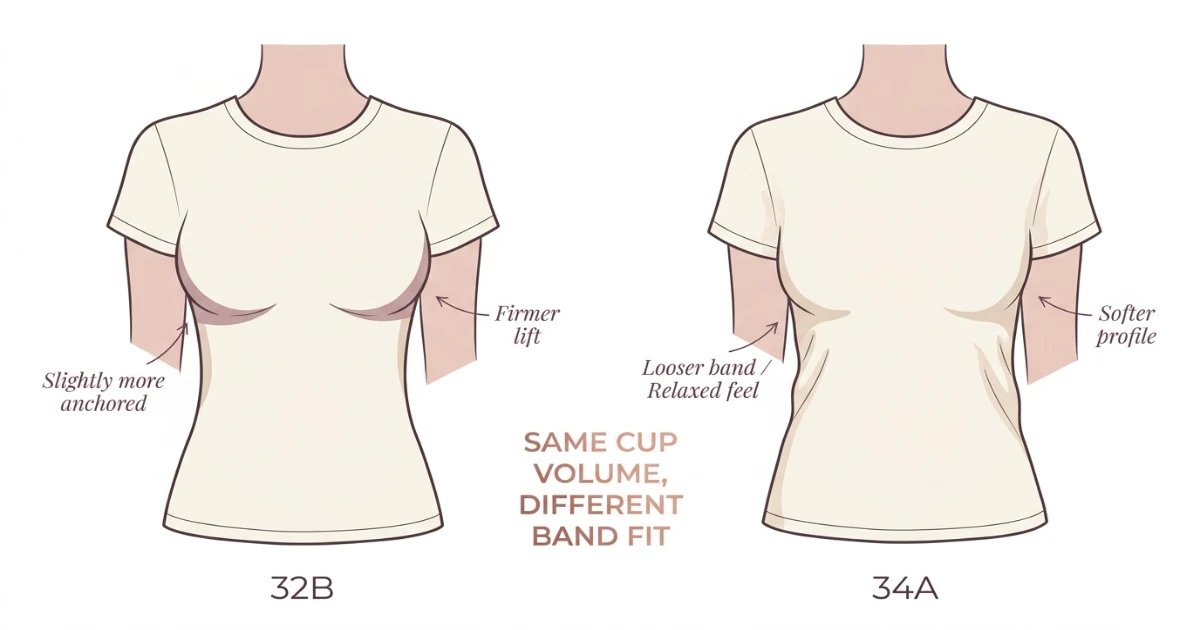
Yes, 32B and 34A are sister sizes — they hold approximately the same cup volume. The key difference is the band: a 32B wraps around a smaller ribcage with noticeably firmer tension, while a 34A fits a slightly larger ribcage with a looser, more relaxed feel. Same cup volume does not mean the same fit experience. The band changes how support is distributed, where the underwire sits, how the cups feel against the breast tissue, and how the bra behaves throughout the day.
Key Takeaways
- 32B and 34A are confirmed sister sizes — they hold roughly equivalent cup volume.
- The 32B band is firmer and targets an underbust of approximately 28–30 inches; the 34A targets 30–32 inches.
- Cup letters are relative to the band — that is why a B on a 32 and an A on a 34 can hold similar cup volume.
- Band tension directly affects support level, underwire placement, cup projection, and overall comfort.
- Breast shape — shallow, projected, wide-root, or narrow-root — can make one sister size fit better than the other even when volume is equal.
- Brand variation matters: some labels cut their bands tighter, and molded bra styles behave differently than unlined ones across sister sizes.
- Your underbust measurement, breast shape, and real-wear comfort signals should guide your final choice — not the cup letter alone.
Why 32B and 34A Confuse So Many People
If you’ve ever been told that 32B and 34A are “basically the same size,” you’ve heard something that is technically true and practically incomplete. Yes, these two bra sizes sit on the same sister size row, and yes, they are designed to hold a very similar amount of breast tissue. But the moment you actually put them on, the differences become obvious — and sometimes, significant.
The confusion comes from how bra sizing works. Most people assume the cup letter is an absolute measurement, like a clothing size number. It isn’t. A B cup on a 32 band is not the same physical space as a B cup on a 36 band. Cup volume scales with the band, which means the letter alone tells you very little without the number beside it. That relationship is the key to understanding both sister sizing and the 32B vs 34A comparison specifically.
This guide walks through exactly what makes these two sizes different — not just on paper, but in real wear. You’ll understand the measurement logic, the fit signals, how breast shape factors in, how brands change the equation, and how to decide confidently which one belongs in your drawer.
What 32B and 34A Actually Mean
Every bra size is a combination of two measurements: the band size (the number) and the cup size (the letter). Understanding both is essential before comparing any two sizes.
The Band Number
The band size reflects the circumference of your ribcage, measured snugly just below the bust. A 32 band is designed for a body with an underbust of roughly 28 to 30 inches. A 34 band fits an underbust of approximately 30 to 32 inches. The difference between them is about two inches of elastic — enough to meaningfully change how firmly the bra grips your torso and how much structural support it provides throughout the day.
The Cup Letter
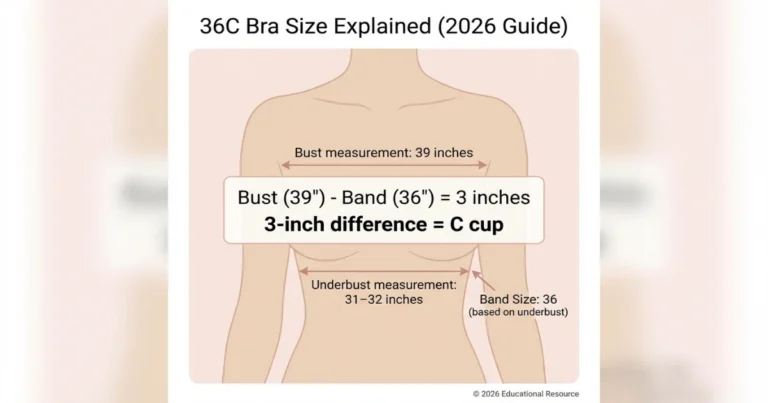
Cup letters are usually based on the difference between your full bust measurement and your underbust measurement, but in real-world bra fitting the actual result also depends on band size, brand grading, and cup shape. In most consumer bra charts, a 32B is associated with about a 2-inch bust-to-underbust difference, while a 34A is associated with about a 1-inch difference. Even so, the larger 34 band changes the physical dimensions of the cup itself — meaning a 34A is cut wider and slightly shallower to accommodate a broader frame. That is why a 34A can hold approximately the same cup volume as a 32B, even though the letters look different on paper. The band shifts the geometry of the entire cup, not just the band length.
Band: ~28–30 in underbust
Cup difference: ~2 inches
Band feel: Firm, close-fitting
Best for: Narrower ribcages
Band: ~30–32 in underbust
Cup difference: ~1 inch
Band feel: Relaxed, slightly looser
Best for: Slightly wider ribcages
Are 32B and 34A Sister Sizes?
Yes. 32B and 34A are definitively sister sizes. Sister sizing identifies bra sizes that, despite different band-and-cup combinations, hold approximately the same volume of breast tissue. When you go up one band size, you go down one cup letter — and cup volume is approximately preserved. So 32B and 34A sit on the same sister size row. If you move from a 32B to a larger band, you become a 34A. If you move from a 34A to a smaller band, you become a 32B. The cup volume travels with you either way.
32B vs 34A Measurements
To understand the fit difference in real terms, here are the measurement ranges each size targets. These are approximate, since brands apply different grading standards — but the general picture holds across most major lingerie labels.
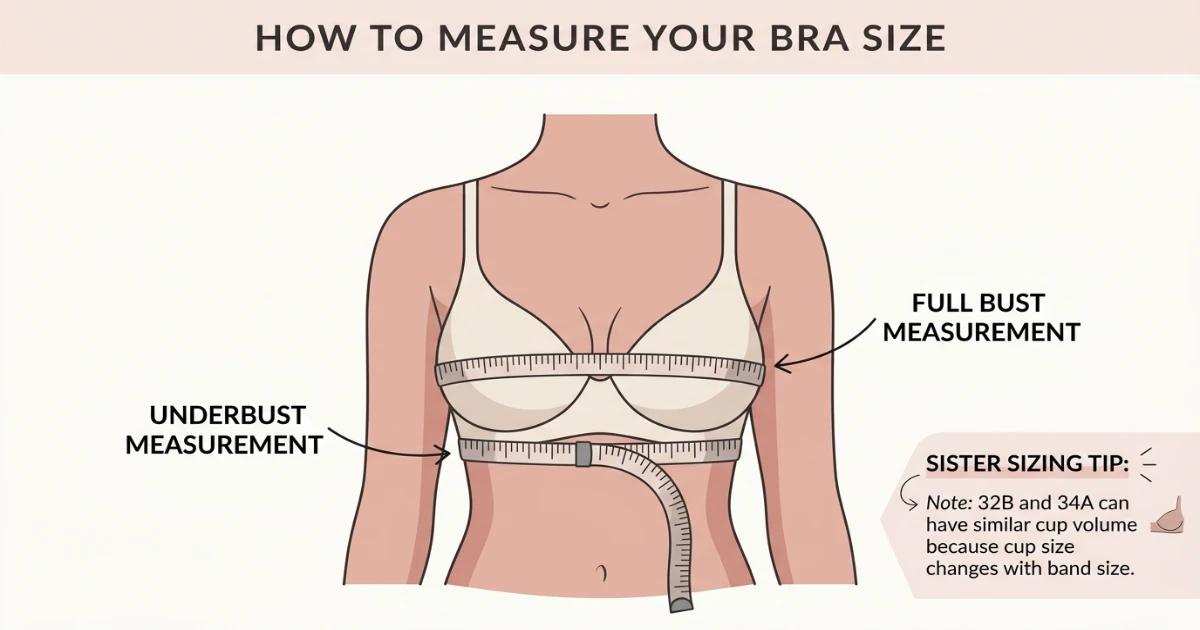
- Underbust: approx. 28–30 in (71–76 cm)
- Full bust: approx. 33–35 in (84–89 cm)
- Cup difference: ~2 inches (B on 32 band)
- Band stretch: snug to firm
- Underbust: approx. 30–32 in (76–81 cm)
- Full bust: approx. 33–35 in (84–89 cm)
- Cup difference: ~1 inch (A on 34 band)
- Band stretch: relaxed to comfortable
Notice that the full bust measurement is similar across both sizes — that is the sister size principle at work. What shifts is the underbust and the corresponding band tension. If your ribcage measures close to 30 inches, you may genuinely sit between these two sizes, which is why real wear testing (and a tool like the bra size calculator at Bra-Calculator.com) is always more reliable than guessing from a chart.
Cup Volume: Is 32B Bigger Than 34A?
No — the cup volume is approximately the same. 32B is not bigger than 34A, and 34A is not bigger than 32B in terms of how much breast tissue each cup is designed to hold. They are sister sizes for exactly this reason.
However, the cups may feel different on your body because of how band tension affects cup position. A firmer band (32) pulls the cups closer to the body, creating a more contained, slightly more projected feel. A looser band (34) allows the cups to sit softer against the chest — more relaxed, but also less supportive over long hours. To see how cup volumes relate across multiple sizes visually, the bra cup volume comparison guide makes the sister size relationship immediately clear.
Band Fit Difference: 32 vs 34
The band does approximately 80% of the work in a well-fitting bra. Straps are for positioning, not for carrying weight. This means the two-inch difference between a 32 and a 34 band has a much larger effect on wearing experience than it appears on paper.
How a 32 Band Feels
A 32 band is firm by design. When brand new, you should be able to fit two fingers underneath the back band but not slide your whole hand under. It should lie parallel to the floor, not ride up toward the shoulder blades. On a narrower ribcage, this firmness feels secure and stable all day without requiring strap adjustment. The support is structural and reliable.
How a 34 Band Feels
A 34 band is more relaxed. On an underbust of 30 to 32 inches, it fits comfortably without pressing. On a ribcage closer to 28 or 29 inches, it will almost certainly feel too loose — the back rides up, the straps do too much work, and the cups shift. For the right body, though, a 34 band offers a gentler wearing experience than a firm 32, and is particularly well suited to those who find close-fitting bands uncomfortable over long periods.
Real Fit Differences Between 32B and 34A
Beyond band tension, switching between sister sizes produces a cascade of smaller changes that add up to a meaningfully different wearing experience.
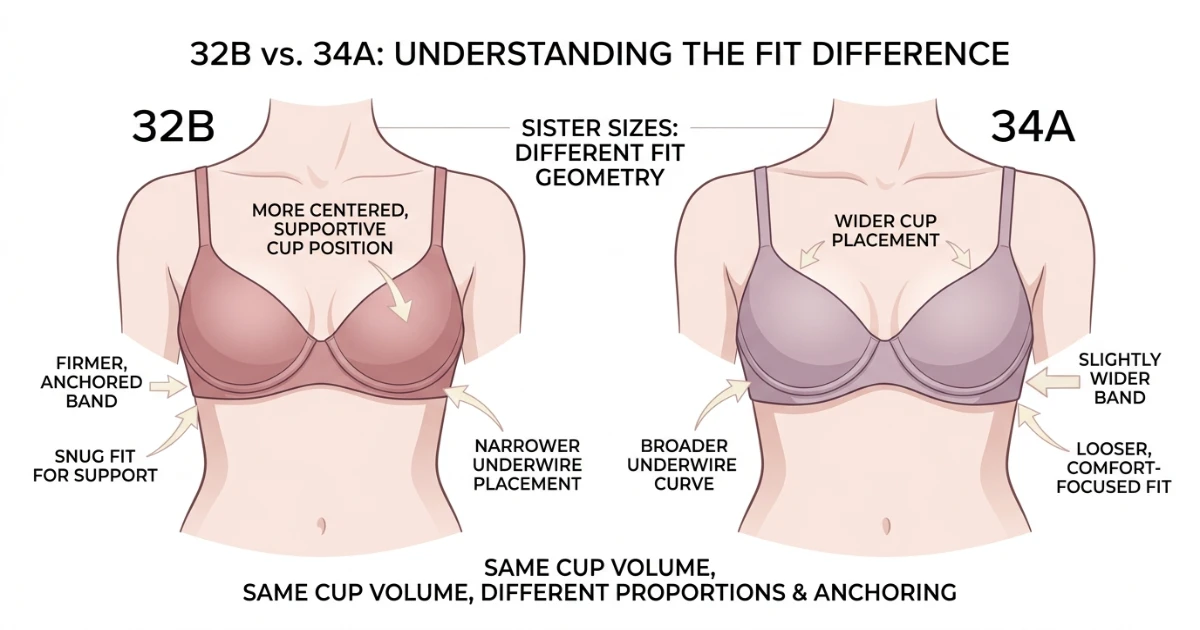
The 32B provides more structural support because the firmer band anchors the bra against the body. The 34A feels softer but provides less lift, especially over long wear periods.
In a 32B, cups sit closer to the center and slightly more upright. In a 34A, cups spread slightly wider — useful for wider-set breasts, but potentially gaping on narrow-set ones.
A 32B underwire is narrower. A 34A underwire is wider to match the broader band. On a narrow torso, a 34A underwire may sit partially off the breast tissue and cause side discomfort.
When the band is too loose, straps unconsciously take over support and begin to dig in. A well-fitting 32B keeps strap pressure light; a loose 34A can cause strap discomfort over time.
How Breast Shape Affects the 32B vs 34A Choice
Cup volume is only one dimension of fit. Breast shape plays an equally important role — and it is the reason two people with the same cup volume can experience the same sister size very differently.
Shallow vs Projected Breasts
Shallow breasts spread wider across the chest with less forward projection. A 34A cup, which is cut slightly wider to accommodate the broader band, often suits shallow breast shapes well — it covers the breast tissue without the cup looking or feeling empty at the center. Projected breasts sit forward with more depth; they tend to fare better in a 32B, where the firmer band keeps the cups anchored and the slightly narrower, deeper cup shape supports the projection rather than letting tissue spill forward over the top edge.
Wide-Root vs Narrow-Root Breasts
Breast root width — where the breast attaches to the chest wall — matters enormously for underwire comfort. Wide-root breasts benefit from the broader underwire of a 34A, which is less likely to sit on breast tissue at the sides. Narrow-root breasts are better served by the narrower underwire of a 32B, which frames the tissue correctly and does not float off the ribcage. This is why two people who both measure as 32B/34A equivalents can still feel like one size fits and the other doesn’t. Shape mismatch, not volume mismatch, is almost always the culprit in these cases.
How Brand Variation Changes the Equation
Sister size theory works as a general framework, but real bras are not made from theory. They are made by brands with their own sizing standards, fabric tension, and cup construction — and this matters when switching between 32B and 34A.
Band Tightness Varies by Label
Some brands — particularly European lingerie labels — cut their bands tighter than their size tag suggests. A 34A from one of these brands may feel as firm as a 32B from a more relaxed-cut American or UK brand. This is why a bra that fits perfectly in one brand at 32B can feel completely different from the same stated size in another. Always try a new brand in both sister sizes if you are close to the boundary between them.
Molded Cups vs Unlined Styles
Molded T-shirt bras have a pre-shaped cup that holds its form regardless of what is placed inside it. If your breast tissue does not fill that pre-molded space precisely — which happens more easily with the wider, shallower A cup of a 34A on a slightly projected breast — you will see gaping at the top of the cup even when the band fits correctly. Unlined or lightly lined bras conform more closely to the breast’s natural shape, making them more forgiving when you are between sister sizes. If you are deciding between 32B and 34A specifically for a molded or padded style, try both before committing to one.
Stretch Fabrics and Soft-Cup Styles
Bralettes and soft-cup designs use highly elastic fabric that blurs the difference between adjacent sizes considerably. In these styles, the 32B vs 34A distinction is less pronounced — both may fit a body that sits between the two measurements. Wired structured bras amplify the difference, because underwire width and band tension are more fixed and less forgiving of sizing approximations.
Common Buying Mistakes With These Sizes
These three mistakes appear repeatedly when people navigate the 32B vs 34A decision — and each one leads to avoidable fit problems.
- Choosing based on cup letter alone. A cups and B cups are not fixed measurements — they are proportional to the band. Buying a 34A because you “need an A cup” while your actual underbust is 29 inches almost guarantees a poor fit. The band measurement must come first, always.
- Sizing up in the band when the real problem is shape. When a 32B doesn’t sit right, the instinct is often to try a 34A for more room. Sometimes this helps — but if the actual issue is cup shape mismatch (wrong depth or width for your breast root), no sister size will solve it. Trying a different bra style in the same size is often the better move.
- Assuming sister sizes always feel identical. They don’t. Sister sizes preserve cup volume — that is the only thing they guarantee. Band tension, underwire width, cup projection, and strap placement all change. Treating 32B and 34A as fully interchangeable will produce inconsistent results across brands and styles.
Who Should Choose 32B vs 34A?
Choose 32B if you…
- Measure 28–30 inches around your underbust
- Find 34A bands sliding up your back
- Want maximum lift and structured support
- Have a narrow ribcage or narrow breast root
- Find 34A cups gaping at the top
- Prefer a snug, secure feel all day
- Are active and need the bra to stay in place
Choose 34A if you…
- Measure 30–32 inches around your underbust
- Find 32B bands uncomfortably tight
- Prefer a more relaxed, gentle wearing experience
- Have wider-set or shallower breast tissue
- Find 32B underwire sitting on breast tissue at the sides
- Prioritize all-day casual comfort over structured lift
- Are between sizes and find 32 cups too projected
Real-Life Fit Scenarios: What the Signs Are Telling You
Sometimes the question isn’t which size to start with — it’s understanding what the fit signals you’re already experiencing actually mean. Here are the most common scenarios and how to interpret each one.
- Your 32B feels tight in the band but the cups fit well. This is the most direct signal to try a 34A. Go up in the band and down in the cup to stay on the same sister size row. Check whether the 34A cups still contain your tissue without gaping. If they do, you may be a genuine 34A. If the cups gap, the issue may be the specific brand’s band construction rather than the size itself — try a different brand’s 32B with a softer elastic.
- Your 34A rides up at the back. A riding band is almost universally too large. Try a 32B. The firmer band should sit level and parallel to the floor, and your straps should immediately feel less pressured. If the 32B cups feel slightly over-projected for your shape, try an unlined 32B style before concluding the cup is wrong.
- Your 34A gaps at the top of the cups. This usually means the cup is too wide or too shallow for your breast shape. A 32B cup is narrower and slightly more projected, which often resolves top-of-cup gaping on narrower or more forward-projecting breast shapes. Alternatively, the issue may be bra style — a plunge or demi cup in 34A may eliminate the gap without any size change.
- Your 32B feels supportive but slightly firm throughout the day. This is normal for a well-fitting 32 band, especially on a new bra. Always start a new bra on the loosest hook, so you can tighten as the elastic relaxes over time. If the firmness feels genuinely painful rather than snug, check that the band is sitting in the correct horizontal position before concluding you need a larger size.
- You are genuinely between 32B and 34A. If your underbust measures right at 30 inches and both sizes fit reasonably, choose based on activity level and comfort preference. For active wear, lean toward 32B. For everyday casual use, 34A may suit your routine better. The sister size calculator can also help you identify whether a 30C might be worth exploring — another equivalent size on the same row.
Common Fit Problems and What They Mean
- Band riding up at the back: Band too large. In a 34A, try a 32B for a lower, anchored back position.
- Cups gaping at the top: Cup too wide or too shallow. Often fixed by switching from 34A to 32B, especially on narrower or more projected breast shapes.
- Side spillage or overflow: Cup too small. If a 34A overflows, your next size is likely 34B — not 32B, which holds the same volume.
- Underwire sitting on breast tissue: Underwire too wide (34A on a narrow chest) or too narrow (32B on a wide-root chest). It should frame tissue completely and rest on the ribcage only.
- Straps digging in: Almost always caused by a loose band pushing all the support load upward. Fix the band first before adjusting straps.
- Center gore not lying flat: Cups too small or band too loose. One of the clearest indicators of a sizing mismatch.
- Persistent shape mismatch despite correct volume: If problems persist after trying both sister sizes, the issue is likely bra style rather than size — try a different cup cut in the same band-and-cup combination.
Sister Sizes Explained Simply
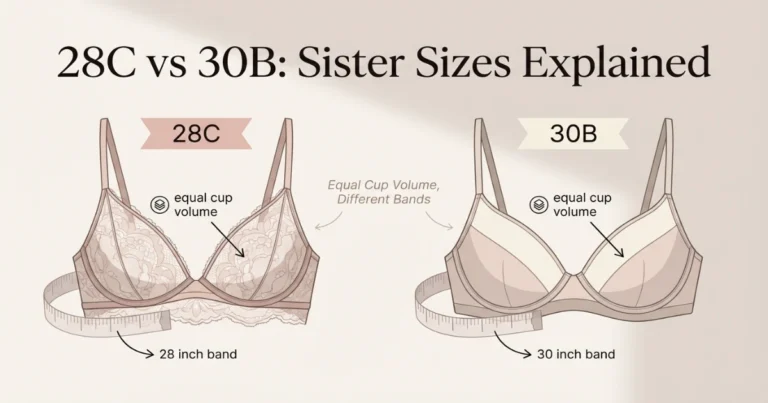
Sister sizes form a row on the bra sizing grid where every size holds approximately the same cup volume. Moving left means a smaller band with a larger cup letter. Moving right means a larger band with a smaller cup letter.
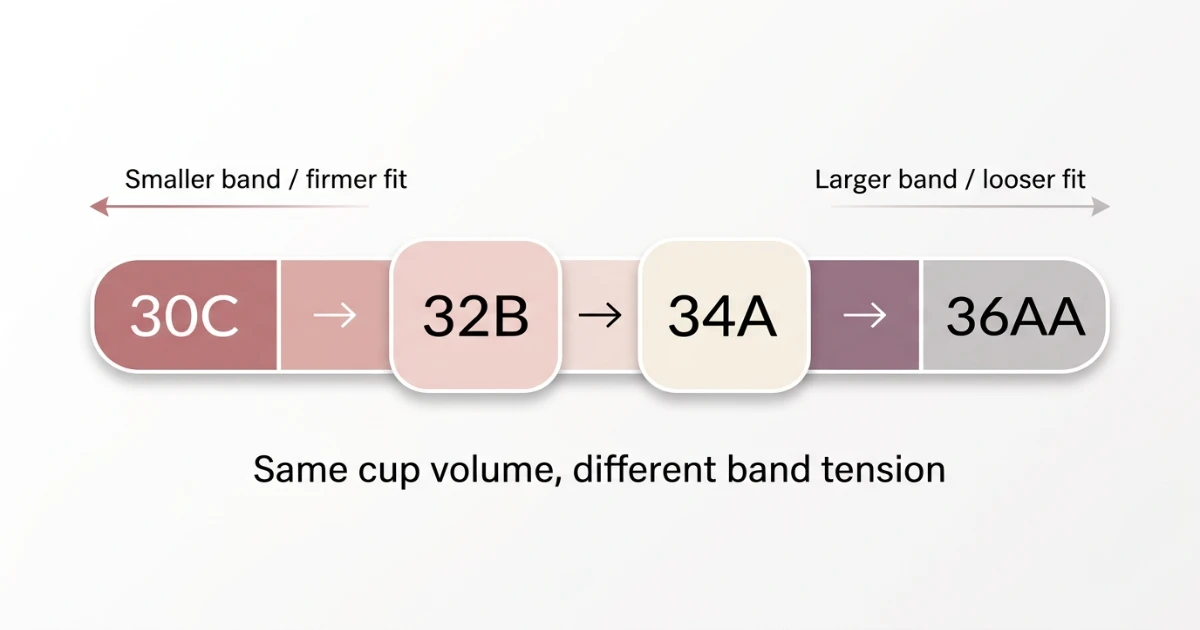
Notice that 30C also sits on this row — on an even narrower band, the cup letter climbs to preserve the same volume. Explore the full grid using the sister size calculator. Understanding your adjacent sizes gives you far more flexibility when shopping across brands, which often grade and stretch differently from one another.
How to Tell Whether 32B or 34A Fits Better
You don’t need a professional fitting appointment to get a clearer answer. These five steps give you a reliable, at-home way to evaluate which size is working for your body right now.
- Check the band position. The band should sit level all the way around your body — parallel to the floor. If the back rides up toward your shoulder blades, the band is too large. Start here, because band problems cascade into cup and strap issues.
- Check the center gore. Press the center panel between the cups flat against your sternum. It should lie completely flat. If it lifts away, the cups are either too small or the band is too loose.
- Check the cups. Look for wrinkling or gaping at the top — the cup is too large or too wide. Look for spillage at the sides or top — the cup is too small. Breast tissue should sit smoothly within the cup with no excess fabric and no overflow at any angle.
- Check strap pressure. Loosen the straps slightly and see if the bra still supports you. If support collapses, the band is doing too little work and is likely too large.
- Do the movement test. Raise both arms overhead, bend forward, and walk around for a minute. A well-fitting bra stays in place. If the band slides, cups shift, or underwire digs in, re-check your measurements at the bra size calculator and compare both sister sizes in a structured style.
32B vs 34A: Comparison Summary
- 32B = firmer band, same cup volume, suits narrower ribcages and projected or narrow-root breast shapes
- 34A = looser band, same cup volume, suits slightly wider ribcages and shallower or wide-root breast shapes
- Both are sister sizes — cup volume is approximately equal between them
- Choose based on underbust measurement, breast shape, brand fit, and support preference — not cup letter alone
Frequently Asked Questions
Is 32B the same as 34A?
They are sister sizes — they hold approximately the same cup volume. However, they are not the same bra. The 32B has a smaller, firmer band for a narrower ribcage, while the 34A has a larger, looser band for a slightly wider ribcage. Same cup volume, different fit experience.
Which is bigger — 32B or 34A?
Neither is bigger in terms of cup volume — they are equivalent sister sizes. In terms of band circumference, the 34A is larger by approximately two inches. The cup letter shifts to compensate, keeping the overall cup capacity approximately equal.
Is 32B smaller than 34A?
In terms of band circumference, yes — the 32B has a smaller band. In terms of cup volume, no — they are sister sizes holding approximately the same amount of breast tissue. The B cup on a 32 band and the A cup on a 34 band are designed to accommodate similar cup volume even though the letters and raw measurement differences look different on paper.
Is 34A looser than 32B?
Yes. The 34A band is larger and sits more loosely around the ribcage than a 32B band. If your underbust is closer to 28–30 inches, a 34A will likely feel too loose and may ride up at the back. The 32B is the tighter of the two sizes.
Is 32B tighter than 34A?
Yes. A 32B band is about two inches smaller in circumference than a 34A band, making it noticeably firmer. On a narrow ribcage this firmness provides correct, supportive fit. On a wider ribcage it can feel uncomfortably tight or restrictive throughout the day.
Can I wear 34A instead of 32B?
Yes, as a temporary sister-size substitute when your usual size is unavailable. The 34A will feel looser in the band and may provide less support. If the band rides up or the cups gap, the 32B is the better fit for your body. Sister sizing works best as a short-term workaround, not a permanent replacement for your measured size.
Why do 32B and 34A fit differently if they are sister sizes?
Sister sizes only preserve cup volume. Band tension, underwire width, cup depth, cup width, strap angle, and how the bra sits on a specific body shape all change between sizes. A bra holding the same volume will feel noticeably different when anchored to a ribcage that is two inches smaller or larger than it was designed for. Breast shape adds another layer of variation on top of that.
What if 32B feels tight but the cups fit perfectly?
Try going up one band and down one cup — that means trying a 34A. If the 34A cups fit the same way but the band feels more comfortable, you may genuinely be a 34A. If the cups gap in the 34A, try a different brand with a softer band construction in the 32B size before changing sizes.
What if 34A rides up in the back?
A band that rides up is almost always too large for the body wearing it. If your 34A consistently rides up, your underbust is likely closer to the 32 range. Try a 32B — the smaller band should sit level across your back and provide noticeably better support without any change in cup volume.
Are 32B and 34A the same in every brand?
Not exactly. Brands apply different grading standards and cut their bands with different elastic tensions, so a 32B from one brand may fit noticeably differently than a 32B from another. The sister size relationship holds in principle, but always check a specific brand’s sizing guide before assuming the same logic applies equally across labels.
Do 32B and 34A look the same on a bra size chart?
They appear on the same sister size row, which shows they share equivalent cup volume. On a standard size grid, they sit diagonally adjacent — one step right in band and one step down in cup letter. You can see this clearly on the full bra size chart.
What sister size comes after 34A?
Moving up the band from 34A, the next sister size is 36AA — a larger band with a smaller cup letter to preserve the same approximate cup volume. Moving down gives you 32B, and further down gives you 30C. All sizes on this row hold approximately the same cup volume with progressively different band tension.
Can weight changes move you from 32B to 34A?
Yes. Weight changes affect both the ribcage and the breast tissue. If your ribcage expands by roughly two inches — through weight gain, pregnancy, or other body changes — a 34A may become more comfortable than your previous 32B. Because they are sister sizes, the cup volume change is minimal. The main shift is in band fit. Re-measuring your underbust after a body change is always the most reliable way to confirm which band is correct now.
How do I know if 32B or 34A is right for me?
Start with your underbust measurement. If it is 28–30 inches, start with 32B. If it is 30–32 inches, start with 34A. Check that the band sits level, the cups contain fully without gaping or overflowing, the center gore lies flat, and straps need only light adjustment. Your measurements combined with real-wear feedback will give you a clearer answer than any chart alone. The bra size calculator is a reliable, measurement-based starting point.
32B vs 34A: Which One Is Right for You?
32B and 34A are sister sizes — that is definitive. They carry approximately the same cup volume, and either can serve as a workable temporary substitute for the other when your first-choice size is unavailable. But they are not interchangeable in the truest sense of the word, and the difference is not trivial once you put them on a body.
The 32B is the right choice if your underbust sits closer to 28–30 inches, if you value firm support and a bra that stays put, or if you have a narrow breast root and find wider underwires uncomfortable. The 34A belongs in your drawer if your ribcage is closer to 30–32 inches, if 32 bands dig in or feel restrictive, or if your breast shape is shallower or wider-set and benefits from the broader cup geometry a 34 band provides.
Beyond the measurements, breast shape, brand construction, and bra style all influence which sister size actually works for your body on any given day. The most reliable path to a confident answer remains the same one it has always been: measure your underbust accurately, try both sizes in a structured style, run through the five-point fit checklist above, and trust what your body tells you over what a size label says. If you want a precise measurement-based starting point, start at Bra-Calculator.com or use the bra size calculator — no guesswork required.