28DDD vs 30DD: Are They Sister Sizes? Same Cup Volume, Different Band Explained (2026)
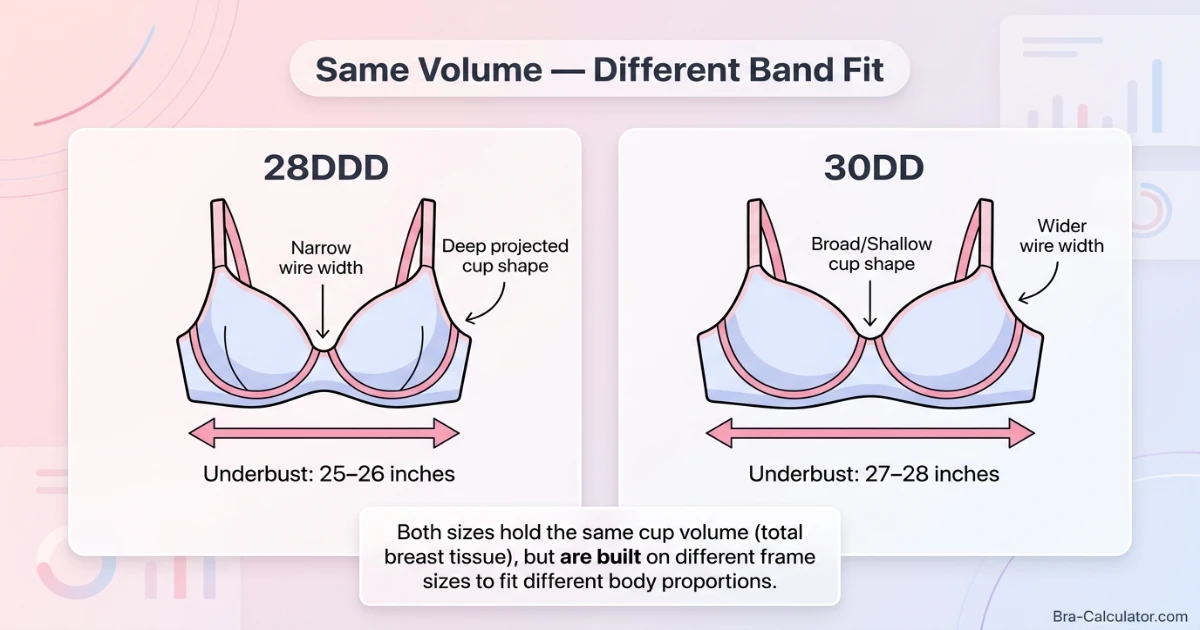
Quick Answer: Yes — 28DDD and 30DD are confirmed sister sizes. They hold approximately the same cup volume on different band sizes. Going up one band from 28 to 30 and dropping one cup letter from DDD to DD follows the sister size rule exactly, preserving cup volume. The difference between them is entirely in the band: 28DDD is firmer for a narrower ribcage; 30DD is wider for a slightly broader one. Your underbust measurement decides which fits — not personal preference.
✅ This is a confirmed sister size comparison. Unlike same-letter comparisons such as 28DDD vs 30DDD — where the same letter on a larger band produces more cup volume — 28DDD and 30DD follow the sister size rule and hold equivalent breast tissue volume. The band is the only meaningful difference between them. When 28DDD is unavailable (which is common), 30DD is the correct same-volume swap — not 30DDD.
ℹ️ UK / EU sizing note: In UK and European sizing, DDD is labelled F and DD is labelled E. So US 28DDD = UK 28F, and US 30DD = UK 30E — the same physical cup sizes with different letter conventions. When shopping UK specialist brands like Freya, Ewa Michalak, Panache, or Bravissimo, search for 28F to find US 28DDD and 30E to find US 30DD. All comparisons in this article apply equally to 28F vs 30E.
💜 28 band availability: The 28 band is one of the most underserved sizes in mainstream retail — most high-street stores do not stock it at all. The 30DD (30E UK) is significantly more accessible across both specialist and mainstream online retailers. If you measure as a 28-band wearer and have been told to “go up to a 30 band on the tightest hook,” you’ve been wearing the wrong size. Your correct 28-band bras do exist — see the specialist sourcing guide below.
⚡ Key Takeaways
- Sister sizes confirmed: 28DDD and 30DD hold approximately equal cup volume — same volume family.
- Band is the only real difference: 28DDD fits ~25–26″ (63–66 cm) underbust; 30DD fits ~27–28″ (68–71 cm) underbust.
- 28DDD = firmest band, deepest cup: More forward projection on an already narrow frame — significant visual difference on the body.
- 30DD = wider band, broader cup spread: Same volume distributed across a broader chest wall with more lateral space.
- UK/EU naming: US 28DDD = UK 28F; US 30DD = UK 30E. Always verify the system a brand uses before ordering.
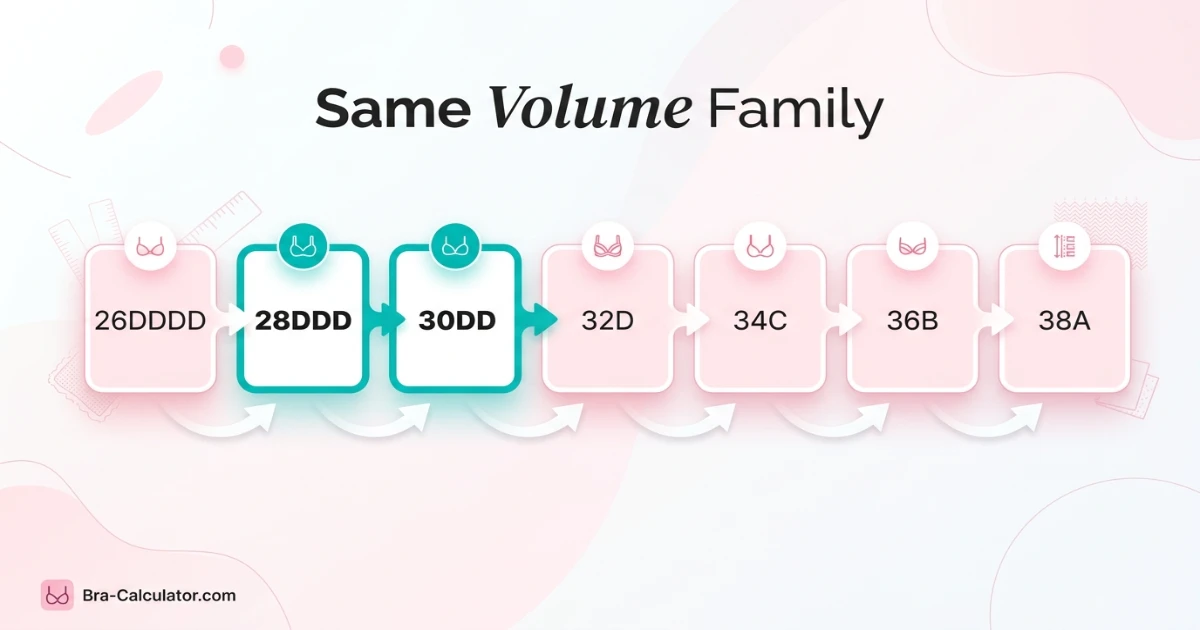
- Full sister size family: 26DDDD (26G) — 28DDD (28F) — 30DD (30E) — 32D — 34C — 36B — 38A.
- Correct substitution: When 28DDD is out of stock, 30DD is the right swap — not 30DDD. When 30DD is unavailable, 28DDD is the correct alternative — not 30D.
- 28DDD is rare; 30DD is accessible: Most Amazon and mainstream listings carry 30DD. Genuine 28DDD (28F) requires specialist retailers.
- Support depends on band fit: On the correct ribcage, both sizes perform equally — measure your underbust accurately before deciding.
- Underwire width differs: The 30DD underwire is wider to match a broader chest wall — wearing it on a 28-inch ribcage means the wire will extend beyond your breast tissue boundary.
Why 28DDD and 30DD Hold the Same Cup Volume
Cup letters in bra sizing are ratios, not fixed measurements. Each letter represents the number of inches by which the bust exceeds the underbust. The principle behind sister sizing is exact: when the band increases by one size — adding approximately 2 inches of circumference to the base — dropping one cup letter offsets that gain precisely, keeping the total enclosed volume roughly constant.
- 1″ = A | 2″ = B | 3″ = C | 4″ = D | 5″ = DD/E | 6″ = DDD/F | 7″ = DDDD/G
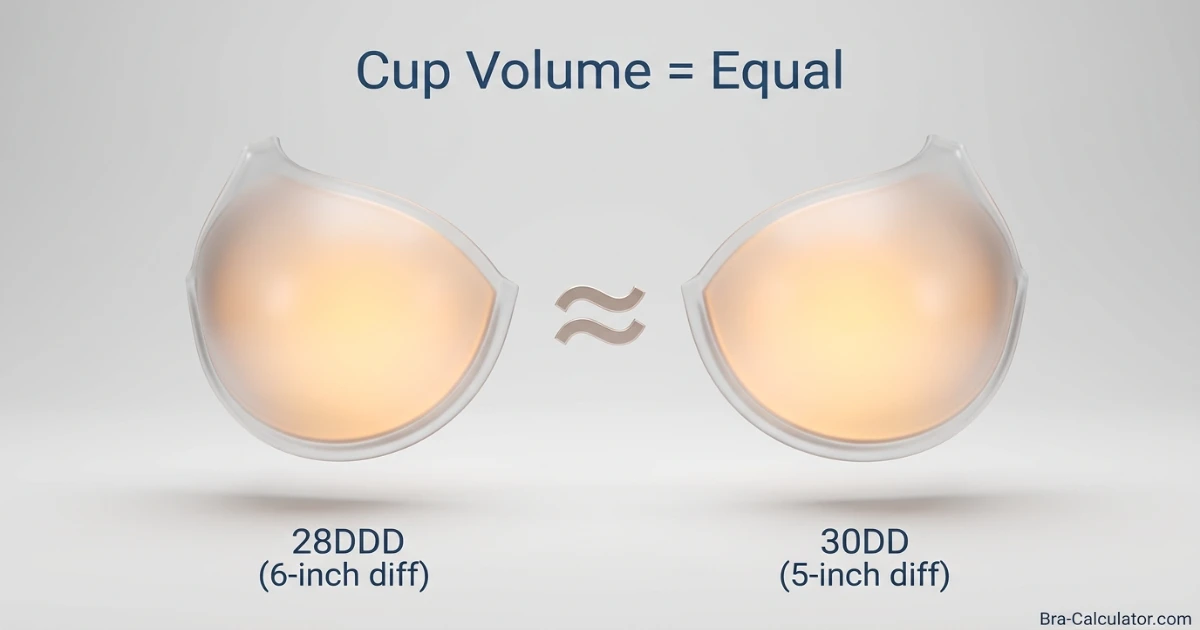
A 28DDD means the bust is 6 inches larger than a 28-inch underbust — producing a bust of approximately 34 inches. A 30DD means the bust is 5 inches larger than a 30-inch underbust — producing a bust of approximately 35 inches. The wider base of the 30 band compensates for the smaller cup differential: the 5-inch gap on a 30-inch frame encloses approximately the same three-dimensional cup space as the 6-inch gap on a 28-inch frame. The letter changes; the volume stays constant.
The critical distinction: this is not the same as comparing 28DDD to 30DDD. Moving to 30DDD while keeping the DDD letter would add one full cup size of volume on top of the wider band — a significantly larger bra. 30DD is the correct sister of 28DDD, not 30DDD. And 30D is the sister of 28DD — not 28DDD. Moving one letter in either direction changes the volume family entirely. See our cup size visuals page for a detailed breakdown of how volume changes across band and cup combinations.
Measurement Breakdown: 28DDD vs 30DD
The table below shows how each size is constructed from real body measurements. The cup differentials differ by letter — but the three-dimensional cup space each size encloses remains approximately equal, confirming the sister size relationship.
| Size | Underbust (Band) | Bust (Fullest Point) | Cup Difference | Cup Volume |
|---|---|---|---|---|
| 28DDD (28F UK) | ~25–26″ (63–66 cm) | ~34″ (86 cm) | 6″ (15 cm) | ≈ Equal ↔ |
| 30DD (30E UK) | ~27–28″ (68–71 cm) | ~35″ (89 cm) | 5″ (13 cm) | ≈ Equal ↔ |
The cup differential numbers differ — 6 inches for 28DDD versus 5 inches for 30DD — but the wider circumference of the 30 band compensates, producing approximately equivalent enclosed volume. This is the mathematical foundation of sister sizing: the ratio changes, the total cup space stays constant across sister pairs.
EU sizing: 28DDD = 60F; 30DD = 65E. Both carry different EU band and cup letters but represent equal cup volume. Always verify with the specific brand’s conversion chart before ordering internationally. Use our international bra size charts for full reference across all regions and brands.
The Sister Size Family: Where 28DDD and 30DD Both Belong
Because 28DDD and 30DD hold the same cup volume, they sit on the same rung of the same sister size ladder. Every size in the chain below holds approximately equal breast tissue volume — the band changes, the cup letter adjusts, but the total enclosed space stays constant throughout the entire family.
The 26DDDD (26G) entry is shown in purple — it is custom-only and not available from mainstream or most specialist retailers. In practice, 28DDD is the firmest widely available size in this family.
Moving left on the ladder tightens the band and deepens the cup; moving right loosens the band and widens the cup — volume stays approximately constant throughout. The immediate practical pair is 28DDD and 30DD — the most commonly swapped sister sizes in this family, particularly because 30DD is widely available while 28DDD requires specialist sourcing.
Why This Is Such a Useful Sister Size Pair in Practice
For most bra size comparisons, both sister sizes are reasonably accessible and the choice is purely about band fit. For 28DDD vs 30DD, the accessibility gap is dramatic: 30DD (30E UK) is stocked by most specialist lingerie retailers and a growing number of mainstream online stores. Genuine 28DDD (28F UK) requires dedicated specialist sourcing and is unavailable on Amazon.
This makes the 30DD the practical “bridge” size — the closest available alternative for 28DDD wearers who cannot source their exact band, and an alternative worth trialling when a 28-band bra is on order. Explore the full sister size chart on our sister sizes guide or generate your personal ladder with the sister size bra calculator.
Real Fit Differences Between 28DDD and 30DD
Cup volume is theoretically equal — but the physical fit experience differs significantly in every dimension except cup volume. Here’s what actually changes between the two sizes and why it matters.
Band Fit: Where the Two Sizes Actually Differ
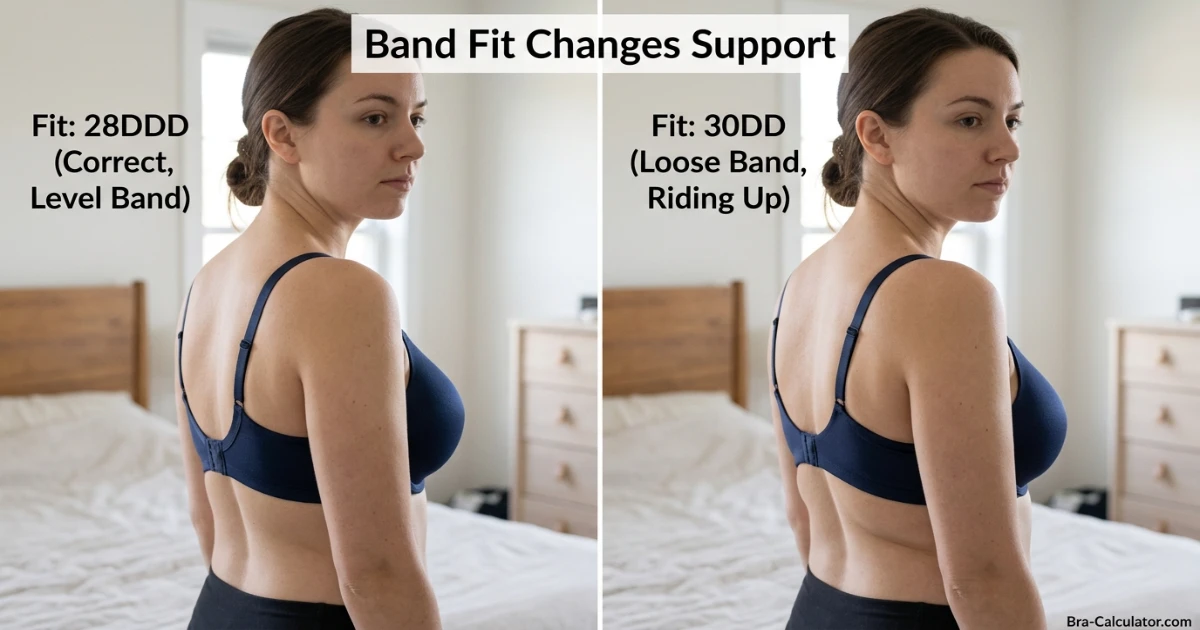
A 28DDD band is engineered for a ribcage of approximately 25–26 inches. On that narrow frame, it grips firmly, stays perfectly level front and back, anchors the substantial weight of a DDD cup without transferring load to the shoulder straps, and maintains its position through a full day of movement. On a 27–28 inch ribcage, the same 28DDD band would feel uncomfortably tight — restricting breathing, leaving marks under the arms, and creating pressure across the torso that worsens progressively through the day.
The 30DD band is built for a 27–28 inch ribcage and delivers the same anchoring function on that slightly broader frame. On a 25–26 inch ribcage, a 30DD band will ride upward at the back within the first hour of wear — and at DDD/DD cup sizes, where breast tissue is substantial, that band failure translates directly into cup drop, aching shoulders, and strap dig-in by midmorning. Band fit at this cup volume is non-negotiable. Never compromise on it to accept a more available size.
Cup Depth, Projection, and Underwire Width
The 28DDD cup is constructed for a very narrow chest wall. The underwire channel is set close together and the cup projects substantially forward from a narrow base — this creates a noticeably upward and forward silhouette on a small ribcage. The projection is one of the striking visual characteristics of a well-fitting DDD cup on a 28-inch band: the bust appears prominent relative to the frame because the cup volume is concentrated forward rather than spread laterally.
The 30DD cup has a wider underwire channel and a more lateral cup spread, designed for breast tissue that roots more broadly across a 27–28 inch chest wall. The same cup volume distributes differently across the wider base. Neither cup shape is better — both are correct for their respective frames. Women with narrow, close-set, or forward-projected breast tissue typically find the 28DDD geometry follows their natural shape more accurately; women with wider-set or more laterally spread breast tissue often find the 30DD underwire channel matches their breast root boundary more cleanly.
What Happens When You Wear the Wrong Band Size
Wearing a 30DD on a 25–26 inch ribcage: the band rides upward throughout the day, the cups drop downward and forward, the gore lifts away from the sternum, and the straps dig in as they compensate for the failing band. At DDD cup volume, this progression is faster and more painful than at smaller cup sizes — the weight being transferred is significant.
Wearing a 28DDD on a 27–28 inch ribcage: immediate constriction across the torso, difficulty taking a deep breath, marks under the arms after the first hour, and posture change as the body tries to compensate for the pressure. The right answer is always the band that matches your actual underbust — not the band that’s easier to find. See our bra fit problems guide for a complete diagnosis checklist.
Who Should Choose 28DDD (28F UK)?
- Your underbust measures approximately 25–26 inches (63–66 cm) snugly beneath the breasts — not loosely, not with the tape resting on the breast tissue below.
- Your bust at the fullest point is approximately 34 inches (86 cm) — a 6-inch differential on this narrow frame.
- You’ve tried a 30DD and found the band riding up your back by midmorning or after any physical activity.
- You find yourself constantly tightening shoulder straps throughout the day — the most reliable single indicator of a band that is too loose for your ribcage.
- Your breast tissue sits close-set, projected, or full at the centre on a narrow chest wall — the 28DDD underwire geometry follows this contour accurately.
- Your current 28DDD cups feel correct but slightly overflow → try 28DDDD (28G UK) on the same band, not 30DD.
- In UK sizing, always shop for 28F — the same physical cup, different label convention.
The 28 band is genuinely difficult to source. See the specialist retailer guide below for where to find it. Confirm your correct fit approach at our how to know your bra fits page.
Who Should Choose 30DD (30E UK)?
- Your underbust measures approximately 27–28 inches (68–71 cm) snugly beneath the breasts.
- Your bust at the fullest point is approximately 35 inches (89 cm) — a 5-inch differential on this slightly broader frame.
- You’ve tried a 28DDD and found the band genuinely constricting, leaving deep marks from the first wear, or restricting deep breathing throughout the day.
- Your breast tissue spreads more broadly toward the underarms and the 28DDD underwire feels too narrow — pressing into the side of your breast tissue rather than sitting cleanly on the ribcage.
- You consistently find 28-band bras painful or too firm, even on the loosest hook from day one.
- Your current 30DD cups feel correct but overflow slightly → try 30DDD (30F UK) on the same band, not 28DDD.
- In UK sizing, shop for 30E when buying from British specialist brands.
Use our breast shape identifier and size charts to verify your best fit across all major brands and sizing systems.
🔍 Where to Find 28DDD (28F UK) — Specialist Sources
The 28 band is not stocked by mainstream retailers. These specialist sources carry genuine 28DDD / 28F stock:
- Ewa Michalak (Poland) — the most extensive 28-band range available anywhere, including 28F in multiple styles; ships internationally; order using centimetre underbust measurements
- Comexim (Poland) — specialist in small bands and proportionally larger cups; made-to-measure and ready-to-wear 28-band options including 28F
- Bravissimo (UK) — carries curated 28-band stock from Freya and Panache, primarily in UK labelling (28F = US 28DDD)
- Rigby & Peller (UK) — premium specialist fitting service with access to 28-band stock across multiple European brands
- HerRoom (US, online) — one of the broader US online selections with small-band filtering; search under 28F to find US 28DDD listings
- Bare Necessities (US, online) — specialist online retailer with dedicated narrow-band category; broadening 28-band selection as of 2026
Pro tip for Polish brands: Use your actual underbust measurement in centimetres rather than the US band number — Ewa Michalak and Comexim size on measured underbust, which produces a more accurate result at narrow band sizes than the US band-number convention.
🛍️ Best Bras for 28DDD and 30DD — Our Top Picks
Genuine 28DDD (28F UK) stock is rarely available on Amazon — the 28 band requires specialist sourcing. The products below are available in 30DD (30E UK) — the confirmed sister size of 28DDD with equal cup volume and a slightly wider band. They are also the most practical daily-wear options for 28DDD wearers waiting on specialist orders, or for 30DD wearers seeking quality, well-reviewed options in their exact size.

Glamorise Women’s Full Figure MagicLift Active Support Wirefree Bra #1005
The most trusted wire-free bra for DD and DDD cup volumes — and an especially practical choice for 28DDD wearers using 30DD as a bridge size while specialist 28-band pieces arrive. The MagicLift inner sling system lifts and separates without an underwire, which matters enormously at DDD/DD cup volumes where wire discomfort on a small frame is a common complaint.
The multi-hook back anchors the band correctly on a 30-inch ribcage, cushioned straps carry load without shoulder dig-in, and the extended size run through 46H means the cup depth is properly graded for DD volume — not just relabelled from a smaller cup. Available in 30DD with cup geometry that equals the volume of your 28DDD.
Available in: 30DD (= 28DDD cup volume) — and full extended range through 46H
View on Amazon →
Glamorise Women’s WonderWire Front-Close Underwire Bra #1245
A front-closure underwire bra specifically engineered for larger cup sizes — and one of the best available options for the 30DD cup volume that equals your 28DDD. The WonderWire technology distributes underwire pressure evenly across a wider, cushioned channel — the most common complaint at DDD and DD cup volumes on narrow frames is single-point underwire pressure, and this design addresses it directly.
Wide side panels prevent lateral tissue escape that standard cups at this volume often miss, and the front close is a genuine practical win for smaller-framed women who find back-hook closures on narrow bands difficult to manage. Multi-hook back delivers long-term band adjustability as the fabric relaxes with regular wear.
Available in: 30DD (= 28DDD cup volume) — and extended range through 48H
View on Amazon →
Warner’s Women’s Elements of Bliss Wire-Free Contour Bra #1269
With over 14,000 Amazon reviews, Warner’s Elements of Bliss has established itself as one of the most reliable all-day wire-free bras for DD cup volumes on smaller band sizes. Available in 30DD — the confirmed sister size of 28DDD — the pre-shaped contour foam cups maintain smooth, consistent shape throughout the day without wrinkling, collapsing, or gaping at the top.
The tagless construction is particularly relevant for 28DDD wearers who have experienced the underarm irritation that narrower, more rigid band structures can cause, and the wide multi-hook back stays level on a 30-inch ribcage without rolling or riding. A practical everyday option while your specialist 28-band pieces are being sourced, or a permanent fixture in the rotation for 30DD wearers.
Available in: 30DD (= 28DDD cup volume) — and full range through 40DD
View on Amazon →ℹ️ As an Amazon Associate, Bra Calculator earns from qualifying purchases. The products above are listed in 30DD — the confirmed sister size of 28DDD — because genuine 28DDD (28F UK) stock is not available on Amazon. For exact 28-band sizing, use the specialist retailers listed in the sourcing guide above. Product availability and pricing subject to change.
The Sister Size Rule Applied to 28DDD and 30DD
| Comparison Type | Example | Same Volume? | Relationship |
|---|---|---|---|
| Band up + Cup letter down | 28DDD → 30DD | ✅ Yes | Sister sizes — equal volume, wider band |
| Band down + Cup letter up | 30DD → 28DDD | ✅ Yes | Sister sizes — equal volume, narrower band |
| Band up + Cup letter down (further) | 28DDD → 32D | ✅ Yes | Sister sizes — equal volume, much wider band |
| Band up, same cup letter | 28DDD → 30DDD | ❌ No | 30DDD is larger — one full cup above 28DDD |
| Band up, same cup letter | 30DD → 32DD | ❌ No | 32DD is larger — one full cup above 30DD |
| Same band, cup up | 28DDD → 28DDDD | ❌ No | 28DDDD is one full cup larger on same narrow band |
| Same band, cup up | 30DD → 30DDD | ❌ No | 30DDD is one full cup larger on the same 30 band |
| Same band, cup down | 28DDD → 28DD | ❌ No | 28DD is one full cup smaller — different volume family |
The only correct band-change substitute for a 28DDD is 30DD — up one band, down one cup letter. Moving to 30DDD adds both a wider band and more cup volume simultaneously, which is never a sister size swap. When 28DDD is out of stock or unavailable, 30DD gives you the closest possible fit on a slightly wider band. When 30DD is unavailable, 28DDD gives you the correct same-volume alternative on a narrower, firmer band.
Quick Bra Fit Test: 5 Checks for 28DDD and 30DD Wearers
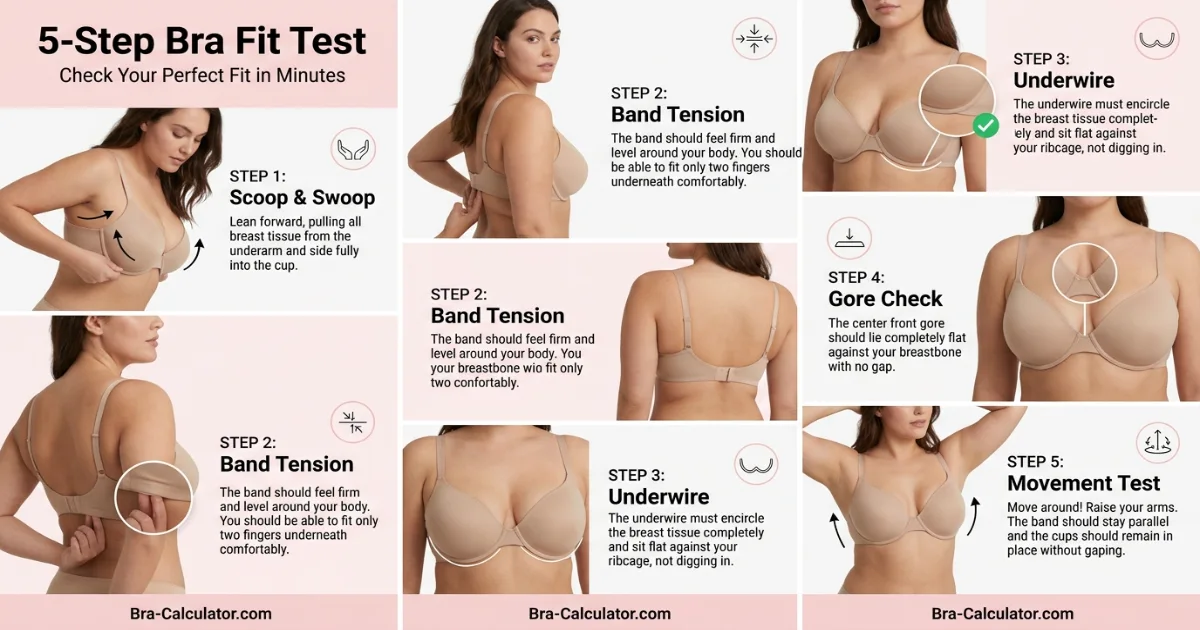
At DDD and DD cup volumes on these band sizes, fit precision is critical. The combination of substantial cup volume and a relatively narrow band means even small errors — a cup letter too large or too small, a band two inches too wide — are immediately apparent and compound quickly into discomfort. Run these five checks every time you try a new size or brand.
Lean forward and scoop all breast tissue — including the significant side and underarm fullness common at DDD and DD cup volumes — fully forward and upward into the cups. After scooping, overflow at the top or sides means the cup is too small on the current band: go up one cup letter on the same band (28DDD → 28DDDD or 30DD → 30DDD). Wrinkling fabric at the top means cup too large: go down one letter on the same band. If you’re in a 30DD and the cup is right but the band is too loose, switch to 28DDD — same cup volume, firmer band. Never switch to 28DD from 30DD to firm the band — that loses you a full cup size.
The gore must lie completely flat against the sternum throughout the entire day. At DDD and DD cup volumes, a floating gore is an unambiguous sign that the cup is too small — the breast tissue is pushing the cups forward and apart. Go up one cup letter on the same band immediately (28DDD → 28DDDD or 30DD → 30DDD). If you’re in a 30DD and the gore lifts, the issue may be that the 30 band is too wide and the cups are drooping forward rather than lifting — try 28DDD (same cup volume, firmer band that keeps the cups properly positioned).
The underwire must sit fully on the ribcage and encircle all breast tissue at every point from the gore to the side seam. For this sister pair specifically, underwire width is a key differentiator: the 28DDD wire is set for a narrower chest wall and the 30DD wire is wider. If you’re in a 30DD and the wire ends extend beyond your natural breast tissue boundary onto bare ribcage — the underwire is too wide for your chest wall.
Try 28DDD. If you’re in a 28DDD and the wire presses into the side of the breast tissue rather than the ribcage beneath it — the underwire is too narrow for your breast root. Try 30DD. Both are band-width problems; the cup volume is correct in both cases.
On the loosest hook, slide two fingers under the back band with firm, consistent resistance. For 28DDD: the band should feel genuinely snug — not painful, but firmly anchored with clear resistance. If your whole hand slides under a 28DDD band, your underbust may genuinely be broader than 26 inches — remeasure and consider the 30DD.
For 30DD: if the band feels comfortably snug with two fingers on the loosest hook and stays level all day, you’re in the right size. If more than two fingers slide under easily and the band begins riding by midmorning — try 28DDD. The band carries approximately 80% of DDD/DD cup support; a loose band at this cup volume fails visibly and quickly.
Raise both arms overhead, twist from side to side, and walk briskly for 60 seconds. The band must stay completely level front and back, cups must remain fully in position, and straps must not dig in or slip off the shoulders. At DDD and DD cup volumes, any downward shift of the cups during movement is a band problem — the band is too loose to anchor the weight of the breast tissue. Do not tighten straps to compensate.
A 28DDD correctly fitted on a 25–26 inch ribcage will not move. A 30DD correctly fitted on a 27–28 inch ribcage will not move. If either moves during this test, the band size is wrong — switch to the sister size with the correct band for your frame.
Still unsure whether 28DDD or 30DD — or whether you’re genuinely a 28 band versus a 30 band — is right for your measurements? Our AI calculator gives you a precise result in under 2 minutes based on your actual underbust and bust numbers.
Try the AI-Powered Bra Size Calculator →28DDD vs 30DD: Full Side-by-Side Comparison
| Feature | 28DDD (28F UK) | 30DD (30E UK) |
|---|---|---|
| Band Size | 28 (~25–26″ / 63–66 cm underbust) | 30 (~27–28″ / 68–71 cm underbust) |
| Cup Letter (US) | DDD — 6″ (15 cm) over underbust | DD — 5″ (13 cm) over underbust |
| Cup Letter (UK/EU) | F | E |
| EU Approximate | 60F | 65E |
| Cup Volume | ≈ Equal ↔ | ≈ Equal ↔ |
| Bust Measurement | ~34″ (86 cm) | ~35″ (89 cm) |
| Sister Size? | ✅ Yes — confirmed sister sizes, same volume family | |
| Underwire Width | Narrower — close-set breast root on narrow frame | Wider — broader breast root on slightly wider frame |
| Cup Shape | Deeper, more forward projection from narrow base | Broader, more lateral distribution across wider frame |
| Band Tightness | Firmer — correct for 25–26″ ribcage | Slightly looser — correct for 27–28″ ribcage |
| Full Sister Family | 26DDDD (26G) — 28DDD (28F) — 30DD (30E) — 32D — 34C — 36B — 38A | |
| If cups too small | Try 28DDDD/28G UK (same band, cup up) | Try 30DDD/30F UK (same band, cup up) |
| If cups too large | Try 28DD/28E UK (same band, cup down) | Try 30D (same band, cup down) |
| If band too narrow | Try 30DD (sister size — same volume) | Try 32D (sister size — same volume) |
| If band too wide | Try 26DDDD (sister — custom/very rare) | Try 28DDD (sister size — same volume) |
| Best For | Underbust ~25–26″, narrow/projected breast shape | Underbust ~27–28″, slightly broader breast root |
| Availability | Specialist retailers only: Ewa Michalak, Comexim, Bravissimo, HerRoom | Widely available — specialist and mainstream online retailers, Amazon |
People Also Ask: 28DDD vs 30DD — Answered
Are 28DDD and 30DD sister sizes?
Yes — 28DDD and 30DD are confirmed sister sizes, meaning they hold approximately the same cup volume on different band sizes. The 28DDD (UK 28F) has a firmer band suited to a ~25–26 inch ribcage with a deeper, more projected cup. The 30DD (UK 30E) has a slightly wider band for a ~27–28 inch ribcage with a broader cup spread. Neither holds more cup volume — the band is the only meaningful difference between them.
Which is bigger — 28DDD or 30DD?
Neither is bigger in cup volume — both enclose approximately the same amount of breast tissue. The 30DD bra is physically wider because of its larger band, but the enclosed cup space is equivalent to the 28DDD. The 28DDD cup projects more forward and deeply from its narrow base; the 30DD distributes the same volume more broadly across a wider frame. Volume is equal; band fit depends entirely on your underbust measurement.
Is 28DDD the same as 28F?
Yes — completely. In UK and European sizing, DDD is universally labelled F. So US 28DDD and UK 28F refer to exactly the same cup size: a 6-inch bust-to-underbust differential on a 28-inch band. Similarly, US 30DD equals UK 30E. When shopping UK specialist brands — Freya, Panache, Ewa Michalak, Comexim, or Bravissimo — always use the UK letter convention: 28F for US 28DDD and 30E for US 30DD. Ordering under the US label from UK brands will often produce a size lookup error.
Can I substitute 30DD for 28DDD?
Yes — 30DD is the correct sister size substitute when your 28DDD is unavailable. Cup volume will be approximately equal. The 30DD band is 2 inches wider, so it will feel noticeably looser on a 25–26 inch ribcage — particularly at DDD cup volume where band anchoring is critical to preventing cup drop throughout the day. If the looser 30DD band causes the bra to ride up or the cups to shift by midmorning, the 30DD band fit is not correct on your frame. Source the 28DDD from a specialist retailer listed above rather than settling for the looser fit long-term.
My 30DD band keeps riding up — should I try 28DDD or 28DD?
Try 28DDD — not 28DD. The 28DDD is the confirmed sister size of 30DD: it holds the same cup volume as your current 30DD on a firmer band. Moving to 28DD would give you a firmer band but one full cup size less volume — you’d experience immediate cup overflow. The sister size rule is precise: when you go down a band size to get a firmer fit, always go up one cup letter to maintain the same volume. 30DD → 28DDD is the correct move; 30DD → 28DD loses you a full cup size.
My 28DDD cups feel too small but the band is correct — should I try 28DDDD or 30DD?
Try 28DDDD (28G UK) — not 30DD. If your 28DDD cups are too small but the band sits correctly, snugly, and level on your ribcage, the band is right and only the cup needs to change. Moving to 30DD gives you a wider band with the same cup volume as your current too-small 28DDD — it solves neither the cup problem nor improves the band. Fix cup fit by going up one letter on the same band: 28DDD → 28DDDD. If 28DDDD is unavailable, that is a sourcing challenge for specialist retailers, not a reason to change the band size.
What is the full sister size family of 28DDD and 30DD?
The complete sister size family is: 26DDDD (26G UK, custom only) — 28DDD (28F UK) — 30DD (30E UK) — 32D — 34C — 36B — 38A. All sizes hold approximately equal cup volume. Moving left tightens the band and deepens the cup; moving right loosens the band and widens the cup. In practice, the most accessible sizes in this family are 30DD, 32D, and 34C — all widely stocked. The 28DDD and especially the 26DDDD require specialist sourcing.
Why is 28DDD so much harder to find than 30DD?
The 28 band is one of the narrowest and least commercially produced band sizes in mainstream retail. Most brands’ pattern-grading systems begin at 30 band, and the engineering required to make a DDD cup function correctly on a 28-inch frame is more complex and less profitable at mainstream volumes. Specialist Polish makers like Ewa Michalak and Comexim, UK specialist Bravissimo, and US online retailers HerRoom and Bare Necessities are the practical sources for genuine 28-band stock. The 30DD (30E UK) is significantly more widely available and is the correct sister size bridge when 28DDD cannot be sourced.
How is 28DDD different from 30DD in terms of cup shape and feel?
Same cup volume — different three-dimensional geometry. The 28DDD cup is engineered for a narrow chest wall: the underwire sits closer together, the cup shell projects substantially forward from a narrow base, and the silhouette is notably upward and forward. On a small ribcage with DDD cup volume, this creates a distinctive prominent silhouette. The 30DD cup has a wider underwire channel and a more laterally spread cup geometry — the same volume distributes across a slightly broader base, creating a slightly wider, marginally less projected profile. Both shapes are correct for their respective frames; the difference is body-specific and neither is better than the other.
How do I know my correct bra size?
Measure your underbust snugly for your band — on a 28 band, snug means genuinely firm contact without compressing the skin — and your bust at the fullest point for your cup. Subtract underbust from bust: 5 inches = DD, 6 inches = DDD. Verify fit with five checks: band level all around, flat gore throughout the day, underwire fully on ribcage matching your breast root width, two fingers under back band with firm resistance on loosest hook, and no cup movement during activity. Use our bra size chart calculator for a precise, personalised result that accounts for your actual measurements.
Use measurements as a starting guide and always try multiple sizes where possible. Amazon product links are affiliate links — we may earn a commission at no extra cost to you. Products listed above are in 30DD because genuine 28DDD (28F UK) stock is not available on Amazon; for exact 28-band sizing, use the specialist retailers detailed in this guide. Product details, availability, and pricing are subject to change. All information reflects general US sizing conventions with UK/EU equivalents noted, for educational purposes only.