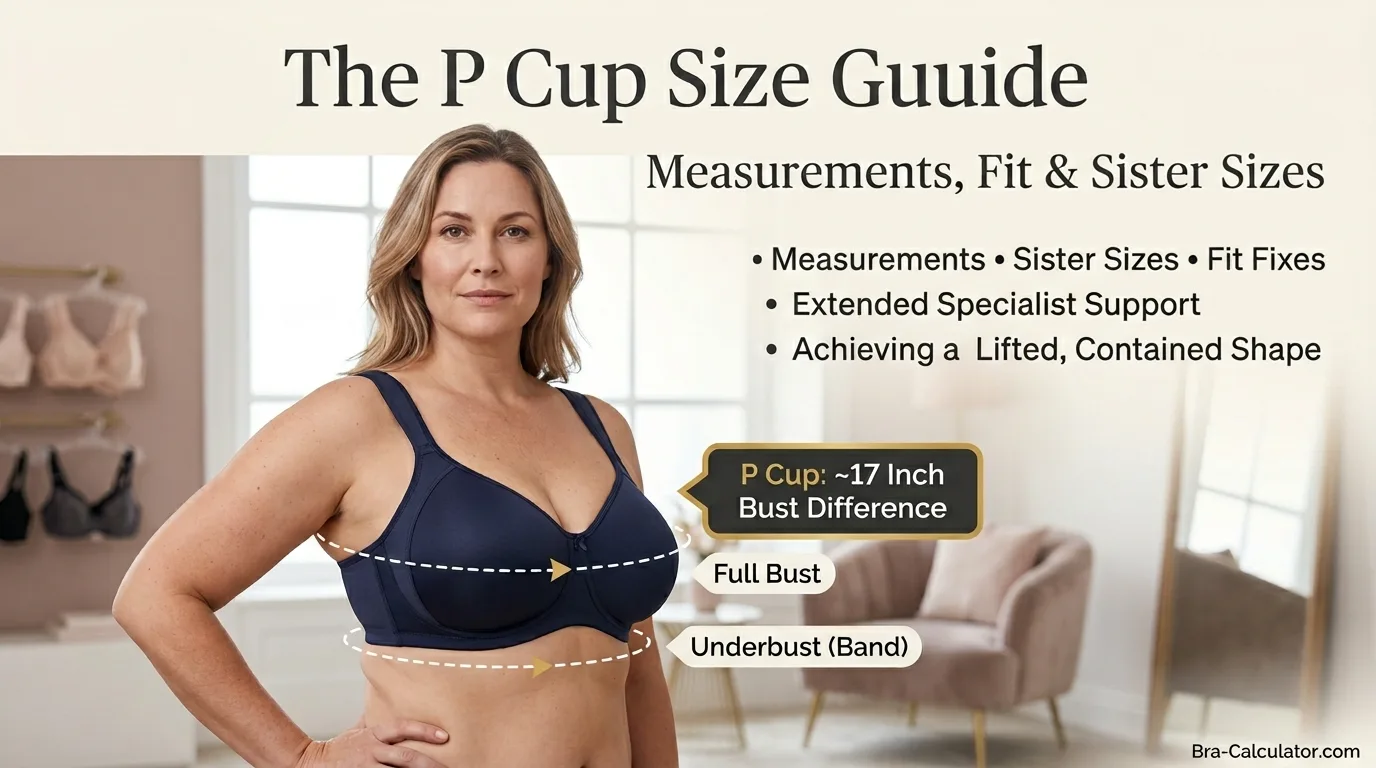
A P cup usually means your full bust is about 17 inches larger than your underbust. It is an extreme extended full-bust size where standard bra construction is rarely enough. A 30P, 34P, 38P, and 40P all use the same cup letter, but they do not hold the same actual breast volume. P cup bras need exceptional depth, full containment, wide padded straps, strong side support, reinforced back wings, a stable band, and careful conversion between US, UK, EU, and AU sizing systems.
P Cup at a Glance
| Attribute | Detail |
|---|---|
| Cup Difference | About 17 inches between underbust and full bust |
| General Category | Extreme extended full-bust / custom-level support range |
| Common Reference Size | 34P, but P cup exists across many band sizes |
| Common Sister Sizes | 34P ≈ 32PP ≈ 36O ≈ 38OO / 38N depending on brand progression |
| Most Common Fit Issue | Limited availability, shallow cups, floating gore, wire pressure, band rolling, shoulder strain |
| Best Bra Styles | Full-cup, side-support, longline, custom-fit, seamed cup, specialist sports bra |
| Usually Avoid | Generic S/M/L bras, shallow molded cups, thin bralettes, weak bands, narrow straps |
| US / UK / EU / AU Cup Label | Highly variable after D; always check the exact brand chart |
| Unique P Cup Fit Rule | P cup usually requires extended-size engineering, professional fit checks, or custom-grade support. |
| Important Rule | P cup volume changes as band size changes |
What Is a P Cup Size?
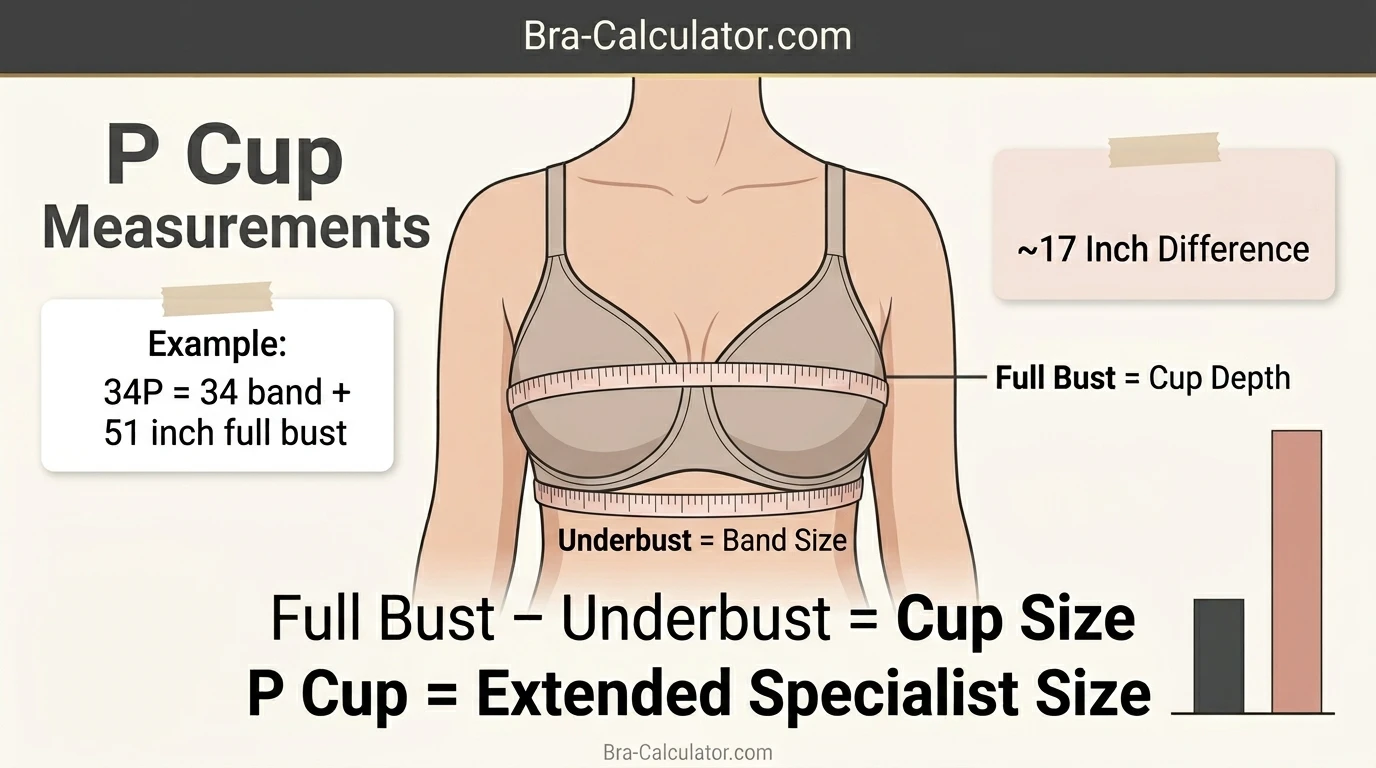
A P cup is an extended specialist bra size where the full bust is usually about 17 inches larger than the underbust. For example, if your underbust is around 34 inches and your full bust is around 51 inches, you may be close to a 34P in a cup progression that maps P to a 17-inch difference. If your underbust is around 38 inches and your full bust is around 55 inches, you may be close to a 38P.
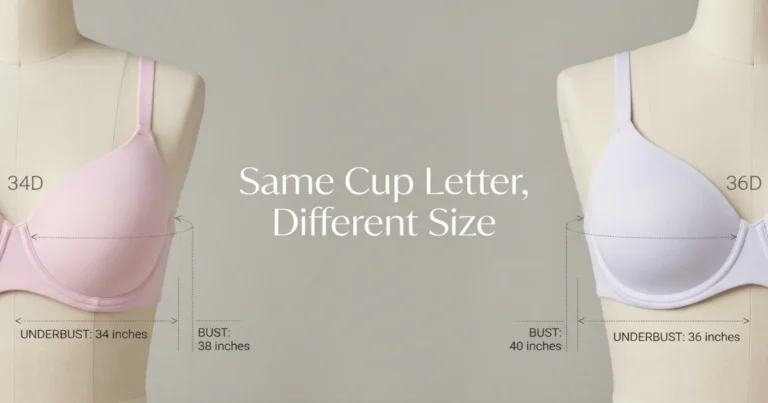
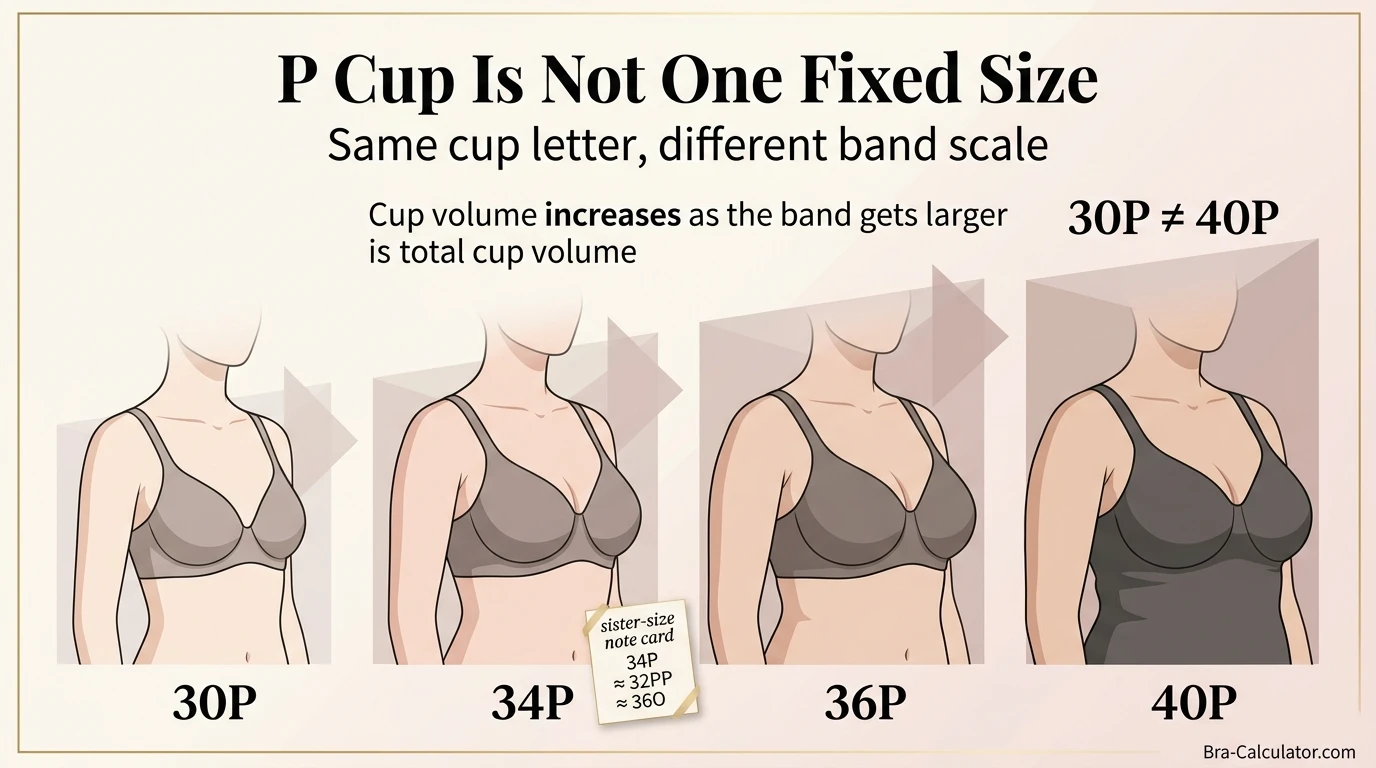
P cup is not one fixed breast size. A 30P is not the same total volume as a 40P. As the band gets larger, the cup becomes wider, deeper, and heavier. This is why P cup must always be understood with its band size. The cup letter gives the measurement difference; the band gives the scale.
At P cup, the bra is not simply shaping the bust. It is managing heavy volume, forward projection, side spread, downward pull, tissue containment, and posture comfort. The band must stay level, the cups must have enough immediate depth, the wires must fully surround breast tissue, and the straps must distribute tension without digging. A bra can have a P label and still fail if the cup is shallow, the wires are too narrow, or the band is too stretchy.
P cup is usually larger than O cup and deep in custom-level full-bust territory. Many wearers need full-bust boutiques, made-to-order brands, professional bra fitting, or specialist construction. The real goal is not only finding “P cup” on a tag — it is finding a bra strong enough to support P cup volume in daily life.
P Cup Measurements
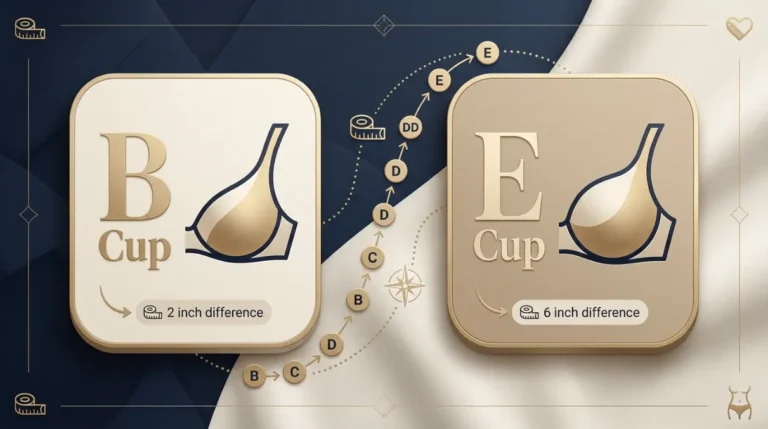
To calculate a P cup, measure your underbust and full bust carefully. Your underbust gives the band size, while the difference between full bust and underbust gives the cup range. For P cup, that difference is usually around 17 inches, or about 43 cm, depending on the sizing system.
About 17 inches difference = P cup range
| Example Size | Typical Underbust | Typical Full Bust | What It Means |
|---|---|---|---|
| 30P | 29–30″ | 46–47″ | Extreme projection on a narrow band |
| 32P | 31–32″ | 48–49″ | Very deep extended cup with high support needs |
| 34P | 33–34″ | 50–51″ | Common P cup reference size |
| 36P | 35–36″ | 52–53″ | Extreme full-bust size on a wider frame |
| 38P | 37–38″ | 54–55″ | Very heavy total cup volume; specialist support required |
| 40P | 39–40″ | 56–57″ | Custom-level support demand |
Wrap the tape directly under your bust. Keep it level and snug. At P cup, even a slightly loose band can shift too much support into the straps and shoulders.
Measure around the fullest point of the bust. For very full or soft tissue, compare standing, leaning, and supported measurements before choosing a final size.
If the full bust is around 17 inches larger than the underbust, you may be in the P cup range. Around 16 inches may suggest O, while more than 17 inches may require a larger specialist cup or custom sizing.
The cups should contain all tissue, the center gore should not float dramatically, the wires should not sit on breast tissue, and the band should stay level without rolling.
P Cup Measurement Visual
What Does a P Cup Look Like?
A P cup usually creates an extremely full, heavy, and highly projected bust shape. In a well-fitted bra, the bust should look lifted, centered, controlled, and fully contained. In a poorly fitted bra, the same volume can look low, wide, compressed, unstable, or painful because the cup is not deep enough or the band is not strong enough.
On a 30P or 32P band, the bust often appears dramatically projected because the cup depth is very large relative to a narrower torso. On 36P, 38P, or 40P, the bust appears wider and heavier because the cup is scaled across a larger ribcage. This is why P cup visuals can look very different across real bodies.
In clothing, the right P cup bra can completely change posture, proportions, and daily comfort. It can lift tissue away from the waist, reduce underarm spread, improve dress fit, reduce button strain, and make the upper body feel more balanced. Poor fit can cause neckline distortion, shoulder grooves, underbust rolling, skin rubbing, back fatigue, and constant readjustment.

Seamed Balconette Bra — Lift, Depth & Structure for P Cup
- Multi-part cup construction supports deeper extended volume
- Useful when molded cups flatten, spill, or collapse
- Helps lift tissue from the base instead of relying only on straps
- Works best when paired with a firm band and full root coverage

Wireless Seamless Bralette — Soft Comfort for Low-Impact P Cup Wear
- Soft stretch fabric adapts to fuller bust volume
- Useful for lounging, rest days, and low-impact comfort
- Wide underband gives better stability than thin casual bralettes
- Best for relaxed wear, not maximum lift or high-impact support
Extreme Projection
30P or 32P can look very projected on a narrow torso. Deep cups and firm band anchoring are essential.
Deep cup fitCustom-Level Support
34P often needs serious structure. Side-support cups help center the bust and reduce side spread.
Side supportBroad Tissue Base
Choose wires wide enough to fully surround tissue. Narrow wires can sit on breast tissue and cause daily pain.
Wider wireNeeds Full Containment
Soft P cup tissue usually needs full coverage, stable upper cup edges, reinforced side panels, and a strong back band.
Full coverageIs a P Cup Considered Extremely Large?
Yes, P cup is considered extremely large and sits deep in extended specialist full-bust territory. It is one cup larger than O cup in the same band and is usually beyond what most mainstream lingerie brands produce. But band size still matters: a 30P and 40P are not the same volume.
The real challenge with P cup is not only cup depth; it is total engineering. The bra must control weight, projection, side spread, bounce, and downward pull. A weak band will ride up. A shallow cup will push tissue outward. A narrow wire will dig into breast tissue. A thin strap will groove the shoulders. A poor side wing will allow the bust to spread toward the underarm.
P cup is an extended specialist size. Most wearers need serious full-bust construction, professional fitting guidance, or custom options.
If your P cup bra hurts, slides, rolls, spills, or collapses, the bra design is likely under-engineered for your body.
How Much Do P Cup Breasts Weigh?
P cup breast weight can be substantial, especially on wider bands. These are practical bra-fitting estimates, not medical measurements. Real weight varies with tissue density, body composition, breast root width, fullness, age, and hormonal history.
| P Cup Size | Approx. Breast Weight | Fit Note |
|---|---|---|
| 30P | Approx. 5.90–8.20 lb per breast | Extreme projection; needs deep cup and firm band. |
| 32P | Approx. 6.80–9.60 lb per breast | Strong side support and full coverage are usually needed. |
| 34P | Approx. 7.90–11.20 lb per breast | Common reference; extended/custom-grade construction helps most. |
| 36P | Approx. 9.00–12.80 lb per breast | Longline and full-cup styles may feel more stable. |
| 38P | Approx. 10.20–14.50 lb per breast | Weak bands and thin straps usually fail quickly. |
Support note: At P cup, daily comfort depends on weight distribution across the band, cups, straps, side wings, and back panel.
Persistent pain, skin breakdown, numbness, or nerve symptoms should be discussed with a qualified healthcare professional.
P Cup Sister Sizes
Sister sizing keeps similar cup volume while changing the band. For P cup, sister sizing can help when the cup volume is close but the band is wrong. However, because P cup volume is heavy, a looser sister size may reduce support even if the cups feel similar.
Using 34P as a reference, a tighter UK-style sister size is 32PP. A looser sister size is 36O, and another looser sister size may be 38OO or a nearby brand-specific equivalent depending on the cup progression. Exact labels may vary because many brands do not standardize cup letters this far into the alphabet.
Rule: Up one band → Down one cup | Rule: Down one band → Up one cup | Example: 34P ≈ 32PP ≈ 36O.
| Reference Size | Tighter Sister Size | Looser Sister Size |
|---|---|---|
| 32P | 30PP | 34O |
| 34P | 32PP | 36O |
| 36P | 34PP | 38O |
| 38P | 36PP | 40O |
P Cup vs Other Sizes
These comparisons help you understand when P cup is right and when you may need O, Q, or a sister size instead. At this range, one cup or one band shift can change support, cup depth, gore position, wire placement, and shoulder comfort.
- About 17-inch bust difference
- More depth and volume than O
- Better if O cups spill, flatten, or make gore float
- About 16-inch bust difference
- Smaller cup volume
- Better if P cup wrinkles or feels too deep
- Extreme specialist support size
- Needs full-bust or custom-grade engineering
- Good if cups contain smoothly
- More cup depth and total volume
- Try if P cup cuts in, spills, or wires sit on tissue
- Reference P cup size
- Good if 34 band stays level and supportive
- Tighter sister size
- Similar cup volume
- Better if 34 band rides up
- Firmer band than 36O
- Usually better support if underbust is closer to 33–34 inches
- Looser sister size
- Similar cup volume
- Use only if 34 band is genuinely too tight
Best Bra Styles for P Cup
P cup bras should be chosen by construction first. The best options usually have firm power-mesh bands, multi-part cups, reinforced side panels, wide straps, stable seams, deep lower cups, and enough coverage to prevent tissue from spilling forward or sideways.
Provides coverage, containment, and stability for very full or soft breast tissue.
Moves tissue forward and inward, helping reduce side spread and improve clothing fit.
Distributes support across more ribcage area and may feel steadier for P cup volume.
Useful when standard wires, cup depths, or band shapes never feel right.
Usually flattens the bust, pushes tissue sideways, and makes the gore float.
Can be comfortable for lounging but rarely gives enough lift or containment for daily wear.
Common Fit Problems with P Cup
The cup may be too small, too shallow, too closed on top, or too narrow at the wire.
The cups may not have enough depth, or the bra may be in the wrong sizing system.
The band is too loose, too narrow, or too weak for extended cup volume.
The cup may be too small, too narrow, or not deep enough at the base.
The straps are doing too much work because the band, cups, or side panels are not supporting enough.
International Size Conversion for P Cup
P cup conversion is extremely important when buying online. US, UK, EU, and AU cup progressions can separate after D. A UK P is not always the same as a US P. Some brands skip letters, some use double letters, and some convert cup labels differently while keeping similar volume.
Before ordering a P cup bra, confirm whether the brand uses UK sizing, US sizing, or its own extended cup chart. Use the Global Bra Size Converter before checkout so you match both the band and cup correctly.
Related P Cup Tools & Guides
Use these supporting pages to confirm your measurements, compare cup visuals, and find a better sister size if your current P cup bra does not fit smoothly.
| Guide / Tool | Why It Helps |
|---|---|
| Bra Size Calculator | Calculate your exact band and cup size from measurements. |
| Cup Size Visuals | Compare P cup with nearby sizes like N, O, and larger specialist sizes. |
| Sister Size Calculator | Find sister sizes like 34P, 32PP, and 36O. |
| Global Bra Size Converter | Convert P cup sizes across US, UK, EU, AU, FR, JP, and more. |
Continue the Cup Size Guide Series
If P cup is close but not perfect, compare it with nearby cup sizes and sister sizes before buying. At this size, one cup or one band shift can completely change support, comfort, and wire placement.
| Next Step | Best For |
|---|---|
| ← O Cup Size Guide | Use this if P cups wrinkle, feel too deep, or leave empty space. |
| Cup Size Visuals → | Compare P cup with all nearby cup sizes visually. |
| AI Smart Fit Calculator → | Check whether the issue is cup depth, band tension, wire width, or sizing-system confusion. |
| Global Bra Size Converter → | Use this before buying P cup bras from international brands. |
Frequently Asked Questions
A P cup usually means your full bust is about 17 inches larger than your underbust. The exact label depends on the brand and sizing system.
Yes, P cup is an extremely large extended full-bust size. A 30P is still smaller in total volume than a 40P because cup volume scales with band size.
In UK-style sizing, common sister sizes of 34P include 32PP and 36O. Some brands may use different extended labels this far into the alphabet.
Yes, P cup is usually one cup size larger than O cup in the same band, although US and UK labels may differ after D.
Choose P cup if O cups spill, flatten, or make the center gore float. Choose O if P cups wrinkle, gape, or feel too deep.
Side spillage usually means the cup is too small, too shallow, or too narrow. Try a deeper cup, wider wires, or a side-support full-cup bra.
34P and 36O can be sister sizes in some UK-style progressions with similar cup volume, but 36O has a looser band and may feel less supportive.
Yes, but P cup wireless bras need serious structure: firm underband, reinforced cups, wide straps, and strong side panels. Thin bralettes are usually for lounging only.
O cup is usually smaller than P cup in the same band, depending on the sizing system.
Q cup or larger specialist sizes are usually bigger than P cup, depending on the brand and country sizing system.
P cup requires extended specialist construction and wider size ranges. Many mainstream brands stop before this size, so full-bust retailers and custom options are often better.
Projected P cup breasts usually fit best in seamed full-cup bras, side-support bras, longline bras, and deep cups with immediate projection near the wire.
Find Your Best P Cup Fit
Measure your underbust and bust to confirm whether P cup, O cup, Q cup, or a sister size is your most comfortable match.