Best Bras for E Cup — Built Around Support, Not Just the Letter
An E cup is where shopping gets more technical: the letter can mean different things across sizing systems, cup depth matters more, and a bra that looks supportive can still push tissue sideways or dump the load into your straps. This guide decodes your E first, then matches construction to shape, band and use.

For E cups, support starts with the sizing system
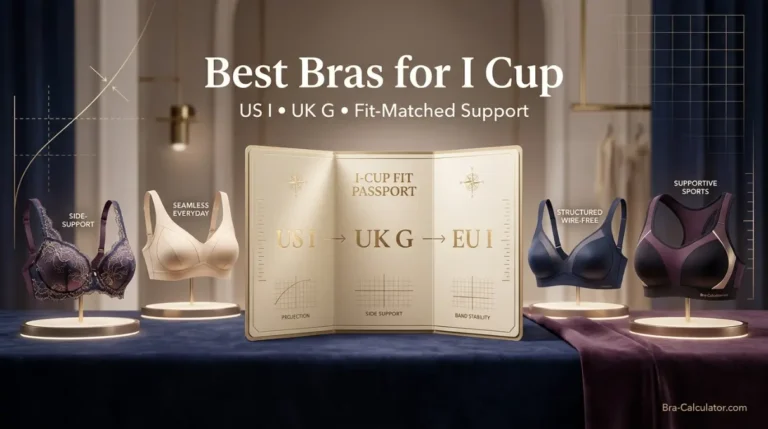
On this page, E cup means UK E unless a product card says otherwise. A common conversion is UK E ≈ US DDD (sometimes US F) ≈ EU F. UK DD is one cup step smaller than UK E. Because brands do not all label cups the same way, identify the cup ladder before you compare bras.
A literal “E” can refer to a different cup step in another sizing system.
A shallow cup can feel small, push tissue sideways, or slide down even when the nominal size is right.
Band, wire/cup frame, side panels and straps should share the work.
Decode the “E” on the Label First
The biggest E-cup shopping mistake is assuming every brand uses the same alphabet. UK fuller-bust brands commonly run D → DD → E → F → FF. Many US brands run D → DD → DDD → G, while some use F instead of DDD. EU charts commonly place UK E at EU F.
About the sixth common cup step above the band baseline in inch-based sizing logic. Cup volume still increases with band size.
Many US charts map UK E to DDD; some brands use F. Read the brand ladder, not the letter alone.
UK E commonly maps to EU F. A literal EU E is usually one step smaller.
E-Cup Support Architecture Studio
Choose the sizing system, shape clue, use and current fit failure. The tool recommends a construction strategy first and a product role only when that role fits your clues.
Why this is the better first test
Best Bras for E Cup — Five Different Support Jobs
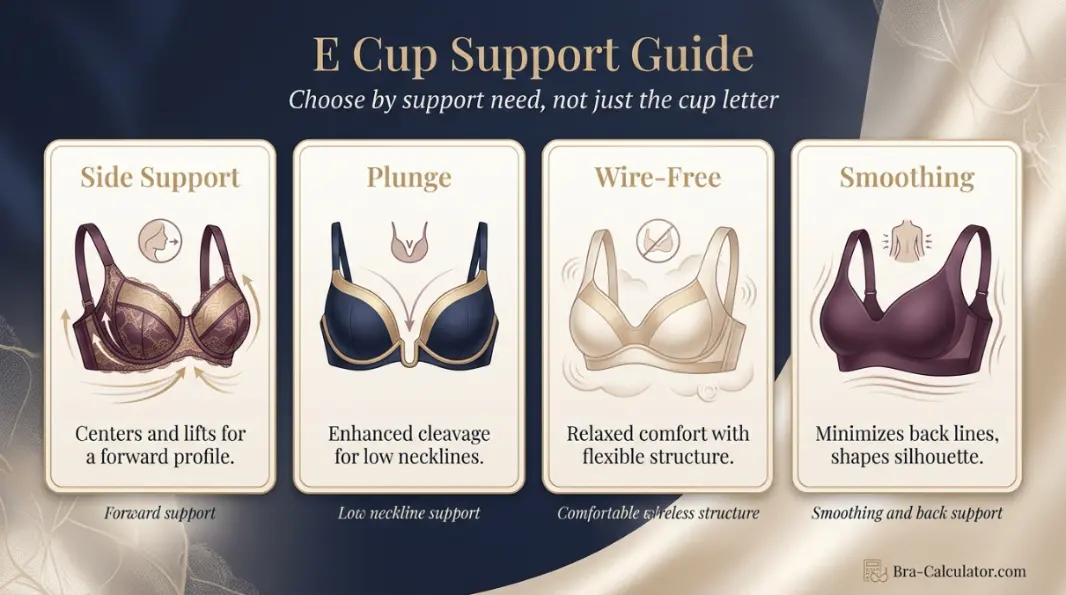
These are not fake “#1 to #5” rankings. Each earns a place because its construction or current size range solves a different E-cup problem. For UK brands, choose UK E. For Wacoal US products, look for the common equivalent DDD.
Fantasie Fusion Full Cup Side Support Bra
Fusion is the most complete everyday E-cup architecture in this set. Fantasie uses a wide wire, three-piece cup and side-support panel to create uplift and forward projection, with fuller coverage through the cup and underarm.
- Strong first test when tissue drifts toward the underarm.
- Useful for projected or balanced fuller-bust shapes that need structure without thick foam.
- Current Fusion versions use flexible neckline details that can be friendlier to softer upper tissue.
Freya Offbeat Side Support Bra
Offbeat uses a four-piece cup with a laminated side panel designed to bring breast tissue forward from the side. That makes it a strong E-cup test when your main complaint is east-west spread, soft side tissue, or a bra that gives coverage without a centered shape.
- The side panel does actual shaping work instead of relying only on strap tension.
- Stretch lace gives the upper cup some adaptability.
- Useful when molded bras flatten or widen your profile.
Elomi Matilda Plunge Bra
Matilda is the strongest plunge route here for readers who need more band coverage. Elomi’s current US page spans bands 32–46 and cups DD–O. Three-section cups plus side support create forward shape while the low center gives plunge without push-up padding.
- Lower center without giving up separation and forward structure.
- Elasticated neckline can be friendlier to softer or fluctuating tissue.
- Moveable J-hook gives a racerback option when strap placement conflicts with clothing.
Wacoal Perfect Primer Wire Free Bra
Perfect Primer is the practical wire-free E-equivalent route because Wacoal’s US range includes DDD and extends through a 46 band. It uses a hidden sling, anchored underbust band and low-stretch adjustable straps instead of relying on a wire.
- Wacoal recommends it for round, shallow-top/full-bottom and pendulous shapes.
- Useful when underwire is the deal-breaker but an unstructured bralette is not enough.
- Encased back elastic and a plush closure emphasize comfort while retaining a real support frame.
Wacoal Back Appeal Underwire Bra
Back Appeal is the smoothing option for shoppers who want support plus extra back and side coverage. Wacoal lists bands through 44 and cups through H, including DDD, with a hidden sling and close-set straps.
- Close-set front straps can help when wide-set straps repeatedly slide toward the shoulder edge.
- Wacoal lists round, east-west and pendulous shapes among its fit recommendations.
- Two-ply cups avoid the rigid molded-shell approach while still creating coverage.
The Four-Part E-Cup Support Architecture
Fuller-bust support is not created by “thicker straps” alone. A good E-cup bra spreads the work across the band, cup frame, cup depth and strap geometry.
The band should stay level through movement. If it rides up, the straps and cups are forced to take load they were not designed to carry.
Projected tissue needs room immediately above the underwire. A cup can be technically large enough yet still slide down if that depth is missing.
A side-support panel can redirect lateral tissue forward, improving separation without simply compressing the breast.
Straps fine-tune cup position. They should not be tightened until the band climbs or the shoulder carries most of the weight.
Best E-Cup Bra Construction by Breast Shape
The same 34E can need a very different cup depending on root width, projection and tissue softness. Choose cup architecture before color or padding.
Look for seamed three- or four-part cups with room immediately above the wire. Sliding down or folding at the base is a classic shallow-cup clue.
Side-support panels can bring tissue forward. Check that the outer wire still surrounds the root rather than cutting into it.
An elasticated or stretch-lace top edge can reduce upper-cup emptiness while the lower cup carries the volume.
Try lower or narrower gores if a tall center sits on tissue. A plunge can work, provided the cup still has enough depth.
Fuller coverage, internal slings and stable side panels can control movement without crushing tissue into a shallow shell.
You have more style flexibility. Compare support, neckline and wire width instead of chasing a special “round breast” bra.
Six E-Cup Fit Problems and the Better Next Test
If the band is stable, test more cup volume or more projection. A shallow E can behave like a too-small cup even when the label is right.
Same band + more usable cup roomThis often points to insufficient immediate depth. Tightening straps may pull the bra up temporarily but does not create room at the wire.
Seamed, deeper lower cupThe cup may be too shallow or lack side control. A side panel can redirect tissue forward without needing a tighter band.
Side-support constructionLoosen them slightly and test whether the band remains stable. If all lift disappears, the band/cup frame is not carrying enough load.
Improve anchorage before strap tensionThis can be shape mismatch rather than a universally too-large cup. Fuller-on-bottom or soft tissue often needs a flexible upper edge.
Stretch lace / elasticated necklineFasten it backwards with cups hanging down. If the band suddenly feels fine, cup compression is stealing band room.
Diagnose cup depth before banding upA 60-Second C-Cup Fitting Room Test
| Check | Good sign | If it fails |
|---|---|---|
| Band | Level, comfortably firm, stays in place when arms move | Rides up → tighter band/sister size. Painful → isolate whether cup compression is the cause. |
| Cup edge | Smooth without cutting in or standing away | Spill → more room. Gap → different height/depth before assuming smaller everything. |
| Wire | Surrounds breast tissue without sitting on it | Wire on tissue → more width/volume. Wire far beyond root → narrower geometry may fit better. |
| Center | Underwire gore rests flat or comfortably close when anatomy allows | Floating center → investigate cup volume, projection and gore shape. |
| Straps | Stay up with light tension | Digging → band/cup support issue. Slipping → placement or band stability issue. |
| Movement | Bra stays put when reaching, sitting and bending | Shifting fit in motion is still a fit failure even if it looked fine standing still. |
Common UK E Sister Sizes
Move down one band and up one cup for a tighter band, or up one band and down one cup for a looser band. The cup volume stays roughly similar, but the bra frame changes.
| UK E size | Tighter sister | Looser sister | What to watch |
|---|---|---|---|
| 30E | 28F | 32DD | Strap placement and wire width change quickly on smaller frames. |
| 32E | 30F | 34DD | Useful when cup volume feels right but the back moves. |
| 34E | 32F | 36DD | One of the most useful comparison ladders across fuller-bust brands. |
| 36E | 34F | 38DD | Check whether the wider sister-size wire still follows your root. |
| 38E | 36F | 40DD | Band recovery becomes increasingly important. |
| 40E | 38F | 42DD | Verify exact style availability before assuming a brand carries it. |
How We Chose These E-Cup Recommendations
This page is useful even if you never click an affiliate button. Product claims are separated from fit principles, and sizing-system uncertainty is stated rather than hidden.
What we verified
- Official construction and cup/band ranges on brand pages checked September 10, 2026.
- Whether UK E or the common US DDD equivalent is available in the specific style.
- Side-support, plunge, wire-free, smoothing, strap and cup-frame features published by the manufacturer.
- International conversion tables from Fantasie, Freya, Elomi and Wacoal.
- That each recommendation solves a meaningfully different shopping problem.
What we do not claim
- That every brand uses E, DDD and F identically.
- That one “best bra” fits every UK E breast shape and band.
- That star ratings outrank cup geometry.
- That wide straps alone create support.
- That current color, stock or price will remain unchanged.
Related E-Cup Guides & Tools
Frequently Asked Questions About the Best Bras for E Cup
What bras are best for an E cup?
For a UK E, start with a stable band and a cup that matches your shape. Multi-part side-support bras are strong everyday options, plunges work when you need a lower center, and structured wireless bras can work when their band and internal cup frame are firm enough.
Is UK E the same as US DDD?
Common conversion charts map UK E to US DDD, with some US brands using F for the same general step. EU F is another common equivalent. Always check the brand’s own sequence because labeling is not perfectly standardized.
Is E cup the same as DD?
Not in UK sizing. The UK sequence runs D, DD, E, F, so E is one cup step above DD. In other systems, the letter E may be used differently.
Why does my E-cup bra still feel unsupported?
A larger cup label does not guarantee better support. A band that rides up, a shallow cup, excess wire width, insufficient side support, or straps carrying too much load can all make an E cup feel unstable.
What is a good wireless bra for an E cup?
Look for a stable underband, controlled stretch, an internal sling or defined cup frame, and adjustable straps. Wacoal Perfect Primer is one current US DDD option with extended band coverage, but the correct fit still depends on shape and band size.
Are side-support bras good for E cups?
They can be excellent when side tissue needs to be directed forward. The main cup must still have enough depth and the side panel should shape rather than squeeze.
What are the sister sizes for 34E UK?
The closest UK sister sizes are 32F on a tighter band and 36DD on a looser band. They hold roughly similar cup volume, but the wire, strap spacing and overall frame change.
Should an E-cup bra always have wide straps?
No. Wider straps may improve comfort, but the band and cup structure should provide most support. If you need to overtighten the straps to feel lifted, the underlying fit is probably not doing enough work.
Reviewed by Amelia
The most important E-cup shopping habit is simple: identify the sizing system before you judge the letter. After that, look at where the breast needs space and where the bra needs structure. A correct label in the wrong cup geometry is still the wrong bra.
Confirm My Bra Size Read the DDD / E Cup GuideBest bras for other cup sizes
- Best Bras for F Cup (2026): UK F / US G Support Guide
- Best Bras for G Cup 2026: Expert Picks & Specialist Guide
- Best Bras for H Cup 2026: Expert Picks, Sister Sizes & Specialist Guide
- Best Bras for I Cup (2026): US I / UK G Fit Guide
- Best Bras for J Cup (2026): US J & UK J Fit Guide
- Cup size visuals: see every cup letter
- Bra size calculator
- Best comfort bras