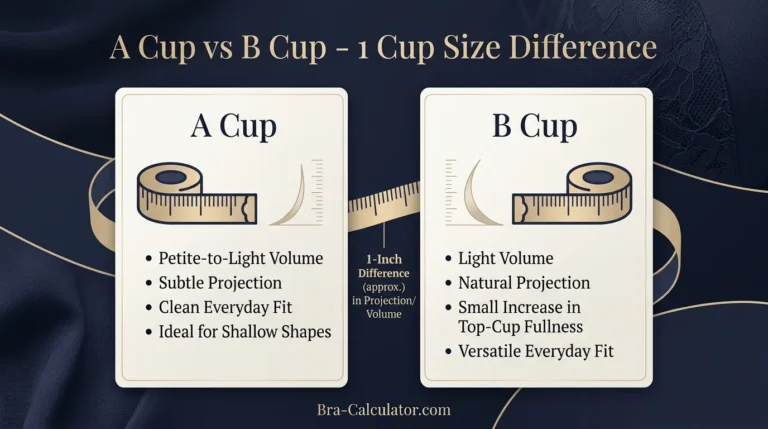
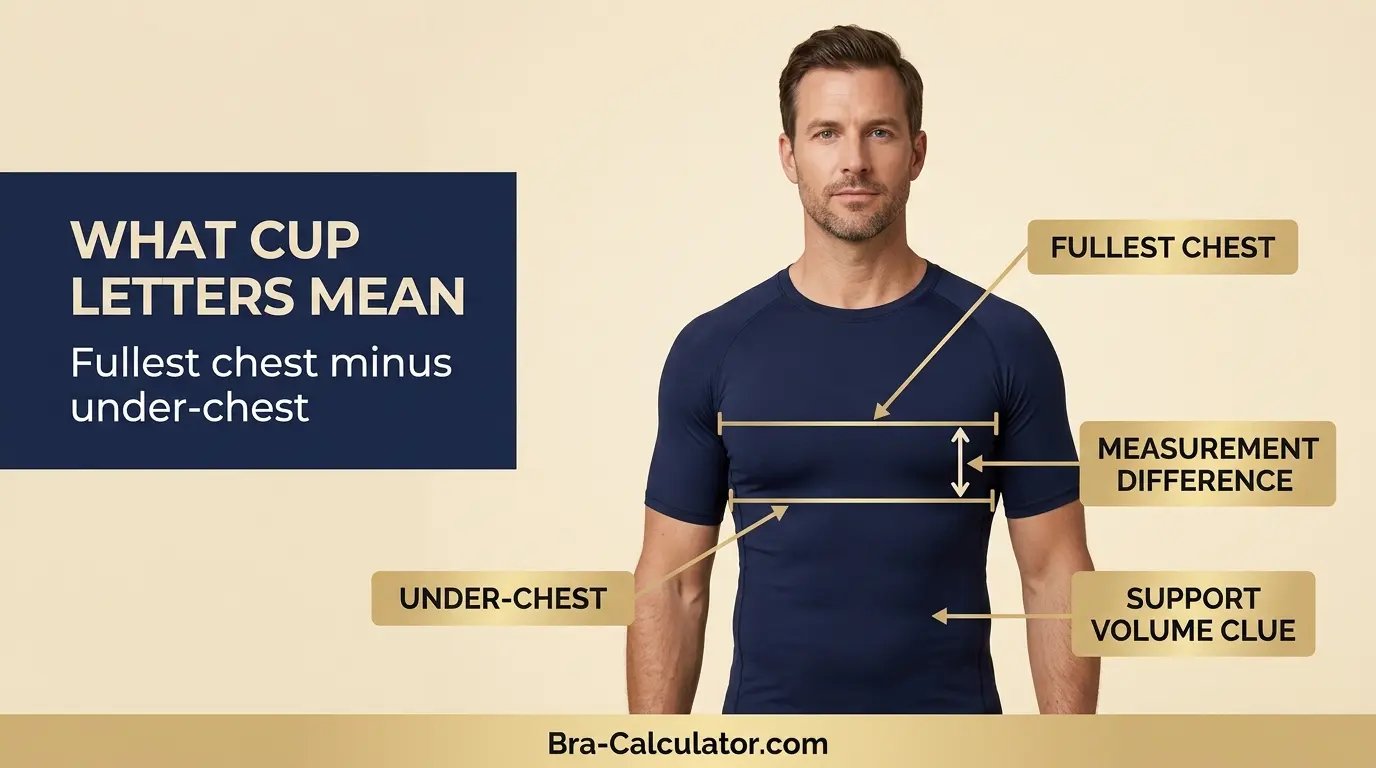
Men’s cup size describes the difference between the under-chest measurement and the fullest chest measurement. It is not a judgment, diagnosis, or gender label. For gynecomastia support, cup letters can help estimate how much front coverage or shaped support may be needed. Smaller differences often point toward light support or compression shirts, while larger differences may need more front depth, soft support tops, or structured gynecomastia support. Use the men’s bra size calculator for a practical starting size.
Choose the fit signs you notice in the band, cups, center and straps. We’ll use them to suggest the most useful next step.
Private fit check — your answers stay in your browser and are used only for this on-page guidance. Nothing is stored or submitted.
Men’s Cup Size at a Glance
| Cup Size Concept | What It Means for Men |
|---|---|
| Cup letter | A rough way to describe front chest volume from the difference between under-chest and fullest chest. |
| Band size | The under-chest/ribcage measurement that gives the base support size. |
| Fullest chest | The largest chest circumference, usually measured across the nipple line. |
| A cup / B cup | Often means a smaller to moderate chest difference; may work with light support, compression tanks, or soft support tops. |
| Larger cup letters | Usually mean more front coverage, shaped support, or structured compression may be needed. |
| Medical meaning | Cup size does not diagnose gynecomastia, grade severity, or distinguish glandular tissue from fat-related fullness. |
What Do Cup Letters Mean for Men?
Cup letters are simply a sizing shorthand. They describe the difference between a person’s under-chest measurement and fullest chest measurement. For men with gynecomastia or chest fullness, cup letters can help translate chest volume into support needs, especially when choosing bra-style garments, soft support tops, or structured support pieces.
The important point is this: a cup letter is not a diagnosis and it is not an identity label. It does not say whether you have true gynecomastia, pseudogynecomastia, fat-related fullness, glandular tissue, or another medical issue. It only helps estimate how much front space or support a garment may need.
Many men do not need cup-letter sizing at all. If you are choosing a compression undershirt, compression tank, or vest, you may use chest measurement, waist measurement, torso length, and compression level instead. But if you are choosing a soft support top or bra-style support, cup letters can become useful because they describe front depth more clearly than small, medium, or large.
Fit truth: Cup size is a tool, not a label. Use it to choose better support, then confirm the fit with breathing, movement, shoulder, hem-roll, and shirt-visibility checks.
Men’s Cup Size Chart for Gynecomastia Support
Use this chart after measuring your under-chest and fullest chest. Subtract under-chest from fullest chest to estimate a cup-letter range. This is a practical support guide, not a medical severity scale.
| Chest Difference | Approx. Cup Letter | What It May Mean for Men | Support Direction |
|---|---|---|---|
| Less than 1 in | AA / Flat | Minimal front depth; clothing or nipple coverage may be the main concern. | Light Undershirt, light compression, or layering. |
| About 1 in | A | Small chest-to-ribcage difference; may need light smoothing or gentle support. | Light support Compression tank or soft support top. |
| About 2 in | B | Moderate visible fullness or movement; support choice depends on clothing and activity. | Moderate Compression undershirt or soft support top. |
| About 3 in | C | More front depth; shaped support or firmer compression may feel more secure. | Moderate-firm Support top, longline compression, or vest. |
| About 4 in | D | Clearer front volume and movement; generic compression may not control the chest enough. | Firm Gynecomastia compression vest or structured support. |
| 5+ in | DD+ | Larger chest-to-ribcage difference; front support, shoulder comfort, and garment length matter more. | Structured Firm vest, wider shoulder support, or professional fitting. |
Important: This chart estimates support volume only. It does not diagnose gynecomastia or measure medical severity. New lumps, sudden changes, nipple discharge, skin changes, or pain should be checked by a healthcare professional.
How to Find Your Cup Size Estimate as a Man
Use this method when a support top, bra-style garment, or size chart asks for cup information. If you are only buying a compression undershirt, you may still use these numbers to understand support demand.
Wrap a soft tape measure around the ribcage directly under the chest tissue. Keep the tape level, snug, and natural. This is your under-chest or band measurement.
Measure around the fullest part of the chest, usually across the nipple line. Keep shoulders relaxed and do not pull the tape tight enough to compress tissue.
If your fullest chest is 39 inches and your under-chest is 36 inches, the difference is 3 inches. That points roughly toward a C-cup estimate.
Use the chart as a starting point only. Fabric stretch, torso shape, compression level, and garment type can change what feels best.
Enter your numbers into the men’s bra size calculator, then check breathing, shoulder pressure, chest movement, and visibility under normal shirts.
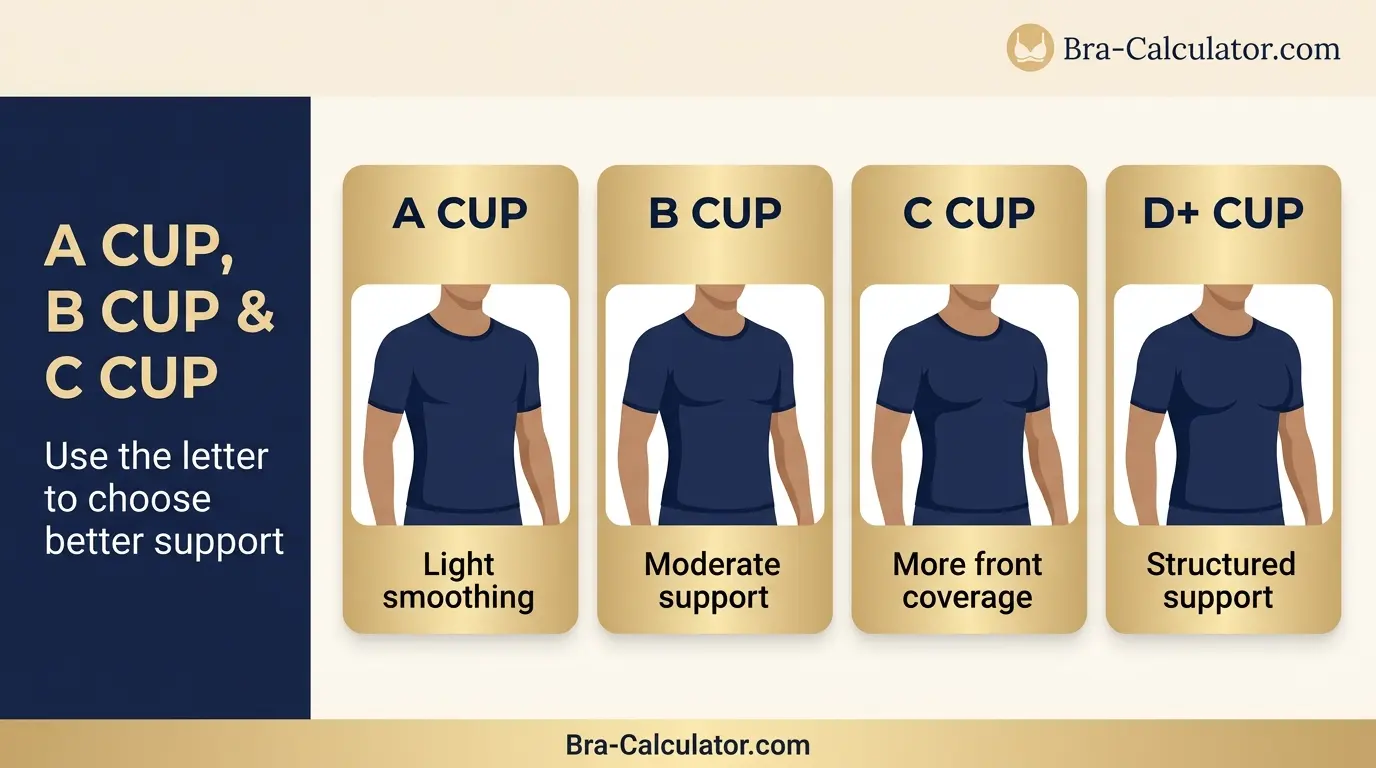
What A Cup, B Cup and C Cup Mean for Men
For men, cup letters are best understood as support-volume clues. They do not need to be emotional, embarrassing, or gendered. They simply help explain how much front depth a garment may need.
A Cup for Men
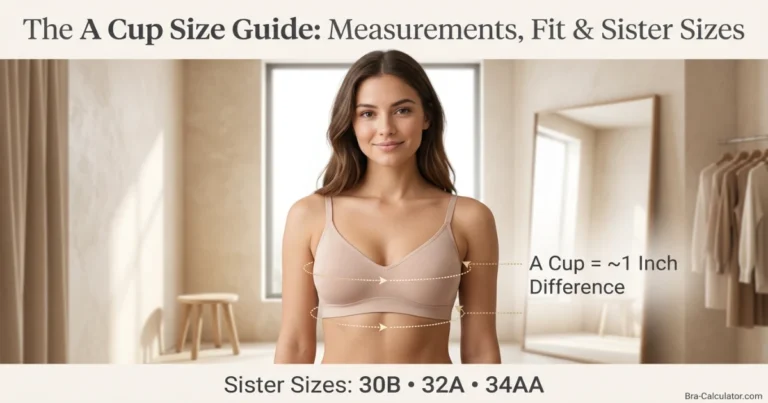
An A-cup estimate usually means about a 1-inch difference between under-chest and fullest chest. The main needs may be nipple coverage, light smoothing, or mild support.
B Cup for Men
A B-cup estimate usually means about a 2-inch difference. This can create visible shirt outline or mild-to-moderate movement depending on tissue firmness and clothing style.
C Cup for Men
A C-cup estimate usually means about a 3-inch difference. Many men in this range need more than a thin undershirt if movement or shirt smoothness is the main issue.
D Cup or Larger for Men
D cup or larger estimates usually mean the front of the garment needs more structure, shoulder comfort, and stable length. Generic compression may feel too weak or too tight.
Should Men Use Cup Size or Compression Size?
Not every support garment uses cup letters. Some use bra-style band and cup sizing, while others use S, M, L, XL, chest circumference, or compression level. The right sizing system depends on the product category.
| Garment Type | Best Sizing System | Why |
|---|---|---|
| Compression undershirt | Chest size + waist + torso length | Designed like a base layer, not a cup-based bra. |
| Compression tank | Chest size + shoulder fit + length | Needs discreet compression and stable shoulder placement. |
| Soft support top | Band + cup estimate | Front depth matters more than a regular undershirt size. |
| Bra-style support | Band + cup size | Cup letters help determine the front volume and support shape. |
| Gynecomastia vest | Chest circumference + compression level | Usually built for structured compression rather than cup depth. |
| Sports compression shirt | Chest size + mobility check | Movement support and breathability matter more than cup labeling. |
Best rule: Use cup size when the product has cups or shaped front support. Use compression size when the product is a shirt, tank, or vest.
Why the Same Cup Letter Can Fit Men Differently
Cup letters only describe a measurement difference. They do not account for shoulder width, torso length, stomach shape, tissue firmness, tenderness, or clothing goals.
Cup May Look Smaller
A B or C cup can look less projected on a broad frame but still need support during movement.
Check movementCup May Show More
The same cup estimate may look more visible under shirts on a narrower torso.
Try seamlessLength Still Matters
Cup size may be right, but compression shirts can roll if waist and torso length are ignored.
Measure lengthSoftness Wins
A smaller cup estimate can still need gentle support if tenderness is the main problem.
Try soft supportFlexibility Helps
Measure around the fullest overall point. New or fast one-sided changes should be checked medically.
Use flexible fitCup Is Not Enough
Movement control needs sports compression or firm support, even if the cup estimate is moderate.
Test motionConstruction Matters
A correct cup estimate can still show if seams, neckline, or fabric shine through clothing.
Choose matte fabricDo Not Guess
Post-op support should follow clinician instructions, not a casual cup-size estimate.
Clinical sizing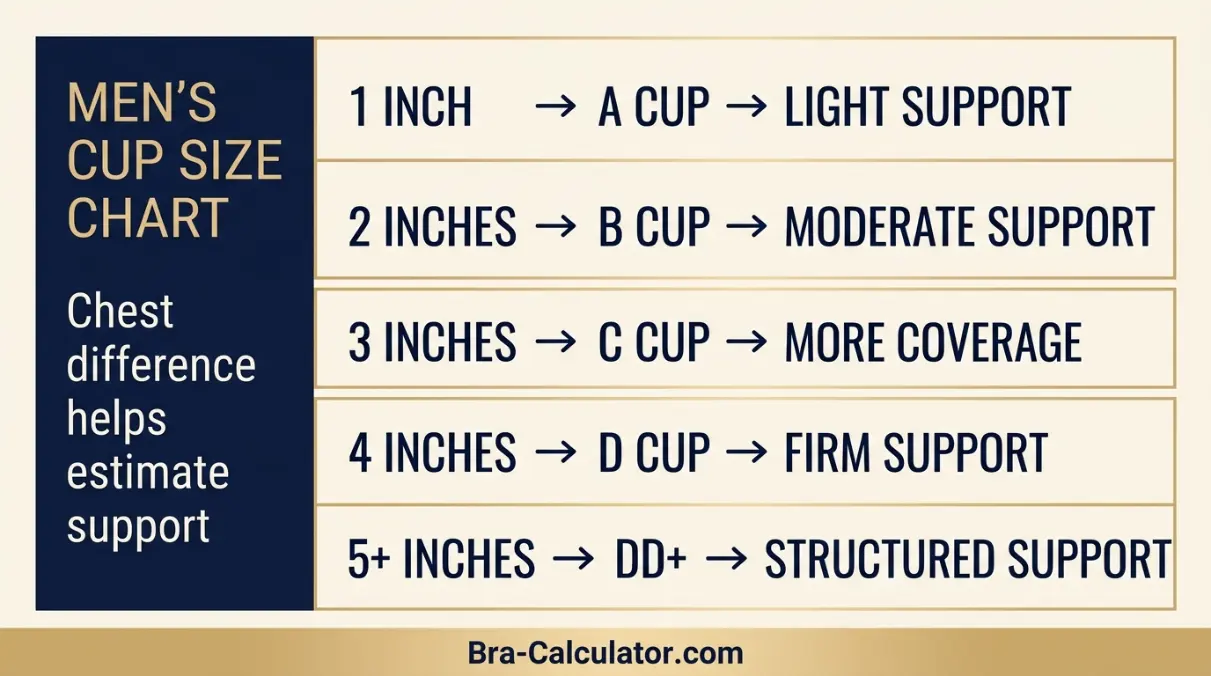
How to Use Cup Letters Without Overthinking Them
A cup estimate is useful only if it helps you choose a better garment. Do not chase a smaller letter or assume a larger letter is automatically a problem. The goal is support that works in real life.
| Your Cup Estimate | Best First Interpretation | Do Not Assume |
|---|---|---|
| AA / A | Light support or coverage may be enough. | That you need no support if movement or tenderness bothers you. |
| B | Moderate support may help shirts sit smoother. | That you must use a bra-style garment. |
| C | More front support or shaped coverage may be useful. | That sizing down will solve everything. |
| D+ | Structured support, wider shoulder comfort, and length matter more. | That maximum compression is automatically best. |
What Should You Fix First?
- You want to know “what cup size am I men?”
- You measured under-chest and fullest chest
- You need a starting support estimate
- Use the cup chart or calculator
- Treat the result as a starting point
- Confirm with comfort checks
- You are choosing between bra, shirt, tank, or vest
- The product uses different size systems
- You are unsure whether cup letters matter
- Use cup size for bra-style garments
- Use compression size for shirts and vests
- Check torso length and waist if rolling happens
- Chest moves during walking or workouts
- Cup estimate seems right but support is weak
- Regular undershirt is not enough
- Choose firmer support structure
- Try sports compression or vest
- Do not simply size down painfully
- Garment shows under shirts
- Seams or neckline are visible
- Support works but looks obvious
- Choose seamless matte fabric
- Match neckline to shirts
- Use compression undershirt for discreet daily wear
What Understanding Men’s Cup Size Usually Improves
These are practical fit outcomes, not medical claims. The goal is to make sizing less confusing and reduce random product guessing.
“Cup letters finally made sense.”
Many men realize cup letters are just measurement differences, not labels. That makes it easier to choose support without embarrassment.
“I stopped choosing only by T-shirt size.”
Once under-chest and fullest chest are compared, it becomes clearer why a regular large shirt may not give the right chest support.
Important: If your cup estimate points one way but the garment restricts breathing, digs, rolls, or shows under shirts, adjust the garment type — not just the letter.
References and Medical Disclaimer
This guide is for comfort, sizing, and support education. It is not medical advice and does not diagnose or treat gynecomastia. Cup letters can help estimate support volume, but they cannot identify the cause of chest fullness or replace professional evaluation.
Seek medical advice if you notice a new hard lump, sudden swelling, one-sided rapid change, nipple discharge, skin dimpling, redness, bleeding, severe pain, or any symptom that feels unusual for you.
Frequently Asked Questions
What does cup size mean for men?
Cup size for men describes the difference between the under-chest measurement and the fullest chest measurement. It can help estimate front chest volume for gynecomastia support, but it should be used as a starting point rather than an identity label.
Do men wear cup sizes?
Some men use cup sizes when choosing bra-style support, soft support tops, or gynecomastia garments. Other men use compression shirt sizing instead. The right system depends on the garment type.
What cup size am I as a man?
Measure around the ribcage under the chest, then around the fullest part of the chest. The difference between those measurements gives a cup-letter estimate. Use the men’s bra size calculator for a faster starting recommendation.
What does A cup or B cup mean for men?
For men, A cup or B cup usually means a smaller to moderate chest-to-under-chest difference. It may point toward light support, soft support tops, compression tanks, or discreet undershirts depending on comfort and clothing needs.
Is a men’s cup size the same as a women’s cup size?
The measurement idea is similar, but men’s gynecomastia support often also depends on torso length, shoulder width, compression level, and how discreet the garment needs to be under clothing.
Can cup size diagnose gynecomastia?
No. Cup size can describe support volume, but it cannot diagnose gynecomastia or distinguish glandular tissue from fat-related chest fullness.
Should men choose compression size or cup size?
Choose compression size for undershirts, tanks, and vests. Use cup size when choosing bra-style support or soft support tops that use band and cup sizing.
When should men get medical advice about chest changes?
Seek medical advice for sudden swelling, a hard lump, ongoing pain, nipple discharge, skin changes, bleeding, or fast one-sided enlargement.
Turn Cup Confusion Into a Starting Support Size
Measure your under-chest and fullest chest, then use the men’s bra size calculator to get a practical starting recommendation before choosing a support top, compression shirt, or gynecomastia vest.