28D vs 30D Bra Size: What Is the Real Difference? (2026 Fit Guide)
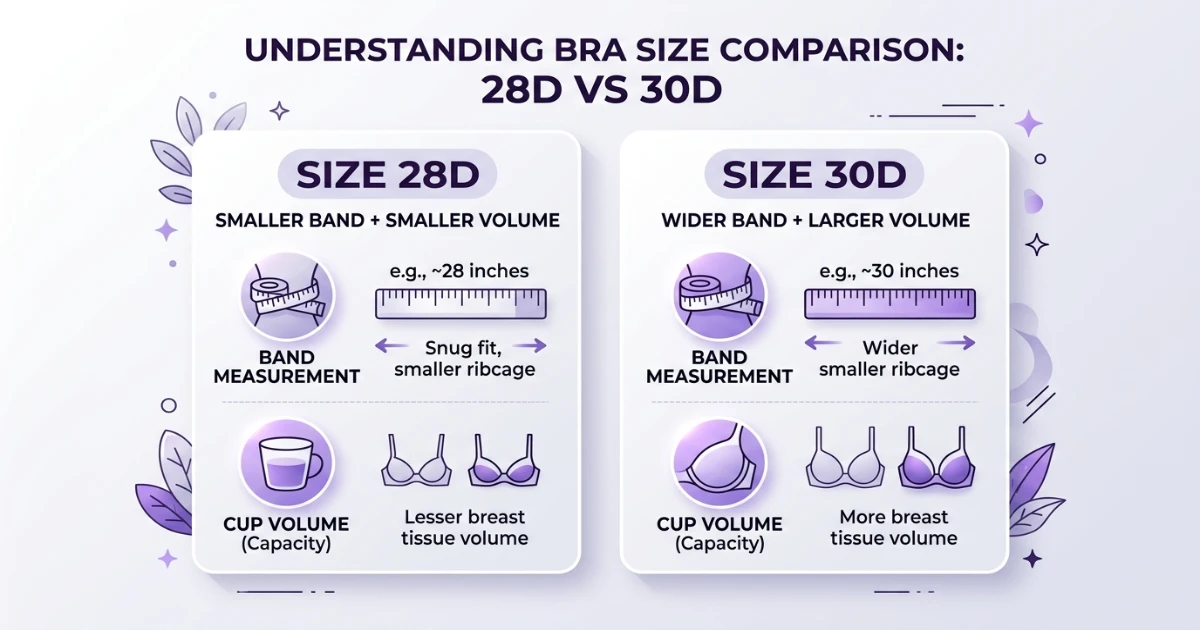
Quick Answer: No — 28D and 30D are not the same size. They share the same cup letter, but 30D is larger overall because it has a wider band and a larger cup volume. A D cup is always relative to the band, so a 30D is physically bigger than a 28D even though both say D.
If you are deciding between the two, the main question is whether you need a larger band only, a larger cup only, or both. If your 28D feels tight only in the band, the closer sister size is 30C. If the 28D band fits but the cups are too small, the better step is 28DD. If both the band and cups feel too small, then 30D may be the correct next size to try.
⚡ Key Takeaways
- 28D and 30D are not the same size.
- 30D is bigger overall — it has a wider band and a larger cup volume.
- 28D is closer in cup volume to 30C.
- 30D is closer in cup volume to 28DD.
- Not sister sizes: 28D ↔ 30C and 30D ↔ 28DD.
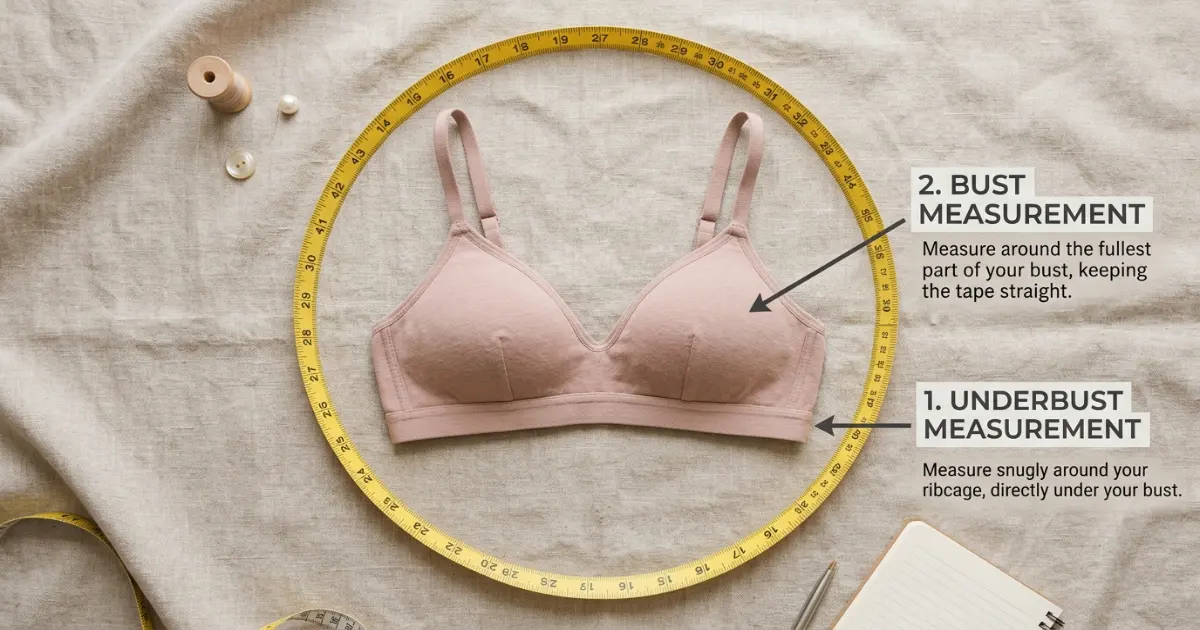
- 28D is for a smaller ribcage, usually around 23–24 inches snug underbust.
- 30D is for a slightly larger ribcage, usually around 25–26 inches snug underbust.
- If your 28D band is too tight but cups fit, try 30C first.
- If your 28D cups are too small but band fits, try 28DD first.
- If both the band and cups of 28D feel too small, then 30D can be the correct next test size.
- 28D is not “big” in absolute terms — cup letters only make sense relative to the band number.
28D vs 30D: The Core Difference Explained
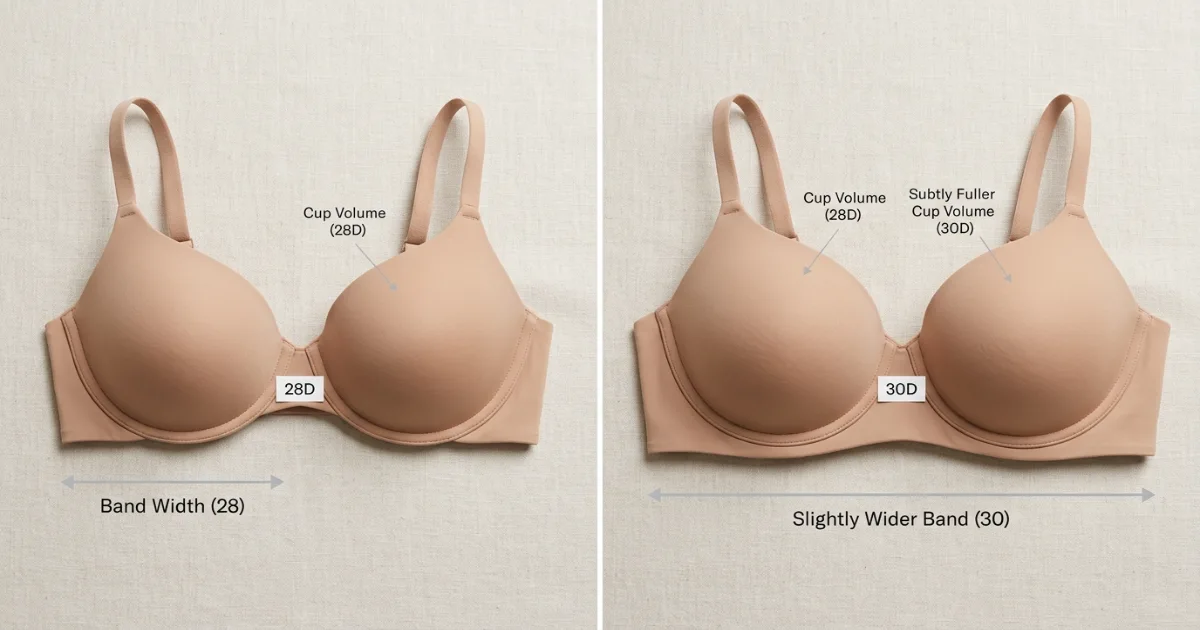
Many people assume that because both sizes use the letter D, the cups must be the same. That is one of the most common bra-size misunderstandings. In bra sizing, the cup letter does not stand alone — it always changes in relation to the band.
A 28D is built on a smaller frame than a 30D. Once the band increases from 28 to 30, the cup attached to that band also becomes larger. The underwire is slightly wider, the cup volume is slightly greater, and the whole bra is made for a broader ribcage.
That means 30D is not simply a looser-band version of 28D. It is a bigger bra overall. This becomes very important when you are trying to solve a fit problem accurately.
If your issue is only band tightness, jumping from 28D to 30D usually over-corrects because it adds cup volume too. In that case, the more precise move is 30C. If your issue is only cup shortage while the band feels right, then the better move is 28DD. Only if you need both a wider band and more cup room does 30D become the logical next size.
The Volume Difference Visualised
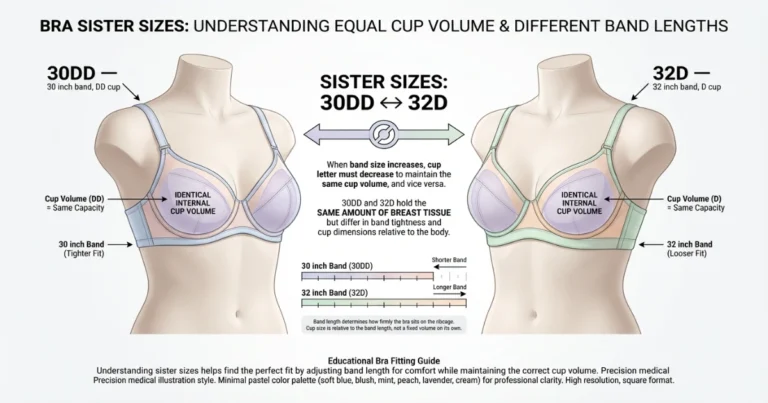
28D sisters to 30C · 30D sisters to 28DD · so 30D is one full volume step above 28D
A simple way to understand this is through sister-size families. 28D belongs to the 30C family. 30D belongs to the 28DD family. Since those are different families, 28D and 30D are not the same size.
Measurement Breakdown: 28D vs 30D
These two sizes look close on paper, but the body measurements they are designed for are not identical. The chart below makes the difference easier to see.
| Size | Underbust (Band) | Bust (Fullest Point) | Cup Differential | UK Equivalent | EU Equivalent | Volume Context |
|---|---|---|---|---|---|---|
| 28D | ~23–24″ (58–61 cm) | ~27–28″ (69–71 cm) | 4″ (10 cm) | 28D | 60D | Same cup volume as 30C |
| 30D | ~25–26″ (64–66 cm) | ~29–30″ (74–76 cm) | 4″ (10 cm) | 30D | 65D | Same cup volume as 28DD |
Both are labeled D because both represent roughly a 4-inch bust-to-underbust difference. But the starting band size is different, so the actual cup volume is different too. A 30D is scaled larger than a 28D in every practical sense.
Sister Sizes: 28D and 30D Belong to Different Volume Families
Sister sizes are the clearest way to understand whether two bras really hold the same cup volume. To keep the same volume, you have to move the band and cup letter in opposite directions. That does not happen when you move from 28D to 30D.
Sister Size Family for 28D
These sizes hold approximately the same cup volume as 28D:
The most practical sister size for 28D is 30C. It gives the same cup volume on a slightly wider band and is usually easier to find in stores.
Sister Size Family for 30D
These sizes hold approximately the same cup volume as 30D:
Here, the tighter-band equal-volume option is 28DD. Since 30D connects to 28DD rather than 28D, it is clearly a larger cup volume than 28D.
The Band-and-Cup Rule Applied to 28D and 30D
| Comparison Type | Example | Same Volume? | What Changes |
|---|---|---|---|
| Band up, same cup letter | 28D → 30D | ❌ No | Band gets wider and cup volume gets larger |
| Band up, cup down | 28D → 30C | ✅ Yes | Looser band, same cup volume |
| Band down, cup up | 30D → 28DD | ✅ Yes | Tighter band, same cup volume |
| Same band, cup up | 28D → 28DD | ❌ No | Same band, larger cup volume |
| Same band, cup down | 30D → 30C | ❌ No | Same band, smaller cup volume |
This rule explains nearly every nearby size confusion. If you want to preserve cup volume, you cannot go straight from 28D to 30D. That makes the whole bra larger. To preserve the same cup volume, one variable has to go up while the other goes down.
Real Fit Differences Between 28D and 30D
1) Band Fit and Support
A 28 band is built for a narrower ribcage than a 30 band. That means a correctly fitting 28D should feel firmer and more anchored on a smaller frame. A 30D will feel more relaxed around the body because it is designed for a slightly larger underbust.
This matters because the band provides most of the support. If someone who truly needs a 28 band wears 30D instead, the band may ride up, the straps may dig in more, and the bra can feel less stable during movement. The bra may seem comfortable at first, but the support can become less precise over time.
2) Cup Fit and Volume
30D has more cup volume than 28D. So if you truly fill a 28D well, moving to 30D can create slight gaping or less precise containment — especially in molded styles. On the other hand, if your 28D feels too small in the cups and tight in the band, 30D may feel noticeably better because it solves both problems at once.
The important part is understanding why it feels better. If 30D works, that does not mean it is the same size as 28D. It means your 28D was likely too small overall.
3) Why 28D Is Commonly Misunderstood
Many people see the letter D and assume it must be “big.” That is not how bra sizing works. A 28D is a D cup on a very small band. It usually represents moderate projection on a small frame, not a large breast volume in absolute terms. In fact, 28D holds less total volume than 30D even though both say D.
Who Should Wear 28D?
- Your snug underbust measures around 23–24 inches.
- Your full bust measures around 27–28 inches.
- You need a supportive 28 band that stays firm and level.
- 30 bands tend to ride up or feel too loose on you.
- Your best volume family is 26DD / 28D / 30C / 32B / 34A.
- You tried 30D and found the band a bit loose or the cups slightly roomy.
- You want a smaller-frame fit with less overall volume than 30D offers.
If 28D is close but not perfect, use the logic carefully: move to 30C if you need a looser band, or move to 28DD if you need more cup room.
Who Should Wear 30D?
- Your snug underbust measures around 25–26 inches.
- Your full bust measures around 29–30 inches.
- You need a 30 band rather than a 28 band for comfort and support.
- You need more total volume than 28D provides.
- Your best volume family is 28DD / 30D / 32C / 34B.
- You tried 28D and found both the band and cups too small.
- You need the slightly bigger overall frame that comes with 30D.
If 30D feels close but the band is too loose, the tighter equal-volume alternative is 28DD.
Which Is Easier to Find: 28D or 30D?
In everyday shopping, 30D is usually much easier to find than 28D. The 30 band is closer to common retail stock, while 28 bands often require specialist brands or online lingerie stores. Because of that, many people who truly fit 28D end up wearing 30D or 30C instead.
Sometimes that works reasonably well, but not always accurately. If your real size is 28D and you cannot find it, 30C is usually the more precise substitute than 30D because it preserves the cup volume. 30D can work when you genuinely need more size overall, but it should not be the automatic replacement for 28D.
🛍️ Best Bras for 28D and 30D — Our Top Picks
At D-cup volumes on smaller bands, the most important features are a stable band, enough cup depth, and a shape that does not feel overbuilt for a smaller frame. These two picks follow the same product-card style as your sample and are strong options when comparing sizes like 28D, 30C, 28DD, and 30D.

Glamorise Women’s MagicLift Active Support Wirefree Bra #1005
A reliable wire-free choice for women who want everyday lift and support without underwire pressure. For sizes around 28D and 30D, this type of bra is useful because it offers structure without becoming overly stiff or bulky on a smaller frame.
The internal support design helps with shape, while the stable back and wider straps reduce the slipping and riding-up feeling that often happens when the band is not quite right. If you are testing nearby sizes, it can help reveal whether your real issue is the band or the cup volume.
Available in: Band sizes 30–46, cups B–K · Check brand chart for closest sister sizes
View on Amazon →
Glamorise Women’s WonderWire Front-Close Underwire Bra #1245
A structured underwire option for women who want firmer lift, better separation, and more defined shape. For size comparisons like 28D vs 30D, a stable underwire can make it easier to notice whether the cup is truly too small, slightly too roomy, or simply paired with the wrong band tension.
The cushioned wire channel softens pressure while the front-close design adds convenience. If your exact label is hard to find, check nearby sister sizes such as 30C or 28DD depending on whether you need a looser band or a deeper cup.
Available in: Broad size range with multiple cup options · Useful for testing nearby sister sizes
View on Amazon →ℹ️ As an Amazon Associate, Bra Calculator earns from qualifying purchases. Product availability may change. Always compare your measurements with the brand’s own chart before ordering, especially when using sister sizes.
5-Step Bra Fit Test: Confirm 28D or 30D Right Now
These five checks help you figure out whether you truly need 28D, 30C, 28DD, or 30D — and which part of the fit actually needs changing.
A true 28 band usually fits a snug underbust around 23–24 inches. A true 30 band usually fits around 25–26 inches. This is the fastest way to know whether you should even be comparing these two sizes closely.
Pull all breast tissue fully into the cups. Overflow means the cup is too small. Wrinkling or empty space can mean the cup is too large. This helps you decide whether you need more cup room, not just a different band.
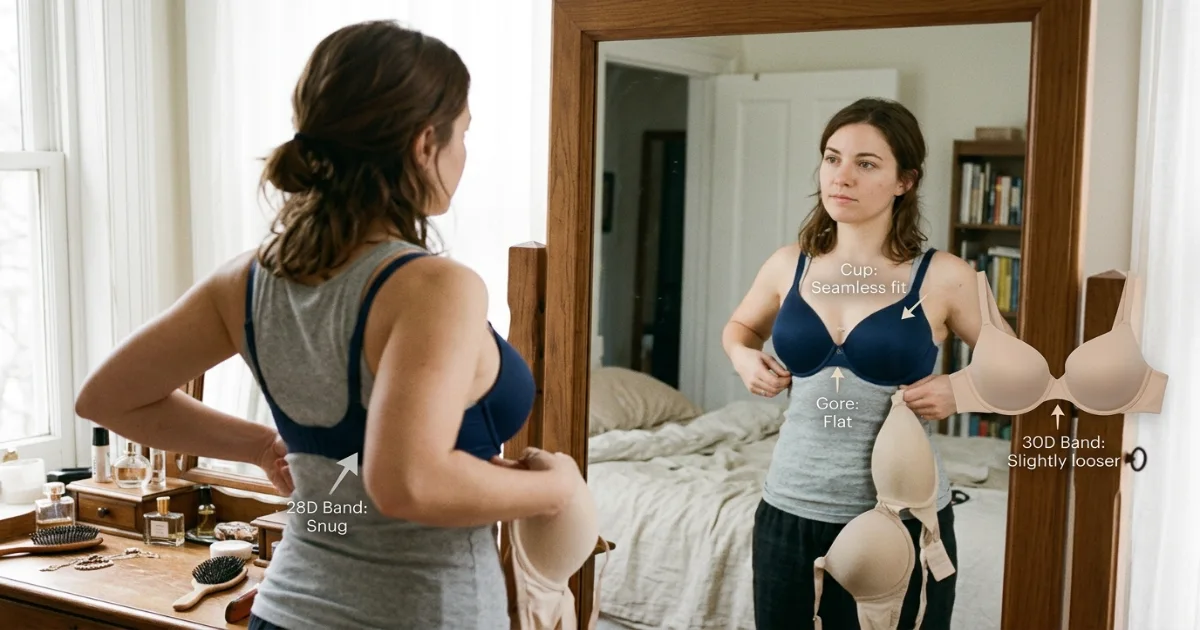
The center gore should lie flat against the sternum. If it floats, the cups are often too small. In that case, moving from 28D to 28DD may be more precise than jumping straight to 30D.
The band should stay level and feel firm on the loosest hook. If 30D rides up but the cup feels okay, you may actually need 28DD. If 28D feels too tight but the cup feels fine, you may need 30C instead of 30D.
Band too tight but cup okay? Try 30C. Band okay but cup too small? Try 28DD. Both too small? Try 30D. This keeps the fitting process accurate instead of guess-based.
Still unsure whether 28D, 30C, 28DD, or 30D is the best fit? Use our calculator to check your size and sister-size options using your actual measurements.
Try the AI-Powered Bra Size Calculator →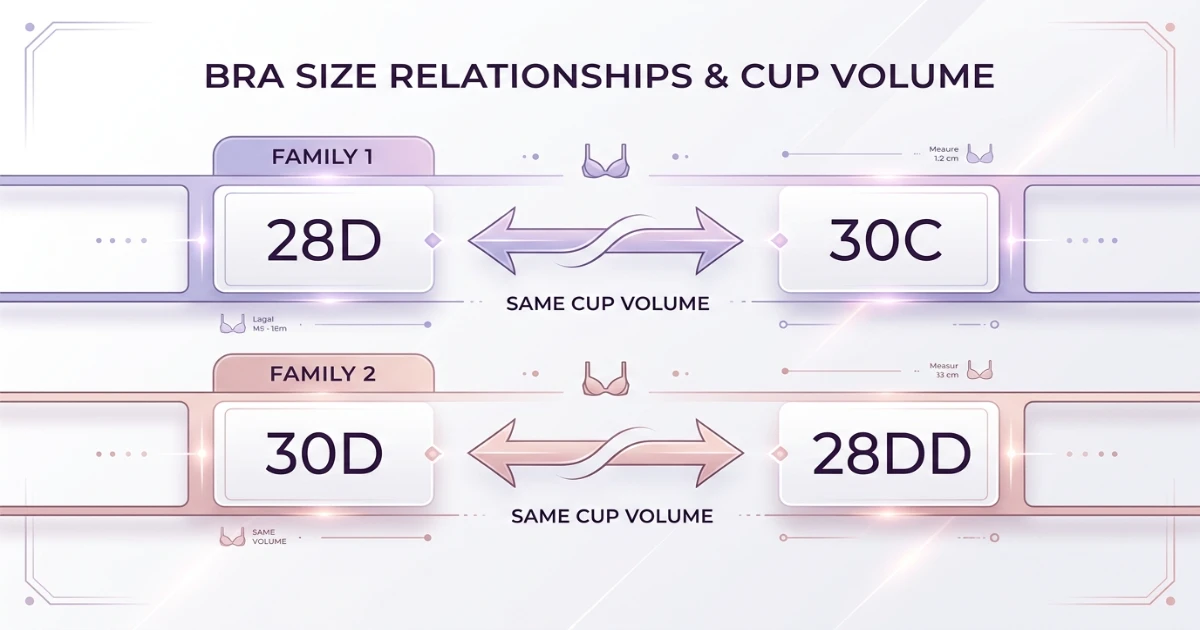
28D vs 30D: Full Side-by-Side Comparison
| Feature | 28D | 30D |
|---|---|---|
| Band Size | 28 | 30 |
| Typical Underbust | ~23–24″ / 58–61 cm | ~25–26″ / 64–66 cm |
| Typical Bust | ~27–28″ / 69–71 cm | ~29–30″ / 74–76 cm |
| Cup Letter | D | D |
| Cup Volume | Smaller | Larger |
| Same Size? | ❌ No | |
| Sister Sizes? | ❌ No | |
| Sister Size Match | 30C / 26DD | 28DD / 32C |
| UK Equivalent | 28D | 30D |
| EU Equivalent | 60D | 65D |
| Better For | Smaller ribcage, firmer band support | Slightly broader ribcage, more overall volume |
| If band is too tight | Try 30C first | Try 32C if cup volume feels right |
| If cup is too small | Try 28DD | Try 30DD |
| If band is too loose | Try 26DD where available | Try 28DD |
| Availability | Harder to find | Usually easier to find |
| Common Mistake | Using 30D as a replacement for 28D when 30C is often the more accurate sister-size alternative | |
People Also Ask: 28D vs 30D — Answered
Are 28D and 30D the same size?
No. They share the same cup letter, but 30D has both a larger band and a larger cup volume than 28D.
Which is bigger — 28D or 30D?
30D is bigger overall. It has a wider band and more cup volume than 28D.
Are 28D and 30D sister sizes?
No. The sister size of 28D is 30C. The sister size of 30D is 28DD.
What is the sister size of 28D?
30C is the main wider-band sister size of 28D. A tighter alternative is 26DD where available.
What is the sister size of 30D?
28DD is the tighter-band sister size of 30D, and 32C is the looser-band sister size.
Can I wear 30D instead of 28D?
Sometimes, but not as a direct equal substitute. If your 28D band is too tight and the cups are too small, 30D may work better. If only the band is tight, 30C is usually the closer match.
What if my 28D cups fit but the band feels tight?
Try 30C first. That keeps the cup volume much closer while loosening the band.
What if my 28D band fits but the cups are too small?
Try 28DD first. That keeps the band the same and increases the cup size by one step.
Is 28D a large bra size?
No. 28D is not large in absolute terms. A D cup on a small 28 band is moderate volume on a small frame, not the same as a D cup on a larger band.