32C vs 34C: Band Size Difference Explained
Everything you need to know about how a two-inch band change affects support, cup volume, and everyday comfort — without changing the cup letter.
Choosing between 32C and 34C is one of the most common decisions people face when shopping for a well-fitting bra. At first glance, both sizes share the same letter — C — which can make it tempting to assume they are essentially the same. They are not. A change in band size triggers a chain reaction that affects band tension, cup volume, breast support, and long-term comfort in ways that are often underestimated.
This guide breaks down the 32C vs 34C difference in clear, practical terms. Whether you are currently wearing one of these sizes and wondering whether to switch, or you are measuring for the first time, you will find everything you need here — from the math behind cup scaling to real-world fit scenarios. You can also explore our full breast size comparison hub for additional side-by-side guides across a wide range of sizes.
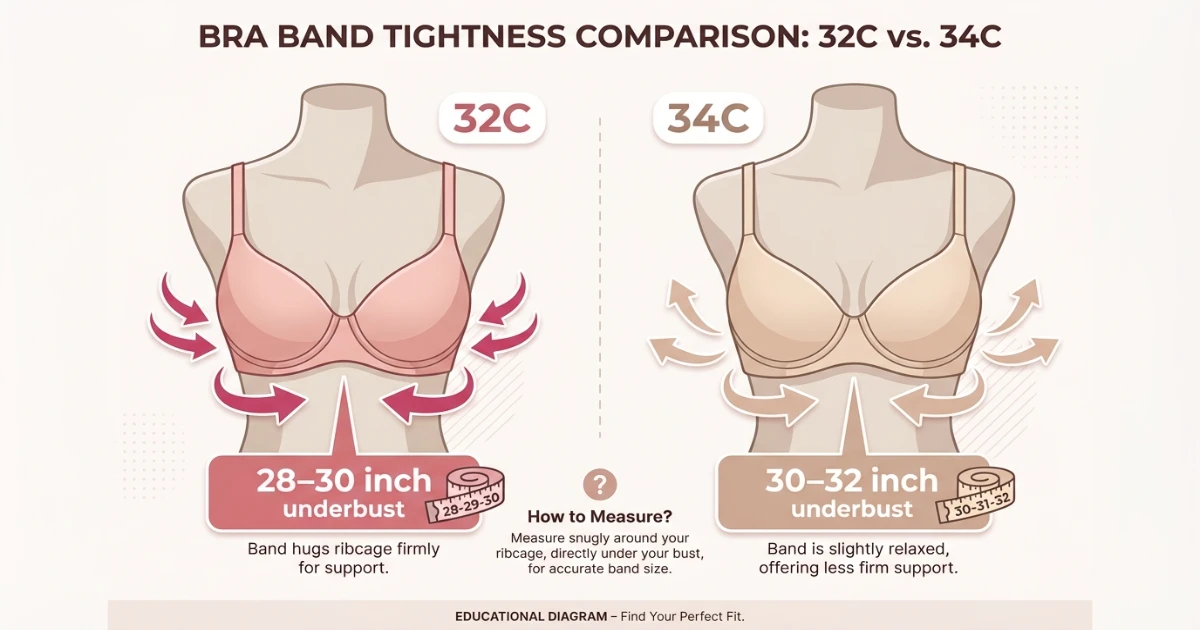
32C vs 34C: 32C has a tighter band (fits a ribcage roughly 28–30 inches) while 34C offers a looser fit (fits roughly 30–32 inches). Although both carry the letter C, the cup volume in 34C is slightly larger because cup size scales with band size — a principle known as sister sizing. Band support and projection will differ noticeably between the two.
Choose the fit signs you notice in the band, cups, center and straps. We’ll turn them into a practical next step for 32C.
Private fit check — your answers stay in your browser and are used only for this on-page guidance. Nothing is stored or submitted.
⭐ Key Takeaways
- 32C and 34C share the cup letter but have meaningfully different cup volumes because cups scale with band size.
- The band in 32C is two inches smaller and provides firmer ribcage support; the 34C band is two inches larger and sits more loosely.
- Support in a bra comes primarily from the band — not the straps — making band size the most critical measurement to get right.
- If your 32C feels too tight or a 34C feels too loose in the band, sister sizing or a professional fitting can help you find the optimal combination.
- Accurate underbust and full-bust measurements are essential before committing to either size.
What Does 32C Mean?
A 32C bra is defined by two measurements working together. The number 32 refers to the band size — a circumference that is designed to fit a ribcage measuring approximately 28 to 30 inches just below the bust. Bra bands are typically manufactured two to four inches larger than the raw underbust measurement to allow for stretch and adjustment on the hook-and-eye closure.
The letter C represents a cup size that, in a 32-band bra, corresponds to a difference of roughly 3 inches between the full-bust measurement and the underbust measurement. Because a 32-band bra has a narrower frame, the cups are positioned closer together and sit within a narrower underwire arc compared with the same letter on a larger band.
For an in-depth breakdown of this size, see our dedicated 32C bra size guide, which covers recommended bra styles, brand fit notes, and common fit adjustments.
What Does 34C Mean?
A 34C bra uses a band designed for a ribcage measuring approximately 30 to 32 inches. The two-inch increase over 32 makes the band noticeably looser on the same body and shifts the underwire arc outward to accommodate a broader frame. The cup letter is still C, but as explained below, the physical cup volume is slightly larger than in the 32C because cups always scale relative to the band they sit on.
34C is one of the most widely stocked sizes in mainstream retail, which means shoppers will find a broader range of styles and fabrics available in this size. However, being common in stores does not automatically make it the right fit — band snugness and cup projection still need to match the individual body.
Explore our dedicated 34C bra size guide for style recommendations tailored to this size’s proportions, along with notes on common fit issues and suggested adjustments.
Band Size Difference Explained
The move from 32 to 34 is a two-inch increase in the band’s nominal circumference. In practical terms, a 34C band has more fabric, more elastic, and a wider hook-and-eye panel than a 32C. On an identical body, a 34C will sit with noticeably less tension against the ribcage than a 32C worn on the same set of hooks.
| Feature | 32C | 34C |
|---|---|---|
| Band size (nominal) | 32 inches | 34 inches |
| Target underbust range | ~28–30 in (71–76 cm) | ~30–32 in (76–81 cm) |
| Cup volume | Smaller C-cup frame | Slightly larger C-cup frame |
| Band tension on ribs | Firmer / snugger | Looser / more relaxed |
| Underwire width | Narrower arc | Wider arc |
| Primary support source | Band carries most load | Band carries load; slightly less tension |
| Best for ribcage width | Narrower frames | Moderate to wider frames |
| Hook rows (typical) | 2–3 columns | 3 columns |
| Sister size equivalent | 30D / 34B | 32D / 36B |
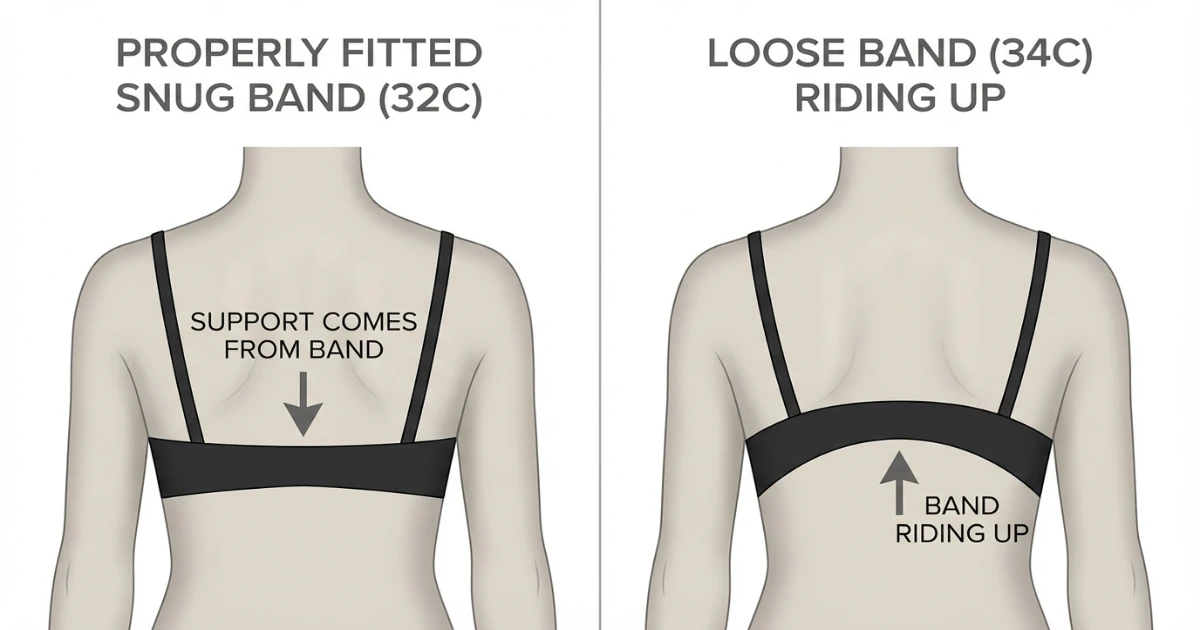
One important detail: most bra-fit experts recommend fastening a new bra on the loosest hook. This gives you room to tighten as the elastic stretches over time. A 32C worn on its loosest hook should feel secure without digging into the skin. If it rides up at the back or feels too constraining, that is diagnostic information worth acting on.
Do 32C and 34C Have the Same Cup Volume?
This is one of the most misunderstood aspects of bra sizing. The short answer is no — they do not hold the same volume, even though both are labeled C.
Cup size is not an absolute measurement. It is a ratio — specifically, the difference in inches between the full-bust measurement and the underbust measurement. A C cup in any size always represents a roughly 3-inch difference. But because that ratio is applied to a progressively larger band frame, the actual fabric surface area and cup depth increase as the band number rises.
Think of it this way: a 3-inch difference measured over a 32-inch ribcage produces a smaller cup shape than the same 3-inch difference measured over a 34-inch ribcage. The arc of the underwire, the height of the cup panel, and the projection all scale upward. This is the core principle behind sister sizing, which lets you move one band size up and one cup letter down (or vice versa) to keep total volume roughly constant.
For a visual illustration of how cup scaling works across different band sizes, visit our cup size visuals guide and explore the sister size bra calculator to find equivalent volumes across the size range.
Support and Comfort Differences
Support is the function most affected by band size. Up to 80 percent of a bra’s lifting and stabilising work comes from the band encircling the ribcage, not from the shoulder straps. A band that is too loose fails to anchor the cups properly, forcing the straps to compensate, which leads to shoulder grooves, neck tension, and a bra that shifts throughout the day.
32C — Firmer Band
- Hugs the ribcage firmly, distributing weight evenly
- Cups stay in position during movement
- Straps require less tension to maintain lift
- Can feel restrictive if the underbust measurement is over 30 inches
- May cause redness or marks if band is genuinely too small
34C — Relaxed Band
- More forgiving around the ribcage
- Comfortable for people who run warm or dislike tight bands
- Cups may shift or gap if the body is closer to a 32-inch underbust
- Straps may need tightening to compensate for loose band
- Better suited to moderate ribcage widths (30–32 inches)
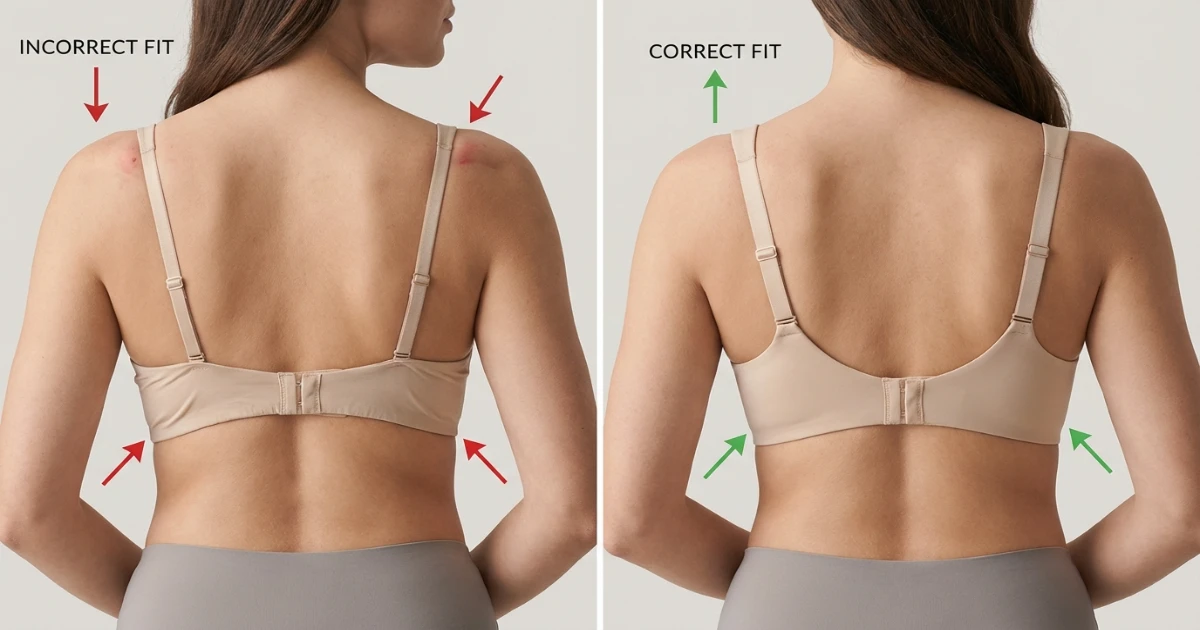
Visual Fit Differences
Beyond comfort, band size affects how a bra looks under clothing. A correctly fitted 32C lies flat against the ribcage, the band remains horizontal at the back, and the cups project naturally without creating visible side bulge. A 34C worn by someone whose underbust is closer to 28 or 29 inches will often show the following tell-tale signs:
- Band rides up at the back — a classic sign that the band is too large to stay anchored at the front.
- Cups tilt forward — because the too-long band shifts upward, pulling the cups away from the chest wall.
- Straps dig in — tightened to compensate for the lack of band support.
- Side fabric wrinkling — because the wider underwire sits outside the natural breast root.
Conversely, a 32C on a body with a genuine 31-inch underbust may show signs of a band that is too tight: red marks after removal, difficulty breathing deeply, or the band itself digging into the skin rather than resting against it.
Who Should Choose 32C?
A 32C is generally the better choice if your measured underbust is between 28 and 30 inches and your full-bust measurement is approximately 3 inches larger than your underbust reading. Beyond the numbers, a 32C is likely a strong fit if:
- You have a naturally narrower or more petite frame.
- You find standard 34 bands feel uncomfortably loose or tend to ride up throughout the day.
- You prefer the firm, secure anchor that a well-fitted band provides.
- You are currently wearing a 34B and notice the cups gap or do not provide enough coverage — moving to 32C keeps the same total volume with a better-fitting band.
- Your shoulder straps frequently slide off your shoulders, suggesting the band is not doing its share of the supporting work.
Who Should Choose 34C?
A 34C is generally the better choice if your underbust measurement falls between 30 and 32 inches and your full-bust measurement is roughly 3 inches larger. You may also prefer a 34C if:
- You find your current 32-band bras leave persistent red marks or feel constraining.
- You have a broader ribcage structure or naturally wider set shoulders.
- You are postpartum or have recently gained weight around the ribcage and need a larger band circumference to accommodate the change.
- You prefer a more relaxed, everyday-comfort fit rather than a high-tension athletic-style hold.
- You are transitioning from a 36B and want the same volume with a snugger band.
Common Fit Problems With an Incorrect Band Size
Wearing the wrong band size is more consequential than most people realise. The problems compound over a full day of wear. If you are experiencing any of the following, your band size may need adjusting — and our bra fit problems guide covers each symptom in detail along with practical corrections:
- Band rides up at the back — band is too large; try a smaller band size.
- Red marks or irritation under the breasts — band may be too small, or the style or material is not suited to your skin.
- Cups gape at the top — possible band-too-large situation causing the cup to tilt; may also be a cup-too-large problem depending on the context.
- Breast tissue spilling at the sides — underwire is likely too narrow, which can happen when wearing a band size whose underwire arc no longer spans the full breast root.
- Shoulder grooves from straps — overworked straps compensating for an insufficiently supportive band.
- Centre gore not lying flat — band may be too small or cup volume insufficient; gore should sit flush against the sternum.
For a systematic assessment of your current fit, our how to know bra fits guide walks through each checkpoint from band to straps so you can diagnose issues confidently.
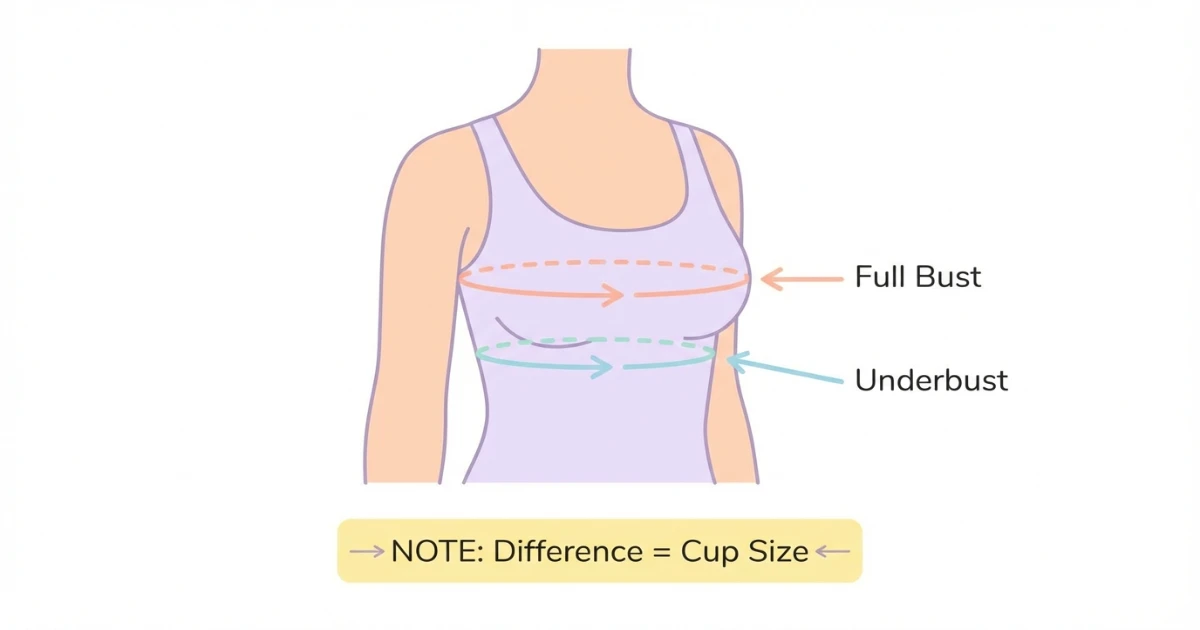
How to Measure Your Bra Size Correctly
Accurate measurements are the starting point for distinguishing between 32C and 34C — and for avoiding the fit problems described above. Use a soft fabric measuring tape, measure in front of a mirror, and aim to measure twice for consistency. Our full step-by-step guide at how to measure your bra size goes into additional detail on posture, tape positioning, and how to handle asymmetry.
- Measure your underbust
Wrap the tape snugly — but not tightly — around your ribcage directly below the breast tissue. Keep the tape level and parallel to the floor. Round to the nearest whole inch. This is your underbust measurement and corresponds directly to your band size: 28–29 inches suggests a 30 or 32 band; 30–31 inches suggests a 32 or 34 band. - Measure your full bust
Keeping the tape horizontal, wrap it around the fullest part of your bust — typically across the nipple line. Do not pull the tape tightly; let it rest against the skin with gentle contact. Note this measurement in inches. - Calculate the cup difference
Subtract your underbust measurement from your full-bust measurement. Each inch of difference corresponds to one cup letter: 1 inch = A, 2 inches = B, 3 inches = C, 4 inches = D, and so on. A difference of 3 inches indicates a C cup for whichever band size you have established. - Determine your band size
Your underbust measurement in inches typically rounds to the nearest even number for your band size (manufacturers add ease into the band construction). If your underbust is 29 inches, your band size is most likely 30 or 32 depending on the brand and your preference for snugness. - Confirm the fit in person
No measurement is a perfect substitute for trying the bra on. Fasten on the loosest hook, check that the band sits level, ensure the centre gore touches the sternum, and verify that cups contain all breast tissue without gaping or overflow. Use our fit checklist to run through each point systematically.
You can also use our AI smart fit bra calculator to get a personalised size recommendation, or check our global bra size converter if you are shopping from international brands that use different sizing conventions.
Best Bra Styles for 32C and 34C
Both sizes share the C cup, which means many of the same style recommendations apply, though fit nuances differ because of the band width. Here is a practical overview:
For 32C
- T-shirt bras with narrow underwires — the narrower frame of a 32-band bra pairs best with underwires that match the breast root width without extending into the armpit.
- Balconette styles — excellent for adding projection and lift on a smaller frame; ensure the upper cup panel is not too deep, which can cause gaping.
- Wireless bralettes — a good everyday option in 32C if you prefer comfort over structured support; look for styles with a firm band even without underwire.
- Sports bras with a dedicated band measurement — many sports bras use S/M/L sizing rather than band numbers; 32C wearers often fit best in XS or S depending on the brand’s sizing chart.
For 34C
- Full-coverage bras — a 34-band frame accommodates wider-set cups that provide full coverage and lateral containment, reducing side spill in everyday wear.
- Plunge styles — well-suited to 34C because the wider band anchors the low centre gore effectively, keeping the plunge shape stable.
- Minimiser bras — available in more styles in 34C than in 32C due to the broader retail availability of this size.
- Nursing bras — 34C is a commonly stocked nursing size; the extra band circumference also accommodates fluctuations in ribcage size that can occur during pregnancy and postpartum recovery.
For related size comparisons that may help you further refine your choice, see our guides on 32D vs 34C, 34C vs 34D, and 34D vs 36C.
Best Bras for 32C& 34C
Tested by real women. Ranked by comfort, fit, and everyday wearability.

Warner’s Easy Does It
Wireless Bra
The comfort pick our readers keep coming back to — no underwire, no digging, just smooth all-day softness with a clean silhouette under any top.
- Seamless look under fitted t-shirts
- Stays comfortable through long wear days
- Soft stretch fits both 32C & 36B well


Bali Full Coverage
Underwire Bra
When lift and structure matter more than softness — this is the pick. Dependable underwire support with a clean, polished shape that holds all day.
- Fuller coverage, no gaps or gaping
- Firm lift and defined silhouette
- Ideal for workwear and structured outfits
Conclusion
The difference between 32C and 34C is not just a number — it represents a meaningful shift in band tension, cup volume, underwire width, and daily comfort. Both sizes are valid and appropriate for the right body, but they serve different ribcage measurements and fit preferences. If your underbust is between 28 and 30 inches, 32C is likely closer to your correct fit. If your underbust is between 30 and 32 inches, 34C is the more anatomically appropriate choice.
Remember: the cup letter alone does not tell the whole story. A C cup in 32 is physically different from a C cup in 34 because of how cup volume scales with band size. Use accurate measurements, try both sizes where possible, and rely on fit checkpoints — not just the tag — to determine which works best for your body. The bra-calculator.com toolkit gives you the measurement guides, calculators, and comparison resources to make that determination with confidence.
Ready to find your perfect fit? Use our free tools to get your accurate bra size in seconds.
AI Smart Fit Calculator Sister Size Calculator Measurement GuideFrequently Asked Questions
Is 32C smaller than 34C?
In terms of band size, yes — 32C has a smaller band circumference than 34C, meaning it wraps more tightly around the ribcage. In terms of cup volume, 32C also holds slightly less volume than 34C because cup size scales proportionally with band size. A C cup on a 32 band corresponds to a narrower, shallower cup shape than a C cup on a 34 band. So overall, 32C is a physically smaller bra in both band and cup dimensions than 34C.
Do 32C and 34C have the same cup volume?
No. Although both sizes use the letter C, which represents a 3-inch difference between full-bust and underbust measurements, the actual volume of the cup is larger in 34C than in 32C. This is because the cup is constructed over a wider band frame, resulting in a deeper cup projection and a broader underwire arc. The principle that makes 34B and 32C approximately equal in total volume is called sister sizing — the cup letter shifts as the band changes in order to preserve volume.
Why does band size affect bra support?
The band is the structural foundation of a bra. It encircles the ribcage and anchors the cups in place, carrying the majority of the breast’s weight — estimates commonly cited in fitting literature suggest around 70 to 80 percent of support comes from the band. When the band is too loose, it cannot maintain this anchor role: it rides up at the back, the cups tilt forward and away from the chest wall, and the shoulder straps are forced to compensate. Over time this leads to shoulder tension, neck strain, and persistent discomfort. A correctly sized band stays level and firm throughout the day, distributing weight across a broad surface area rather than concentrating it on the straps.
When should someone move from 32C to 34C?
Consider moving from 32C to 34C if your ribcage has grown — through weight gain, pregnancy, post-surgical changes, or natural fluctuation — so that it now measures closer to 30 to 32 inches at the underbust. Other signs it is time to upsize the band include: the band leaving persistent red marks even when fastened on the loosest hook; difficulty breathing comfortably; the band fabric bunching or rolling due to excessive tension; or a professional fitter confirming the current band is too tight. Note that if you also experience cup overflow in 32C, the move may be to 32D or even 34C depending on where the cup issue originates.
How tight should a bra band feel?
A correctly fitted bra band should feel snug and secure — firm enough that you cannot pull it more than about one to two fingers away from your back when the bra is fastened on the loosest hook. It should not feel so tight that it restricts breathing, digs into the skin, or creates significant discomfort after a few hours of wear. A band that feels comfortable in the morning but becomes increasingly painful by evening may be slightly too tight, or the style may not suit your body shape. When in doubt, try the next band size up and use a sister size adjustment — one cup letter up — to maintain the same total cup volume.