32B vs 32D: How Much Bigger Is the Cup Difference?
A two-cup-size jump on the same band creates a meaningful change in volume, shape, and fit. Here is exactly what it means for your body.
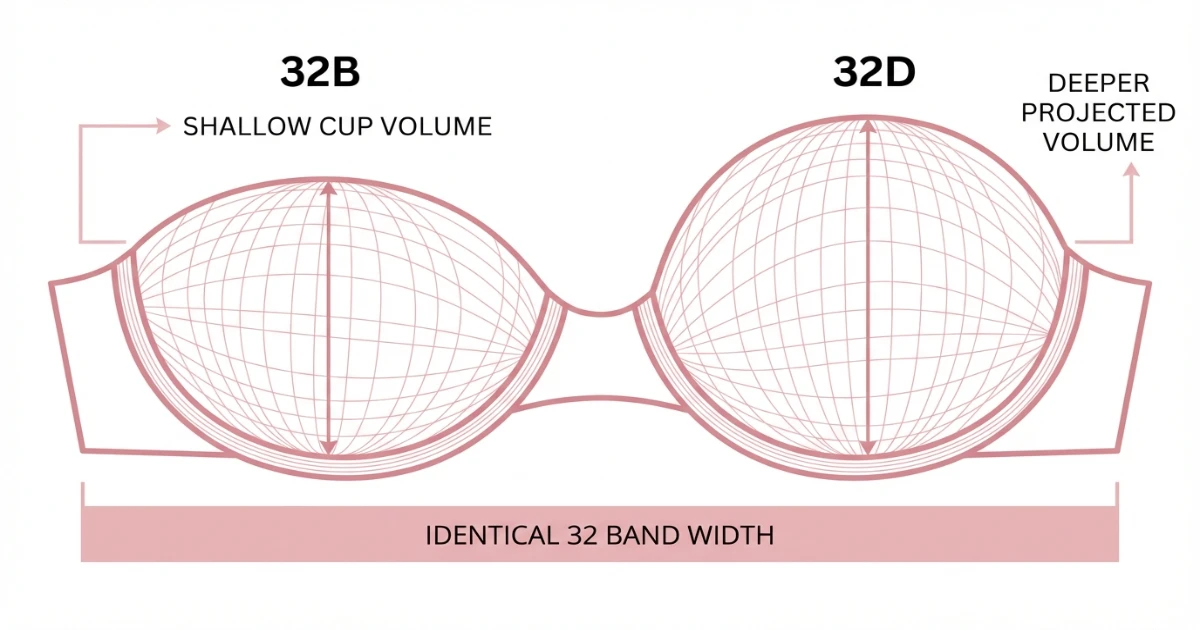
Shopping for a well-fitting bra can feel like decoding a foreign language. Two sizes — 32B and 32D — share an identical band number, yet they belong to meaningfully different places on the cup-size spectrum. Understanding how they differ, and why that difference matters, can spare you years of discomfort, underwire digging, and quadra-boob. This guide unpacks the cup size comparison in plain language, with real measurements, a visual breakdown, and a step-by-step guide to confirming which size is right for you. For a broader overview of sizing tools, visit bra-calculator.com.
If you have ever wondered whether the difference between a B cup and a D cup is minor or major, you are not alone. Many people are surprised to discover that two cup steps translate into a substantial change in cup volume, projected shape, and the way a bra functions on the body. The breast size comparison between 32B and 32D is a great entry point for anyone learning about cup progression.
✓ Key Takeaways
- Same band, different cup: Both sizes share a 32-inch underbust measurement but differ by two cup letters.
- Volume doubles: Upgrading from B to D roughly doubles cup volume due to the exponential nature of cup geometry.
- Two-inch bust difference: A 32B has a 34-inch bust; a 32D has a 36-inch bust — the same underbust, two extra inches of fullness.
- Fit symptoms differ sharply: A too-small cup shows distinct signs; recognising them is the fastest route to the correct size.
- Bra styles differ: Each size is served better by specific silhouettes and support structures.
Choose the fit signs you notice in the band, cups, center and straps. We’ll turn them into a practical next step for 32B.
Private fit check — your answers stay in your browser and are used only for this on-page guidance. Nothing is stored or submitted.
What Does 32B Mean?
- Band size
- 32 inches (underbust)
- Bust measurement
- ~34 inches
- Cup difference
- 2 inches
- Sister sizes
- 30C · 34A
The number 32 refers to the circumference of your ribcage just below the breasts, measured in inches. The letter B represents a two-inch difference between your full bust measurement and that underbust number. In practical terms, a person wearing a 32B has a ribcage measuring roughly 32 inches and a bust that measures around 34 inches at its fullest point.
A B cup is widely considered a small-to-average cup size in absolute volume terms, though volume is always relative to band size. On a 32-inch frame — which is itself quite narrow — a B cup is modest in projection and fullness. The breast tissue sits relatively close to the chest wall, and most fabric cups provide adequate coverage without structured underwire being strictly necessary. For a full profile of this size, see the dedicated 32B bra size guide.
What Does 32D Mean?
- Band size
- 32 inches (underbust)
- Bust measurement
- ~36 inches
- Cup difference
- 4 inches
- Sister sizes
- 30DD · 34C
A 32D shares the same narrow 32-inch band but features a four-inch difference between the bust and underbust. That additional fullness means the cup must project further from the chest, contain a larger volume of tissue, and provide more structured support than a B cup on the same frame. On a narrow ribcage, a D cup often looks fuller and more projected than a D cup on a wider band — this is a critical point that many buyers overlook.
Despite the letter D carrying a cultural reputation for being “large,” within the context of a 32 band, it represents a medium-to-full cup relative to frame size. Many women who discover they wear a 32D were previously squeezing into a 34B or 36A — sister sizes with the same cup volume but looser bands. For everything about this size in one place, visit the 32D bra size guide.
Cup Progression: From B to C to D
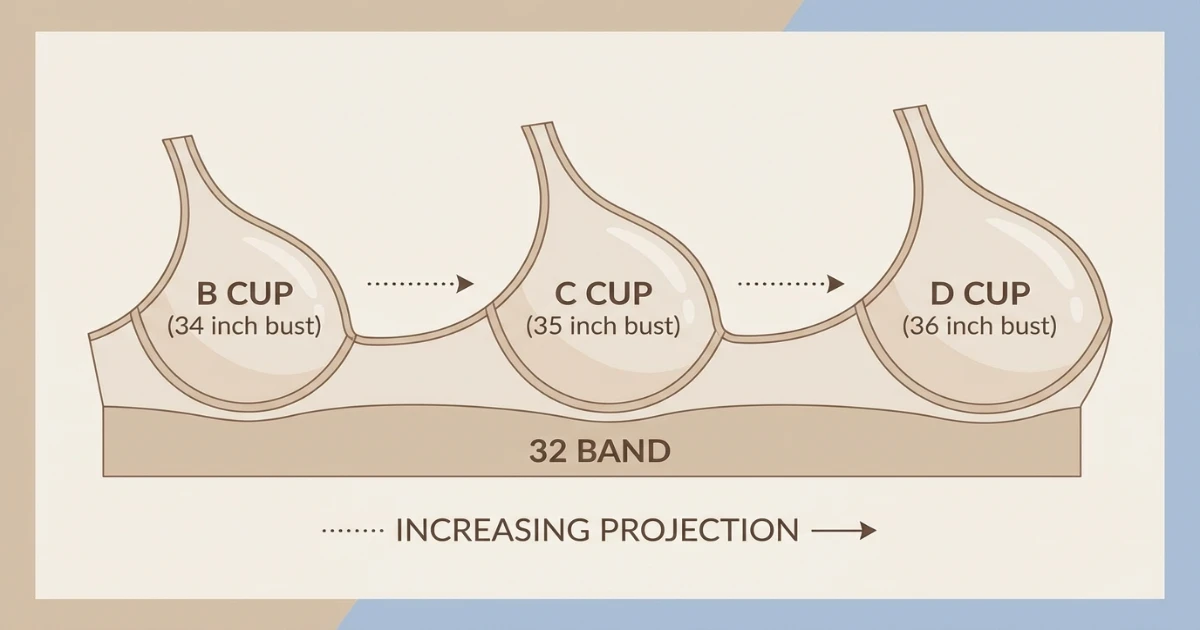
Bra cup letters work on a simple one-inch increment system. Each letter represents one additional inch of difference between the fullest part of your bust and your underbust. The progression looks like this on a 32 band:
The key insight is that although each letter adds only one linear inch to the measurement gap, the corresponding volume increase is far from linear. A cup is a three-dimensional shape. Adding one inch of circumference difference translates into an exponentially larger interior volume because the cup must project further, widen, and deepen simultaneously. This is why a D cup holds considerably more than twice the volume of a B cup in absolute terms — the geometry multiplies the difference. Explore this further with visual cup size comparisons.
Understanding cup progression also unlocks the concept of sister sizing — moving diagonally across the size chart by adjusting band and cup together to maintain the same cup volume. A 32D has the same cup volume as a 34C and a 30DD. This knowledge is especially useful when shopping brands with inconsistent sizing. For comparisons between adjacent letters, the D cup vs DD cup guide is a helpful next read.
How Much Bigger Is 32D Than 32B?
| Measurement / Feature | 32B | 32D |
|---|---|---|
| Band size (underbust) | 32 inches | 32 inches |
| Full bust measurement | ~34 inches | ~36 inches |
| Bust-underbust difference | 2 inches | 4 inches |
| Cup letters apart | 2 sizes (B → C → D) | |
| Relative cup volume | Baseline | ~2× the volume of 32B |
| Cup projection | Modest | Noticeably deeper & forward |
| Sister sizes | 30C · 34A | 30DD · 34C |
| Typical underwire shape | Narrower, shallower | Wider, deeper arc |
| Support structure needed | Light to moderate | Moderate to firm |
Stripped down to numbers: a 32D cup has a four-inch bust-to-underbust gap versus the two-inch gap of a 32B. That two-inch linear difference produces a cup that is substantially deeper front-to-back, wider across the chest wall, and taller from the neckline to the underwire channel. When translated into volumetric terms — because cup depth, width, and height all increase together — the 32D holds roughly double the tissue that a 32B does.
The Measurement Science Behind Cup Sizes
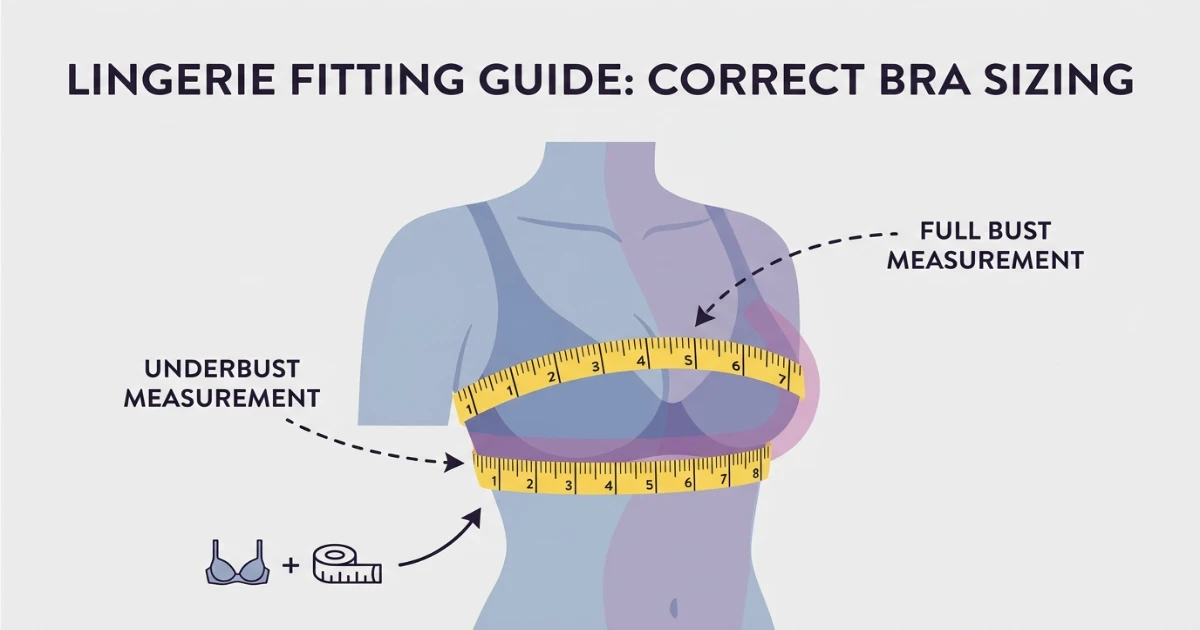
Bra sizing is built on two circumference measurements, and understanding them demystifies every size on the chart. The underbust measurement — taken firmly around the ribcage directly beneath the breasts — determines the band number. The full bust measurement — taken loosely across the fullest part of the breasts while standing — determines the cup letter when subtracted from the underbust figure.
For a 32B: underbust ≈ 32 inches, full bust ≈ 34 inches. Difference = 2 → B cup.
For a 32D: underbust ≈ 32 inches, full bust ≈ 36 inches. Difference = 4 → D cup.
It sounds almost too simple, but the formula is the foundation of every sizing system. The complication arises from the fact that breast tissue is not distributed evenly — it varies in root width, projection angle, and upper-fullness profile — which is why two people with the same measurements can fit differently in identical bra models. That is precisely why understanding the starting point (the numbers) and then refining through fit is the gold-standard approach. Use the bra size chart calculator to map your numbers instantly.
Visual Difference on the Body
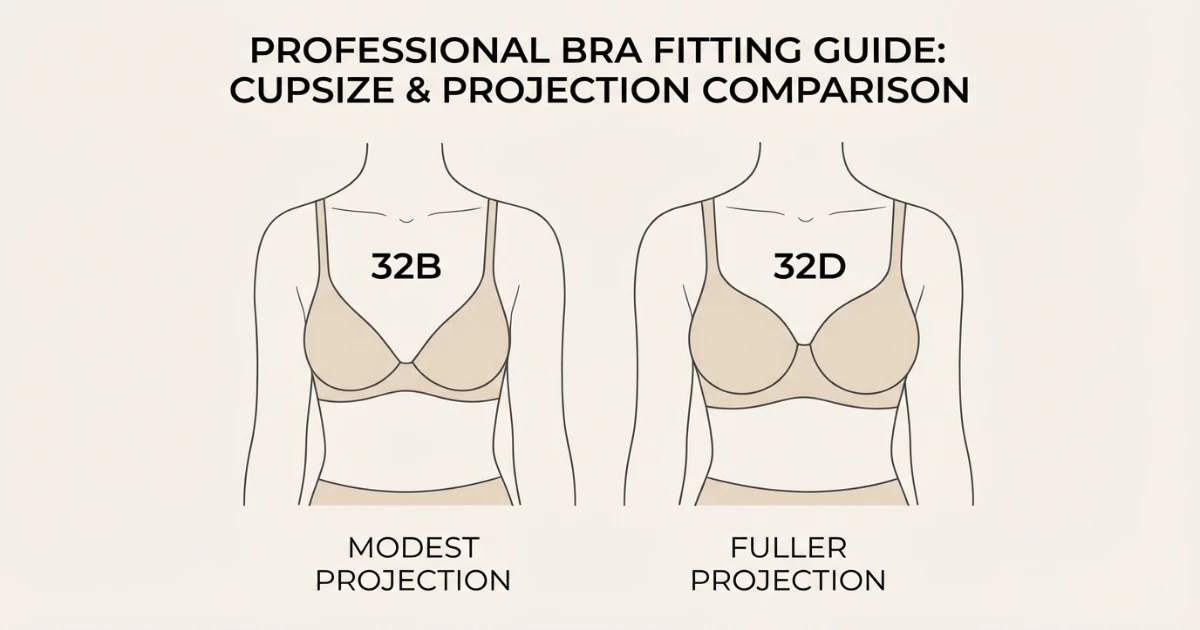
On a narrow 32-inch frame, the visual contrast between a 32B and a 32D is unmistakable. Because the ribcage is slim, any increase in cup fullness is more apparent than it would be on a wider band. A 32B sits relatively flat against the chest, with modest forward projection and a gentle slope from the chest wall to the nipple. Clothing sits smoothly across the bust with minimal wrinkling at the side seams.
A 32D on the same narrow frame presents with noticeably more forward projection, a rounder silhouette, and fuller upper-cup appearance in form-fitting tops. The underwire on a D cup sweeps wider along the chest, and the cup depth is meaningfully greater — which is precisely why a B-cup bra will show clear fit failure on a D-cup wearer (and vice versa). For visual side-by-side references, the cup size visuals page provides illustrated comparisons across the size spectrum.
It is worth noting that external appearance alone should not determine your size. Tissue density, shape (shallow vs projected, narrow vs wide root), and breast placement all alter how a given size looks on different bodies. Measurement and fit testing together are the only reliable guide.
Fit Issues When the Cup Is Too Small
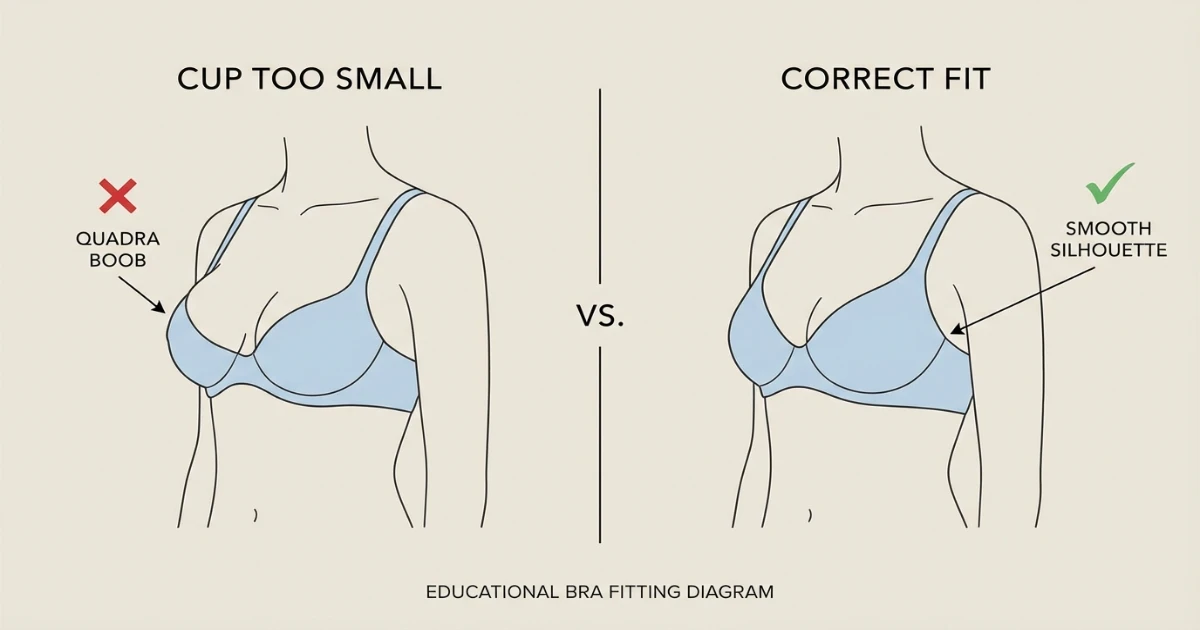
If a 32D wearer attempts to wear a 32B, a predictable cascade of fit failures occurs. Recognising these symptoms is the fastest way to identify that you need a larger cup:
- Quadra-boob or double-bubble: Breast tissue overflows the cup edge, creating a visible secondary ridge under clothing.
- Underwire sitting on breast tissue: The wire should sit flat against the chest wall. If it digs into the side or under-breast, the cup is too shallow.
- Straps digging in: When a cup is too small, straps bear more weight than the band, causing shoulder and neck pain.
- Center gore not lying flat: The piece of fabric between the cups should touch the sternum. If it floats away, the cups are fighting tissue that does not belong there.
- Wrinkling or gaping at the top: Counterintuitively, a cup that is far too small can wrinkle at the top while overflowing at the sides — the cup shape is simply wrong for the breast shape.
- Constant bra adjusting: Frequent strap pulling, cup repositioning, or underwire poking throughout the day all signal a size mismatch.
These issues are not a matter of preference — they indicate structural mismatch between the bra and the body. For a comprehensive checklist of every fit indicator, the how to know if your bra fits guide walks through every sign step by step.
Who Should Wear a 32B?
A 32B is the right size for someone whose underbust measures approximately 30–32 inches and whose full bust measures approximately 33–34 inches, resulting in a two-inch cup difference. This is a genuinely common size on petite and slim-framed bodies, and it is well-served by a wide range of bra styles. You likely belong here if:
- Your tape measure shows a bust-to-underbust difference of two inches consistently.
- Your current bra sits flat across the chest with no overflow or gaping.
- Straps stay put without digging, and the center gore lies flat against your sternum.
- You feel comfortable and supported throughout the day without constant adjustment.
It is equally important to note that body weight, pregnancy, hormonal changes, and age can all shift you out of a 32B. Sizing is not a permanent label — it is a current measurement.
Who Should Wear a 32D?
A 32D is the correct size for someone with a 32-inch underbust and a full bust measuring approximately 36 inches — a four-inch difference. On a narrow frame this feels surprisingly full, which is why many 32D wearers spent years in the wrong size. You may actually wear a 32D if:
- You currently wear a 34B or 36A and find the band rides up while the cups barely contain you.
- Your underwires consistently sit on breast tissue rather than the chest wall.
- You experience shoulder pain and back discomfort from poor weight distribution.
- Your measurements consistently show a four-inch bust-to-underbust difference.
Best Bra Styles for Each Size
Best styles for 32B
Because a 32B involves modest volume and a narrow frame, lighter structures work well. Bralettes and soft-cup bras offer comfort without over-engineering. T-shirt bras with light padding create a smooth silhouette under fitted tops. Balconette styles add lift and roundness for those who want more visual fullness. Underwire is optional at this size — many 32B wearers are equally comfortable with wire-free designs on most days.
Best styles for 32D
A 32D benefits from more structure. Full-coverage underwire bras distribute weight evenly and prevent migration throughout the day. Plunge bras work well for forward-projected tissue. Balconette and half-cup styles lift and define the silhouette beautifully at this size. Avoid unstructured bralettes for everyday wear as they typically do not offer adequate lift or containment for a D cup. Side-support panels and three-part cups are worth seeking out for longer days or active use.
Step-by-Step Measuring Guide
The most reliable way to settle the 32B vs 32D question is to take two accurate measurements. Here is exactly how, following the method detailed on the how to measure guide:
- Measure your underbust. Stand upright and wrap a soft measuring tape snugly around your ribcage, directly under your breasts. Keep the tape level all the way around. Breathe out naturally and note the number in inches. This is your band size.
- Measure your full bust. With the tape now relaxed (not tight), wrap it around the fullest part of your bust — typically across the nipple line. Keep the tape parallel to the floor. Note this number.
- Calculate the difference. Subtract your underbust from your full bust. A difference of 2 inches = B cup. A difference of 4 inches = D cup.
- Combine band and cup. Your band number (underbust, rounded to the nearest even number) plus your cup letter = your starting size. Example: 32-inch underbust + 4-inch difference = 32D.
- Try and refine. Put on the size your measurements suggest, fasten on the loosest hook, and check all the fit indicators listed in the fit issues section above. Adjust one variable at a time — cup first, then band — until every point is comfortable.
Want your calculations done instantly? Use our free online tools to confirm your exact bra size.
AI Smart Fit Calculator Size Chart CalculatorConclusion
The 32B vs 32D difference is genuinely significant — not a half-step tweak, but a two-cup jump that roughly doubles cup volume, visibly changes breast projection, and demands a different level of structural support from the bra. Both sizes share a 32-inch band, meaning the frame is identical. What changes is the cup: from a two-inch bust difference to a four-inch difference, with all the geometric consequences that brings.
If you have been wearing a 32B and suspect it may no longer be right — because of overflow, wire migration, or persistent strap pain — it is worth measuring again and trying a 32C or 32D. Equally, if you have been avoiding a D cup because of cultural assumptions around the letter, know that on a narrow 32-inch frame a D cup is a medium-to-full size relative to your body, not an extreme one.
The right bra is the one that fits. Start with your measurements, use the free resources at bra-calculator.com, and let the numbers guide you. Your shoulders, back, and posture will thank you.
Frequently Asked Questions
How much bigger is 32D than 32B?
A 32D is two cup sizes larger than a 32B. In measurement terms, the bust-to-underbust difference increases from 2 inches (B) to 4 inches (D). Volumetrically, a 32D holds approximately double the tissue of a 32B — roughly 170–180 ml more — because the cup must increase in depth, width, and height simultaneously.
Is 32D large compared with 32B?
Relative to a 32B on the same narrow frame, yes — a 32D is noticeably fuller and more projected. In the wider context of all bra sizes, a 32D is a medium-to-full cup size. It is considerably larger than B in volume, but it is far from the upper end of the cup size spectrum, which extends through DD, E, F, and beyond.
Can weight gain change a 32B to a 32D?
Yes. Breast tissue contains a high proportion of fat, so weight gain can increase the full bust measurement while the ribcage (underbust) expands more slowly. If your full bust grows by two inches while your underbust stays at 32 inches, your cup size moves from B to D. Hormonal changes, pregnancy, and age-related tissue redistribution can also shift cup size independently of overall body weight.
What does cup progression mean?
Cup progression refers to the way bra cup letters correspond to increasing bust-to-underbust measurement differences, with each letter adding one inch of difference. A = 1 inch, B = 2 inches, C = 3 inches, D = 4 inches, and so on. Because the cup is a three-dimensional shape, each additional inch of difference creates a proportionally larger volume increase — the progression is not merely linear.
How do I know if my cups are too small?
The clearest signs include breast tissue overflowing the cup edge (quadra-boob), underwires sitting on breast tissue rather than the chest wall, the center gore floating away from the sternum, straps digging painfully into shoulders, and the need to constantly readjust your bra throughout the day. If you experience three or more of these regularly, try increasing your cup size by one letter and retesting fit. The bra fit guide covers every indicator in detail.