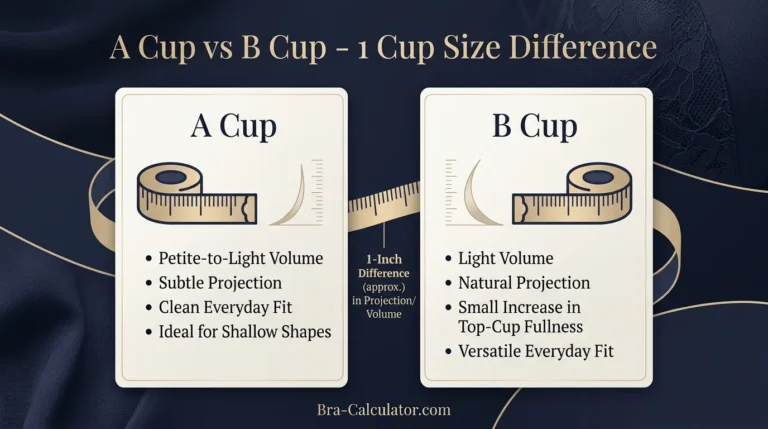
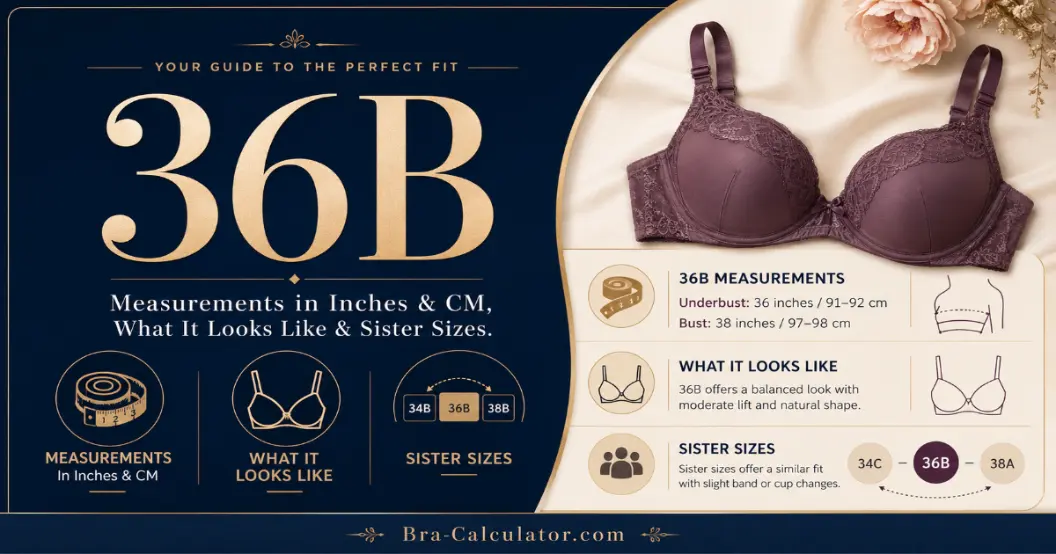
36B (sometimes written 36 B) is a B-cup volume built on a 36 band, and it’s generally considered a moderate size — not particularly big or small. A B cup usually represents about a 2-inch or 5 cm difference between full bust and underbust. In a direct-fit approach, a common starting range is a 35–36 inch (89–91.5 cm) underbust and a 37–38 inch (94–97 cm) bust. In European size, 36B converts to roughly EU 80B. The nearest sister sizes are 34C for a firmer band and 38A for a looser band.
Jump to a Section
36B Bra Size at a Glance
| Attribute | 36B Detail |
|---|---|
| Band label | 36 band; exact snug-underbust range depends on the brand and fitting system |
| Cup difference | Approximately 2 inches or 5 cm |
| General cup description | Moderate cup volume on a wider band |
| Closest sister sizes | 34C and 38A |
| One cup smaller | 36A |
| One cup larger | 36C |
| Common fit issues | Band riding up, top-edge gaping, cup overflow, floating gore, wide-set straps and wire pressure |
| Useful starting styles | T-shirt, balconette, plunge, spacer, side-support and structured wireless bras |
| International equivalents | US 36B · UK 36B · EU 80B · AU/NZ 14B |
What Does a 36B Bra Size Really Mean?
Here’s the short version: the “36” is your band — the number that wraps around your ribcage — and the “B” is how much your bust adds beyond that band. Change either number and you’re describing a different body, even if the letter stays the same.
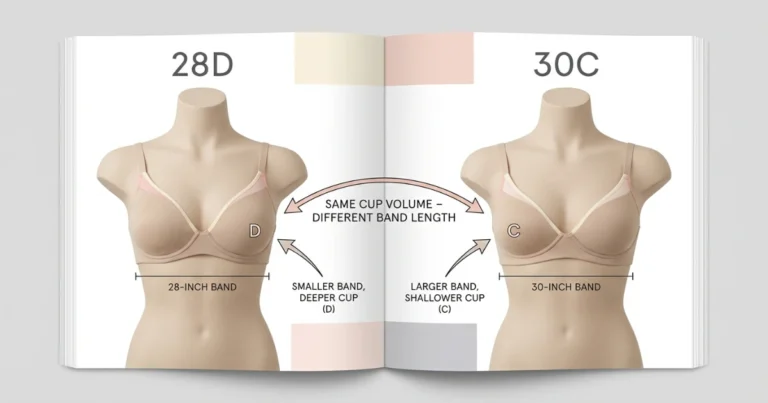
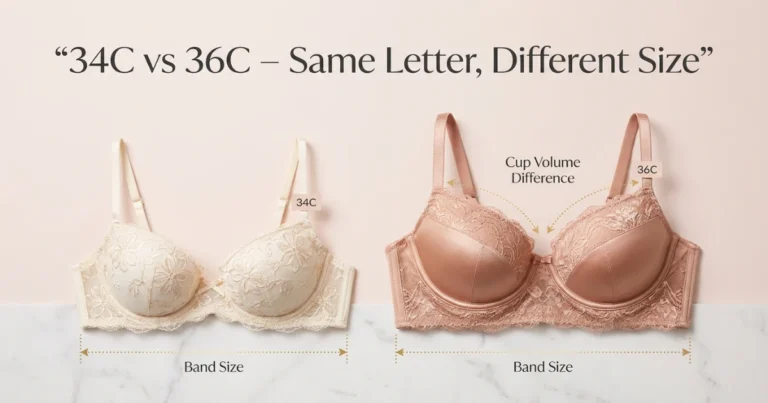
That’s the part people often miss: a B cup isn’t a fixed size you can picture in isolation. It’s relative to the band it’s sitting on. A 36B carries more volume than a 34B and less than a 38B, because the whole cup is graded around the band it’s built on. If you’ve ever wondered why a friend’s “B cup” looks nothing like yours, that’s usually why — the band underneath is doing more of the work than people give it credit for. In this case, the closest volume matches on either side are 34C and 38A.
36B also happens to be one of the most widely stocked sizes out there, which is genuinely useful — you’ll rarely struggle to find it on a shelf. But “easy to find” and “fits you perfectly” aren’t the same thing. If the band keeps riding up, the cups cut in, or the straps keep sliding off your shoulders, that’s not something to just live with. It usually means the band, the cup volume, or the actual construction of the bra needs a second look — not that your body is somehow “wrong” for the label.
You’ll also see this size written as “36 B” or “B36” here and there — all three mean exactly the same thing: a 36 band with B-cup volume. And to answer the question a lot of people are quietly asking: on its own, 36B is a genuinely moderate size. It’s not big, it’s not small — it sits one cup above 36A and one cup below 36C, right in the middle of where most brands concentrate their stock.
Size and shape are two different conversations. A shallower 36B often wants a wider, shorter cup. A more projected 36B usually needs more room near the wire than a standard molded cup gives it. Same size label, genuinely different bra.
36B Bra Size in Inches and CM
Here’s why two “36B” charts can disagree: modern direct-fit methods and the older plus-four charts don’t measure the band the same way, so the numbers shift depending on which system a brand happens to use.
What Is 36B Bra Size in CM?
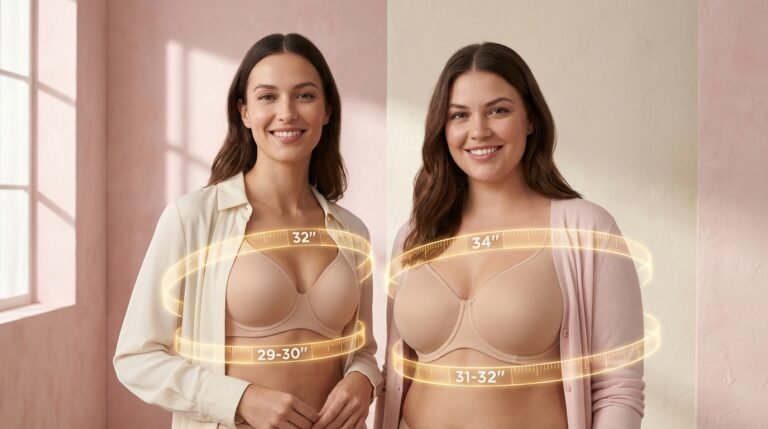
In cm, you’re typically looking at an 89–91.5 cm snug underbust with a 94–97 cm full bust — roughly a 5 cm gap between the two, which is what puts you in B-cup territory. In inches, that’s about 35–36 inches underbust and 37–38 inches at the fullest point of the bust, with close to a 2-inch difference between them.
| Measurement Method | Typical Snug Underbust | Typical Full Bust | Fit Note |
|---|---|---|---|
| Modern direct-fit approach | About 35–36 in 89–91.5 cm | About 37–38 in 94–97 cm | The band label stays close to the measured ribcage. |
| Legacy plus-four approach | About 31–32 in 79–81 cm | About 33–34 in 84–86 cm | Four inches are added before assigning the 36 band. |
| Brand-specific chart | Varies | Varies | Band stretch, cup width, cup depth and grading can shift the best size. |
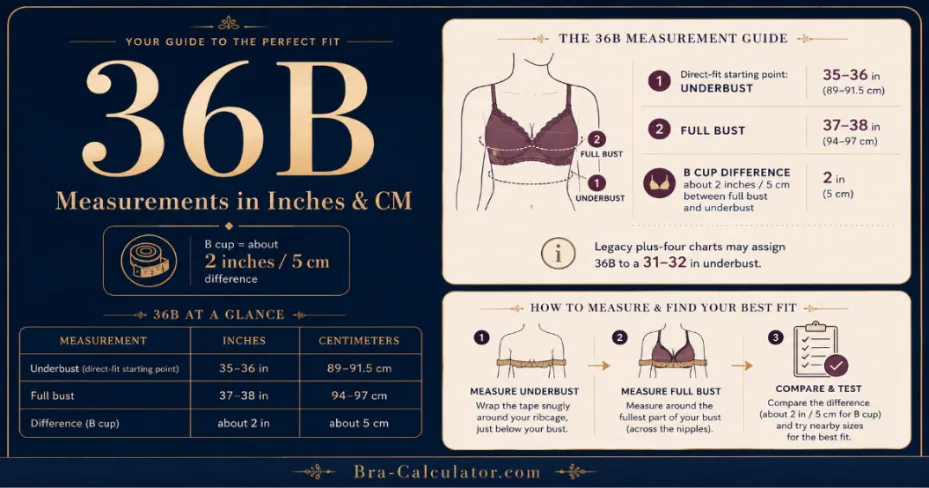
Place the tape directly under the breast root. Keep it level and comfortably firm.
Measure around the fullest point without flattening tissue or lifting the tape.
A larger leaning measurement can reveal projection or softer tissue that needs extra cup depth.
Test 36B alongside 34C, 36C or 38A when the first bra is close but not quite right.
The band should stay level and the tissue should remain inside the cups when you sit, reach and raise your arms.
What Does 36B Look Like? How 36 Breast Size Appears
If you’re here because you typed “what does 36B look like” or “how does 36 breast size look in real life,” you’re not alone — a number on a tag is hard to picture, and photos online rarely match your actual frame. So here’s the honest answer: 36B usually reads as a balanced, moderate bust line, but the same exact size can look genuinely different from one body to the next. On a broader torso, that volume spreads out and looks more subtle. On a narrower frame, the same 36B can look noticeably more prominent — same bra, same size, different silhouette.
Projection changes the picture too. Someone with more projected tissue will see more forward depth and a rounder profile, while a shallower shape tends to look wider across the front. If your tissue sits wide-set, you’ll likely keep a natural gap at the center — that’s normal, not a fit failure. And if you’re fuller at the bottom of the breast, you might notice a little extra room at the top of a tall cup, which is more about cup shape than cup size.
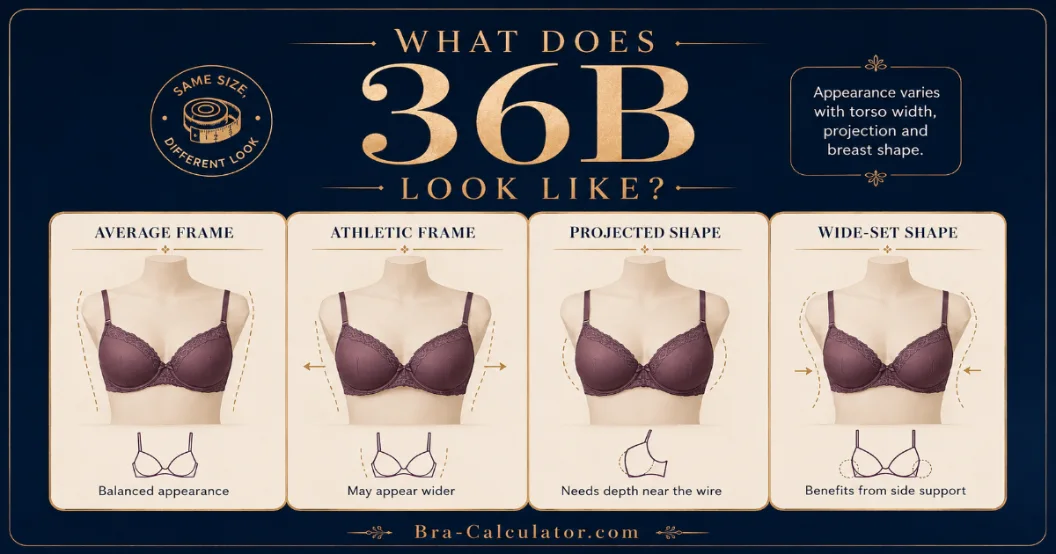
Balanced appearance
36B often looks moderate and proportionate, with visible shape but not necessarily strong projection.
Balanced proportionsMay appear wider
Broader shoulders and pectoral structure can spread the same volume across more chest width.
Needs depth near the wire
A shallow molded cup may slide downward or flatten tissue despite the correct label.
Try seamed cupsNeeds side guidance
Side-support panels can create a more centered silhouette without forcing the natural placement.
Check side supportThere’s no single “correct” way for a 36B to look. The label is a garment measurement, not a body type — your version of 36B is allowed to look like your body, not like a stock photo.
Amazon Bra Picks for 36B
These product types cover three common 36B needs: shape definition, wireless comfort and movement support. Confirm current 36B availability before ordering.

Structured Plunge or Push-Up Bra
- Useful when you want more centered lift under lower necklines.
- Firm cups make overflow, gaping and gore placement easier to evaluate.
- Compare 36B with 36C if the cup edge cuts in after scooping.

Structured Wireless Everyday Bra
- A firm underband can provide relaxed support without an underwire.
- Shaped cups are more useful than a loose stretch-only bralette.
- Ideal for everyday wear, travel and lower-impact comfort.

Encapsulation Sports Bra
- Separate cups help control movement without relying only on compression.
- Useful for checking band stability, bounce and hidden cup pressure.
- Choose the support level according to walking, gym, running or sport needs.
How Breast Shape Changes 36B Fit
A correct volume can still feel wrong when cup height, wire width or depth does not match where the breast tissue sits.
Try wider, shorter cups
Tall projected cups may gape even when the cup is not technically too large.
Demi or spacerTry deeper cups
Seamed cups can provide more room near the wire than standard shallow molds.
Depth over paddingTry a low gore
A plunge center can reduce pressure when a tall gore sits on breast tissue.
Lower centerTry flexible edges
Stretch lace and adjustable straps adapt more easily than rigid molded foam.
Fit the larger sideIs 36B Considered Average, Small or Large?
Straight answer: 36B is genuinely average. It’s one of the most widely stocked sizes in mainstream retail, and most fitting guides will describe it as moderate without much debate. But “average” is a shelf-stocking statistic, not a prediction of how it’ll actually look on you — that part depends on your frame, not the label.
What’s more useful than a generic “is it big” answer is how 36B relates to the sizes right around it. On the same band, it’s one cup more than 36A and one cup less than 36C. Move across bands instead, and it lines up closely with 34C and 38A. Those relationships tell you a lot more about fit than any “average size” headline ever will.
The fit-first answer: 36B is right for you when the band sits securely without digging or riding up, the cups hold the full breast without spilling or gaping, and you can move through a normal day without thinking about it. That’s the only test that actually matters.
36B Sister Sizes
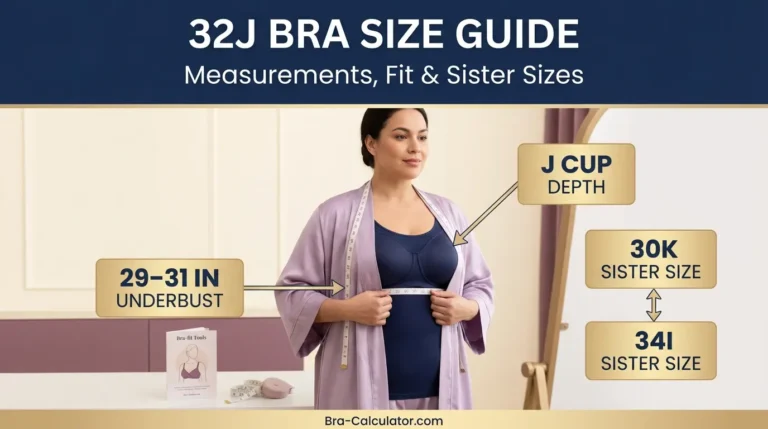
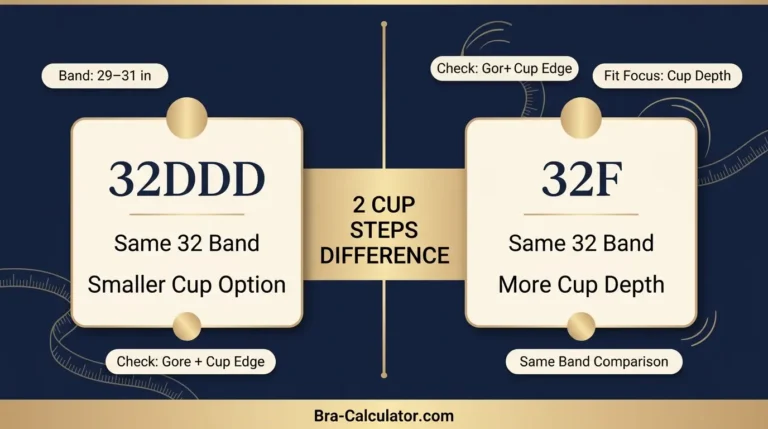
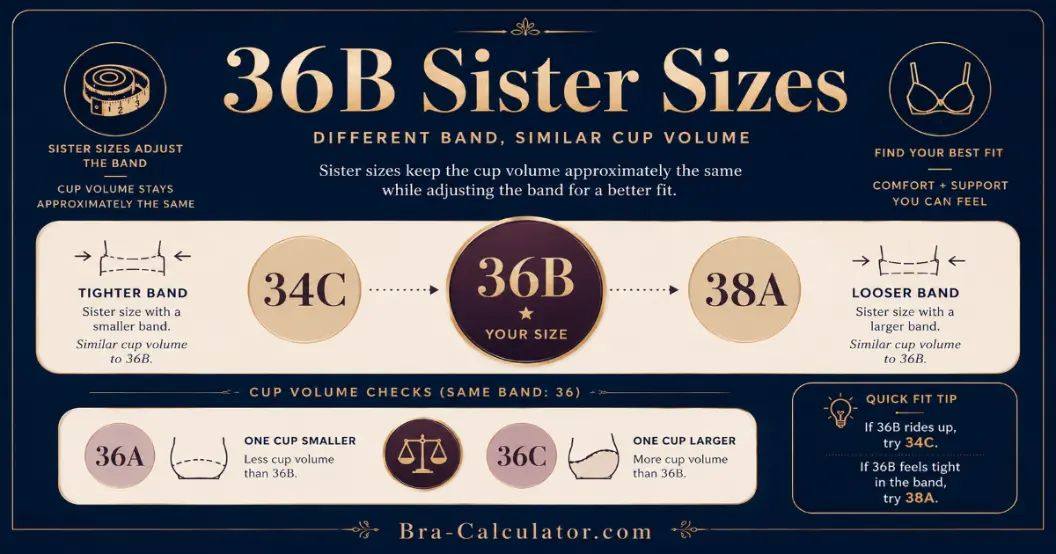
If your 36B cups feel right but the band doesn’t, you don’t need to guess your way through every size on the rack — you need its sister sizes. For 36B, that’s 34C and 38A (also searched as “36 B sister size”).
34C
Firmer band with similar cup capacity
36B
Reference size
38A
Looser band with similar cup capacity
| Fit Situation | Try | Why |
|---|---|---|
| 36B band rides up | 34C | Shorter band with approximately similar cup capacity. |
| 36B band is genuinely tight | 38A | Longer band with approximately similar cup capacity. |
| 36B cups spill while band fits | 36C | Same band with one cup more room. |
| 36B cups are roomy throughout | 36A or a shorter cup | The cup may be too large or the style may be too tall. |
36B vs Nearby Bra Sizes
The main difference between 36B and 36C bra size is cup volume: both share the same 36 band and wire width, but 36C has one cup size more capacity than 36B, roughly an extra inch of depth. Compare 36B against 36A, 36C, 34C and 38A below.
- Same 36 band
- One cup more capacity
- About 2-inch cup difference
- Better when 36A cuts in or spills
- Same 36 band
- One cup less capacity
- About 1-inch cup difference
- Try when 36B is roomy throughout
- Same 36 band
- One cup smaller
- Works when the cup edge stays smooth
- May be too small if the gore floats
- Same 36 band
- One cup more capacity
- Offers more depth and coverage
- Try when 36B spills but band fits
- Longer band
- Similar cup capacity to 34C
- Better when 34 feels restrictive
- May ride up on a smaller torso
- Shorter, firmer band
- Closest tighter sister size
- Useful when 36B rides up
- Frame and wire position may shift
- Shorter band
- Similar cup capacity to 38A
- Usually gives firmer anchoring
- Best when 38A shifts
- Longer band
- Closest looser sister size
- Useful when 36B is truly tight
- May reduce lift if too loose
Which Bra Styles Work Best for 36B?
36B is genuinely one of the more forgiving sizes to shop for — but “forgiving” doesn’t mean “one style fits all.” What actually works for you comes down to your breast shape, how much lift you want, and how much coverage feels good, not just the size on the tag.
Creates a smooth outline when the cup height and projection match the breast shape.
Often suits shallow, bottom-full or wide-set shapes because the cup is shorter and more open.
Useful for V-necks and close-set tissue when a tall center gore feels uncomfortable.
Helps guide side tissue forward on a wider frame without forcing artificial cleavage.
Choose a firm underband and shaped cups rather than a loose stretch-only bralette.
Can gape on shallow or bottom-full tissue even when the cup volume is close.
Common Fit Problems in 36B
If something feels off about your 36B, it’s almost always one of these six things — and every single one has a straightforward fix, no guesswork required.
The band is too loose, stretched or being pulled upward by overtightened straps.
Small or shallow cups can pull the bra forward and make the band feel tighter.
The cup may be too small, too shallow or too closed at the neckline.
The cup may be too large, but it may also be too tall or too rigid for the breast shape.
The cups may lack depth, or the gore may be too high or wide for the tissue placement.
The band may be moving, or the straps may be set too wide for the shoulders.
International Size Conversion for 36B
These are approximate label conversions. Band stretch, wire width and cup construction can still vary by brand.
36B in European Size (EU 80B)
36B in European size is typically listed as EU 80B. The band number switches from an inch-based scale to a centimeter-based one, so “36” becomes “80,” while the B cup letter usually stays the same. If a European retailer’s own chart shows a different band number, always check their specific size guide, since regional grading can vary slightly by brand.
Use the Global Bra Size Converter and Brand Size Decoder before buying across regions.
Related Tools & Guides for 36B
| Guide / Tool | Why It Helps |
|---|---|
| Bra Size Calculator | Calculate a starting band and cup using measurements. |
| B Cup Size Guide | Understand how B-cup volume changes across band sizes. |
| 34C Bra Size Guide | Useful when 36B cups fit but the band rides up. |
| Sister Size Calculator | Compare 34C, 36B and 38A instantly. |
| Cup Size Visuals | See how cup letters change with band size and body shape. |
| AI Smart Fit Bra Calculator | Diagnose gaping, spillage, floating gore, strap pressure and band movement. |
Frequently Asked Questions
A 36B is a B-cup volume built on a 36 band. A B cup usually reflects about a 2-inch or 5 cm difference between full bust and underbust, although the band recommendation varies by brand.
In a direct-fit approach, 36B may start around a 35–36 inch or 89–91.5 cm snug underbust and a 37–38 inch or 94–97 cm full bust.
The closest sister sizes are 34C for a firmer band and 38A for a looser band. They have approximately similar cup capacity.
They have approximately similar cup capacity because they are sister sizes. The main difference is band length and tension.
36B is widely stocked and often described as moderate in mainstream retail, but it can look fuller or subtler depending on torso width and breast shape.
The cup may be too large, but gaping often means the cup is too tall, rigid or projected. Try a shorter balconette, demi or flexible spacer cup before changing size.
Yes, if the 36 band feels secure and the cup edge cuts in or tissue spills. 36C keeps the same band while adding one cup of capacity.
Yes. Choose a structured wireless bra with a firm underband, shaped cups and adjustable straps rather than relying only on soft stretch fabric.
36B is neither particularly big nor small. It’s a moderate, widely-stocked size that sits in the middle of most retail charts, though how full it looks still depends on torso width, projection and breast shape rather than the label alone.
36B in European size converts to approximately EU 80B. The band number changes from an inch-based to a centimeter-based scale, but the B cup letter generally stays the same across US, UK and EU sizing.
36B and 36C share the same 36 band, so band length and wire width match. 36C simply has one cup size more volume than 36B, roughly an extra inch of cup depth.
A 36 breast size (36B) usually looks like a moderate, balanced bust line on an average frame, though it can appear fuller on a narrower torso or more spread out on a broader, athletic frame.
Find Your Best 36B Fit
Use your measurements, sister sizes, breast shape and real fit symptoms to decide whether 36B, 34C, 38A or 36C gives the cleanest and most supportive result.
Nearby sizes and related guides
- The 36A Bra Size Guide: Measurements, Fit & Sister Sizes
- The 36C Bra Size Explained: 2026 Fit, Volume, Real-Body Guide
- 34B Bra Size: Measurements in Inches & CM + Sister Sizes
- 38B Bra Size Guide: Measurements, Fit, Sister Sizes & Best Styles
- 38A Bra Size Guide: Measurements, Fit, Sister Sizes & Best Styles
- 34C Bra Size: Measurements in Inches & CM + Sister Sizes
- Sister size bra calculator
- All bra size guides and charts
- Bra size calculator