38F vs 40E: Sister Size Fit, Band Comfort & Cup Volume
In UK sizing, 38F and 40E are direct sister sizes. The main decision is whether you need firmer anchoring or more ribcage ease.

Choose the fit signs you notice in the band, cups, center and straps. We’ll turn them into a practical next step for 38F.
Private fit check — your answers stay in your browser and are used only for this on-page guidance. Nothing is stored or submitted.
38F vs 40E: the practical difference
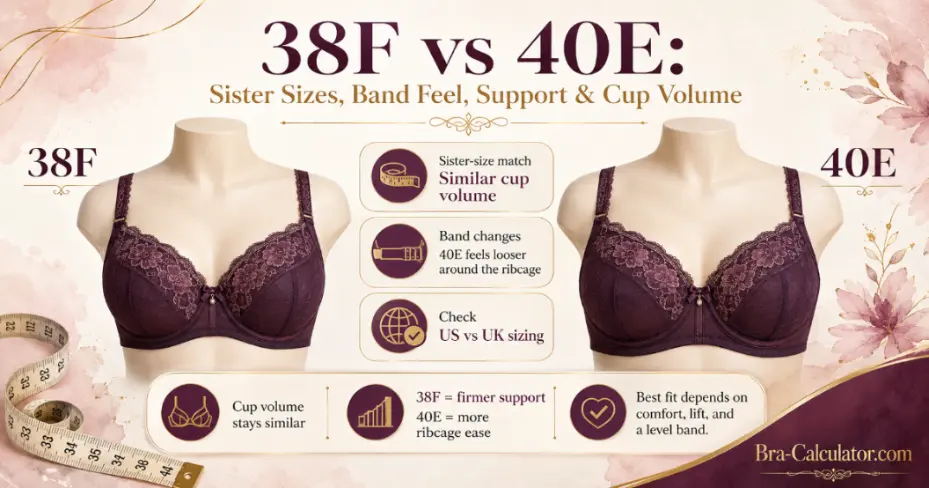
In UK sizing, 38F and 40E are direct sister sizes: cup capacity is designed to stay similar while the band changes. Choose 38F for a firmer, more anchored fit; choose 40E when the 38 band is genuinely too tight but the cup volume feels right. If you are shopping a US brand, confirm how it uses E and F before assuming the same relationship.
Which Should You Choose: 38F or 40E?
38F is the support-first option. A correctly fitted 38 band should sit level, resist riding up and let the straps act as stabilizers rather than primary lifters. If 40E feels comfortable at first but shifts by midday, the firmer sister size may be the better long-wear choice.
40E is the comfort-first sister option when the 38 band itself is the problem. It gives more room around the torso while stepping the cup down to preserve similar capacity in UK sizing. The key is that “easier” should not become “mobile”: the back still needs to stay horizontal.
Best comparison method: This is a clean UK sister-size test, so preserve the bra model and compare anchoring. If the product is not UK sized, pause and map the labels first rather than assuming F-to-E carries the same volume relationship.
A True Sister-Size Comparison—With One Important Caveat
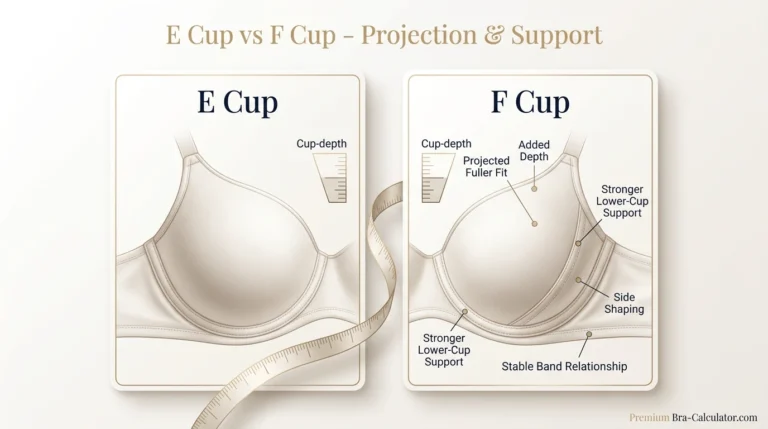
This pair is a textbook UK sister-size example. Move up from a 38 band to a 40 band and move down one UK cup step from F to E. The breast volume stays in the same neighborhood, while the support architecture changes because the band is longer.
The caveat is international labeling. Many US brands do not use E and F in the same way, so an online listing can make the pair look equivalent when the product chart says otherwise. If the bra is sold in UK sizes, the relationship is straightforward; if not, translate the size system first.
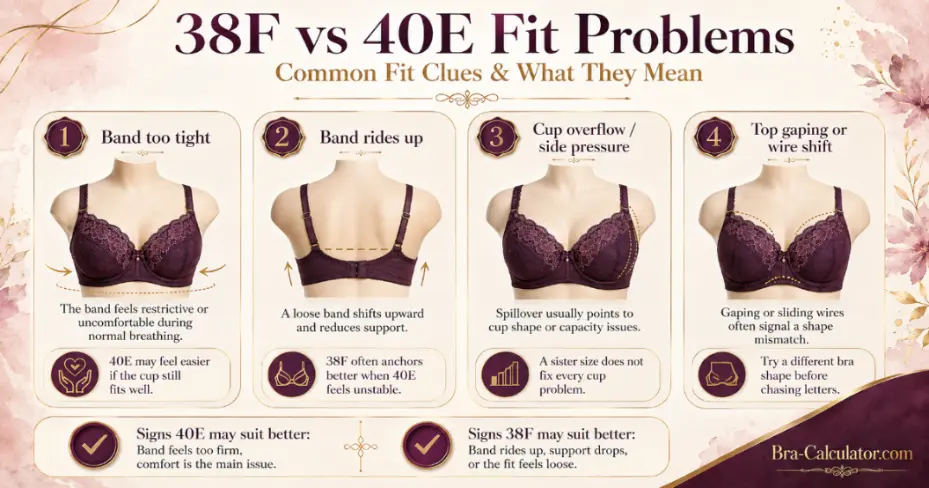
Sister sizing is especially useful when a bra is nearly right. It is not meant to rescue a bad cup shape. If both 38F and 40E wrinkle in the same place or both cut into the same area, the pattern is telling you to change the bra design rather than the band.
How Measurements Change the 38F vs 40E Decision
The nominal band difference is two inches. The 38 distributes support with more tension; the 40 uses a longer band and therefore feels less firm in the same fabric. People between bands may prefer either depending on ribcage sensitivity, torso shape and how stretchy the style runs.
Because the cups are sistered in UK sizing, your fit check should focus on stability rather than looking for a dramatic volume change. The wire should encircle the same tissue in both. The question is which band keeps that cup in the correct position for several hours.
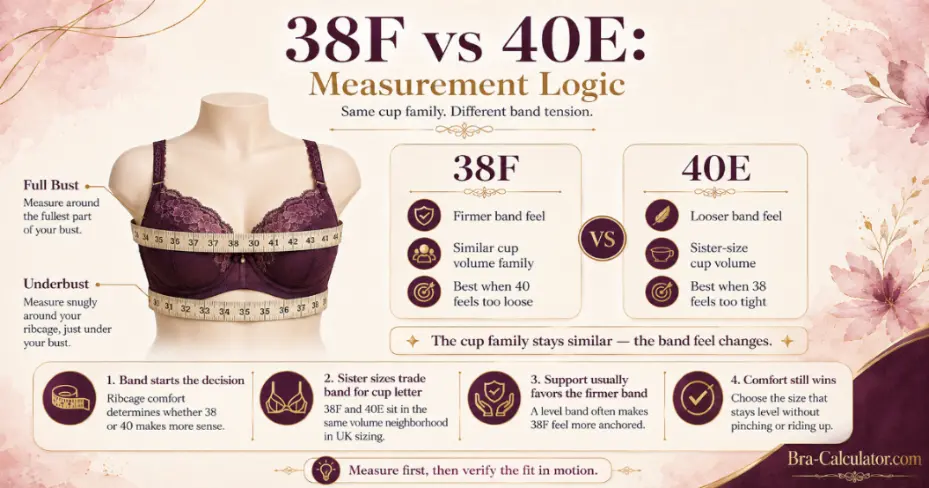
Read the Bra, Not Just the Size Tag
| Fit area | What you want | What the comparison may reveal |
|---|---|---|
| Band tension | 38F: firmer and more anchoring | 40E: more circumference and softer pressure |
| Cup capacity | Very similar in UK sister sizing | Very similar in UK sister sizing |
| Back movement | Should remain low and level | Watch carefully for upward drift |
| Straps | Usually need less tightening when the band anchors well | May need more adjustment if the band is borderline loose |
| Best use case | You want security and the 38 is comfortable | You want ribcage ease and the 40 still stays stable |
For 38F vs 40E, the most revealing symptom is band migration. Similar cup capacity should sit in a similar place; if the 40 band lets the whole frame creep upward, the extra comfort is costing support.
How to Compare 38F and 40E Without Guessing
Confirm UK sizing
Make sure the bra is actually labeled in the system where F-to-E sister sizing applies.
Compare on the loosest hook
A new bra should start there so you have room to tighten as the elastic relaxes over time.
Do the two-finger movement check
Instead of obsessing over a finger rule, move, breathe and raise your arms; the band should stay put without pain.
Watch the cup location
The cup should not slide downward or outward in 40E just because the band is more comfortable.
Choose the better all-day anchor
Comfort after five minutes is useful; stability after several hours is the real test.
Three Bra Constructions That Make the Difference Easier to See
The best test bras for this sister pair have stable bands and predictable cups. That keeps the comparison focused on whether your torso prefers 38-level tension or the extra circumference of a 40.

Supportive Seamed Full-Cup Bra
A stable frame makes the 38-vs-40 band difference easy to feel while keeping the cup shape consistent.
- Strong band gives a clear anchoring comparison
- Seamed cup handles fuller volume well
- Ideal for same-model sister-size testing

Side-Support Lift Bra
If you dislike a very enclosed full cup, side support can preserve forward shape while you compare band comfort.
- Balances lift with less upper coverage
- Good control at the outer cup
- Useful for long-wear comfort testing

High-Support Sports Bra
Exercise magnifies a loose band immediately. Compare 38F and 40E during low-impact movement before trusting the larger band for higher impact.
- Band stability becomes obvious quickly
- Encapsulation reduces cup compression
- Helpful for support-first wearers
Breast Shape Can Change Which Size Looks Right
A tapered torso can hold a 40 band differently from a straighter ribcage, so do not judge only by circumference. If the band climbs toward a narrower part of the back, 38F may stay anchored better even when both feel comfortable initially.
For soft tissue, the steadier 38 band can help keep the cup and wire in place. For rib flare or sensory sensitivity, 40E may distribute pressure more comfortably. A wider band with more rows of hooks can sometimes provide the best of both worlds.
Use Sister Sizing Only After You Know the Correct Cup Position
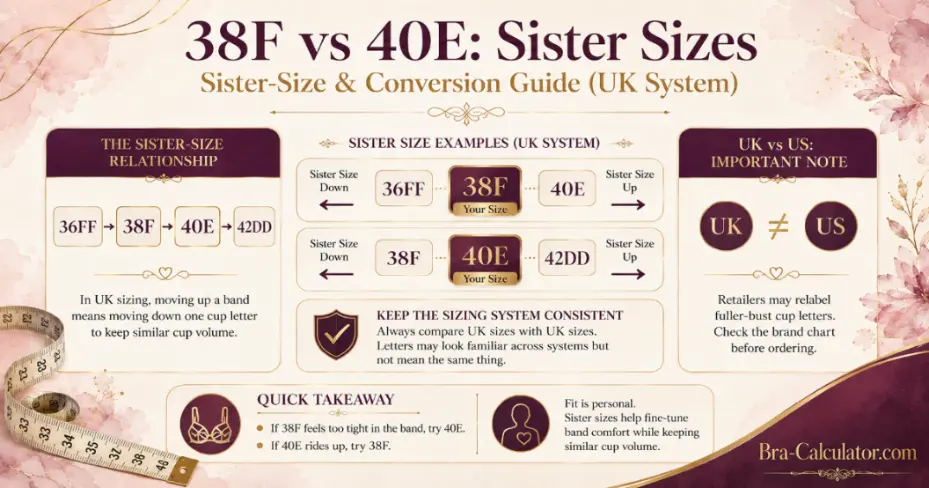
UK sister sizing around this pair runs along the same volume family—for example, a tighter-band sister of 38F is 36FF, while the looser-band sister is 40E. Continue along the sequence only when the brand truly uses UK cup letters.
In a US chart, F may mean DDD and E may mean DD, or the brand may skip E entirely. That does not make the bra “wrong”; it simply means you must map by cup position, not by letter appearance.
Open the Sister Size Calculator → · Check International Conversions →
If You’re Ordering 38F or 40E Online
When buying a UK-sized bra online, check whether the retailer converts sizes automatically based on your country. Some shops display the manufacturer’s UK size; others relabel it for a US customer. Save a screenshot of the chart or note the manufacturer size so returns and reorders stay consistent.
If you sit between bands, consider the bra’s fabric before choosing. A very stretchy 38 can feel like a typical 40, while a firm 40 can feel surprisingly secure. Reviews that mention band stretch are more helpful here than broad comments about whether the bra “runs small.”
What Usually Goes Wrong in a 38F vs 40E Comparison
- Treating 40E as “bigger overall” when the cup capacity is intended to stay similar in UK sizing.
- Choosing 40E because it feels softer for thirty seconds even though it rides up later.
- Staying in 38F despite painful band pressure during normal breathing.
- Using a US retailer’s E/F notation as if it were automatically UK sizing.
- Changing sister size to fix gaping that is actually caused by cup shape.
Tools That Help You Confirm the Fit
38F vs 40E FAQs
Are 38F and 40E sister sizes?
Yes in UK sizing. They are designed to have similar cup capacity with different band lengths.
Which offers more support?
Usually 38F, provided the band is not uncomfortably tight, because the firmer band supplies more anchoring.
Which is more comfortable?
That depends on your ribcage and the bra. 40E can feel easier around the torso, but it should not sacrifice stability.
Does the cup look smaller in 40E?
The letter is smaller, but in UK sister sizing the actual cup capacity remains in the same volume family because the band is larger.
What if both sizes fit the cup but one rides up?
Choose the band that stays level. A riding band is a clear sign that the looser option is not anchoring well enough.
Can I use this relationship in US brands?
Only after checking the brand chart. US E/F conventions are inconsistent, so translate by cup sequence rather than letter alone.
The Bottom Line on 38F vs 40E
For a UK-size bra, 38F vs 40E is a clean sister-size decision: same neighborhood of cup capacity, different band tension. Pick 38F for firmer anchoring or 40E for genuine ribcage ease—then confirm the band stays level in motion.
Still Between 38F and 40E?
Treat 38F and UK 40E as two ways to carry similar cup volume. The right one is the band that stays put while breathing and moving, with straps adjusted for comfort rather than used to manufacture lift.