30A vs 30B: What’s the Real Cup Size Difference? (2026 Fit Guide)
Quick Answer
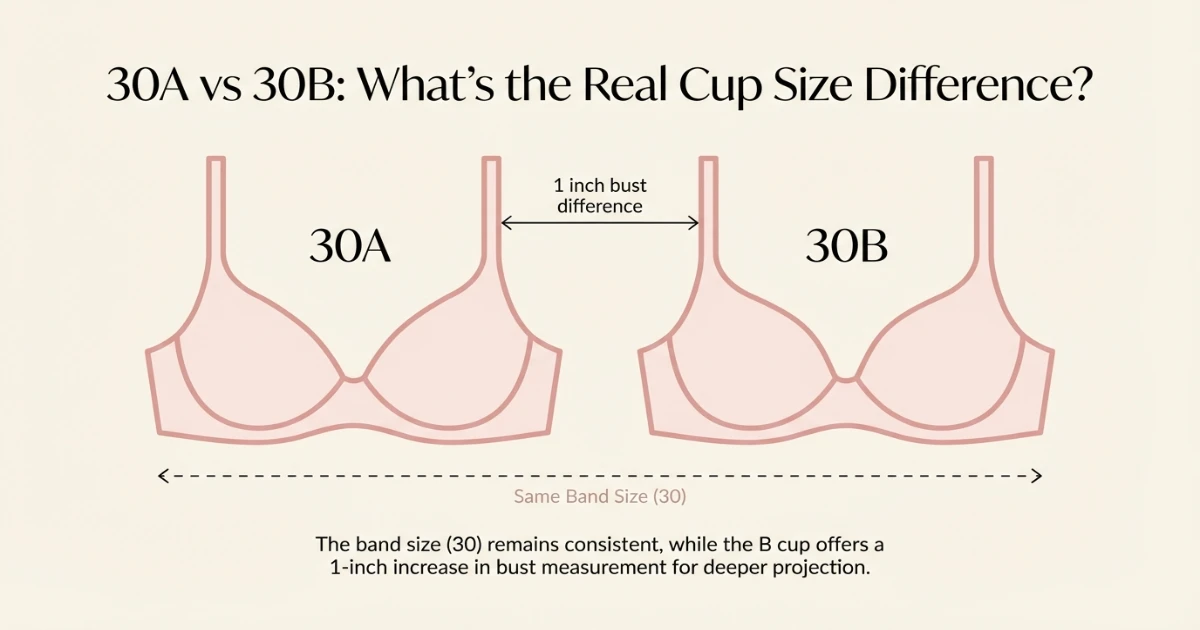
30B is one cup size larger than 30A. Both sizes share the same band size — a 30-inch underbust measurement — but a 30B has roughly one inch more bust volume than a 30A. That single inch translates to a noticeably different fit in coverage, cup fullness, and how the bra sits against your body.
Key Takeaways
- 30A and 30B share a 30-inch band — the difference is entirely in the cup.
- A 30B cup holds approximately one inch more bust projection than a 30A.
- Moving from A to B means roughly ~8–10% more cup volume for a 30-inch frame.
- A 30A typically has a bust measurement of about 31 inches; a 30B measures about 32 inches.
- Visible signs that you’ve outgrown a 30A include spillage over the top or sides of the cup.
- Signs that a 30B is too large include cup wrinkling, gaping, or fabric pulling away from your chest.
- Both sizes have sister sizes that give you the same cup volume with a different band fit.
Understanding Bra Cup Letters
Bra sizing can feel surprisingly confusing if you’ve never had it broken down clearly. The letter part of your bra size — A, B, C, D, and so on — is called the cup size, and it tells you how much breast volume the cup is designed to hold. But here’s what trips a lot of people up: cup letters don’t exist in isolation.
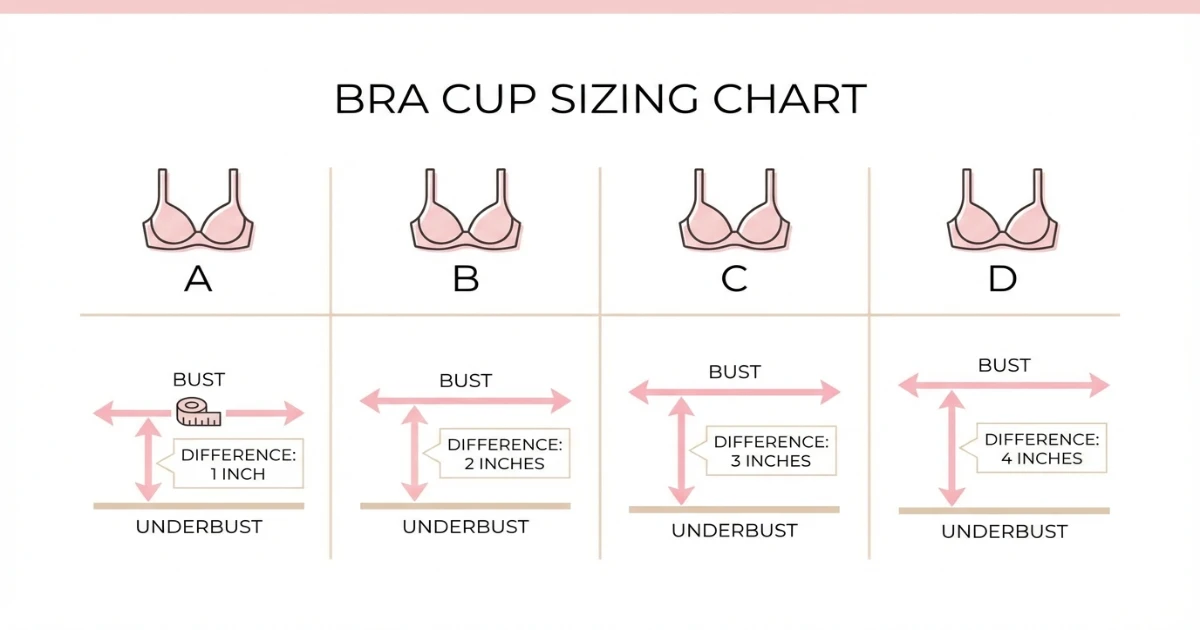
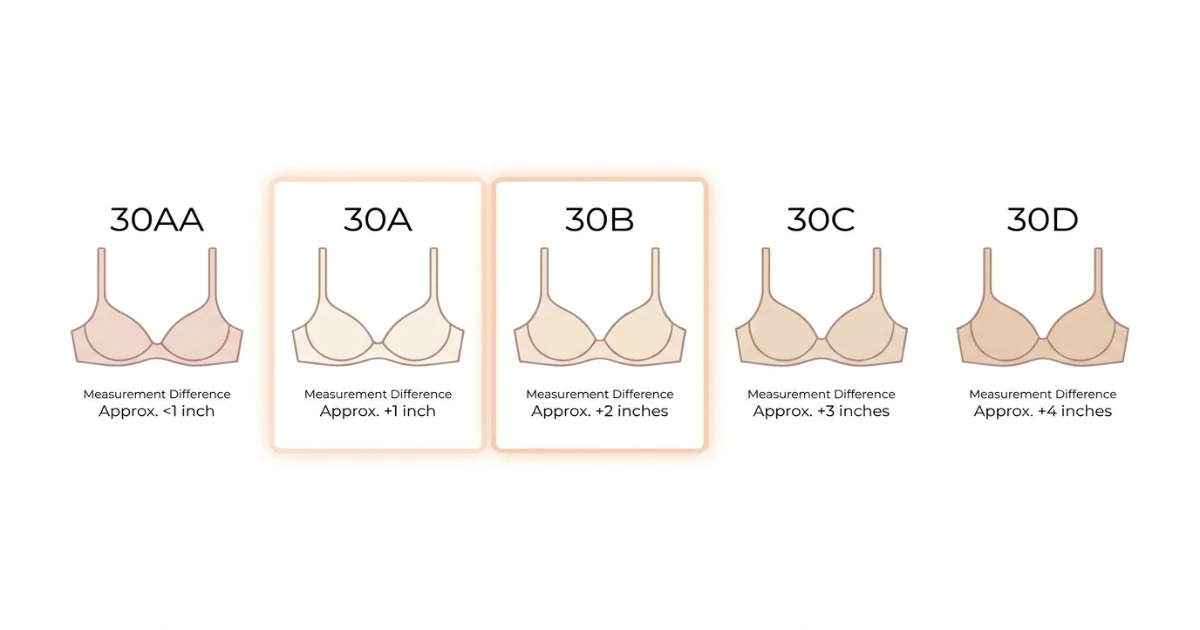
Cup size is always a relationship between your bust measurement and your band size. Each letter represents roughly a one-inch difference between the two. So an A cup means your bust is about one inch larger than your underbust. A B cup means it’s about two inches larger. That’s it — that’s the whole system.
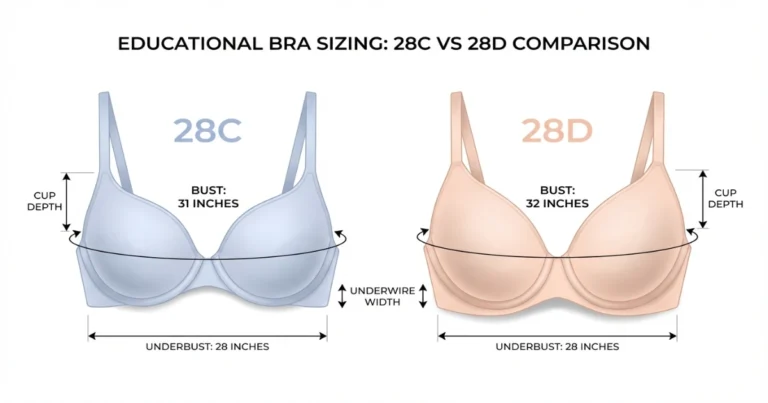
When the band number stays the same (in this case, 30), moving up one letter means your bust measurement has increased by one inch. So a 30A has a one-inch difference, and a 30B has a two-inch difference. Same band, more projection, more volume. The cups themselves are physically cut larger to accommodate that extra tissue.
It’s also worth knowing that a “B cup” in a 30 band is not the same volume as a “B cup” in a 36 band. Cup letters only describe a proportional difference — not an absolute size. This is why bra sizing gets interesting (and sometimes frustrating) the moment you compare across different band numbers. You can explore the full system on our bra size charts page.
Measurement Breakdown: 30A vs 30B by the Numbers
Let’s put actual numbers behind this. If you’ve measured yourself at home, or you’re trying to decode a fitting room experience, these figures will help you understand exactly where each size sits.
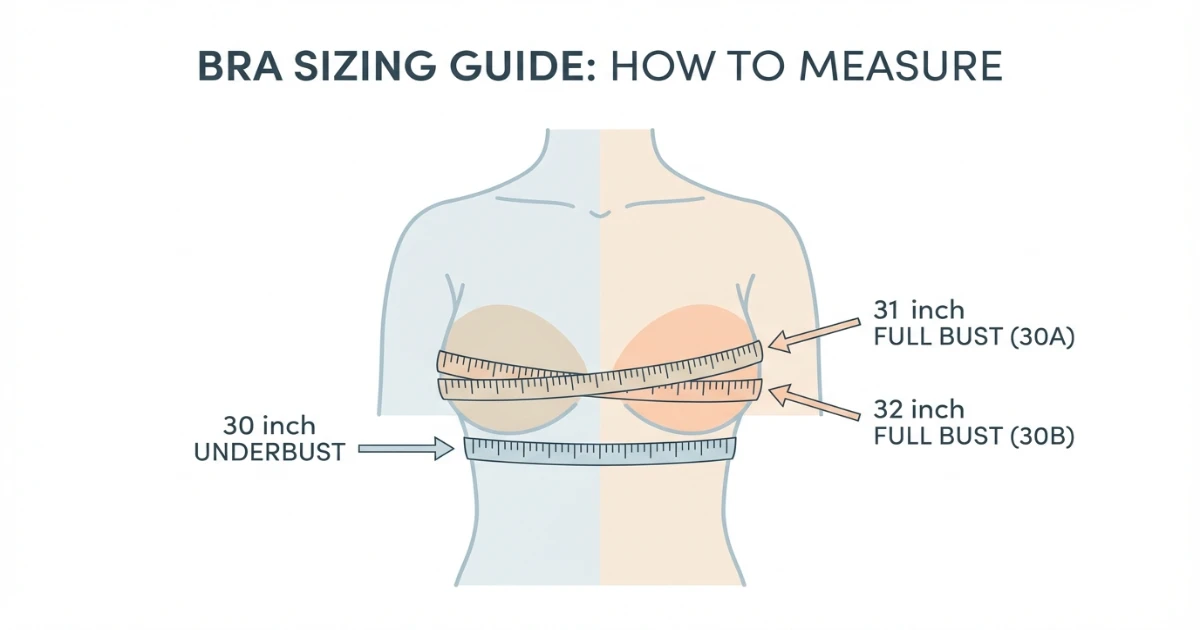
Both sizes start with the same underbust measurement. A 30-band bra is designed for someone who measures approximately 30 inches around the ribcage, just below the bust. Everything from there is determined by how much your full bust measurement exceeds that number.
30A
Band size: 30 inches (76 cm)
Underbust: ~30 in / ~76 cm
Full bust: ~31 in / ~79 cm
Bust–band difference: ~1 inch / ~2.5 cm
30B
Band size: 30 inches (76 cm)
Underbust: ~30 in / ~76 cm
Full bust: ~32 in / ~81 cm
Bust–band difference: ~2 inches / ~5 cm
So the difference between a 30A and a 30B comes down to that single extra inch — roughly 2.5 centimeters — in your full bust circumference. It may sound small, but on a 30-inch frame, that’s a meaningful change. Your ribcage is already quite narrow, so even small variations in breast tissue translate more visibly to cup fit than they would on a larger band size.
When measuring yourself, always measure your underbust snugly (but not so tight that it digs in) and your full bust loosely across the fullest point. The difference between those two numbers is your cup size. A 1-inch difference = A cup. A 2-inch difference = B cup. Learn more about the exact technique on our how to measure for a bra guide.
One thing to keep in mind: bra sizing isn’t perfectly standardized across every brand. Some brands run large, some run small, and certain styles are cut differently even within the same size. The measurements above reflect general US sizing conventions. Always factor in how a specific bra feels on your body, not just what the tag says.
Cup Volume Difference: How Much More Is a 30B?
Numbers tell one story, but volume is what you actually feel when you put on a bra. So how much bigger is a 30B cup compared to a 30A, in real terms?
Think of it this way: each cup size increase in a 30-band bra adds approximately 8–10% more cup volume. That’s meaningful on a petite frame. A 30B cup is roughly shaped to accommodate a small handful more of breast tissue than a 30A. You’d notice the difference in how much fabric sits against your chest, how much vertical coverage the cup offers, and whether the center gore (the piece between the cups) sits flat against your sternum.
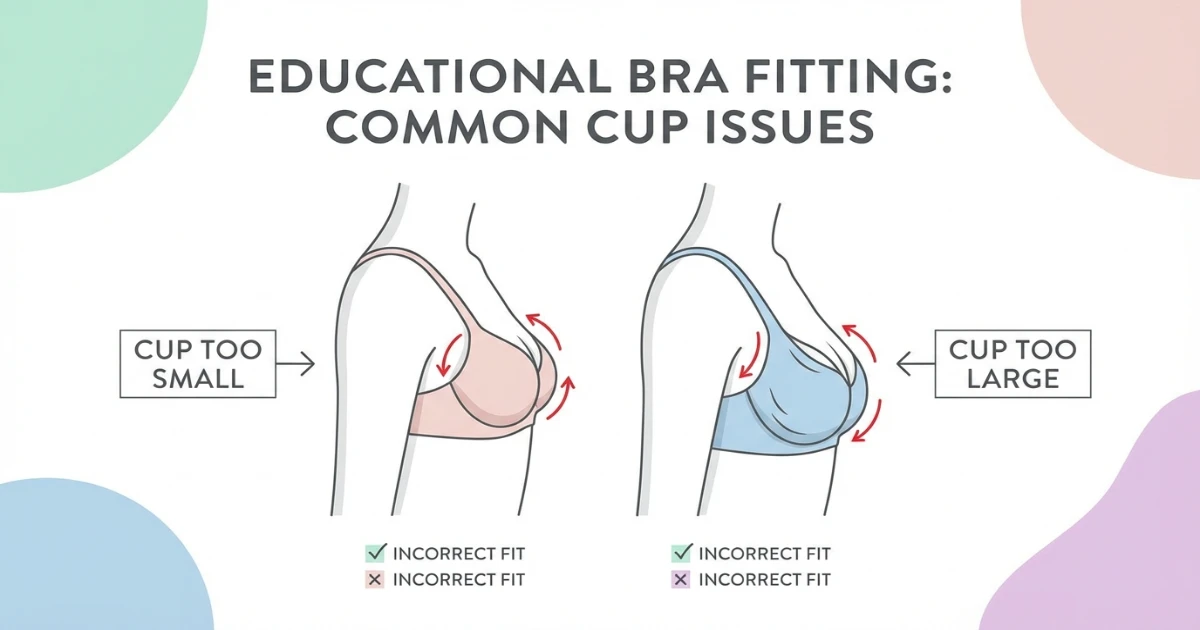
For most people with smaller frames, the visual difference between a 30A and 30B is subtle from the outside but quite noticeable in fit. A cup that’s one size too small will tend to cut into breast tissue at the top or sides. A cup that’s one size too large will wrinkle and gape, especially at the top of the cup near the underwire.
If you want a visual reference for how cup sizes scale across the full range of sizes, our cup size visuals page shows side-by-side comparisons that make it much easier to picture. You can also run your measurements through our bra size chart calculator to find your size instantly.
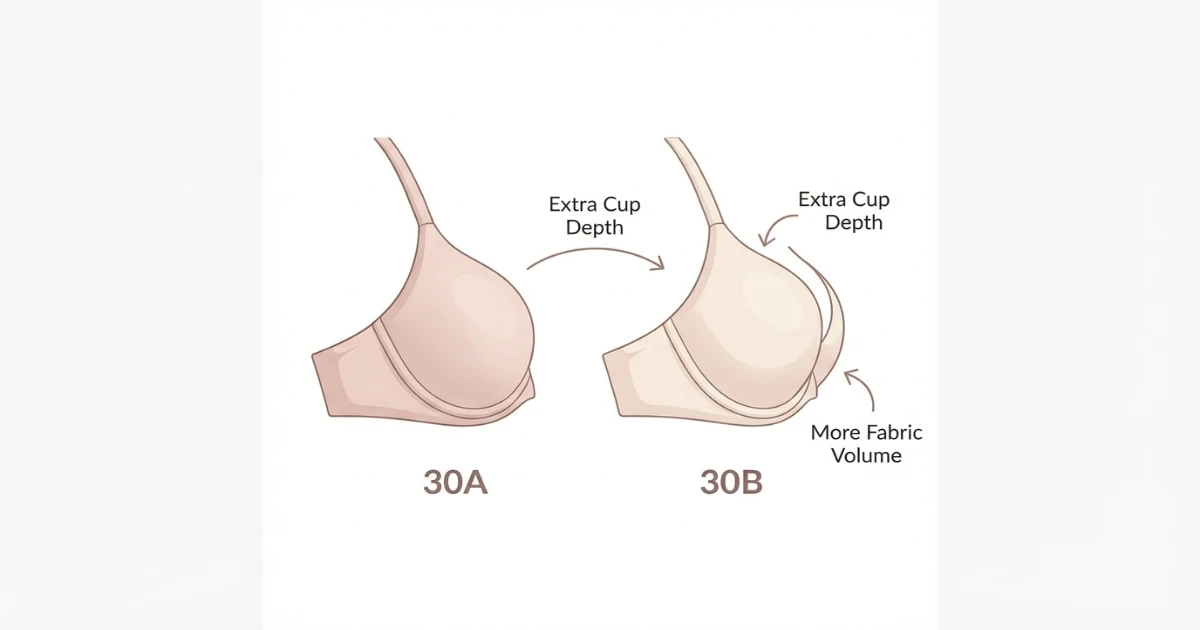
Another useful way to think about it: if you’ve ever tried on two bras in the same style and found that one feels snug while the other gapes slightly, you’ve experienced exactly this one-cup difference. The band hasn’t changed. The underwire width is essentially the same. The only variable is how deep the cup is cut.
Fit Differences You May Notice
Fit differences between 30A and 30B show up in very practical ways during daily wear. Here’s what to look for:
Cup Gaping (Sign of Too Much Cup)
If you’re in a 30B and you notice the top of the cup pulling away from your chest — especially when you lean forward — that’s gaping. It usually means your breast tissue isn’t filling the cup fully. This is a strong sign that a 30A might give you a smoother, more fitted silhouette.
Spillage (Sign of Too Little Cup)
Spillage is the opposite problem. If breast tissue is pushing over the top of your cups or squeezing out at the sides near the underwire, your current cup is too small. If you’re in a 30A and experiencing this, a 30B could resolve it without any change to your band.
Strap Pressure and Shoulder Dig
This is an indirect fit issue. When a bra cup is too small, the bra has to work harder — and the straps often compensate by pulling tighter to lift. That leads to shoulder grooves and discomfort. Sizing up from A to B can sometimes relieve strap tension, because the cups are actually supporting the load more effectively.
Underwire Position
In a well-fitted bra, the underwire sits flat against your ribcage and wraps around the full base of your breast without sitting on breast tissue. In a 30A that’s too small, the underwire may cut into the breast. In a 30B that’s too large, the underwire may sit too wide for your breast root.
Recognizing these fit signals is a skill — and it makes a huge difference in comfort. You can find a full visual guide to common bra fit issues on our bra fit problems page.
Who Should Choose 30A
Not everyone who wears a 30 band needs to size up to a B. A 30A is genuinely the right fit for plenty of people, and wearing a larger cup than you need doesn’t improve anything — it just creates fit problems in the other direction.
You’re likely a 30A if:
- Your bust measures about one inch more than your underbust (around 31 inches).
- You’ve tried a 30B and the top of the cup wrinkles or gapes when you put it on.
- You have a shallow breast shape — meaning your breast projects outward less than average, often sitting wider on the chest wall rather than forward.
- You have minimal projection and don’t need a deep cup to contain your breast tissue.
- The center gore of a 30B doesn’t sit flat against your sternum.
Breast shape matters a lot in cup selection. Two people with identical measurements can fit differently depending on whether their breast tissue is projected, wide-set, close-set, or shallow. Learn more about how shape affects fit on our breast shape identifier.
Who Should Choose 30B
A 30B is often the better choice when someone has outgrown their 30A — or when they’ve been wearing the wrong size to begin with. Many women with petite frames are actually under-cupped, because small band sizes in larger cups aren’t always easy to find in mainstream stores.
You’re likely a 30B if:
- Your full bust measures about two inches more than your underbust (around 32 inches).
- Breast tissue spills over the top or sides of your 30A cups.
- You have fuller breast tissue that fills the lower cup and needs more vertical coverage.
- The underwire of a 30A sits on breast tissue rather than flat on your ribcage.
- You feel like you need more cup coverage to feel supported through the day.
The difference between wearing the right cup and the wrong one can be dramatic — not just in comfort, but in posture and confidence too. If you’re not sure whether your current bra fits correctly, our bra fit guide walks through every checkpoint you should be looking for.
Sister Sizes Explained
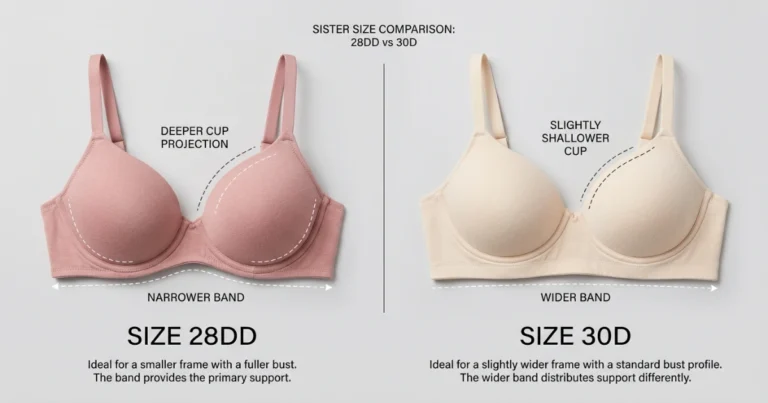
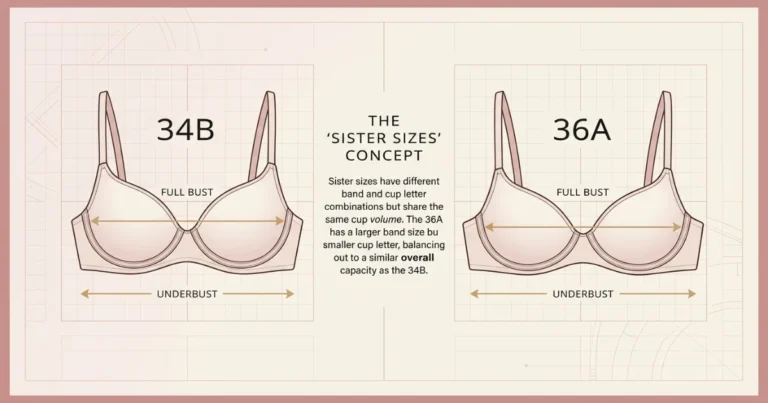
Sister sizes are one of the most useful concepts in bra fitting — and one of the least talked about. The idea is simple: as the band size changes by two inches, the cup letter adjusts to keep the same cup volume. So if you love how a bra fits in the cup but the band is a little too snug or too loose, you can move to a sister size instead of abandoning the style entirely.
30A Sister Sizes
- 28B — same cup volume, smaller/tighter band
- 32AA — same cup volume, larger/looser band
30B Sister Sizes
- 28C — same cup volume, smaller/tighter band
- 32A — same cup volume, larger/looser band
This comes in handy more often than you’d think. If you’re between band sizes — or if a brand’s 30-band runs a little large — trying the sister size can get you closer to the fit you want without changing your actual cup volume. It’s also useful for online shopping, where you can’t try before you buy.
Keep in mind that sister sizes aren’t identical to your “true” size — the band tension will feel different, which affects how the bra supports you overall. Use them as alternatives, not replacements. Explore all your options with our sister size guide or find your exact alternatives using the sister size bra calculator.
Quick Bra Fit Test
Not sure whether your current bra is the right size? Run through these steps right now — all you need is a soft measuring tape and two minutes.
- Put on your most comfortable bra and stand in front of a mirror.
- Check the band: it should sit horizontally all the way around without riding up at the back.
- Check the cups: no wrinkling or excess fabric (too large), no spillage or bulging (too small).
- Check the center gore: it should sit flat against your sternum, not floating away from your chest.
- Check the underwire: it should encircle your breast fully without sitting on any breast tissue.
- Check the straps: they should stay up with two fingers of slack — not digging in, not sliding off.
- Measure your underbust (snug) and full bust (relaxed, over the fullest point). Subtract to find your cup difference.
Still unsure about your bra size? Try our AI-powered bra size calculator for a personalized recommendation in seconds.
Try the AI Bra Size Calculator →30A vs 30B: Side-by-Side Comparison
| Feature | 30A | 30B |
|---|---|---|
| Cup volume | Smaller — ~1 in bust–band difference | Larger — ~2 in bust–band difference |
| Full bust measurement | ~31 in / 79 cm | ~32 in / 81 cm |
| Support level | Good for minimal tissue | Better for fuller projection |
| Coverage | Less vertical coverage | More vertical coverage |
| Spillage risk | Higher if tissue is fuller | Low for appropriate breast size |
| Gaping risk | Low for appropriate breast size | Higher if tissue is minimal |
| Comfort | Best for shallow / minimal projection | Best for fuller / projected tissue |
| Best breast shapes | Shallow, east-west, wide-set | Round, projected, full, close-set |
| Sister sizes | 28B / 32AA | 28C / 32A |
People Also Ask
Yes. A 30B is one cup size larger than a 30A. Both share the same 30-inch band measurement, but a 30B has approximately one inch more bust projection — meaning the cup is cut deeper and holds more volume.
In standard US sizing, a B cup is approximately one inch (about 2.5 cm) larger in bust circumference than an A cup, assuming the same band size. This translates to roughly 8–10% more cup volume on a 30-inch frame. The difference is subtle in measurement terms but noticeable in how the bra fits and feels.
No. A 30B is considered a small bra size overall. The 30-inch band indicates a narrow ribcage, and a B cup is the second-smallest cup letter. Together, they describe someone with a petite frame and modest breast volume. Sizes like 30D or 30DD are considered larger within the 30-band range.
The sister sizes of 30A are 28B (same cup volume, smaller band) and 32AA (same cup volume, larger band). Sister sizes are useful when a style doesn’t come in your exact size or when you’re between band sizes.
A cups can feel too small if your breast tissue has grown, if you’ve been wearing the wrong size to begin with, or if the specific bra style runs smaller than average. Breast volume can also change with weight fluctuations, hormonal shifts, or pregnancy. If your 30A cups consistently show spillage or underwire displacement, a 30B is worth trying.
Yes, but only if the 30B fits correctly. Wearing a 30B when your actual size is 30A means you’ll likely experience cup gaping, a center gore that doesn’t lie flat, and a less supportive fit overall. Cup size should match your breast volume — not be chosen larger “just in case.” A proper fit always starts with an accurate measurement.
Yes — cup letters are relative to band size, not absolute measurements. A 30B and a 36B are both labeled “B cup,” but the 36B holds significantly more volume because the cup is proportionally larger for a wider frame. This is why two people with the same letter cup but different band sizes will look and feel very different in terms of actual breast volume.
A B cup means your full bust measurement is approximately two inches larger than your underbust measurement. It’s the second cup size in the standard US/UK sizing system (after A), and it indicates a modest but defined difference between ribcage and bust. On a 30 band, this translates to a full bust of roughly 32 inches.
Related Bra Size Comparisons
Now that you understand the difference between 30A and 30B, you might find it helpful to explore how other nearby sizes compare. Sizing doesn’t exist in isolation — understanding the full picture makes it much easier to find bras that actually fit well across different brands and styles.
Whether you’re curious about how 30B compares to 32A, how A cups differ across band sizes, or how to visualize cup volume differences at a glance, we’ve put together a full library of comparisons to help. Visit our breast size comparison hub to explore more side-by-side breakdowns.
You can also use our bra size chart calculator or jump straight into our AI-powered smart fit calculator for a fully personalized recommendation based on your exact measurements.