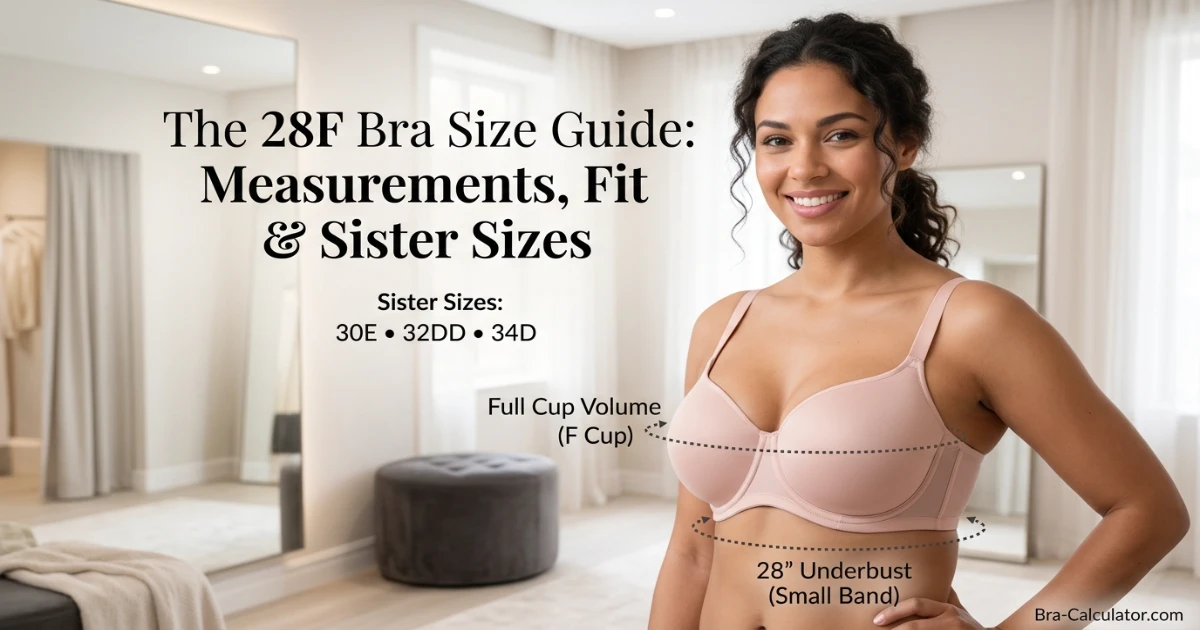
A UK 28F bra size means your underbust is around 23–24 inches (58–61 cm) and your full bust is about 31–32 inches (79–81 cm). That’s an 8‑inch difference — a distinctly projected shape on a tiny band. Despite the F cup, a 28F is a small overall volume (similar to a 34D). A well‑fitted 28F bra will grip your narrow ribcage tightly, lift and center your tissue, and eliminate all the slipping and gaping of a larger band.
28F at a Glance
| Attribute | Detail |
|---|---|
| Band Size | 28 inches (underbust 23–24″ / 58–61 cm) |
| Full Bust Measurement | 31–32 inches (79–81 cm) |
| Cup Difference | ~8 inches (~20.3 cm) — UK F cup |
| Sister Sizes (UK) | 26FF (tighter band) · 30E (looser band) |
| Likely US Equivalent | 28G (check brand chart) |
| EU Size | 60G |
| AU / NZ Size | 6F |
| S/M/L Equivalent | Petite sized support |
| Cup Volume Equivalent | Similar to 26FF and 30E |
What Is a 28F Bra Size?
28F is a UK size that pairs an extremely narrow 28 band with an F cup, indicating 8 inches of forward projection. In everyday terms, this is a petite ribcage with a visibly rounded bust. The cup letter F often surprises people who associate it with “full‑bust,” but on a 28 band, it’s still a compact volume — think of it as the small‑band equivalent of a 30E, 32DD, or 34D. The key is that the band must be tight enough to support this depth without shifting.
The 28 band must be very secure. At this cup depth, even moderate breast weight can pull a loose band up your back. A true 28 band stays horizontal all day and acts as the primary support structure. You may initially find it firm, but that sensation subsides as the bra breaks in. A 30 band might seem more comfortable initially, but it will ride up, tilt the cups, and force the straps to carry the weight — causing shoulder pain and constant readjustment. Trust the 28 if your underbust measures 23–24 inches.
The F cup requires adequate depth and projection. Molded foam cups often lack the immediate depth at the underwire that an 8‑inch difference demands, leading to wrinkling at the bottom or a flattened shape. Seamed balconettes, side‑support bras, and stretch‑lace cups are the best solutions. They shape the tissue forward and up, create a natural rounded silhouette, and adapt to breast shape variations. Many UK brands specialize in this size range, and you’ll find plenty of beautiful, supportive options in 28F.
If you’ve previously worn a 30E, 32DD, or even 34C, moving to a 28F may change your entire posture and comfort level. The band’s firm grip redistributes weight onto the ribcage, where it belongs, and the cup’s correct depth eliminates gaping and spillage simultaneously.
28F Bra Measurements
Take these measurements against bare skin with a soft tape. Stand in front of a mirror, breathe normally, and pull the tape snug (not tight) for the bust. For the underbust, pull it to the firmness you’d like a bra band to feel.
8‑inch difference = UK F cup
Wrap the tape around your ribcage directly under your bust. Keep it parallel and pull it to the firmness you’d want a band to feel. For 28F, the measurement is usually 23–24 inches. If you measure 25 inches or more, start with a 30 band.
Place the tape over the fullest part of your bust, typically at nipple level, without flattening the tissue. For 28F, the reading is typically 31–32 inches. If one breast is larger, use the larger measurement.
Each inch of difference equals one cup letter in the UK sequence: 8 inches = F. If your difference is 7 inches, you’re a 28E; 9 inches means 28FF. The UK system uses double letters, so FF follows F.
Put the bra on the loosest hooks. Scoop all breast tissue forward into the cup. The band should sit level and not ride up; the gore (center piece) must lie flat on your sternum. The cups should be completely filled — no wrinkles, no overflow. Straps must stay put without digging.
What Does 28F Look Like?
A 28F bust is petite overall but noticeably projected in profile. The breasts are typically round and sit relatively high on the chest wall due to the small band. On a slender frame, this creates a pretty, balanced silhouette — what might be called “small but shapely.” The cleavage is natural rather than dramatic, and the bust doesn’t dominate the frame. In clothing, a well‑fitted 28F bra creates a smooth, lifted line without bulging or flattening.

Seamed Balconette Bra — Deep Cups & Secure Band for 28F
- Multi‑part cup provides immediate depth at the underwire
- Vertical seams lift and round the shape
- Firm 28 band anchors on narrow ribcages
- Open neckline suits most top styles

Wireless Seamless Bralette — Gentle Hold for 28F
- Soft, stretch fabric adapts to your projection
- No wires; ideal for relaxed days
- Wide underband for light anchoring
- Select XXS or Petite for a snug ribcage fit
Narrow Torso
28F on a slim figure looks softly rounded and perfectly proportioned. The band must be very snug to stay level.
Firm 28 bandDefined Upper Body
Even with broader shoulders, the small ribcage requires a 28 band. A racerback or convertible style adds security.
Racerback optionLower Fullness
Tissue concentrated below requires a cup with deep lower projection. A seamed balconette is the ideal shape.
Seamed cupRound & Perky
Can wear a wide variety of styles, including half‑cups and lightly padded bras, as long as cup depth is adequate.
Demi or half‑cupIs 28F Considered Large?
No. The F cup paired with a 28 band is still a small overall volume — roughly equivalent to a 34D, which most people consider a medium or small‑medium size. The letter F simply indicates an 8‑inch difference from the underbust, not a massive breast. The perception of F as “large” comes from seeing it on much larger bands. A 28F wearer is typically petite and slim, with a defined but compact bust.
28F is a perfectly normal, petite size. Don’t let the letter fool you. The right bra will make you look lifted and proportionate, not top‑heavy.
If a 28F feels too snug in the cup, try a 28FF. If the band feels impossibly tight, first try the band backwards to rule out cup interference, then consider a 30E sister size.
28F Sister Sizes
Sister sizes preserve cup volume while letting you adjust the band. For 28F, going down a band gives 26FF (one cup larger, tighter band). Going up a band gives 30E (one cup smaller, looser band). Remember that wire width and strap placement may shift slightly across sister sizes.
Rule: Up one band → Down one cup (28F → 30E) | Rule: Down one band → Up one cup (28F → 26FF) | Result: Cup volume remains very similar.
| Smaller Band | Reference Size | Larger Band |
|---|---|---|
| 26FF | 28F — You | 30E |
| 24G | 28F | 32DD |
28F vs Other Sizes
This quick comparison clarifies the difference between 28F and its closest neighbors.
- One cup larger than 28E
- 8″ difference vs 7″
- Better if 28E causes quad boob or wires cut in
- Same band, less depth
- Good if 28F cups are too deep or gape
- One cup smaller than 28FF
- Fits if cups fill smoothly
- Same band, more depth (9″ difference)
- Try if 28F spills or gore floats
- Firmer band for 23–24″ underbust
- Better support and anchorage
- Sister size — same cup volume
- Looser band; only if 28 band is painfully tight
- Standard 28 band
- Starting point for most
- Tighter sister size
- Same cup volume
- Use if 28 band rides up or feels loose
Best Bra Styles for 28F
28F is a sweet spot for many UK full‑bust brands. You’ll find a wide range of beautiful, supportive bras designed specifically for this proportion. Seamed balconettes, side‑support bras, and stretch‑lace full cups will be your best allies. Avoid shallow, seamless foam domes that lack projection.
Multi‑part cup construction gives excellent depth and a lifted, rounded look. Works for most breast shapes.
Brings tissue forward, creating a narrower front silhouette. Very comfortable for daily wear.
Stretch lace on top accommodates size changes and asymmetry without cutting in.
If the wires are wide enough, a half‑cup can look beautiful on a 28F. Check projection at the wire.
A single‑piece foam cup may lack immediate depth, causing wrinkling and a flat, wide appearance.
Very sheer, unstructured mesh cannot support an 8‑inch projection for long. Look for stable seams and bands.
Common Fit Problems with 28F
The band is too big for your underbust. A 30 or 32 band will not stay level on a 23–24″ ribcage.
Cup is too small or too closed on top. Your 8‑inch projection may need a more open neckline or a larger cup.
The cup lacks immediate projection at the wire. The breast pushes the bra downward.
The wires are too narrow for your root, or the cup is too small. Tissue escapes at the sides.
International Size Conversion for 28F
In the UK, this is a straightforward 28F. US brands usually label it as 28G (though some call it 28DDD or use non‑standard letters). European size is 60G. Australian is 6F. When buying a US brand, count cup sizes up from D: UK D‑DD‑E‑F means 3 cups above D. Ensure the US brand’s alphabet matches that count.
To be safe, always buy UK‑sized bras in your UK size. If you must order a US brand, use the Global Bra Size Converter to verify before checkout.
Frequently Asked Questions
Usually a US 28G. Some brands may label it differently; always count cup letters from D.
An underbust around 23–24 inches and a full bust around 31–32 inches — an 8‑inch difference.
Yes, the overall volume is small (comparable to a 34D). It simply has more projection on a narrow frame.
UK sister sizes are 26FF (tighter) and 30E (looser). They keep similar cup volume.
Choose 28F if the cups fit smoothly. Choose 28FF if you have spillage, a floating gore, or wire discomfort.
UK brands like Panache, Freya, Cleo, and Curvy Kate. Online at Brastop, Bare Necessities, Figleaves, or Amazon. Search for “28F bra”.
Lock In Your Perfect 28F Fit
Measure accurately to find out if 28F, 26FF, 30E, or a nearby size is your ultimate comfortable match.