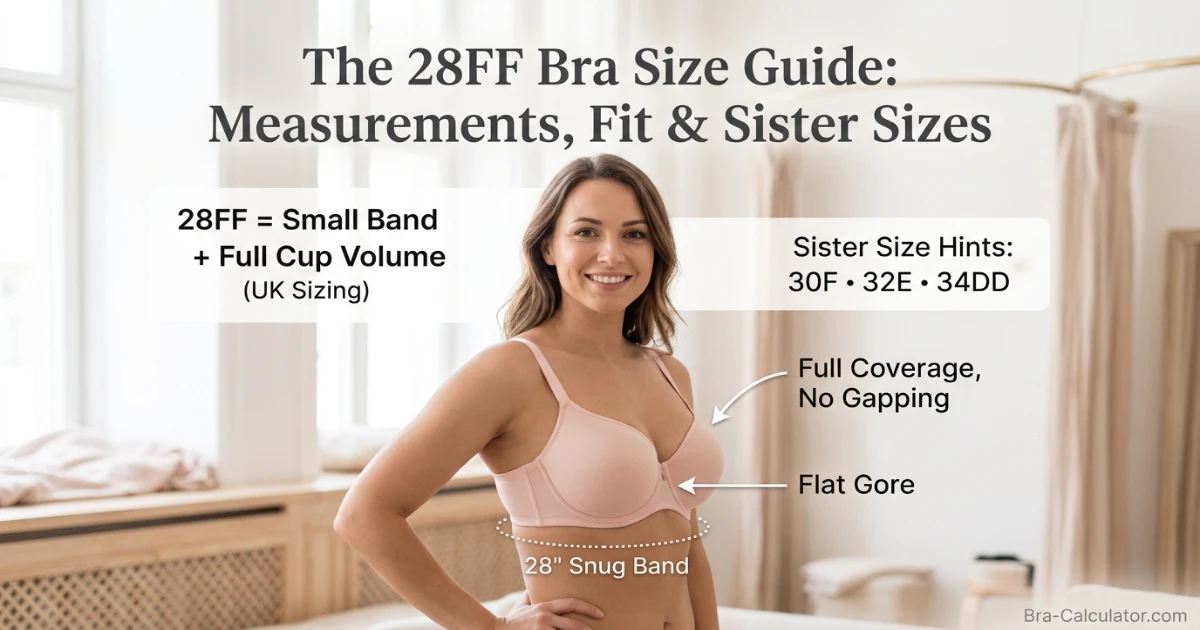
A UK 28FF bra size indicates an underbust of about 23–24 inches (58–61 cm) and a full bust of about 32–33 inches (81–84 cm). That’s a 9‑inch difference — a notably projected shape on the narrowest standard band. Despite the double letter, a 28FF is a small overall volume (similar to a 34DD or 32E). The right 28FF bra will grip your ribcage securely, provide deep enough cups for your projection, and completely eliminate the slipping, gaping, and digging of larger band sizes.
28FF at a Glance
| Attribute | Detail |
|---|---|
| Band Size | 28 inches (underbust 23–24″ / 58–61 cm) |
| Full Bust Measurement | 32–33 inches (81–84 cm) |
| Cup Difference | ~9 inches (~22.9 cm) — UK FF cup |
| Sister Sizes (UK) | 26G (tighter band) · 30F (looser band) |
| Likely US Equivalent | 28H (check brand chart) |
| EU Size | 60H |
| AU / NZ Size | 6FF |
| S/M/L Equivalent | Petite support sizing |
| Cup Volume Equivalent | Similar to 26G and 30F |
What Is a 28FF Bra Size?
28FF is a UK size that combines the smallest standard band with an FF cup, indicating a 9‑inch projection from the ribcage. In the UK cup sequence, FF is the 9th cup size — placing it at the beginning of the “full‑bust” range on a 28 band. But remember, band size defines the scale; a 28FF holds much less volume than a 34FF. This is still a petite torso with a curvy, defined bust.
The 28 band is critical for support. At this projection level, any looseness in the band will cause the weight of the breasts to pull the band up your back, transferring strain to your shoulders. A firm 28 band that stays horizontal is non‑negotiable. If you’ve been wearing a 30F or 32E, you’ll be amazed at how much lighter and more secure a 28FF feels once the band is correctly tight.
The FF cup provides generous depth. The cups need to project forward without collapsing or pushing tissue sideways. Seamed cups, especially multi‑part balconettes and side‑support styles, are essential. They lift from the bottom, contain the side tissue, and create a beautifully rounded, front‑facing profile. Moulded foam cups often lack the immediate depth needed at the wire, leading to wrinkles and a flattened shape — they’re best avoided in this size unless specifically designed for projection.
Many who measure 28FF have been fitted into 32DD or 30E, where the band was too large and the cup depth mismatched. Once you try a true 28FF, the difference is night and day: no more adjusting straps, no more band riding up, and a silhouette that looks lifted and naturally proportioned. Your shoulders will thank you.
28FF Bra Measurements
Take these measurements on bare skin, standing in front of a mirror. Use a flexible tape, keep it level, and don’t compress the bust tissue.
9‑inch difference = UK FF cup
Wrap the tape around your ribcage directly under your bust. Pull it as tight as a supportive bra band should feel. For 28FF, this is 23–24 inches. If your measurement is 25 inches or greater, a 30 band may be more comfortable.
Place the tape over the fullest part of your bust, keeping it parallel to the floor. Don’t indent the tissue. The measurement for 28FF is typically 32–33 inches.
Each inch of difference equals one cup letter. 9 inches = FF in UK sizing. If you have an 8‑inch difference, try 28F; 10 inches, try 28G.
Fasten the bra on the loosest hook. Scoop and swoop all tissue into the cup. The band must sit level, the gore must tack, and the cups must be completely filled with no overflow. If the band rides up, try 26G.
What Does 28FF Look Like?
A 28FF bust looks distinctly projected and rounded. On a slim, petite frame, it can create a noticeable curve, often appearing fuller than it actually measures because the band is so small. The breasts typically sit higher on the chest, giving a perky, balanced appearance. In a well‑fitted seamed bra, the silhouette is forward‑facing and lifted, not wide or heavy. Many 28FF wearers describe themselves as “petite but curvy” — and a correct bra reveals that beautiful shape rather than disguising or squashing it.

Seamed Balconette Bra — Deep Projection & Secure Band
- Multi‑part cup with deep lower panel for 9‑inch projection
- Vertical seams lift and center the bust
- Firm 28 band stays put on narrow ribs
- Open neckline suitable under most clothing

Wireless Seamless Bralette — Gentle Support for 28FF
- Stretchy, seamless fabric conforms to your projection
- No wires; perfect for relaxation or low‑impact days
- Wide underband for light, even hold
- Choose XXS or Petite for a snug band fit
Narrow Build
28FF on a very slender figure looks curvaceous and balanced. A very firm 28 band is essential to prevent movement.
Snug 28 bandDefined Shoulders
Even with a sporty upper body, the small ribcage needs a 28 band. A racerback or convertible style secures the fit during movement.
Racerback clipBottom‑Heavy Shape
Projected lower tissue requires a cup with deep immediate projection at the wire. A seamed balconette is the gold standard.
Seamed cupUpper Fullness
Tissue that is full above the nipple needs an open neckline. A stretch‑lace balconette or half‑cup prevents cutting in.
Stretch lace topIs 28FF Considered Big?
No, not in absolute terms. A 28FF holds the same total volume as a 30F, 32E, or 34DD — all of which are generally considered small to medium. The FF letter simply reflects a 9‑inch difference on a very narrow band. The “large cup” myth persists because many people are in the wrong band size. If you’ve been wearing a 34C or 32D and discover you’re a 28FF, it’s not that you’ve gained size — it’s that your band was too loose and your cup too small, obscuring your true shape. A 28FF bra properly contains and lifts, often making the bust look more compact and defined, not larger.
28FF is a natural, proportionate size on a small frame. The right bra will lift and define, never make you feel overwhelmed. If your bra feels heavy or painful, the band is almost certainly to blame — not your cup letter.
If 28FF cups feel too small, try 28G. If the band is uncomfortably tight, first check the cup fit (a too‑small cup can make the band feel tight). Then consider a 30F sister size.
28FF Sister Sizes
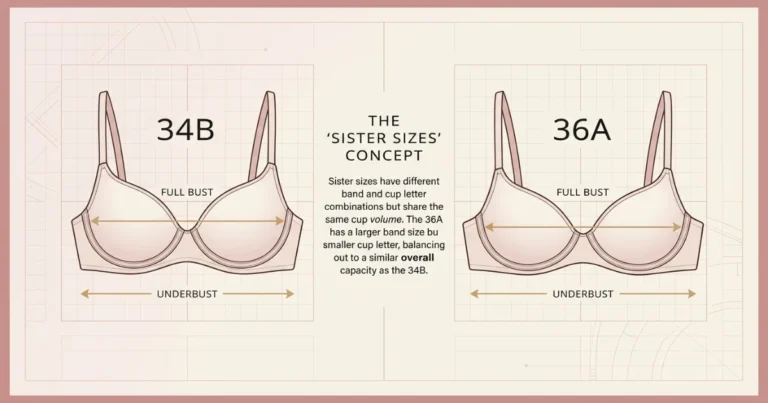
Sister sizing allows band adjustment while keeping cup volume constant. For 28FF, the tighter sister is 26G (down one band, up one cup), and the looser sister is 30F (up one band, down one cup). Keep in mind that as the band changes, the wire width and strap positioning may shift slightly, so always try on the specific bra.
Rule: Up one band → Down one cup (28FF → 30F) | Rule: Down one band → Up one cup (28FF → 26G) | Result: Cup volume remains very similar.
| Smaller Band | Reference Size | Larger Band |
|---|---|---|
| 26G | 28FF — You | 30F |
| 24GG | 28FF | 32E |
28FF vs Other Sizes
This detailed comparison clears up confusion between 28FF and its adjacent sizes.
- One cup larger than 28F
- 9″ difference vs 8″
- Fixes spillage, quad boob, and floating gore from 28F
- Same band, less depth
- Good if 28FF cups wrinkle, gape, or feel too roomy
- One cup smaller than 28G
- Fits if cups are completely filled without overflow
- Same band, more depth (10″ difference)
- Try if 28FF still causes spillage or wire digging
- Firmer, more supportive band
- Ideal if your underbust is 23–24″
- May feel snug at first, but breaks in
- Sister size — same cup volume
- Looser band; only use if 28 feels painfully tight despite correct cup
- Standard 28 band
- Comfortable starting point
- Tighter sister size
- Same cup volume
- Use if 28 band still rides up or feels loose
Best Bra Styles for 28FF
28FF is well‑catered for by UK full‑bust brands, with a great variety of seamed, supportive bras. Look for multi‑part cups, side support, and firm power‑mesh wings. Avoid shallow, single‑piece foam cups — they can’t accommodate 9 inches of projection without wrinkling or collapsing.
Deep lower cup and vertical seams give a lifted, rounded shape. Works for most breast shapes.
Side panels bring tissue forward, creating a narrower, more centered silhouette.
Stretch lace top accommodates hormonal changes and asymmetry without cutting in. Deep lower section holds firm.
If the lower cup is deep enough, a half‑cup can be beautiful on 28FF. Check wire width.
A single layer of rigid foam almost never has enough space at the wire for a 9‑inch difference.
Extremely sheer mesh without structural seams cannot support FF projection for long wear.
Common Fit Problems with 28FF
Band is too large for your 23–24″ underbust. A 30 or 32 band will never stay level.
The cup is too small or too closed on top. The 9‑inch projection may need a 10‑inch cup.
The cup lacks immediate projection at the wire. The breast pushes the bra out of the breast fold.
Wires are too narrow, or the cup is too small. Side tissue isn’t being fully contained.
International Size Conversion for 28FF
The UK uses FF as a distinct cup size. Most US brands skip it and label this volume as 28H. European size is 60H; Australian/NZ is 6FF. To convert safely, count the number of cup sizes from D. In UK, 28FF is 4 cups above D (D‑DD‑E‑F‑FF). In a US brand, find the 4th cup above D in their alphabet — often labelled H.
When ordering from a US brand, don’t assume “H” equals UK FF — some brands compress the alphabet. Use the Global Bra Size Converter to cross‑reference.
Frequently Asked Questions
Typically a US 28H, but check the brand’s specific cup progression. Always count the number of cups from D.
An underbust of 23–24 inches and a full bust of 32–33 inches — a 9‑inch difference.
Yes, the total volume is small to medium (comparable to a 34DD). It just has more projection on a tiny band.
UK sister sizes are 26G (tighter) and 30F (looser). They keep the cup volume similar.
Choose 28FF if the cups fit smoothly with no overflow. Choose 28G if you have quad boob, wire digging, or a floating gore.
Online retailers: Brastop, Bare Necessities, Figleaves, Amazon. UK brands: Panache, Freya, Cleo, Curvy Kate. Search “28FF bra”.
Find Your Perfect 28FF Fit
Use accurate measurements to confirm whether 28FF, 26G, 30F, or a nearby size is your most comfortable, supportive match.