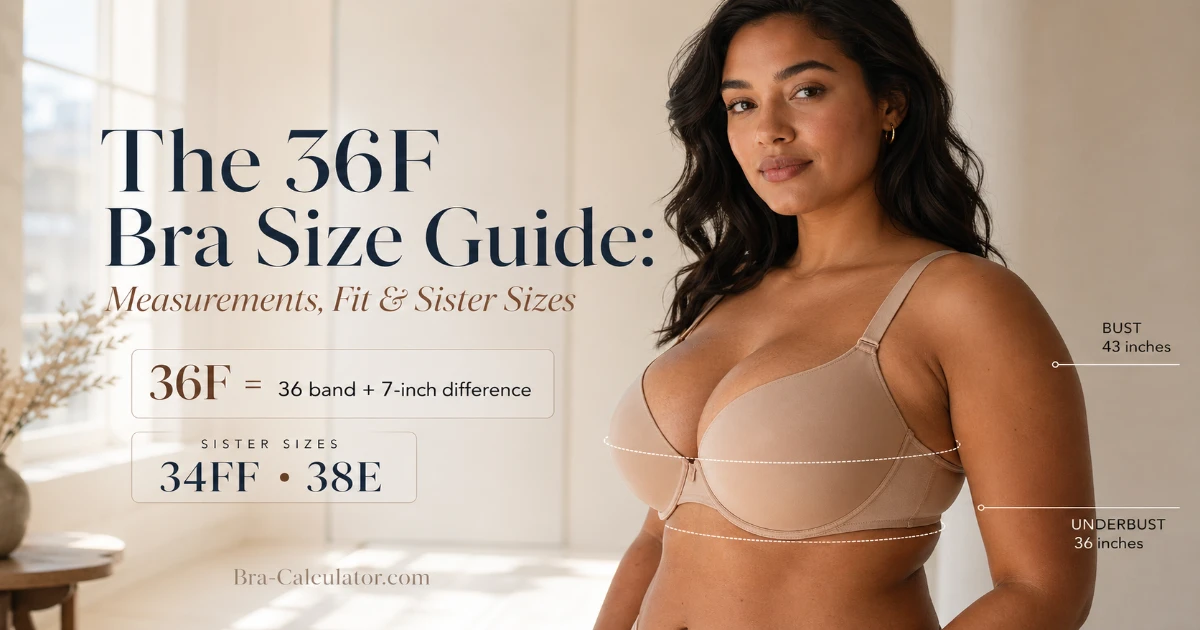
A 36F bra size usually means your underbust measures approximately 31–32 inches (79–81 cm) and your full bust measures around 38–39 inches (97–99 cm) — about a 7-inch difference. This makes 36F a fuller-bust size with strong cup depth, visible projection, and more support needs than 36DDD / 36E. The 36 band supports the ribcage, while the F cup gives enough depth to fully contain projected or fuller breast tissue.
36F at a Glance
| Attribute | Detail |
|---|---|
| Band Size | 36 inches (underbust 31–32″ / 79–81 cm) |
| Full Bust Measurement | 38–39 inches (97–99 cm) |
| Cup Difference | ~7 inches (~17.5 cm) — F cup level |
| Sister Sizes | 34G (tighter band) · 38E (looser band) |
| US Size | 36G in some US charts / 36F in others |
| UK Size | 36F |
| EU Size | 80G or 80F depending on brand system |
| AU / NZ Size | 14F |
| S/M/L Equivalent | Usually fuller-bust specific sizing |
| Cup Volume Equivalent | Similar to 34G and 38E |
What Is a 36F Bra Size?
36F is a fuller-bust bra size that combines a medium-to-wide 36 band with a deep F cup. In practical fitting terms, this means the ribcage measurement sits around 31–32 inches, while the bust measurement is usually around 38–39 inches. The result is a full, projected size that needs more structure than smaller cup sizes.
The biggest mistake people make with 36F is judging it by the letter alone. An F cup does not exist in isolation. A 30F, 34F, 36F, and 40F are not the same physical cup volume. Cup volume increases as band size increases. That is why a 36F is not simply “an F cup” — it is an F cup built on a 36 band, which makes it fuller than an F on a smaller band and smaller than an F on a larger band.
The number 36 is the band size. This is the foundation of support. For most people, a 36 band corresponds to a snug underbust of about 31–32 inches. At 36F, the band has to do serious work. It should sit level around the body, feel firm on the loosest hook when new, and provide most of the lift. If the band is loose, the straps will dig into the shoulders because they are forced to carry breast weight that the band should be carrying.
The letter F describes cup depth. On a 36 band, F cup depth generally reflects around a 7-inch difference between underbust and full bust. This makes 36F visibly fuller than 36DDD / 36E and one cup smaller than 36G in many sizing systems. It is a size where shallow molded cups often fail because they do not offer enough depth at the center, lower cup, or side cup.
For SEO and real user intent, the most important answer is this: 36F is a full-bust size, but it is not abnormal, rare, or impossible to fit. It simply needs better bra construction. Many people who think they are “hard to fit” are actually wearing a sister size with the wrong band, a cup that is too shallow, or a bra style made for a smaller bust shape.
36F Bra Measurements
To confirm 36F, measure two things: your snug underbust and your full bust. The underbust gives the band. The difference between the bust and underbust gives the cup depth.
Difference = F Cup Level (~7 in)
Wrap a soft measuring tape snugly around your ribcage directly beneath your breasts. Keep the tape level. For a 36F, this usually reads around 31–32 inches.
Measure around the fullest part of your bust without compressing breast tissue. For 36F, this usually reads around 38–39 inches.
Subtract underbust from full bust. Around 7 inches of difference usually points to F cup level on a 36 band.
The band should stay level, cups should fully contain tissue, and straps should rest comfortably. At 36F, shoulder pain often means the band or cup shape is wrong.
What Does 36F Look Like?
A 36F usually looks full, rounded, and projected. It has more visible bust presence than 36DD or 36DDD / 36E, but the way it appears changes dramatically from body to body. A tall person with a broader ribcage may look balanced in 36F, while a shorter person with a smaller upper body may look much fuller in the same size.
This is why “what does 36F look like?” has no single visual answer. Breast root width, tissue density, spacing, fullness distribution, posture, and bra shape all change the outcome. A 36F in a deep balconette can look lifted and compact. The same size in a shallow molded cup can look flattened, wide, and uncomfortable.

Full-Support Bra — Lift, Containment & Comfort for 36F
- Designed for deeper cup volume and fuller-bust support
- Helps contain side tissue and reduce bounce
- Best with a firm band, wider straps, and deep cups
- Ideal when shallow molded cups spill or collapse
Fuller Frame
On a fuller frame, 36F can look naturally proportionate while still giving a strong, rounded bust line. Supportive bras keep the shape lifted instead of heavy.
Full and balancedBroad or Athletic Build
On a broad upper body, 36F tissue may distribute wider across the chest. Side-support and seamed cups help bring the bust forward.
Needs side controlShorter Torso
On a shorter torso, 36F may appear more prominent because there is less vertical space between shoulders, waist, and bust.
More visual impactProjected Breasts
Projected 36F tissue needs deeper cups. Shallow bras can push tissue outward or upward, causing overflow and discomfort.
Needs deep cupsIs 36F Considered Large?
Yes, 36F is generally considered a fuller-bust size. It has noticeable volume, strong projection, and real support needs. But it should not be treated as strange or unwearable. Many people wear 36F comfortably once they move away from shallow fashion bras and into bras designed for fuller cup depth.
The reason 36F can feel “too large” in the wrong bra is often construction, not size. A shallow cup will make tissue spill. A loose band will make the bust feel heavy. A narrow wire can poke into tissue. A tall molded cup can gape at the top even when the cup volume is technically close. These issues make people doubt their size, when the real problem is the bra shape.
36F is full, but it should feel supported — not painful. A correct 36F bra lifts from the band, contains tissue fully, and reduces shoulder strain.
If your 36F feels heavy, unstable, or painful, check band firmness, cup depth, wire width, and sister sizes before assuming the size is wrong.
36F Sister Sizes
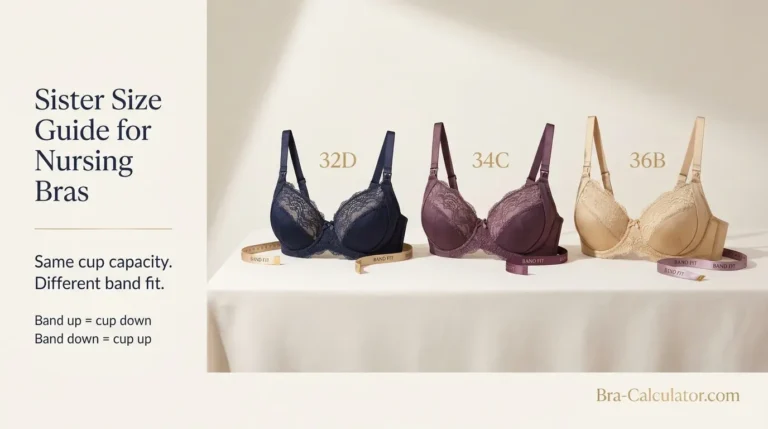
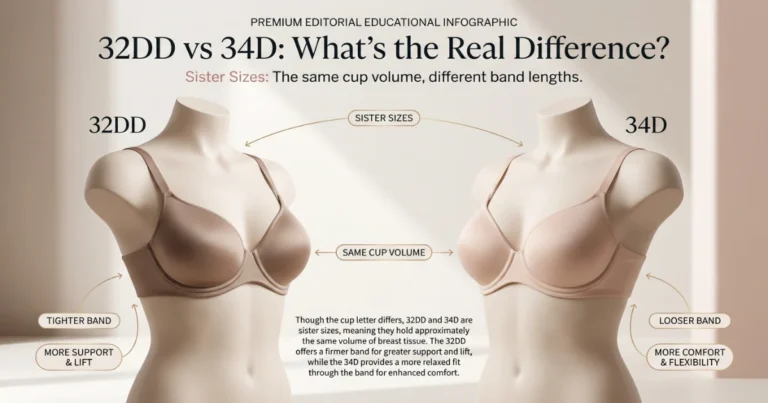
Sister sizing is essential for fuller cup sizes because the same cup volume can fit very differently depending on band size. If your 36F cups feel right but the band feels wrong, sister sizing helps you correct the band without losing cup capacity.
Use the Sister Size Calculator or read the full Sister Sizes Guide for exact conversion logic.
Rule: Go up one band = go down one cup letter | Rule: Go down one band = go up one cup letter | Result: Cup volume stays similar
| Smaller Band | Reference Size | Larger Band |
|---|---|---|
| 34G | 36F — You | 38E |
| 32H | 36F | 40DD |
36F vs Other Sizes
Select a comparison to understand exactly how 36F differs from nearby and commonly confused sizes.
For a broader size map, explore the Breast Size Comparison hub.
- Same 36 band as 36DDD
- Deeper cup with more projection
- Better if 36DDD causes spillage
- Needs deeper cup construction
- Same band fit
- One cup smaller in many systems
- Better if 36F cups wrinkle or gape
- Less cup depth and capacity
- One cup smaller than 36G
- Fuller than 36DDD / E
- Correct if cups contain tissue smoothly
- Should not spill at center or side
- Same 36 band
- More cup depth and projection
- Try if 36F cuts into tissue
- Better for fuller center or side tissue
- Firmer band for 31–32″ underbust
- Less total volume than 38F
- Better if 38 band rides up
- Looser band for wider ribcage
- Same cup letter but larger total cup volume
- Only correct if your underbust needs a larger band
- Looser band than 34G
- Similar cup volume
- Fits around 31–32″ underbust
- Tighter sister size
- Similar cup capacity
- Better if 36F band rides up
Best Bra Styles for 36F
At 36F, the best bras are not just pretty — they are engineered. You need enough depth, a supportive band, stable straps, and cup construction that matches your breast shape. Many fashion bras stop working here because they are too shallow, too stretchy, or too weak in the band.
Best for everyday support, lift, and stability. Choose firm bands, deeper cups, wide straps, and strong lower-cup structure.
Excellent for 36F because it brings side tissue forward and creates a more centered shape under clothing.
Great for lift and shaping if the cup is deep enough. Seams give better structure than shallow molded cups.
Useful when you want less forward projection. Avoid minimizers that simply flatten or push tissue into the armpit.
Helpful for asymmetry, monthly size changes, or upper fullness. Look for stretch plus strong lower support.
Often too flat for 36F. It can cause spillage, floating gore, cup collapse, or tissue pushed toward the sides.
Common Fit Problems with 36F
36F fit problems usually come from three places: the band is too loose, the cups are too shallow, or the wire shape does not match your breast root.
The 36 band is too loose or stretched out. At F cup volume, this quickly transfers weight to your shoulders.
The cup is too small, too shallow, or too closed at the top. Center spillage often means the cup lacks depth near the gore.
The cup may be too large, too tall, or too projected for your shape.
This usually means the band is not doing enough work. Straps should stabilize, not carry the full bust weight.
The wire is too narrow, the cup is too small, or the bra is not deep enough at the side.
A floating gore can mean cups are too small, too shallow, or incompatible with close-set breasts.
International Size Conversion
36F can be confusing internationally because cup letters change between US, UK, EU, and brand-specific charts. Always check the brand chart before ordering, especially for fuller-bust sizes.
Important: US, UK, and EU charts do not always use the same cup-letter sequence. A UK 36F may not equal a US 36F in every brand. This is why fuller-bust shoppers should always compare the brand’s own size chart rather than relying only on the label.
Use the Brand Size Decoder and Global Bra Size Converter before buying international bras.
Frequently Asked Questions
Direct answers for snippets, AI Overviews, and real search intent.
Yes. 36F is considered a fuller-bust size because it has noticeable projection and usually reflects around a 7-inch difference between underbust and full bust. How large it appears depends on frame width, height, and breast shape.
A 36F usually fits an underbust around 31–32 inches and a full bust around 38–39 inches. This creates about a 7-inch difference between ribcage and bust.
Yes. In most sizing systems, 36F is one cup size larger than 36DDD or 36E on the same 36 band.
Common sister sizes include 34G on the tighter-band side and 38E on the looser-band side. These sizes keep similar cup capacity while changing band fit.
Choose 36F if your cups contain all tissue smoothly. Try 36G if you see spillage at the top, sides, or center, or if the underwire sits on breast tissue.
Strap digging usually means the band is not supporting enough. Try tightening the band, replacing stretched bras, or testing 34G if the 36 band rides up.
36F usually fits someone with a 31–32 inch underbust and a full bust around 38–39 inches. It can suit fuller frames, broad frames, projected shapes, softer tissue, or average-plus bodies.
Confirm Your True Size
Use your exact measurements to confirm whether 36F, 36G, 36DDD, 34G, 38E, or another nearby size fits you best.