28D vs 30C: Are They Sister Sizes? (Bra Fit Guide 2026)
By Amelia; Updated March 2026 · 11 min read
Quick Answer
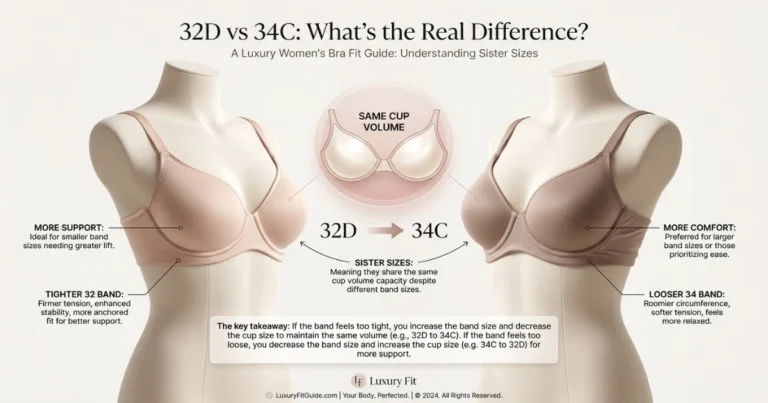
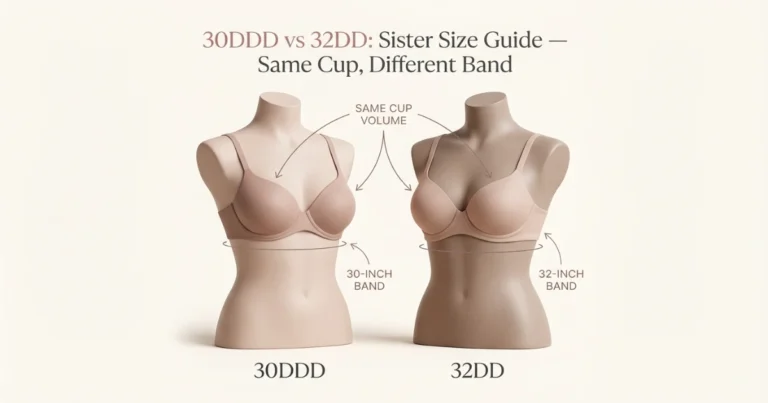
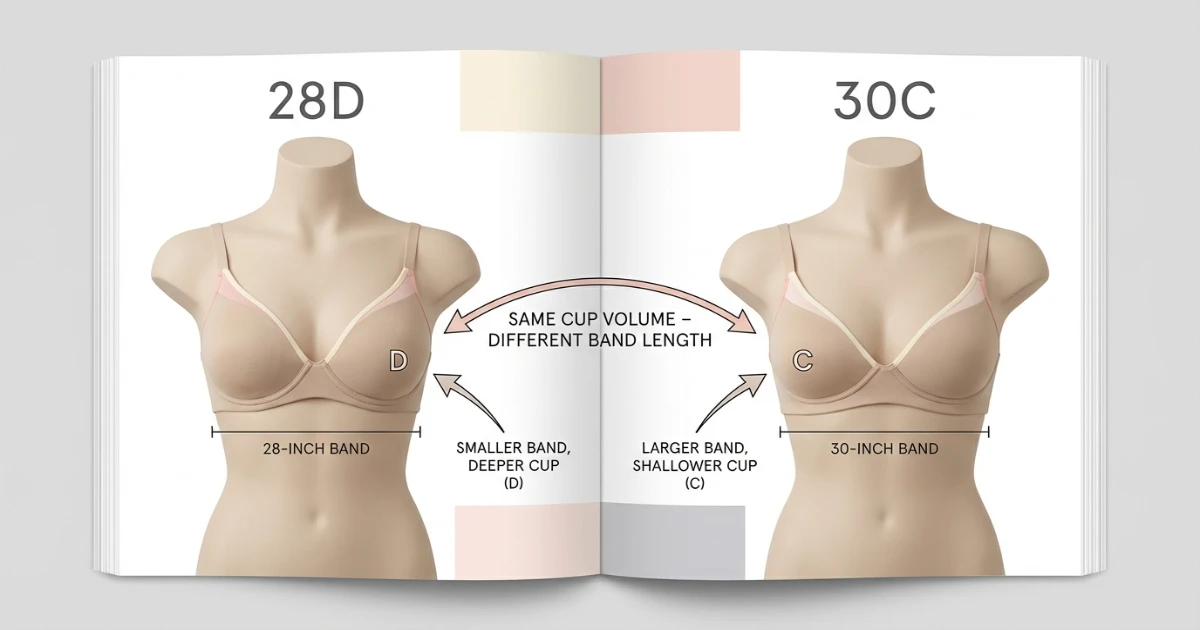
Yes — 28D and 30C are sister sizes. They hold almost identical cup volume, but the band is two inches wider in a 30C than in a 28D. If you find the 28D band too firm or restrictive, switching to a 30C gives your ribcage a little more breathing room while keeping the same breast coverage. If your 30C band feels loose or rides up, moving to a 28D tightens the fit and restores support.
Key Takeaways
The Short Version
- 28D and 30C are sister sizes — same cup volume, different band widths.
- The 28D band sits two inches tighter around the ribcage, providing firmer support.
- The 30C band is two inches wider and generally more comfortable for ribcages measuring closer to 30 inches.
- Cup letters shift by one step when band size changes by two inches — this is the core mechanic of sister sizing.
- Neither size is “bigger” than the other in terms of how much breast tissue the cup holds.
- Your true band size should be based on your underbust measurement, not comfort preference alone.
- 28-band bras are less stocked in mainstream retail; 30-band options are more widely available.
Understanding Sister Sizes: The Concept Behind 28D and 30C
Sister sizing is one of the most useful — and most misunderstood — concepts in bra fitting. Once it clicks, it changes how you shop forever.
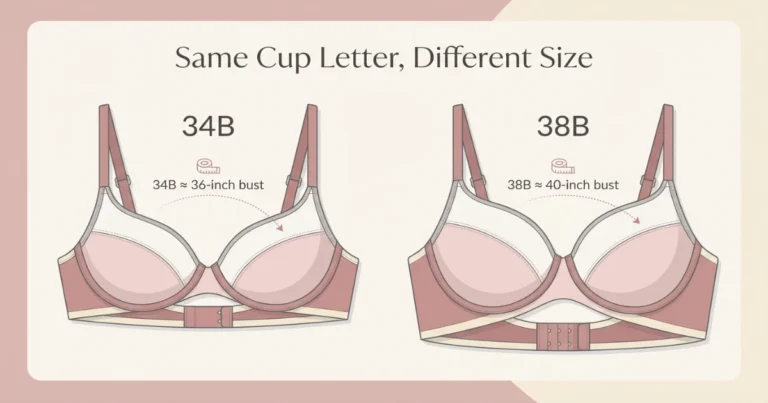
Here’s the core principle: cup volume stays constant as you move up or down the band size ladder, as long as you adjust the cup letter by one step in the opposite direction. Go up a band size? Drop one cup letter. Go down a band size? Add one cup letter.
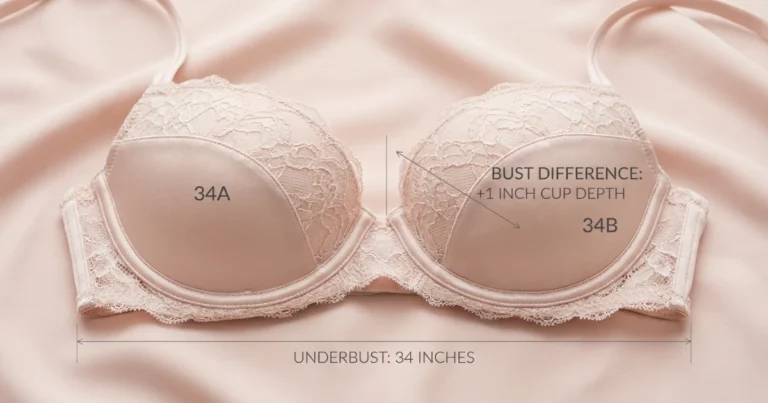
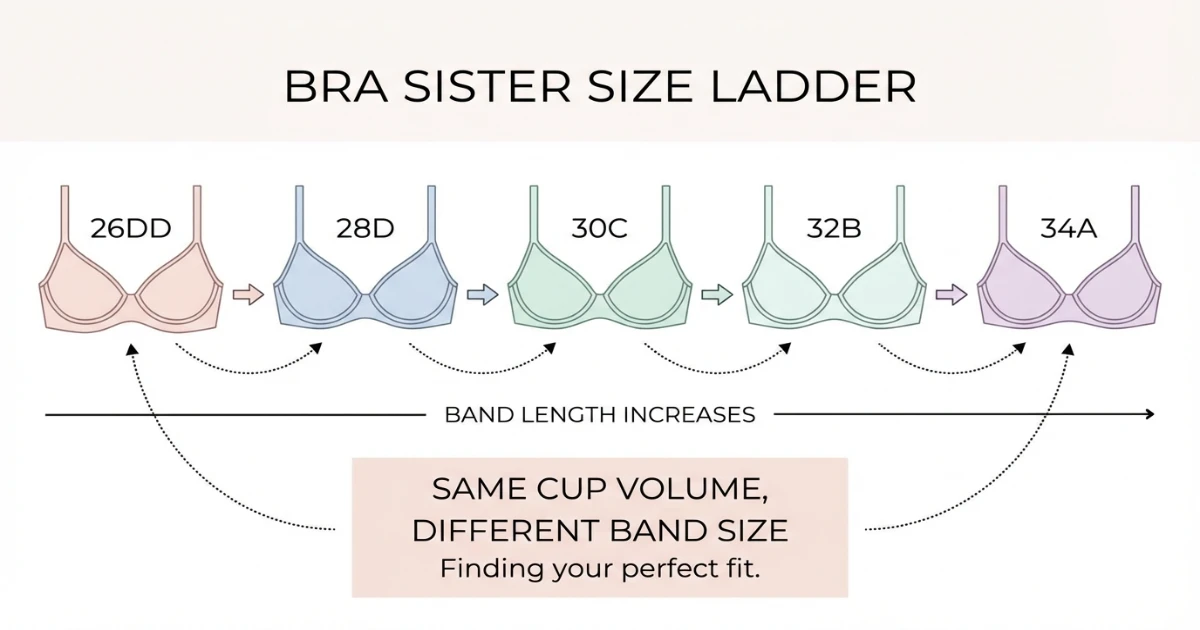
So a 28D, 30C, 32B, and 34A all hold approximately the same amount of breast tissue. They look different on the hanger and feel different on the body because the band length changes, but the cup cavity is functionally equivalent in terms of volume.
This matters enormously when you’re between sizes, when your true size isn’t in stock, or when you’ve lost or gained weight and your band measurement has shifted slightly. Women move between sister sizes all the time — the key is understanding what changes and what doesn’t when you make the switch.
The full mechanics of this system are explained on our sister sizes guide, with examples across multiple size families.
Measurement Breakdown: 28D vs 30C in Inches and Centimeters
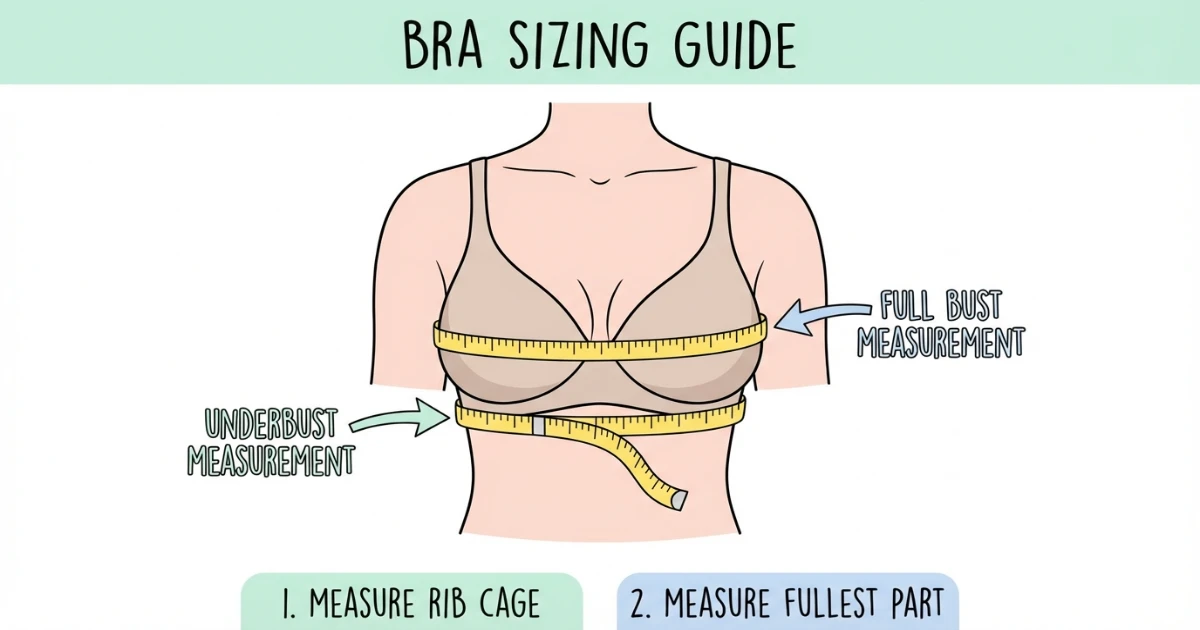
Let’s look at the actual numbers behind these two sizes. Both use the same calculation method: cup size equals the difference between your full bust measurement and your underbust measurement.
28D
Underbust (Band)
~28 in / ~71 cm
Full Bust
~32 in / ~81 cm
Cup Difference
4 inches / ~10 cm
Cup Letter
D (4-inch difference)
30C
Underbust (Band)
~30 in / ~76 cm
Full Bust
~33 in / ~84 cm
Cup Difference
3 inches / ~7.5 cm
Cup Letter
C (3-inch difference)
Notice what happened: the band went up by two inches (28 to 30), and the cup letter stepped down by one (D to C). The bust measurement moved from 32 to 33 inches — just one inch more — because the band itself grew by two. The net result is nearly the same breast volume in both cups.
This is why sister sizes work: the cup volume is determined by the relative difference between band and bust, not by either number in isolation. A D cup on a 28-inch band creates a pocket almost identical in depth and width to a C cup on a 30-inch band.
To measure yourself accurately, use a soft tape measure. Take your underbust snugly around your ribcage just below the breasts, then take your full bust measurement around the fullest point of your chest with the tape parallel to the floor. Always measure without a padded bra for the most reliable result. Our step-by-step how-to-measure guide has everything you need.
Band Size Difference: What Two Inches Actually Means for Your Fit
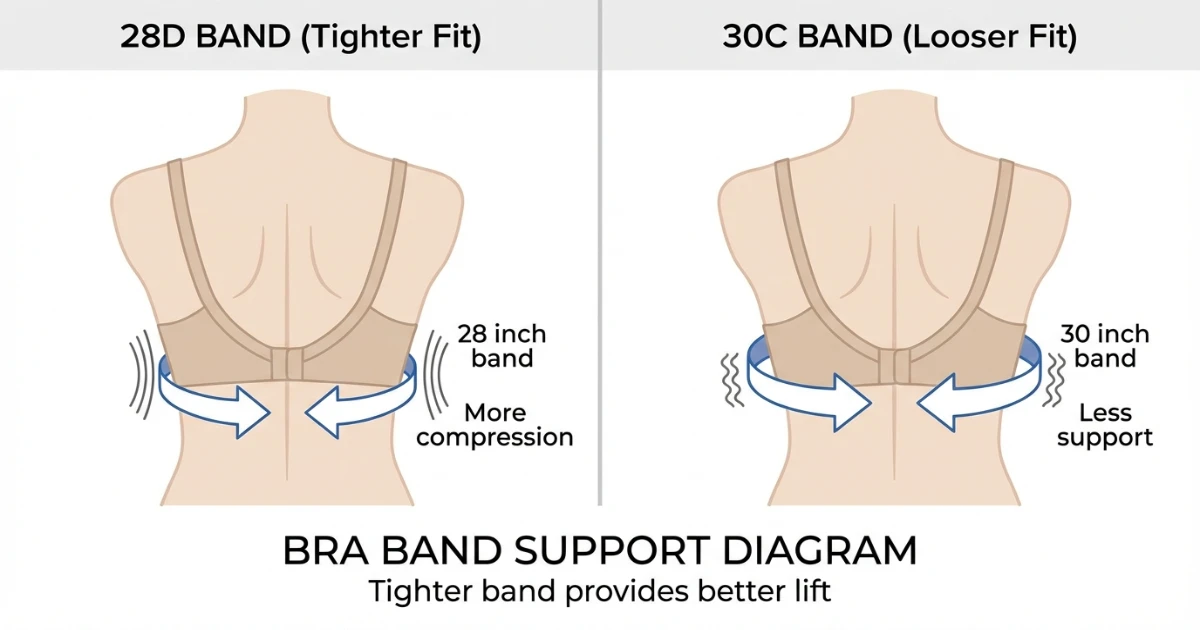
The band is doing the heavy lifting in a bra — roughly 80% of the support load comes from it, not the straps. So when the band size changes by two inches, the difference is more significant than it might sound on paper.
28D — Firmer Band
Wraps snugly at 28 inches. Provides maximum support with minimal movement. Ideal if your underbust actually measures around 27–28 inches. Can feel restrictive if your ribcage is closer to 29–30 inches.
30C — Slightly Looser Band
Sits more comfortably at 30 inches. Better choice if you find narrower bands uncomfortable or if your ribcage fluctuates with breathing and movement. May feel insufficiently supportive if your true underbust is 28 inches.
How Band Elasticity Affects Long-Term Fit
New bras should always be fastened on the loosest hook. As the elastic stretches with washing and wear over time, you move to the tighter hooks to maintain the same level of snugness. This means a 30C band that fits on the first hook today will still serve you for months as it relaxes — eventually worn on the third hook.
If you find yourself reaching for the tightest hook within the first few weeks, the band is already too large for your frame. That’s often a sign you should have been in the smaller band size all along.
When the Band Rides Up
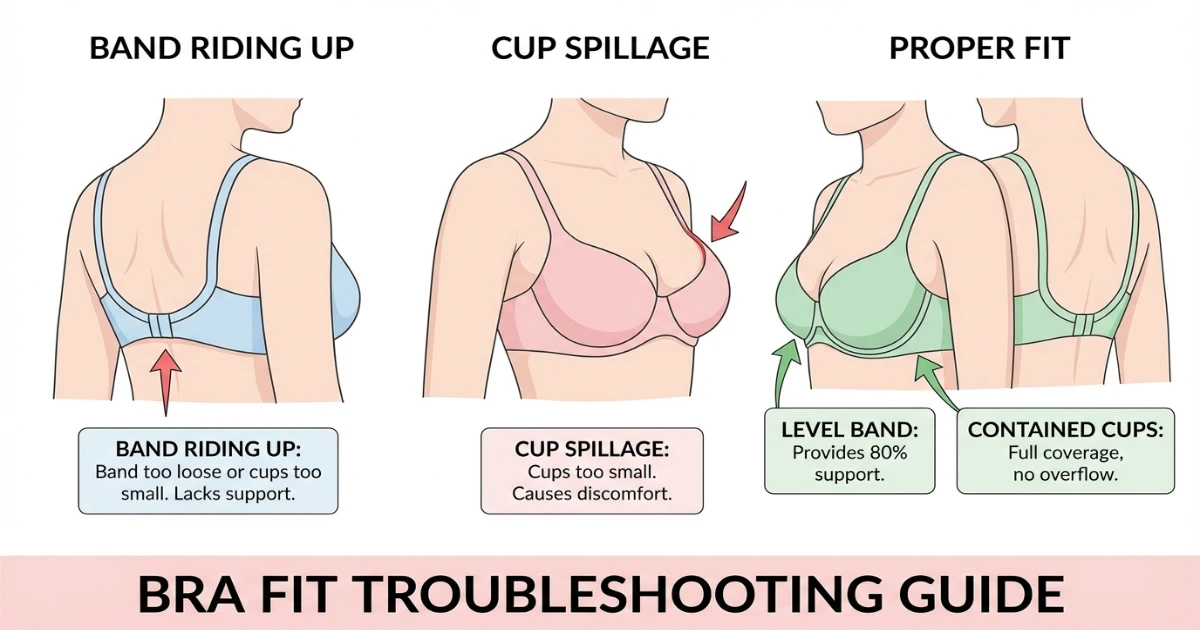
A band that rides up your back is one of the most reliable signs that it’s too large. When the band can’t anchor properly at the front, it migrates upward at the back, pulling the cups down with it — and suddenly nothing sits where it should. If this is happening in your 30C, a 28D will solve it. Our guide on why bra bands ride up covers the specific causes and fixes in detail.
On the flip side, red marks around your ribcage, difficulty breathing deeply, or skin that bulges around the band edges are signs the 28 band is too snug. Moving to a 30C resolves those issues immediately.
Cup Volume Comparison: Is the Breast Tissue Capacity Really the Same?
Yes — nearly identical, though not perfectly so in every brand. In theory, sister sizes share the same cup volume. In practice, manufacturers scale cup depth and width as band sizes increase, which can introduce minor variation. But the difference is small enough that most women who wear a 28D will find a 30C fills similarly on the breast.
What changes between sister sizes isn’t how much the cup holds, but how the breast sits within it. A narrower 28D band pulls the cups closer together, which can shift breast tissue slightly inward. A wider 30C band has more lateral spread, so the cups sit slightly further apart. For women with widely-spaced breasts, a wider band sometimes provides better coverage. For women with close-set breasts, the narrower band tends to sit more naturally.
Visually, both sizes look nearly the same on the breast. If you undress and compare the cups side by side, you’ll notice the cup depth and width are almost identical — only the band length is clearly different. Our breast size comparison tool lets you visualise multiple sizes on a similar frame, which can be helpful when you’re deciding between sizes.
Fit Differences You’ll Actually Notice Day to Day
Support and Stability
The 28D provides noticeably more support for the same cup volume because the tighter band transfers weight more efficiently. If you’re active, exercising, or on your feet all day, the firmer band of a 28D typically feels more secure and prevents movement throughout the day.
Strap Pressure
In a well-fitted bra, the straps should carry about 10–20% of the support load. If your 30C band is too loose and not doing its job, your straps compensate — pulling tighter and digging into your shoulders. Switching to a 28D often eliminates strap discomfort because the band takes over its proper share of the work.
Breast Coverage and Shape
Since cup volume is similar, coverage should be comparable between both sizes. However, if you’re borderline between cup letters, the relative tightness of the 28D band can make breast tissue appear slightly more projected or lifted than the same tissue in a 30C. This is a subtle difference, but some women notice it in how they look under fitted clothing.
All-Day Comfort
For women whose true underbust falls between 28 and 30 inches — say, 28.5 or 29 inches — comfort can genuinely go either way. Some prefer the security of the 28D even if it’s slightly snug; others prefer the ease of the 30C even with minor band migration. There’s no universal correct answer. Our bra fit problems guide helps you diagnose which specific issue you’re dealing with and which size adjustment addresses it.
Who Should Choose 28D vs Who Should Choose 30C
Choose 28D if you…
- Measure 27–28 inches around the underbust
- Find the 30C band loose or migrating upward
- Prefer firm, secure support throughout the day
- Are active or need reliable support during movement
- Have tried the 30C and find the cups gaping slightly
Choose 30C if you…
- Measure 29–30 inches around the underbust
- Find the 28D band uncomfortably tight or restrictive
- Experience red marks or skin irritation from narrow bands
- Prefer a more relaxed fit for everyday wear
- Struggle to find 28-band bras in local stores
The best way to confirm which size works for you is to measure first, then try both. Knowing your underbust measurement takes the guesswork out of this decision. Use our complete bra fit guide to read the signs your body gives you once both sizes are on. And for a full picture of how nearby sizes compare, the size chart reference is a handy companion.
The Full Sister Size Ladder for 28D and 30C
Both 28D and 30C sit within the same sister size family. Here’s how the complete ladder looks, from narrowest to widest band:
Moving one step left on the ladder (toward narrower bands) means going up one cup letter. Moving one step right means going down one cup letter. The total cup volume stays constant throughout.
Keep in mind that 26DD is a very narrow size and may only be stocked by specialty brands. The 34A end of the ladder is much more widely available in standard retail. Use our sister size bra calculator to instantly generate your full sister size list across any starting size.
Quick At-Home Fit Test: 28D or 30C?
Put on the bra you’re currently wearing and work through these five checks. They take about two minutes and will give you a clear picture of which direction to size.
- Test the band at the back. Slide two fingers under the back band. It should feel snug but not painfully tight. If the band pulls away easily or you can fit your whole hand underneath, the band is too large — try the 28D. If you can barely fit one finger and it’s leaving marks, try the 30C.
- Check whether the band rides up. Stand normally and look in a mirror. The back band should sit horizontally — level with the front. If it’s creeping up toward your shoulder blades, the band is too loose. Switch to a smaller band (28D).
- Look at the underwire position. The underwire should encircle your breast tissue and anchor against your ribcage below and to the sides. If it’s pressing on breast tissue or floating away from the chest, the cup fit needs adjusting — but first confirm your band is correct.
- Check for breast spillage or cup gaping. Lean forward slightly. If breast tissue bulges over the top or sides of the cup, the cup is too small (try going up a cup in your current band). If the cup fabric wrinkles or pulls away from the breast, the cup is too large.
- Assess the straps. Straps should stay in place without constant adjustment and shouldn’t dig into your shoulders. If they’re the only thing holding everything up, your band isn’t providing enough support — this usually means the band is too large.
Still unsure whether 28D or 30C is the right fit for you? Our AI Smart Fit Calculator analyses your measurements and fit feedback to pinpoint your ideal size.
Try the AI Smart Fit Calculator →28D vs 30C: Side-by-Side Comparison
| Feature | 28D | 30C |
|---|---|---|
| Band Size | 28 in / 71 cm | 30 in / 76 cm |
| Full Bust Measurement | ~32 in / ~81 cm | ~33 in / ~84 cm |
| Cup Volume | Equivalent (D on 28 band) | Equivalent (C on 30 band) |
| Band Tightness | Firm — snug on ribcage | Relaxed — slightly looser |
| Support Level | Higher — band works harder | Moderate — band less anchored |
| Comfort for Wide Ribcage | May feel restrictive | More comfortable |
| Comfort for Narrow Ribcage | Ideal fit and support | Band may be too loose |
| Spillage Risk | Low — cup contains tissue well | Low — cup volume equivalent |
| Gaping Risk | Low if tissue matches D cup | Low if tissue matches C cup depth |
| Retail Availability | Specialist retailers mainly | More widely stocked |
| Best Underbust Measurement | ~27–28.5 inches | ~29–30.5 inches |
| Sister Size Relation | Same family as 30C | Same family as 28D |
People Also Ask: 28D vs 30C FAQ
Are 28D and 30C the same size?
28D and 30C are sister sizes — they hold nearly the same cup volume, but the band lengths differ by two inches. A 28D band is firmer and more supportive for narrower ribcages; a 30C band is looser and more comfortable for slightly wider frames. They are not identical, but the cup volume is functionally equivalent.
Is 30C bigger than 28D?
Not in terms of cup volume — they hold the same amount of breast tissue. However, the 30C has a wider band (30 inches vs 28 inches), so the overall circumference of the bra is larger. In terms of cup depth and breast capacity, they are sister sizes and effectively equivalent.
What is the sister size of 28D?
The sister sizes of 28D are 26DD (narrower band, larger cup), 30C (wider band, smaller cup), 32B, and 34A. All hold equivalent cup volume. Use our sister size calculator to get a full list instantly.
Why does 28D feel tighter than 30C?
Because the band is two inches shorter. The 28D band wraps around a 28-inch ribcage with minimal stretch, while the 30C band has two extra inches of material and elastic. The tighter feel of a 28D is by design — it provides more support. If it feels uncomfortably tight, your underbust likely measures closer to 30 inches than 28.
Can someone wear 30C instead of 28D?
Yes, if their ribcage measures closer to 30 inches. Since cup volume is similar, breast coverage will be comparable. The trade-off is that the 30C band provides less support than a 28D for the same body, and it may ride up the back if the ribcage is genuinely narrower than 30 inches.
How do sister sizes work in bras?
Sister sizes work by shifting the cup letter one step for every two inches of band size change. Go up two inches in band (e.g., 28 to 30)? Drop one cup letter (D to C). Go down two inches in band? Add one cup letter. This keeps cup volume constant across the size change. The band fit changes; the cup capacity doesn’t.
Is 28D a common bra size?
28D is a valid and real size, but it’s underrepresented in mainstream retail because narrow-band sizes serve a smaller commercial demographic. Specialty lingerie brands — including many online retailers — carry a full range of 28-band sizes. Many women who actually wear a 28D end up in a 32B or 34A by default because those sizes are easier to find in stores.
Why are smaller band sizes harder to find?
Most mainstream bra brands design their core ranges around the most statistically common sizes — typically 32–38 band with A–D cups. Narrow bands (28 and 30) and large cups (DD and above) are often produced in smaller quantities and may only be available through specialist retailers or online. This doesn’t mean the size is unusual — it’s a retail stocking decision, not a reflection of how many women wear it.
Does cup size change when I change my band size?
The cup letter changes, but the cup volume stays the same — that’s the whole point of sister sizing. If you go from a 28D to a 30C, you’re wearing a C cup instead of a D cup, but the actual space inside the cup is nearly identical. Cup letters are proportional measurements, not absolute volume labels.
Explore More Size Comparisons
Understanding how 28D and 30C relate to each other is a great foundation — but bra sizing gets more nuanced the more you explore it. Whether you’re curious about the sizes just above or below these two, or want to see how a D cup behaves across different band widths, there’s a lot more to discover.
Our breast size comparison hub covers dozens of size pairings with the same level of measurement detail and fit guidance as this guide. Some starting points worth exploring:
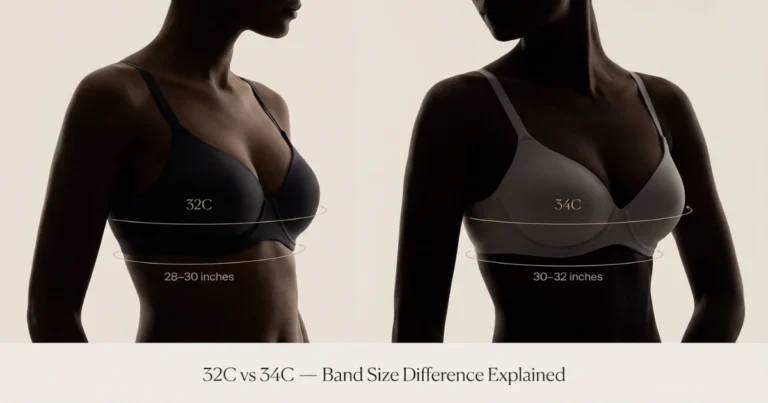
- Women comparing within the C cup family across bands often find it helpful to look at 32C and 34C size guides — to see how the same letter behaves at larger band sizes.
- If you’re exploring the D cup family across bands, the 32D and 34D guides show how the size scales up in both volume and coverage.
- Not sure what your measurements translate to? Our bra size chart calculator converts your numbers into a size recommendation instantly.
Ready to find your actual size? Enter your underbust and bust measurements and get a personalised size recommendation in under a minute.
Find My True Size →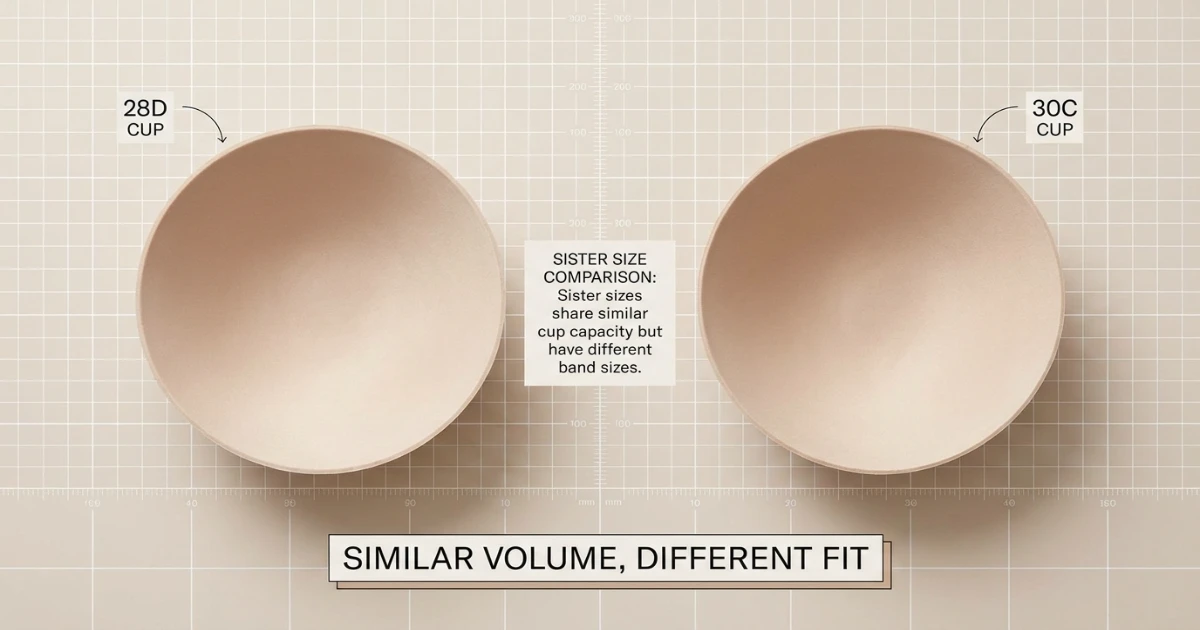
The Bottom Line
28D and 30C are sister sizes — two different paths to the same destination in terms of cup volume. The decision between them comes down to your ribcage measurement and how you want the band to feel on your body. If you measure close to 28 inches and value firm, reliable support, 28D is almost certainly the better fit. If you measure closer to 30 inches or find narrow bands uncomfortable, 30C gives you the same cup coverage with more breathing room around your ribcage.
Neither size is “better” — they each serve a slightly different body. What matters is that you use your measurements to guide the choice rather than availability or habit. Too many women end up in the wrong sister size simply because it was easier to find in store. Your size is determined by your body, not by what’s on the rack.
Start with your measurements. Try both if you can. And use the fit checks in this guide to interpret what each size tells you once it’s on your body.