
By Amelia · Updated 2026 · 14 min read
There is no single normal breast size for a 25-year-old. At this age, adult size has usually stabilised but varies widely based on genetics, body weight, hormonal contraception, and personal biology. The most commonly worn sizes in the mid-twenties range from 32B through 38D, but sizes well outside this range are entirely normal. Your correct bra size is determined by your measurements — not your age.
| Attribute | Detail |
|---|---|
| Is there a “normal” size at 25? | No. Size is determined by genetics, weight, and hormones — not age. |
| Most commonly worn band range | 32–38 inches (varies significantly with body frame) |
| Most commonly worn cup range | B through D (population average; individual range is AA through K+) |
| Is breast development complete at 25? | Usually yes, though small hormonal changes can still occur |
| Most common cause of size change at 25 | Weight change, hormonal contraception, menstrual cycle fluctuation |
| How often to remeasure | Every 6–12 months; immediately after any hormonal or weight change |
| Key internal link | Free Bra Size Calculator → |
What “Normal Breast Size at 25” Actually Means
“Normal” is not a useful concept when it comes to breast size. The question most people are really asking is one of three things: Is my size healthy? Is my size common? Am I wearing the right bra? All three are answerable — but none of them have anything to do with what size is “normal for a 25-year-old.”
By 25, most people’s breast development from puberty is complete. The hormonal surges of adolescence have settled. What you have at 25 is largely a function of your genetics and your adult body composition. Two women with the same height, weight, and body frame can still differ by three cup sizes — because the underlying distribution of glandular and fatty tissue is primarily genetic.
What age 25 does tell you: you are in a relatively stable phase. The most dramatic size changes have likely already happened (puberty, early adulthood) or have not yet happened (pregnancy, perimenopause). That said, the 25-year-old body is not completely static — and the section below explains exactly what can still shift it.
Every size is a normal size. A 28AA and a 42J are both real, valid bra sizes worn by real women — neither is more normal than the other. The goal of this guide is to help you find your correct fit, not to tell you what size you should be.
What Drives Your Size
What Actually Determines Breast Size at 25
Six factors determine breast size in the mid-twenties. Understanding which ones are active for you explains why your size may be what it is — and whether it is likely to change.
Genetics
The primary determinant. Your baseline breast size is inherited. Family history — particularly your mother and maternal grandmother — is the strongest single predictor of eventual adult size and tissue density.
Body Weight & Composition
Breasts contain significant fatty tissue. A 10–15 lb weight change typically shifts cup size by one full letter. This is the most common reason for size change in the 20s outside of hormonal events.
Hormonal Contraception
Combined oral contraceptives containing oestrogen can increase breast fullness by half to one full cup size. Changing formulation or stopping the pill can reverse this change within weeks.
Menstrual Cycle
Oestrogen and progesterone fluctuations during the cycle cause breast fullness to vary by up to half a cup size within a single month. This is why bras bought at one point in the cycle can feel tight at another.
Exercise & Muscle
Significant pectoral muscle development changes how bras fit across the chest wall, even without changing breast tissue volume. Athletic builds often need a wider underwire and more structured cup.
Pregnancy
If applicable. Pregnancy typically increases breast size by 1–4 cup sizes. Post-nursing size often differs from pre-pregnancy size in both cup and band.
Data & Context
Common Bra Sizes at 25 — What the Data Shows
Population-level bra size data has significant limitations — it reflects sizes sold rather than sizes women actually need, and it is biased toward mainstream retail ranges. With that context, here is what size research consistently shows for women in their mid-twenties in English-speaking markets.
Commonly cited average sizes (e.g., “34C is average”) reflect data from markets where poorly fitting bras are common. Studies using professional fitting find significantly different distributions — typically smaller bands and larger cups than self-reported. The most important number is your measurement, not a population average.
Specific Size Questions
Is My Bra Size Normal at 25? Specific Sizes Answered
The most searched version of this question is about a specific size. Here is a direct answer for the sizes most frequently asked about by women in their mid-twenties.
Completely normal
Common on petite frames with a narrower ribcage. Not small — just proportionate to a slimmer band. 32B and 30C hold the same cup volume.
Very common at 25
One of the most commercially available sizes globally. Average frame, moderate cup volume. Often a good starting point for first adult bra shopping.
Among the most common
Widely worn across Western markets. A 34C, 32D, and 36B all hold the same cup volume — different band widths, identical cup capacity.
Normal — fuller frame
Reflects a broader ribcage and moderate cup depth. Common for average-to-fuller frames. Widely stocked in most mainstream lingerie retailers.
Normal — common at 25
Fuller-side of mainstream retail. Widely available. Reflects a combination of broader band and more cup volume — both features that naturally occur across body types at any age.
Normal — genetics-led
Not unusual at 25. A 34DD is the sister size of 32F and 36D — same cup volume, different band. Common in women with genetic predisposition to fuller bust on a moderate band.
Normal — petite + full
Small band, large cup. More common than most people realise — often misdiagnosed as 34C in mainstream fittings. Specialist brands (Panache, Freya, Fantasie) stock this range well.
Normal — specialist range
Very small band, very full cup. Requires specialist sizing. A 28G is not “large” — it is a narrow ribcage with significant cup depth. Valid and real. Seek specialist fitters and brands.
💡 The size label tells you nothing about whether something is “normal.” Every size in the range above is worn by healthy women at 25. The only question worth asking is whether your bra fits correctly — not whether your size compares favourably to someone else’s.
What to Expect
Why Breast Size Can Change in Your Mid-Twenties
The mid-twenties are a relatively stable sizing period — but not a completely fixed one. These are the most common reasons a 25-year-old finds her bras suddenly fitting differently than they did at 22.
1. Hormonal contraception changes. Starting, stopping, or changing the pill is the single most common driver of cup size change in this age group. Combined oral contraceptives with oestrogen can increase breast fullness by half to one cup size within one to three months of starting. This is not permanent weight gain in breast tissue — it is hormonal fluid retention and glandular stimulation. When the pill changes or stops, the effect often reverses within a similar timeframe.
2. Body weight change. A 10-pound change in body weight typically shifts cup size by one letter in the corresponding direction. In the mid-twenties, body composition often shifts gradually as metabolism, diet, and activity levels evolve. Bras bought at 21 may genuinely not fit the same body at 25 for this reason alone.
3. Menstrual cycle fluctuation. Breast fullness peaks in the premenstrual phase, driven by progesterone-related fluid retention. This can feel like a half to full cup size increase in the week before a period, followed by reduction after it begins. This is normal and expected — not a permanent size change. Buying bras in the premenstrual phase often produces a size that feels too large the rest of the month.
4. Fitness and muscle changes. Building significant pectoral muscle mass — common in women who take up strength training in their twenties — changes the shape of the chest wall behind the breast tissue. This affects how cups sit and how bands feel without changing the actual breast tissue volume. The result is often needing a different bra style or a small size adjustment even though nothing about the breast itself has changed.
The Correct Method
How to Measure Your Bra Size at 25
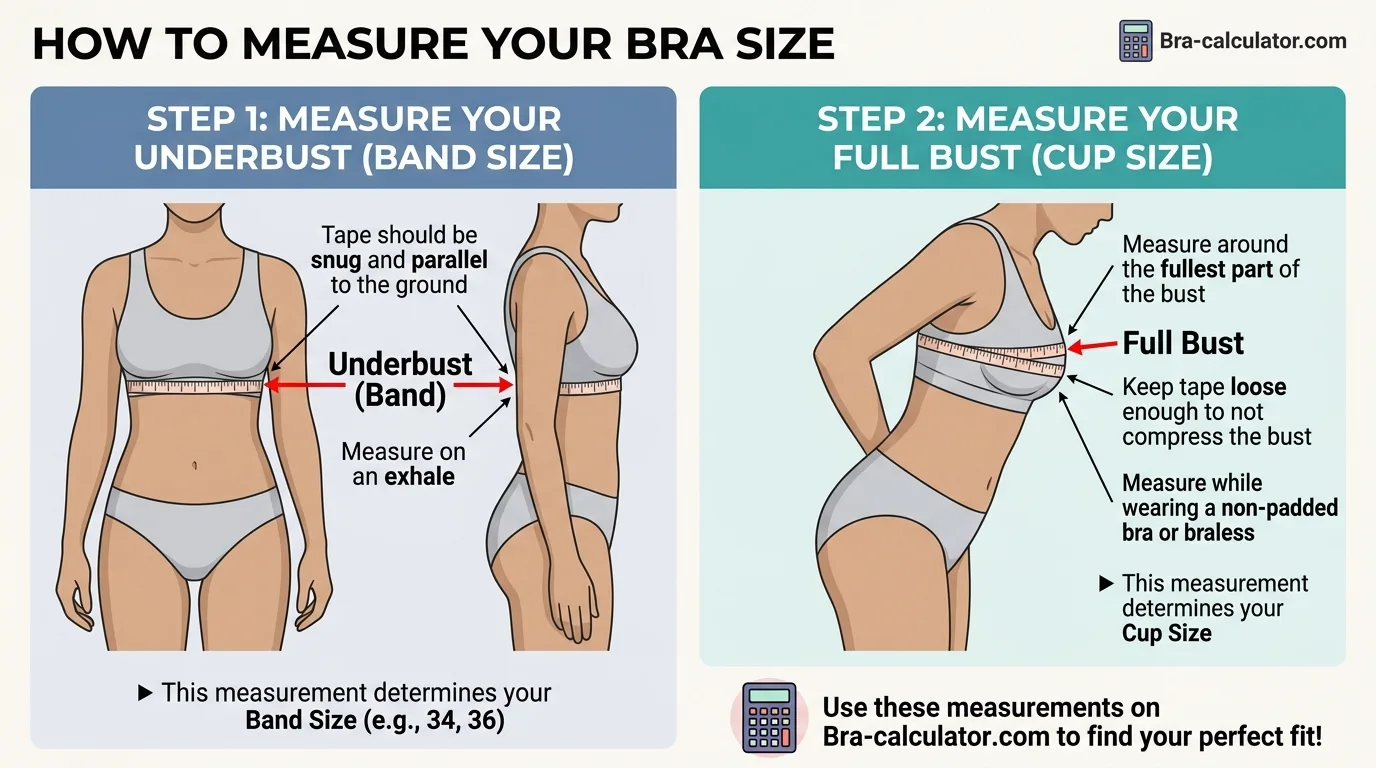
Two measurements. Taken on bare skin. That is the entire process. The most common mistakes are measuring over a padded bra and measuring too loosely on the underbust.
- Measure your underbust (band size)
Stand straight and wrap a flexible tape measure snugly around your ribcage, directly under your breasts. The tape should be firm — you should be able to slide two fingers under it, but no looser. Do not hold your breath or suck in. Record in inches. Round to the nearest even number. This is your band size. If your measurement is 33, your band is 34; if it is 31, your band is 32.
- Measure your full bust
Lean slightly forward so your breast tissue falls naturally forward. Wrap the tape around the fullest part of your bust — typically across the nipples. Keep the tape level across your back. Do not compress the tissue. Stand naturally for the final reading. Record in inches.
- Calculate your cup size
Subtract your band measurement from your bust measurement. The difference in inches maps to a cup letter: 1 = A, 2 = B, 3 = C, 4 = D, 5 = DD/E, 6 = DDD/F, 7 = G. Example: 37″ bust − 34″ band = 3 inches = C cup. Your size is 34C.
- Try the size and adjust using sister sizes if needed
A new bra should fit comfortably on the loosest hook with the band level all the way around your back. The center gore should sit flat against your sternum. No spillage, no gap. If the band is correct but cups are too tight, go up one cup (34C → 34D). If the cups are right but the band feels too tight, try a sister size one band up (34C → 36B).
| Band Down (Tighter) | Your Size | Band Up (Looser) | Cup Volume |
|---|---|---|---|
| 30C | 32B | 34A | Same as 30C and 34A |
| 30D | 32C | 34B | Same as 30D and 34B |
| 32C | 34B | 36A | Same as 32C and 36A |
| 32D | 34C | 36B | Same as 32D and 36B |
| 32DD | 34D | 36C | Same as 32DD and 36C |
| 32F | 34DD | 36D | Same as 32F and 36D |
| 34D | 36C | 38B | Same as 34D and 38B |
| 34DD | 36D | 38C | Same as 34DD and 38C |
Rule: going up one band = drop one cup letter. Going down one band = go up one cup letter. Cup volume stays identical across sister sizes. See the full Sister Size Calculator →
Common Confusion Cleared
Breast Size vs. Bra Size — They Are Not the Same Thing
This distinction resolves the most persistent confusion in sizing conversations. People use “breast size” and “bra size” interchangeably, but they mean entirely different things.
Breast size refers to the actual physical volume of breast tissue — an objective, absolute measurement. It does not change based on which bra you wear or which sizing system you use.
Bra size is a two-part label (band + cup) that represents a ratio — specifically, the ratio of your bust circumference to your underbust circumference. Because it is a ratio, the same absolute breast volume can be described by completely different size labels depending on the band size. A woman with a 30-inch underbust and significant breast volume might be a 30G. The same breast volume on a woman with a 36-inch underbust would be a 36D or 36DD. Same absolute tissue volume. Completely different labels.
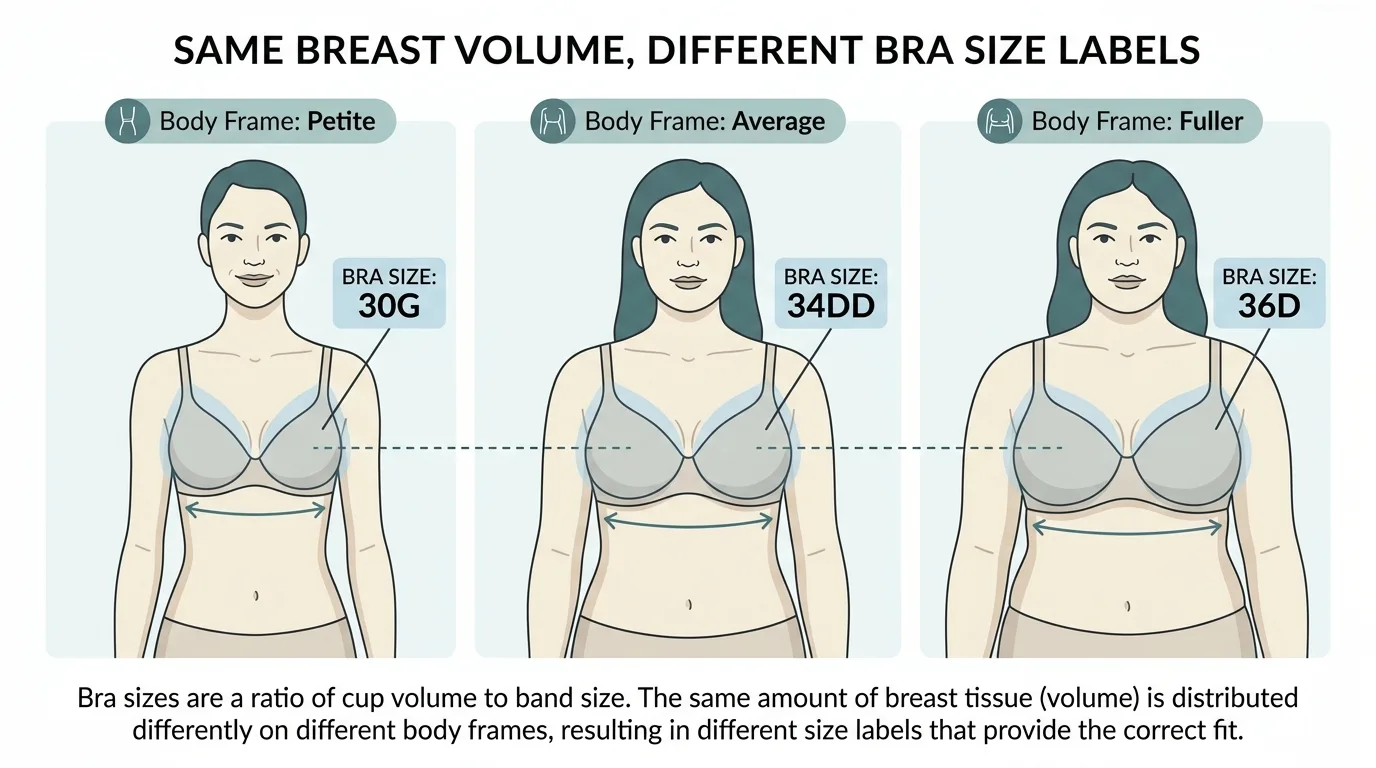
This is why cup size alone — “C cup,” “D cup,” “DD cup” — is meaningless without the band number. And this is why comparing your bra size to someone else’s tells you almost nothing about your actual breast size relative to theirs.
✓ Practical takeaway: Focus on whether your bra fits — not on what the label says. A 30G who is wearing a 34C because it “sounds more average” is wearing a bra that provides no support. Your correct size is the one that fits your body, regardless of what letters and numbers appear on the tag.
Bra Wardrobe at 25
Best Bra Styles for Your Mid-Twenties
At 25, breast tissue is typically at its firmest and most structurally supported. This is the age range with the widest style options — virtually every bra design works well with appropriately firm tissue on a stable frame. Here are the three essential styles for a mid-twenties bra wardrobe, with one recommendation per category.
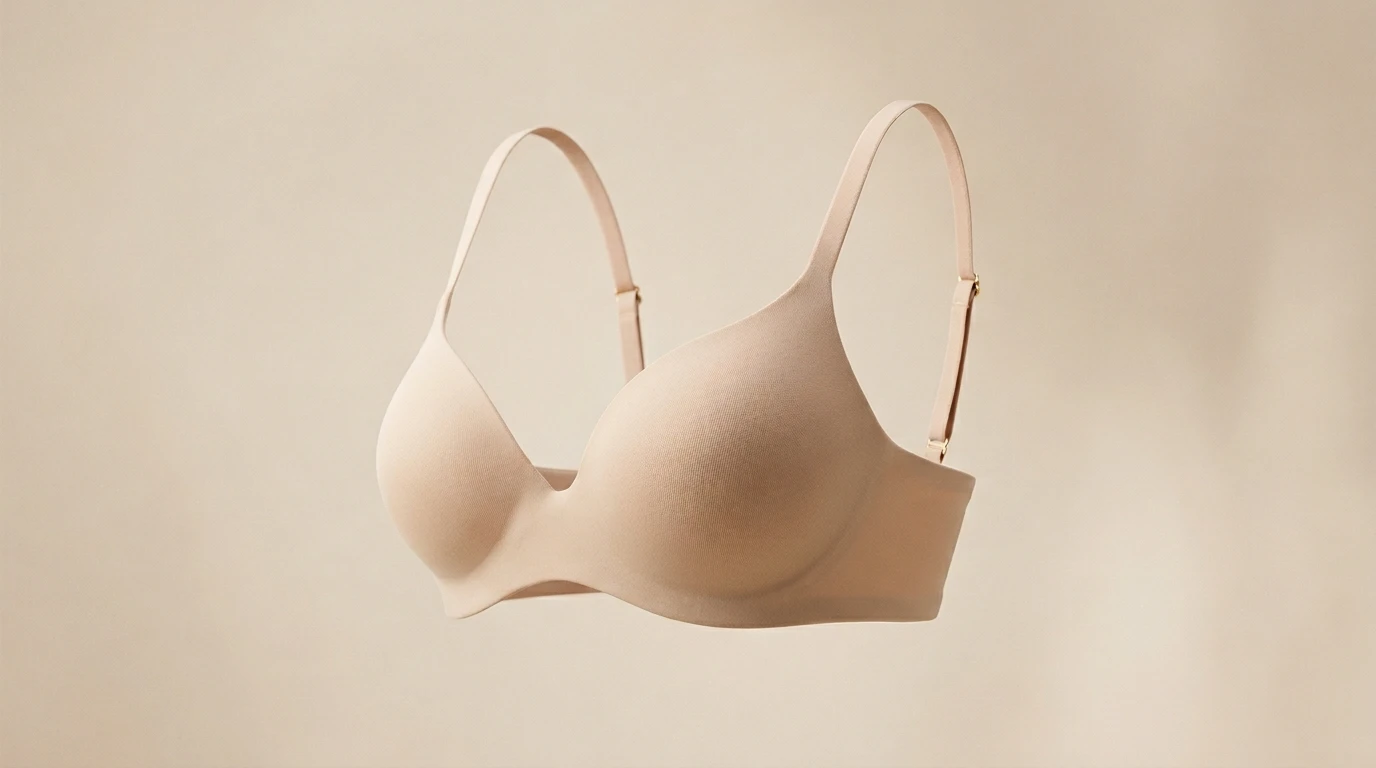
Seamless T-Shirt Bra — Daily Wear Foundation
- Smooth moulded cups — invisible under fitted tees and blouses
- Wide, adjustable straps for all-day comfort without shoulder digging
- Available in extended sizes AA through G+
- Fits most breast shapes; ideal for projected and average shapes
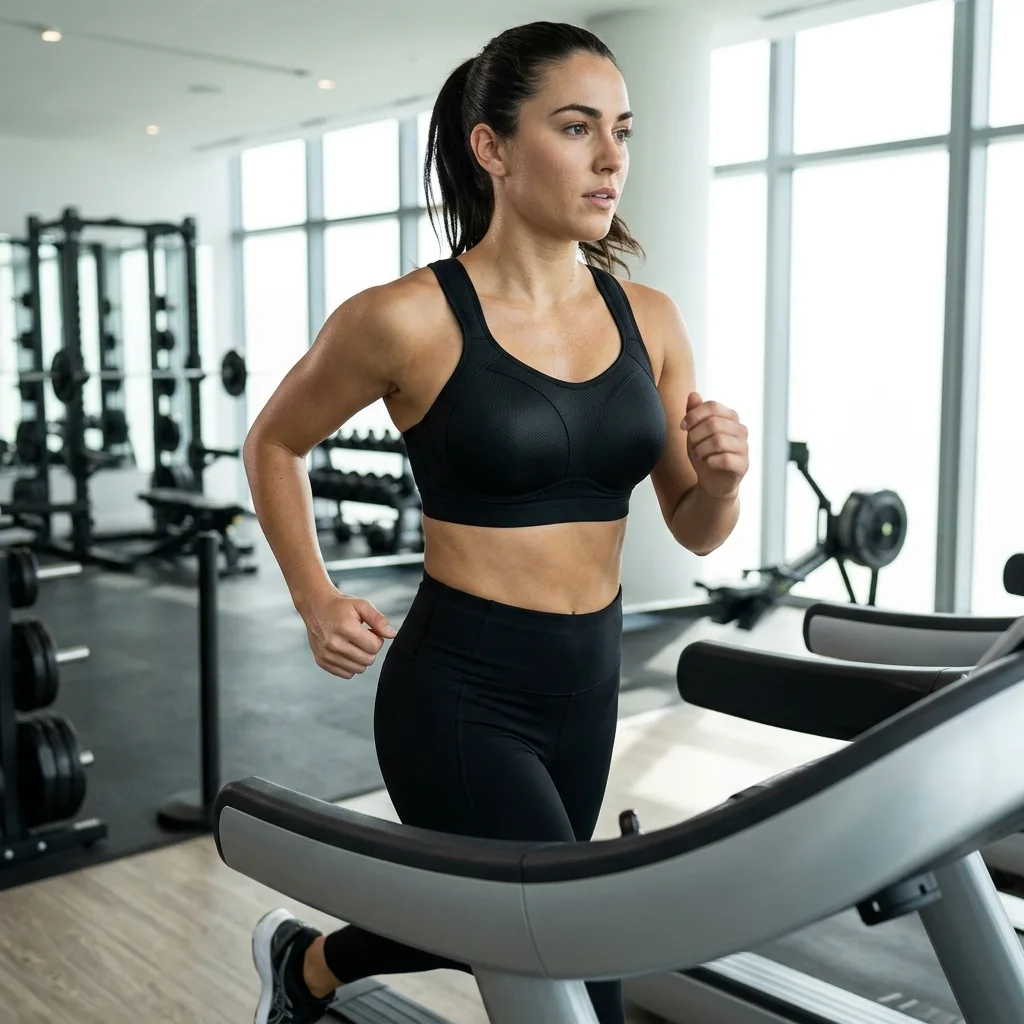
High-Impact Sports Bra — Workout Essential
- Encapsulation style — each breast supported independently for cups C+
- Adjustable underband and straps for locked-in support during running
- Moisture-wicking fabric prevents skin irritation during long sessions
- More structured than lounge bras — sized true to cup measurement
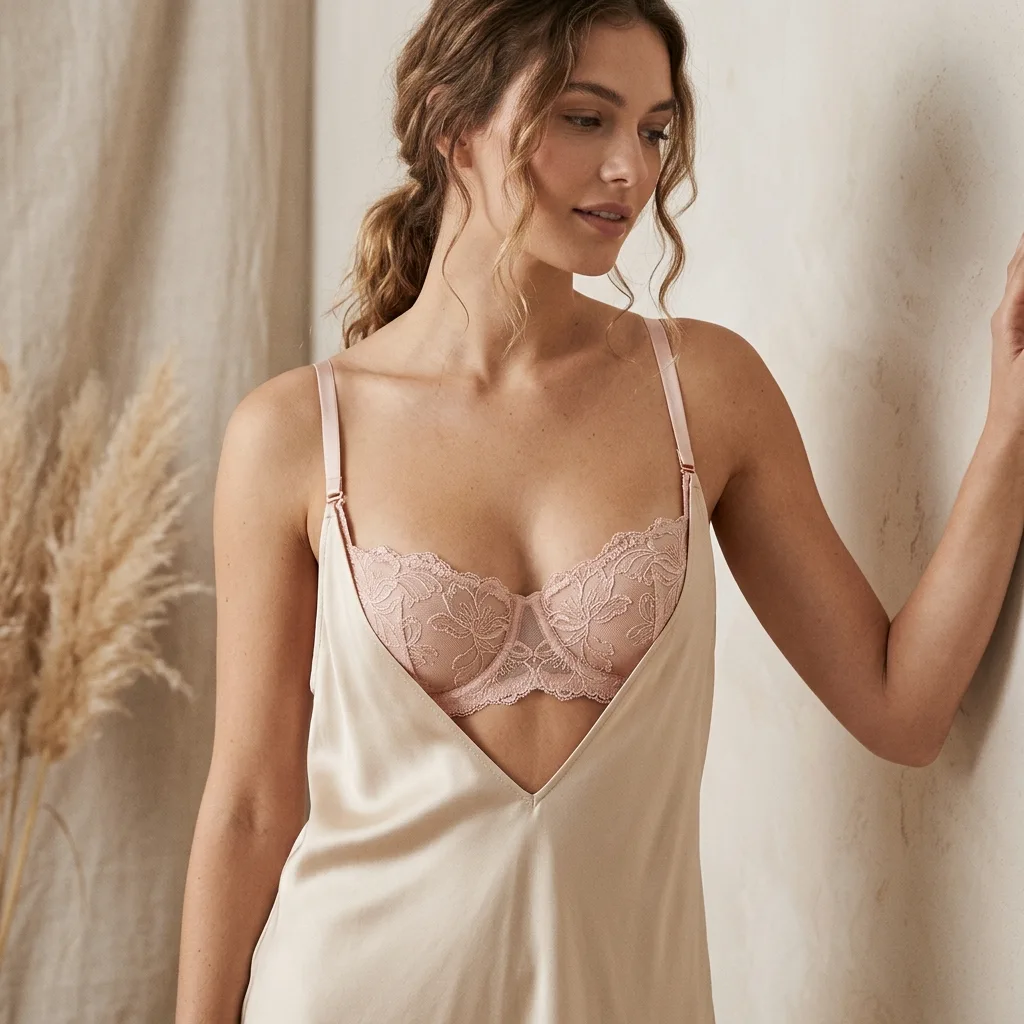
Balconette or Demi Bra — Outfit Versatility
- Lower cup height suits off-shoulder, square-neck, and low-cut tops
- Lifts breast tissue upward and inward for a shaped silhouette
- Works best for round and bottom-full breast shapes
- Can also be used as everyday if you prefer a more shaping style
Affiliate disclosure: As an Amazon Associate, Bra-Calculator.com earns from qualifying purchases at no additional cost to you.
Find Your Exact Bra Size at 25
Your bra size at 25 is determined by your measurements — not your age, not what you’ve always bought, not what someone else your age wears. Two measurements. 60 seconds. Accurate result — with sister sizes, international conversions, and style guidance included.
Calculate My Bra Size — Free →Is My Breast Size Normal? The Answer Every Time
The short answer: yes.
The longer answer: there is no breast size that is abnormal in a healthy adult woman. There is no size that is too small, too large, too asymmetrical, or too unusual. Breast size varies on a continuous spectrum from AA to beyond K — and every point on that spectrum is worn by real women living real lives without medical issue. What varies is how well the commercial bra market serves different points on that spectrum, not whether those sizes are valid.
If you are asking because you feel self-conscious about your size relative to peers, media, or social comparison: that feeling is understandable and common, but the premise behind it — that there is a size that is “more normal” than yours — is false. Bodies vary. That is not a problem to solve.
If you are asking because something about your breasts has changed suddenly, or because you notice a lump, skin change, or nipple discharge: that is a different question, and the answer is to speak with a healthcare provider promptly. See the disclaimer below.
Frequently Asked Questions
Normal Breast Size at 25 — FAQs
Continue Reading