DDD Cup vs G Cup: Measurements, Fit & Sister Sizes
Premium fuller-cup comparison guide with exact fit logic, visual volume notes, sister sizes, support symptoms, product suggestions, in-content images, and calculator links.
On the same band size, G cup is usually about 1 cup step larger than DDD cup in many US-style sizing paths. DDD often represents about a 6-inch bust-to-underbust difference, while G often represents about a 7-inch difference. Because this is usually a smaller gap than D-to-G or DD-to-H comparisons, the decision depends heavily on fit symptoms: cup edge cutting, center gore position, side wire placement, lower-cup strain, and whether the band stays level during movement.
Jump to a Section
Choose the fit signs you notice in the band, cups, center and straps. We’ll use them to suggest the most useful next step.
Private fit check — your answers stay in your browser and are used only for this on-page guidance. Nothing is stored or submitted.
DDD Cup vs G Cup at a Glance
| Attribute | DDD Cup | G Cup |
|---|---|---|
| Typical same-band difference | About 6 inches | About 7 inches |
| Gap size | Usually about 1 cup step on the same band in many US-style progressions | |
| Key fitting theme | G is slightly deeper, but DDD may still be correct if G wrinkles, gaps, feels too tall, or overprojects. | |
| Best test method | Compare DDD and G in the same structured bra model, not across random styles. | |
| Main reminder | DDD and G labels vary by country and brand, so always confirm the specific chart. | |
What Does DDD Cup vs G Cup Really Mean?
DDD Cup vs G Cup is a close fuller-bust comparison. Unlike wider comparisons where the gap is several cup steps, DDD to G is often a fine-tuning decision. Both sizes are already in a fuller cup range, so the main question is not whether one is “small” and the other is “huge.” The better question is whether DDD has enough depth, side containment, and center room for your breast tissue, or whether G creates a smoother and more stable fit.
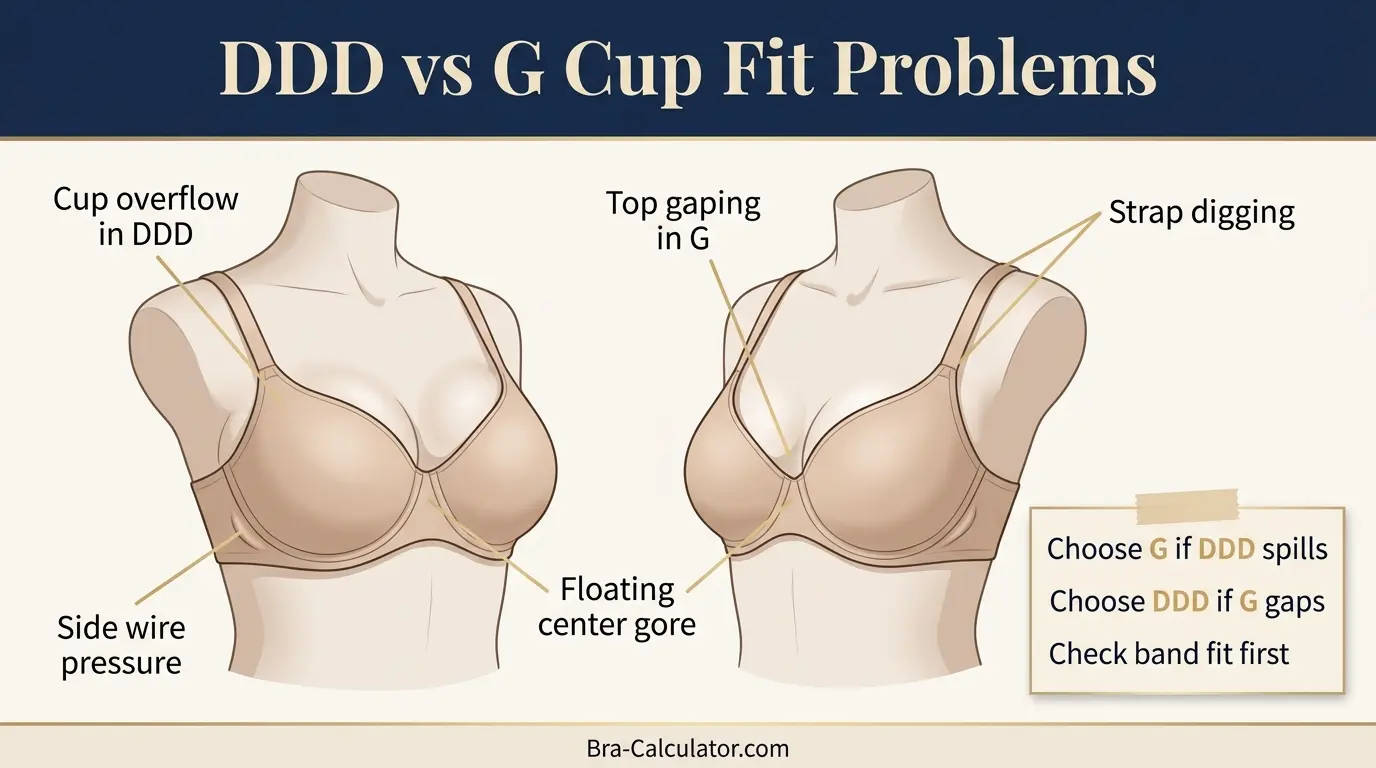
DDD can be correct when the band is level, the cup edge is smooth, the center gore sits close or flat, and the wires surround the breast tissue without pressing on it. G becomes more likely when DDD repeatedly creates mild-to-clear overflow, pushes tissue toward the underarm, causes the gore to float, or feels shallow in the lower cup.
The tricky part is that G can also overcorrect. If the G cup wrinkles at the top, feels too tall, wraps too far under the arm, or leaves empty space near the upper cup, the problem may not be cup size alone. It may be cup shape, wire width, cup height, or brand scaling. A different DDD style or a different G construction may solve the issue more cleanly than changing letters blindly.
Best fitting mindset: DDD vs G is a precision-support page. The right size should reduce pressure and spillage without creating empty space, unstable wires, or a cup shape that feels built for a different body.
Exact Measurement Difference Between DDD and G
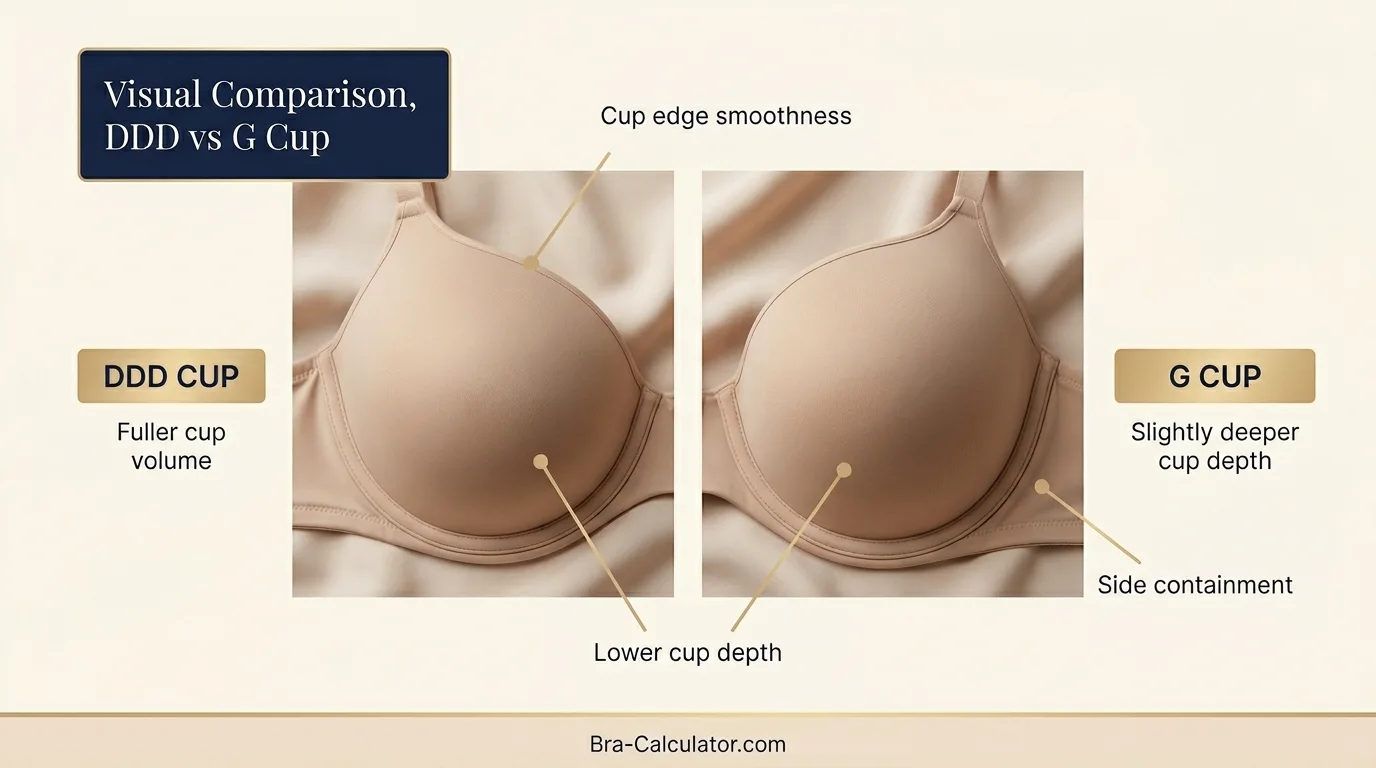
In many US-style sizing paths, DDD often represents about a 6-inch difference between snug underbust and full bust, while G often represents about a 7-inch difference. In practical terms, G usually adds one cup step of depth on the same band. That extra step can be enough to fix overflow, but it can also be too much if the original DDD issue was actually caused by shape mismatch.
Important: DDD and G should ideally be tested in the same band and the same bra model.
| Fit Sign | Usually points to DDD | Usually points toward G |
|---|---|---|
| Cup edge | G wrinkles, gaps, or feels too tall | DDD cuts in, spills, or creates a visible ridge |
| Center gore | DDD sits close or flat without pressure | DDD floats because the cup lacks center depth |
| Side wire | Wire surrounds tissue cleanly | Wire sits on breast tissue or misses outer fullness |
| Support feel | G feels overbuilt, wide, or empty | DDD feels shallow, compressed, or unstable during movement |
A loose band can make G gap and a tight band can make DDD look too small. The band must be stable before comparing cups.
Before judging DDD or G, scoop tissue from the side and bottom into the cup so wire placement and cup depth are tested honestly.
Changing both size and style at the same time can confuse the result. Test DDD and G in the same model when possible.
Choose the size that gives a smooth cup edge, flat gore, clean wire placement, and stable support without strap overload.
What Does DDD Cup vs G Cup Look Like?
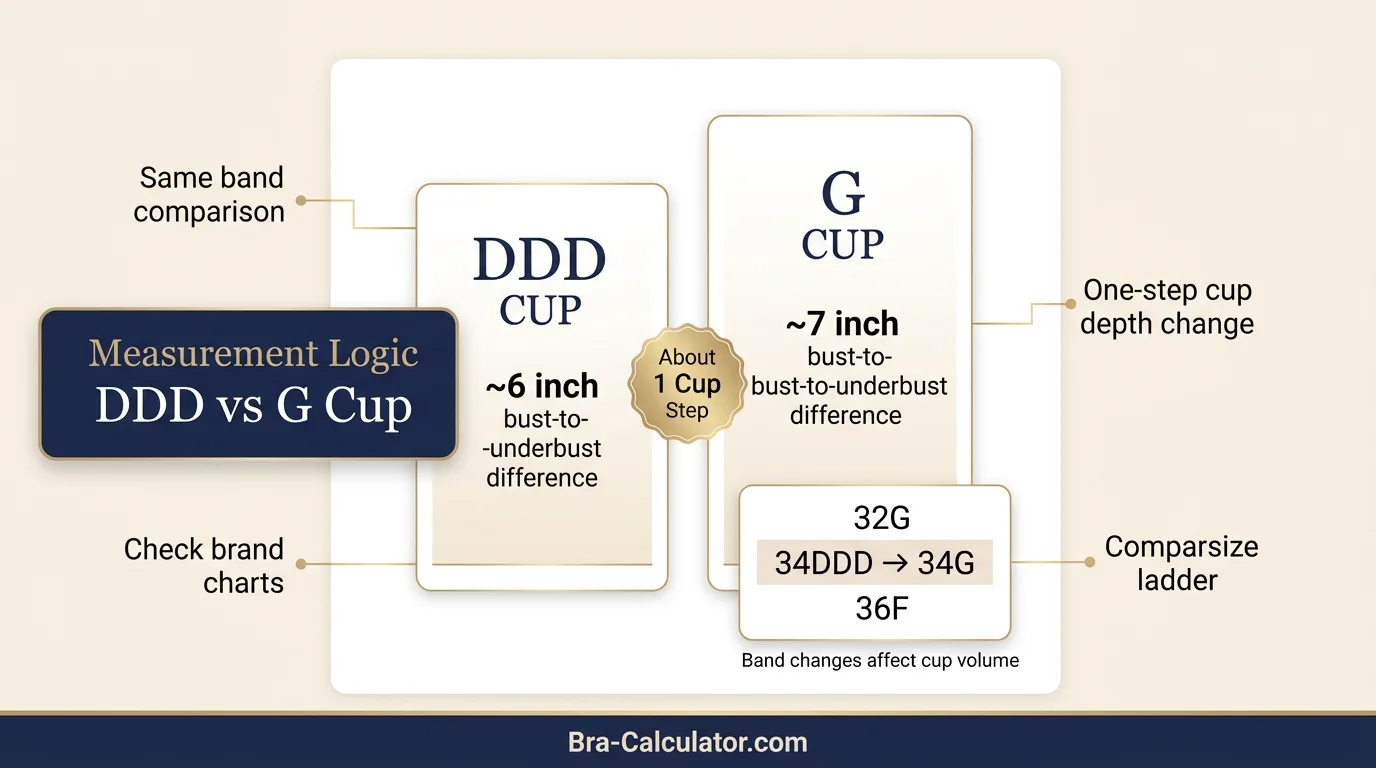
Visually, DDD vs G is often a subtle but important difference. On the same band, G usually gives slightly more depth and containment than DDD. The change may show as a smoother cup edge, less side spillage, a flatter center gore, or better lower-cup lift rather than a dramatic change in overall appearance.
On projected tissue, the extra depth in G can make the bra look calmer because the tissue is no longer being compressed. On softer tissue, G may reduce cutting at the cup edge. On shallow or wide-set tissue, however, G may wrinkle near the top or feel too projected, especially in full-cup styles.
Body frame also changes the visual result. On a petite frame, one cup step may look more obvious. On a broader frame, DDD and G may look very close. This is why the most reliable signs are fit symptoms: wire location, gore stability, cup edge smoothness, and whether the band stays level after movement.
Real fit rule: A correct G does not always look much bigger than DDD. It should simply remove strain, pressure, and spillage while preserving a secure, smooth silhouette.
Best Products to Test DDD Cup vs G Cup
For DDD vs G, the best test bras are structured enough to reveal one-step differences clearly. Very stretchy bras may hide whether the cup is truly too small or whether the issue is band tension, wire width, or cup shape.

Full-Coverage Support Bra
- Useful for checking cup edge smoothness and full containment
- Helps reveal whether DDD is slightly shallow or G is too roomy
- Strong option for fuller-bust support and daily coverage
- Best tested in nearby sizes using the same bra model

Specialist Side-Support Bra
- Helps center side tissue and reduce outward spread
- Useful when DDD spills near the sides or wire sits on tissue
- Reveals whether G improves containment or overprojects
- Especially helpful for wider roots and fuller outer tissue

U-Back Support Bra With Wide Straps
- Helps distribute support more evenly across back and shoulders
- Useful when straps dig because the band or cup is doing too little
- Good for testing movement stability between DDD and G
- Choose the correct band first, then compare cup depth
How Body Shape Changes DDD Cup vs G Cup
Body shape can make DDD vs G feel either like a small adjustment or a clear improvement. Since the difference is often one cup step, shape compatibility becomes extremely important. Projection, root width, tissue softness, torso length, and breast spacing can all change the verdict.
G May Feel Slightly Taller
With less torso height, the extra depth or height of G may feel more noticeable. Lower-coverage or balconette styles can help if full cups feel too tall.
Watch cup heightDifference May Look Subtle
Volume spreads across a wider chest, so DDD and G may look very close. Focus on wire placement and cup edge smoothness.
Check wire widthG May Solve Compression
Projected tissue often shows the benefit of one extra cup step quickly through a flatter gore and smoother lower cup.
Depth matters mostDDD May Still Win
G may gap if it is too projected or tall. A different DDD style may fit better than simply sizing up.
Shape match firstDDD Cup vs G Cup Sister Sizes
Sister sizing matters because DDD and G are close enough that a band change can completely alter the comparison. A 34G is not the same as a 36G, and a 34DDD may hold a different practical volume than expected when compared across brands. Always solve band fit first.
Use same-band testing first for DDD vs G. If the band is wrong, a one-cup comparison becomes unreliable.
| Situation | Try | Why |
|---|---|---|
| DDD cuts slightly | G in same band | One cup step may smooth the edge without changing the band. |
| DDD band rides up | Down one band, up one cup | Firmer band support may solve the problem more than cup depth alone. |
| G cup gaps at top | DDD or shape change | G may be too deep, too tall, or wrong for your tissue distribution. |
| Wire sits on tissue in DDD | G or wider-wire style | You may need slightly more cup capacity or better side containment. |
DDD vs G: Real Fit Differences
- DDD is already a fuller-bust cup.
- May be correct if G wrinkles, gaps, or feels too tall.
- Can be slightly shallow if the cup edge cuts in.
- Should contain tissue smoothly after scoop-and-swoop.
- G adds a small but important depth increase.
- Often improves containment when DDD compresses tissue.
- Should create smoother support, not just a bigger label.
- Best judged in the same bra model as DDD.
- DDD may work well for moderate-to-full projection.
- Can fail on very projected or outer-full tissue.
- Shape mismatch can mimic a cup-size problem.
- Try a different DDD style before assuming G is needed.
- G often gives slightly more center and lower-cup room.
- Projected tissue usually benefits most clearly.
- Wide or shallow tissue may need a different G shape.
- Side-support can improve centered shape.
- DDD may feel close at rest but fail during movement.
- Watch for strap digging, bounce, and side spillage.
- A correct band is essential before judging the cup.
- Shape adjustment may be enough if symptoms are mild.
- G should improve containment without creating empty space.
- Needs stable band support to avoid strap overload.
- Movement testing is essential in this cup range.
- Full-cup or side-support designs are often better tests.
- Try DDD if G gaps or feels overbuilt.
- Compare in the same bra model for best accuracy.
- Use structured styles for accurate testing.
- Do not judge only from stretchy bralettes.
- Try G if DDD repeatedly spills, compresses, or floats at the gore.
- Look for smoother cup edge and better side containment.
- Use seamed, side-support, or specialist construction.
- Verify brand charts because G varies internationally.
Which Bra Styles Work Best for DDD Cup vs G Cup?
The right style depends on whether the issue is cup depth, cup height, band stability, or shape. Because DDD and G are close, construction often decides the winner more than the letter alone.
Best first test for containment, top edge smoothness, and stable everyday support.
Excellent for outer fullness, wide roots, and centering tissue in fuller cups.
Movement testing reveals whether the cup and band truly support fuller volume.
Useful when full cups feel too tall or when upper-cup gaping appears.
Good for close-set tissue or lower necklines when a tall center gore irritates.
Too stretchy for accurate DDD vs G diagnosis and usually lacks real cup separation.
Common Fit Problems in DDD Cup vs G Cup
If DDD only shows mild cutting, G may be enough. If G gaps or feels overbuilt, DDD may still be right and the issue may be shape rather than size.
International Conversion Notes for DDD Cup vs G Cup
International sizing is especially important around DDD and G because brands may use US, UK, EU, or custom letter progressions. DDD may map closer to E or F in some systems, while G may not represent the same cup step in another brand.
Use the Global Bra Size Converter and the Brand Size Decoder before buying across regions — especially when comparing DDD and G labels.
Related Tools & Guides for DDD Cup vs G Cup
| Guide / Tool | Why It Helps |
|---|---|
| Bra Size Calculator | Calculate your band and cup from real measurements instead of guessing. |
| Cup Size Visuals | Understand visual volume without assuming cup letters are fixed body categories. |
| Sister Size Calculator | Adjust the band while keeping similar cup capacity across nearby sizes. |
| Global Bra Size Converter | Check label differences across US, UK, EU, AU, and brand systems. |
| AI Smart Fit Bra Calculator | Diagnose gaping, spillage, strap digging, floating gore, and side tissue issues. |
Frequently Asked Questions
On the same band, G cup is usually about 1 cup step larger than DDD cup in many US-style size paths. DDD often represents about a 6-inch bust-to-underbust difference, while G often represents about a 7-inch difference. The exact label sequence can vary by brand.
G is deeper than DDD on the same band, but the visual difference is often moderate. On a broader frame, DDD and G may look quite close, while on a petite or projected frame the change may be more noticeable.
Consider G if DDD creates repeated cup-edge cutting, side overflow, wire pressure, or floating gore. If G wrinkles or feels overbuilt, DDD may still be correct and the issue may be bra shape.
Yes. Since the difference is often one cup step, DDD and G can look similar, especially when body frame, band size, and bra style differ.
Try DDD and G in the same structured bra model if possible. Scoop all tissue into the cup, then check cup edge, center gore, side wire position, band level, and movement stability.
Top wrinkling usually means G is too large, too tall, too projected, or the wrong shape. Step back to DDD or choose a more suitable cup shape such as balconette, side-support, or lower-coverage construction.
Yes. DDD and G labels vary across US, UK, EU, AU, and individual brands. Always check the brand chart and use a converter before buying internationally.
Use this comparison as a precision fit check. The best size is the one that gives a level band, smooth cup edge, stable center gore, and wire placement around the breast tissue without relying on straps.
Find Your Best Cup Size
Use your measurements, fit symptoms, sister-size options, and shape clues to decide whether DDD, G, or a nearby band-and-cup combination gives the cleanest fit.