30DD vs 32D: Sister Size Difference Explained
Choose the fit signs you notice in the band, cups, center and straps. We’ll turn them into a practical next step for 30DD.
Private fit check — your answers stay in your browser and are used only for this on-page guidance. Nothing is stored or submitted.
Quick Answer
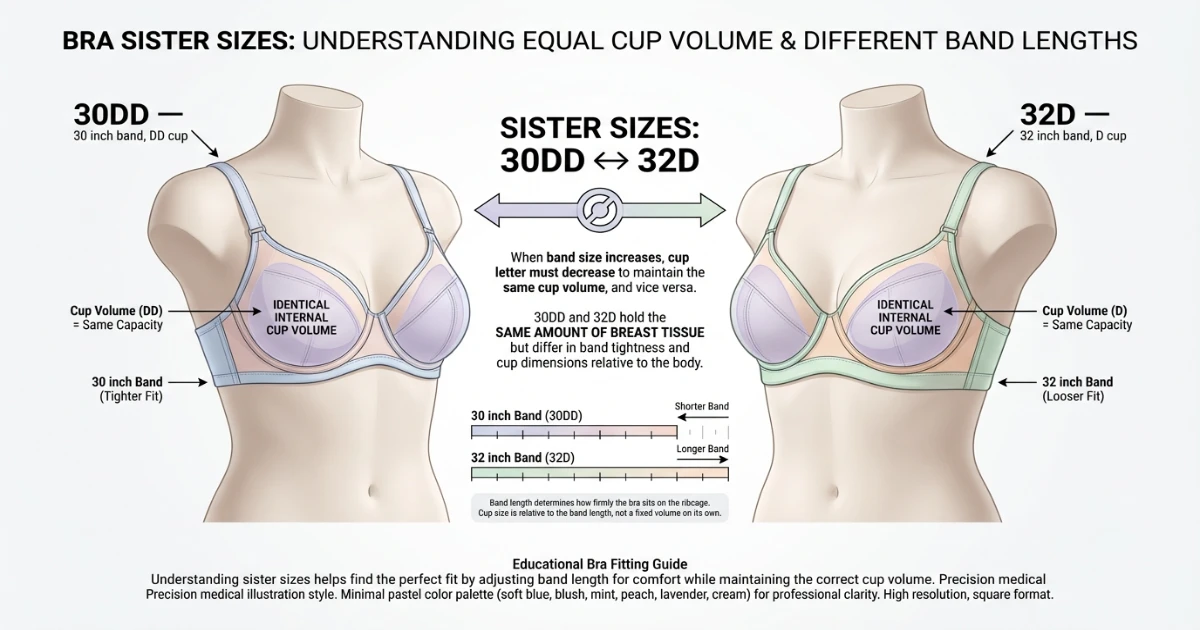
30DD and 32D are sister sizes — they share the exact same cup volume. The only structural difference is the band: a 30DD uses a 30-inch band (firm, high-anchor support) while a 32D uses a 32-inch band (slightly more relaxed). If your current 30DD cups fit perfectly but the band digs in and leaves marks, a 32D is your ideal sister size substitute. If your 32D band rides up your back, drop to 30DD for a snugger foundation.
No breast tissue is gained or lost in this swap — only the band tension and the cup letter change together, keeping internal cup space identical.
Key Takeaways
- Equal cup volume: 30DD and 32D contain the same internal cup space — confirmed by the sister size formula.
- 2-inch band difference: 30DD wraps a 30-inch underbust; 32D wraps a 32-inch underbust.
- DD ≠ double the cup: DD is simply the step above D, representing a 5-inch bust-to-band difference (US/UK sizing). It does not mean “two D cups.”
- Support architecture shifts: A 30DD anchors more through the band; a 32D redistributes some load to the shoulder straps.
- Availability advantage: 32D is more commonly stocked at mainstream retailers; 30DD is easier to find at specialist lingerie brands.
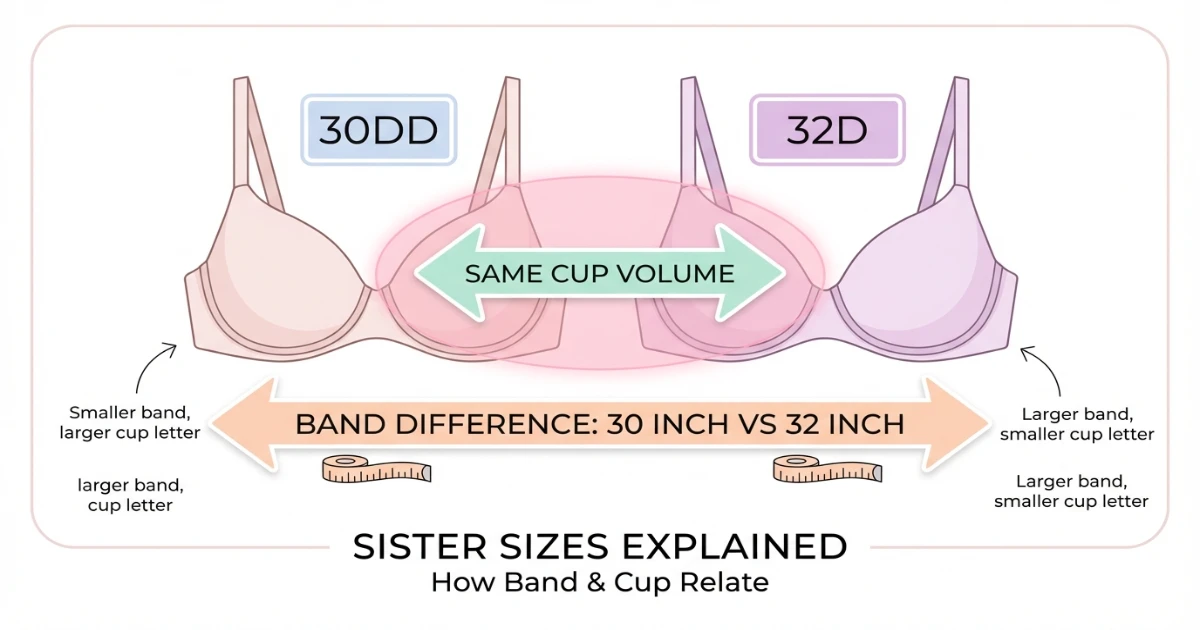
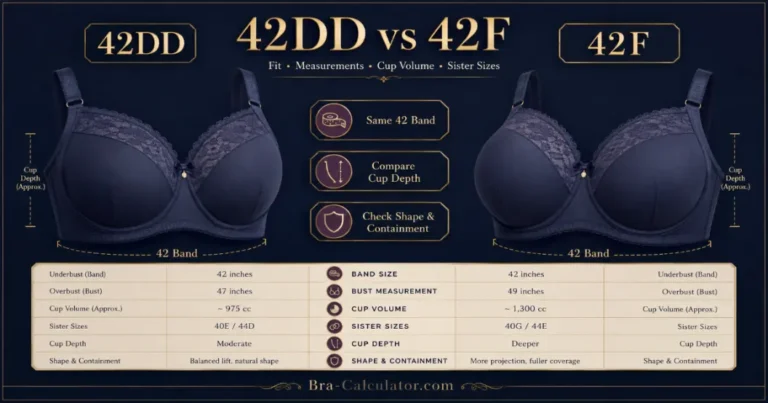
30DD and 32D are sister sizes: the cup volume is identical; only the band circumference changes. (View full size chart →)
Sister Size Logic
Bra cup letters do not represent an absolute volume — they represent a ratio: the difference in inches between your full-bust measurement and your underbust (band) measurement. In the US/UK system, each inch of difference equals one cup step. D = 4 inches over the band; DD = 5 inches over the band.
The consequence of this ratio structure is that when you increase the band by 2 inches (one band size step), you must decrease the cup letter by one step to maintain the same cup volume. This is the mathematical foundation of sister sizing.
Applied here: a 30DD has a 30-inch band with a DD cup (5-inch differential = 35-inch bust). A 32D has a 32-inch band with a D cup (4-inch differential = 36-inch bust). The projected cup cavity is the same because the extra 2 inches added to the band is exactly offset by dropping one cup step. This is why the sister size calculator will always pair 30DD with 32D in the same row.
Measurement Breakdown
- Band Size
- 30 inches (76 cm)
- Cup Letter
- DD — 5 inches over band
- Full Bust (approx.)
- 35 inches (89 cm)
- Cup Volume
- Equal to 32D
- Ideal Underbust
- 28–30 inches
- Band Size
- 32 inches (81 cm)
- Cup Letter
- D — 4 inches over band
- Full Bust (approx.)
- 36 inches (91 cm)
- Cup Volume
- Equal to 30DD
- Ideal Underbust
- 30–32 inches
Not sure of your underbust measurement? Our step-by-step measuring guide shows you exactly how to take an accurate reading with a soft tape measure.
Band Size Difference
The band is the primary support structure of any bra, responsible for approximately 80% of total lift and projection. A 30-inch band is classified as a small-to-narrow band size and is designed to fit an underbust circumference of 28–30 inches measured snugly. A 32-inch band targets an underbust of 30–32 inches.
On the body, the practical difference is significant. A correctly fitted 30DD band will feel firm and may initially feel tight to someone accustomed to wearing a larger band. It should stay level around the ribcage all day without migrating upward. A 32D band will feel comparatively relaxed — still supportive when the fit is correct for your frame, but with more stretch and movement.
The most common sister-size mistake with 30DD and 32D is wearing the 32D on a 29-inch underbust simply because it was more readily available in-store. The result is a band that creeps up the back, cups that separate from the chest wall, and shoulder straps that bear far too much weight — classic signs that the band is too large. Our bra fit problems guide covers every symptom and its solution.
Cup Volume Comparison
One of the most persistent misconceptions in bra sizing is that a larger cup letter always means more breast tissue. It does not — the cup letter only has meaning relative to the band number. A 30DD cup is shallower and narrower in its physical construction than a 38DD cup, because the 30-inch frame it sits on is much smaller. Yet 30DD and 32D project the same volume of breast tissue from their respective frames.
This is why a woman who has always been told she is a “D cup” might find she fits perfectly into a 30DD — the D on her 32-inch band and the DD on a 30-inch band are the same real-world cup space. The letter is a label for a ratio, not an absolute measurement of cup size.
Seeing this visually helps many people understand it quickly. Use our cup volume visualizer (linked in the tools section below) to compare how 30DD and 32D project side by side on-screen.
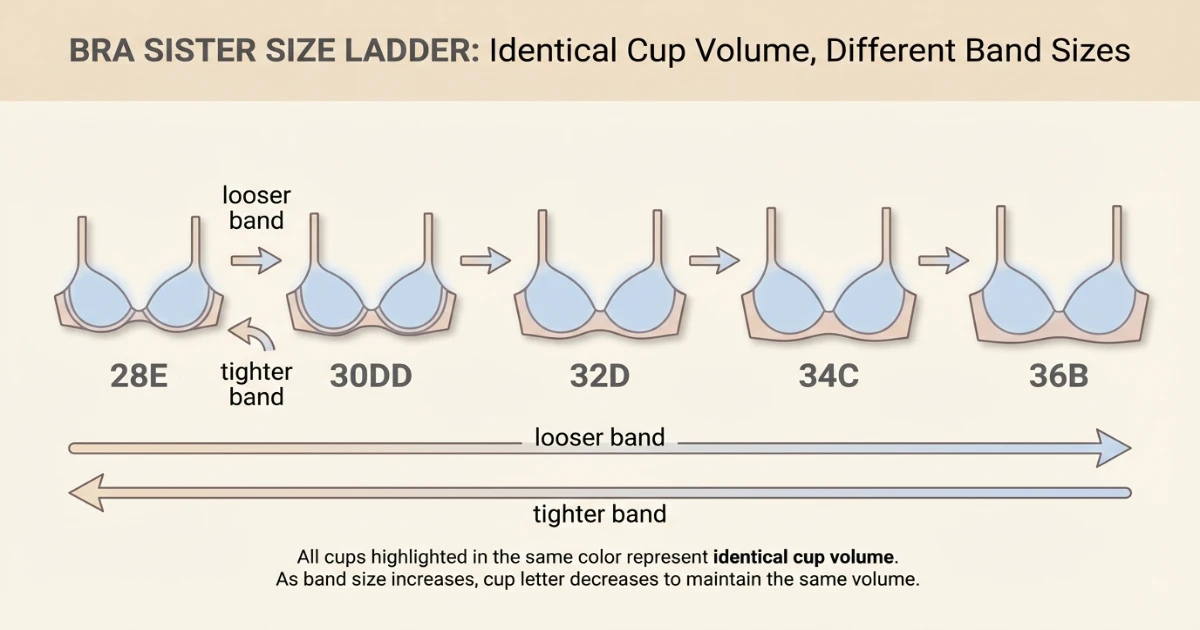
The full sister size row: 28E · 30DD · 32D · 34C all contain equal cup volume. (Use the sister size calculator →)
Fit Differences: How 30DD and 32D Feel on the Body
Even with matching cup volumes, these two sizes produce noticeably different wearing experiences. Here is what to expect when you compare them side by side:
- Band pressure: The 30DD grips the ribcage firmly; the 32D has a perceptibly looser, more relaxed encirclement of the torso.
- Back migration: On a sub-30-inch underbust, a 32D will ride up the back within hours; the 30DD stays anchored at the base of the ribcage.
- Cup projection: Because the 32D band is wider, its cups are set slightly further apart — this can cause minor gaping at the inner or outer cup edge on narrower chests.
- Underwire span: The 32D underwire is physically longer and wider at the base, which can press on soft tissue or poke the armpit on a narrower frame.
- Strap tension: A 32D on a small underbust requires tighter strap adjustment to compensate for band migration, often leading to shoulder grooving and neck discomfort.
- Silhouette and lift: A properly fitted 30DD typically delivers a rounder, higher-lifted shape because the tighter band anchors the underwire in the correct anatomical position.
These differences are most pronounced in wired, structured, or padded bras. Unlined, wireless, and stretch-cup styles are more tolerant across sister size differences.
Who Should Choose 30DD vs 32D?
Choose 30DD if you…
- Measure 28–30 inches snugly at the underbust
- Have a petite or narrow ribcage frame
- Need firm band support for a fuller bust
- Find 32D bands ride up your back throughout the day
- Experience shoulder grooving from over-tightened straps
- Wear underwired, minimizing, or full-coverage bras
- Do high-impact activities and need maximum lift stability
Choose 32D if you…
- Measure 30–32 inches at the underbust
- Find 30DD bands leave marks or feel restrictive
- Cannot find 30DD stocked locally or online in your style
- Are between band sizes and prefer a looser feel
- Have a broader or fuller ribcage frame
- Prefer wireless, bralette, or soft-cup styles with band stretch
- Are postpartum or in a period of body fluctuation
Sister Size Ladder
30DD and 32D occupy the same horizontal row of the sister size grid — the row that corresponds to their shared cup volume. Every size in the same row is a valid sister size substitute. Moving left on the ladder means a tighter band and a larger cup letter; moving right means a looser band and a smaller cup letter.
All six sizes share identical cup volume. Your correct band size is determined solely by your underbust measurement.
To generate your personal sister size row for any size, use the interactive sister size calculator.
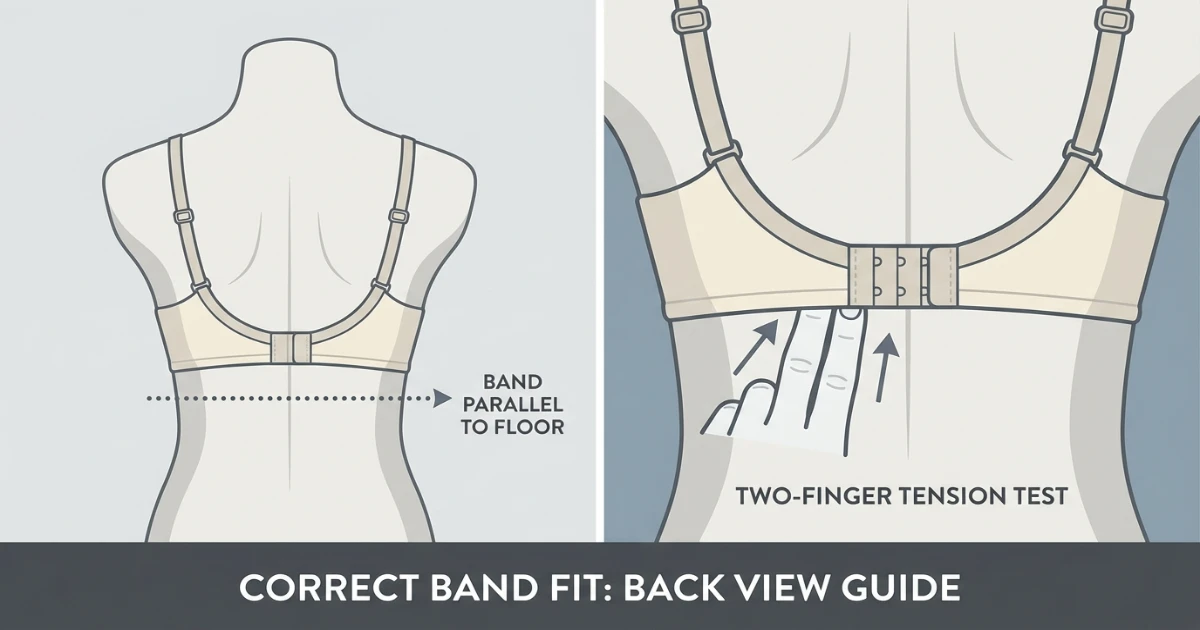
The band should run parallel to the floor all the way around and allow only two fingers underneath — not a full hand. (Diagnose your fit issues →)
Fit Test Guide: 30DD or 32D?
Work through this five-step fit check on the loosest hook of a brand-new bra. If you are testing a worn bra, use the middle hook to account for stretch.
Band level check: Stand side-on to a mirror. The band should be level all the way around — back parallel to the floor, not angled upward toward your shoulder blades. If the back is higher than the front, the band is too big. Try 30DD.
Two-finger test: Slide two fingers under the band at the center back. They should fit with some resistance but not freely slip through. If you can insert your whole hand, the band is too large (move to 30DD). If two fingers barely enter, the band is tight (consider 32D if the cups still fit).
Red-mark and comfort check: Wear the bra for two hours and then remove it. Faint temporary marks on the underbust are normal. Deep, painful ridges or welts that persist for more than 20 minutes indicate the 30DD band is too firm — try 32D.
Cup fill and overflow check: Breast tissue should fill the cup completely with no wrinkling at the top (too big) or spillage over the underwire or at the sides (too small). If cups fit in 30DD but gape in 32D, your true band is 30 inches — stay with 30DD.
Underwire placement check: The underwire must lie flat against the ribcage, sitting entirely beneath breast tissue and not pressing on any part of the breast. Underwire that pokes the armpit or floats off the chest suggests the cup width or band is mismatched — use the AI bra calculator for a full personalized fit analysis.
30DD vs 32D: Full Comparison Table
| Factor | 30DD | 32D |
|---|---|---|
| Band circumference | 30 in (76 cm) | 32 in (81 cm) |
| Cup letter (US/UK) | DD (5 in differential) | D (4 in differential) |
| Cup volume | Equal | Equal |
| Ideal underbust range | 28–30 in | 30–32 in |
| Band firmness feel | Firm / snug | Relaxed / moderate |
| Primary support source | Band (high) | Band + straps (shared) |
| Risk of band riding up | Low (on correct frame) | High (on sub-30 in underbust) |
| Underwire base width | Narrower | Wider |
| Cup gore width | Narrower set | Slightly wider set |
| High-impact suitability | Excellent | Good (on correct frame) |
| Mainstream retail availability | Specialist stores | Widely stocked |
| Full sister size row | 28E · 30DD · 32D · 34C | 28E · 30DD · 32D · 34C |
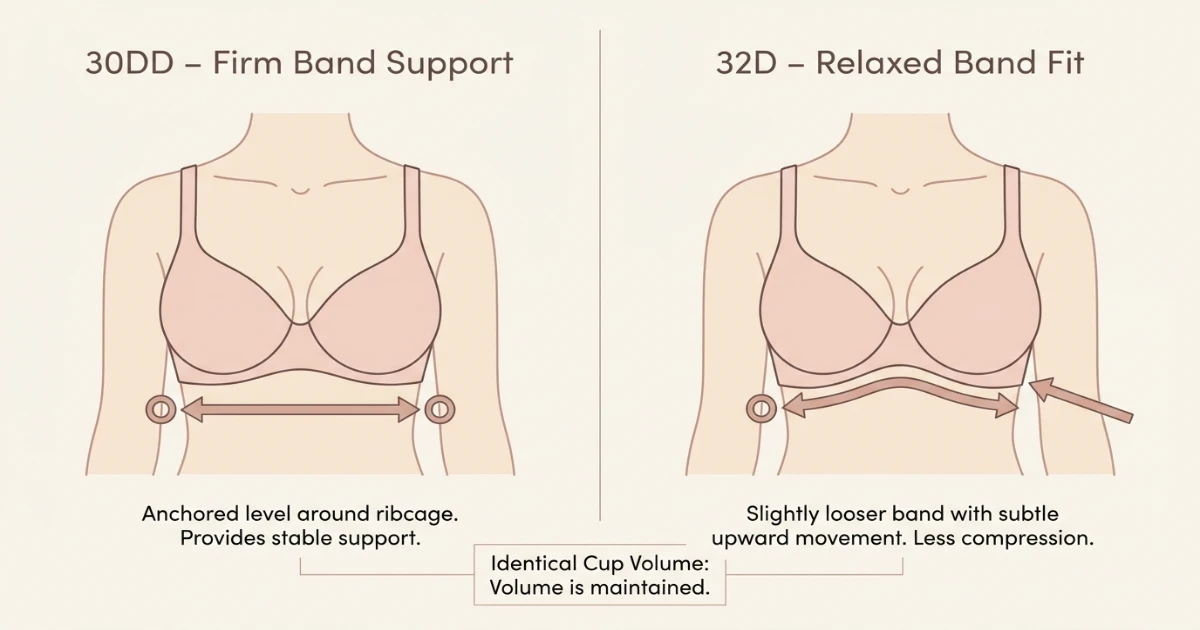
30DD (left) anchors firmly at the base of the ribcage; 32D (right) sits with more band flex. Cup volume is identical in both. (How to measure yourself →)
People Also Ask
Is 30DD the same as 32D?
Yes — 30DD and 32D are sister sizes with identical cup volume. The cup letter drops by one step (DD to D) when the band increases by one step (30 to 32), keeping the internal cup space mathematically equivalent. The only real difference you will feel is band tension: 30DD grips more firmly, while 32D feels comparatively looser.
Which is bigger — 30DD or 32D?
Neither is larger in cup volume — they are equal. However, 32D has a physically larger band circumference (32 inches versus 30 inches), making the overall bra frame wider. The cup depth, which determines how much breast tissue can be accommodated, is the same in both sizes. Do not confuse the higher cup letter (DD) with a larger cup — in this context, DD on a 30 band equals D on a 32 band.
Can I wear 32D if I normally wear 30DD?
Yes, with caveats. The cups will hold the same volume of breast tissue. However, if your underbust measures less than 30 inches, the 32D band will be too loose and will ride up your back, potentially causing the cups to tilt forward and lose their shape. If your underbust is genuinely 30–32 inches, 32D is likely your correct size, not a sister-size compromise.
What are the sister sizes of 30DD?
The full sister size row for 30DD is: 26F – 28E – 30DD – 32D – 34C – 36B. All sizes in this row contain the same cup volume. Moving toward a smaller band means a larger cup letter; moving toward a larger band means a smaller cup letter. Use our sister size calculator to generate the complete row for your current size instantly.
Why does my 32D feel loose in the band but my cups fit?
This is a classic sign that your band size is actually 30 inches, not 32 — meaning 30DD is your correct size and 32D fits in the cup only by coincidence of the sister size relationship. A loose band cannot provide proper support, and the cups will eventually lose their shape as the band migrates. Switching to 30DD will give you the same cup fit with a properly anchored band. Our bra fit problems guide explains this in detail.
Is DD a large cup size?
DD sounds large to many people, but cup size is relative to the band. A 30DD is actually a moderately proportioned cup relative to its band — much smaller in real volume than a 36DD or 38DD, which are often what people picture when they think of a “DD cup.” On a 30-inch frame, DD simply means the full bust measures 5 inches more than the underbust. It is important to treat the number and letter together rather than the letter alone.
Does going from 30DD to 32D affect the shape of the bra?
Yes — even though cup volume is identical, the physical shape and dimensions of the bra change. The 32D will have a wider underwire, a broader cup base, cups positioned slightly further apart, and more band stretch. On a narrow frame, this can cause the underwire to sit on breast tissue rather than underneath it, the cups to gape at the sides, and the gore (center panel) to not lie flat. These are all signs the sister-size swap has gone too far for your particular body shape.
Where can I buy 30DD bras?
30DD is a small-band, full-cup size that most high-street retailers do not carry. Your best options are specialist lingerie brands such as Freya, Panache, Fantasie, Curvy Kate, and Elomi (UK brands with excellent small-band ranges), as well as dedicated online retailers like Bare Necessities, HerRoom, and Bravissimo. If you are struggling to find 30DD in a specific style, 32D from the same brand is the recommended sister size alternative — the same brand’s sizing will be most consistent across sister sizes.
Not Sure If You’re a 30DD or 32D?
Get a personalized bra size recommendation based on your actual measurements — in under 60 seconds, no fitting room required.
Try the AI Bra Calculator → How to Measure at HomeRelated Size Comparisons
Exploring nearby sizes or other sister-size pairs? These guides apply the same principles explained above:
Further Reading & Tools
- International Bra Size Charts — convert between US, UK, EU, FR, IT, AU sizing systems, including DD equivalents
- How to Measure for a Bra — illustrated step-by-step measuring guide
- Bra Fit Problems Solved — every symptom, its cause, and the fix
- AI Bra Size Calculator — personalized recommendation from your measurements
- Sister Size Calculator — generate your full sister size row for any bra size
- Size Comparison Hub — browse all head-to-head bra size comparisons
Note: Sizing conventions vary between brands and countries. All measurements above use standard US/UK sizing. European brands may label DD as E — always consult our international size chart when ordering from non-US/UK brands. | Last reviewed March 2026 by the Bra-Calculator.com editorial team.