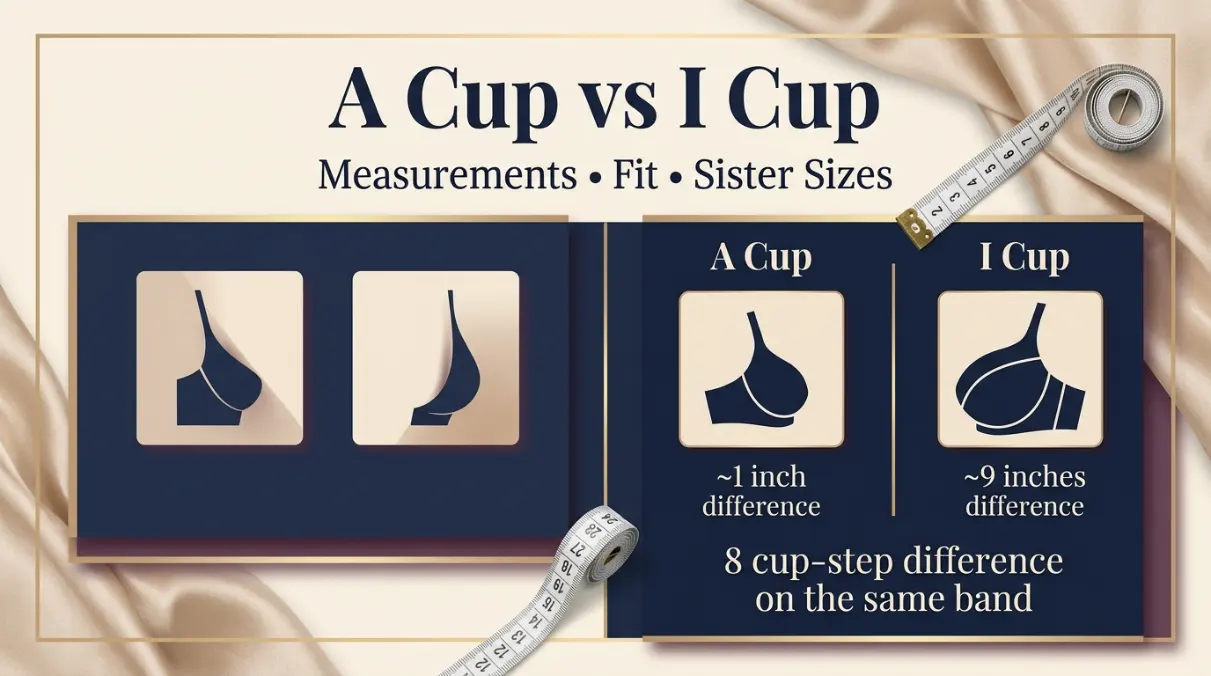
On the same band size, I cup is about 8 cup steps larger than A cup. In standard inch-based logic, A commonly represents about a 1-inch bust-to-underbust difference while I represents about a 9-inch difference. This is a very large cup-depth gap where band stability, wire width, center depth, and tissue containment matter more than the letter alone, so the right answer should be judged by smooth cup edges, full tissue containment, a level band, and a center gore that sits flat or close without painful pressure.
Jump to a Section
Choose the fit signs you notice in the band, cups, center and straps. We’ll use them to suggest the most useful next step.
Private fit check — your answers stay in your browser and are used only for this on-page guidance. Nothing is stored or submitted.
A Cup vs I Cup at a Glance
| Attribute | A Cup | I Cup |
|---|---|---|
| Typical same-band difference | About 1 inch | About 9 inches |
| Cup-step gap | 8 cup-step difference when the band stays the same | |
| General role | Smaller / shallower reference point | Fuller / deeper reference point |
| Best clue | Better if the larger cup wrinkles, gaps, or feels too tall | Better if the smaller cup cuts in, spills, compresses, or makes the gore float |
| Core reminder | Cup volume is not fixed. Band size, sister sizes, shape, brand grading, and bra construction can change the real-life look. | |
What Does A Cup vs I Cup Really Mean?
A Cup vs I Cup compares a smaller cup category with a much deeper cup category, but the comparison only works when the band is the same. A cup letter is not a body type, a weight category, or a universal visual size. It is a relationship between the ribcage measurement and the fullest bust measurement.
Because this page compares a smaller starting cup with a fuller ending cup, the most common mistake is assuming the larger cup must look extreme. In accurate bra fitting, a larger cup can look smoother and more discreet than a too-small cup because tissue is no longer being pushed upward, outward, or into the center.
The difference between A and I can also be exaggerated or softened by breast shape. Projected tissue usually needs more immediate depth near the wire and more center room. Shallow tissue may need wider, lower-profile cups even when measurements suggest a larger letter. Soft tissue can escape from a too-small cup faster, while firmer tissue may make the cup edge cut in before obvious spillage appears.
For that reason, this guide does not treat A cup as “small” and I cup as one fixed “large” look. It explains the real fitting logic: where the cup needs depth, where the wire should sit, why the band matters, how sister sizes affect volume, and which bra styles give the cleanest test.
Exact Measurement Difference Between A and I
In many common US-style systems, each cup step represents roughly one additional inch between the full bust and snug underbust. That makes A Cup vs I Cup a 8-step difference on the same band. The larger size should not simply feel “bigger”; it should solve clear fit symptoms such as cup cutting, side spillage, center compression, or a floating gore.
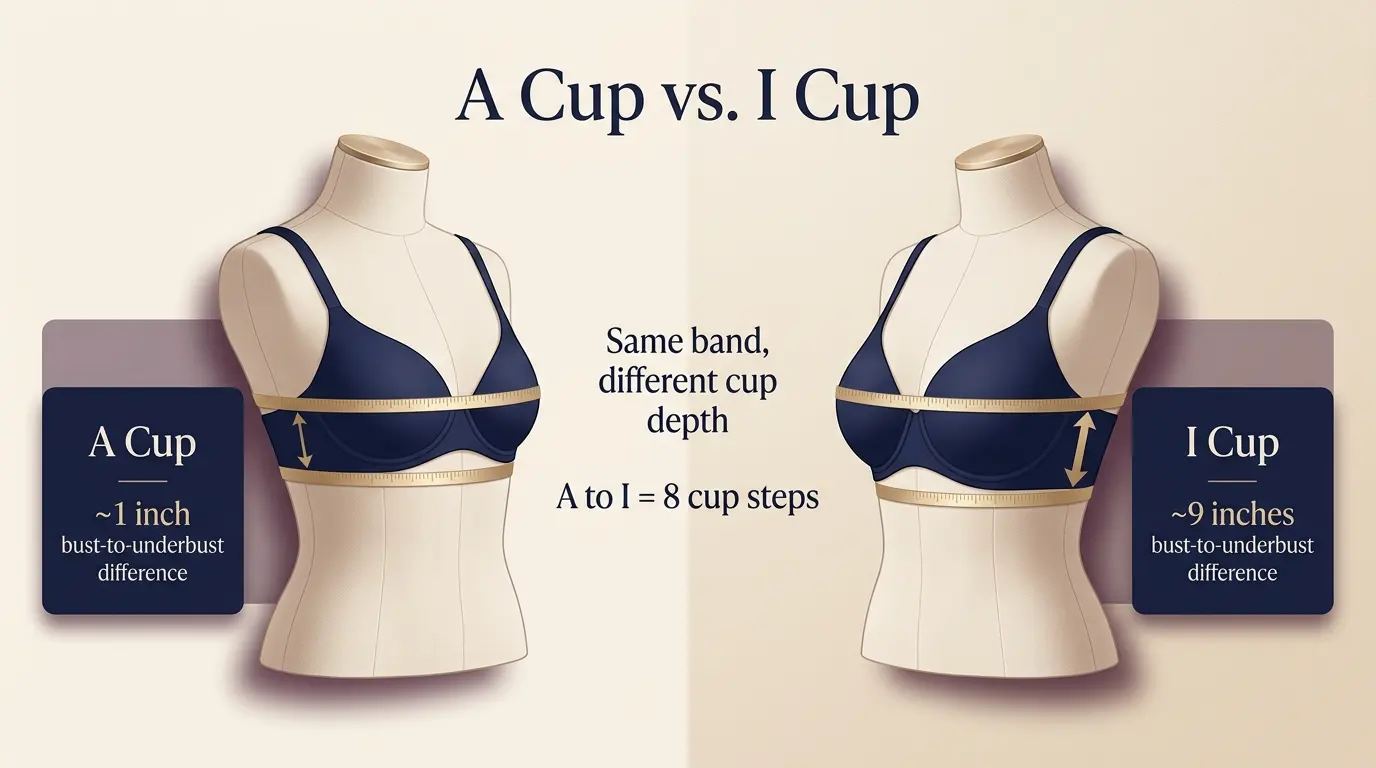
The band is the support base. If it is wrong, the cup comparison becomes unreliable.
Keep the tape level around the fullest part without compressing breast tissue.
Comparing two different bra styles can make the wrong size look right.
Spillage, gaping, floating gore, wire placement, and strap pressure tell you more than the label.
What Does A Cup vs I Cup Look Like?
On the same band, this comparison can show a strong difference in depth and containment. The smaller cup may look flatter or shallower, while the larger cup usually gives more forward projection, more lower-cup capacity, and more room at the center and sides.
The visual gap may still look different from person to person. A petite frame may make the difference look more obvious. A broader frame may distribute the same cup volume across more chest width. A shallow breast shape can make the larger size appear too tall even when the measurement difference seems possible, while projected tissue may make the larger size look instantly smoother.
Real fit beats cup-letter myths. The best size is the one that looks calmer under clothing, keeps the band level, and stops the cup from cutting, folding, or forcing tissue out of place.
For big-gap comparisons like A Cup vs I Cup, it is normal to need a shape change as well as a cup-letter change.
Best Products to Test A Cup vs I Cup
These picks focus on the support behavior that matters most in this comparison: stable bands, reliable cup edges, side containment, and enough structure to show whether the larger cup is solving a real fit problem.

Full-Coverage Support Bra
- A deeper full-coverage cup is useful for checking containment, lower-cup space, and center-gore stability.
- Best used when comparing both cup sizes in the same or similar bra construction.
- Check band level, side wire position, strap pressure, and cup edge smoothness before deciding.
- Choose comfort and correct fit signs over the cup label alone.

Side-Support Bra With Wider Straps
- Side support helps bring tissue forward and reduces the side escape that often appears in too-small cups.
- Best used when comparing both cup sizes in the same or similar bra construction.
- Check band level, side wire position, strap pressure, and cup edge smoothness before deciding.
- Choose comfort and correct fit signs over the cup label alone.
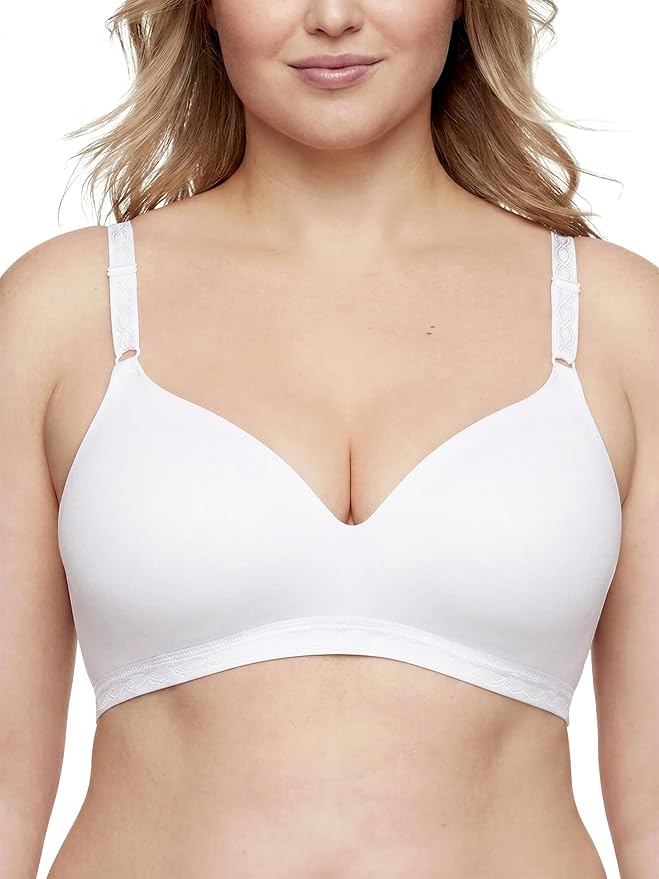
Wireless Comfort Bra With Cushioned Straps
- A comfortable wireless option can help test whether pressure is caused by the cup size, the wire shape, or the band.
- Best used when comparing both cup sizes in the same or similar bra construction.
- Check band level, side wire position, strap pressure, and cup edge smoothness before deciding.
- Choose comfort and correct fit signs over the cup label alone.
How Body Shape Changes A Cup vs I Cup
Body shape is the reason two people with the same measurements can need different bra styles. Treat the cup comparison as a fit investigation, not a simple label upgrade.
Depth Shows Quickly
Projected breasts often reveal a too-small cup through floating gore, center pressure, and lower-cup collapse.
Prioritize depthShape May Matter More
Shallow shapes may need wider, lower cups rather than a very tall larger cup.
Check cup heightWire Width Matters
A larger cup may still fail if the wire is too narrow and sits on outer tissue.
Check side wireContainment Is Key
Soft tissue may spill from a shallow cup and may need stretch lace, fuller coverage, or side support.
Contain gentlyA Cup vs I Cup Sister Sizes
Sister sizing helps when the cup volume is close but the band feels wrong. The rule is simple: go down one band and up one cup, or go up one band and down one cup. This preserves similar cup capacity while changing the support base.
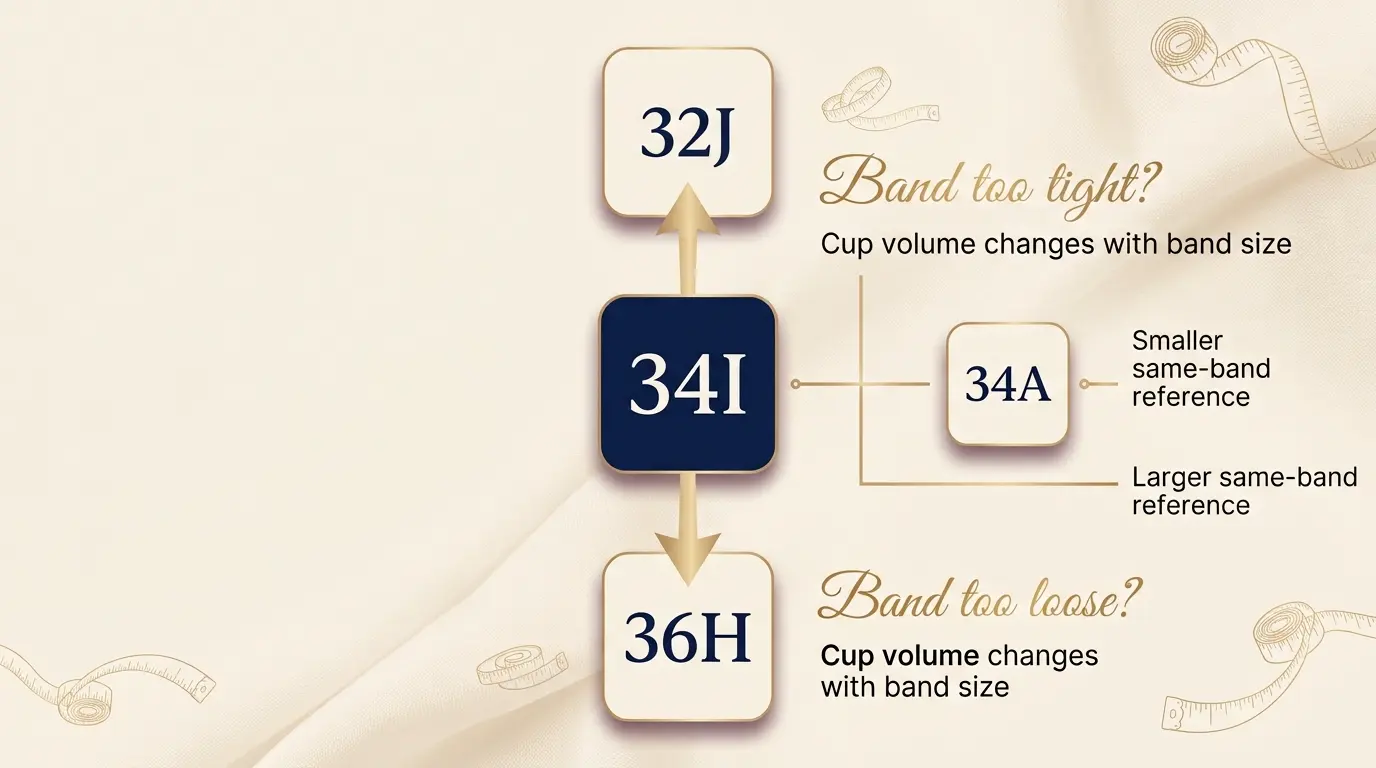
| Situation | Try | Why |
|---|---|---|
| Smaller cup spills | Move toward I on the same band | You likely need more depth or a better cup shape. |
| Larger cup gaps | Try A, a lower cup, or a shallower shape | The bigger cup may be too tall or too projected for your tissue. |
| Band rides up | Down one band, up one cup | Keep similar volume with firmer support. |
| Band feels tight | Up one band, down one cup | Keep similar volume while giving the ribcage more room. |
A vs I: Real Fit Differences
- Less same-band cup depth
- May suit shallow or lower-volume tissue
- Can gap less if the larger cup is too tall
- Can cut in when actual tissue needs more space
- More same-band cup depth
- Better when the smaller cup compresses tissue
- Often improves center gore and side containment
- Needs the right wire width and cup height
- Can be cleaner for shallow shapes
- May feel too small if tissue pushes over the cup edge
- Works best when the band and wire are correct
- Can handle more projection and lower-cup depth
- May gap if the cup is too tall or open
- Often needs stronger construction in fuller ranges
- May feel light when correct
- Can make straps overwork if too small
- May distort the band when tissue is compressed
- Should improve containment and comfort
- Needs a firm level band to work correctly
- May require wider straps or side support
- Try if I wrinkles or feels too tall
- Check under thin tops for smoothness
- Avoid fixing gaping only by tightening straps
- Try if A spills, cuts in, or makes the gore float
- Use brands with fuller-cup construction
- Check returns because brand grading varies
Which Bra Styles Work Best for A Cup vs I Cup?
The right test style should reveal fit truth without hiding it. Very soft bralettes can be comfortable, but they may not show whether the cup depth, gore, and wire width are actually right.
Best for checking lower-cup depth and full containment in the larger size.
Helps center tissue and makes side spillage easier to diagnose.
Useful when the larger cup feels too tall but more width is needed.
Helpful for close-set shapes and lower center gores.
Shows bounce, compression, and support problems quickly.
Too flexible for a fair big-gap cup comparison.
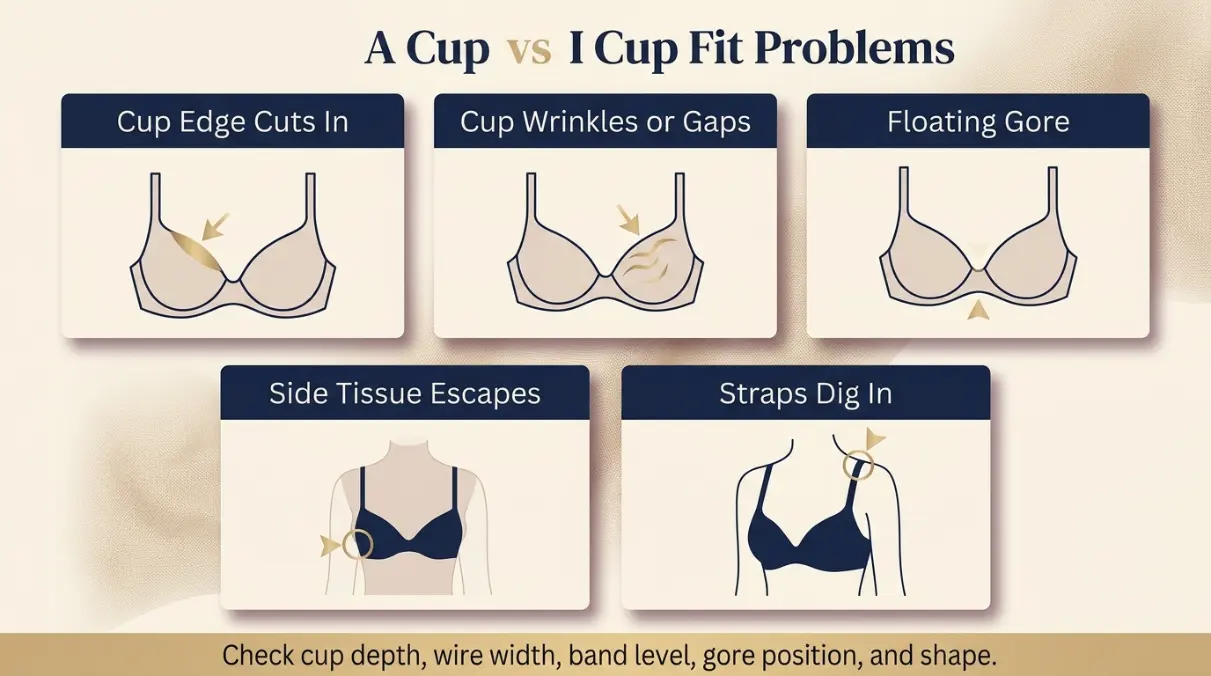
Common Fit Problems in A Cup vs I Cup
The smaller cup may not have enough depth or edge openness.
The larger cup may be too tall, too projected, or too open for your tissue.
The cup may lack center depth, especially on projected or close-set tissue.
The wire may be too narrow or the smaller cup may not surround the full root.
Straps often compensate when the band and cups are not carrying support correctly.
International Conversion Notes for A Cup vs I Cup
International sizing can change cup labels, especially in larger cup ranges. A US I may not map neatly to every UK or EU chart, and brands may grade cups differently. Always check the brand size chart before buying across regions.
Use the Global Bra Size Converter and the Brand Size Decoder before buying across regions.
Related Tools & Guides for A Cup vs I Cup
| Guide / Tool | Why It Helps |
|---|---|
| Bra Size Calculator | Calculate your band and cup using measurements rather than guesswork. |
| Cup Size Visuals | Understand how cup letters change with band size and body shape. |
| Sister Size Calculator | Adjust band and cup together while preserving similar volume. |
| Global Bra Size Converter | Check size labels across US, UK, EU, AU, and more. |
| AI Smart Fit Bra Calculator | Diagnose gaping, spillage, strap digging, floating gore, and side tissue issues. |
Frequently Asked Questions
On the same band, I cup is about 8 cup steps deeper than A cup. That means the larger cup gives much more room for projection, lower-cup depth, and side containment.
It is larger on the same band, but it is not a fixed body size. A I cup on a smaller band can look very different from the same letter on a larger band.
Yes. Measurements can point to one size while tissue shape points to another. Root width, projection, softness, and cup construction all affect the final fit.
That usually means the issue is shape, not just volume. Try a cup with different height, wire width, and edge openness before assuming both sizes are wrong.
Yes, especially if the cup volume feels close but the band rides up or feels too tight. Sister sizing helps separate band problems from true cup-depth problems.
A seamed full-cup, balconette, or side-support style usually gives the clearest test because it shows depth and containment better than very soft bralettes.
Measure, scoop and settle, wear the bra for several minutes, raise your arms, sit down, and check whether the band, gore, wires, straps, and cup edge stay stable.
Do not judge by the letter alone. A Cup vs I Cup is best understood through band size, cup depth, tissue shape, and real fit symptoms.
Find Your Best Cup Size
Use your measurements, fit symptoms, and sister-size options to decide whether A, I, or a nearby band-and-cup combination gives the cleanest fit.