48 Bra Size Guide: Every 48 Band Size from 48AA to 48K
Use one complete 48-band hub to compare cup differences, approximate bust measurements, sister sizes, fit clues, bra constructions and international equivalents—without opening a dozen repetitive pages.
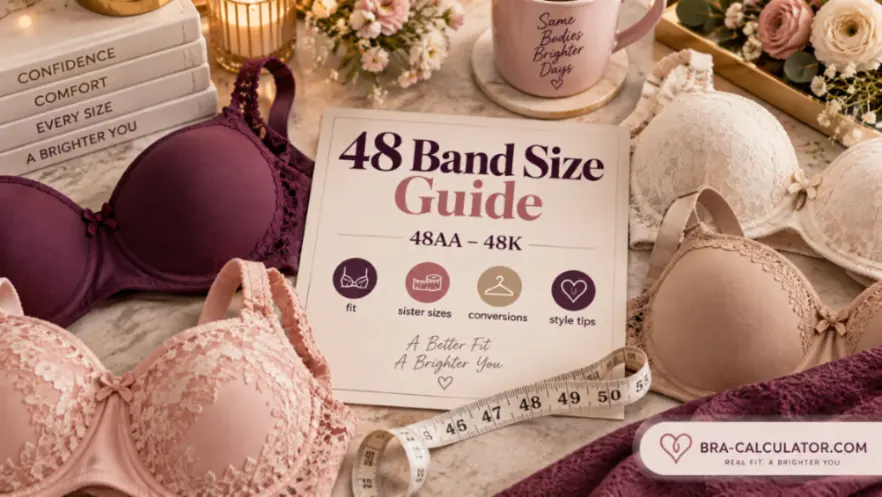
A 48 bra size is a band family, not one cup volume. This hub covers 48AA through 48K and uses the raw snug underbust as the band starting point rather than automatically adding four inches. At this band range, elastic recovery, back height, side-wing geometry and cup depth can change how secure the same printed 48 feels, so use the chart as a starting point and confirm the fit on your body.
48 Bra Size Chart: 48AA Through 48K
The band baseline stays fixed while cup depth rises. The bust column uses simple cup-step math from a 48-inch baseline so you can compare sizes consistently. It is not a promise that every person wearing a 48 band measures exactly 48 inches underbust or that every brand stretches the same way.
| Size | Cup difference | Approx. full bust* | Tighter sister | Looser sister | UK · EU · AU/NZ |
|---|---|---|---|---|---|
| 48AA | Less than 1 in | ~48–49 in | 46A | No common larger sister | 48AA · 110AA · 26AA |
| 48A | 1 in | ~49 in | 46B | 50AA | 48A · 110A · 26A |
| 48B | 2 in | ~50 in | 46C | 50A | 48B · 110B · 26B |
| 48C | 3 in | ~51 in | 46D | 50B | 48C · 110C · 26C |
| 48D | 4 in | ~52 in | 46DD | 50C | 48D · 110D · 26D |
| 48DD / 48E | 5 in | ~53 in | 46DDD / 46F | 50D | 48DD · 110E · 26DD |
| 48DDD / 48F | 6 in | ~54 in | 46G | 50DD / 50E | 48E · 110F · 26E |
| 48G | 7 in | ~55 in | 46H | 50DDD / 50F | 48F · 110G · 26F |
| 48H | 8 in | ~56 in | 46I | 50G | 48FF · 110H · 26FF |
| 48I | 9 in | ~57 in | 46J | 50H | 48G · 110I · 26G |
| 48J | 10 in | ~58 in | 46K | 50I | 48GG · 110J · 26GG |
| 48K | 11 in | ~59 in | 46L | 50J | 48H · 110K · 26H |
Why a 48D Does Not Require an Exact 52-Inch Bust
The chart uses a clean one-inch cup-step model so you can compare sizes consistently. Real bodies are less tidy. A person can measure a little below or above the simple reference and still fit the same labeled cup because standing, leaning and lying measurements can spread differently, breast tissue can be soft or firm, and bras distribute volume in different shapes.
A nominal 48D reference of about 52 inches helps explain the cup step. It is not a rule that your tape must read exactly 50.00 inches to wear 48D.
Two people with similar full-bust numbers may need different cup shapes if one carries more depth forward and the other has a wider, shallower root.
If your leaning measurement is noticeably larger than your standing measurement, a deeper or seamed cup may fit better than a shallow molded cup even at the same labeled size.
Is a 48 Band Actually Right for You?
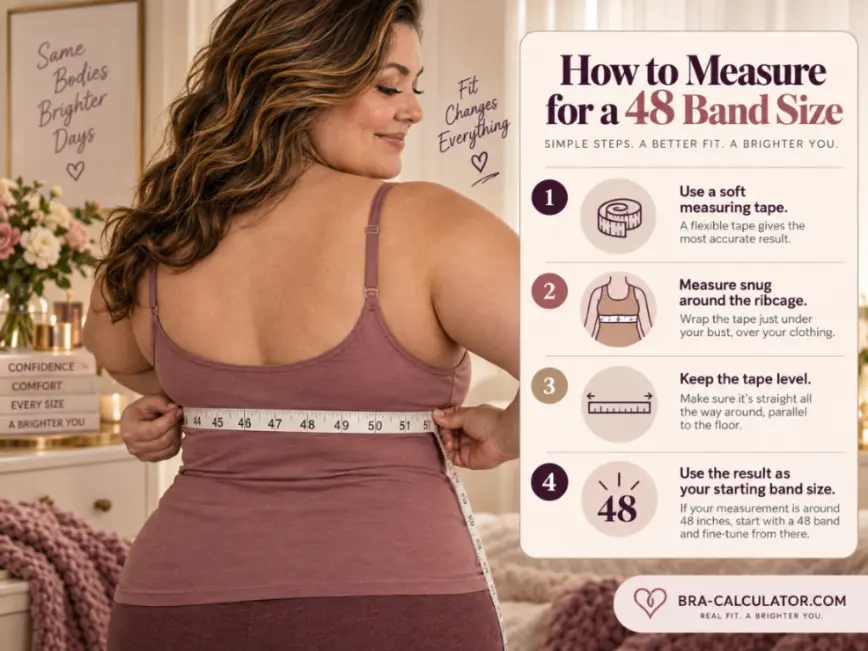
A 48 band should feel secure enough to anchor the cups without climbing the back, but it should not create painful restriction. A snug underbust around the upper-40s can place you near this band family, with the final choice affected by elastic stretch, torso softness, hook position, cup depth and personal comfort.
The band stays level, the back does not ride upward, the front remains stable and you can breathe and move without painful pressure.
If the cups fit but the back climbs, test a 46 sister size with the cup moved up one step. Do not tighten the straps to compensate for a loose band.
Check the cups first. Too-small or too-shallow cups can pull the whole bra forward and create false band tightness. If the cups truly fit, compare the 50 sister size.
For a fresh starting size, use the Bra Size Calculator. For band-only troubleshooting, use the Bra Band Size Guide.
Why Two 48 Bands Can Feel Completely Different
The printed number tells you the nominal band family, but it does not tell you how the elastic behaves. In a 48 band, a soft high-stretch back can feel much looser than a firm power-mesh back with the same label. Cup depth also matters: a shallow cup can borrow room from the band and make a correctly sized 48 feel falsely tight.
A band that stretches easily but does not recover can ride upward after an hour. A firmer band may feel snugger at first yet stay more stable through the day.
A taller back and more hooks can spread pressure across more torso area, but height is not automatically better if the upper edge rolls or the back panel is too stretchy.
Higher wings can improve side containment, especially in fuller cups, while a short torso may find the same wing rubs under the arm. Match height to your body, not just your cup letter.
If the wire is pushed away from the root or the cup slides down, test more immediate projection before moving to 50. Cup shape can create false band tightness.
Useful test: fasten the bra backward with the cups hanging down. If the 48 band feels comfortably firm by itself but painfully tight when worn normally, inspect cup size and cup shape before changing the band.
When a 48 Band Rolls, Pinches or Feels Heavy: Read Where the Pressure Happens
Extended-band fit is easier to troubleshoot when you identify where the discomfort starts. Even pressure around the torso points to a different problem than a rolling lower edge, underarm rubbing or front-only restriction.
If the band stays level and you can breathe and move normally, a firm new-band feel can be compatible with a secure fit. Judge it after several minutes of normal movement, not from the first fastening alone.
This can come from wing height, torso contour, very soft elastic or the band sitting in a natural body crease. Test a shorter or more contoured back before assuming the 48 itself is too small.
If the back feels reasonable but the front feels restrictive, inspect cup depth, wire width and center fit. Cups that are too shallow can pull the entire frame forward.
That often points to wing height, cup height or strap-set geometry rather than raw band circumference. A different frame can solve the problem without moving to 46 or 50.
Comfort rule: support should feel secure, not punishing. Persistent painful pressure, numbness, broken skin or significant rubbing means the size or construction needs to be reassessed rather than “broken in.”
46 vs 48 vs 50 Band: Which Direction Should You Test?
Use sister sizing only when cup volume is already close. Moving one band step tighter requires moving one cup step larger; moving one band step looser requires moving one cup step smaller.
| What you feel | What to test | Keep in mind |
|---|---|---|
| 48 rides up while cups fit | Test the 46 sister size | Move the cup one step larger to preserve approximate volume. |
| 48 is stable and comfortable | Stay in the 48 family | Fine-tune cup size and cup shape without changing the anchor. |
| 48 is truly restrictive after cup fit is confirmed | Test the 50 sister size | Move the cup one step smaller to preserve approximate volume. |
| 48 feels tight only when cups are worn normally | Test deeper or larger cups first | This often points to cup compression or insufficient projection rather than the band. |
Example: if 48D has the right cup volume but the band rides up, compare 46DD. If 48D has the right cup volume but the band is genuinely too firm, compare 50C.
48AA to 48K: Individual 48 Band Size Profiles
Each profile keeps the 48-band anchor constant but focuses on the fit clues that become more useful at that cup depth: cup height at AA–B, projection and wire position around C–DD, then root width, center fullness, tissue softness and structural support through the fuller G–K range.
48AA Bra Size: Measurements, Fit & Sister Sizes
48AA is the smallest cup step in this hub. The comparison model places it at less than a 1-inch bust-to-band difference, roughly 48–49 inches around the fullest bust on a 48 baseline. At this size, the most common false signal is a cup that is simply too tall or too rigid: the neckline can gap even when the actual cup volume is close.
Most useful clue: cup height and neckline shapeHow 48AA should fit
A good 48AA should anchor around the torso without the back climbing. After a full scoop-and-settle, the cup edge should follow the breast without standing away, collapsing, or pressing breast tissue sideways into the wing.
At this cup depth, a tall molded cup can create empty space even when the volume is correct. If the lower cup is smooth but the top edge gaps, compare a shorter cup, lower neckline or softer spacer construction before assuming you need a smaller cup.
If the cup edge cuts in or tissue escapes toward the underarm, 48A may be the better same-band test. If the band itself rides upward while the cup looks right, 46A is the tighter sister-size experiment.
48-band nuance: On a 48 band, low-volume cups are often graded on a broader frame. If a tall side wing or wide strap set feels intrusive while the cup itself is smooth, compare a lower-wing, more centered design before changing band size.
Best bra styles to test
Test shorter T-shirt cups, spacer bras, low-coverage wireless styles and lower-profile plunges. Flexible cup edges are especially useful when rigid foam leaves a visible shell above the tissue.
Avoid judging fit from neckline gaping alone. Press the cup gently toward the wire: if the bottom fills but the top still floats, cup height or shape is more suspicious than raw volume.
48A Bra Size: Measurements, Fit & Sister Sizes
48A represents about a 1-inch cup step above the 48-band baseline, with a simple reference near 49 inches. The useful distinction is whether visible space comes from excess volume or from a cup that is too tall, too wide, or too stiff for a shallower breast shape.
Most useful clue: edge gaping vs true extra volumeHow 48A should fit
The 48 band should stay level and do most of the anchoring while the straps sit comfortably rather than being tightened to hold the bra down. The cup should contain the breast root without the wire extending far beyond it or the upper edge hovering away.
If you see a small gap only near the strap, check whether the cup is too tall or the strap is set too wide before dropping to 48AA. A cup that is too shallow can also push tissue outward and make the neckline look emptier than it really is.
If the center or cup edge cuts in after scooping, compare 48B. If the band can be pulled far away and rides upward, compare the 46B sister size instead of simply tightening the straps.
48-band nuance: Longer 48-band frames can place strap anchors farther apart. If the cups fit but the straps repeatedly sit near the shoulder edge, prioritize a more centered strap attachment rather than tightening the straps or dropping cup volume.
Best bra styles to test
Useful tests include spacer cups, flexible lightly lined bras, shallow balconettes and wire-free bras with a defined underband. Try one smooth cup and one seamed or soft-cup style so you can separate a volume issue from a rigid-shape issue.
For a short torso, watch tall side wings and high cups: a technically correct 48A can still feel wrong if the bra extends too far into the underarm.
48B Bra Size: Measurements, Fit & Sister Sizes
48B uses an approximate 2-inch bust-to-band difference, giving a simple reference near 50 inches. At this step, cup placement matters as much as the letter: two B cups can distribute the same volume very differently across width, height and forward depth.
Most useful clue: wire width and where the cup volume sitsHow 48B should fit
A well-fitting 48B should let the band remain stable while the cup follows the breast without a sharp ridge at the neckline. The wire or cup edge should sit around the breast root instead of drifting backward into the side or sitting on tissue.
If the cup looks empty near the top but feels tight near the side, the issue can be a wide/tall cup rather than excess volume. If the wire is being pushed downward, the cup may be too shallow even though B sounds like a modest cup letter.
Compare 48C if tissue bubbles above the cup or the center cannot settle. Compare 48A only when the cup has genuine loose space after scooping and the wire placement still looks appropriate.
48-band nuance: A very stretchy 48 back can feel comfortable for ten minutes and then lose its anchor. If the cups remain smooth but the back creeps upward during the day, compare firmer elastic or the 46C sister size before assuming the cup is wrong.
Best bra styles to test
Try lightly lined cups, shallow balconettes, soft seamed cups and supportive wireless bras. A lower balconette can be revealing here because it shows whether the breast is filling the base of the cup rather than merely disappearing inside a taller shell.
If straps repeatedly slip, check strap-set width and cup height before blaming the band. Some 48B frames need more centered straps rather than more strap tension.
48C Bra Size: Measurements, Fit & Sister Sizes
48C represents about a 3-inch cup step above the 48 baseline, with a comparison reference near 51 inches. This is where projection mismatches often start to become obvious: a cup can look smooth at the top yet still be too shallow near the wire.
Most useful clue: projection at the wireHow 48C should fit
The band should stay horizontal while the bottom of the cup sits close to the breast root. If the cup repeatedly slides down an inch after you put it on, that is a useful clue that you may need more depth near the wire rather than a tighter strap.
Look at the center and lower cup together. A floating center, flattened lower cup or crease just above the wire can mean the cup is too shallow even if there is no dramatic top spillage.
If the entire cup is smoothly loose, compare 48B. If the lower cup is packed and the top edge cuts in, compare 48D or a more projected 48C before changing bands.
48-band nuance: At 48C, rolling or folding at the lower band edge is not automatically proof that the band is too small. Check torso shape, band height and elastic recovery; a shorter or more contoured back can sit better without moving to 50.
Best bra styles to test
Compare a supportive T-shirt bra with a seamed balconette or side-support cup. The contrast is useful: if the seamed cup stays in the root while the molded cup slides down, cup shape—not necessarily cup size—is driving the problem.
People with softer tissue may prefer a slightly more closed upper cup; fuller-on-top shapes often need a more open neckline to avoid cutting in.
48D Bra Size: Measurements, Fit & Sister Sizes
48D represents about a 4-inch bust-to-band difference, with a simple comparison reference near 52 inches. D is often the point where a shallow molded cup can create false band tightness by pushing the whole bra away from the breast root.
Most useful clue: center fit + lower-cup depthHow 48D should fit
A stable 48D should keep the back level while the lower cup stays seated in the breast crease. On wired bras, the center should approach the sternum as closely as your breast spacing and the design allow without forcing tissue sideways.
At D, projection mismatches become easier to see. A too-shallow molded cup may flatten the breast, push the wire downward or make the center float even if the neckline looks smooth under clothing.
If tissue escapes at the top or side after a full scoop, test 48DD/48E. If 48D has broad empty space but the wire width is appropriate, compare 48C or a shorter cup before changing to a 46 or 50 band.
48-band nuance: For 48D, separate pressure from the band itself from pressure created by cup compression. If the backward-band test feels comfortably firm but the worn bra feels restrictive, test deeper 48D cups or 48DD before moving to a 50 band.
Best bra styles to test
Useful constructions include seamed balconettes, side-support bras, full-cup bras with a firm lower cup and well-shaped T-shirt bras. One seamed and one molded test bra can tell you more than trying three similar foam cups.
If you are close-set, pay attention to center-gore width. A wide center can sit on tissue even when cup volume is correct; a narrower or lower center may solve that without changing size.
48DD / 48E Bra Size: Measurements, Fit & Sister Sizes
48DD / 48E is the fifth cup step in this US-centric comparison model, with a reference near 53 inches. Around this depth, center fullness, top-edge openness and immediate projection can produce very different fit outcomes even when the total cup volume is close.
Most useful clue: top-edge cutting vs center fullnessLabel note: Many US charts use DD and E for the same fifth cup step, while UK charts commonly print DD. Treat the brand chart as the final authority.
How 48DD / 48E should fit
The band should remain the anchor while the cups contain the full root at the side and bottom. If the upper cup cuts in mainly near the center but looks fine near the strap, center fullness or a closed neckline may be the issue—not automatically a need for the next cup.
Softer tissue can settle differently in a 48DD than firmer tissue. A supportive cup needs enough containment to prevent folding at the neckline without becoming so tall that it rubs the underarm or leaves space above the breast.
If the wire stays low and the center floats, try a deeper 48DD/E or 48DDD/F. If the whole cup wrinkles after scoop-and-settle, compare 48D in the same model before touching the band.
48-band nuance: At 48DD/E, a high wing can improve side containment but can also rub on a short torso. Judge wing height independently from band size: the right 48 band should not require tolerating underarm pressure.
Best bra styles to test
Test side-support balconettes, full-cup seamed bras, stretch-lace upper cups and supportive smooth bras with real lower-cup depth. Stretch lace can be especially forgiving when one breast is slightly fuller or tissue changes across the month.
If a molded 48DD feels wide and flat, do not assume DD is too large until you have tried a seamed cup with more immediate projection.
48DDD / 48F Bra Size: Measurements, Fit & Sister Sizes
48DDD / 48F represents about a 6-inch cup step above the 48 baseline, with a simple reference near 54 inches. At this point, seamed construction usually reveals fit more clearly than rigid foam because depth, wire width and upper-cup tension can be evaluated separately.
Most useful clue: immediate projection and side supportLabel note: Many US brands place DDD/F at this sixth cup step, while UK sizing commonly calls the comparable step E. Do not assume every brand alphabet is identical.
How 48DDD / 48F should fit
A good fit should keep the cup base close to the breast root and prevent the band from being dragged forward by cup pressure. If the bottom of the cup folds or the wire slides down, look for more depth directly above the wire.
At this step, wire width becomes more noticeable. A cup can have enough overall volume but still feel wrong if the wire extends far behind the breast root or, conversely, sits on side tissue because it is too narrow.
If the upper cup cuts in evenly and the center is pushed away, test 48G. If the cup is loose mainly at the top, first compare a more closed or shorter 48DDD/F before dropping to DD.
48-band nuance: On a 48 band, lower-cup reinforcement and side support start to matter more because the frame spans a larger torso area. Support should come from band recovery plus cup structure—not from simply making the straps wider or tighter.
Best bra styles to test
Good diagnostic styles include three-part or four-part seamed cups, side-support panels, balconettes with firm lower sections and full-cup bras with a stable frame. These constructions make it easier to see whether you need width, depth or more upper-cup room.
If shoulder straps are doing most of the lifting, reset the band and cup fit first. A wider strap can distribute pressure, but it cannot replace a stable underband.
48G Bra Size: Measurements, Fit & Sister Sizes
48G represents about a 7-inch bust-to-band difference, with a simple reference near 55 inches. Root width and center fullness become especially important: a cup can have enough volume overall but still feel wrong if that volume is placed too far toward the side.
Most useful clue: root width + center fullnessHow 48G should fit
The 48 band should remain level while the cup controls tissue without forcing it into the underarm. If the center floats only at the top, check for center fullness or a too-wide gore before automatically moving up a cup.
If the wire sits well at first but slides down during the day, the lower cup may be too shallow. If the wire reaches far behind the breast root and the cup still feels roomy, the shape may be too wide rather than simply too large.
Compare 48H when there is genuine all-over spillage or compression. Compare 48DDD/F when the cup has loose volume throughout, not just a wrinkle caused by shape mismatch.
48-band nuance: At 48G, watch for a wide-wire/depth tradeoff. If the wire already extends too far back while the cup still feels shallow, look for narrower, more projected cups rather than automatically sizing up in the same frame.
Best bra styles to test
Try multi-part full cups, side-support bras, projected balconettes and structured wireless bras with a firm underband. For center-full shapes, a narrower or lower gore may be more comfortable than a very wide full-cup center.
Soft tissue often benefits from a cup that combines a stable lower section with a slightly elastic top edge; very rigid open cups can either cut in or fail to contain movement.
48H Bra Size: Measurements, Fit & Sister Sizes
48H represents about an 8-inch cup step above the 48 baseline, with a comparison reference near 56 inches. A common UK equivalent is around 48FF. Here the diagnostic priority shifts toward projection, side containment and whether the upper cup matches tissue softness.
Most useful clue: lower-cup reinforcement + band stabilityHow 48H should fit
Check the band before the straps: it should stay anchored when the straps are loosened slightly. If most of the breast weight immediately drops into the straps, either the band is too loose or the cup/frame is not supporting from below.
Watch the lower cup for collapse. A deep cup with a weak lower panel can still feel unsupported; a reinforced lower cup or diagonal seam can hold the breast closer to the frame without simply flattening it.
If the center is pushed away and tissue bulges broadly, test 48I or more projection. If only the upper edge cuts in, a more open or stretch-lace 48H may solve the issue without changing cup volume.
48-band nuance: Soft or pendulous tissue in 48H often benefits from a stable lower cup and controlled upper edge. Excessively stretchy lace can feel forgiving at first but allow the cup to lose containment as you move.
Best bra styles to test
Prioritize reinforced seamed cups, side-support panels, full-cup frames and projected balconettes with a stable underband. If you prefer wireless, look for a distinct inner support frame or firm underband rather than a very soft lounge-bra construction.
For a shorter torso, compare side-wing height carefully. Extra fabric can improve containment but becomes counterproductive if it rubs the underarm or folds when you sit.
48I Bra Size: Measurements, Fit & Sister Sizes
48I represents about a 9-inch bust-to-band difference, with a simple reference near 57 inches. The challenge is often balancing enough depth with wires that are not unnecessarily wide and cups that are not excessively tall.
Most useful clue: projected volume vs over-wide wiresHow 48I should fit
A 48I should contain the full root without sending the wire far into the back simply to create volume. If you need deep cups but routinely get wires that are too wide, look for constructions that create more forward projection instead of adding width.
If the center sits on breast tissue, consider whether your breasts are close-set or center-full before assuming the cup is too small. A narrower gore can change comfort dramatically without changing volume.
If the cup is packed at the bottom and center, compare 48J or a deeper 48I. If there is loose fabric along the entire cup and the wire extends beyond the root, compare 48H or a narrower style.
48-band nuance: At 48I, do not accept shoulder strain as inevitable. If support disappears when the straps are loosened slightly, reassess band recovery, lower-cup reinforcement and cup depth before increasing strap tension.
Best bra styles to test
Test deep multi-part cups, narrow-gore balconettes, full-cup side-support styles and frames with strong lower-cup seams. The goal is controlled forward depth without forcing every fuller cup into a very wide, very tall shape.
If straps sit close to the shoulder edge, look for more centered strap placement. Fuller-cup grading can push straps outward even when the cup itself is close to the right size.
48J Bra Size: Measurements, Fit & Sister Sizes
48J represents about a 10-inch cup step above the 48 baseline, with a simple reference near 58 inches; a common UK equivalent is around 48GG. Cup height, gore width and strap placement can matter just as much as raw depth.
Most useful clue: cup height, gore width and strap setHow 48J should fit
The cup should give enough vertical room without cutting into the underarm or swallowing a short torso. If the bra feels bulky at the side but still compresses the breast forward, you may need a deeper and narrower shape rather than a larger overall frame.
Check the bridge width and strap set together. A too-wide center can sit on close-set tissue while wide-set straps can pull the cup outward, creating tension that looks like a size problem.
Compare 48K when there is true compression through the whole cup. If the bottom is filled but the top is loose, try a more closed 48J before sizing down.
48-band nuance: For 48J, soft-tissue containment usually improves more from a strong side panel and stable lower cup than from simply making the cup taller. A very tall cup can create underarm bulk without solving forward depth.
Best bra styles to test
Look for projected full cups, four-part seamed cups, side-support panels, narrower bridges where available and straps that are not excessively wide-set. Strong elastic along the upper cup can help soft tissue stay contained without requiring a rigid high neckline.
A smooth molded cup may be difficult to match at this depth because foam fixes the shape. Seamed fabric cups generally give you more useful information about where the fit mismatch is happening.
48K Bra Size: Measurements, Fit & Sister Sizes
48K is the largest cup step in this hub, about an 11-inch bust-to-band difference with a simple reference near 59 inches; a common UK equivalent is around 48H. At this depth, the strongest designs balance band recovery, cup depth, side support and strap geometry instead of relying on any one feature.
Most useful clue: structural support without excessive widthHow 48K should fit
A well-fitting 48K should feel anchored from the band and lower cup. The wire or support edge should remain at the root through normal movement rather than sliding down while the straps become progressively tighter.
Fuller cup grading can create very tall cups and wide wires. If the cup has enough volume but the wire extends too far back or the upper edge reaches too high, search for a narrower, more projected construction before assuming you need a smaller cup.
If there is true all-over compression, your next move may be a larger cup in a brand that extends beyond this hub. If only one zone is tight—center, top or side—treat that as a shape clue first.
48-band nuance: At 48K, structural balance is the fit test: a firm back, reinforced lower cup, appropriate wire width, side support and usable strap position should work together. More height or more width is not automatically more supportive.
Best bra styles to test
Prioritize firm multi-part cups, strong lower-cup seams, side-support structures, stable backs and full-cup or balconette frames designed for deeper cups. Wide straps can improve comfort, but the band and cup frame should still carry most of the support.
For soft or pendulous tissue, containment and depth may matter more than an ultra-low neckline. For firm or center-full tissue, cup openness and bridge width can matter just as much as cup depth.
Quickly Compare Two 48 Bra Sizes
Choose any two 48-band sizes. The tool compares their cup steps while keeping the band constant, which is useful for questions such as 48D vs 48DD or 48DD vs 48DDD. These are not sister-size comparisons because the band does not change.
How a Well-Fitting 48 Band Bra Should Behave
Judge the whole garment after scooping and settling breast tissue into the cups. One symptom alone can be misleading; the combination tells you whether to change band, cup or bra shape.
Level around the torso, secure on the loosest hook when new and not climbing toward the shoulder blades.
Contain tissue without obvious cutting, bubbling, empty folds or compression at the side.
On wired styles, the center should sit as close to the sternum as your breast shape and bra design comfortably allow.
Sit outside breast tissue and remain in the root area instead of sliding downward or resting on tissue.
Raise your arms, sit, lean and twist. The band and cups should remain stable without painful rubbing.
Common 48 Band Fit Problems
The 48 may be too loose, or the straps may be over-tightened to compensate.
Try the 46 sister size with one cup step up.A shallow or too-small cup can steal room from the band and make the 48 feel tighter than it is.
Check cup fit before moving to 50.Could be too much volume, but also a cup that is too tall, rigid or open on top.
Try a shorter or more flexible cup shape before sizing down.The cup may be too small, shallow or narrow even when the band feels firm.
Try one cup up on the same 48 band or a deeper construction.Often linked to insufficient depth near the wire or a cup that is being pushed away from the root.
Test a more projected or seamed cup.Strap placement, cup size and band stability all matter. Wider straps alone do not correct a poor foundation.
Fix band and cup fit first, then fine-tune straps.For symptom-by-symptom guidance, open Bra Fit Problems.
48 Band International Conversion Notes
This hub uses a common US-centric cup-step ladder for comparison: AA, A, B, C, D, DD/E, DDD/F, G, H, I, J, K. UK sizing branches after D, and individual US brands do not all use DD/E or DDD/F aliases in exactly the same way. The 48 band commonly maps to EU 110 and AU/NZ 26, but the cup letter must be converted as part of the whole size.
That is why the chart above converts the whole size rather than swapping only the band number. When a retailer provides its own chart, treat that chart as the checkout authority.
Useful 46-to-48 Sister-Size Pathways
If you are arriving from the 46 band, use the 46 hub to confirm the cup volume that is already close, then move one cup step smaller when testing the 48 band. We are intentionally not inventing thin 46-vs-48 comparison URLs; this hub keeps the logic in one crawlable resource.
What to Look for When Shopping the 48 Band
For a 48 band, the most important shopping question is not simply “does this brand make my cup?” It is whether the back elastic recovers well, the side wing matches your torso, the cup provides the depth you need and the strap placement works with your shoulder width. Two bras labeled 48D can feel dramatically different because their stretch and geometry are different.
Use the checklist below to compare construction before brand name. The affiliate cards are fit-test categories—not universal winners—and availability must be checked in the exact 48-band cup you need.
A band should stretch enough to fasten comfortably and then recover. Very soft elastic can feel pleasant initially but ride up later.
More hooks can spread pressure, but only a stable back actually anchors the bra. Tall backs that roll are not an upgrade.
Higher wings can improve containment, especially in fuller cups. On a shorter torso they may rub, buckle or push the cup upward.
If wires are already too wide but the cup still feels shallow, search for deeper cups rather than simply buying a larger cup in the same shape.
Some extended-band patterns place straps farther outward. If they slide despite correct tension, a more centered strap attachment may fit your frame better.
When possible, try neighboring cup sizes in the same bra before comparing across brands. That isolates cup-volume changes from changes in band stretch and frame shape.
Extended-band availability can vary by style even inside the same brand. Confirm the exact 48-band cup and the retailer’s current sizing system before relying on a review of a neighboring size.
Start with shorter, lower-profile cups, flexible edges and moderate side height. Diagnose cup height before assuming every gap means excess volume.
Compare one smooth cup with one seamed cup. Projection at the wire, gore width and upper-cup openness often explain the difference between “looks okay” and actually fits.
Prioritize stable backs, multi-part cups, lower-cup reinforcement, side support and enough depth. Straps should fine-tune the fit, not carry the whole load.
 Everyday Fit Test
Smooth-Cup Shape Test
Use this type when you want a clean under-clothing profile and need to learn whether gaping comes from excess volume or a cup that is simply too tall or rigid.
- Best starting point for lighter-to-moderate cup depths.
- Compare nearby cup sizes in the same bra model.
- Confirm the exact 48-band size is stocked.
 Comfort Pick
Wireless Band-Support Test
Use this type when wire sensitivity is the main issue. The test is whether the underband still anchors and the cup contains the root without rolling or letting tissue escape sideways.
- Useful for everyday comfort and wire sensitivity.
- Watch for band roll-up and side escape.
- Check the brand chart because stretch changes the feel.
 Projection Test
Seamed Projection & Side-Support Test
Use this type from roughly D upward when molded cups slide down, flatten the breast or push tissue outward. Seams make depth, width and side-support mismatches easier to diagnose.
- Seams can create more targeted depth than foam.
- Useful for fuller-bust fit diagnosis.
- Confirm US/UK cup naming before checkout.
48 Bra Size Guide Methodology
This page uses a measurement-first comparison model: raw snug underbust for the band starting point, then cup steps based on the difference between the band baseline and fullest bust. It deliberately avoids presenting cup letters as universal because US, UK, EU and brand-specific alphabets diverge after D.
Sister sizes are shown one band step tighter and one cup step larger, or one band step looser and one cup step smaller, using a common US progression. Sister sizing preserves approximate cup volume—not identical wire geometry, strap placement or band feel—so it should be treated as a fitting experiment rather than a guaranteed equivalent.
The approximate bust figures are deliberately labeled as comparison references, not qualifying ranges. The main calculator can use standing, leaning and lying bust measurements because two people with the same standing circumference can distribute breast volume very differently. Tissue softness, pregnancy or hormonal change, age, torso shape, band stretch and brand construction can all shift the best-fitting label.
For the 48 band specifically, this guide also treats elastic recovery, back height, side-wing geometry and strap-set position as fit variables because extended-band patterns can feel meaningfully different even when the nominal band number is the same.
48 Bra Size Guide FAQs
What does a 48 bra size mean?
A 48 bra size is a band-size family. The 48 identifies the band starting point, while the cup letter describes the bust-to-band difference. A 48B, 48D and 48H share the same band family but have different cup volumes.
What bust measurement is a 48D?
The simple comparison reference is about 52 inches because 48D represents roughly a four-inch cup step above a 48 baseline. It is not a requirement: someone measuring slightly below or above that standing-bust number may still fit 48D depending on leaning and lying measurements, breast shape, tissue softness and bra construction.
What bust measurement is a 48DD?
A common comparison reference is about 53 inches on a 48 baseline. Treat that as a way to understand the fifth cup step, not as an exact body-measurement range; real fit can shift with shape, projection and brand construction.
Is 48DD the same as 48E?
Many US brands use DD and E for the same fifth cup step, while UK sizing commonly prints DD. Brand cup alphabets vary, so verify the exact chart before ordering.
Is 48DDD the same as 48F?
Many US brands use DDD and F for the same sixth cup step, but not every brand follows that convention. UK sizing commonly uses E at the comparable step.
What is the sister size of 48D?
The common tighter sister size is 46DD and the common looser sister size is 50C.
What is the sister size of 48G?
In a common US progression, 46H is the tighter sister size and 50DDD or 50F is the looser sister size.
What does a 48 band convert to in EU and Australian sizing?
A US or UK 48 band commonly maps to EU 110 and AU/NZ 26. Cup letters must be converted separately because cup sequences diverge after D.
How do I know whether I need a 46, 48 or 50 band?
Use your snug underbust as the starting point, then judge the real bra. A correct band stays level and secure without painful restriction. If the cups fit but the band rides up, test the tighter 46 sister size; if the cups fit but the 48 band is genuinely too firm, test the looser 50 sister size.
Why does a 48 band sometimes roll?
Rolling can come from band height, torso contour, elastic softness or the band sitting in a natural body crease. A shorter or more contoured back may solve the problem without changing band size.
Should every 48-band bra fit the same?
No. Elastic stretch, wing height, hook count, wire width, cup height, strap placement and cup projection vary by brand and style. Use the label as a starting point and confirm the fit on the body.

Written & reviewed by Amelia
Amelia is the founder of Bra-Calculator.com and reviews size, sister-size and fit guidance with a practical measurement-first approach. This page separates garment-fit guidance from medical advice and treats brand charts as the final authority for brand-specific sizing.
Read Amelia’s bio & editorial methodology →Not Sure Which 48 Band Size Is Yours?
Use current measurements to get a starting size, then confirm it with band stability, cup containment, wire position, center fit and movement. The printed label is useful only when the bra actually fits your body.
Fit note: This guide provides general bra-sizing and garment-fit information. Persistent breast pain, a new lump, skin changes or other health concerns should be discussed with an appropriate healthcare professional.