The best supportive plus size bras combine a firm underband, deeper cups, reinforced side wings, wide adjustable straps, and shape-matched construction. For fuller busts, support should come mostly from the band and cup structure, not from pulling the straps tighter. Start with your real measurements, check sister sizes, then choose a style based on your shape: full-cup for coverage, side-support for forward lift, minimizer for smoothing, wireless for soft comfort, and encapsulation sports bras for movement control.
Jump to a Section
Find Your Best Bra Match
Answer a few fit questions to get bra styles matched to your support needs, breast shape and everyday preferences.
Question 1 of 5
Why it matches
What to look for
What may not work
Private fit matching: your answers are used only to build the recommendation on this page. No measurements or fit selections are submitted to Bra-Calculator.com.
This tool suggests a starting bra style, not a medical or diagnostic recommendation. Individual brands and bra models can fit differently.
Supportive Plus Size Bras at a Glance
Supportive plus size bras are not simply larger versions of standard bras. They need stronger engineering because fuller busts create more downward, outward, and forward movement during normal daily wear. A beautiful bra can still fail if the band stretches quickly, the cups are too shallow, the side wings collapse, or the straps are expected to do work that the underband should be doing.
| Support Area | What to Look For | Why It Matters |
|---|---|---|
| Band | Firm, level, wide enough, starts on loosest hook | Provides the foundation for lift and reduces strap pressure. |
| Cups | Deep enough, smooth edge, no center spill | Contains breast tissue without pushing it upward or sideways. |
| Side wings | Tall, stable, reinforced fabric | Controls side tissue and improves forward shape. |
| Straps | Wide, adjustable, not over-tightened | Balances comfort without carrying the whole bust weight. |
| Fabric | Firm stretch, breathable lining, stable seams | Prevents bounce, heat, and fast elastic breakdown. |
What Makes a Plus Size Bra Truly Supportive?
A supportive plus size bra works like a small structure built around the body. The band anchors the bra to the ribcage. The cups shape and contain the bust. The center gore stabilizes the front. The side wings prevent tissue from moving outward. The straps fine-tune the position but should never be the main support system. When all parts work together, the bra feels calmer: less pulling, less bouncing, less heat under the bust, and less shoulder fatigue by the end of the day.
The most common mistake is judging support by how tight the straps feel. Tight straps can create the illusion of lift for a few minutes, but they usually lead to grooves, neck tension, and a band that rides up. A better test is to loosen the straps slightly while wearing the bra. If the cups collapse or the bust drops immediately, the bra is not supportive enough from the band and cups. A strong plus size bra should remain reasonably stable even when the straps are not doing all the work.
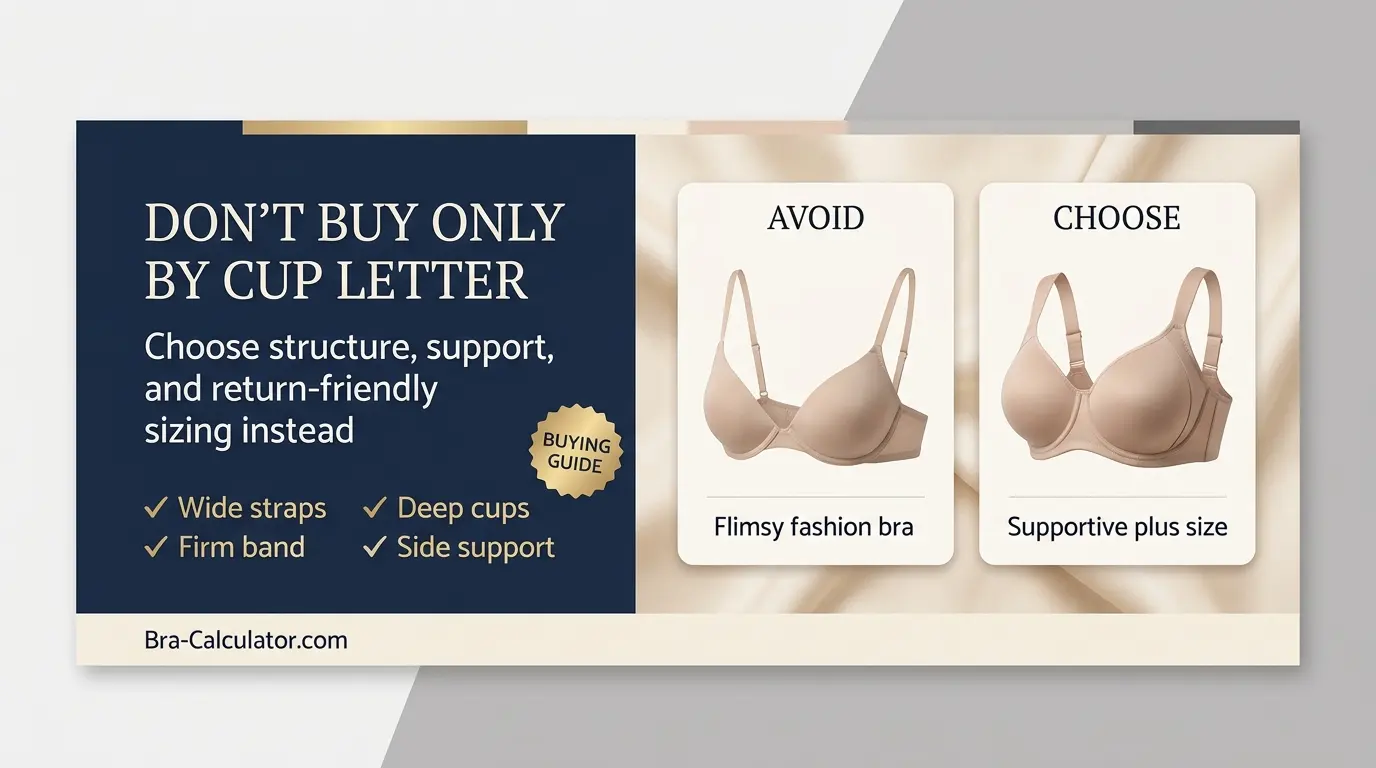
For fuller busts, cup depth is just as important as cup letter. A molded T-shirt bra may technically be your size but still be too shallow at the bottom or center. This creates the classic pattern: the band feels tight, the gore floats, the cups cut at the top, and the wearer assumes the whole bra is too small. Sometimes the real issue is not the band; it is that the cups lack the depth and side support required for the bust shape.
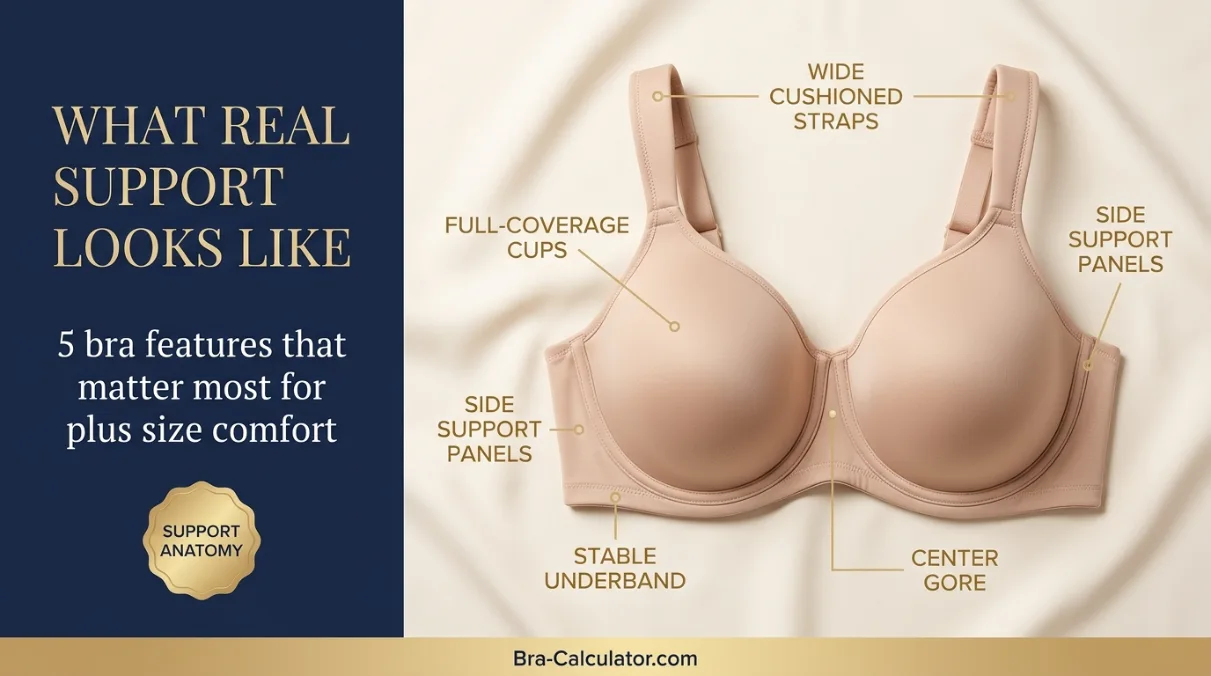
Fit specialist rule: A supportive plus size bra should feel secure around the ribcage, smooth through the cup, and light on the shoulders. If the shoulders are doing most of the work, the bra is not giving true fuller-bust support.
Measure First: Why Plus Size Bra Support Starts with the Right Band
Before buying supportive plus size bras, measure your underbust and full bust again. Weight changes, hormonal shifts, posture, pregnancy, breastfeeding, workouts, and even daily bloating can change how a bra feels. Many fuller-bust shoppers keep buying the same old size because it once worked, but the body and the elastic have both changed. A fresh measurement gives you a better starting point.
Measure the underbust snugly around the ribcage directly under the bust. The tape should be level and firm, not painfully tight. Then measure around the fullest part of the bust without compressing tissue. For projected or softer tissue, measuring while leaning slightly forward can sometimes show hidden volume that a standing measurement misses. Use the Bra Size Calculator as a starting point, then use fit symptoms to confirm the final size.
Plus size support often improves dramatically when the band is corrected. A band that is too loose rides up at the back, pushes the bust downward in front, and makes the straps carry extra weight. A band that is too tight can distort the cups, press into the ribs, or make the wearer choose a cup that is too small just to feel compressed. The goal is a firm but wearable band that stays level after movement.
Keep the tape level and close to the body. This creates your support foundation.
Do not flatten the tissue. Fuller busts need honest cup depth, not compression.
A new supportive bra should start on the loosest hook so you can tighten it as elastic relaxes.
If the cup is right but the band is wrong, use the Sister Size Calculator instead of guessing.
7 Features to Check Before Buying Supportive Plus Size Bras
Support is not one feature. It is a group of design decisions that work together. When shopping online, scan product photos and descriptions for the construction details below. If the listing only shows a pretty front view and says “comfortable” without explaining band, cup, side, and strap structure, treat it carefully.
Stable underband
A wider band spreads tension across the ribcage and helps the bra stay level. This is the first thing to check for fuller bust lift.
Reinforced side wings
Side panels help guide tissue forward instead of letting it escape toward the underarm or back.
Enough lower-cup room
Fuller busts often need more depth at the bottom and center. Shallow cups can feel tight even when the band is correct.
Padded or wide straps
Wide straps reduce pressure, but they should support comfort rather than replace the band.
Center front control
The center gore should sit close where possible. A floating gore can signal too-small cups or wrong cup shape.
Firm stretch recovery
Soft fabric feels nice, but support needs recovery. The bra should stretch and return instead of loosening quickly.
Best Product Types for Supportive Plus Size Bras
Product recommendations should help the reader solve a fit problem, not just click a random bra. For this page, the best affiliate strategy is to recommend categories based on need: full coverage for everyday lift, side-support for shape control, wireless support for soft comfort, and minimizer or sports styles for special situations. The cards below use Amazon search URLs with your affiliate tag so you can replace them with exact product URLs later if you want.

Wide-Band Full-Coverage Support Bra
- Best first test for daily wear because it checks band stability, cup containment, and shoulder comfort together.
- Helpful for fuller busts that need coverage without a tall, stiff, uncomfortable cup edge.
- Look for wide wings, strong hook-and-eye closure, and cups that do not collapse under the bust.
- Good internal link match: best bras for large bust.

Side-Support Plus Size Bra
- Best when tissue escapes near the underarm or the bust looks wider than expected in T-shirts.
- Side support panels help move tissue forward and can make the waistline look cleaner under clothes.
- Choose this when the cup volume seems right but the side wire and side wing feel weak.
- Great follow-up for readers with bra fit problems.

Supportive Wireless Plus Size Bra
- Best for days when underwire feels too intense but you still need controlled support and coverage.
- Choose styles with a strong lower band, separate cup zones, and high side panels.
- Avoid flimsy bralettes if you need true all-day fuller-bust support.
- Useful for readers comparing comfort bras and structured support bras.
How Breast Shape Changes the Best Plus Size Bra
Two people can wear the same size and need completely different bras. Plus size bra support depends on shape as much as size. Projection, root width, tissue softness, shoulder slope, torso length, and breast position all change which style feels supportive. This is why one person loves a full-cup bra while another finds the same style too tall, too wide, or too closed at the top.
Needs depth, not flattening
Projected shapes often need seamed cups, deeper lower cups, and strong center support. Shallow molded cups may push tissue downward or outward.
Try seamed or side-supportNeeds wire width
Wide-rooted busts can feel pinched in narrow wires. Look for wider cups and side panels that contain without cutting.
Check side wireNeeds smooth containment
Softer tissue may spill in plunge or low-coverage cups. Full-cup, stretch-lace upper cups, and stable bands often work better.
Avoid over-compressionNeeds lower height
Very tall cups or high side wings can dig into the underarm. Look for supportive styles with balanced cup height.
Watch cup heightShape-first buying tip: If your measured size is correct but every bra still feels wrong, the issue is usually construction. Try a different cup shape before changing size again.
Choose the Right Style for Your Support Need
The best supportive plus size bra is the one that solves your specific problem. A minimizer may be perfect for button-down shirts but unnecessary for relaxed clothing. A wireless bra may be ideal at home but not enough for long walking days. A sports bra may control bounce beautifully but feel too compressive for desk work.
- Full-cup support bra
- Side-support underwire bra
- Wide band with three or more hook rows
- Seamed cups for forward lift
- Thin straps doing all the work
- Very stretchy bands with weak recovery
- Shallow molded cups if you need depth
- Old bras with relaxed elastic
- Wireless support bra with firm band
- Soft-cup bra with separated cup zones
- Cushioned straps and breathable lining
- Longline wireless styles for extra anchoring
- Wireless does not always mean supportive
- Too much stretch can become bounce
- Low center fronts may spill
- Size range must include real cup depth
- Minimizer for button-down shirts
- Smooth full-coverage T-shirt bra
- Balconette for lifted neckline
- Side-support bra for cleaner silhouette
- Minimizers should not flatten painfully
- Too-small cups create visible ridges
- Thick seams may show under thin fabrics
- Plunge styles need center containment
- Encapsulation sports bra
- High-impact bra with separated cups
- Adjustable band and straps
- Higher coverage during workouts
- Single-layer compression only for larger busts
- Loose bands that bounce upward
- Thin elastic straps
- Sports bras that require painful compression
The 60-Second Test for Supportive Plus Size Bras
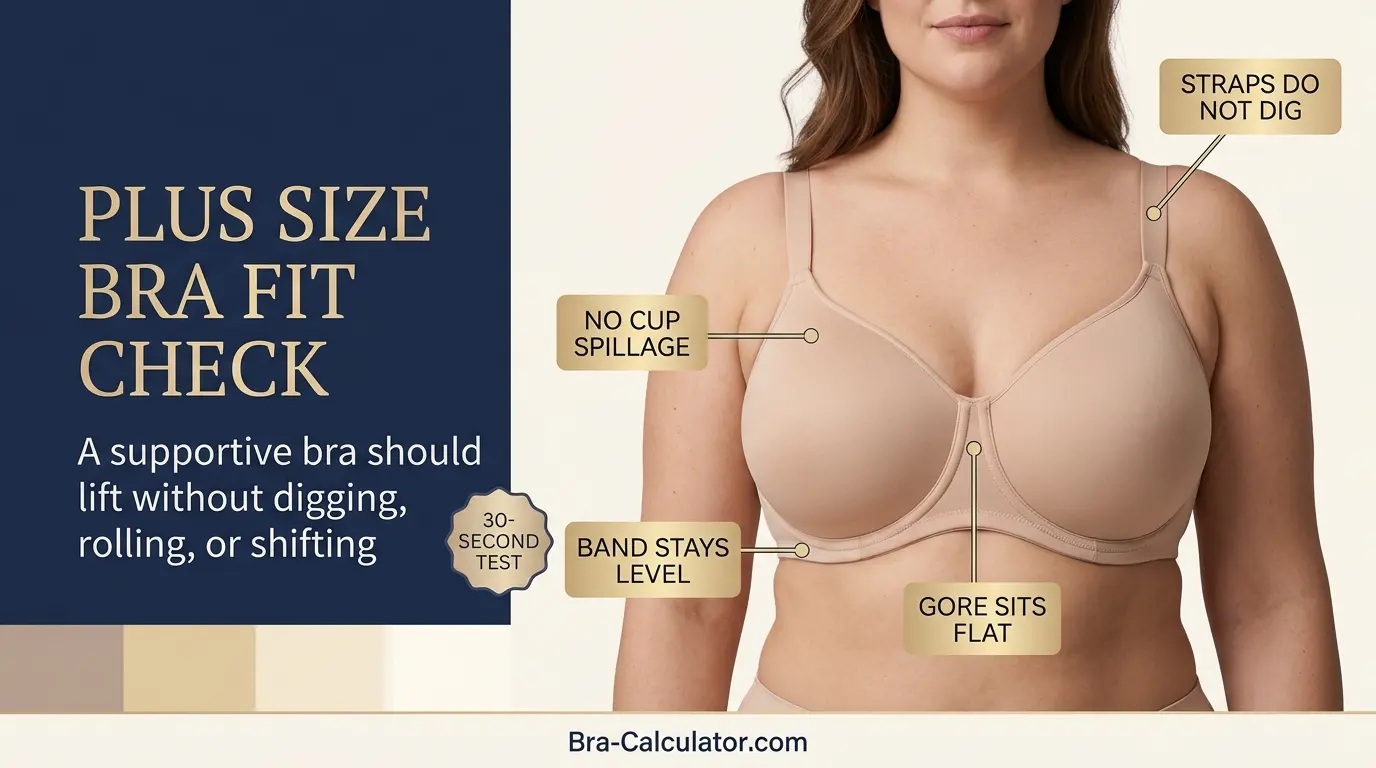
A bra can look good in the mirror and still fail after an hour. Before removing tags, test it like real life. Sit down, stand up, raise both arms, bend slightly, twist gently, and walk around. The band should stay level. The cups should not overflow. The straps should not slide or dig. The center front should not stab. The underbust should not roll or fold immediately.
Look sideways in the mirror. The back band should not climb higher than the front.
After moving tissue into the cups, there should be no major center, top, or side spill.
You should fit a finger under the strap without deep grooves or painful tension.
Walk, sit, and raise your arms. A supportive bra should remain stable without constant adjusting.
Best Bra Styles for Plus Size Support
Each style below has a role. The best wardrobe usually includes two or three different support categories instead of one “perfect” bra for everything. Daily bras, comfort bras, and movement bras solve different problems.
Best for coverage, stable cups, and everyday fuller-bust containment.
Excellent for side tissue, forward shape, and a cleaner silhouette.
Best for walking, workouts, and reducing bounce without flattening everything.
Helpful under button-down shirts, but it should smooth rather than crush.
Good for comfort days when it still has a firm band and cup structure.
Often too weak for true plus-size support unless used only for lounging.
Common Fit Problems with Supportive Plus Size Bras
If a bra fails, do not assume your body is the problem. Fit problems are usually a clue. One symptom can have multiple causes, so use the fixes below as a diagnosis path.
The band is probably too loose, stretched out, or being pulled upward because the cups are too small.
The straps are compensating for weak band support or insufficient cup depth.
The cups may be too small, too shallow, or too low at the center front.
The wire may be too tall, too narrow, or sitting on breast tissue.
The band may be too tight, too narrow, too stretchy, or sitting on a soft tissue fold.
The elastic may be weak, the band may be too loose, or the cup structure may not hold tissue through movement.
How to Make Supportive Plus Size Bras Last Longer
Fuller-bust bras work harder than lighter support bras, so care matters. Wearing the same bra every day stretches the band faster because elastic needs time to recover. Rotating at least three everyday bras helps each one last longer and keeps support more consistent. If a bra used to fit but now rides up, the band may simply be worn out.
Wash bras gently. Hand washing is best, but a delicate machine cycle inside a lingerie bag can work if the hooks are fastened first. Avoid heat. Dryers damage elastic, warp wires, and shorten the lifespan of the band. Air dry flat or hang from the center gore rather than the straps. If you hang a wet bra by the straps, the weight of the water can stretch them.
| Care Step | Best Practice | Why It Helps |
|---|---|---|
| Rotation | Keep 3+ daily bras if possible | Allows elastic recovery between wears. |
| Washing | Use gentle detergent and cool water | Protects fibers and stretch recovery. |
| Drying | Always air dry | Heat breaks down elastic and can warp wires. |
| Storage | Stack molded cups without folding | Prevents cup dents and shape distortion. |
| Replacement | Replace when the band rides up on tightest hook | Weak bands can no longer carry support. |
Related Tools & Guides for Supportive Plus Size Bras
| Guide / Tool | Why It Helps |
|---|---|
| Bra Size Calculator | Find your starting band and cup using current measurements. |
| Sister Size Calculator | Adjust band and cup together when one part fits and the other does not. |
| Best Bras for Large Bust | Supports readers who need fuller-bust lift and daily structure. |
| Minimizer Bras for Large Busts | Useful for outfit smoothing and button-down shirt fit. |
| AI Smart Fit Bra Calculator | Diagnose strap digging, gaping, overflow, band riding up, and side tissue. |
Frequently Asked Questions
For everyday wear, start with a full-coverage or side-support bra with a firm band, wide straps, and cups deep enough for your breast shape. The best choice is not always the thickest bra; it is the one that stays level, contains tissue smoothly, and feels comfortable after several hours.
They should be snug, not painful. A supportive band should feel secure on the loosest hook when new, but you should still breathe, sit, and move comfortably. Pain, rib pressure, or deep red marks usually mean the size or construction needs adjustment.
Some are, but only when they have a firm lower band, structured cups, high side panels, and strong fabric recovery. A thin stretchy bralette is usually not enough for all-day fuller-bust support.
Rolling can happen when the band is too narrow, too tight, too stretchy, or positioned on soft tissue. A wider band, longline style, or different sister size may help.
Full coverage is usually better for daily lift and containment. A minimizer is better when you want a smoother front profile under certain outfits. A minimizer should never feel like painful compression.
Three everyday bras is a practical minimum if possible: one to wear, one resting, and one washing. Rotation helps elastic recover and keeps support stronger for longer.
Look for center spill, top cutting, side tissue escape, wire sitting on breast tissue, or a floating center gore. If the band feels tight but these symptoms appear, the cups may be too small or too shallow.
The biggest mistake is buying for strap comfort only. Straps matter, but true support comes from the band, cup depth, side structure, and shape match.
Start with Measurements, Then Match the Bra to Your Shape
Use your current underbust, full bust, sister-size options, and real fit symptoms to choose a supportive plus size bra that lifts from the band, contains tissue smoothly, and stays comfortable through the day.