Unlocking the Mystery of Men’s Bra Sister Sizes: Your Guide to Finding the Perfect Fit!(2026)
Sister sizing works identically for men as it does for anyone else — the mathematics of the system don’t change based on who’s wearing the bra. What does change is the starting point: male body proportions typically produce wider band sizes with smaller cup letters, placing most men in sizes like 38A, 40A, 40B, or 42B. Once you know your correct size, sister sizes give you access to equivalent cup volume across a range of band widths — which is especially useful because wide-band, small-cup sizes are among the least stocked in mainstream retail.
More men wear bras than is commonly discussed. Whether for gynecomastia, gender identity, post-surgical comfort, or personal preference, the practical challenge is the same: finding the right size, understanding when to substitute, and knowing how to get consistent fit when your exact size is unavailable. This guide covers all of it — from how to measure accurately on a male body to the complete sister size families most relevant to male wearers, with specific buying recommendations for each common size range.
If you’re here because you’ve been frustrated by confusing sizing charts, bras that feel wrong the moment you put them on, or the simple fact that your exact size seems impossible to find, you’re not alone. For many male wearers, sister sizing is the shortcut that turns a dead end into real options — and once you understand it, shopping gets dramatically easier.
⚡ Key Takeaways
- Sister sizing works the same for everyone: up one band + down one cup letter = same cup volume. This is mathematical and universal.
- Most men wear wider band sizes with smaller cups: 36A–44C is the most common range for gynecomastia and general male wear.
- Wide band + small cup sizes are the least stocked in mainstream retail — sister sizing is therefore especially valuable for male wearers, dramatically expanding the available options.
- Male chest anatomy creates specific fit challenges not covered in standard bra fitting guides: flatter chest wall, wider ribcage relative to projection, and different breast tissue distribution all affect which styles work best.
- Underwire width is the most common fit problem for men — many standard bra underwires are narrower than a male chest wall, causing the wire to sit on the chest rather than following the breast tissue boundary.
- Wire-free bras are often the better starting point for men, particularly for gynecomastia, because they avoid the underwire width mismatch entirely.
- Measurement is the same process as for anyone: underbust for band, chest at fullest point for bust, subtract to get cup differential.
- Comfort, discretion, and confidence are valid reasons to wear a bra regardless of gender. There is no wrong reason to want a correctly fitting bra.
Why Men Wear Bras — and Why Sister Sizing Matters for Each Reason
There is no single reason men wear bras — and the reason influences which type of bra, which fit priorities, and which sister size strategy makes the most sense. Here are the most common reasons, and what each one means for finding the right size.
The sister size principle is relevant for all of these reasons — but it’s particularly valuable for gynecomastia and general male wear, where the typical size range (wide band, small cup) is among the most sparsely stocked in mainstream retail. A 40A in a specific style may simply not exist, but a 38B or 42AA — which hold the same cup volume — may. Knowing this ahead of time changes what’s available to you.
How Male Body Proportions Affect Bra Sizing
The bra sizing system was designed around average female body proportions — where the bust typically extends noticeably beyond the ribcage. Male body proportions differ in several ways that directly affect which sizes fit and which styles work, even when the measurements are technically correct.
The Wider Band, Smaller Cup Pattern
Most men have a broader ribcage relative to the amount of chest projection than the female body proportions that bra sizing was built around. A man with a 40-inch underbust and a 41-inch chest measurement at the nipple line calculates as a 40A — because the differential is 1 inch. This is a common real-world example for mild-to-moderate gynecomastia. On a female body, a 40-inch underbust would rarely come with just 1 inch of chest projection. This means that many male bra sizes sit in ranges that are genuinely underserved by the retail market.
Cup Depth vs Cup Width
Even when the band and cup letter are correct, male breast tissue often distributes differently than the cup geometry assumes. Standard bra cups are designed for breast tissue that projects forward from the chest wall in a specific cone shape. Gynecomastia breast tissue often sits more flat and wide on the chest wall — more lateral spread, less forward projection. This means that even a correctly sized cup may gape at the front while fitting at the sides, or feel too deep at the front while the tissue escapes at the underarm.
Practical implication: Men with flatter, wider gynecomastia tissue often find that soft-cup, wire-free bras fit more naturally than underwire styles — because wireless cups are more forgiving of tissue distribution differences. When underwire styles are preferred, a full-coverage style with a shallower cup and wider wires tends to work better than demi-cups.
Underwire Width — The Most Common Fit Problem
Standard bra underwires are set to a width corresponding to female breast root width on a given band size. On a male body, the chest wall is typically broader, meaning the underwire ends may sit on the chest wall rather than just at the outer edge of the breast tissue. This produces the classic underwire-dig-in complaint — not because the cup is wrong, but because the wire channel is too narrow for the chest wall width. Trying styles with wider underwires, or switching to wire-free options entirely, resolves this without changing the cup volume. See our bra fit problems guide for a complete diagnosis checklist.
How to Measure Your Bra Size as a Man — Step by Step
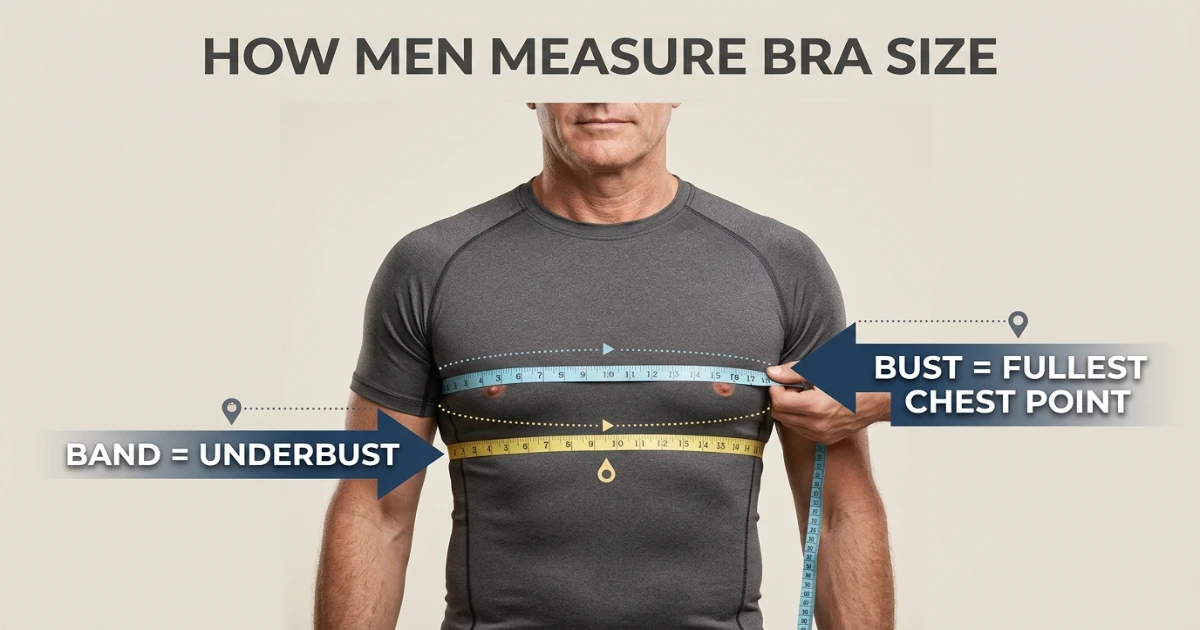
The measurement process is identical to measuring for any bra. Use a soft measuring tape, measure in inches, and take measurements without a shirt on for accuracy. See our full how to measure your bra size guide for detailed visual instructions.
Wrap the tape measure snugly around your ribcage, directly beneath your chest — not over it. Keep the tape level and parallel to the floor all the way around. Breathe normally and take the measurement at a natural breath. Round to the nearest even number: this is your band size. If your measurement falls on an odd number, round up to the next even number. Example: 39 inches → 40 band.
Wrap the tape around the fullest part of your chest — for gynecomastia, this is usually the nipple line. Keep the tape parallel to the floor and don’t pull tight; a relaxed but contact-maintaining tension is correct. Note this measurement in inches.
Subtract your underbust measurement from your chest measurement. The difference in inches determines your cup letter: 0–½″ = AA, 1″ = A, 2″ = B, 3″ = C, 4″ = D, 5″ = DD/E. Most men with mild gynecomastia will find a difference of 1–2 inches (A or B cup). This is your starting point — not necessarily your perfect fit, but the right place to begin.
Put the bra on using the loosest hook and run five fit checks: band level all around, chest tissue contained without overflow or gaping, gore (if underwire) or front panel lying flat, straps staying on shoulders without digging in, no movement during activity. If cups overflow, go up one cup letter on the same band. If cups gape or wrinkle, go down one letter. Never change both band and cup at the same time when diagnosing fit.
If your calculated size is hard to find in the style you want, or if the fit in that size is slightly off in a way that seems band-related, use the sister size rule: up one band + down one cup letter, or down one band + up one cup letter. Both give you approximately the same cup volume in a more or less accessible size. See the sister size tables below for your specific size range.
Common Male Bra Sizes and What They Mean
Male bra sizes cluster heavily in a band range that’s thinly stocked by mainstream retailers. Here’s a breakdown of the most common size categories, what body measurements they correspond to, and what sister size options are available in each range.
| Common Male Bra Size | Typical Underbust | Typical Chest | Cup Differential | Common Context |
|---|---|---|---|---|
| 36A / 36B | ~33–34″ | ~34–36″ | 1–2″ | Slim build, mild gynecomastia or small-framed trans women early in development |
| 38A / 38B | ~35–36″ | ~36–38″ | 1–2″ | Average male build with mild-to-moderate gynecomastia — one of the most common ranges |
| 40A / 40B | ~37–38″ | ~38–40″ | 1–2″ | Broader male build, moderate gynecomastia or comfort wear — very common |
| 42A / 42B | ~39–40″ | ~40–42″ | 1–2″ | Larger male build with mild-to-moderate gynecomastia |
| 44A / 44B | ~41–42″ | ~42–44″ | 1–2″ | Larger build; A cup in 44 band is extremely rare — 42B sister size usually more accessible |
| 38C / 40C | ~35–38″ | ~38–41″ | 3″ | More significant gynecomastia or trans women with breast development beyond grade I |
| 40D / 42C | ~37–40″ | ~41–43″ | 3–4″ | Significant gynecomastia grade II–III or ongoing HRT breast development |
The Sister Size Principle for Men — How It Works
The sister size principle is built into how bra sizing is constructed. Cup letters are ratios — each letter represents the number of inches the chest measurement exceeds the underbust measurement. When the band increases by one size (approximately 2 inches), dropping one cup letter compensates exactly, preserving the enclosed cup volume. This relationship is mathematical and applies regardless of who’s wearing the bra.
For men, this principle is practically even more useful than for women, because:
- Wide-band, small-cup sizes (38A, 40A, 42B) are among the least stocked in mainstream retail
- Sister sizes in the same volume family are often more available — 38B (sister of 40A) is far more commonly stocked than 40A itself
- Different styles fit differently on a male chest — and the style that works for your specific chest wall shape may only come in your sister size band
- Understanding sister sizes means you can shop from a significantly larger pool of options
Sister Size Families Most Relevant to Male Wearers
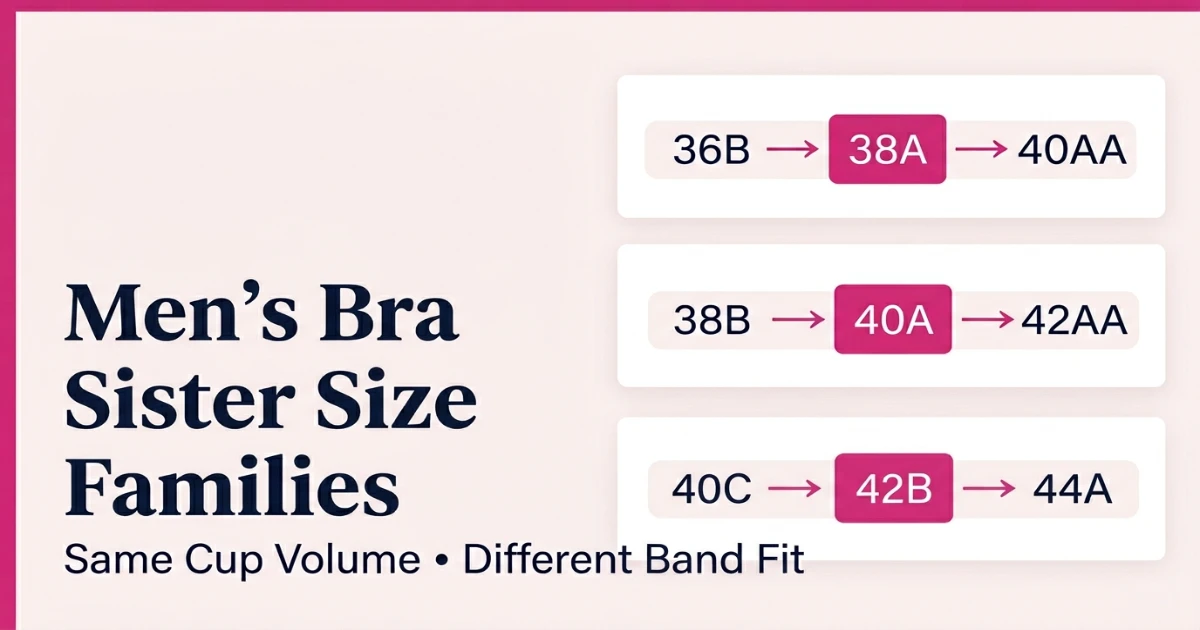
Below are the sister size families that cover the most common male bra size ranges. Each family holds approximately equal cup volume across all sizes — moving left gives a firmer band; moving right gives a wider band. Use the sister size bra calculator to generate your complete personal ladder.
The 40A Family — The Most Common Range for Moderate Gynecomastia
If 40A is unavailable in your preferred style: try 38B — same cup volume, band 2 inches narrower. 38B is one of the most commonly stocked bra sizes and opens up a dramatically wider range of styles. The 36C also holds equal volume if you need a firmer band still.
The 38A Family — Slim to Average Build, Mild Gynecomastia
38A is not commonly stocked. The most practical sister size is 36B — firmer band, same cup volume, far more widely available. If the 36 band is too firm for your 35–36 inch ribcage, the original 38A is correct and specialist sourcing (or online retailers with extended size ranges) is the path.
The 40B Family — Moderate to More Significant Gynecomastia
40B is moderately available — it falls within the size range that some mainstream retailers carry. If unavailable: 38C gives the same cup volume on a firmer band; 42A gives the same cup volume on a wider band (though 42A is itself uncommon).
The 42B Family — Broader Build, Moderate Gynecomastia
42B is the most commonly recommended starting size for broader men with moderate gynecomastia. It sits at a practical intersection of accessibility and fit. Sister size 40C is a good alternative if the 42 band feels too wide; 44A is available if you need more band width — though 44A stock is limited.
Full Sister Size Reference Table — Most Common Male Ranges
| Your Size | Firmest Available Sister | Next Firmer Sister | Next Wider Sister | Widest Sister |
|---|---|---|---|---|
| 36A | 34B (narrow) | — | 38AA (rare) | — |
| 36B | 34C | — | 38A | 40AA (rare) |
| 38A | 36B | 34C | 40AA (rare) | — |
| 38B | 36C | 34D | 40A | 42AA (rare) |
| 38C | 36D | 34DD | 40B | 42A |
| 40A | 38B | 36C | 42AA (rare) | — |
| 40B | 38C | 36D | 42A | 44AA (rare) |
| 40C | 38D | 36DD | 42B | 44A |
| 42A | 40B | 38C | 44AA (rare) | — |
| 42B | 40C | 38D | 44A | — |
| 42C | 40D | 38DD | 44B | — |
| 44B | 42C | 40D | 46A (rare) | — |
5 Fit Tips Specific to Men Wearing Bras
Wire-free bras are generally the better starting point for men. They avoid the underwire-width mismatch that makes many standard underwire styles uncomfortable on a male chest wall, they accommodate flatter or more laterally distributed gynecomastia tissue more naturally, and they’re significantly more forgiving of small measurement discrepancies. Once you know your size from a well-fitting wireless option, transitioning to underwire styles becomes much easier because you already know your correct band and cup. See our guide to the best wireless comfort bras for detailed options.
Full-coverage cups are designed to contain tissue that doesn’t project significantly beyond the cup base — which is exactly the fit challenge that gynecomastia tissue presents. Demi and balconette cups assume a more forward-projected breast shape and tend to gape at the top or bottom when the tissue is flatter and more spread. Full-coverage styles, particularly T-shirt bras and soft-cup full-coverage designs, almost universally fit male chest tissue more naturally.
The most common fitting error is prioritising cup comfort over band fit. The band carries approximately 80% of breast support — on a male body with significant gynecomastia, a loose band means the weight of that tissue ends up in the straps within the first hour. A correctly fitted band should feel genuinely snug on the loosest hook with two fingers fitting with mild resistance. If the band feels too tight but you’ve measured correctly, try the sister size one band wider — your cup volume will be preserved with one letter down.
If wearing a bra under clothing with a goal of discretion, seamless soft-cup bras in nude or skin-tone colours are the most effective option. The smooth profile leaves no visible texture line under fitted shirts, and the skin-tone colour doesn’t show through thinner fabrics. Avoid lace or textured cups under thin or white clothing — even in the correct size, texture prints through fabric. Our bra fit guide covers which styles work best under different clothing types.
If you’ve been self-measuring or relying on an old size estimate, take a fresh measurement before purchasing multiple bras. Male chest proportions change significantly with weight fluctuation, gynecomastia progression or regression, age, and hormone changes (including HRT). A measurement taken more than 6–12 months ago may no longer reflect your current correct size — and an incorrect band size wastes the entire bra regardless of how well the cup fits. Use our AI smart fit bra calculator for a current, accurate result based on your current measurements.
🛍️ Best Bras for Men — Our Top Picks
These options are the most practical starting points for male wearers — especially if your priorities are support, comfort, discretion, easier dressing, or finding something that works with broader bands and smaller cups. Instead of chasing whatever looks most feminine or most medical, focus on what solves your real problem: stable band support, forgiving cup shape, wider coverage, and all-day comfort.

Esteem Apparel Original Men’s Chest Compression Shirt
If you want something reliable for everyday wear, this is the safest starting point. It smooths the chest under shirts, improves confidence instantly, and feels close to a normal undershirt — not like a medical garment.
Best for: daily wear, mild–moderate gynecomastia, comfort + discreet support
Check Price on Amazon →
Underworks Men’s Extreme Gynecomastia Chest Binder
This is ideal when standard support isn’t enough. It holds everything firmly in place, reduces movement, and creates a visibly flatter profile — especially under fitted shirts or during active use.
Best for: moderate–severe gynecomastia, strong compression, maximum flattening
Check Price on Amazon →ℹ️ As an Amazon Associate, Bra Calculator earns from qualifying purchases. All picks are independently selected based on construction, extended size availability, and fit characteristics relevant to male wearers. Prices and availability subject to change.
Ready to find your correct bra size? Our AI calculator works for all body types — input your underbust and chest measurements and get your band, cup, and complete sister size family in under 2 minutes.
Find My Correct Bra Size →Frequently Asked Questions: Men’s Bra Sister Sizes
Do sister sizes work the same way for men?
Yes — the sister size principle works identically regardless of the wearer’s gender. Sister sizes are pairs of bra sizes that hold approximately equal cup volume on different band sizes: going up one band and down one cup letter, or vice versa. The mathematics of this relationship is built into the sizing system itself and doesn’t change based on who’s wearing the bra. What does change for male wearers is which sizes are most common, which styles fit best on male chest anatomy, and which sister size substitutions are most practically accessible given retail stocking patterns.
How do men find their bra size?
The process is identical to measuring for any bra: measure snugly around the ribcage just beneath the chest for the band size, then measure around the fullest part of the chest (typically the nipple line for gynecomastia) for the bust. Subtract the band from the bust — each inch of difference equals one cup letter: 1 inch = A, 2 inches = B, 3 inches = C, 4 inches = D. Use our how to measure guide for step-by-step instructions, or the AI bra size calculator for an instant result.
What bra size do most men with gynecomastia wear?
The most common bra sizes for men with gynecomastia fall in the 36–44 band range with A or B cup letters — reflecting typical male body proportions where the ribcage is broader relative to the amount of breast tissue projection. The most frequently worn sizes are 38A, 38B, 40A, 40B, and 42B. Men with more significant gynecomastia (grade II–III) may measure as C or D cup in the same band ranges. Individual variation is significant — measurement is always the reliable guide.
Can men wear regular women’s bras?
Yes — most bras sold in women’s sizing fit male bodies in the appropriate size. The sizing system is based on measurements, not gender, and the same band-plus-cup formula applies to everyone. The main fit challenges specific to male bodies are: underwire width (standard wires may be too narrow for a male chest wall), cup depth (may be more projected than flatter gynecomastia tissue needs), and style (full-coverage, wire-free options tend to work better than demi or balconette cups for most male tissue distribution patterns).
Why is my correct size so hard to find in stores?
Wide-band, small-cup combinations — which are the most common range for male bra wearers — are among the least stocked sizes in mainstream retail. Most bra retailers optimise their inventory around the most statistically common female body proportions, which produces smaller band + larger cup as the dominant stocking pattern. Sizes like 40A, 42A, and 42B are genuinely difficult to find in high-street stores. Online retailers, specialist extended-size brands, and sister sizing are the practical solutions. If your exact size is unavailable, the sister size with one band down and one cup up (e.g. 38B instead of 40A) is the most commonly available equivalent.
What is the sister size of 40A for a man?
The confirmed sister sizes of 40A — sizes that hold approximately equal cup volume — are: 38B (one band narrower, one cup larger) and 42AA (one band wider, one cup smaller — rarely stocked). In practice, 38B is the most useful sister size for a 40A wearer because it’s far more widely available. The 36C is also a sister size of 40A (same volume, two bands narrower) and is accessible in mainstream retail. Use our sister sizes guide to confirm your full family.
Is it normal for bra underwires to dig into my chest sides?
Yes — this is one of the most common fit complaints for men wearing standard women’s bras. Standard underwire channels are set to a width corresponding to average female breast root width, which is typically narrower than a male chest wall. The result is that the underwire ends sit on the chest wall rather than just at the edge of the breast tissue, causing the classic side-dig-in discomfort. Solutions: switch to wire-free bras (eliminates the problem entirely), or seek underwire styles with wider wire channels (Glamorise WonderWire is specifically designed with a wider, cushioned channel). Changing the band or cup size won’t fix an underwire width problem.
Should I use a bra extender to get a better band fit?
A bra extender adds approximately 2–3 inches to the back band — which is equivalent to going up one band size. If your underbust genuinely measures at the next band size up, it’s better to buy the correct band size rather than using an extender long-term. However, extenders are a genuinely useful tool for: trialling whether a wider band would work better before committing to a new size; temporarily accommodating weight fluctuation; and extending the life of a bra whose band has begun to stretch out. If using an extender consistently, consider using your sister size (one band up, one cup down) as your primary bra going forward.
Do bras help with gynecomastia pain and discomfort?
Many men with gynecomastia report meaningful reduction in physical discomfort — particularly the movement-related tenderness and nipple friction that can occur without support — when wearing a well-fitted bra. A correctly fitted bra provides physical support that reduces breast tissue movement during activity, which is often the main source of discomfort. The key word is correctly fitted: a bra with the wrong band size transfers the tissue weight to the straps, which worsens shoulder and neck tension rather than relieving it. Band fit is the most important factor for gynecomastia comfort.
Are there bras specifically made for men?
Yes — a growing number of brands specifically design bras for male bodies, addressing the underwire width, cup depth, and overall construction differences that make standard women’s bras less than ideal for many male wearers. However, these specialist options remain limited in range and availability compared to mainstream women’s bras. For most male wearers, particularly those just starting to find their correct bra size, standard women’s bras in wire-free, full-coverage styles are the most practical and accessible option — and sister sizing gives you the full range of what’s available in your volume family. Use our bra size chart calculator to confirm your measurements first.
How do I know if I need a different bra size after losing or gaining weight?
Both the band and the cup can change with significant weight fluctuation — the band because the ribcage circumference changes, and the cup because the amount of breast tissue changes. Take a fresh measurement whenever your body weight changes by more than 10–15 pounds in either direction, or whenever your current bra begins to feel consistently too tight or too loose. The band is the most reliable indicator: if the band rides up your back during normal activity, it’s too wide; if you can’t fit two fingers under it on the loosest hook from day one, it’s too narrow. Use our AI bra size calculator to get an updated size based on current measurements.
Affiliate Disclosure: This article contains affiliate links to Amazon. If you purchase through these links, Bra Calculator may earn a small commission at no additional cost to you. All product recommendations are independently selected based on construction quality, extended size availability, and fit characteristics relevant to male wearers. Prices and availability are subject to change.
More gynecomastia support guides
- Gynecomastia bra guide
- Gynecomastia bra size chart
- How to Measure Male Chest for a Support Garment
- What Size Bra Should a Man With Gynecomastia Wear? Size Guide 2026
- The Most Advanced Gynecomastia / Men’s Bra Size Calculator (2026 Complete Guide)
- Gynecomastia Workout Compression: 7 Best Gym Support Tips
- Gynecomastia Support for Travel: 7 Smart Comfort Tips