34DD vs 36DD: Are They the Same Size? Same Letter, Different Cup Explained (2026)
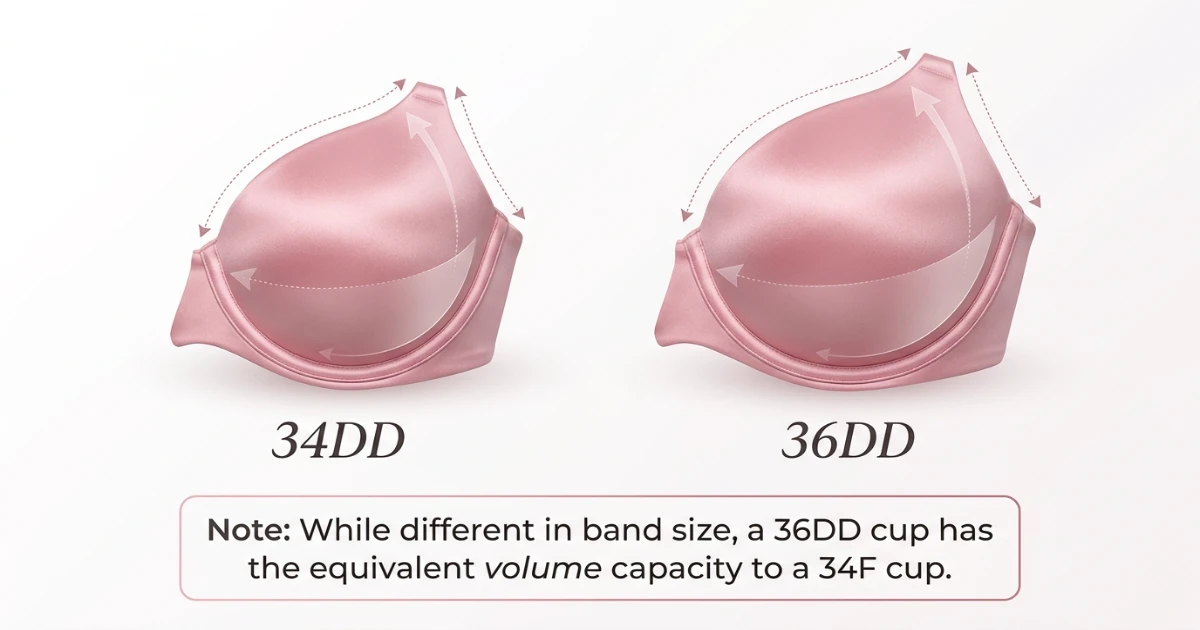
Quick Answer: No — 34DD and 36DD are not the same size. Despite sharing the same cup letter, they hold different cup volumes and fit entirely different body frames. The 36DD is larger in both band size and cup volume. The 36DD cup holds the equivalent volume of a 34F (34DDD) — one full cup size above the 34DD. Sharing a cup letter does not make two sizes equal when the band numbers differ.
⚠️ This is not a sister size comparison. Unlike 34DD vs 36D — where different letters on different bands produce equal volume — 34DD and 36DD share the same letter but carry different volumes. The 36DD is larger. They belong to entirely separate sister size families and cannot substitute for each other.
Choose the fit signs you notice in the band, cups, center and straps. We’ll turn them into a practical next step for 34DD.
Private fit check — your answers stay in your browser and are used only for this on-page guidance. Nothing is stored or submitted.
⚡ Key Takeaways
- NOT the same size: 34DD and 36DD hold different cup volumes — the 36DD is meaningfully larger.
- Same letter ≠ same size: DD on a 36 band encloses more volume than DD on a 34 band.
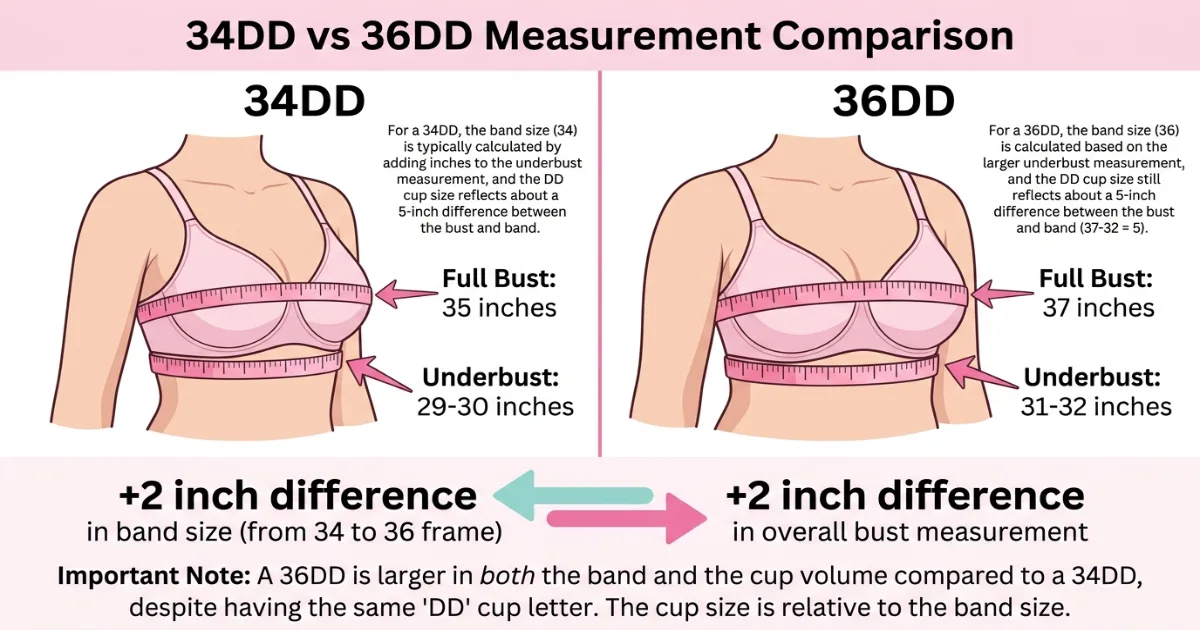
- Different band sizes: 34 fits ~29–30″ (74–76 cm) underbust; 36 fits ~31–32″ (79–81 cm) underbust.
- Different bust measurements: 34DD bust ~35″; 36DD bust ~37″ — approximately 2 inches apart.
- 36DD = 34F in volume: The 36DD holds one full cup size more than the 34DD.
- Not sister sizes: They belong to completely separate volume families.
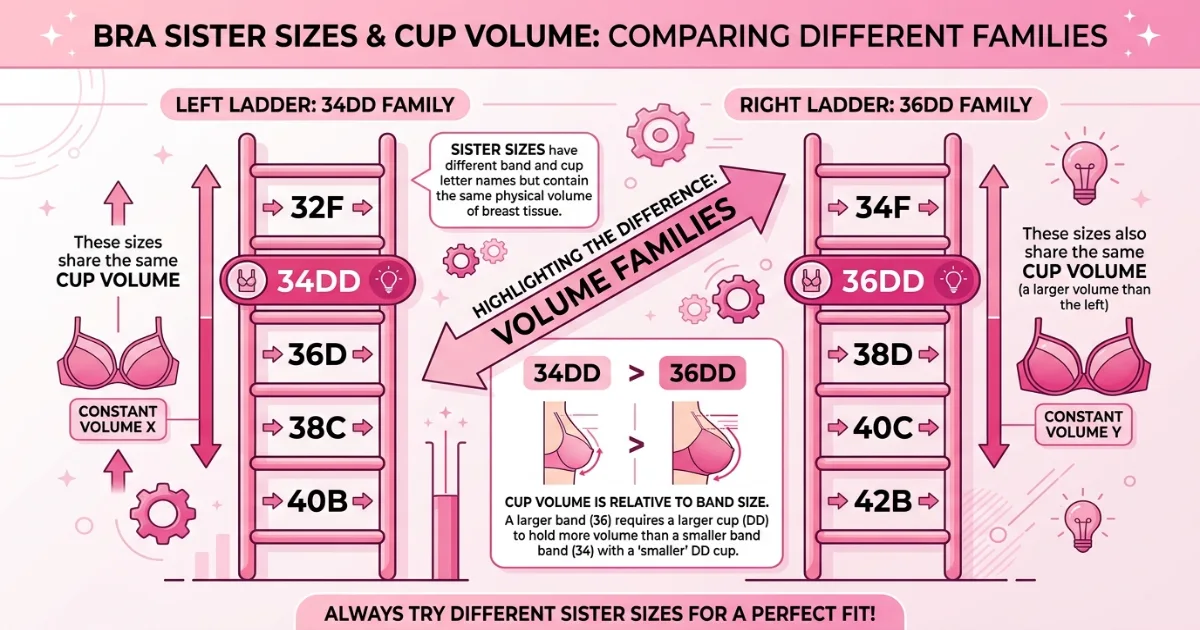
- 34DD sister sizes: 32F (32DDD), 36D, 38C, 40B — not 36DD.
- 36DD sister sizes: 34F (34DDD), 38D, 40C, 42B — not 34DD.
Why the Same Letter Does Not Mean the Same Size
Cup letters in bra sizing are ratios, not fixed measurements. The letter DD simply means the bust measurement is 5 inches larger than the underbust — regardless of which band size that differential is calculated from. Change the band number and the same 5-inch ratio produces an entirely different physical volume of cup space.
- 1″ = A | 2″ = B | 3″ = C | 4″ = D | 5″ = DD | 6″ = DDD/F
A 34DD means the bust is 5 inches larger than the underbust on a 34-inch frame — producing a bust of approximately 35 inches. A 36DD means the bust is 5 inches larger than the underbust on a wider 36-inch frame — producing a bust of approximately 37 inches. The ratio is identical but the underlying circumference is completely different, producing a meaningfully larger enclosed cup space in the 36DD.
The Volume Gap Visualised
The critical insight: 36DD = 34F in cup volume. The 36DD holds the same amount of breast tissue as a 34F (also labelled 34DDD) — one full cup size above the 34DD on the same band. If you are a 34DD wondering whether a 36DD might be easier to find, know that you would be wearing a cup with significantly more volume than you currently fill. Explore this concept further on our cup size visuals page.
Measurement Breakdown: 34DD vs 36DD
| Size | Underbust (Band) | Bust (Fullest Point) | Cup Difference | Cup Volume |
|---|---|---|---|---|
| 34DD | ~29–30″ (74–76 cm) | ~35″ (89 cm) | 5″ (13 cm) | Smaller ↓ |
| 36DD | ~31–32″ (79–81 cm) | ~37″ (94 cm) | 5″ (13 cm) | Larger ↑ |
The cup difference column is identical — 5 inches in both cases, hence both labelled DD. But the bust measurements differ by approximately 2 inches, confirming the 36DD encloses more breast tissue. The 36DD is equivalent in volume to a 34F (34DDD), and the 34DD is equivalent to a 36D — one full size below the 36DD.
UK sizing: 34DD = 34E; 36DD = 36E. EU sizing: 34DD = 75E; 36DD = 80E. Same letter, different band — different sizes in every convention. Cross-reference all international sizes using our international size charts.
Different Sister Size Families: Where 34DD and 36DD Each Belong
Because 34DD and 36DD hold different cup volumes, they belong to entirely separate sister size families. The most revealing fact: 38D is a sister of 36DD — which confirms the 36DD holds one full cup size more than the 34DD, whose sisters run a full volume row below.
34DD Sister Size Family
36DD Sister Size Family
The 36DD family sits one full volume row above the 34DD family. If your 34DD is unavailable, the correct substitute is 32F (tighter band, same volume) or 36D (looser band, same volume) — never a 36DD. Explore the full logic on our sister sizes guide or calculate your own ladder using the sister size bra calculator.
Real Fit Differences Between 34DD and 36DD
Band Fit and Structural Support
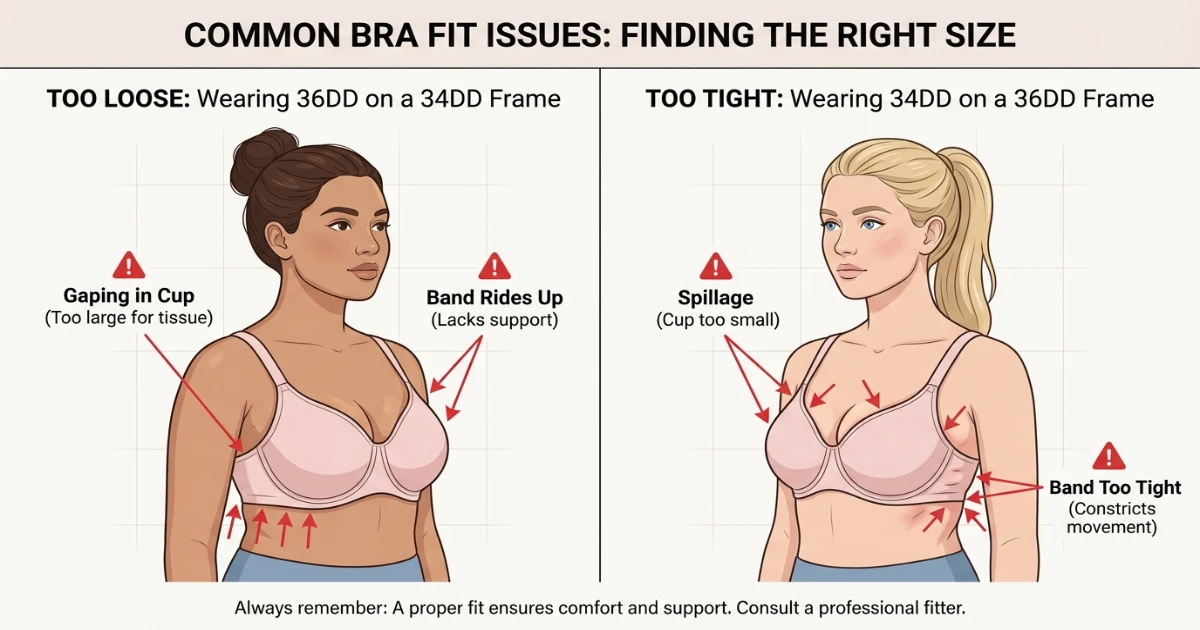
Both sizes share the DD cup letter but live on very different band foundations. A 34DD band is engineered for a 29–30 inch ribcage — gripping it firmly, running level, and anchoring the DD cup securely against the body. A 36DD band on that same narrower frame will ride upward at the back within hours, pushing the cups downward and transferring the full weight of a DD bust onto the shoulder straps. At DD cup sizes, that shift becomes painful surprisingly quickly.
On a 31–32 inch ribcage, the reverse applies: the 36DD band sits correctly and the 34DD will feel constricting from the first wear. Band fit is always the non-negotiable starting point — never sacrifice it to access a different cup letter.
Cup Volume and Underwire Width
The 34DD cup is built for a narrower chest wall with a closer underwire channel. The 36DD cup is physically wider, designed for breast tissue that roots more broadly across a larger ribcage. Wearing a 36DD when you measure as a 34DD means the underwire ends will sit on bare ribcage well beyond your natural breast tissue boundary — a common cause of side-poking, red marks under the arms, and persistent discomfort that no amount of strap adjustment will fix. Diagnose these issues in detail on our bra fit problems guide.
Cup Overflow vs Gaping
A genuine 36DD wearer forced into a 34DD will experience overflow — tissue spilling at the top and sides, a floating centre gore, and underwire pressing into breast tissue rather than resting on the ribcage. A genuine 34DD wearer in a 36DD will experience gaping — wrinkling fabric across the cup, empty space at the top, and a band that rides up at the back before noon. Neither outcome is a fit problem that can be adjusted away; both are solved exclusively by wearing the correctly measured size.
Who Should Choose 34DD?
- Underbust measurement approximately 29–30 inches (74–76 cm) snugly measured.
- Bust measurement at the fullest point of approximately 35 inches (89 cm) — a 5-inch differential.
- Previously tried a 36DD and found gaping cups, a loose riding band, or underwire extending past breast tissue.
- Breast tissue sits close-set with forward projection on a narrower chest wall.
- Current band feels correct but cups slightly overflow → try 34F (34DDD), not 36DD.
Confirm your correct fit at our how to know your bra fits page.
Who Should Choose 36DD?
- Underbust measurement approximately 31–32 inches (79–81 cm) snugly measured.
- Bust measurement at the fullest point of approximately 37 inches (94 cm) — a 5-inch differential on the wider frame.
- Previously tried a 34DD and found the band constricting even on the loosest hook from day one.
- Breasts have a wider root and spread toward the underarms — the 34DD underwire digs into side tissue.
- Current cups feel too small but band is correct → try 36F (36DDD), not a band change.
Use our breast shape identifier and size charts to verify your best fit.
🛍️ Best Bras for 34DD and 36DD — Our Top Picks
DD cup wearers need a band that anchors firmly and cups that fully enclose breast tissue without underwire migration. These two highly rated options on Amazon are available across both the 34 and 36 band — and are built specifically for the support demands of DD cup sizes.


ℹ️ As an Amazon Associate, Bra Calculator earns from qualifying purchases. Product availability and pricing subject to change.
The Sister Size Rule That Explains Everything
| Comparison Type | Example | Same Volume? | Relationship |
|---|---|---|---|
| Band up + Cup letter down | 34DD → 36D | ✅ Yes | Sister sizes — equal volume |
| Band up, same cup letter | 34DD → 36DD | ❌ No | 36DD is larger — equal to 34F |
| Band down + Cup letter up | 34DD → 32F | ✅ Yes | Sister sizes — equal volume |
| Band up + Cup letter up | 34DD → 36F | ❌ No | 36F is larger still — 2 sizes up |
The correct substitute for a 34DD is always a size where the band increases by one AND the cup letter drops by one — that is 36D. Alternatively, go down one band and up one cup: 32F. A 36DD is never a substitute for 34DD — it is the sister of 34F, which is one full cup size above 34DD on the same band.
Quick Bra Fit Test: 5 Checks for DD Cup Wearers
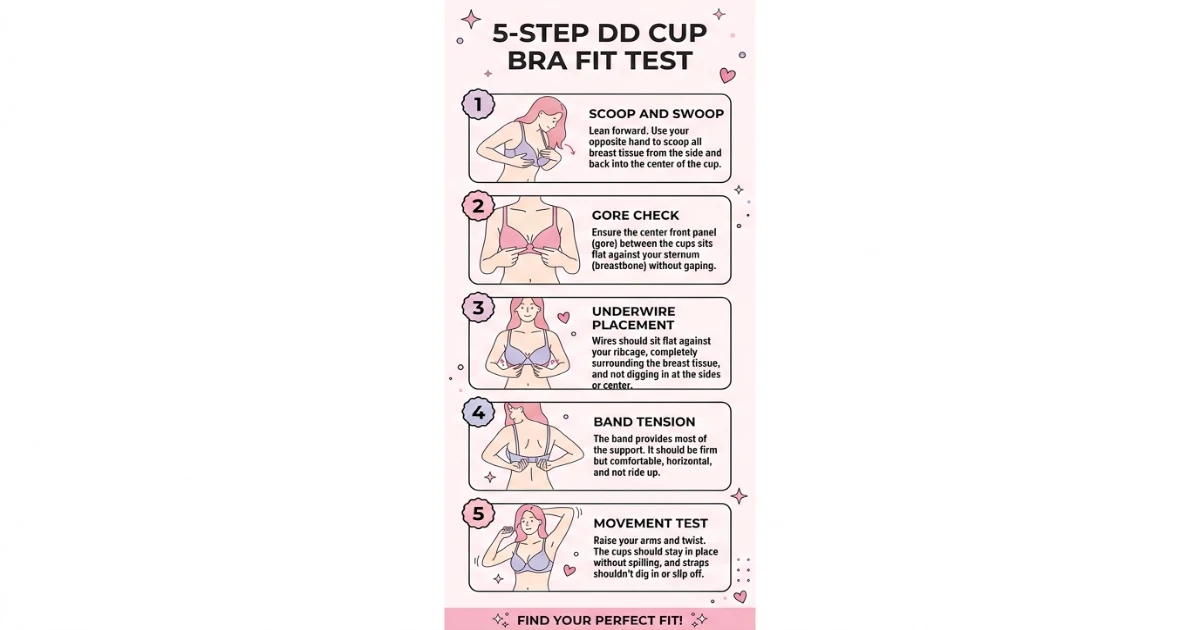
At DD cup sizes, both band and cup fit errors have an outsized impact on comfort, posture, and long-term support. Run through these five checks to confirm whether you are in the correct size.
Lean forward and scoop all breast tissue — including side fullness toward the armpits, which is significant at DD cup sizes — fully forward and upward into the cup. Overflow at top or sides after scooping = cup too small, go up one letter on the same band (34DD → 34F). Wrinkling fabric at the top = cup too large, go down one letter on the same band.
The centre gore must lie completely flat against the sternum. In DD cup sizes, a floating gore is almost always a sign that the cup is too small — go up one cup letter in the same band before changing anything else. This is the most reliable volume indicator at DD+ cup sizes and takes precedence over all other visual signals.
The underwire must encircle all breast tissue completely and rest entirely on firm ribcage. Check the wire width carefully: it should begin and end at the exact outer edge of your natural breast tissue. Wire ending on bare ribcage beyond the breast = underwire too wide (try 34DD instead of 36DD). Wire pressing into side breast tissue = too narrow (try 36DD or a wide-wire style).
On the loosest hook, slide two fingers under the back band — you should feel firm resistance only. At DD cup sizes, even mild band looseness means the weight of the bust shifts to the straps within the first hour. If more than two fingers slide in easily, the band is too large — move down one band and up one cup letter to preserve volume. The band must run level all the way around.
Raise arms overhead, twist side to side, walk briskly for 60 seconds. In a correctly fitted DD cup bra, the band stays level, cups stay fully in position, and straps stay on the shoulders without digging. Cups creeping down during movement = band too loose. Tissue escaping during movement = cup too small. These are separate problems with separate solutions — do not fix both by changing the band alone.
Still unsure whether 34DD or 36DD — or a completely different size — is correct for your body? Get a precise answer from your actual measurements.
Try the AI-Powered Bra Size Calculator →34DD vs 36DD: Full Side-by-Side Comparison
| Feature | 34DD | 36DD |
|---|---|---|
| Band Size | 34 (29–30″ / 74–76 cm underbust) | 36 (31–32″ / 79–81 cm underbust) |
| Cup Letter | DD — 5″ (13 cm) over underbust | DD — 5″ (13 cm) over underbust |
| UK Size | 34E | 36E |
| EU Size | 75E | 80E |
| Cup Volume | Smaller ↓ (~2″ less bust circumference) | Larger ↑ (~2″ more bust circumference) |
| Bust Measurement | ~35″ (89 cm) | ~37″ (94 cm) |
| Volume Equivalent | Same as 36D | Same as 34F (34DDD) |
| Underwire Width | Narrower — close-set breasts | Wider — broader breast root |
| Band Tightness | Tighter — correct for 29–30″ ribcage | Looser — correct for 31–32″ ribcage |
| Sister Sizes | 32F and 36D | 34F and 38D |
| Are They Sisters? | ❌ No — different volume families | |
| If cups too small | Try 34F (same band, next cup) | Try 36F (same band, next cup) |
| If cups too large | Try 34D (same band, prior cup) | Try 36D (same band, prior cup) |
| Best For | Underbust ~29–30″, bust ~35″ | Underbust ~31–32″, bust ~37″ |
| Availability | Moderate — specialty and online retailers | Wide — most mainstream retailers |
People Also Ask: 34DD vs 36DD — Answered
Are 34DD and 36DD the same size?
No — 34DD and 36DD are not the same size and are not sister sizes. They share the same cup letter but hold different cup volumes. The 36DD is larger — it holds the same volume as a 34F (34DDD), which is one full cup size above the 34DD. Sharing a letter only means the bust-to-underbust ratio is identical, not that the physical size is equal.
Which is bigger — 34DD or 36DD?
The 36DD is bigger in both band size and cup volume. The 36DD bust measures approximately 37 inches at the fullest point; the 34DD measures approximately 35 inches. That 2-inch difference represents a meaningful increase in cup volume. The 36DD is equivalent in volume to a 34F — a full cup size above the 34DD on the same band.
Is 34DD and 36DD the same cup size?
No — the letter is identical but the cup size is not. A DD cup on a 36 band is physically wider and encloses more volume than a DD cup on a 34 band. The 36DD cup volume is equivalent to a 34F. Cup volume is always a product of both the band number and the cup letter together — the letter alone tells you nothing about absolute size.
How much bigger is 36DD than 34DD?
The 36DD bust is approximately 2 inches larger than the 34DD at the fullest point — roughly 37 inches vs 35 inches. Both share the same 5-inch cup differential from their respective underbust measurements, but the wider 36 frame makes the actual enclosed cup space meaningfully larger. The 36DD equals a 34F in cup volume.
Can I wear a 36DD instead of 34DD?
Not as a substitute — they hold different volumes and are not sister sizes. Wearing a 36DD when you measure as a 34DD gives you a loose band and a cup with significantly more space than your breast tissue fills. The result is gaping cups, a riding band, and poor support. If your 34DD is unavailable, the correct substitutes are 32F (tighter band, same volume) or 36D (looser band, same volume).
What are the sister sizes of 34DD?
The sister sizes of 34DD — holding approximately equal cup volume — are: 32F (32DDD), 36D, 38C, and 40B. If 34DD is unavailable, 32F (tighter band) or 36D (looser band) are the correct substitutes. The 36DD is not in this family — it holds one full cup more volume than 34DD and is a sister of 34F.
What are the sister sizes of 36DD?
The sister sizes of 36DD — holding approximately equal cup volume — are: 34F (34DDD), 38D, 40C, and 42B. Note that 38D is a sister of 36DD — confirming the 36DD holds one full cup size more volume than the 34DD. The 34DD is not in this family and holds less volume than 36DD.
If my 34DD cups are too small, should I try 36DD?
No — if your 34DD cups feel too small but the band fits correctly, try a 34F (34DDD) first. Staying on the same band and increasing the cup letter is always the correct response to cups that are too small. Moving to 36DD gives you both a looser band and more volume — which fixes one problem while creating another. Only change the band if your underbust measurement specifically points to 31–32 inches.
Which gives better support — 34DD or 36DD?
The size matching your underbust measurement always gives better support. At DD cup sizes, band fit is critical — breast tissue is heavy and a loose band transfers that weight to the straps within the hour. A 34DD on a 29–30 inch ribcage outperforms a 36DD on the same frame. A 36DD on a 31–32 inch ribcage outperforms a 34DD on that wider frame. Measurements are everything.
What is 34DD in UK sizing?
34DD in US sizing is equivalent to 34E in UK sizing. UK bra sizing uses E where US sizing uses DD — the cup letters diverge at D, with UK going D, DD, E, F, FF and US going D, DD, DDD/F, G. A 34DD wearer shopping UK brands such as Freya, Panache, or Curvy Kate should search for 34E.
How do I know my correct bra size?
Measure your underbust snugly for your band and your bust at the fullest point for your cup. Subtract underbust from bust — each inch equals one cup letter. A 5-inch differential = DD cup on any band. Verify fit: level band, flat gore, underwire on ribcage matching breast root width, two fingers under back band, no movement during activity. Use our bra size chart calculator for a precise result.