32C vs 36B: Do They Hold the Same Cup Volume? (2026 Bra Fit Guide)
You may have heard that a 32C and a 36B hold roughly the same cup volume. It’s a popular claim rooted in the sister-size system — but it’s only part of the story. This guide breaks down what the numbers actually mean, how a four-inch band difference changes the entire fit experience, and which size is truly right for your body.
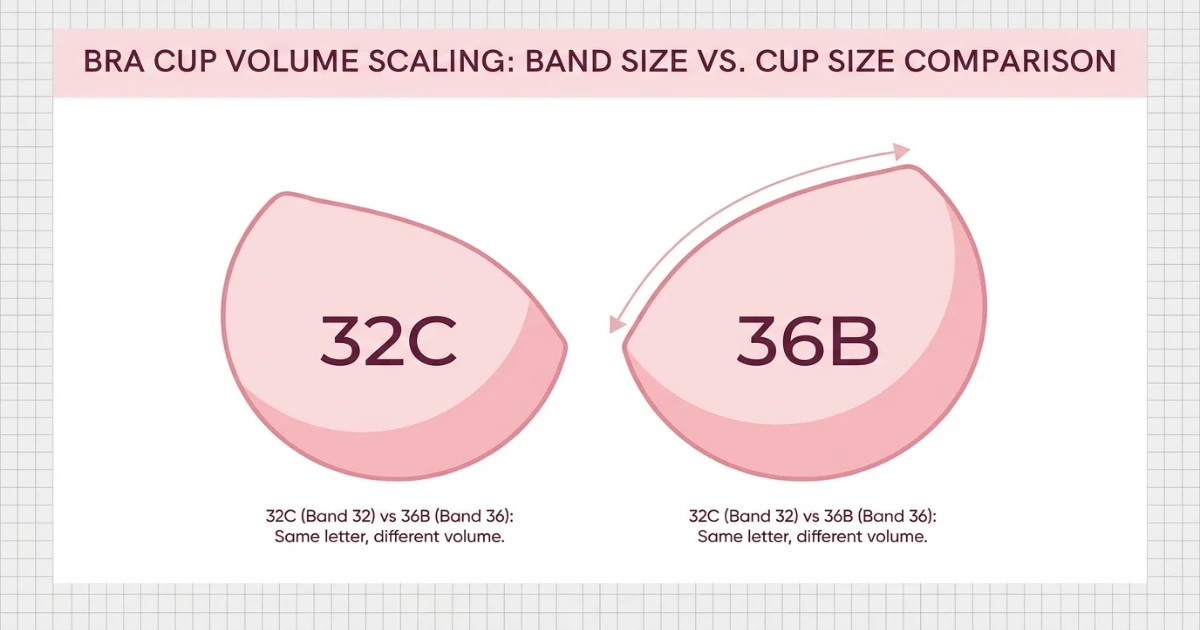
32C and 36B are not direct sister sizes and do not hold the same cup volume. A 36B has a noticeably larger cup than a 32C because the cup letter scales up with the band number. Although they are sometimes loosely grouped in sister-size discussions, the 36B band is four inches wider, provides far less tension, and creates a very different fit experience. For most bodies, they are not interchangeable.
📋 Key Takeaways
- 32C and 36B are not true sister sizes — the cup volumes are not equivalent.
- The sister-size chain for 32C runs: 28E → 30D → 32C → 34B → 36A.
- A 36B band is four inches wider, fits looser, and provides significantly less lift and support.
- Cup letters only mean the same thing when the band number stays constant; as the band grows, the letter must shrink to maintain volume.
- Always measure your underbust and full-bust before switching sizes.
Choose the fit signs you notice in the band, cups, center and straps. We’ll turn them into a practical next step for 32C.
Private fit check — your answers stay in your browser and are used only for this on-page guidance. Nothing is stored or submitted.
What Does 32C Mean?
A 32C bra has a band that measures 32 inches around the underbust and a cup that sits 3 inches above that number. The letter C always represents a 3-inch bust-to-band difference, regardless of the band size. So a 32C wearer typically measures approximately 32 inches under the bust and 35 inches at the fullest point of the bust.
A 32-inch band is considered a snug, firm-fitting band. It provides strong anchor support, which means the underwires and cup fabric do most of their structural work correctly — holding the breast tissue close to the chest wall with minimal lateral migration.
People who genuinely wear a 32C tend to have a narrower ribcage with a moderate breast volume. The firmness of the band can feel unfamiliar if someone has been wearing a 36 or 38 band for years, but that firmness is exactly what creates proper lift and reduces shoulder strap pressure.
For a full breakdown of fit features, visit the dedicated 32C bra size guide.
What Does 36B Mean?
A 36B bra has a band that measures 36 inches around the underbust and a cup sitting 2 inches above that — because B always represents a 2-inch difference. A 36B wearer typically measures roughly 36 inches underbust and 38 inches full bust.
A 36-inch band is a wider, more relaxed band. It distributes pressure over a broader surface area, which can feel more comfortable initially, but it also means the band does less structural work. The wider the band, the lower the tension required to keep the bra in place — and lower tension means less lift and more movement of the bra during daily activity.
People who genuinely wear a 36B usually have a medium-to-wide ribcage with a relatively modest breast volume relative to their frame. See the complete 36B bra size guide for style recommendations and fit notes.
Are 32C and 36B Sister Sizes?
No — 32C and 36B are not sister sizes. This is one of the most common misconceptions in bra fitting. Understanding why requires a quick look at how the sister-size system actually works.
Sister sizes are pairs (or chains) of bra sizes that share approximately the same cup volume achieved through a one-step adjustment in opposite directions: go up one band size, drop one cup letter; go down one band size, go up one cup letter. The cup volume stays roughly the same across adjacent steps.
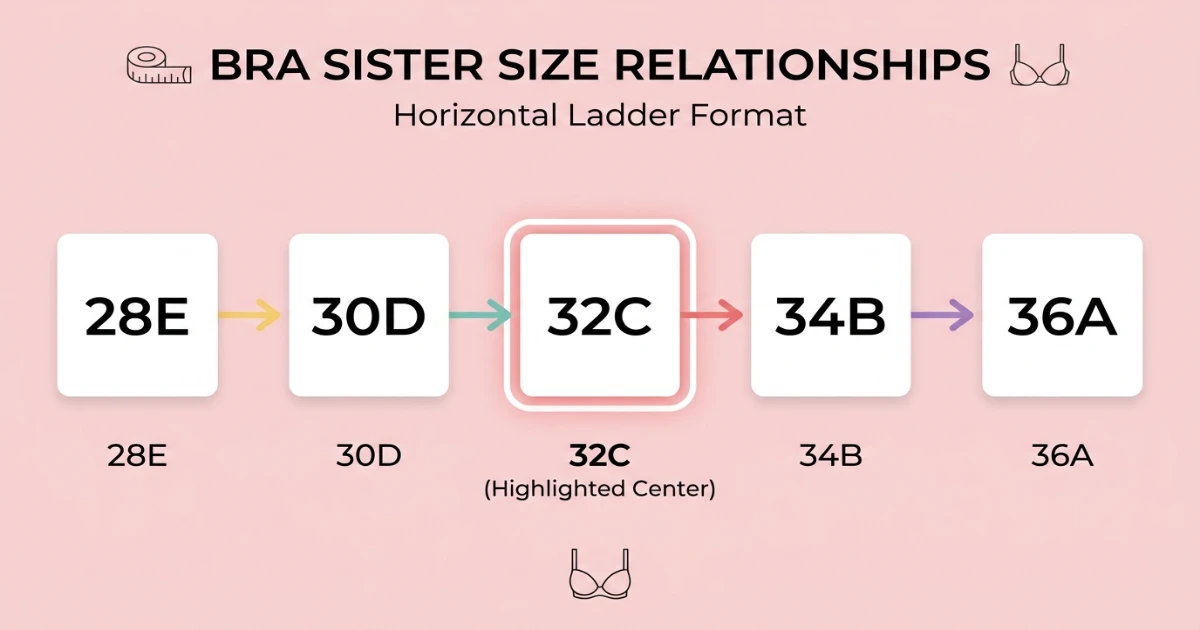
The sister-size chain for 32C is:
- 28E (smallest band, deepest cup)
- 30D
- 32C (your true size)
- 34B (one step larger — slight volume gain)
- 36A (two steps larger — noticeable volume shift)
Notice that 36B does not appear anywhere in the 32C sister-size chain. The 36B sits in its own chain: 32D → 34C → 36B → 38A. A 36B actually contains more cup volume than a 32C, not the same volume, because B on a 36 band corresponds to a 2-inch difference on a much wider base.
Use the Sister Size Bra Calculator to map out your exact chain and explore safe alternatives. For a deeper dive into how the system works, the sister sizes explained guide is an excellent resource.
Cup Volume Relationship Explained
Cup volume is not simply determined by the letter alone. It is determined by the combination of band number and cup letter together. This is why bra fitting professionals always evaluate both measurements before recommending a size.
| Size | Band (inches) | Cup Letter | Bust–Band Diff. | Approx. Cup Volume |
|---|---|---|---|---|
| 32C | 32 in | C | 3 inches | Moderate on a small frame |
| 34B | 34 in | B | 2 inches | Closest sister to 32C |
| 36A | 36 in | A | 1 inch | Lower than 32C |
| 36B | 36 in | B | 2 inches | Larger than 32C |
As the table shows, a 36A would be a closer (though still imperfect) match to 32C in terms of cup volume, while a 36B actually holds more volume. For visual comparisons of cup shapes and depths, the cup size visuals guide is a helpful reference. You can also explore a broader range of size comparisons in the breast size comparison hub.
Band Size Difference Explained: What 4 Inches Really Means
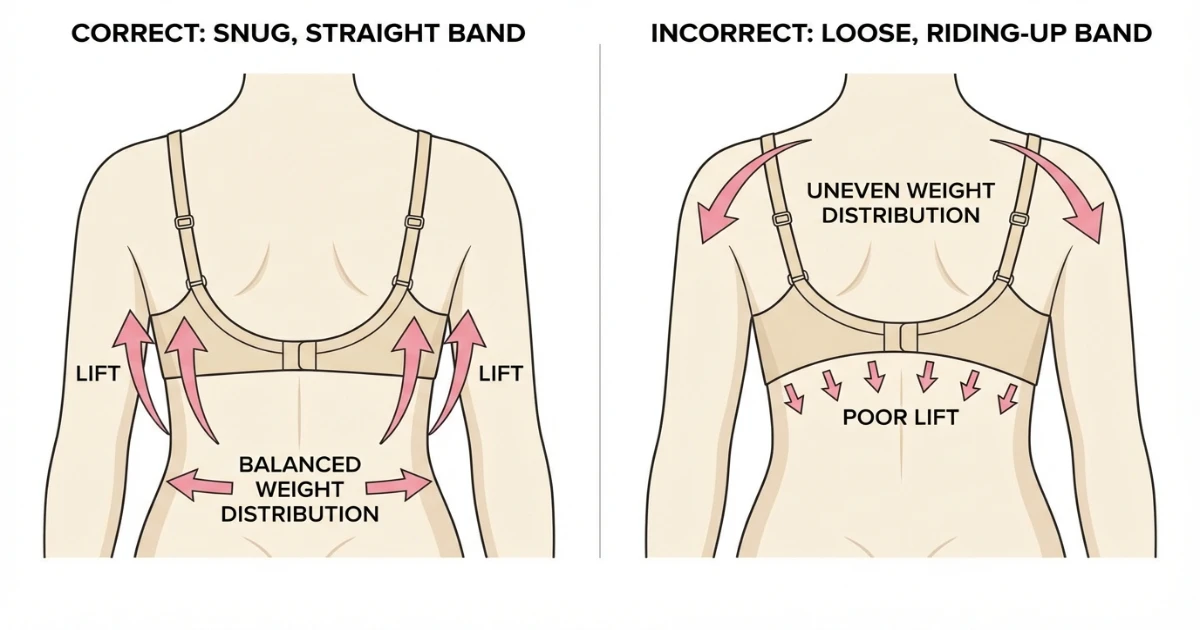
The band in a bra provides roughly 80% of the garment’s total support. The straps contribute the remaining 20% — they are designed to guide shape and prevent cup gaping, not to carry weight. This single fact is why a four-inch difference in band size is far more significant than it might appear on a tag.
Here is what changes when you move from a 32 band to a 36 band:
- Tension decreases: A 32 band must stretch more to reach its circumference, creating elastic tension that holds the band firmly in place. A 36 band reaches its resting position with less stretch and therefore less grip.
- Lift changes: Firm band tension lifts the breast upward and inward. A loose band allows the bra to ride up the back and shift forward, reducing the effective lift.
- Weight distribution shifts: With a snug 32 band, weight is distributed evenly around the torso. With a loose 36 band, more weight transfers to the straps, which can cause shoulder grooving, neck strain, and upper-back discomfort.
- Cup placement alters: When the band rides up at the back, the underwires simultaneously press into soft tissue at the front rather than lying flat on the ribcage, causing the classic “stabbing wire” complaint.
Support and Comfort: 32C vs 36B Side by Side
| Feature | 32C | 36B |
|---|---|---|
| Band tension | Firm, high | Relaxed, low |
| Lift provided | Strong | Moderate to low |
| Weight carried by straps | Minimal | Higher |
| Movement during activity | Very little | More noticeable |
| Underwire placement | Flat on ribcage | Can dig forward |
| Initial comfort | May feel snug at first | Feels loose, easy |
| Long-term comfort | Excellent with correct size | Decreases as band stretches |
| Shoulder strap pressure | Minimal | Higher |
Visual Fit Differences
Even if the raw cup volume were identical between two sizes, the visual result on the body would differ because the anchor point (the band) is in a different position. A narrower 32 band sits closer to the natural underbust crease. A wider 36 band sits lower on the torso or migrates upward depending on how much tension it generates.
From the side, a properly fitted 32C gives a forward, lifted silhouette with cups sitting at the midpoint between the shoulder and elbow. A 36B, particularly if it is the wrong size for the body, tends to flatten projection and allow tissue to drift to the sides — a condition known as “side spillage” or “armpit migration.”
Under clothing, a well-fitted 32C typically disappears under a shirt or dress because there are no tension gaps, back fat bulges from a too-tight strap, or cup gaps. A 36B on a person with a 32-inch ribcage may create visible band riding and center-front gaping even under thin fabrics.
Who Should Wear a 32C?
A 32C is the right choice when your underbust measurement is genuinely close to 30–32 inches and your full bust measures approximately 3 inches more than that. Good candidates include:
- People with a slender to average ribcage and moderate breast volume
- Those who currently wear a larger band and experience strap digging, back pain, or cups that gap at the top
- Individuals who feel their current bra provides poor lift or shifts during movement
- Anyone who measures out to this size using a proper measurement technique
Who Should Wear a 36B?
A 36B fits best when the underbust genuinely measures in the 34–36 inch range and the full bust measures 2 inches larger. This size suits:
- People with a medium-to-wide ribcage and modest breast volume relative to frame
- Those who find 34B or 34C bands too snug and 38 bands too loose
- Individuals whose underbust measurement consistently returns 35–36 inches across multiple reads
- Anyone for whom the band of a 32 or 34 leaves marks, restricts breathing, or causes back panel rolling
Common Fit Problems When Switching Between These Sizes
If you are considering swapping a 32C for a 36B — or vice versa — without measuring first, these are the most likely problems you will encounter. The Bra Fit Problem Solver can help you diagnose specific issues, and the full list of common bra fit problems covers every symptom in detail.
If you switch from 32C to 36B when your underbust is actually 32 inches:
- Band will ride up at the back within an hour of wear
- Straps will slip off the shoulders
- Center gore will not lie flat against the sternum
- Cups may gape or cause breast tissue to push under the wire
- You will likely increase strap tension to compensate, causing shoulder pain
If you switch from 36B to 32C when your underbust is actually 36 inches:
- Band will feel painfully tight and leave red marks
- Back panel may roll or dig into skin
- Cups will likely be too small, causing the four-breast effect or overflow
- Underwires may sit on breast tissue rather than the chest wall
For more guidance on fit diagnosis, visit the how to know your bra fits page.
How to Measure Your Bra Size Correctly
Accurate measurement is the only reliable way to determine whether a 32C or a 36B is appropriate for your body. Use a soft tape measure and measure directly against the skin (not over clothing) for best results.
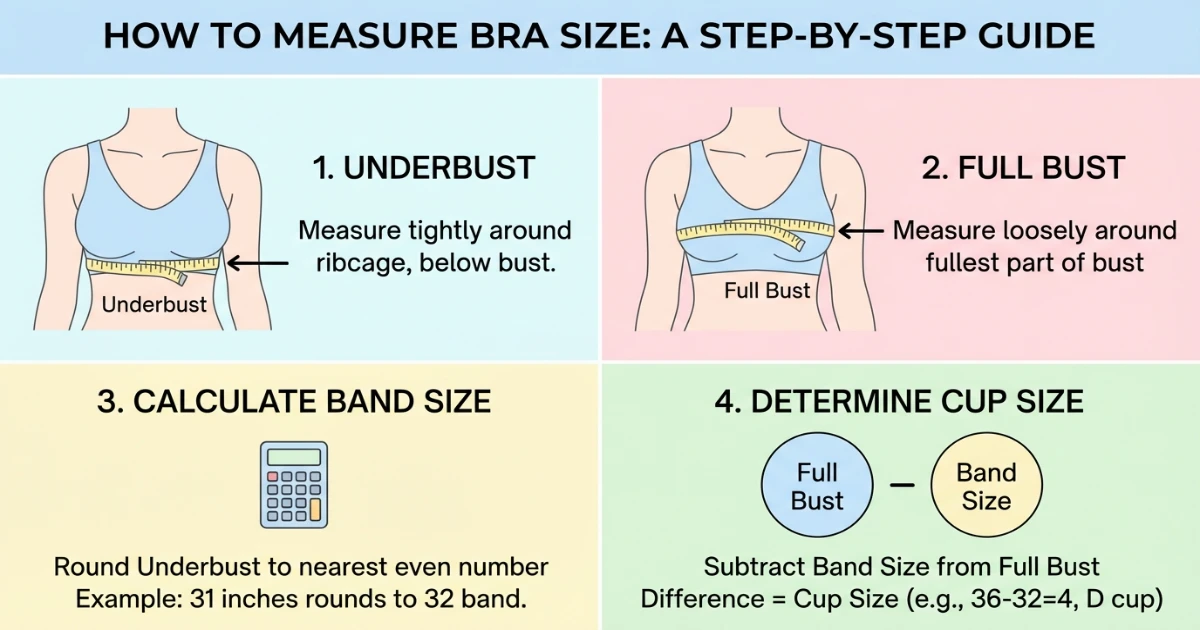
- Measure your underbust. Wrap the tape measure snugly around your ribcage directly beneath the breast tissue. The tape should be firm — not digging in, but not loose. Record the number in inches. This is your band baseline.
- Measure your full bust. Lean slightly forward and wrap the tape around the fullest point of the breast, keeping it parallel to the floor. Do not compress the tissue. Record in inches.
- Calculate the bust-to-band difference. Subtract your underbust measurement from your full-bust measurement. Each inch of difference corresponds to one cup size (1 in = A, 2 in = B, 3 in = C, 4 in = D, and so on).
- Determine your likely bra size. Combine your band number with the cup letter from step 3. If your underbust is 32 and the difference is 3 inches, your starting size is 32C. Run your numbers through the AI Smart Fit Bra Calculator or the Bra Size Chart Calculator for a cross-referenced result.
- Confirm support and cup fit on the body. Try the size and check: band sits level all around, no riding up; straps stay on shoulders with two fingers of slack; cups contain all breast tissue with no overflow or gaping; center gore lies flat on the sternum. Use the fit checklist to verify each point.
For international shoppers, the Global Bra Size Converter translates your measurements into UK, EU, AU, and other regional sizing standards. Full size reference tables are available in the size charts library.
Best Bra Styles for 32C and 36B
Best styles for 32C
- Full-cup underwire — Maximises coverage and support for a snug band; encapsulates tissue cleanly.
- Balconette — Creates lift and forward projection; works beautifully with a firm 32 band.
- Plunge with side boning — Controls lateral migration and shapes well on a narrower ribcage.
- T-shirt bra with moulded cups — Smooth under fitted clothing; the snug band prevents riding.
Best styles for 36B
- Minimizer underwire — Redistributes tissue broadly across a wider cup base; suited to wider-set breasts.
- Full-cup soft-cup — Comfortable for all-day wear with a wider band base.
- Sports bra (encapsulation style) — A firm sports band often works better than a loose everyday band for 36-inch ribcages during activity.
- Wirefree with side support panels — A good option when underwires feel too rigid on a wider band.
For additional size comparisons related to these ranges, explore 32D vs 34C, 34D vs 36C, and 28C vs 30B — all part of the breast size comparison hub.
Best Bras for 32C & 36B That Are Actually Worth Clicking
Handpicked for support, comfort, shape, and everyday wear. These two picks suit the needs most readers have when comparing 32C vs 36B.
Best Bras for 32C & 36B
Tested by real women. Ranked by comfort, fit, and everyday wearability.

Warner’s Easy Does It
Wireless Bra
The comfort pick our readers keep coming back to — no underwire, no digging, just smooth all-day softness with a clean silhouette under any top.
- Seamless look under fitted t-shirts
- Stays comfortable through long wear days
- Soft stretch fits both 32C & 36B well


Bali Full Coverage
Underwire Bra
When lift and structure matter more than softness — this is the pick. Dependable underwire support with a clean, polished shape that holds all day.
- Fuller coverage, no gaps or gaping
- Firm lift and defined silhouette
- Ideal for workwear and structured outfits
Conclusion
32C and 36B are fundamentally different bra sizes. The persistent myth that they share the same cup volume comes from a misapplication of the sister-size concept — a system that only works across adjacent, one-step band changes, not across four-inch jumps. In reality, a 36B holds more cup volume than a 32C, sits on a dramatically looser band, and produces a completely different fit experience.
The most important takeaway is this: always measure before switching sizes. A bra that feels loose, rides up, or transfers weight to your straps is not necessarily a 36B problem or a 32C problem — it is a fit problem. The right size is the one that matches your actual measurements, holds the band level, and keeps all tissue comfortably inside the cups without digging or gaping.
Use the tools at bra-calculator.com to confirm your size, explore sister options, and find a bra that genuinely supports your body. For questions about specific fit issues, the Bra Fit Problem Solver is always a good starting point.
Find Your Perfect Fit in Seconds
Use our free AI-powered calculator to get a personalised size recommendation — no guesswork required.
Try the Smart Fit Calculator →Frequently Asked Questions
Are 32C and 36B sister sizes?
No. 32C and 36B are not sister sizes. The sister-size chain for 32C is 28E → 30D → 32C → 34B → 36A. A 36B belongs to a different chain (32D → 34C → 36B → 38A) and holds more cup volume than a 32C. Sister sizes only stay equivalent across single, one-step band adjustments — not four-inch jumps.
Do 32C and 36B hold the same cup volume?
No. A 36B has a larger cup volume than a 32C. The cup letter B on a 36-inch band represents a 2-inch bust-to-band difference starting from a wider base, which yields a physically larger cup than the C letter on a 32-inch band. Only sizes within the same adjacent sister-size step come close to sharing volume, and even then the match is approximate rather than exact.
Which size gives better support?
For someone with a 32-inch underbust, a 32C will always provide better support because the tighter band creates the tension needed to hold the bra in place, distribute breast weight around the torso, and reduce strap pressure. A 36B worn on a smaller ribcage will ride up, shift, and transfer load to the straps — the opposite of good support. The correct size for your measurements is always the most supportive choice.
Can I wear a 36B instead of a 32C?
Only if your underbust measurement genuinely matches a 36-inch band. If your underbust is around 32 inches, wearing a 36B will result in band riding, poor lift, strap slippage, and cup gaping or spillage. Sister sizing is a short-term workaround for finding a temporary substitute — it is not a long-term sizing strategy, and it does not apply to a four-inch band difference.
Why does a bigger band change the fit so much?
Because the band provides approximately 80% of a bra’s total support. A firm band generates elastic tension that holds the bra level, lifts the cups, and distributes breast weight around the whole torso rather than onto the shoulder straps. A wider, looser band lacks that tension — it migrates upward at the back, pushes the underwires forward into soft tissue, and forces the straps to carry weight they were never designed to handle. Even a two-inch band change can noticeably alter comfort and support, so a four-inch difference is significant.
Similar Posts
36A vs 38AA: Measurements, Fit, Cup Volume & Sister Sizes
36A vs 38AA Premium Fit Guide · Size Comparison 36A vs 38AA: Measurements, Fit & Sister Sizes Deep comparison guide with exact…
40H vs 40I: Measurements, Fit, Cup Volume & Sister Sizes
40H vs 40I Premium Fit Guide · 40/42 Band Comparison 40H vs 40I: Measurements, Fit & Sister Sizes Authority-level comparison guide with…
34D vs 36C
Home / Size Comparisons / 34D vs 36C ✓ Fit guidance reviewed by Amelia Updated August 20, 2026 34D vs 36C: What’s…
36F vs 36G: Measurements, Fit, Cup Volume & Sister Sizes
36F vs 36G Premium Fit Guide · Size Comparison 36F vs 36G: Measurements, Fit & Sister Sizes Deep comparison guide with exact…
40F vs 40G: Real Cup Size Difference & Full-Bust Fit Guide 2026
40F vs 40G Bra Size: What Is the Real Difference? (2026 Fit Guide) Quick Answer: 40F and 40G share the same 40-inch…
36D vs 38D: Are They the Same Size? Same Letter, Different Cup | Bra Calculator
36D vs 38D: Are They the Same Size? Same Letter, Different Cup Explained (2026) Quick Answer: No — 36D and 38D are…