30B vs 30C: What’s the Real Cup Size Difference? (2026 Fit Guide)
Updated for 2026 · By Amelia
Choose the fit signs you notice in the band, cups, center and straps. We’ll turn them into a practical next step for 30B.
Private fit check — your answers stay in your browser and are used only for this on-page guidance. Nothing is stored or submitted.
Quick Answer
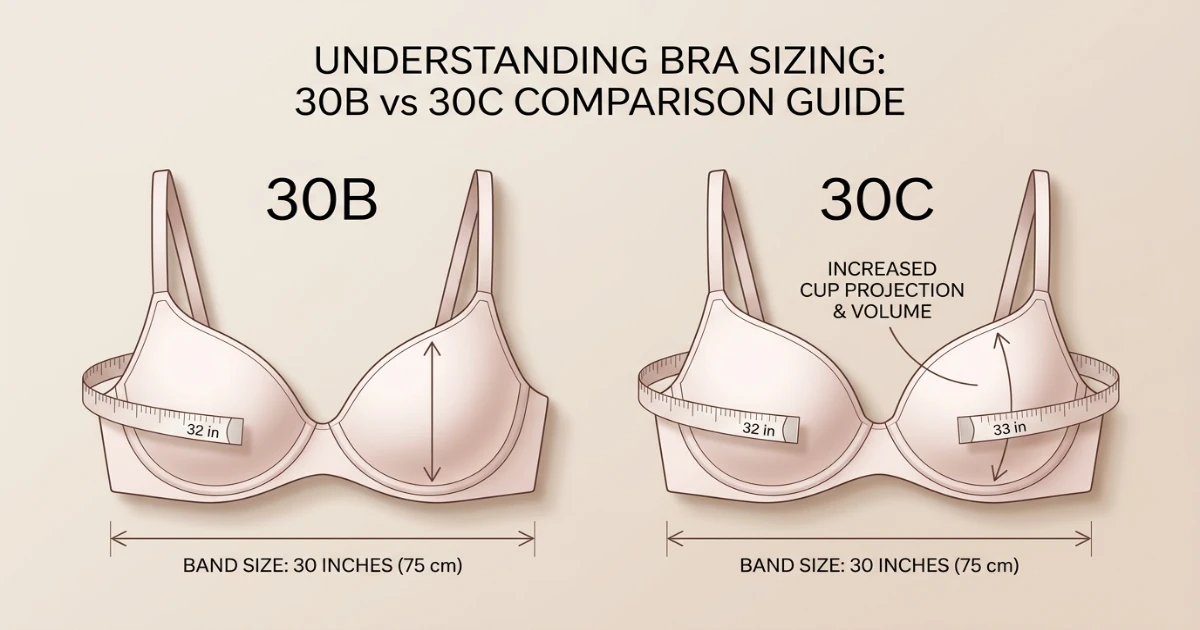
30C is one full cup size larger than 30B. Both bras share the same band size — meaning the underbust measurement is approximately 30 inches — but the 30C cup holds roughly one inch more of bust measurement than the 30B.
In practical terms, a 30C cup has noticeably more volume and coverage than a 30B. If your current 30B feels slightly too snug across the cup or you notice any overflow at the top or sides, sizing up to a 30C is likely the right move.
If your 30C cups wrinkle, gape, or feel empty, a 30B will give you a cleaner, more secure fit.
Key Takeaways
- Same band, different cup volume: 30B and 30C both have a ~30-inch underbust, but the cups differ by approximately one inch of bust projection.
- The C cup holds more breast tissue: A 30C accommodates fuller or slightly more projected breast shapes compared to 30B.
- One cup letter = one inch of difference: In standard US/UK sizing, each cup letter represents roughly a 1-inch increase in the difference between bust and underbust measurement.
- Fit clues matter more than numbers: Spillage and underwire digging inward signal you need a larger cup; wrinkling fabric and gaping signal you need a smaller cup.
- Sister sizes exist for both: 30B shares volume with 28C and 32A; 30C shares volume with 28D and 32B.
- Neither size is inherently “small” or “large”: On a 30-inch band, both are considered petite-band sizes and are perfectly proportional for a narrow ribcage.
- Brand variation is real: A 30C in one brand may feel like a 30B in another — always try before you commit.
Understanding Bra Cup Letters
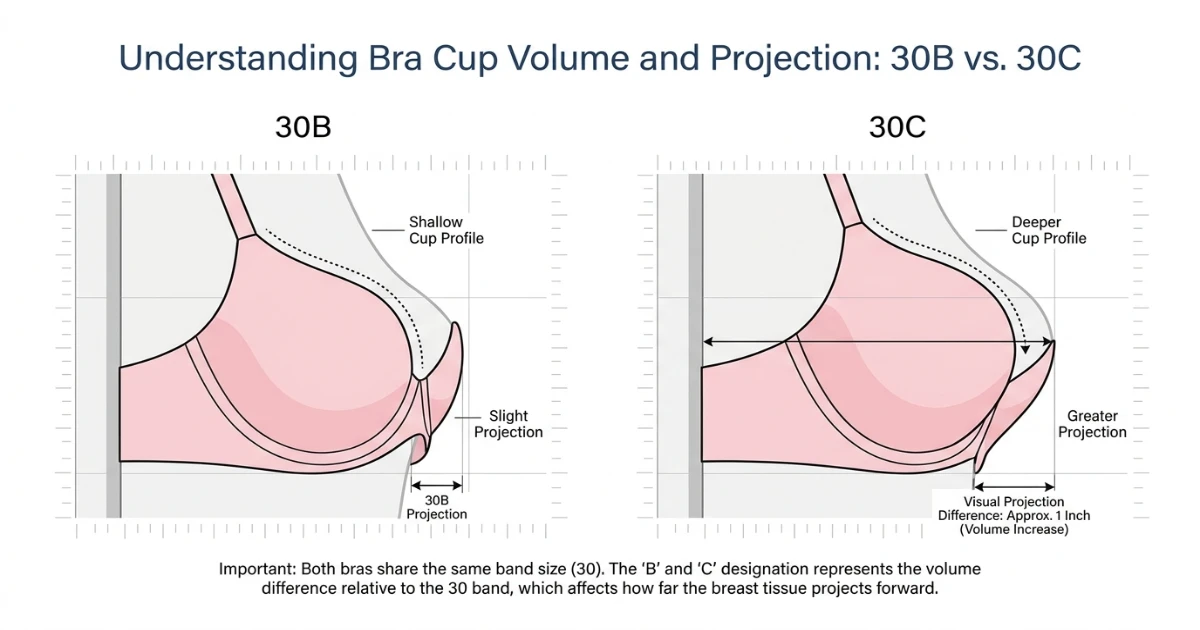
Bra cup letters are not a fixed measurement on their own — they always work in relationship to the band size. That’s a detail that trips up a lot of women, especially when shopping across different brands or moving between sister sizes.
The cup letter is determined by the difference between your full bust measurement (taken across the fullest part of your chest) and your underbust measurement (the snug circumference just below your breasts). In standard US and UK sizing:
- A 1-inch difference = A cup
- A 2-inch difference = B cup
- A 3-inch difference = C cup
- A 4-inch difference = D cup
- And so on, with each letter representing one additional inch
So when you move from a B cup to a C cup — at the exact same band size — you’re adding one inch of cup volume. That’s the entire difference between a 30B and a 30C. It sounds modest on paper, but it translates to a meaningful change in how the bra fits, how much breast tissue it covers, and how projected the cup actually sits.
It’s also worth noting that a C cup on a 30-inch band is a very different physical size from a C cup on a 36-inch band. The letter just tells you the relative difference — the band tells you the actual dimensions. For a full overview of how cup sizes scale, visit our bra size charts.
Measurement Breakdown: 30B vs 30C in Numbers
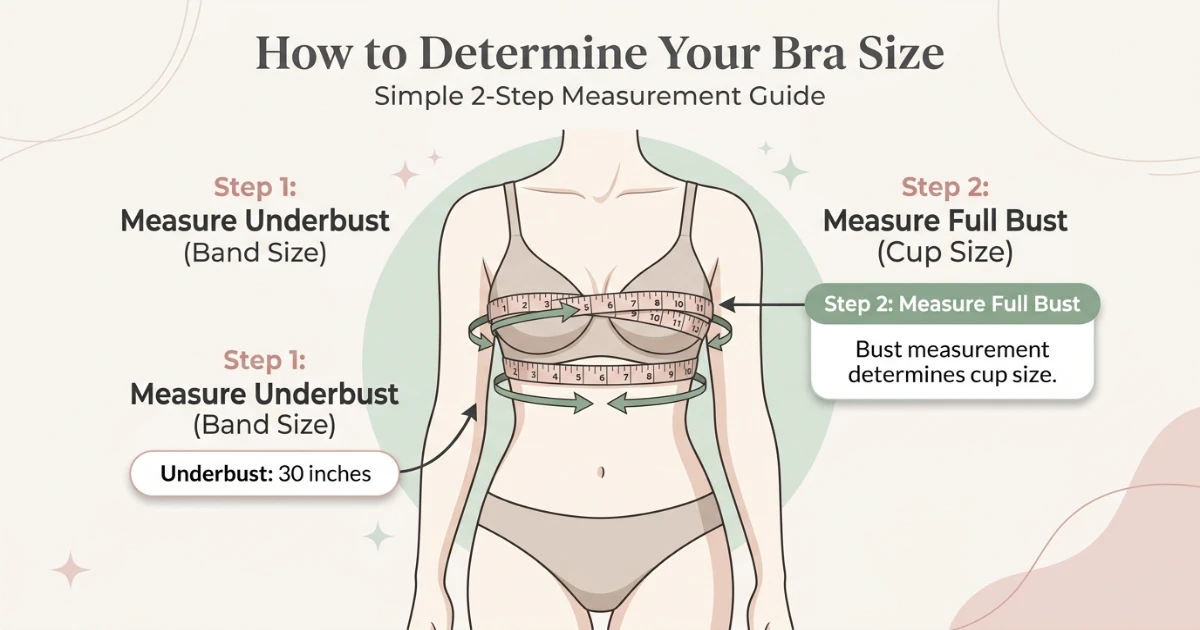
To understand the difference concretely, let’s look at the actual measurements each size corresponds to. These figures follow standard US sizing conventions.
30B
Underbust: ~30 in / ~76 cm
Full Bust: ~32 in / ~81 cm
Cup Difference: 2 inches / ~5 cm
Projection: Moderate, closer to the chest
30C
Underbust: ~30 in / ~76 cm
Full Bust: ~33 in / ~84 cm
Cup Difference: 3 inches / ~8 cm
Projection: Slightly fuller, more projected
Notice that the underbust stays the same — both sizes are designed to anchor at 30 inches (approximately 76 cm). What changes is the full bust measurement the cup is engineered to accommodate. The 30C accounts for one additional inch of bust circumference, which adds meaningful volume when you consider the three-dimensional shape of the cup.
What Does One Inch Actually Look Like?
An inch may not sound like much, but in bra sizing it’s genuinely significant. Imagine the difference between a cup that just barely contains your breast tissue versus one that gives you a comfortable centimeter of breathing room. That’s the gap between a 30B and a 30C. For women with petite ribcages, the cups in this size range are smaller overall — so one inch of difference represents a proportionally larger shift in fit comfort than it would at a larger band size.
If you’d like to take your own measurements and compare them against both sizes, our step-by-step measuring guide walks you through the process with a soft tape measure.
Cup Volume Difference: How Much More Is a C Cup?
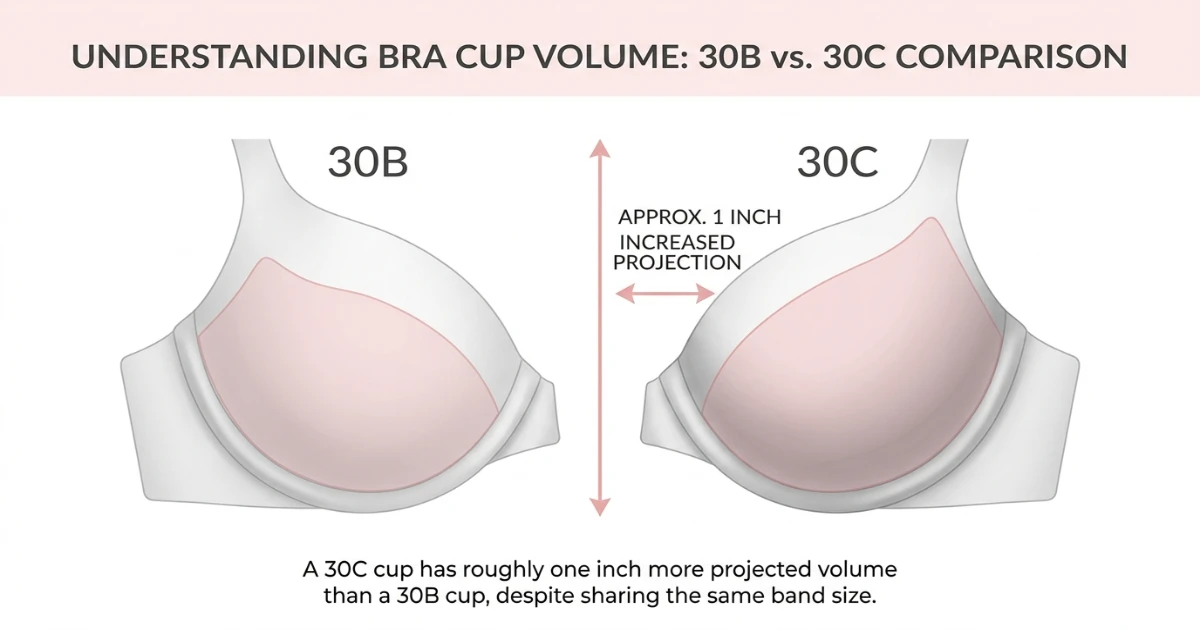
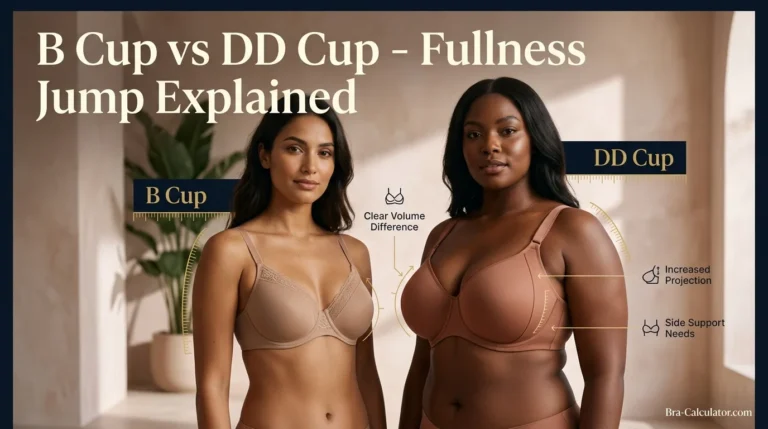
Volume is where the real difference lives. A C cup is not just “a little wider” than a B cup — it’s deeper, taller, and wider simultaneously, because the cup has to accommodate breast tissue that projects further from the chest wall.
Think of it this way: a B cup is like a shallow bowl, while a C cup is like a slightly deeper bowl of the same diameter that can hold more. For a 30-inch band, the difference in cup volume between a B and a C is approximately equivalent to half a cup of liquid — roughly 150–200ml depending on the specific bra’s construction. That’s a tangible amount.
How This Affects Shape and Projection
Women who wear a 30B typically have a breast shape that projects 2 inches away from the underbust, while women in a 30C project approximately 3 inches. This is why cup choice directly affects how a bra looks under clothing — a 30C creates a rounder, more forward silhouette than a 30B at the same band.
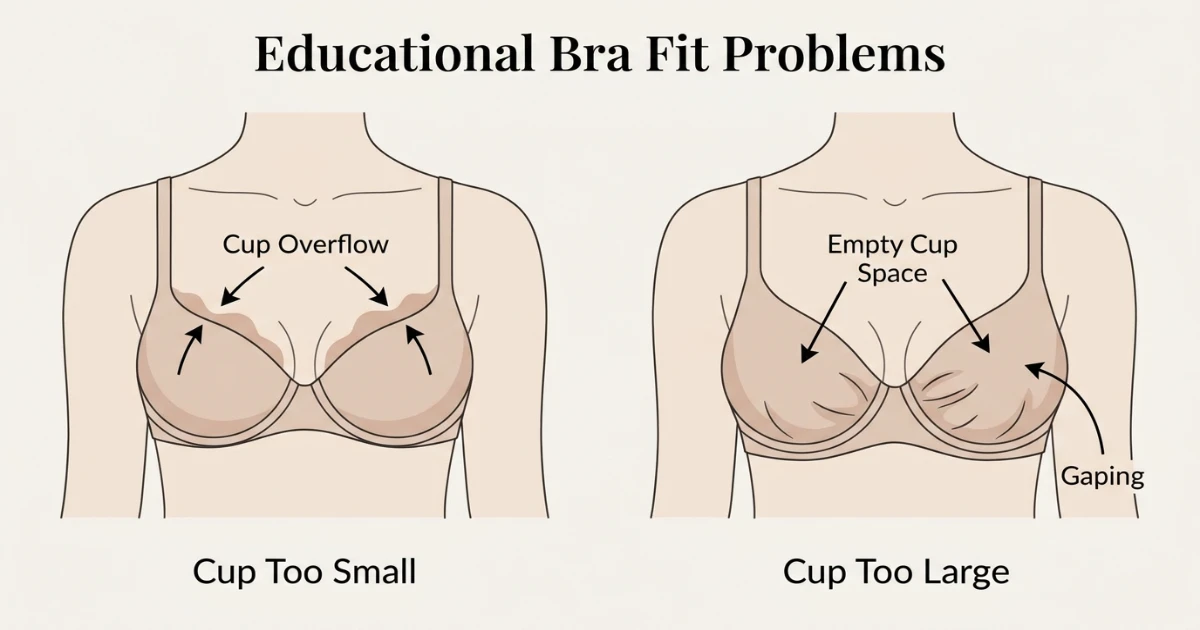
It also affects where the breast tissue sits. In a properly fitting 30B, the tissue is comfortably held without compression. Move to a 30C without the corresponding volume and the cup fabric will wrinkle or fold forward. Move down to a 30B when you actually fill a 30C and the breast tissue will push over the cup edges or underwire — a classic sign of being in too small a cup.
For a side-by-side look at how cups look across sizes, our cup size visuals page includes illustrated comparisons across multiple band and cup combinations. You can also use our bra size chart calculator to see where your measurements fall across the full sizing spectrum.
Fit Differences You May Notice
The best way to know which size is right for you is to pay attention to how the bra behaves on your body. Here’s what to watch for:
Signs Your 30B Might Be Too Small
- Mild spillage: Breast tissue creeping over the top edge of the cup or pushing out at the sides near the underwire.
- Underwire sitting on breast tissue: The wire should sit flat against your ribcage; if it’s digging into the outer edge of your breast, the cup is too small.
- Strap digging in: When the cups are overfilled, the straps often compensate by pulling tighter — leading to shoulder pressure and red marks.
- Four-boob effect: A defined ridge or second bump at the top edge of the cup means you’ve outgrown the cup volume.
- The center gore lifts: If the fabric between the cups doesn’t lie flat against your sternum, the cups may be too small.
Signs Your 30C Might Be Too Large
- Gaping at the cup top: Wrinkled or loose fabric at the upper part of the cup is a clear sign there’s more cup than breast tissue to fill it.
- Cups fold or collapse: Especially noticeable in unlined or lightly lined styles.
- Underwire floats away from the body: The wire should anchor flat; if it hovers or gaps outward, the cup is too large.
- Straps constantly fall: When the cup volume is off, the geometry of the bra shifts, and straps lose their ability to stay in place.
For a more comprehensive guide to common fit issues and how to resolve them, see our bra fit problems guide.
Who Should Choose 30B
A 30B is the right choice when the cup proportions genuinely match your breast volume and shape. You’re likely a good fit for a 30B if:
- Your 30C cups consistently wrinkle, gape, or show empty fabric at the top.
- You have a shallow breast shape — meaning your breasts are wide and sit close to the chest wall rather than projecting far forward.
- You have minimal natural projection, even if your overall breast width is moderate.
- Styles with lower-depth cups (like balconette or demi-cup bras) fit you well, as these are cut shallower by design.
- You wear a 28C or 32A comfortably — these are sister sizes with equivalent cup volume to a 30B.
Shallow-breasted women are often surprised to find that fuller-cup styles leave them with gaping — even in smaller sizes. A 30B in a well-designed shallow-cup style may give far better results than a 30C in a generic full-cup bra. Our breast shape identifier can help you understand which bra styles are constructed for your specific shape.
Who Should Choose 30C
A 30C is the right choice when your breast tissue consistently overfills the 30B or when you need slightly more coverage and depth. Consider a 30C if:
- You experience spillage — especially at the top or sides — in a 30B.
- You have fuller or rounder breast tissue that projects away from your chest rather than sitting flat.
- You need more vertical cup height to cover the upper part of your bust, especially in lower-cut styles.
- The underwire in your 30B consistently presses into the outer edge of your breast tissue.
- You wear a 28D or 32B comfortably — these are sister sizes with equivalent cup volume to a 30C.
Women with fuller breast tissue and narrow ribcages often find that mainstream sizing steers them toward a larger band when a smaller band with a larger cup would actually serve them much better. If you’re unsure whether your current bra truly fits, our bra fit guide breaks down exactly what a correctly fitting bra should feel and look like.
Sister Sizes Explained
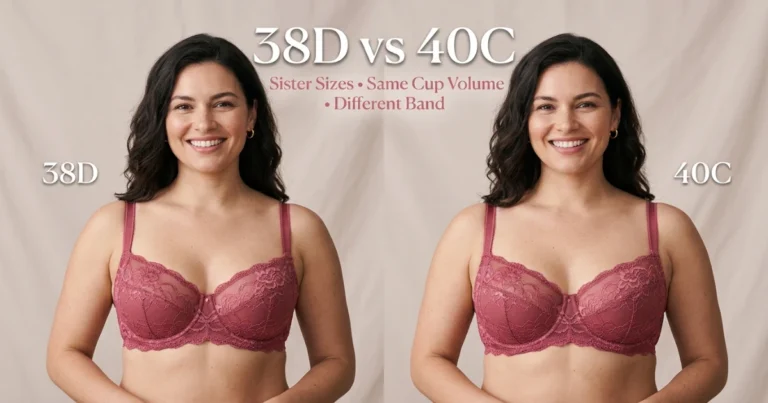
Sister sizes are pairs (or groups) of bra sizes that share the same cup volume despite having different band-and-cup combinations. Understanding them is incredibly useful when your exact size is out of stock, or when you need to try a bra style that doesn’t come in your size.
The rule is simple: as band size goes up by one step (e.g., 30 to 32), the cup letter goes down by one step (e.g., C to B), and the cup volume stays the same. The reverse is also true.
30B Sister Sizes
- 28C — smaller band, larger cup letter, same volume
- 32A — larger band, smaller cup letter, same volume
Note: A 32A will feel looser around the ribcage than a 30B. It’s a useful fit trick, not a permanent swap.
30C Sister Sizes
- 28D — smaller band, larger cup letter, same volume
- 32B — larger band, smaller cup letter, same volume
Note: A 32B will feel looser around the band. Use sister sizing for fit experiments, then return to your true size.
Sister sizes are a great troubleshooting tool when a bra “almost” fits — you can size the band up and the cup down (or vice versa) to test whether a fit adjustment resolves the problem. For a complete sister-size reference chart, visit our sister sizes guide. You can also use our sister size calculator to instantly generate all sister sizes for any bra size.
Quick Bra Fit Test: Are You a 30B or 30C?
Before buying a new bra, run through these simple checks to get a clearer sense of which cup size is right for you. You’ll need your current bra and a soft measuring tape.
- Check band fit first. Put on your bra on the loosest hook. You should be able to slide two fingers comfortably under the band, but no more. If the band rides up at the back, it’s too loose; if it digs in or feels tight at rest, it may be too small.
- Look at the cup top edge. Stand in front of a mirror and check for any overflow or bulging above the cup edge. If you see tissue spilling, your cup is too small. If you see wrinkled fabric, your cup is too large.
- Feel the underwire. Run a finger along the underwire from the center to the side. It should sit entirely on soft tissue-free ribcage. If it presses against breast tissue anywhere, size up in the cup.
- Check the center gore. The center panel between the cups should lie flat against your sternum. If it floats, the cups are too small. If it gaps outward, the cups may be too large.
- Measure your difference. Measure your underbust snugly (A) and your full bust relaxed (B). Subtract A from B. A 2-inch difference = B cup. A 3-inch difference = C cup. If your result is between sizes, try both and assess by fit feel, not just the number.
Still unsure about your bra size? Our AI-powered tool analyzes your measurements and gives you a personalized size recommendation in seconds.
Try the AI Smart Fit Calculator →30B vs 30C: Full Comparison Table
| Feature | 30B | 30C |
|---|---|---|
| Band Size | ~30 in / 76 cm underbust | ~30 in / 76 cm underbust |
| Bust Measurement | ~32 in / ~81 cm | ~33 in / ~84 cm |
| Cup Difference | 2 inches / ~5 cm | 3 inches / ~8 cm |
| Cup Volume | Smaller — less projection | Larger — more projection |
| Support | Good for lower volume | Better for fuller bust |
| Coverage | Standard coverage | More breast coverage |
| Spillage Risk | Higher if near C-volume | Low for true C-volume |
| Gaping Risk | Low for true B-volume | Higher if closer to B-volume |
| Comfort | Comfortable for shallow shapes | Comfortable for fuller shapes |
| Best Breast Shapes | Shallow, wide-set, less projected | Round, projected, fuller tissue |
| Sister Sizes | 28C, 32A | 28D, 32B |
People Also Ask
Yes. A 30C is one full cup size larger than a 30B. Both bras have the same band size (~30-inch underbust), but the 30C cup accommodates roughly one more inch of bust measurement, giving it noticeably more volume, depth, and projection than a 30B.
In standard US and UK sizing, a C cup is one inch larger than a B cup in terms of the difference between bust and underbust measurements. A B cup corresponds to a 2-inch difference; a C cup corresponds to a 3-inch difference. This translates to a meaningful increase in cup depth, width, and overall volume.
No — a 30C is not considered a large bra size. On a 30-inch band (which is a petite ribcage measurement), a C cup is mid-range and proportionate. “Large” bra sizes are usually defined by a larger band (36+ inches) or a significantly bigger cup letter (DD/E and above). A 30C is a small-to-medium petite bra size.
The sister sizes of 30B are 28C and 32A. These three bra sizes share the same cup volume. A 28C has a smaller, tighter band with a larger cup letter; a 32A has a larger, looser band with a smaller cup letter. Sister sizing is useful when your exact size is unavailable but should not replace your true size for everyday wear.
A 30B may feel too small if your breast tissue has changed volume, if you’re wearing a style with shallow cups that don’t match your breast shape, or if you’re actually closer to a 30C in volume. Common signs include spillage over the cup edges, underwire sitting on breast tissue rather than ribcage, and straps digging in from the pressure of overfilled cups.
Only if your breast volume genuinely matches the 30C cup. If you size up to a 30C without actually filling it, you’ll experience cup gaping, wrinkling, and the underwire may float away from your body. Always size based on actual fit signs rather than simply going larger.
Yes — cup size is relative to band size. A C cup on a 30-inch band is physically smaller than a C cup on a 36-inch band. This is why the same cup letter looks and fits very differently at different band sizes. Bra sizing is always a combination of band and cup — neither number means anything on its own.
In standard US and UK bra sizing, a C cup means the full bust measurement is 3 inches larger than the underbust measurement. It is the third cup size in the alphabet sequence (A, B, C, D…) and falls between a B cup (2-inch difference) and a D cup (4-inch difference). The physical size of a C cup varies significantly depending on the band size.
Related Bra Size Comparisons
Understanding the difference between 30B and 30C is a great starting point, but bra sizing has a lot of nuance — especially once you start comparing across band sizes or further up the cup alphabet. Here are some comparisons you might find helpful:
- How does a 30C compare to a 32B? (They’re sister sizes — same volume, different band feel.)
- What’s the difference between 30C and 30D? (Another one-cup-letter step, another inch of projection.)
- How does a 28D compare to a 30C? (Also sister sizes with matching volume.)
Explore our full library of breast size comparisons to find the specific sizes you’re curious about, with visuals and measurement breakdowns for each.
Sizing Disclaimer: Bra sizing varies between brands, countries, and bra styles. The measurements and differences described in this article follow standard US and UK sizing conventions. Your best-fit size may differ from these guidelines depending on the brand, cup style (e.g., balconette vs. full cup), and fabric construction. Always try before you buy when possible, and use our bra size calculator as a starting reference, not an absolute final answer.