28B vs 30A: Are They Sister Sizes? (Bra Fit Guide 2026)
Choose the fit signs you notice in the band, cups, center and straps. We’ll turn them into a practical next step for 28B.
Private fit check — your answers stay in your browser and are used only for this on-page guidance. Nothing is stored or submitted.
Quick Answer
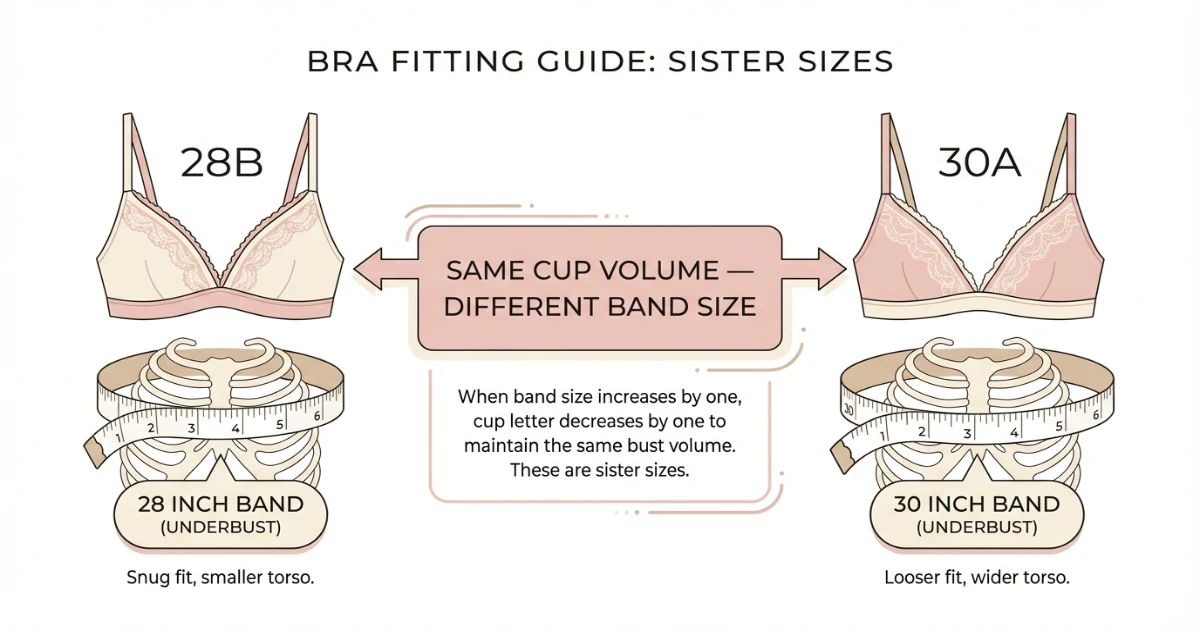
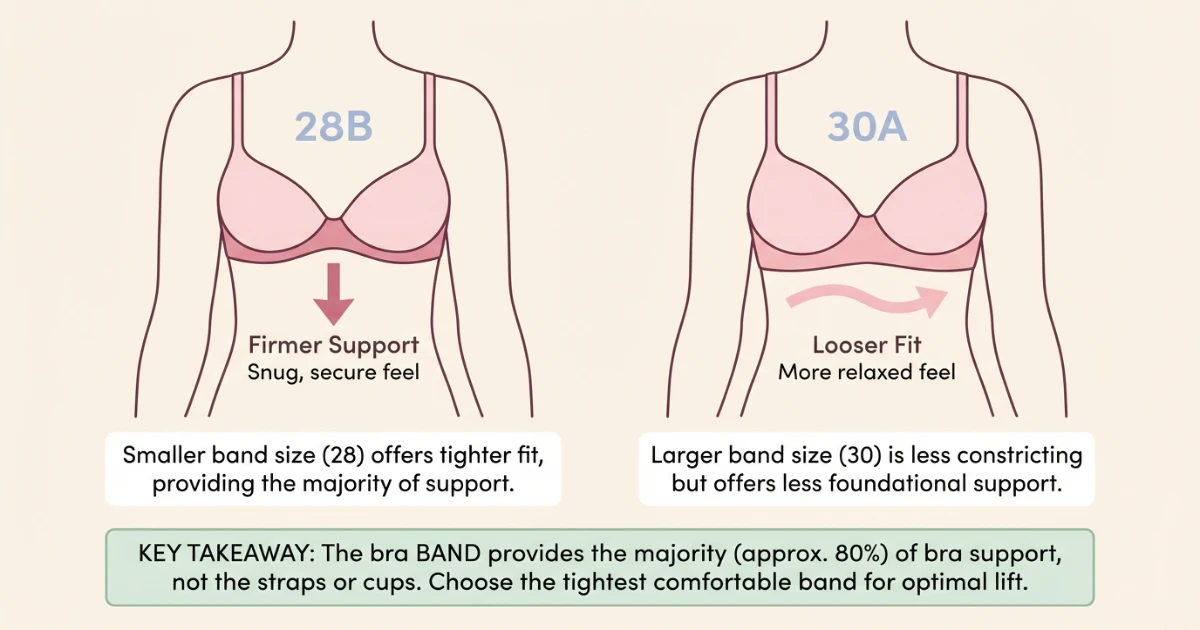
Yes — 28B and 30A are sister sizes. They share almost identical cup volume, meaning the actual space inside the cup is nearly the same. The key difference is the band: a 28B wraps around a 28-inch underbust and offers a firmer, more supportive fit, while a 30A fits a 30-inch underbust and feels noticeably looser. If one doesn’t fit well, switching to the other is a smart first move.
Key Takeaways
- 28B and 30A are sister sizes — the cup volume is approximately equal.
- The band in a 28B is two inches smaller than in a 30A, making it noticeably tighter.
- A 30A will feel looser around the ribcage; a 28B will feel snugger and more supportive.
- Neither size is “bigger” — they simply sit on different parts of the sister size ladder.
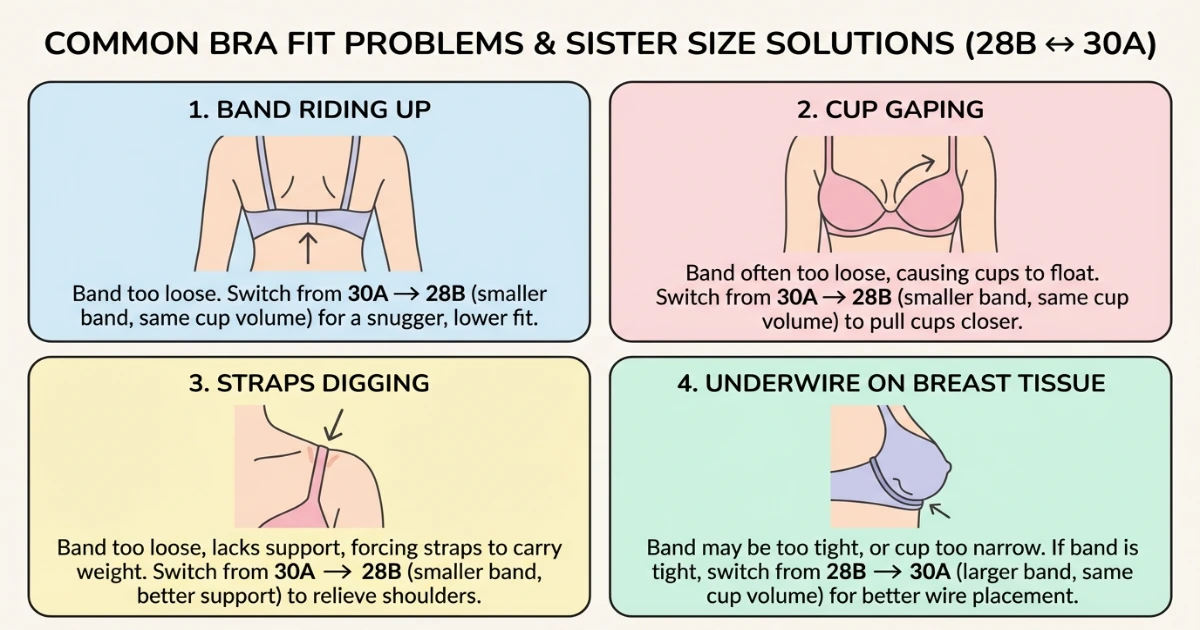
- If your 30A band slips up your back, trying a 28B is the logical next step.
- If your 28B band leaves red marks or feels suffocating, a 30A is worth a try.
- Most mainstream stores don’t stock 28-band bras — but specialist brands like Ewa Michalak, Comexim, and some ASOS own-brand lines do carry them.
What Are Sister Sizes?
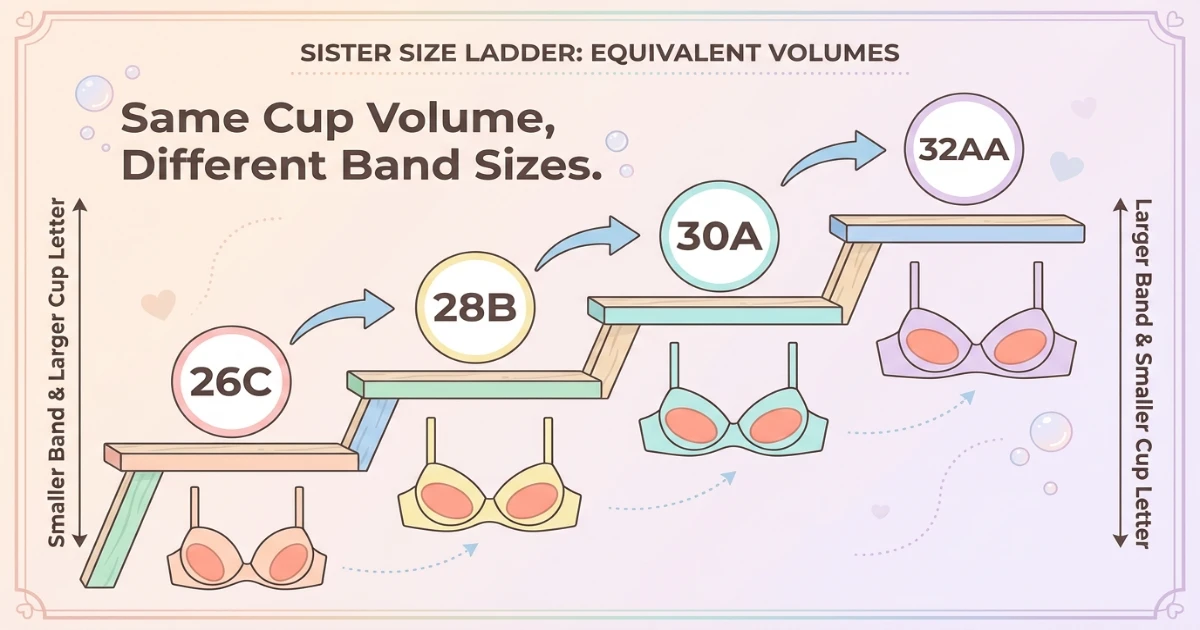
Sister sizing is one of the most genuinely useful concepts in bra fitting — and also one of the most misunderstood. Here’s the simple version: when you go up one band size, the cup letter drops by one. When you go down one band size, the cup letter goes up by one. Throughout that shift, the volume inside the cup stays essentially the same.
So a 28B, a 30A, a 26C, and a 32AA all hold roughly the same amount of breast tissue. What changes is where the band sits and how tightly it holds. A smaller band means more of the support comes from the band itself (which is ideal — the band should do the heavy lifting in any well-fitted bra). A larger band offloads some of that support onto the straps, which can cause them to dig in.
Many women discover sister sizing by accident — they try on a size they’d never have picked themselves and find it fits beautifully. It’s especially useful when you’re between sizes or when a particular style doesn’t come in your exact measurement. Learn more about how sister sizing works in full on our sister sizes guide.
Measurement Breakdown: 28B vs 30A
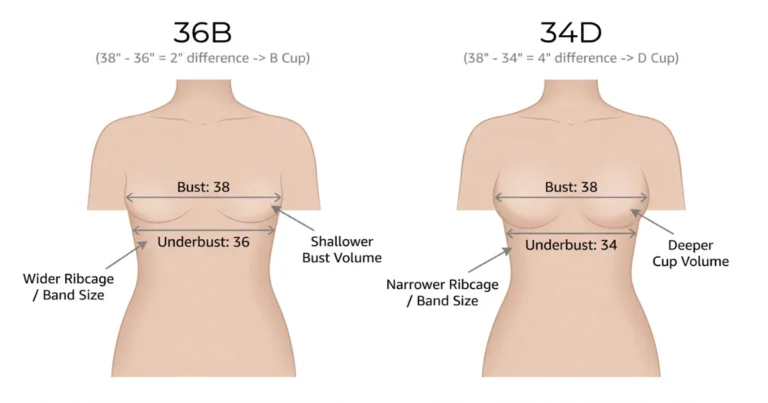
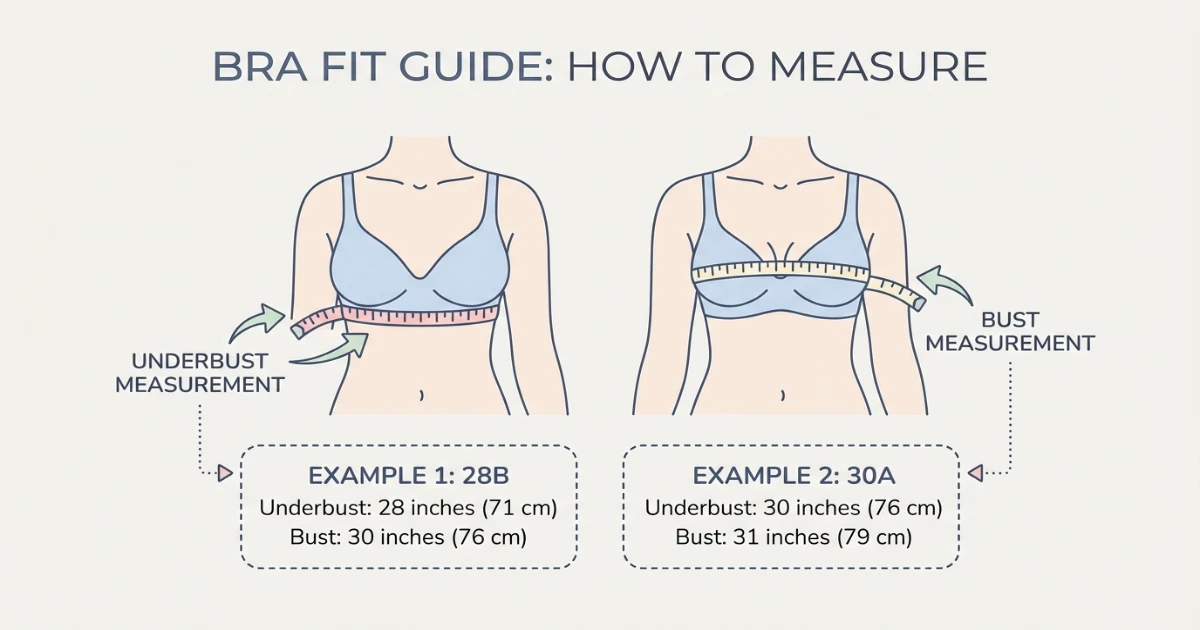
Let’s get specific. Bra sizes are based on two measurements: the underbust (the circumference of your ribcage just below your breasts) and the bust (the fullest part of your chest). The difference between those two numbers is what determines your cup size — roughly one inch of difference per cup letter in US sizing.
28B
Underbust: ~28 in / ~71 cm
Bust: ~30 in / ~76 cm
Difference: ~2 in / ~5 cm
Cup volume: B cup on a 28 band
30A
Underbust: ~30 in / ~76 cm
Bust: ~31 in / ~79 cm
Difference: ~1 in / ~2.5 cm
Cup volume: A cup on a 30 band
Notice that even though the underbust measurements differ by two full inches, the bust measurements are much closer together. That’s what makes these two sizes sister sizes — the cup shape adjusts to accommodate the wider band, but the total volume remains nearly equivalent.
It’s worth noting that sizing standards aren’t perfectly uniform across brands. A 28B in a UK brand like Freya may have slightly different cup depth than a 28B from a US brand. Want to make sure you’re measuring yourself correctly? Use our step-by-step bra measurement guide for accurate results.
Band Size Difference — Why It Matters More Than You Think
This is the part that surprises most people: the band does somewhere between 70–80% of the work in a well-fitted bra. The straps merely keep things in place. So when the band isn’t doing its job — because it’s too loose, too stretchy, or the wrong size — you feel it everywhere: straps that dig, cups that gap, and a bra that rides up at the back.
Why a 28 Band Feels So Much Tighter
A brand-new bra band should feel snug on the loosest hook — firm enough that you can only slide two fingers underneath it comfortably. A 28 band starts with 28 inches of circumference, which means it has considerably less stretch to give than a 30-band bra. For someone with a naturally slim ribcage, that firmness feels like proper support. For someone whose underbust is closer to 30 inches, wearing a 28 band will feel uncomfortably tight and may leave red marks after a few hours.
How Band Elasticity Works Over Time
All bra bands stretch out with wear and washing. That’s precisely why bras come with multiple hook positions — you start on the loosest hook and move inward as the band loosens over weeks and months. A 28B that fits on the loosest hook today might need the middle hook in three months. Once you’re on the tightest hook and the band still feels loose, it’s time for a new bra.
If your bra band is riding up at the back, that’s a near-certain sign the band is too large — or has stretched beyond its useful life. Our guide to why bra bands ride up goes through the most common causes and fixes in detail.
Cup Volume: Why They’re So Similar
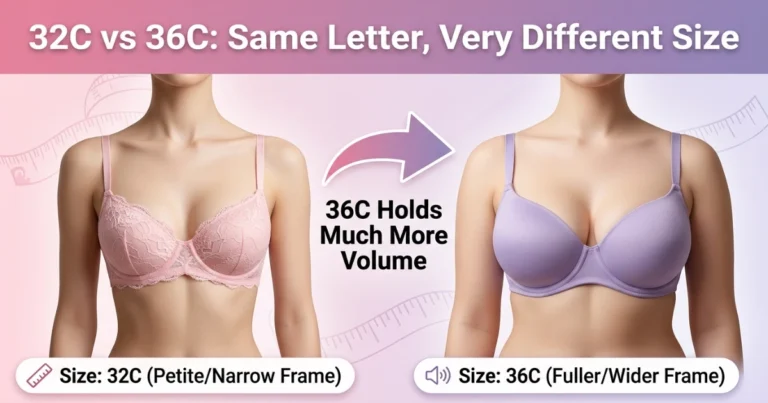
Cup size is relative — not absolute. A “B cup” doesn’t refer to a fixed volume; it refers to a difference of roughly two inches between your underbust and your bust measurement. That means the actual fabric and space inside a B cup on a 28 band is proportionally smaller than a B cup on a 36 band.
When you move from a 30A to a 28B, the cup letter goes up (A to B) but the band goes down (30 to 28). These two changes cancel each other out, leaving you with practically the same internal cup volume. The cup shape may look slightly different on the bra itself — a 28B cup will appear taller and narrower on the underwire — but the amount of breast tissue it’s designed to hold is effectively the same.
This is exactly why sister sizing works as a practical fit strategy rather than a rough approximation. If you’re experiencing gaping cups in a 30A but your band feels right, try going down a cup to see if that helps — or if the band is the real issue. Take a look at our cup size visuals page for a side-by-side comparison of how cup sizes look across band sizes.
Fit Differences You May Notice When Switching
Switching between sister sizes isn’t always perfectly seamless. Because the band and cup dimensions have changed in opposite directions, you may notice some real-world differences when you put the bra on.
Band Tightness and Support
The most obvious difference is how the band grips your ribcage. A 28B will hold you more firmly and stay parallel to the ground even without the straps adjusted. A 30A may feel immediately more comfortable around the torso but could migrate upward at the back, especially during active movement.
Strap Tension
In a 30A, there’s a tendency to overtighten the straps to compensate for a band that isn’t quite doing its job — which leads to shoulder grooves and upper back tension. In a 28B, you often find you can loosen the straps considerably without losing lift or shape.
Breast Coverage and Cup Behavior
The cups in a 28B sit closer to the center of your chest and often have a slightly different underwire shape. If you have narrower-set breasts, a 28B may actually give you a more flattering shape. If you’ve been wearing 30A and found the cups gaping at the top, a 28B’s proportionally deeper cup might eliminate that problem entirely.
For a full rundown of common bra fit issues and how to diagnose them, our bra fit problems guide is a great starting point.
Who Should Choose 28B?
The 28B is likely your better fit if:
- Your actual underbust measurement is right around 28 inches (ideally between 27.5 and 28.5 inches).
- Your 30A band slips upward throughout the day, no matter how you adjust the straps.
- You feel like your bra provides almost no support from the band, with most of the work falling to your straps.
- You have a naturally petite or slim ribcage and find that most standard-size bras are simply too large in the band.
- You want firmer, more athletic-style support — for example during exercise or long days on your feet.
One important caveat: 28-band bras are genuinely hard to find in physical stores. Most major retailers start at 32 or even 34. You’ll have the best luck shopping online with specialist brands. Once you know your correct size, use our how to know if your bra fits guide to verify the fit on arrival before removing the tags.
Who Should Choose 30A?
The 30A is probably a better starting point if:
- Your underbust measures closer to 29–30.5 inches.
- A 28B leaves red marks, feels suffocating, or is visibly too tight even on the loosest hook.
- You tend to run warm or find band compression uncomfortable for extended wear.
- You’re newer to bra fitting and prefer to start with a more accessible size while you dial in your preferences.
- You’ve tried a 28B and found the underwire shape doesn’t suit your breast placement.
30A is considerably easier to find across mainstream and specialty retailers. If you want to explore all your options in one place, our bra size charts page shows equivalent sizes across different brand sizing systems.
The Sister Size Ladder for 28B / 30A
Here’s where 28B and 30A sit within the full sister size family. Every size on this ladder holds approximately the same cup volume — only the band changes.
Moving left (down the band, up the cup letter) gives you a firmer grip. Moving right (up the band, down the cup letter) gives you more band ease. There’s no “better” position on the ladder — it entirely depends on your actual ribcage measurement and personal comfort preference.
Want to map out your full sister size range instantly? Our sister size bra calculator generates your complete ladder in seconds.
Quick Bra Fit Test: Is Your Band the Right Size?
Before you order a new size, run through this fast check with the bra you’re currently wearing:
- Two-finger test: Slide two fingers under the band at the back. Snug but manageable = good. Fingers slide in easily with room to spare = band is too large. Can’t get fingers in = band is too small.
- Lift test: Without touching the straps, try to lift the back of the band away from your body. It should only move about an inch. More than that, and the band is too loose.
- Strap check: Are your straps doing all the work? If removing them would make the bra fall off, your band is too large.
- Check the center gore: The little piece of fabric between the cups (the gore or bridge) should sit flat against your sternum. If it floats away from your chest, the cups are too small — try a larger cup or a sister size with a smaller band.
- Look at the underwire: It should frame your breast tissue completely, not sit on it. Any part of the wire resting on breast tissue means the cup is too small or the shape doesn’t match your breast root.
Still unsure which size is right for you? Our AI-powered calculator takes the guesswork out of sister sizing entirely.
Use the AI-Powered Bra Calculator →28B vs 30A: Full Comparison Table
| Feature | 28B | 30A |
|---|---|---|
| Band tightness | Firm — snug grip around ribcage | Relaxed — more ease around torso |
| Cup volume | ~Equal to 30A | ~Equal to 28B |
| Support level | High — band does most of the work | Moderate — straps carry more load |
| Comfort (tight ribcage) | Excellent | May feel too loose / unsupportive |
| Comfort (larger ribcage) | May feel too tight / leave marks | Comfortable, natural fit |
| Spillage risk | Low (deeper cup on narrower band) | Low (similar volume, wider base) |
| Gaping risk | Low if band fits correctly | Moderate if band is too large for ribcage |
| Best underbust size | ~27.5–28.5 inches / 70–72 cm | ~29–30.5 inches / 74–77 cm |
| Availability | Specialist brands / online only | Widely available in most stores |
People Also Ask
Related Bra Size Comparisons
Sizing note: Bra sizing is not standardized across brands. A 28B from one brand may fit differently from a 28B in another due to differences in band elasticity, underwire width, cup depth, and fabric. The measurements and comparisons in this article are based on average US and UK sizing conventions and are intended as a general guide. Always check individual brand size charts and, where possible, try before you buy.