34C vs 34D: What’s the Real Difference in Cup Size?
Updated for 2026
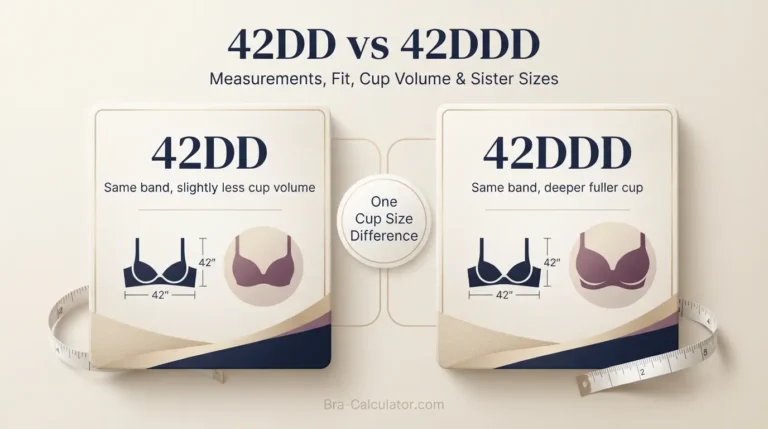
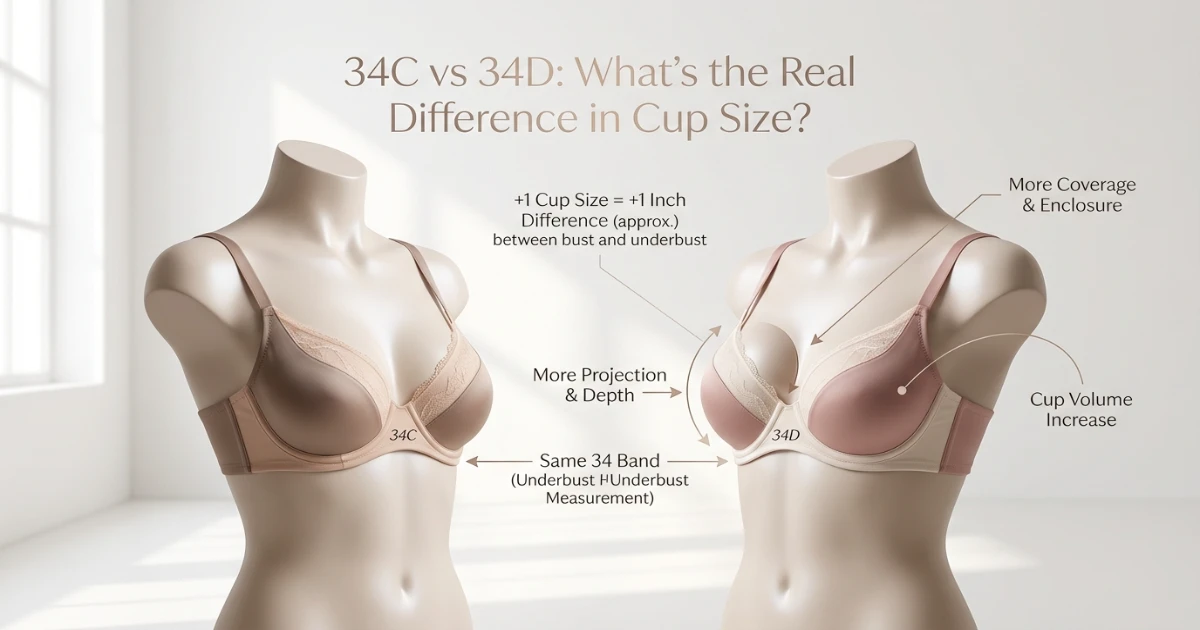
A 34D holds roughly one inch more breast tissue than a 34C, measured by the difference between your bust and underbust. If your 34C cups spill over, cut in at the top, or push tissue toward your underarms, your body is likely asking for a 34D. Both sizes share the same band — the only change is how much volume each cup is designed to hold.
If you’ve ever stood in a fitting room holding both sizes wondering “which one is actually right for me?” — you’re not alone. The difference between a C and D cup is one of the most misunderstood steps in bra sizing. Women cycle between these two sizes for years without ever landing on the fit that actually works.
This guide breaks it all down clearly: the volume difference, what each size feels like in real life, fit problems that point you to the right size, and a simple test you can do at home right now. You can also browse our full breast size comparison hub to see how these sizes compare across the entire size spectrum.
Choose the fit signs you notice in the band, cups, center and straps. We’ll turn them into a practical next step for 34C.
Private fit check — your answers stay in your browser and are used only for this on-page guidance. Nothing is stored or submitted.
Key Takeaways
- A 34D cup holds approximately 1 inch (2.5 cm) more volume than a 34C — around 5–8% more tissue coverage.
- Both 34C and 34D use the same band size; the difference is entirely in the cup depth and projection.
- Spillage over the top or sides of a 34C cup is a strong signal to try a 34D.
- A gaping 34D cup — fabric lifting away from your breast — typically means a 34C is a better fit.
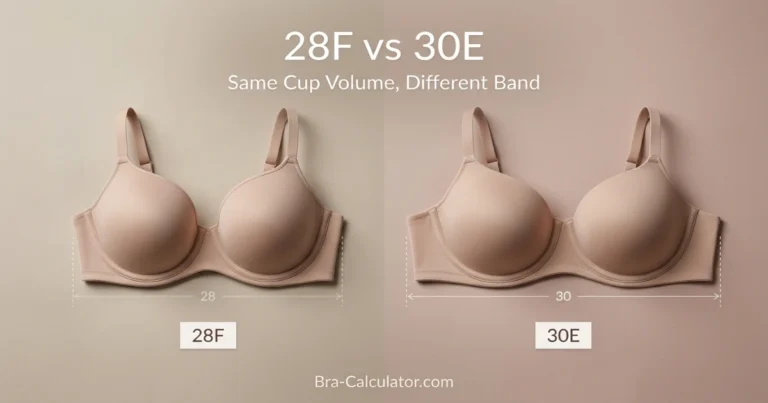
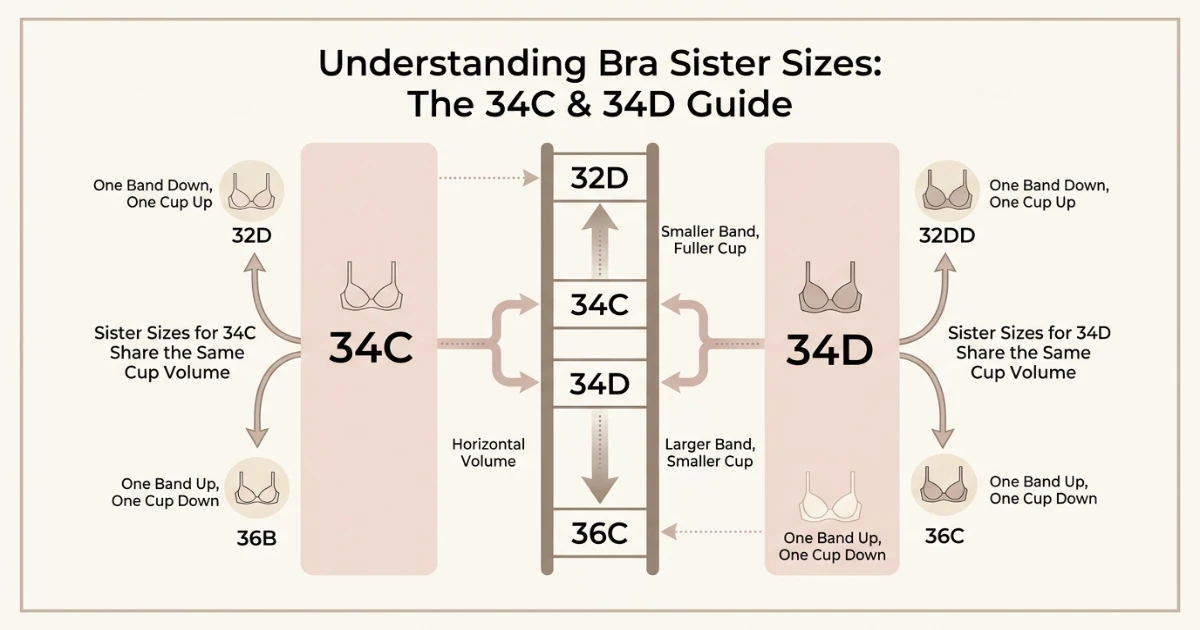
- Sister sizing means a 32D and 36C hold the same cup volume as a 34C; a 32DD and 36D match a 34D.
- Cup shape (balconette, full cup, plunge) affects fit independently of size — the wrong shape can cause fit issues even in the right size.
- Most women benefit from using a bra size calculator to confirm measurements before buying.
Understanding Cup Size Letters
Cup letters — A, B, C, D, DD — don’t represent a fixed volume. They represent a ratio: the difference between your full bust measurement and your underbust (band) measurement. Each letter step equals approximately one inch of difference.
- A cup = 1 inch difference
- B cup = 2 inches difference
- C cup = 3 inches difference
- D cup = 4 inches difference
- DD/E cup = 5 inches difference
This is why a 34C and a 38C look and fit very differently despite sharing a “C” cup letter — the actual tissue held is quite different because the band sizes differ. For a deeper look at how sizes relate across bands, see our sister size chart.
Moving from C to D within the same band size means one additional inch of bust-to-underbust difference. That sounds small — and visually it is subtle — but in terms of fit, it’s the difference between comfortable coverage and constant spillage.
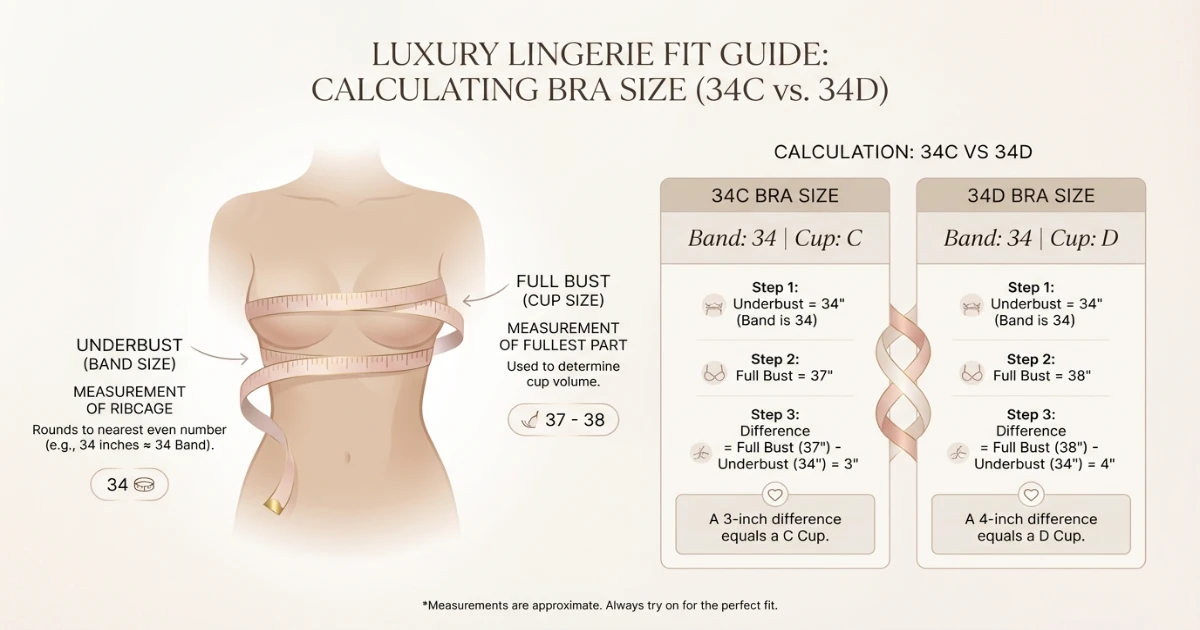
Measurement Breakdown: 34C vs 34D
Both sizes share a 34-inch band, which corresponds to an underbust measurement of roughly 30–32 inches (the band is worn snug). The difference is entirely in the bust measurement:
34C
- Band size: 34 in / 86 cm
- Underbust: ~30–32 in / 76–81 cm
- Full bust: ~37 in / 94 cm
- Cup difference: 3 in / ~7.5 cm
- Cup depth: Moderate
34D
- Band size: 34 in / 86 cm
- Underbust: ~30–32 in / 76–81 cm
- Full bust: ~38 in / 97 cm
- Cup difference: 4 in / ~10 cm
- Cup depth: Deeper projection
Use these numbers as a starting guide. If your measurements fall between sizes, the fit test below will help you decide. You can also use our how to measure bra size guide for step-by-step instructions on getting an accurate reading at home.
Cup Volume Difference: How Much Bigger Is a D Cup?
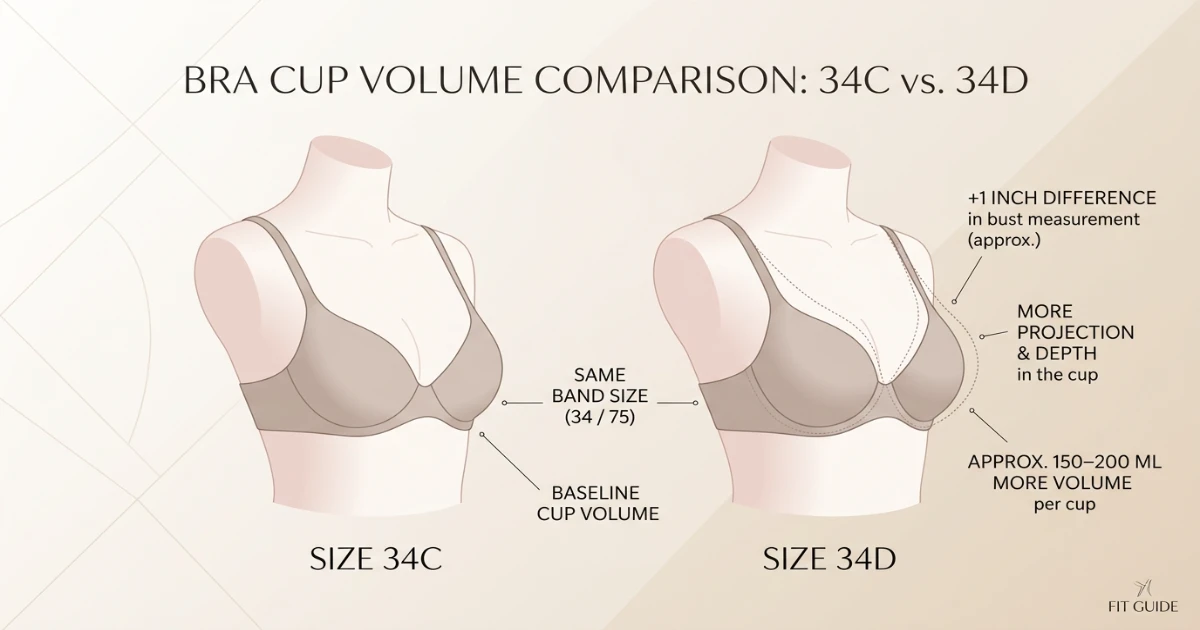
Research and fit experts estimate that each cup size step increases cup volume by roughly 150–200 ml for average band sizes around 34. So a 34D holds approximately 150–200 ml more than a 34C — about the equivalent of a small cup of tea.
That may not sound like much, but the difference in cup depth and projection is what really matters for fit. A D cup is cut deeper from the center outward, which means it projects further from the chest wall. Women with fuller, rounder, or more projected breast shapes often find a D cup simply encloses their tissue better — even if their total measurement sits right on the borderline.
For a detailed side-by-side look at how volume scales across sizes, our cup volume comparison tool lets you visualize exactly how cups relate. You can also use the projection depth analyzer if you know your breast shape projects forward prominently.
💡 Quick visual: Imagine holding a standard measuring cup (250 ml). A 34D holds roughly three-quarters of that extra volume compared to a 34C. For some body types, that inch makes all the difference between a bra that gapes and one that holds everything in place.
Fit Differences You’ll Actually Notice Day-to-Day
Numbers are useful, but fit is something you feel. Here’s what each fit problem is trying to tell you:
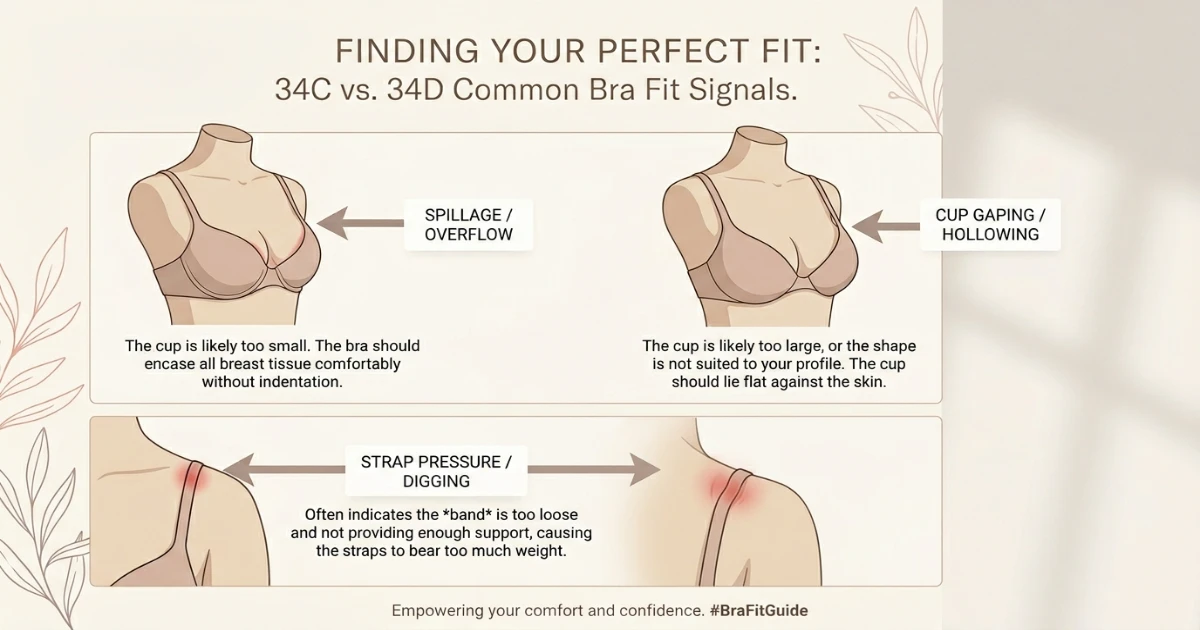
Spillage
If your breast tissue spills over the top wire or pops out of the sides when you lean forward, put on a jacket, or raise your arms — your cup is too small. In a 34C, this typically means you need a 34D. The extra cup depth in the D will contain the tissue that was escaping before.
Cup Gaping
If the top edge of your bra cup pulls away from your skin — you can slip two fingers under it easily — the cup is too large. If this happens in a 34D, try dropping back to a 34C. A gaping cup also tends to cause the bra to ride up at the back, which makes the band feel loose even when it isn’t.
For more detail on diagnosing fit issues like this, visit our bra fit problems guide.
Strap Pressure
Constantly tightening your straps is almost never a cup problem — it’s usually a band problem. But if you wear a 34C and your straps dig in and leave marks, it may mean the cups aren’t supporting from below, so your straps are compensating. Moving to a 34D with a deeper cup can redistribute load back to the band and underwire where it belongs.
Side Tissue Migration
Breast tissue that drifts toward your underarm or back is classic cup-too-small behavior. A C cup that doesn’t scoop in from the sides is allowing tissue to wander. A D cup with a wider underwire frame can address this, especially in full-coverage styles.
Who Should Choose 34C?
A 34C is typically the better fit when:
- Your bust measurement is consistently around 37 inches (94 cm) across multiple measurements.
- Your breasts sit relatively close together on the chest (narrow root width).
- You have less projection — your breasts are fuller at the base but don’t project far forward.
- A 34D consistently gapes at the top, even in soft-cup or balconette styles.
- You’re petite in frame and find D-cup bras visually or structurally overwhelming.
- You’re shopping for a strapless style — see our strapless bra sizing guide for how cup size affects strapless support specifically.
Who Should Choose 34D?
A 34D is likely the better fit when:
- Your bust measurement is consistently around 38 inches (97 cm).
- Your 34C cups overflow at the top or create a “double bubble” effect (tissue spilling over the cup edge).
- You have rounder, fuller, or more projected breasts that need deeper cup depth to sit properly.
- Your underwire sits on breast tissue rather than on your chest wall in a 34C.
- The center gore (the part between the cups) floats away from your sternum instead of lying flat.
- You find yourself adjusting and scooping your breast tissue back into the cup throughout the day.
📌 Reminder: If your underbust is snug but your cups are spilling, don’t just tighten the band — size up in the cup first. A cup that’s too small will never feel right no matter how you adjust the rest of the bra.
Simple At-Home Fit Test
Try this quick checklist in your current bra before buying a new size:
- Band check: With straps loose, slide two fingers under the back band. It should feel snug but not painful. If it rides up your back, the band is too loose.
- Cup check — top edge: Look in a mirror. Does the top of the cup lie flat against your breast or does it gap away? Gaping = cup too big. Bulging tissue = cup too small.
- Cup check — side seam: Run your finger along the side seam of each cup. Is all your tissue inside? If any pushes to the side or under the armpit, the cup is too small.
- Gore check: Press the center panel between the cups against your sternum. Does it lie flat? If it lifts, the cups are likely too small for your tissue.
- Lean forward test: Bend forward 45 degrees. Does your breast tissue stay inside the cup, or does it pour out? Spillage here confirms cup is too small.
- Strap check: Loosen straps slightly. Does the bra still stay in place? If everything falls apart without tight straps, your band or cup isn’t doing its job.
- Movement check: Raise both arms overhead. Does the bra band ride up toward your shoulders? If yes, the band is too loose — try a firmer band before changing cup size.
Still unsure? Run your measurements through our bra size calculator for a more precise recommendation.
Common Fit Mistakes That Keep You in the Wrong Size
Choosing the Cup Too Small
This is the most common mistake. Most women underestimate their cup size because larger cups carry cultural weight they don’t want associated with their bodies. Functionally, though, a cup that’s too small causes spillage, poor shape, and back pain from redistributed weight. Go up one cup before assuming the fit won’t work.
Tightening Straps to Fix a Band Problem
Straps should only carry about 10% of your bra’s support. If you’re relying on them to stop the bra from sagging, something else is wrong — usually the band. Tightening straps until they dig grooves into your shoulders is both uncomfortable and ineffective.
Wearing the Wrong Cup Shape for Your Breast Shape
A plunge bra in a D cup will gap on someone with wide-set breasts. A balconette may cause spillage on someone with high, projected tissue even if the cup letter is technically right. Cup shape matters as much as cup size. Learn how shape affects your options in our compare bra sizes resource.
Ignoring Sister Sizes When a Size Doesn’t Feel Right
If 34D feels too big in cup but tight in band, try 36C instead of giving up on D cups entirely. If 34C feels fine in cup but loose in band, try 32D. Sister sizing is one of the most powerful and underused fit tools in bra shopping.
Sister Sizes to Try
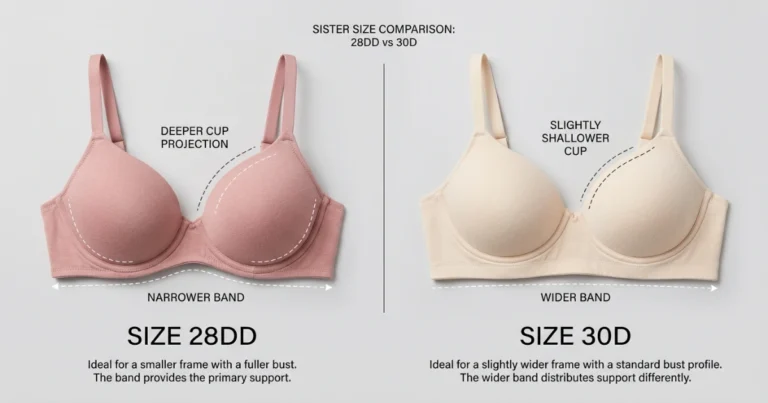
Sister sizes share the same cup volume but use different band sizes. Going up one band size means going down one cup letter to maintain the same total volume — and vice versa.
Same volume as 34C. Smaller, tighter band.
Standard reference size for this family.
One cup up from 34C. Same band, more cup depth.
Same volume as 34D. Larger, looser band.
Practical tip: If you’re between a C and D in a 34 band, try 36C if your band feels fine but the cup overflows, or try 32D if your band feels loose but your cups are correct. Full sister size relationships are mapped out in our sister size chart.
34C vs 34D: Quick Comparison Table
| Feature | 34C | 34D |
|---|---|---|
| Cup volume | Moderate (~3 in difference from underbust) | Larger (~4 in difference from underbust) |
| Cup depth / projection | Shallower profile | Deeper projection from chest wall |
| Breast coverage | Good for smaller, lower-projection shapes | Better for rounder, fuller, more projected shapes |
| Support level | Adequate for C-volume tissue | Better support for larger tissue volume |
| Risk of spillage | Higher if bust ≥ 38 in / 97 cm | Lower — designed for that volume |
| Risk of gaping | Lower in most styles | May gap on shallow or widely-spaced breasts |
| Sister size equivalent | 32D · 36B | 32DD · 36C |
| Best body types | Narrow root width, less projection, smaller frame | Round shape, forward projection, fuller upper pole |
Frequently Asked Questions
Is 34D bigger than 34C?
Yes. A 34D cup holds more volume than a 34C. The D cup is designed for a bust-to-underbust difference of 4 inches, while the C cup is built for a 3-inch difference. Both use the same 34-inch band — the cup depth is what changes.
How much bigger is a D cup than a C cup?
In a 34-band size, a D cup holds approximately 150–200 ml more than a C cup. Visually, the D cup projects further from the chest and offers wider coverage across the breast. The difference corresponds to roughly one inch of additional bust measurement.
Should I size up to 34D if my 34C bra spills over?
Yes — spillage over the top or sides of the cup is the clearest signal to go up a cup size. Try a 34D and make sure the underwire sits flat on your chest wall, not on breast tissue. If the D cup gaps instead, your issue may be cup shape rather than letter size.
Why does my 34C feel tight even though I measured correctly?
Measurement guidelines give a starting point — they don’t account for breast shape, density, or projection. If your bust measurement sits right at the borderline between C and D, rounder or denser tissue often needs the extra depth of a D cup even when the tape measure says C. Also check whether the band is the issue: if the band digs in, try 36C instead.
What sister sizes work for 34D?
The sister sizes that carry the same cup volume as a 34D are 32DD (smaller, tighter band) and 36C (larger, looser band). If a 34D fits your cup well but the band feels slightly off, these sister sizes are your first options to try.
Can I wear a 34C and 34D depending on the brand?
Absolutely. Bra sizing is not standardized across manufacturers. A 34C from one brand may fit identically to a 34D from another. Always try before you buy, or check brand-specific fit notes. When in doubt, use our bra size calculator as a neutral starting point.
Is a 34D considered a large bra size?
No. A 34D falls squarely within mainstream sizing and is stocked by nearly every major retailer. It sits in the middle of the size spectrum — not at either extreme. Many women discover they’re a D cup or above after a proper fitting, having worn a smaller size for years.
Conclusion: Trust the Fit, Not the Label
The difference between a 34C and a 34D comes down to one inch of bust measurement and roughly 150–200 ml of cup volume — but in practice, that inch determines whether you spend the day comfortable or constantly adjusting. Spillage, a floating center gore, or tissue migrating to your underarms are your body’s way of asking for more cup depth.
Rather than guessing, measure yourself properly, run a quick at-home fit test, and try both sizes if you can. Don’t forget that sister sizes like 32D and 36C give you alternative band options if the 34 band itself isn’t quite right.
Ready to find your exact size? Use our bra size calculator, explore the full bra size comparison guide, or check how your size relates to others in our cup volume comparison tool. The right fit exists — it just needs to be found.