We built the fitting room we couldn’t find on the high street
Bra Calculator is an independent bra-fitting resource. We turn two tape-measure numbers into a size that actually holds, explain the reasoning behind it, and tell you when the number on the label is the wrong thing to chase.

Size calculations run since launch
Sizing systems supported: US, UK, EU, FR, IT, AU, JP
Fit guides, size charts and conversion tables
Cost to use — no signup, no email wall
Three shops, three sizes, one very bad afternoon
I spent fifteen years buying lingerie for retailers before I started this site, which makes the following slightly embarrassing: for most of my twenties I wore the wrong size. Not slightly wrong. Two band sizes and three cups wrong.
What finally broke it was an afternoon of being measured in three different shops on the same street. I walked out with three different sizes, three confident fitters, and zero explanation of how any of them got there. One used a tape over a jumper. One added four inches to my ribcage because a chart from the 1950s said so. One never measured me at all — she looked, guessed, and was closer than the other two.
The problem was never that women can’t measure. It’s that nobody shows their working.
So we built the thing I wanted that afternoon: a calculator that gives you a size and the arithmetic behind it, plus the sister sizes to try when that first number is close but not quite there. No jumper. No mystery four inches. No upsell.
Bra Calculator has stayed independent and free since. There’s no login, no email gate, and no version of this site where your measurements get sold to anyone.
How the calculator actually reaches a size
Most sizing tools are a black box. Here is ours, opened up. If you disagree with a step, you can see exactly which one and adjust.
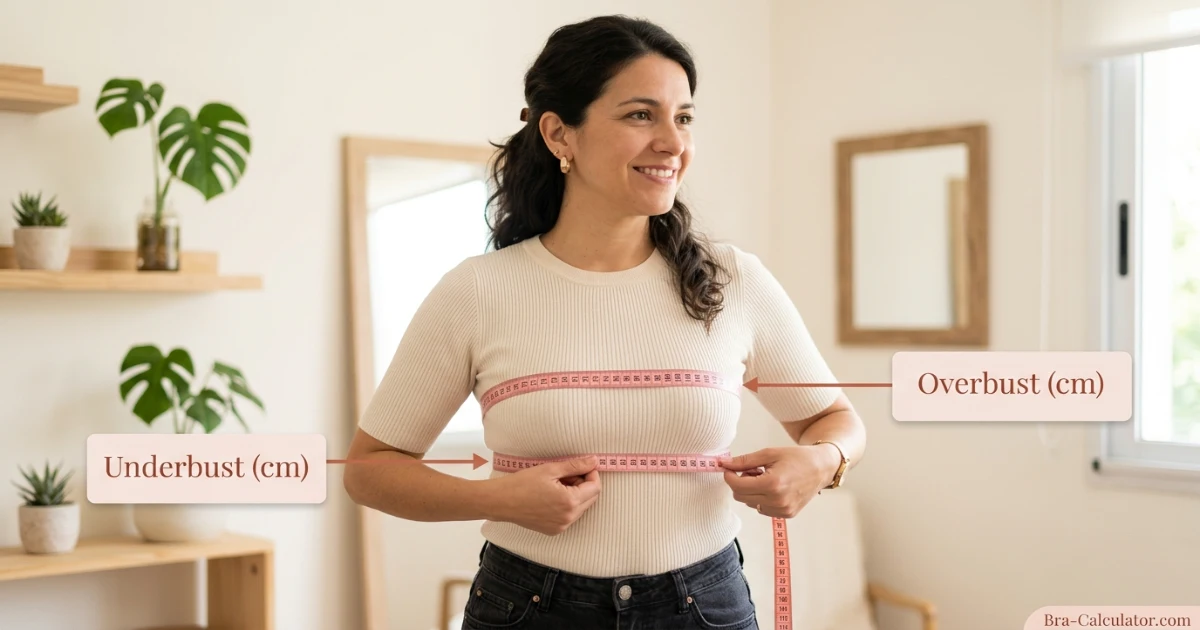
Band from the ribcage, snug, nothing added
We take your underbust measurement as your band size and round to the nearest even number. We do not add four or five inches. That addition was a workaround for rigid 1950s fabrics and it is the single most common reason a band rides up your back.
Cup from the difference, not the bust
Cup size is the gap between your bust and band measurement — roughly one inch per cup letter on the US scale, one for UK. A cup letter is a ratio, never a fixed volume, which is why a 30D and a 38D are nothing alike.
Sister sizes as a range, not a single answer
Every result comes with its sister sizes — same cup volume, different band. Go down a band, go up a cup. It’s the fastest fix when a style runs tight, or when your size has sold out everywhere except one listing.
Conversion across seven sizing systems
US, UK, EU, French, Italian, Australian and Japanese systems diverge above a D cup, and they diverge differently. We map your result across all seven rather than assuming a straight letter swap, because a UK DD is not a US DD — and Italian sizing doesn’t use letters at all.
Shape and style, layered on top
Two people at the same size need different bras. Root position, fullness and projection change which cut works — so our guides pair the number with the fit checks that tell you whether it’s right on your body.
Re-check at life’s inflection points
Size is not permanent. Weight shifts, hormonal cycles, pregnancy and postpartum, and perimenopause all move the numbers. We treat re-measuring as routine maintenance, not failure.
What a calculator can’t do for you
Any site that tells you a tape measure solves fit is selling something. Here’s where ours stops.
- It gives you a starting size, not a final one. Treat the result as the first bra you try on, then use the five-point fit check to judge it. The mirror outranks the maths.
- Brands are not standardised. A 34DD is cut differently by every label, and by every style within a label. Expect to sit across two or three sizes in your wardrobe. That’s normal, not a measuring error.
- Soft or squishy tissue skews the numbers. If your bust measurement changes by more than an inch depending on posture, the calculation will read low. Our guides cover the lean-forward method for exactly this.
- We can’t assess a medical concern. Pain, marked asymmetry, post-surgical fitting or lymphoedema garments need a clinician or a specialist fitter — not a web tool.
- Nursing and post-surgery sizing move fast. During those months, measure more often and buy fewer bras at a time. We’d rather you bought three than thirty.
How our content gets written, checked and corrected
Who writes it
Every guide is written or edited by someone with hands-on fitting or garment-industry experience. Articles carry a named byline linking to that person’s credentials. We do not publish anonymous fit advice.
How it’s sourced
Sizing claims are checked against published brand size charts and current garment-industry standards. Where sources disagree — and on cup grading above a D, they routinely do — we say so in the article rather than picking one silently.
How often it’s reviewed
Size charts and conversion tables are re-checked against brand data on a rolling schedule. Every page shows the date it was last reviewed, not just the date it was first published.
Corrections
If we get something wrong, we fix the page and note what changed. Found an error or an out-of-date chart? Tell us and we’ll check it.
What we never do
We don’t accept payment for a recommendation, don’t publish sponsored guides dressed as editorial, and don’t store or sell the measurements you enter into the calculator.
Who’s behind the numbers
A small team. Retail fitting experience on one side, sizing data on the other.
Amelia
Founder & Editor
Fifteen years buying lingerie for retail before starting this site. Sets the editorial standards above, writes the fit guides, and answers most of the email that comes in.

Michael Chen
Head of Technology
Builds and maintains the sizing engine and the conversion logic behind our international size charts. Responsible for making sure a UK 32E converts to the right thing everywhere else.
Emma Rodriguez
Fit Specialist
Works on the hard cases: shallow and full-on-bottom shapes, extreme band-to-cup ratios, and the sizes most high-street shops simply don’t stock.
From a spreadsheet to a sizing engine
A spreadsheet, then a calculator
The first version was a spreadsheet Amelia used to explain sister sizes to friends. Michael turned it into a web tool that didn’t require anyone to understand the formula.
Conversion tables added
Readers kept asking the same question — what’s my size on a European site? — so we mapped the UK, EU, French and Australian systems properly instead of assuming letters matched.
Fitting rooms closed
With in-person fittings unavailable, traffic changed shape overnight: fewer casual lookups, far more people trying to solve a real fit problem alone at home. We rewrote the guides for that reader.
The +4 method dropped
Our biggest change to date. We removed the legacy band addition from the calculator and rebuilt cup grading around measured difference alone. It shifted results for a lot of readers — and stopped a lot of bands riding up.
Life-stage guides
Dedicated coverage for pregnancy, nursing and postpartum sizing, where the standard advice fails hardest and changes fastest.
Where we are now
Expanding brand-specific fit notes, because the gap between a calculated size and a specific label’s cut is the last unsolved part of this problem.
What people write in to tell us
I’d been wearing a 36B for a decade because that’s what I was measured at once, aged nineteen. Turns out I’m a 32DD. The band explanation was the bit that made it click.
Jessica M. — first-time user
Ordering from European brands used to be a coin flip. The conversion chart is the only one I’ve found that doesn’t just swap the letters and hope.
Sophia L. — reader, two years
Sister sizing changed how I shop. When my size sells out I now know exactly which two to check instead of giving up on the listing.
Maya R. — fitness instructor
How Bra Calculator makes money
The calculator and every guide on this site are free, and always will be. We earn through affiliate commission: when you buy a bra through some of our links, the retailer pays us a small percentage. It costs you nothing extra.
Three rules we hold ourselves to. We never recommend a bra we wouldn’t put a reader in. Commission rate never decides ranking or placement — fit and availability in your size do. And no brand can pay to appear in a guide, or pay to be removed from one.
As an Amazon Associate we earn from qualifying purchases. If a recommendation ever reads like an advert to you, say so — that’s a failure on our side and we’ll fix it.
About us, answered
Who is behind Bra Calculator?
Bra Calculator was founded in 2018 by Amelia, a former lingerie buyer with fifteen years of retail and fitting experience. She works with a small team covering the sizing engine and specialist fit cases. Every guide carries a named byline, and the site is independently owned.
Is the Bra Calculator sizing method accurate?
Our calculator uses the measured-difference method: band taken directly from the ribcage with nothing added, cup derived from the bust-to-band gap. It produces a reliable starting size for most people, but brand cut varies, so treat the result as the first bra to try rather than a final verdict.
Why doesn’t Bra Calculator add inches to the band measurement?
The “+4 inches” rule dates from an era of rigid, non-stretch fabrics and inflates band sizes with modern elastics. Adding inches is the most common cause of a band riding up the back and straps carrying the weight. We removed it from our calculator in 2022.
Does Bra Calculator store the measurements I enter?
No. The calculator runs your measurements to produce a size and we do not store, sell or share them. There’s no account to create and no email required to see your result.
How does Bra Calculator make money if the tools are free?
Through affiliate commission on some retailer links, at no extra cost to you. Brands cannot pay for placement, coverage or a higher ranking in our guides. Recommendations are based on fit and size availability only.
How do I report an error or contact the team?
Use our contact page. We read everything, and if you’ve spotted an out-of-date size chart or a factual error we’ll correct the page and note the change.
Ready to find a size that actually holds?
Two measurements, sixty seconds, and the reasoning shown at every step. Free, no signup.