38G vs 40F: Sister Size or Not? US vs UK Fit Guide
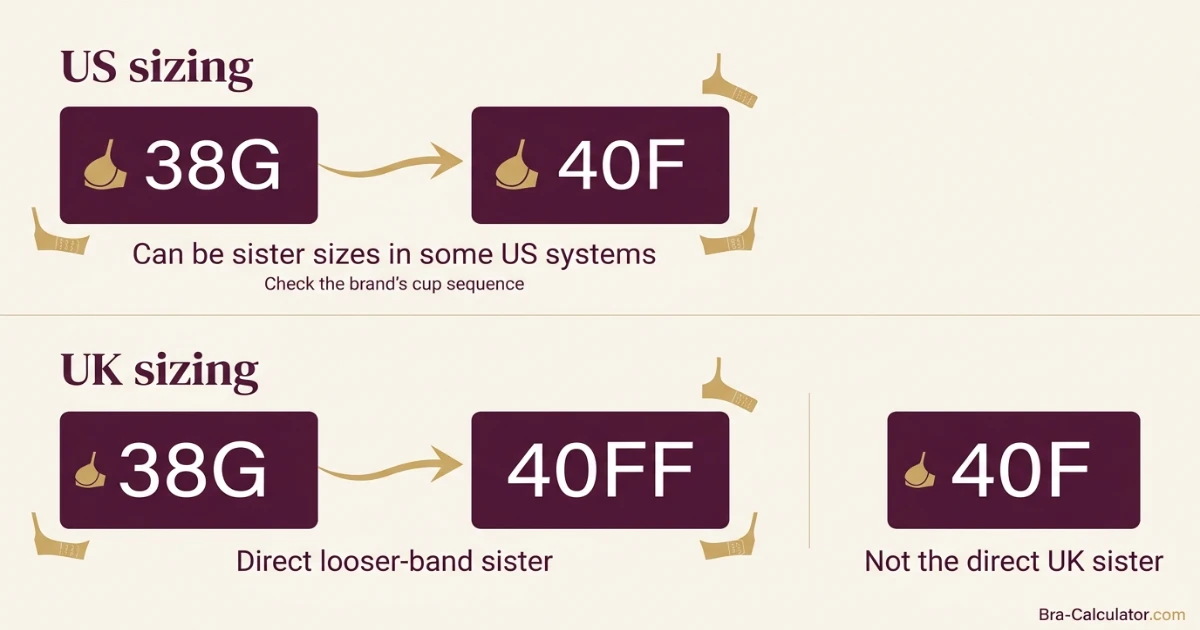
These can behave like sister sizes in some US charts, but not in UK sizing. Check the cup sequence before you trade a 38 band for a 40.

Choose the fit signs you notice in the band, cups, center and straps. We’ll turn them into a practical next step for 38G.
Private fit check — your answers stay in your browser and are used only for this on-page guidance. Nothing is stored or submitted.
38G vs 40F: the practical difference
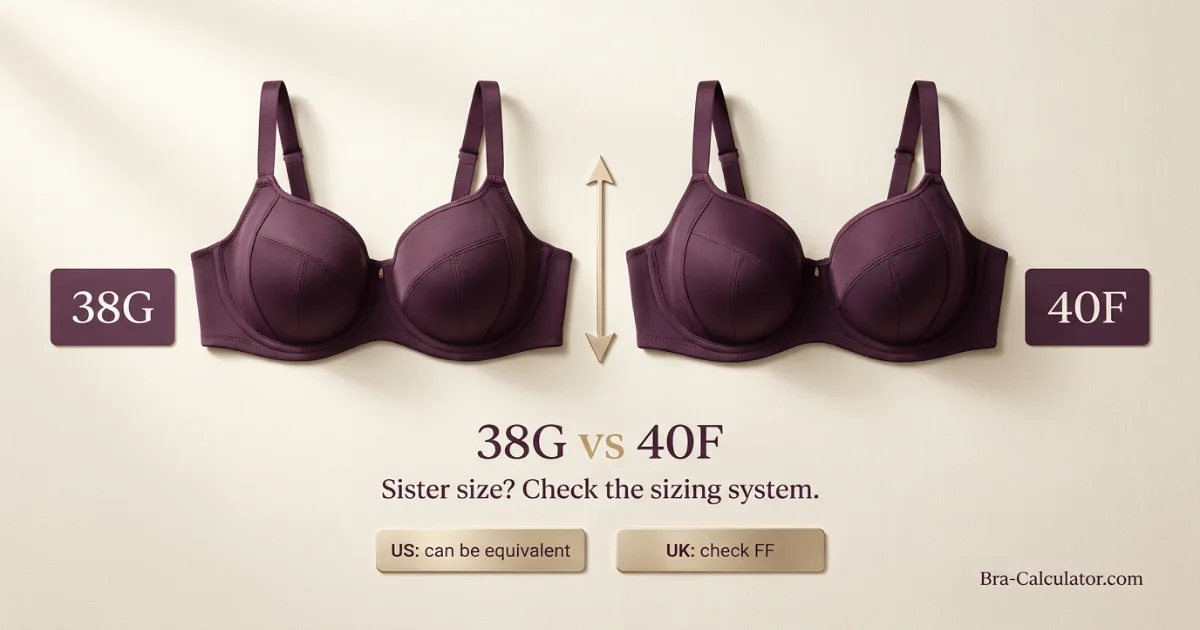
In many US systems where F represents DDD and G is the next cup, 38G can sister to 40F. In UK sizing, however, 38G usually sisters to 40FF, not 40F. Choose 38G when you need firmer band support; consider 40F only when the 38 band is truly too tight and the brand chart confirms equivalent cup capacity.
Which Should You Choose: 38G or 40F?
38G is the more anchored option. If the 40 band drifts upward, the gore moves away from the sternum during the day, or the straps need constant tightening, the 38 band is doing a better job of holding the cup in place.
40F is useful when the 38 band passes the cup test but fails the comfort test. It can relieve ribcage pressure, yet it should not create new cup overflow through a label mismatch. Verify the cup position in the exact chart before treating it as an even trade.
Best comparison method: For 38G vs 40F, start with the sizing system because the sister relationship is not universal. Once the true equivalent is known, compare the smaller and larger bands in the same frame and watch which one keeps the cups anchored.
Why This “Sister Size” Depends on the Country on the Label
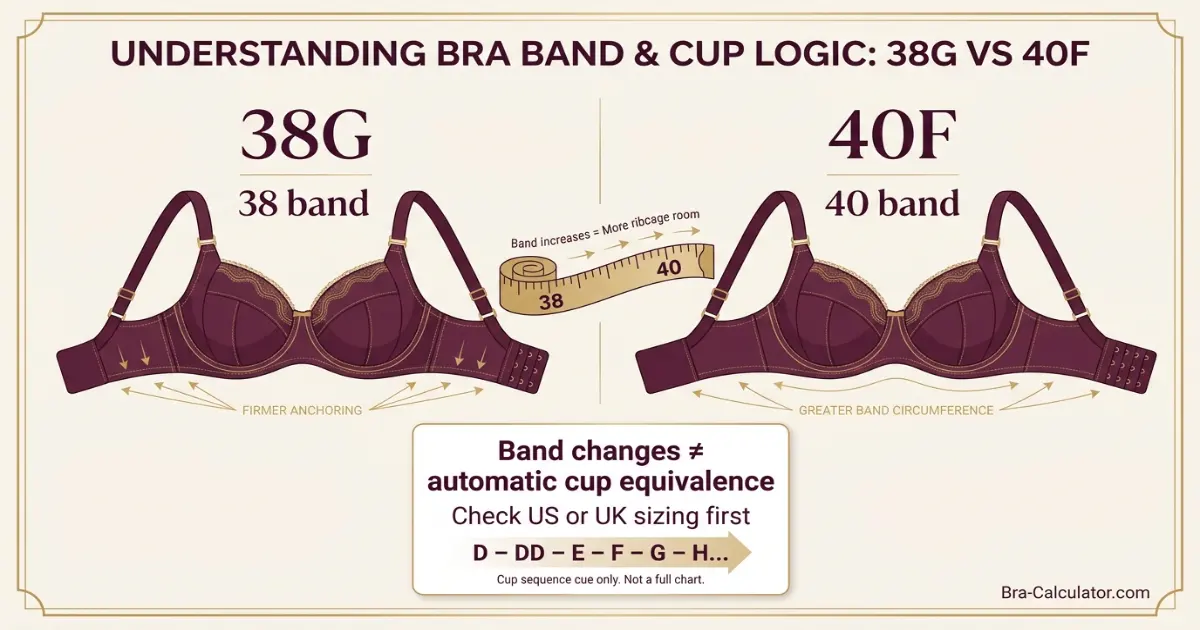
38G vs 40F looks like a simple up-band/down-cup move. In a US brand that uses F/DDD before G, that can be exactly what it is. In a UK brand, the sequence includes FF between F and G, so the direct looser-band sister of 38G is 40FF.
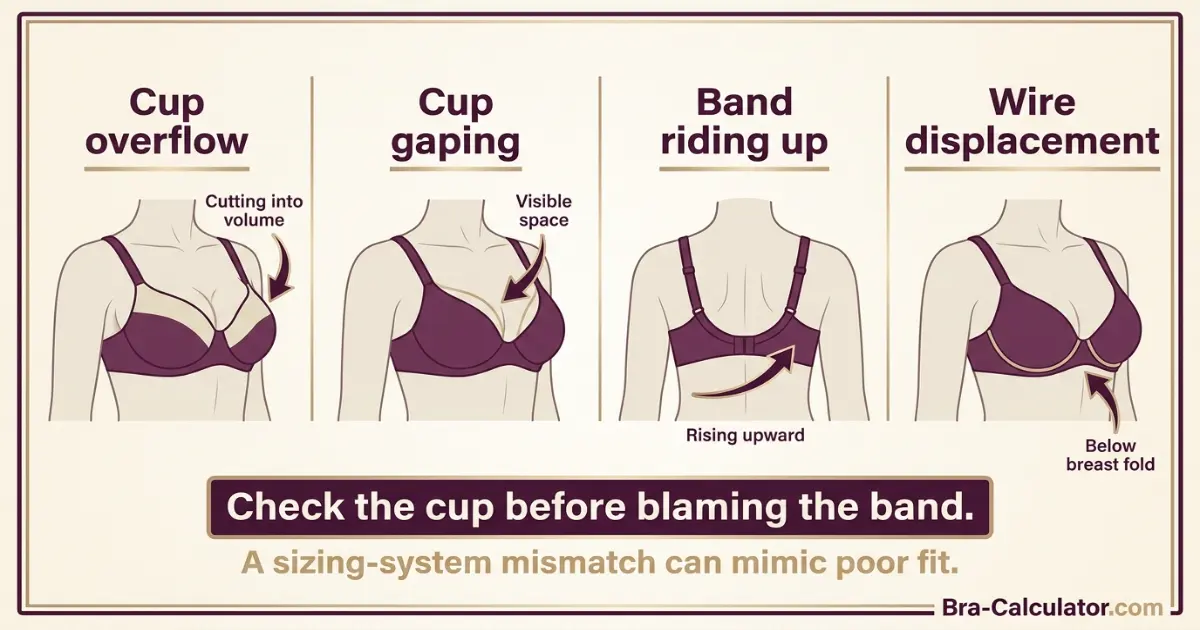
That difference matters more at fuller cup volumes because an unintended cup drop can create immediate crowding. You may think the 40 band is still too tight when the actual issue is that 40F does not have enough cup capacity in that sizing system.
The reliable workflow is: identify the sizing system, test the band independently, then compare the correctly mapped sister sizes. This prevents the common loop of going looser in the band every time a cup is too small.
How Measurements Change the 38G vs 40F Decision
A 40 band is nominally two inches larger than a 38, so it should feel less firm in the same model. That is the intended change. If the 38 leaves painful marks even during the band-only test, a larger band may be appropriate; ordinary temporary impressions are not automatically a bad fit.
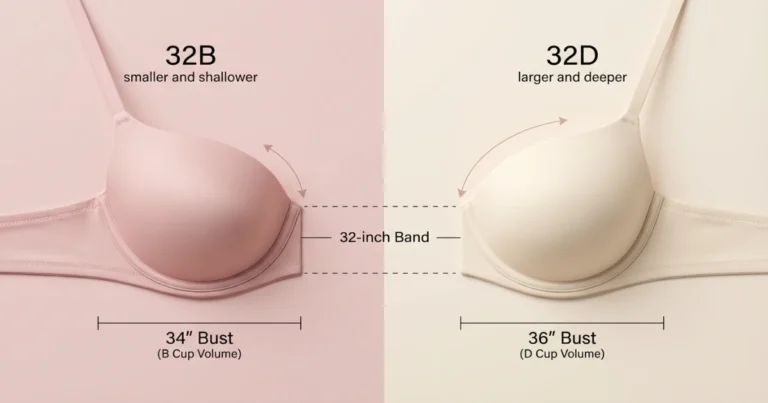
Cup capacity must be mapped by sequence rather than the visible letter. Once you have a true sister pair, the breast should occupy a similar amount of cup space in both, while the band changes how firmly that cup is anchored to the torso.
Read the Bra, Not Just the Size Tag
| Fit area | What you want | What the comparison may reveal |
|---|---|---|
| Band anchor | 38G: firmer, better resistance to riding up | 40F: softer tension, more circumference |
| Cup equivalence | Can sister to 40F in some US systems | Not the direct UK sister of 38G |
| Gore stability | Often stronger when the 38 band suits you | May become less stable if 40 is too loose |
| Cup crowding | Should be assessed separately from band tightness | Can appear if the F label is a smaller cup position in that system |
| Best check | Band-only test plus brand chart | Same-model try-on with correct mapped cup |
This pair often produces a false “band still too tight” signal when 40F is actually a smaller UK cup position than expected. If the looser band still feels strained at the front, verify the cup mapping before going looser again.
How to Compare 38G and 40F Without Guessing
Read the size tag carefully
Look for US/UK/EU sizing printed inside the bra or on the retailer chart.
Test 38G without the cups
Use the backward/upside-down method to decide whether the 38 band itself is uncomfortable.
Map the true 40-band sister
Use 40F only if the chart places it at the same cup capacity; otherwise test the correct label such as UK 40FF.
Compare strap tension
The larger band should not force you to shorten straps dramatically to restore lift.
Recheck after movement
Walk and raise your arms; a true sister fit should preserve cup placement, not just feel looser.
Three Bra Constructions That Make the Difference Easier to See
Use structured bras here to separate cup crowding from band comfort. The clearer the band and wire feedback, the less likely you are to mistake a labeling error for a fit preference.

Full-Cup Support Bra
A full-cup frame exposes both band movement and cup crowding, making it useful when label systems are the main source of confusion.
- Stable wings make band comparison obvious
- Fuller cup handles G-range tissue
- Good for checking whether 40F loses capacity

Side-Support Fuller-Bust Bra
Side support keeps fuller tissue forward, so you can tell whether a 40 band is actually improving comfort without sacrificing shape.
- Outer cup control
- Balanced everyday lift
- Helpful for soft tissue

Encapsulation Sports Bra
If the 40 band is borderline loose, movement will expose it quickly. Use this only after you have mapped the correct cup label.
- Strong band feedback
- Separate cup control
- Useful for fuller-bust stability testing
Breast Shape Can Change Which Size Looks Right
Rib flare can make a 38 band feel locally firm at the front while still fitting correctly around the back. A band with a softer lower edge or more hook rows may solve comfort better than jumping to 40. Conversely, a genuinely broad or sensitive ribcage may prefer the larger band.
If 40F creates spill but feels wonderfully comfortable around the torso, do not conclude that 40 is wrong. The band may be correct while the cup mapping is wrong. Try the correct sister cup for that system before abandoning the larger band.
Use Sister Sizing Only After You Know the Correct Cup Position
In a US sequence where F/DDD sits immediately below G, 38G → 40F can be a legitimate sister move. In UK sizing, 38G → 40FF is the direct looser-band sister because FF sits between F and G.
This is exactly why automated sister-size charts should state their sizing system. If a chart does not, use it as a clue rather than a purchasing rule.
Open the Sister Size Calculator → · Check International Conversions →
If You’re Ordering 38G or 40F Online
Marketplace listings are especially risky in this range because sellers may place US and UK labels in the same title. Use the manufacturer’s size chart, not the listing headline, and check whether the dropdown says US, UK or “manufacturer size.”
If you already own a well-fitting 38G, use its inside tag as your reference. Many bras print several regional equivalents on that tag. Matching the manufacturer’s own conversion is more reliable than translating G and F by memory.
What Usually Goes Wrong in a 38G vs 40F Comparison
- Using 40F as the UK sister size of 38G.
- Blaming the 38 band for tightness caused by a cup that is too small.
- Accepting a 40 band that rides up because it feels softer.
- Mixing a US bra size from one product with a UK chart from another retailer.
- Ignoring the inside-tag conversion labels that often reveal the actual sizing system.
Tools That Help You Confirm the Fit
38G vs 40F FAQs
Are 38G and 40F sister sizes?
They can be in some US sizing systems. In UK sizing, 38G usually sisters to 40FF instead.
Which band is more supportive?
38G usually anchors more firmly because the band is smaller, assuming it is comfortable and correctly fitted.
Why does 40F spill if it is supposed to be a sister size?
The most likely reason is a sizing-system mismatch or a different cup shape. Check the brand’s sequence first.
Can I stay in 38G if it leaves marks?
Temporary marks can occur in a supportive band. Pain, numbness or difficulty breathing is not acceptable; use the band-only test and consider a larger band or extender.
Would an extender help before moving to 40F?
Yes, a non-stretch extender can be useful when a new 38 band is slightly firm but otherwise stable. It lets you add a small amount of room without changing cup volume.
What should I prioritize: comfort or support?
Both. The best fit is secure enough to hold the bra in place and comfortable enough for normal breathing and all-day wear.
The Bottom Line on 38G vs 40F
38G vs 40F is only a sister-size comparison after the sizing system confirms it. Protect yourself from label confusion: map the cup sequence first, then decide whether you prefer the firmer 38 anchor or the easier 40 band.
Still Between 38G and 40F?
Map the cup first, then choose the band. When 40F is a true sister in your brand, it should trade some anchoring for ribcage ease—not create new overflow or force the straps to rescue the fit.